




Karsten Wenzlaff, Advisor
August 26th, 2025
Karsten Wenzlaff is a Crowdfunding and Fintech Expert from Germany. He is Secretary-General of Digit[...]


July 3, 2026 | NCFA Insight | Cybersecurity And Fraud, Digital Identity And Trust, Risk Compliance And Regtech, Payments And Money Movement, Digital Assets Blockchain And Tokenization, Artificial Intelligence And Data

Governments are no longer treating post-quantum cryptography as a research topic. They're now publishing migration plans.
On June 22, 2026, the White House issued an order on advanced cryptographic attacks, including the risk that adversaries collect encrypted data today so they can decrypt it later. The same day, a separate White House order advanced U.S. quantum innovation across computing, sensing, networking, applications, and industry partnerships.
That combination is the useful development marker for fintech. Governments are funding quantum capability while also pushing organizations to prepare for the security risk that follows.
The financial sector doesn't need to know the exact year a cryptographically relevant quantum computer arrives before it starts planning. Long time customer data, payment credentials, digital identity systems, API certificates, custody systems, vendor software, archived records, and cryptographic keys may remain sensitive for years.
Quantum readiness is therefore becoming an operating requirement. Not someday. Now.
The policy picture is getting clearer.
NIST finalized its first three post quantum cryptography standards in August 2024. The standards are FIPS 203 for ML-KEM, FIPS 204 for ML-DSA, and FIPS 205 for SLH-DSA. NIST says organizations should begin migrating systems to quantum resistant cryptography.
NCFA has already tracked how post quantum cryptography is entering implementation, with payments, digital identity, secure messaging, APIs, and financial data all exposed to the migration challenge.
Canada has started, too. The Canadian Centre for Cyber Security published a roadmap for migrating Government of Canada non classified IT systems to post quantum cryptography, covering stakeholders, phases, milestones, governance, and departmental planning.
Financial authorities are paying attention too. The Bank for International Settlements published a quantum readiness roadmap for the financial system, and the G7 Cyber Expert Group issued a roadmap for the financial sector's transition to post quantum cryptography.
The practical message is this. Start with awareness, find where cryptography is used, assess risk, plan migration, and work with vendors before deadlines become urgent.
The hardest quantum risk is not only future system compromise. It is long term data.
Financial institutions protect account records, payments data, identity documents, loan files, custody records, private market documents, insurance records, tax files, transaction histories, and compliance archives. Some of that data must stay confidential for years or decades.
That creates the harvest now, decrypt later problem. An attacker can collect encrypted data now and wait for stronger decryption capability later.
For fintechs, this impacts the planning window. A company doesn't need to be systemically important to hold sensitive data. A payments provider, open banking intermediary, wallet provider, identity service, lending platform, wealthtech app, regtech vendor, or crypto custodian may all depend on cryptography that was never designed for a quantum era.
Post quantum migration starts with discovery.
Most organizations know they use TLS, certificates, signing keys, databases, cloud services, APIs, authentication systems, payment connections, and vendor platforms. Fewer have a current inventory of which cryptographic algorithms protect each system, which assets must remain confidential long term, and which vendors control the upgrade path.
That's why cryptographic inventory keeps appearing across official guidance.
A fintech should be able to answer basic questions:
Without that inventory, migration plans become guesswork.
Fintech security is rarely managed by one company anymore.
A single product may rely on cloud hosting, identity verification, payment processors, data aggregators, card issuing platforms, custodians, wallet technology, fraud systems, CRM tools, analytics software, email providers, certificate authorities, and outsourced compliance systems.
That makes post quantum readiness a vendor risk issue.
A fintech can upgrade its own code and still remain exposed through a vendor that cannot explain its cryptographic dependencies. Banks and credit unions face the same issue in reverse. They may need to ask whether fintech partners can support post quantum requirements before onboarding, renewing, or expanding contracts.
The procurement question changes from "is this vendor secure today?" to "can this vendor survive a cryptographic transition without disrupting our product, customers, or regulatory obligations?"
Quantum readiness touches more than cybersecurity teams.
In payments, cryptography protects authentication, transaction integrity, messaging, API connections, certificates, and sensitive account data.
In digital identity, it protects credentials, signatures, documents, device binding, verification records, and trust chains.
In crypto and digital assets, it touches wallets, custody, private keys, signing systems, transaction authorization, smart contract administration, and institutional key management. BTQ's quantum safe Bitcoin and stablecoin roadmap highlights one approach to preparing digital asset infrastructure for post quantum cryptography.
In open banking, it affects API security, consent records, data sharing, third party access, and customer authentication.
In capital markets, it touches trading access, fund administration, investor records, tokenized securities, transfer agency, data rooms, reporting, and long term documents.
In AI and data systems, it affects model access, training data, confidential records, synthetic data pipelines, and secure data exchange.
That breadth is why the topic belongs with executives, product leaders, compliance teams, boards, and investors, not only cryptography specialists.
Canada's Cyber Centre roadmap gives public sector organizations a starting point. It also gives fintech and financial services leaders useful guidance that migration will take planning, governance, technical discovery, budgets, and coordination.
Canada doesn't yet have a full financial sector post quantum mandate comparable to a hard compliance deadline, but that statement should not create comfort.
Canadian fintechs operate in a global market. They sell into banks, credit unions, enterprises, governments, insurers, capital markets, payment networks, and regulated financial institutions. Their buyers may start asking post quantum questions before Canadian rules require formal answers.
A fintech that can show cryptographic inventory, vendor readiness, migration planning, and crypto agility may have an advantage in enterprise sales. A fintech that cannot answer basic questions may face longer diligence, higher security friction, or blocked procurement.
The near term opportunity is not building quantum computers. It's helping financial organizations prepare for the cryptographic transition. Quantum Bridge's USD $8M raise shows Canadian capital already backing deployment ready quantum safe security for finance, telecom, government, and defence.
Product opportunities include:
These opportunities are practical because they map to work financial firms already need to do. They need to know what they use, what they protect, which systems carry the highest risk, which vendors control dependencies, and how migration can happen without breaking production systems.
These are the kinds of tools that belong on NCFA's Financial Innovation Map, such as identity, payments, custody, regtech, data governance, and cyber resilience.
Quantum readiness won't arrive as a single upgrade.
Organizations will need inventories, test environments, migration sequencing, vendor commitments, product changes, audit evidence, customer communications, and fallback plans. Some systems will be easy to update. Others will depend on old software, hardware limits, contracts, third party platforms, or regulatory approvals.
That's why waiting for a precise quantum break date is the wrong approach for operators. Ask yourself, your team, your leadership this simpler question, "If a regulator, bank partner, insurer, enterprise buyer, or board asked tomorrow where vulnerable cryptography sits in the business, could the company answer?"
For many fintechs, the honest answer is probably no. So that's the opening to start.
Takeaway: Post quantum cryptography isn't a distant science fiction story anymore. It's becoming part of how financial organizations prove they can protect data, manage vendors, maintain trust, and keep critical services running through the next security transition.
If post quantum readiness starts with knowing where cryptography lives, should fintech due diligence now include a cryptographic inventory before major bank, payments, custody, or identity partnerships?
 The National Crowdfunding & Fintech Association (NCFA Canada) is a financial innovation ecosystem that provides education, market intelligence, industry stewardship, networking and funding opportunities and services to thousands of community members and works closely with industry, government, partners and affiliates to create a vibrant and innovative fintech and funding industry in Canada. Decentralized and distributed, NCFA is engaged with global stakeholders and helps incubate projects and investment in fintech, alternative finance, crowdfunding, peer to peer finance, payments, digital assets and tokens, artificial intelligence, blockchain, cryptocurrency, regtech, and insurtech sectors. Join Canada's Fintech & Funding Community today FREE! Or become a contributing member and get perks. For more information, please visit: [www.ncfacanada.org](http://www.ncfacanada.org)
 |  |  |
|---|---|---|
 |  |  |
July 2, 2026 | NCFA Fintech Market Activity | Digital Assets Blockchain And Tokenization, Wealthtech And Investing, Digital Identity And Trust, Risk Compliance And Regtech, Fintech And Innovation
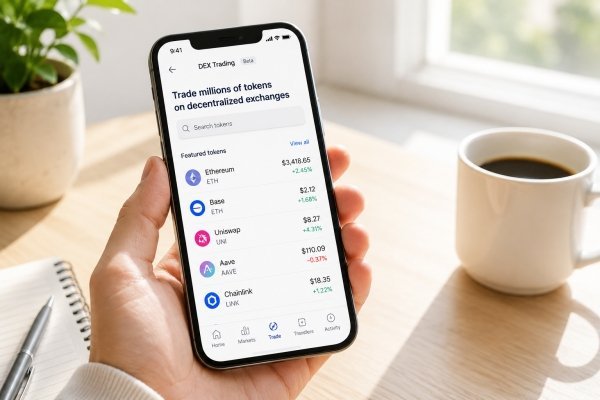
On July 2, 2026, Wealthsimple launched DEX trading in beta, giving eligible clients a way to trade on-chain tokens directly inside the Wealthsimple app.
The beta gives clients access to millions of tokens, starting with Ethereum-based assets. Base and Solana support are planned. The service charges a flat 0.85% trading fee and currently includes $0 network fees, which Wealthsimple Web3 Inc. covers during the early release.
This isn't the same product as Wealthsimple's centralized crypto account. When a client makes a first DEX trade, the app creates a separate self-custody wallet. The app holds DEX assets separately from centralized crypto holdings. They aren't insured, and don't have the same regulatory oversight as Wealthsimple's listed crypto offering.
A normal DEX user has to manage a wallet, fund it, connect it to a decentralized exchange, check token contracts, manage network fees, understand slippage, approve transactions, and protect private keys. As a result, there are a lot of steps that add complexity.
The beta removes much of that setup from the user experience. Its help guide says clients can search for DEX-labelled assets in the Discover tab, create a DEX wallet during the first trade, and buy or sell eligible DEX tokens directly in the app.
Behind the scenes, the app converts the funding asset into USDC. It then withdraws the funds to the self-custody wallet and routes the order through a third-party DEX aggregator before executing the trade.
Centralized crypto assets go through the platform's listing process, and the platform holds them on behalf of clients. DEX assets haven't gone through that centralized listing process.
Wealthsimple says a third-party vendor flags malicious tokens, and the app automatically filters them, and asset pages can display risk flags such as new asset history, top holder concentration, low holder count, low liquidity, sketchy token permissions, and artificial trading patterns.
Those flags are useful, but they aren't a safety guarantee. The help guide tells users to research tokens before trading and notes that blockchain transactions can't be reversed. If a client buys a scam or fraudulent token, the transaction can't be undone.
While the product lowers the operational barrier to on-chain markets, users still face risks that don't exist in the same way inside a curated centralized exchange custodial account.
Clients hold WS DEX assets in a self-custody wallet. They aren't covered by insurance, don't have government-backed loss protection, and aren't held by Wealthsimple on the client's behalf.
The support team can't recover the wallet or reverse transactions if something goes wrong. The user authorizes trades, and the wallet sits outside Wealthsimple's centralized crypto infrastructure.
There are also product limits during early release.
At the end of the day, there are limits to what the beta product is at this point. Embedded self-custody trading inside a controlled retail app, not a full open-wallet DeFi experience.
Wealthsimple's IPO Access launch gave eligible retail investors a way to request shares in selected Canadian and U.S. IPOs before public trading. Wealthsimple's 2025 product event added zero fee options, real gold, and private market portfolios. Wealthsimple's Fey acquisition added AI research and trading tools to the roadmap.
DEX trading adds another access layer. Clients can use one app for listed securities, crypto, IPO access, options, gold, private market portfolios, and now on-chain token trading.
Most clients won't need millions of tokens. The acid test is whether the app can make on-chain trading simple enough to try without making the risks feel smaller than they are.
One path is regulated centralized crypto access, where platforms list a smaller set of assets, hold assets through custodial arrangements, follow dealer rules, and provide clearer investor protections. Canadian crypto regulation has pushed platforms toward stronger custody, registration, and operating controls.
The other path is on-chain access, where users reach a broader token universe but also take on more responsibility for token risk, wallet access, tax tracking, execution, and irreversible transactions.
The beta sits between those paths. It keeps the user inside a mainstream Canadian app, but the assets trade through decentralized markets and sit in a self-custody wallet. That's different from both a traditional crypto exchange and a fully independent DeFi wallet.
Wallet usability becomes a core feature. Token risk intelligence becomes part of the trading interface. Slippage controls, routing quality, transaction monitoring, tax tooling, scam detection, and user education become operating requirements rather than extras.
Those areas connect directly to NCFA's Financial Innovation Map, including self-custody wallets, retail digital asset access, token risk analytics, on-chain finance, digital identity and trust, and compliance technology.
The opportunity isn't only trading more tokens. It's building the trust, data, user experience, and risk tools that let mainstream investors interact with on-chain markets without pretending those markets are safe by default.
If mainstream investing apps make self-custody DEX trading feel simple, will the next phase of retail crypto adoption depend more on token access or risk intelligence?
The National Crowdfunding & Fintech Association (NCFA Canada) is a financial innovation ecosystem that provides education, market intelligence, industry stewardship, networking and funding opportunities and services to thousands of community members and works closely with industry, government, partners and affiliates to create a vibrant and innovative fintech and funding industry in Canada. Decentralized and distributed, NCFA is engaged with global stakeholders and helps incubate projects and investment in fintech, alternative finance, crowdfunding, peer-to-peer finance, payments, digital assets and tokens, artificial intelligence, blockchain, cryptocurrency, regtech, and insurtech sectors. Join Canada's Fintech & Funding Community today FREE! Or become a contributing member and get perks. For more information, please visit: [www.ncfacanada.org](http://www.ncfacanada.org)
| | |
|---|---|---|
| | |
July 2, 2026

Businesses produce large quantities of data from sales systems, customer interactions, marketing campaigns, websites and operational processes. Organising this information is necessary for identifying opportunities plus making decisions based on facts. Cloud data lakes are flexible environments where organizations store large volumes of structured and unstructured data in one place, which provides a basis for complex analytics but also business intelligence.
Traditional storage systems often require users to organize data before they store it. In contrast, cloud data lakes allow businesses to collect information from many sources and analyze it when necessary - this method helps organizations understand customer behavior, market trends, operational performance as well as potential for future expansion.
A cloud data lake is a central location for storing raw data in its original form. It allows businesses to keep information that does not fit into standard databases. Data is available from websites, mobile applications, social media, sensors, financial systems and tools for managing customer relationships.
Flexibility makes cloud data lakes useful for growth analytics. Organizations are able to combine data from different departments without long preparation periods - this creates a complete view of business activities or helps teams find connections and patterns that are otherwise difficult to see.
Gathering information from many business systems is a primary benefit of cloud data lakes. Marketing data, sales records, customer service interactions, inventory reports next to website analytics are stored together - this broad approach improves the quality and precision of business analysis.
Detailed understanding of performance across the entire organization is possible when businesses collect information from many sources. Analysts are able to study how marketing campaigns affect sales, how support affects customer retention or how inventory management relates to profit - these connections support strategic planning plus initiatives for growth.
Growth analytics require the accurate measurement of performance. Free cloud storage supports constant monitoring - collecting information from operational but also financial systems quickly - this allows organizations to follow key performance indicators and react to changes.
Revenue growth, costs to acquire customers, operational efficiency as well as product performance are measurable through integrated tools. Finding performance issues early allows managers to fix problems before they change the final results significantly.
Cloud data lakes make it simple for authorized teams to find information. Users retrieve data from a central location instead of searching through separate systems - this increases efficiency and reduces the time required for decision making.
Better accessibility also promotes cooperation between departments. Marketing teams, finance departments, operations managers but also executives use the same data. Decisions are consistent and follow the general goals of the business.
Cloud data lakes provide the storage as well as computing power necessary for advanced analytical methods. Businesses use predictive analytics, machine learning models and statistical analysis to find patterns that help future growth - these tools allow organizations to look at future opportunities rather than only looking at past reports.
Complex analytics show trends in customer purchasing, identify segments of the market that produce profit or predict demand. By using these insights, businesses distribute resources effectively and make decisions that support expansion while avoiding unnecessary risks.
Understanding how customers behave is a vital part of business growth. Cloud data lakes allow organizations to join customer information from many channels, like websites, mobile apps next to purchasing platforms - this creates a complete profile of the customer.
Preferences, habits and engagement patterns are visible when businesses have a unified view of customer activity - these insights help organizations create specific marketing campaigns, improve the customer experience plus increase loyalty. Better understanding of customers often results in higher revenue and a better position in the market.
Data volumes often increase quickly as businesses grow - Cloud data lakes scale to meet the needs of the organization, which allows companies to store and analyze large datasets without spending heavily on new infrastructure - this scalability supports long term growth without the need to replace systems constantly.
Many organizations start data projects with affordable solutions, like limited storage for testing. Businesses move to larger environments with more capacity as their needs for analysis grow. Some providers offer plans with unlimited cloud storage but companies should check usage policies or performance needs before choosing one.
Reliable and honest information is necessary for effective growth analytics. Businesses should create data governance rules that define how they collect, store, access next to maintain information. Clear policies improve the quality of data and help the company follow regulations.
Security measures like access controls, encryption plus monitoring tools protect private information. Strong governance ensures that analysis is based on accurate data, which gives decision makers confidence in the insights they use for growth strategies.
Cloud data lakes are a strong foundation for business growth analytics because they centralize information, make data accessible and support complex analysis. They allow organizations to combine data from many sources, understand customers better, monitor performance but also find opportunities for expansion.
Using governance practices and analytical tools helps businesses change large amounts of data into useful insights. A managed cloud data lake helps organizations make decisions based on facts, improve how they operate as well as create growth in a business environment that relies on data.
The National Crowdfunding & Fintech Association (NCFA Canada) is a financial innovation ecosystem that provides education, market intelligence, industry stewardship, networking and funding opportunities and services to thousands of community members and works closely with industry, government, partners and affiliates to create a vibrant and innovative fintech and funding industry in Canada. Decentralized and distributed, NCFA is engaged with global stakeholders and helps incubate projects and investment in fintech, alternative finance, crowdfunding, peer-to-peer finance, payments, digital assets and tokens, artificial intelligence, blockchain, cryptocurrency, regtech, and insurtech sectors. Join Canada's Fintech & Funding Community today FREE! Or become a contributing member and get perks. For more information, please visit: www.ncfacanada.org
| | |
|---|---|---|
| | |
Jul 2, 2026 | NCFA Resource | Artificial Intelligence And Data, Digital Assets Blockchain And Tokenization, Risk Compliance And Regtech
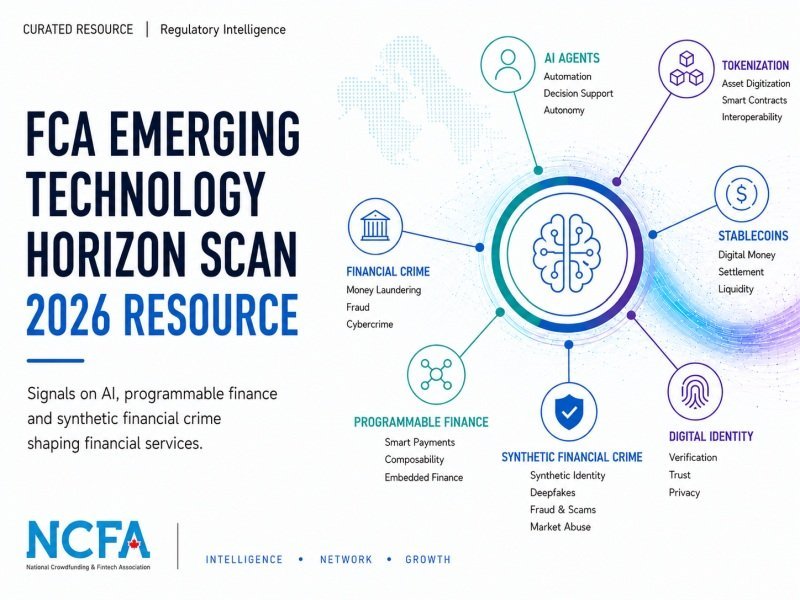
On June 10, 2026, the UK Financial Conduct Authority published the FCA Emerging Technology Horizon Scan 2026. The report examines how AI agents, synthetic financial crime and programmable finance could affect consumers, firms, markets and financial infrastructure through 2030.
NCFA's FCA Emerging Technology Horizon Scan guide turns the report into an interactive regulatory foresight resource. It separates the FCA's findings from implementation considerations, NCFA interpretation and Canadian relevance.
The FCA organizes the Horizon Scan around three technology convergence themes:
The guide also connects the Horizon Scan with later FCA work, including the Mills Review, the Supercharged Sandbox and the joint frontier AI cyber resilience statement.
The resource helps fintech leaders assess technology combinations rather than treating AI, distributed ledgers, identity, data, payments and cyber risk as separate issues.
Readers can use the interactive explorer to review:
The FCA Horizon Scan sits before formal regulation. It identifies early indicators that may affect product governance, consumer protection, financial crime controls, market surveillance, operational resilience and infrastructure design.
This resource is useful for fintech founders, financial institutions, AI developers, digital asset firms, regtech providers, compliance teams, cybersecurity leaders, investors, policymakers and market infrastructure firms.
It is especially relevant to teams assessing AI agent governance, synthetic identity, deepfake risk, automated financial crime, tokenized finance, programmable payments, stablecoins, digital identity, smart data and operational resilience.
The resource's main strength is its focus on convergence. It shows how AI agents, identity systems, synthetic media, tokenized assets, smart contracts and payment infrastructure may operate together.
It also supports practical planning. Firms can use it to test product assumptions, fraud controls, data strategy, identity plans, tokenized financial infrastructure and board level governance.
The FCA Horizon Scan is not regulatory guidance, a rulebook or a prediction. It does not create requirements or confirm that its scenarios will occur. Readers should use the guide for regulatory intelligence, scenario planning and strategic review, not as legal, financial, investment, compliance or professional advice.
FCA Emerging Technology Horizon Scan (interactive NCFA Regulatory Intelligence guide)
FCA Emerging Technology Horizon Scan 2026 (primary FCA source)
The Mills Review (FCA review of AI and retail financial services through 2030)
Frontier AI And Cyber Resilience (FCA, Bank of England and UK Treasury statement)
AI Agents Enter Governed Financial Workflows (AI governance and controls)
Tokenization Starts Looking Like Financial Infrastructure (programmable finance context)
MIT AI Risk Repository For Fintech Governance (AI risk taxonomy resource)
The National Crowdfunding & Fintech Association (NCFA Canada) is a financial innovation ecosystem that provides education, market intelligence, industry stewardship, networking and funding opportunities and services to thousands of community members and works closely with industry, government, partners and affiliates to create a vibrant and innovative fintech and funding industry in Canada. Decentralized and distributed, NCFA is engaged with global stakeholders and helps incubate projects and investment in fintech, alternative finance, crowdfunding, peer to peer finance, payments, digital assets and tokens, artificial intelligence, blockchain, cryptocurrency, regtech and insurtech sectors. Join Canada's Fintech & Funding Community today FREE! Or become a contributing member and get perks. For more information, please visit www.ncfacanada.org.
| | |
|---|---|---|
| | |
July 2, 2026 | NCFA Fintech Market Activity | Digital Assets Blockchain And Crypto, Wealthtech, Capital Markets And Funding, Fintech And Innovation

On June 30, 2026, Webull Canada Crypto announced it will begin offering cryptocurrency trading after receiving approval from the Canadian Investment Regulatory Organization.
The approval gives Webull another asset class inside its Canadian investing platform, which already supports U.S. and Canadian stocks, ETFs, options, margin accounts, cash accounts, TFSAs, and RRSPs through Webull Securities Canada.
Beta access for selected clients is expected to start soon, with a wider rollout planned in the coming weeks. Webull says the crypto experience will include 24/7 trading for assets such as Bitcoin, Ethereum, Solana, XRP, Cardano, and Litecoin.
This is another regulated online brokerage aligning digital assets among the same customer experience as traditional investing.
Webull Canada Crypto Limited is regulated by CIRO. Webull Securities Canada Limited is also regulated by CIRO and is a member of CIPF.
That structure is important because crypto trading and traditional securities accounts don't carry the same investor protections. Webull's disclosure says crypto assets are not protected by CIPF, although CIPF protection may be available for eligible cash held in a crypto trading account, subject to applicable limits and policy terms.
The approval arrives after Canadian regulators spent several years moving crypto platforms toward dealer registration and CIRO membership, custody expectations, risk disclosure, and stronger client asset controls.
Regulated access is becoming the path for retail crypto distribution in Canada.
When Webull expanded brokerage services to Canada in early 2024, the initial story was low cost access to Canadian and U.S. listed equities.
The platform has since expanded around commission free trading, advanced charting, market data, options access, registered accounts, and now crypto.
Webull is building toward a multi asset retail investing platform where users can fund accounts, monitor portfolios, review reporting, and trade across asset classes without leaving the ecosystem.
Crypto increasingly looks less like a standalone destination and more like another investing capability inside regulated financial apps.
Canadian online brokers used to compete heavily on commissions, execution, research tools, and account access. In 2026, competition is about platform depth as investors want fewer disconnected accounts. Platforms want more customer activity, better retention, more data, and a wider share of the investor relationship, and eventually more personalized portfolio features.
Webull is entering a market where Wealthsimple already combines investing, crypto, cash, tax, and other financial services. KOHO adding regulated crypto trading inside its money app flashing the same pattern from a consumer finance angle.
The Canadian crypto market has gone through enforcement, registration pressure, custody scrutiny, stablecoin restrictions, and platform exits. Yet regulated distribution keeps expanding.
Canada hasn't treated retail crypto as an unregulated free for all. It also hasn't eliminated retail access. Oversight of the market is evolving toward regulated firms, clearer disclosures, tighter custody controls, and platforms that can operate within securities rules.
Webull's entry adds another regulated access point for Canadian investors and increases pressure on every platform that wants to be a primary investing destination.
The approval gives Webull permission to compete, but it doesn't guarantee adoption.
Crypto also brings higher volatility, suitability questions, security expectations, and investor education demands. A smooth user experience can't hide the risk profile of the asset class.
The advantage for Webull is that crypto can now be offered alongside the rest of its investing platform. The challenge is that investors will compare the experience not only with crypto exchanges, but with every brokerage and fintech app trying to become the main place Canadians manage investments.
Crypto trading platforms moving toward CIRO oversight shows how Canadian regulation is reshaping digital asset distribution.
Crypto custody rules are becoming a core operating issue for dealer members and digital asset platforms.
KOHO's regulated crypto rollout shows digital assets moving into broader consumer finance platforms.
Tokenization becoming a measurable business shows how digital assets are moving deeper into regulated capital markets infrastructure.
NCFA's Financial Innovation Map tracks digital assets, wealthtech, brokerage competition, capital markets infrastructure, custody, and investor access opportunities.
If every major investing platform eventually offers stocks, ETFs, options, registered accounts, and crypto, what becomes the next competitive advantage?
The National Crowdfunding & Fintech Association (NCFA Canada) is a financial innovation ecosystem that provides education, market intelligence, industry stewardship, networking and funding opportunities and services to thousands of community members and works closely with industry, government, partners and affiliates to create a vibrant and innovative fintech and funding industry in Canada. Decentralized and distributed, NCFA is engaged with global stakeholders and helps incubate projects and investment in fintech, alternative finance, crowdfunding, peer-to-peer finance, payments, digital assets and tokens, artificial intelligence, blockchain, cryptocurrency, regtech, and insurtech sectors. Join Canada's Fintech & Funding Community today FREE! Or become a contributing member and get perks. For more information, please visit: www.ncfacanada.org
| | |
|---|---|---|
| | |
July 2, 2026

image: Magnific/DC Studio
When a province opens a private online gambling market, the headlines tend to chase the money: tax points, operator counts, and the size of the prize. The quieter story, and the one that matters more to the people who actually log in, is how the rules try to keep play from sliding into harm. Alberta's shift to a regulated online casino market is, underneath the commercial framing, a player-protection project. The design choices that decide whether a customer can set a hard deposit cap, lock themselves out across every site at once, or get flagged before a bad week becomes a worse one are buried in standards documents, not press releases.
That angle fits readers who follow how Canadian regulation, payments, and consumer safeguards lock together rather than chasing the latest welcome offer. The interesting question is not which brand has the loudest promotion. It is whether the protections written into the law and the regulator's standards are strong enough to hold once real money starts moving through licensed platforms.
Plenty of attention has already gone to who is lining up to operate. Data and comparison publishers such as Lineups keep running directories of the online casino options in Alberta, which gives outside observers a useful map of which brands are entering under the new framework. This piece takes the other side of that map and audits the safeguards instead: what each protection is meant to do, how it functions in practice, and who carries the duty to enforce it.
Alberta is not inventing online gambling. Residents have placed bets through offshore and grey-market sites for years, usually with no Canadian oversight, no local self-exclusion option, and no recourse when something went wrong. The case for a regulated market rests less on novelty and more on control. Once play happens on licensed platforms, the province can attach conditions to it: verified identity, mandatory limit tools, a shared exclusion list, and a regulator with the power to pull a license.
So the honest way to read this market is as a safeguards audit. A new framework is only as good as the protections it forces operators to build and the body willing to test them. The rest of this article walks each guardrail in turn, asks how it is supposed to work, and names the party on the hook when it fails. That structure matters because responsible-gaming language is easy to print on a homepage and hard to operate at scale.
Alberta split the job in two, which is a useful tell about how the province thinks risk should be managed. The Alberta Gaming, Liquor and Cannabis commission, known as AGLC, is the regulator. It registers operators and suppliers, writes and publishes the standards, audits compliance, and runs the centralized self-exclusion system. A separate body, the Alberta iGaming Corporation, holds the commercial agreements that operators need before they can legally take a bet in the province.
The point of separating the regulator from the conduct-and-manage entity is to keep the referee away from the revenue. The body chasing market growth is not the same body deciding whether an operator broke the rules. For a consumer-protection reader, that division is one of the more reassuring features of the design, because it reduces the pressure to look away from a profitable but non-compliant brand. It is also the structure the regulator can point to when a customer complaint needs an independent path that does not run through the operator's own support desk.
This dual model echoes the approach Ontario used when it launched its commercial market in 2022, which has since registered dozens of operators. Alberta watched that rollout closely and borrowed the parts that worked while trying to tighten the parts that drew criticism, including how exclusions and advertising are handled.
The safeguard with the most practical weight is the centralized self-exclusion program, and it is meant to be live from the first day of the regulated market. The mechanics are simple to describe and surprisingly hard to deliver. A person who wants to stop signs up once, and the exclusion then applies across every licensed online platform in the province at the same time. Timeframes run from six months to permanent, with options in between.
Compare that to the offshore status quo, where excluding yourself from one site does nothing on any other. Under the old arrangement, a person in a bad spiral could close one account and open three more by lunchtime. A shared list closes that gap, at least within the licensed perimeter. The regulator operates the program, and operators are required to integrate with it as a condition of registration, which is what turns a good intention into an enforceable obligation rather than a marketing badge.
The honest caveat is that a self-exclusion list only covers the sites inside it. A determined person can still reach unlicensed offshore platforms that ignore Alberta entirely. That limit is not a flaw in the design so much as a boundary on what any single province can reach, and it is one reason the market opening is paired with messaging that steers players toward licensed sites in the first place.
Self-exclusion is the emergency brake. The day-to-day controls are the limit tools every licensed operator has to offer from launch. The required set covers deposit limits, spending limits, and session time controls, plus regular activity statements that summarize a player's history so the picture is harder to ignore. The design logic is that most harm does not arrive as a single dramatic event. It accumulates quietly across many ordinary sessions, and friction introduced early is cheaper than intervention introduced late.
Limit tools work best when they are easy to set and slow to loosen. The detail that matters is the direction of friction: tightening a limit should take effect quickly, while raising one should carry a cooling-off delay so a heated moment cannot instantly undo a careful decision. Activity statements add a second layer by putting real numbers in front of a player who might otherwise round their losses down in their own memory. None of this stops a person who is determined to chase, but it narrows the path and creates record-keeping the regulator can later inspect.
For an audience that thinks about product design and payments, these controls are essentially consumer-finance guardrails applied to entertainment spending. They borrow the same logic as deposit caps and spending alerts in digital banking, and they live or die on the same question: are they switched on by default and built into the flow, or buried three menus deep where almost no one finds them.
The audit is easier to read as a table. Each row pairs a protection with how it is meant to operate and the party responsible for making it stick.
| Safeguard | How it works | Who enforces |
| Centralized self-exclusion | One sign-up blocks access across every licensed site, from six months to permanent | AGLC operates the list; operators must integrate |
| Deposit and spending limits | Player-set caps with fast tightening and delayed loosening | Operators build the tools; AGLC sets the standard |
| Session time controls | Reminders and limits on continuous play length | Operators implement; AGLC audits |
| Activity statements | Periodic summaries of deposits, wagers, and net results | Operators generate; player reviews |
| Identity and age verification | Account checks confirm the customer is of legal age and who they claim to be | Operators run checks under AGLC rules |
| Intervention duties | Staff and systems flag signs of problem play and act on them | Operators monitor; AGLC can sanction |
| Independent accreditation | Third-party review of responsible-gaming programs | Responsible Gambling Council |
| Advertising limits | Restrictions on inducements, targeting, and athlete imagery | AGLC writes and enforces the rules |
The pattern in that final column is the point. Almost every safeguard depends on a division of labor, where the operator builds and runs the tool while the regulator sets the floor and keeps the power to punish a brand that cuts corners. Protections without an enforcer are suggestions, and the structure here is built to avoid that trap.
For a fintech-minded reader, the most underrated safeguard is the one that happens before a single game loads. Verified identity and age checks are the gate. A licensed operator has to confirm that the person opening an account is a real, of-age resident rather than a minor borrowing a card or a fabricated profile. That single requirement does more quiet work than most flashy responsible-gaming features, because it anchors every later protection to a confirmed person rather than an anonymous login.
The payments trail extends that anchor. When deposits and withdrawals run through regulated channels, the money becomes traceable, limits become enforceable against a verified account, and patterns become visible. A customer who suddenly raises deposits and plays at odd hours leaves a record that a monitoring system can read. The same plumbing that supports anti-money-laundering checks also supports harm-reduction, since both depend on knowing who is transacting and being able to see the shape of their activity over time.
This is where Alberta's market intersects with the broader push for safer digital finance. The tools are familiar to anyone working in payments or regtech: identity proofing, transaction monitoring, and configurable limits. NCFA's own explainer on how Canadian online casino regulations work sets out how these checks, betting limits, and help resources fit into the national context, which is useful background for anyone weighing Alberta against other provinces. Applying the tools to gambling does not require new invention so much as honest implementation, and the regulated framework is what forces that implementation to be more than a checkbox.
The framework does not leave the burden entirely on the player to ask for help. Licensed operators carry a duty to look for signs of problem gambling and to act on what they find, rather than waiting for a customer to come forward. In practice that means behavioral monitoring: flagging sharp escalation in deposits, chasing patterns, marathon sessions, and other markers that research links to harm, then triggering an intervention such as a message, a prompt to set a limit, or a referral to support.
Active monitoring is the difference between a passive set of tools and a system that reaches toward people who would never click a help link on their own. The people most at risk are often the least likely to self-identify, so a safeguard that depends on the player raising a hand will miss them. By making intervention an operator obligation, the standards shift part of the responsibility onto the business that profits from the activity, which is the correct place for it to sit.
The unavoidable tension is that the operator is being asked to gently slow down its own best customers. That conflict of interest is exactly why an independent regulator with audit powers and an outside accreditation body both sit in the structure. Trust-but-verify only works if someone is actually verifying.
One more layer sits above the operator's own programs. The Responsible Gambling Council, a long-standing Canadian non-profit based in Toronto, runs an accreditation program that reviews whether a gambling operation actually meets recognized responsible-gaming standards rather than just claiming to. Independent review is what separates a genuine program from a glossy policy page, because the reviewer has no stake in the operator's revenue and no reason to grade on a curve.
Bringing an external standard into the framework matters for credibility. A regulator can write rules and audit against them, but a third-party accreditation adds a second set of eyes with its own published criteria. For consumers, the practical value is a signal they can read from outside the company: a program that has passed independent review has at least been measured against something firmer than its own marketing.
Safeguards inside the product only help people who are already playing. The advertising rules try to control how many people get pulled in and how aggressively. Alberta's standards restrict where operators can promote inducements and bonuses, generally limiting them to a brand's own site or to direct marketing that a player has explicitly consented to receive. Operators are also barred from targeting minors, high-risk individuals, and vulnerable groups.
One detail drew particular notice: advertisements cannot feature current or retired athletes. That choice is a direct response to a complaint heard across several markets, where celebrity and athlete endorsements were seen as normalizing betting for younger audiences who follow sports. Pulling familiar faces out of gambling ads is a blunt instrument, but it reflects a view that the supply of temptation deserves regulation alongside the tools that manage demand.
A fair audit ends with the gaps, not a victory lap. None of these safeguards eliminate harm, and pretending otherwise would undercut the whole exercise. The centralized exclusion list only governs licensed sites, so the offshore market remains a leak in the wall. Limit tools depend on default settings and honest design, and a tool that is technically present but practically hidden protects almost no one. Intervention duties ask operators to act against their own short-term incentives, which is why ongoing audits matter more than launch-day promises.
There is also the simple reality that regulation lags behavior. New payment methods, new game formats, and new marketing channels will test the rules faster than the rules can be rewritten. The honest verdict on Alberta's market will not come from the standards as written in 2025 and 2026 but from how seriously they are enforced two and three years on, when the novelty has worn off and the pressure to relax inconvenient rules has set in. A framework like this is best judged by its worst enforcement case, not its best brochure.
Anyone who wants to see how the entry bar was actually built can read this legal analysis of Alberta's Bill 48 iGaming framework, which lays out the registration structure and consumer-protection duties that form the practical floor every licensed brand must clear before taking a bet. The Alberta model is one experiment among several, and the provinces are quietly learning from each other's mistakes.
The takeaway is not that the new market is risk-free. It is that a regulated market with verified identity, a shared exclusion list, mandatory limit tools, intervention duties, and an independent regulator is a meaningful upgrade over an offshore status quo that offered none of those things. The safeguards are real. Their value depends entirely on whether the bodies named in that enforcement column keep doing the unglamorous work of checking.
When does Alberta's regulated online casino market open?
The province set a launch for its competitive online gambling market in 2026, with the legal foundation laid by legislation passed in 2025. Exact timing has shifted during the rollout, so the safest approach is to check the regulator's current guidance rather than rely on a date quoted in an older article.
Can I exclude myself from every Alberta site at once?
Yes. The centralized self-exclusion program is designed so a single sign-up applies across all licensed online platforms in the province at the same time, with durations from six months up to permanent. This is a deliberate improvement over excluding yourself from one site, which previously had no effect on any other.
What responsible-gaming tools are operators required to offer?
Licensed operators must provide deposit limits, spending limits, and session time controls from launch, along with periodic activity statements that summarize a player's history. They are also required to verify identity and age and to monitor for signs of problem gambling rather than waiting for players to ask for help.
Are online casinos legal everywhere in Canada now?
No. Gambling regulation in Canada is provincial, so the rules differ by province, and a framework like Alberta's does not change the law elsewhere. Several provinces still rely on a single government-run platform, while others, including Ontario and now Alberta, have opened competitive private markets under their own conditions.
Where can someone in Alberta find gambling-harm support?
Alberta's GameSense program and the Alberta Health Services Addiction Helpline offer free and confidential support around the clock. Licensed operators are also required to surface responsible-gaming resources and self-exclusion options directly within their platforms, so help is reachable from inside the account rather than only through an outside search.
The National Crowdfunding & Fintech Association (NCFA Canada) is a financial innovation ecosystem that provides education, market intelligence, industry stewardship, networking and funding opportunities and services to thousands of community members and works closely with industry, government, partners and affiliates to create a vibrant and innovative fintech and funding industry in Canada. Decentralized and distributed, NCFA is engaged with global stakeholders and helps incubate projects and investment in fintech, alternative finance, crowdfunding, peer-to-peer finance, payments, digital assets and tokens, artificial intelligence, blockchain, cryptocurrency, regtech, and insurtech sectors. Join Canada's Fintech & Funding Community today FREE! Or become a contributing member and get perks. For more information, please visit: www.ncfacanada.org
| | |
|---|---|---|
| | |
July 1, 2026 | NCFA Fintech Market Activity | Capital Markets And Funding, Consumer Finance And Lending, SME Finance And Business Banking, Fintech And Innovation

On June 25, 2026, Financeit closed a C$201 million term ABS transaction backed by home improvement loans, issuing Series 2026-1 notes through Financeit Securitization Limited Partnership.
Financeit says the deal is the first Canadian term asset backed securitization backed by home improvement loans. Morningstar DBRS rated the notes from AAA(sf) to BBB(low)(sf). Goldman Sachs acted as structuring and joint lead placement agent, CIBC Capital Markets acted as joint lead placement agent, and BMO Capital Markets acted as co manager.
The transaction is a capital markets milestone for Canadian fintech lending. Financeit is turning point of sale home improvement loans into rated institutional paper, giving the company another funding channel as annual loan originations approach C$2 billion.
Financeit already had warehouse and lending facilities. The new ABS deal adds longer term institutional funding to support loan growth.
VersaBank's real time funding pilot with Financeit showed how point of sale receivables can be funded closer to origination, while this ABS transaction moves the loan book into rated capital markets paper.
The company says the transaction, combined with existing lending facilities, gives it approximately C$2.5 billion in annual loan funding capacity, a reliable volume of capital.
Casper Wong, co founder and CEO of Financeit, said the transaction reflects the scale and performance of the platform:
"Over the last four years, we have grown at a 33% compounded annual growth rate, fueled by strong execution in our home improvement business and continued expansion across multiple verticals."
Home improvement lending is at the intersection of consumer finance, merchant finance, and household infrastructure spending. Borrowers want payment flexibility. Contractors and dealers want higher close rates. Lenders need repeatable underwriting, servicing, funding, and loss performance.
Financeit built its model through merchant and dealer networks rather than a branch based lending channel. The company says it has funded more than C$10 billion in loans since inception, serves nearly one million Canadians, and works with more than 10,000 dealers across Canada.
That scale gives securitization investors a pool of receivables large enough to analyze. It also gives Financeit a path to recycle capital more efficiently as originations rise.
Securitization rewards platforms that can show repeatable underwriting, clean servicing, predictable cash flows, and enough data for rating agencies and institutional buyers.
The ABS market gives lenders access to deeper capital, but it also increases scrutiny. Investors will watch delinquencies, prepayments, losses, dealer performance, borrower quality, and whether loan growth stays disciplined.
For Canadian fintech lenders, that scrutiny is healthy. It separates platforms that can originate loans from platforms that can fund, service, monitor, and report credit at institutional scale.
Float's $85 million Series C shows Canadian business finance platforms raising growth capital to expand payments, cash management, credit, and AI finance workflows.
Conexus backing JUDI.AI highlights how AI cash flow underwriting is entering credit union and community bank lending.
EQ Bank's Business Card launch shows digital banking moving deeper into business spending, cash flow, and operating accounts.
Better banking options for Canadian SMEs remain a live competition issue as businesses seek faster credit, lower friction, and more useful financial tools.
NCFA's Financial Innovation Map tracks lending, securitization, capital formation, SME finance, embedded finance, and credit infrastructure opportunities.
If Canadian fintech lenders can turn specialized loan books into rated ABS transactions, which lending categories become large enough for institutional capital next?
The National Crowdfunding & Fintech Association (NCFA Canada) is a financial innovation ecosystem that provides education, market intelligence, industry stewardship, networking and funding opportunities and services to thousands of community members and works closely with industry, government, partners and affiliates to create a vibrant and innovative fintech and funding industry in Canada. Decentralized and distributed, NCFA is engaged with global stakeholders and helps incubate projects and investment in fintech, alternative finance, crowdfunding, peer-to-peer finance, payments, digital assets and tokens, artificial intelligence, blockchain, cryptocurrency, regtech, and insurtech sectors. Join Canada's Fintech & Funding Community today FREE! Or become a contributing member and get perks. For more information, please visit: www.ncfacanada.org
| | |
|---|---|---|
| | |


August 26th, 2025

January 4th, 2024

June 1st, 2021

September 9th, 2020

July 9th, 2018

January 3rd, 2018

September 25th, 2017

June 20th, 2017

May 10th, 2017

December 14th, 2016