




Karsten Wenzlaff, Advisor
August 26th, 2025
Karsten Wenzlaff is a Crowdfunding and Fintech Expert from Germany. He is Secretary-General of Digit[...]


June 4, 2026 | NCFA Market Activity | Capital Markets And Funding

On June 1, 2026, FrontFundr launched the Back The Next Canadian Startup Challenge, a national initiative inviting investors, founders, advisors, partners, supporters, and startup operators to nominate Canadian companies ready to raise capital.
The challenge targets founders building innovative or high growth businesses with early traction, strong market potential, and plans to raise within the next 3 to 6 months. Companies can apply directly or be nominated by someone in the ecosystem. All participating companies must still submit an application.
Applications require a pitch deck, an overview of the business and fundraising goals, and an explanation of why the company fits community investment. Founders can also submit an optional 45 to 60 second video explaining their story, mission, and motivation to raise on FrontFundr.
FrontFundr will review applications based on business innovation, market opportunity, founder strength, execution capability, readiness to raise, and alignment with community investing. Nominations and applications run from June 1 to 30. Shortlisted companies advance to a live pitch competition in early July, where the top 3 to 5 companies will deliver a 5 minute pitch followed by 5 minutes of Q&A.
One selected company receives a free opportunity to launch a FrontFundr campaign and raise from its own supporters and FrontFundr’s investor community. FrontFundr values the package at $13,000. It includes a free campaign listing, due diligence and campaign preparation, and complimentary documentation drafting. Standard closing costs and trade fees still apply.
Finalists and high potential applicants may also continue through an accelerated pathway toward launching a FrontFundr campaign, based on fit, readiness, and alignment with community investing.
Referrers may earn $1,250 when a referred company signs and launches a campaign. Eligible companies must be new to FrontFundr, Canadian, raise at least $250,000, and launch within 6 months of introduction. Rewards can be paid as cash or platform credit upon milestone completion.
FrontFundr says companies on its platform have raised more than $367M across more than 300 campaigns, supported by more than 73,000 investors across Canada.
The winner reduces upfront campaign costs and receives support with preparation, documentation, and platform launch. Finalists may still gain visibility and a faster review process.
 The National Crowdfunding & Fintech Association (NCFA Canada) is a financial innovation ecosystem that provides education, market intelligence, industry stewardship, networking and funding opportunities and services to thousands of community members and works closely with industry, government, partners and affiliates to create a vibrant and innovative fintech and funding industry in Canada. Decentralized and distributed, NCFA is engaged with global stakeholders and helps incubate projects and investment in fintech, alternative finance, crowdfunding, peer-to-peer finance, payments, digital assets and tokens, artificial intelligence, blockchain, cryptocurrency, regtech, and insurtech sectors. Join Canada's Fintech & Funding Community today FREE! Or become a contributing member and get perks. For more information, please visit: www.ncfacanada.org
 |  |  |
|---|---|---|
 |  |  |
June 2, 2026 | NCFA Insight | Artificial Intelligence And Data, Capital Markets And Market Infrastructure, Risk Compliance And Regtech

On May 26, 2026, Liquid launched Co Invest for ChatGPT and Claude, allowing users to research markets, construct portfolios, fund accounts, and execute trades from inside an AI conversation. The platform supports more than 500 markets across stocks, ETFs, commodities, crypto, FX, prediction markets, and pre IPO opportunities. Every trade still requires user confirmation before execution.
The launch is testing a new distribution model for financial services. For two decades, brokers competed to convince customers to visit websites and download apps. Liquid is testing a different idea. This is already happening in commerce. Agent driven checkout and payments are moving purchase decisions closer to AI assistants.
What happens if the customer never leaves the AI assistant?
Traditional brokerage growth follows a familiar formula. Acquire the customer. Get them into the platform. Keep them engaged. Generate more activity inside the platform.
Co Invest reverses that process. The customer already lives inside ChatGPT or Claude. Research happens there. Portfolio construction happens there. Market comparisons happen there. The trade happens there. The broker becomes the infrastructure underneath the conversation.
The launch announcement describes Co Invest as a way to move from market question to live execution inside a single workflow. If customers increasingly begin their financial decisions inside AI assistants, brokers may need to compete for agent connectivity as aggressively as they once competed for app downloads.
Much of the discussion around AI and investing focuses on autonomous trading. Liquid's current product doesn't do that. Users must still approve all trades before execution (at least for now). The assistant can research, compare, explain, size positions, and prepare orders, but it cannot freely move money or trade without permission (aka the agentic trading model).
Perhaps before markets and regulators reach fully autonomous investing, there will be a type of 'permissioned investing' that gets iterated before then. The goal isn't unrestricted authority. It's a type of controlled automation with clear limits, permissions, and accountability.
Example: A customer could authorize an agent to purchase a specific ETF under preset conditions, apply position limits, avoid leverage, stop trading after a certain loss threshold, and require additional approval for larger transactions.
This approach may appeal to regulators, brokers, and investors because it preserves accountability while reducing friction.
The benefits are easy to understand. AI agents can monitor markets continuously, enforce risk rules consistently, compare opportunities quickly, and reduce emotional decision making.
The risks are less obvious. If millions of investors eventually rely on similar models, data sources, prompts, and optimization goals, market behaviour could become more concentrated. Markets already experience crowding through index investing, quantitative strategies, and algorithmic trading. Agentic investing could introduce a new version of the same challenge if many systems begin reaching similar conclusions at the same time.
The concern is that a large number of investors could end up acting through similar decision frameworks without fully realizing it. A model that works well for one investor may create new market risks when millions of investors use similar prompts, data sources, and optimization rules. The result could be more crowded trades, sharper reversals, and less diversity in market decision making.
If AI assistants become the place where investors start financial decisions, brokers lose some control over the customer interface and relationship.
Distribution changes and brokers may need to prove itself to the AI systems that sit between customers and financial products.
That creates a different kind of competition. Brokers may be forced to compete on permission controls, API reliability, execution quality, and audit records as much as interface design.
The broker with the most reliable AI integrations may win more order flow than the broker with the best looking app.
Canada's discussions around consumer driven banking, digital identity, AI governance, retail payment oversight, and securities regulation all intersect here. If AI assistants become a gateway to investing, accountability becomes more important than automation.
Who approved the instruction? What permissions were granted? What limits were applied? What records were created? Who supervised the activity? Those questions are more important than whether the interaction started in a brokerage app or a chatbot.
Current securities rules already apply to firms using AI, and AI is creating new audit and authorization questions for financial firms. The harder challenge is determining how responsibility should be shared when AI systems increasingly participate in financial decisions and transaction workflows.
Liquid's launch doesn't answer those questions, but it provides an early look at where the industry may be heading.
If AI assistants become the primary place where investors research markets, compare opportunities, and initiate transactions, will brokers compete for customers or compete for connectivity to the agents representing those customers?
The National Crowdfunding & Fintech Association (NCFA Canada) is a financial innovation ecosystem that provides education, market intelligence, industry stewardship, networking and funding opportunities and services to thousands of community members and works closely with industry, government, partners and affiliates to create a vibrant and innovative fintech and funding industry in Canada. Decentralized and distributed, NCFA is engaged with global stakeholders and helps incubate projects and investment in fintech, alternative finance, crowdfunding, peer-to-peer finance, payments, digital assets and tokens, artificial intelligence, blockchain, cryptocurrency, regtech, and insurtech sectors. Join Canada's Fintech & Funding Community today FREE! Or become a contributing member and get perks. For more information, please visit: www.ncfacanada.org
| | |
|---|---|---|
| | |
June 2, 2026 | NCFA Feature | Capital Markets And Funding, Open Banking Open Finance And Data Sharing, Digital Assets Blockchain And Tokenization

On May 28, 2026, Wealthsimple announced IPO Access for Canadian retail investors, giving eligible clients a way to request shares in select Canadian and US initial public offerings at the offering price before public trading begins. Four days later, Robinhood completed its WonderFi acquisition and entered Canada with a regulated crypto base.
Canada’s retail finance market is turning into a contest over access, loyalty, status, and who owns the customer relationship.
Wealthsimple says IPO Access lets eligible clients review available IPOs inside the platform, submit a conditional offer to buy before public trading begins, and receive shares at the offering price if an allocation is available. Canadian IPOs and US IPOs marketed in Canada by prospectus are open to eligible clients, while US only IPOs require accredited investor status.
Clients don't automatically receive shares. Wealthsimple can only distribute the IPO shares it receives through participating investment banks, so investors may receive all, some, or none of the shares requested. IPO Access opens the door to a process long dominated by institutions and high net worth investors. Allocation size, issuer quality, investor suitability, disclosure, and demand will decide whether it becomes meaningful market access or a loyalty feature with thin supply.
If Wealthsimple ever pursued its own public listing, IPO Access would face its most visible credibility check. Can retail investors receive meaningful allocation in a high demand Canadian IPO, or only permission to submit a request?
Robinhood’s WonderFi acquisition gives it Canadian market entry through regulated crypto infrastructure. WonderFi operates Bitbuy and Coinsquare, two long running Canadian crypto platforms. When Robinhood announced the WonderFi deal in May 2025, WonderFi reported more than C$2.1B in assets under custody. The all cash transaction valued WonderFi at about C$250M, with shareholders receiving C$0.36 per share.
Robinhood is entering Canada with a larger consumer finance model (not just crypto trading). Its US strategy already reaches beyond trading into managed portfolios, premium membership, family accounts, credit products, AI tools, and lifestyle finance. Robinhood’s wealthtech and lifestyle finance push lays out the direction clearly. The company wants a larger share of the customer relationship, extending beyond trading into crypto, cash, credit, rewards, and everyday financial activity.
Wealthsimple already owns the local bank challenger position. Robinhood now has regulated crypto distribution and global brand recognition. Banks have the widest financial relationships. The competitive question is who can turn access, trust, price, rewards, and habit into the primary customer relationship.
Canadian banks still dominate deposits, lending, mortgages, advice, card relationships, business banking, and full service wealth management. Their brokerage arms have responded with lower cost trading offers, ETF promotions, digital tools, and stronger wealth integration.
Wealthsimple’s three year Billy Bishop airport partnership puts a fintech brand inside a premium travel moment that banks and card issuers have historically owned through lounges, rewards, and status. The June 1 to August 31 pop up is brand marketing. The broader agreement is more strategic, linking financial products to membership, identity, and lifestyle.
Banks can match prices, bundle accounts, and improve digital apps. Cultural relevance is harder to buy. Wealthsimple and Robinhood sell access, control, status, simplicity, and participation. Banks sell security, breadth, advice, and balance sheet strength. The winner will combine both without making the customer feel trapped.
IPO Access now has to prove allocation quality, not only product demand.
Robinhood has to show whether WonderFi becomes a crypto foothold or the base for a broader Canadian wealth and money platform.
Banks have to decide whether to respond with better access and pricing or mainly protect existing margins. They now have to defend the relationship, not just the account.
Regulators have to keep investor protection strong without blocking access models that could improve capital formation.
For NCFA's community, the capital markets innovation angle is interesting. Canada needs more public market participation, deeper retail access, stronger fintech competition, and clearer rules for digital investing. Wealthsimple’s IPO Access launch puts a practical test in the market. Robinhood’s Canada entry raises the competitive stakes.
If fintechs can give Canadians better access to IPOs, crypto, investing, rewards, and everyday money tools, will banks respond by opening up the customer relationship or by making their existing bundles harder to leave?
The National Crowdfunding & Fintech Association (NCFA Canada) is a financial innovation ecosystem that provides education, market intelligence, industry stewardship, networking and funding opportunities and services to thousands of community members and works closely with industry, government, partners and affiliates to create a vibrant and innovative fintech and funding industry in Canada. Decentralized and distributed, NCFA is engaged with global stakeholders and helps incubate projects and investment in fintech, alternative finance, crowdfunding, peer-to-peer finance, payments, digital assets and tokens, artificial intelligence, blockchain, cryptocurrency, regtech, and insurtech sectors. Join Canada's Fintech & Funding Community today FREE! Or become a contributing member and get perks. For more information, please visit: www.ncfacanada.org
| | |
|---|---|---|
| | |
June 1, 2026 | NCFA Fintech Market Activity | Digital Assets Blockchain And Tokenization, Capital Markets And Funding, Capital Markets And Market Infrastructure

On June 1, 2026, Further and 3iQ introduced USD Class II for the Further x 3iQ Alpha Digital Fund, adding a new share class for USD investors who want long Bitcoin exposure plus digital asset alpha without buying, converting, or custodying BTC directly.
3iQ and Further aren't just selling Bitcoin exposure. They are separating investor needs by base currency, custody preference, and risk objective. The fund now has three share classes:
Tommaso Mancuso, President and CIO, 3iQ:
“USD Class II combines two things institutional investors increasingly want in the same product. It pairs disciplined alpha generation across liquid digital asset markets with long exposure to Bitcoin's scarcity and convexity. Delivering both within a USD-denominated, institutionally risk-managed structure is what makes this share class distinctive.”
The useful part is the share class design. Allocators are not all trying to solve the same objective. Some want USD Class I focused on active digital asset returns with less reliance on Bitcoin’s price direction. Some want Bitcoin exposure but need to fund and redeem in USD. Others already hold BTC and want to stay in BTC instead of selling first.
USD Class II reduces one operational problem. It gives USD investors Bitcoin linked exposure without asking them to source or custody BTC themselves (which can slow adoption even when investors already believe in the asset class).
3iQ brings a longer Canadian product history into this launch. The company was founded in 2012 and says it launched the world’s first Digital Assets Managed Account Platform. It also points to earlier Bitcoin and Ethereum ETP launches, staking integration in Ethereum and Solana ETPs, and other regulated ETPs.
In February 2026, Coincheck completed its 3iQ acquisition, including 3iQ’s regulated product track record in Canada. The question now is whether this share class design attracts allocator demand, not whether Bitcoin access exists.
Will institutional digital asset adoption grow more through broad Bitcoin exposure, or through fund structures that let allocators choose currency, custody, alpha, and beta on their own terms?
The National Crowdfunding & Fintech Association (NCFA Canada) is a financial innovation ecosystem that provides education, market intelligence, industry stewardship, networking and funding opportunities and services to thousands of community members and works closely with industry, government, partners and affiliates to create a vibrant and innovative fintech and funding industry in Canada. Decentralized and distributed, NCFA is engaged with global stakeholders and helps incubate projects and investment in fintech, alternative finance, crowdfunding, peer-to-peer finance, payments, digital assets and tokens, artificial intelligence, blockchain, cryptocurrency, regtech, and insurtech sectors. Join Canada's Fintech & Funding Community today FREE! Or become a contributing member and get perks. For more information, please visit: www.ncfacanada.org
| | |
|---|---|---|
| | |
May 29, 2026 | NCFA Fintech Whisperer Weekly Intelligence | Payments And Market Infrastructure, Artificial Intelligence And Data, Digital Assets Blockchain And Tokenization, Capital Markets And Market Infrastructure

Image: Freepik
This live weekly NCFA intelligence page tracks financial technology developments that significantly affect how fintechs build, sell, raise capital, and operate under scrutiny. Coverage prioritizes Canada and includes global events that directly influence competitive conditions, market access, and execution realities across fintech sectors. This page will be updated throughout the week with market movers in a live format and then each week we'll close the prior week's contents in prep for the upcoming week, and continue on a rolling basis. (Missed prior week's Fintech Whisperer? (December 6-12, 2025, December 13-19, 2025, January 1-9, 2026, January 10-16, 2026, January 17-23, 2026, January 24-30, 2026, January 31-February 6, 2026, February 7-13, 2026, February 14-20, 2026, February 21-27, 2026, February 28-March 6, 2026, March 7-13, 2026, March 14-20, 2026, March 21-27, 2026, March 28-April 3, 2026, April 4-10, 2026, April 11-17, 2026, April 18-24, 2026, April 25-May 1, 2026, May 2-8, 2026, May 9-15, 2026, May 16-22, 2026).
AI compliance is moving from broad principles into operating guidance for agents, automated decisions, procurement, and personal data use. Fintechs, banks, insurers, regtech firms, and AI vendors should track how privacy rules shape AI product design, governance, and customer trust.
Project Agorá's focus is not retail crypto speculation. It is wholesale financial infrastructure, cross border settlement efficiency, programmable payments, and institutional control over tokenized money movement. Go deeper, visit NCFA's curated fintech reports and research library, where the BIS Project Agorá report is listed.
This is not open access to the Fed system. It is a narrower settlement pathway for legally eligible firms operating outside the traditional bank model. Stablecoin issuers, PSPs, crypto firms, tokenization platforms, and embedded finance providers should track whether limited Reserve Bank account access becomes a practical alternative to sponsor bank dependence. This connects to NCFA’s analysis of Fed Payment Accounts and fintech settlement access.
Onchain finance needs shared coordination standards before institutional adoption can scale cleanly. Banks, wallets, PSPs, exchanges, tokenization platforms, and agentic payment builders should track whether identity, messaging, and transaction standards become competitive infrastructure rather than optional middleware.
Large payment networks are adding regulated digital asset permissions to support stablecoin, tokenized settlement, and digital asset infrastructure at institutional scale. Banks, PSPs, exchanges, custodians, and fintech platforms should track which firms secure licences that let crypto services connect with mainstream payment networks.
Stablecoins are moving deeper into consumer banking distribution, not just crypto infrastructure. Banks, fintechs, PSPs, and regulators should watch whether regulated bank issued stablecoins begin competing directly with cards, deposits, remittance products, and embedded payment flows. Also supports this analysis of stablecoins becoming payment infrastructure.
National currency stablecoins are expanding beyond major economies. Stablecoin issuers, banks, PSPs, regulators, and treasury teams should track how smaller jurisdictions use digital fiat infrastructure to compete for payment flows, fintech investment, and cross border settlement.
Climate disclosure is moving back toward company specific materiality rather than a dedicated SEC climate reporting regime. Public companies, fintech lenders, ESG data providers, regtech firms, investors, and capital markets platforms should track how climate risk reporting moves across U.S. federal rules, state rules, EU requirements, and voluntary investor expectations.
Bank charter strategy is becoming part of digital asset and payment infrastructure competition. Banks, fintechs, stablecoin firms, custodians, and compliance teams should track which institutions secure federal supervision, stronger operating permissions, and clearer access to national banking infrastructure.
MiCA is moving from licensing theory into enforcement risk. Crypto exchanges, custodians, wallet providers, brokers, and compliance teams should treat EU authorization, local regulator engagement, and operating perimeter checks as immediate market access priorities.
Prediction markets are moving deeper into conflict with gambling, derivatives, and securities frameworks. Exchanges, fintechs, tokenization firms, and prediction market operators should expect more pressure around licensing, market surveillance, consumer protection, and jurisdictional authority as these platforms expand globally.
USMCA risk is now back inside Canada’s competitiveness file. Fintech lenders, payment firms, investors, marketplaces, and platforms serving SMEs should watch how tariff uncertainty affects customer margins, capital demand, foreign exchange exposure, supplier payments, and cross border expansion.
Crypto sanctions enforcement now reaches deeper into financial infrastructure networks, not just individual wallets or isolated actors. Exchanges, custodians, PSPs, banks, compliance teams, and blockchain monitoring firms should expect more scrutiny around transaction tracing, counterparty checks, and sanctions controls tied to digital asset flows.
Post trading rules are becoming more important as Europe modernizes settlement operations, CSD messaging, and market infrastructure controls. CSDs, brokers, banks, custodians, tokenization platforms, and compliance teams should track how messaging standards affect settlement efficiency, operational risk, and future market infrastructure integration.
Blockchain based settlement is moving into formal U.S. market infrastructure permissions. Brokers, custodians, tokenization platforms, exchanges, and asset managers should track how SEC registered clearing models affect securities settlement, custody design, and tokenized market structure.
Retail investing scale increasingly depends on back end clearing and custody infrastructure. Fintech platforms, brokers, clearing firms, embedded finance providers, and regulators should track how large consumer apps choose clearing partners that can support faster launches, broader products, and stronger operational controls.
This week was less about crypto adoption and more about who gets trusted access to the pipes. The Fed tested a narrow settlement account, Paxos received SEC clearing agency registration, Mastercard secured a BitLicense, SoFi launched a bank issued stablecoin, and Project Agorá moved wholesale tokenized settlement into deeper testing. The fresh lesson is that access is becoming tiered. Firms won’t all get the same rails, licences, or settlement rights.
NCFA offers various curated resources to help founders and investors stay current on developments that impact fintech markets, subscribe to NCFA weekly newsletter updates, view a rundown of current fintech news and insights, or dive into the latest fintech industry research.
The National Crowdfunding & Fintech Association (NCFA Canada) is a financial innovation ecosystem that provides education, market intelligence, industry stewardship, networking and funding opportunities and services to thousands of community members and works closely with industry, government, partners and affiliates to create a vibrant and innovative fintech and funding industry in Canada. Decentralized and distributed, NCFA is engaged with global stakeholders and helps incubate projects and investment in fintech, alternative finance, crowdfunding, peer-to-peer finance, payments, digital assets and tokens, artificial intelligence, blockchain, cryptocurrency, regtech, and insurtech sectors. Join Canada's Fintech & Funding Community today FREE! Or become a contributing member and get perks. For more information, please visit: www.ncfacanada.org
| | |
|---|---|---|
| | |
May 29, 2026 | NCFA Fintech Market Activity | Digital Assets Blockchain And Tokenization, Capital Markets And Market Infrastructure, Risk Compliance And Regtech
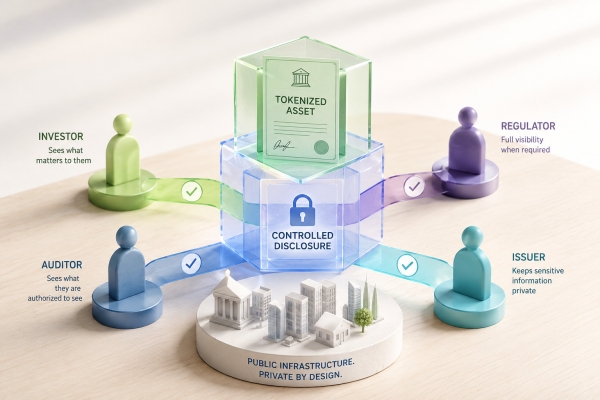
On May 27, 2026, Toronto based Polymath launched Confidential Assets on Polymesh, a protocol level privacy feature for tokenized securities and real world assets. It uses zero knowledge cryptography to keep transaction details private while preserving access for regulators, auditors, and authorized parties.
Privacy solves a practical market problem. Public blockchains can expose positions, client data, and transaction flows. Private chains can protect confidentiality, but they can also silo activity inside closed systems. Confidential Assets is Polymath aim to give regulated asset markets privacy without giving up public permissioned infrastructure.
Martin Halford, CEO, Polymath:
“The question the market has been asking is not whether assets can be tokenized -- they can. The question is whether tokenization can be done at an institutional scale, with the privacy and compliance standards that real financial infrastructure demands. Confidential Assets is our answer to that question.”
The stronger use case isn't about keeping secrets, but rather controlled disclosure. Issuers, investors, and asset managers need privacy around holdings and transfers. Yet a wide range of stakeholders from regulators to auditors, custodians, and compliance teams still need access when rules require it.
Confidential Assets is built into the Polymesh protocol, not added through a third party tool or Layer 2 solution. This allows privacy to work within the same system that handles compliance, governance, and settlement. A fund, private credit issuer, real estate platform, or broker dealer could use the feature to complete a compliant transfer without exposing position size or counterparty details to the broader market.
The ultimate goal and impact is the right mix of privacy and oversight. If Polymath gets that balance right, Confidential Assets could make Polymesh more useful for real capital markets activity, not just token issuance.
Confidential Assets is available immediately to institutions building on Polymesh. Polymath has been building regulated asset infrastructure since 2017 and contributed the ERC 1400 security token standard. Polymesh achieved SOC 2 Type 1 compliance in 2025. Polymath also says a post quantum ready version of Confidential Assets is in development for long term assets that may remain on chain for decades.
For Canadian capital markets and fintech firms, controlled disclosure is becoming core infrastructure for tokenized assets. Platforms that manage who can see what, and when, will become harder to replace in digital securities markets, over time.
Can tokenized markets reach institutional scale without protocol level privacy, or will controlled disclosure become a core requirement for regulated digital assets?
The National Crowdfunding & Fintech Association (NCFA Canada) is a financial innovation ecosystem that provides education, market intelligence, industry stewardship, networking and funding opportunities and services to thousands of community members and works closely with industry, government, partners and affiliates to create a vibrant and innovative fintech and funding industry in Canada. Decentralized and distributed, NCFA is engaged with global stakeholders and helps incubate projects and investment in fintech, alternative finance, crowdfunding, peer-to-peer finance, payments, digital assets and tokens, artificial intelligence, blockchain, cryptocurrency, regtech, and insurtech sectors. Join Canada's Fintech & Funding Community today FREE! Or become a contributing member and get perks. For more information, please visit: www.ncfacanada.org
| | |
|---|---|---|
| | |
May 26, 2026 | NCFA Insight | Risk Compliance And Regtech, Digital Assets Blockchain And Tokenization, Payments And Money Movement

Canada’s revoked MSB registry shows where payments, crypto, FX, and money transfer compliance risk is concentrated.
On May 21, 2026, FINTRAC modeified the public revoked money services business registry, currently showing 396 revoked registrations within the broader MSB registry of 7,745 firms. These revoked registrations span multiple years, but some quick analysis shows where payments, crypto, FX, and money transfer compliance risk is concentrated.
Below we show the total number of revoked registrations (396) by revocation year:
The registry is cumulative, but 2022 and 2026 stand out with greater numbers. The 2022 spike may reflect several factors, including delayed compliance reviews, expired or inactive registrations, pandemic era business disruption, and firms failing to respond to FINTRAC requests or update operating information.
The 2026 peak shows revocations are active again, but the registry doesn't explain why each firm was removed.
Of the 151 registrations revoked in 2026:
These activity counts exceed 151 because many businesses offered multiple services under one registration. They operated across money transfer, FX, virtual currency, PSP activity, and sometimes crowdfunding or money order services at the same time. That combination can make compliance harder because one firm may need controls for several activity types at once.
Wallets, stablecoin services, remittance platforms, crypto OTC desks, merchant payout tools, and embedded finance products often cross several regulatory categories. Companies building in these areas need clearer service mapping, stronger AML controls, and faster regulatory response processes.
By Province:
By City:
The above counts simply show where revoked registrations are concentrated in the dataset. Vancouver and Toronto are also major hubs for payments, FX, crypto services, incorporation activity, and cross border commerce, so higher counts likely reflect market density as well as supervisory attention.
MSBs must keep records, verify client identity, maintain a compliance regime, report certain financial transactions, and register their business. FINTRAC can revoke registration when a business becomes ineligible, misses a clarification request deadline, fails to respond to information demands, fails to update operating information, or fails to assist the Centre.
Founders should treat MSB registration as an active regulatory relationship. Address changes, service category changes, ownership changes, agent changes, and compliance officer changes all need disciplined tracking. Compliance teams should also review whether real business activity still matches registered categories, especially where firms blend payments, crypto, FX, remittances, PSP activity, and embedded finance.
Investors should add registry hygiene, AML staffing, virtual currency exposure, PSP activity, and regulator response history to diligence checklists. Growth can hide weak compliance operations for a while, but public registries can make those weaknesses visible.
This all aligns with recent Canadian oversight changes, such as the Bank of Canada’s PSP Registry under the RPAA, new Bank of Canada guidance for PSPs, and FINTRAC’s focus on Bitcoin ATM money laundering risks.
Which crypto firm looks stronger to regulators, investors, and banking partners: one that treats compliance as paperwork, or one that builds it into the operating system?
The National Crowdfunding & Fintech Association (NCFA Canada) is a financial innovation ecosystem that provides education, market intelligence, industry stewardship, networking and funding opportunities and services to thousands of community members and works closely with industry, government, partners and affiliates to create a vibrant and innovative fintech and funding industry in Canada. Decentralized and distributed, NCFA is engaged with global stakeholders and helps incubate projects and investment in fintech, alternative finance, crowdfunding, peer-to-peer finance, payments, digital assets and tokens, artificial intelligence, blockchain, cryptocurrency, regtech, and insurtech sectors. Join Canada's Fintech & Funding Community today FREE! Or become a contributing member and get perks. For more information, please visit: www.ncfacanada.org
| | |
|---|---|---|
| | |


August 26th, 2025

January 4th, 2024

June 1st, 2021

September 9th, 2020

July 9th, 2018

January 3rd, 2018

September 25th, 2017

June 20th, 2017

May 10th, 2017

December 14th, 2016