





Karsten Wenzlaff, Advisor
August 26th, 2025
Karsten Wenzlaff is a Crowdfunding and Fintech Expert from Germany. He is Secretary-General of Digit[...]


Apr 14, 2026 | NCFA Fintech Market Activity | Identity Privacy And Data Governance, Payments And Money Movement

On April 14, 2026, Interac and Kijiji introduce verified identity for marketplace users, bringing Interac Verified solutions into peer to peer transactions. The integration allows Canadians to confirm who they are dealing with before messaging, meeting, or completing a purchase.
Interac connects nearly 300 financial institutions and is used more than 20 million times per day to move money across Canada. Kijiji operates at national reach with more than 4 million live listings and over 1 million new listings added each month. This puts verified identity into a place where millions of transactions happen and trust issues show up most often.
Peer to peer marketplaces have historically relied on ratings and reviews. Those signals describe past behaviour, but they don't confirm identity. Verified identity addresses that gap directly. It confirms that the person behind an account is real before a transaction begins, reducing uncertainty in both high-value categories such as automotive and real estate and in everyday transactions.
Amanda Zeffiro, General Manager, Kijiji Canada:
“Integrating Interac Verified solutions to bring verified identity to Kijiji is how we raise that standard, giving Canadians the confidence to transact with people they’ve never met.”
Interac is rolling this out in stages and keeping identity verification in Canada. People can verify their identity today through participating financial institutions, using systems already trusted for payments. Later this year, a second option will let users verify with government-issued ID and a quick liveness check. This gives people different ways to verify depending on what they are comfortable with and the type of transaction.
Interac’s network already supports a large share of how money moves domestically, and this approach uses that same system for identity. At a time when data control is becoming more important, keeping verification tied to Canadian institutions carries weight with both users and regulators.
The benefits are clear. Verifying identity upfront can reduce impersonation and fraud, especially in higher risk transactions. It can also make people more confident when buying or selling. Over time, this kind of verification can connect more closely with payments and onboarding, giving platforms a more complete way to manage trust across the full transaction.
Interac is extending beyond payments into identity verification at scale. By placing verified identity before the transaction, Interac is positioning itself as part of the trust infrastructure that reduces risk and helps establish trust and therefore who can safely transact.
 The National Crowdfunding & Fintech Association (NCFA Canada) is a financial innovation ecosystem that provides education, market intelligence, industry stewardship, networking and funding opportunities and services to thousands of community members and works closely with industry, government, partners and affiliates to create a vibrant and innovative fintech and funding industry in Canada. Decentralized and distributed, NCFA is engaged with global stakeholders and helps incubate projects and investment in fintech, alternative finance, crowdfunding, peer-to-peer finance, payments, digital assets and tokens, artificial intelligence, blockchain, cryptocurrency, regtech, and insurtech sectors. Join Canada's Fintech & Funding Community today FREE! Or become a contributing member and get perks. For more information, please visit: www.ncfacanada.org
 |  |  |
|---|---|---|
 |  |  |
April 10, 2026

Few things are as terrifying as finding yourself in a financial pinch, and the worst part is that one could crop up at any time. Medical emergencies, property damage, and car issues—all of these can throw a wrench into your financial plans, and finding a solution as soon as possible is necessary so that you can get back on track.
One way you can do this is to borrow money from a trustworthy lender. With a loan or a virtual credit line, you can pay for the financial emergency right away and then spread out your payments across a certain time period to make them more manageable.
But it can be tricky to find a reliable provider, as well as borrower-friendly solutions. If you plan on borrowing money, it’s crucial to look for options that are safe and reputable if you want to avoid additional long-term debt or financial stress.
Here are a few tips to help you filter out the riskier options and find lenders and borrowing solutions that will genuinely be good for your situation:
If you’re looking for a reputable lender to borrow money from, then you should first explore the options offered by trustworthy banks. Banks usually offer low annual percentage rates (or APRs) for personal loans, making each installment easy to pay back. Some banks may also offer better rates or payment options for existing customers.
Alternatively, instead of borrowing money from a traditional bank, you can consider approaching a Bangko Sentral ng Pilipinas-regulated digital bank. Maya provides good options if you have a time-sensitive goal and you’re looking for a fast loan that is both convenient and secure. You can also expect fewer requirements for approving loans and a less complicated application process, allowing you to get the funds you need as soon as possible.
Besides traditional and digital banks, there are also many trustworthy lending platforms out there with good rates and transparent terms and conditions. The first step towards determining if a lender is safe is to check if it’s registered with the Securities and Exchange Commission (or SEC).
You can easily check this through the SEC website. Steer clear of lenders that don’t display any credentials, contact information, or licensing details on their site.
Reviews from previous customers are a reliable way to check a lender’s trustworthiness and safety. But don’t just look through their website’s testimonials. Instead, look for discussions on online forums, independent review platforms, and social media groups. These sites are where customers can be fully transparent about their experiences with a particular lender or a borrowing solution. Feel free to jump into these conversations as well to ask about their thoughts on the customer service, terms and conditions, and collection practices.
There are many predatory lenders out there who are out to take advantage of desperate borrowers, and it’s up to you to keep yourself safe by being on the lookout for any red flags. Be sure to stay away from lenders with high interest rates, unclear payment terms, or lack of proper paperwork.
Also, when speaking to a potential lender, pay attention to their customer service and how they generally treat you as a borrower. Loan sharks, or illegal money lenders, often use intimidation or threats during payment collection. Remember to trust your gut—if you don’t feel safe continuing the transaction, it’s better to back out before you borrow.
If you know anyone who already has experience with lenders or lending platforms, good or bad, feel free to ask them about insights and recommendations. They may have had a good borrowing experience and are happy to give you a referral, or they may be able to warn you about shadier lenders that you should avoid. Personal referrals can be a reliable shortcut to finding trustworthy loan sources, especially if you’re overwhelmed and unsure where to begin looking.
Keep your guard up even as you’re about to commit to a lender or solution. Before you consent to the agreement, make sure to read the terms and conditions carefully and ensure that the fees, interest rates, payment schedules, and penalties for missed payments are clear-cut and free of loopholes.
Avoid loan providers, for example, that bury important details in the fine print or pressure you into signing quickly. If something in the terms is unclear, don’t be afraid to ask for clarification; if the lender is unable to do so, then it’s better to cancel the loan entirely and search for a more trustworthy option than risk it.
At the end of the day, the best way to determine if a lender is trustworthy or not is by following your instinct. Even if they have no visible red flags throughout the entire transaction, if something doesn’t sit right with you, then it’s better to move on to other available options.
Rest assured that there are plenty of reputable services out there that can offer you the convenience you need without making you feel uneasy, from regulated digital banks to established lending platforms. Even if you need the money as soon as possible, carefully weigh the best options before settling on one.
The National Crowdfunding & Fintech Association (NCFA Canada) is a financial innovation ecosystem that provides education, market intelligence, industry stewardship, networking and funding opportunities and services to thousands of community members and works closely with industry, government, partners and affiliates to create a vibrant and innovative fintech and funding industry in Canada. Decentralized and distributed, NCFA is engaged with global stakeholders and helps incubate projects and investment in fintech, alternative finance, crowdfunding, peer-to-peer finance, payments, digital assets and tokens, artificial intelligence, blockchain, cryptocurrency, regtech, and insurtech sectors. Join Canada's Fintech & Funding Community today FREE! Or become a contributing member and get perks. For more information, please visit: www.ncfacanada.org
| | |
|---|---|---|
| | |
Mar 31, 2026 | NCFA Fintech Market Activity | Payments And Money Movement

On March 30, 2026, RBC and HTS launched a long term travel collaboration that brings Hopper Technology Solutions into Avion Rewards. The new booking portal goes live later this year for all Avion Rewards members, including Avion credit cardholders.
RBC is not just adding another travel partner. It's bringing search, booking, pricing, and redemption deeper into its own rewards product. Members will be able to use points across flights, accommodations, car rentals, activities, and packages. The platform also adds price insights built on historical and predictive data. Avion cardholders keep fixed points pricing on any airline, any flight, any time, with no blackout dates or seating restrictions.
That's the fintech angle. Travel stops being only a redemption feature at the end of the card relationship. It becomes part of the card experience itself. The bank gets more control over where travel spend happens, how rewards get used, and what it learns from search, booking, and redemption behaviour.
Avion Rewards already describes itself as Canada’s largest bank owned loyalty program. HTS brings the software behind the experience. Its 2026 travel commerce report draws on $6B in travel sales, 410M reachable cardholders, and 2.2M annual fintech purchases. RBC is adding travel commerce software, pricing intelligence, and a tighter booking flow to a large existing rewards base.
If other banks follow, rewards programs will start competing on more than points. Cardholders may start comparing how easy it is to search, book, and use rewards, not just how many points they earn. Customers stand to benefit if booking gets easier, pricing gets clearer, and redemption works with less friction. Banks benefit if more travel activity stays inside their own platform.
The booking layer may be just the start. Once search and rewards are part of the same experience, the bank can add instalments, insurance, trip support, and targeted offers at the point of booking. Ultimately, that turns travel rewards into more than a marketing perk. It starts to look like a real financial service channel.
If banks bring booking deeper into rewards, what's more important over time: the points currency, the booking layer, or the customer data that sits between them?
The National Crowdfunding & Fintech Association (NCFA Canada) is a financial innovation ecosystem that provides education, market intelligence, industry stewardship, networking and funding opportunities and services to thousands of community members and works closely with industry, government, partners and affiliates to create a vibrant and innovative fintech and funding industry in Canada. Decentralized and distributed, NCFA is engaged with global stakeholders and helps incubate projects and investment in fintech, alternative finance, crowdfunding, peer-to-peer finance, payments, digital assets and tokens, artificial intelligence, blockchain, cryptocurrency, regtech, and insurtech sectors. Join Canada's Fintech & Funding Community today FREE! Or become a contributing member and get perks. For more information, please visit: www.ncfacanada.org
| | |
|---|---|---|
| | |
Mar 26, 2026 | NCFA Fintech Market Activity | Banking And Credit, Digital Assets And Tokenization
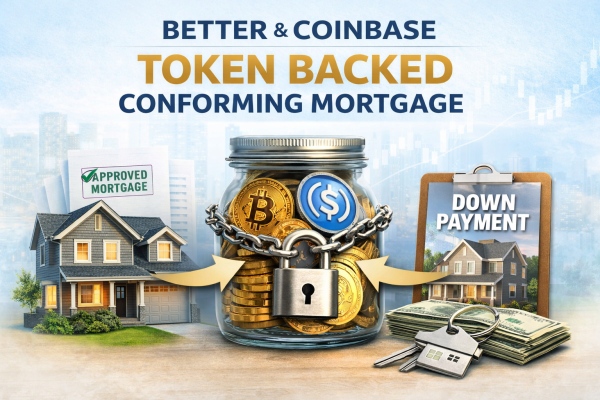
On March 26, 2026, Better and Coinbase launched the first token backed conforming mortgage. Qualified borrowers can pledge Bitcoin or USDC to fund a cash down payment while still taking out a standard mortgage that meets Fannie Mae rules. The structure lets borrowers use digital assets without selling them first and without automatically triggering a taxable sale event.
The product targets a large and growing borrower base. Better and Coinbase put the addressable market at 52 million Americans who own digital assets, equal to 20% of American adults. They also mention quite an age split, with 45% of younger investors holding crypto versus 18% of older investors. That age gap means it's much harder for younger buyers to meet traditional down payment cash requirements, yet many already hold part of their savings in digital assets.
There are no margin calls and no required top ups if Bitcoin falls in value. Price moves alone do not trigger liquidation. Collateral comes into play only if a borrower becomes 60 days delinquent, under the same treatment applied to standard conforming mortgages. Borrowers using USDC can also earn rewards on pledged balances, which may offset mortgage payments and lower the net effective rate.
The buyer profile is also broader than a luxury crypto niche. Better and Coinbase said 67% of token holders are 45 or younger and 26% earn less than US $75,000 a year. They also pointed to Redfin data showing 12.7% of Gen Z and Millennial homebuyers have already sold tokenized assets to fund a down payment, versus 3.5% of Gen X and 0.5% of Baby Boomers.
Digital assets are now included in standard mortgage structure, not just a trading or investment account. Token holdings now help fund a conforming mortgage down payment without forcing a sale first. As this model grows, digital assets will look less like something borrowers need to liquidate and more like collateral lenders may be willing to work with.
Better and Coinbase also plan to expand eligible collateral over time to include tokenized equities, fixed income, and tokenized real estate assets. If that happens, the story will not stop at mortgages. It will continue to proliferate into which consumer lending products can absorb token backed collateral and under what terms.
If digital assets can now help fund a conforming mortgage, which standard lending products could be next to accept token backed collateral?
The National Crowdfunding & Fintech Association (NCFA Canada) is a financial innovation ecosystem that provides education, market intelligence, industry stewardship, networking and funding opportunities and services to thousands of community members and works closely with industry, government, partners and affiliates to create a vibrant and innovative fintech and funding industry in Canada. Decentralized and distributed, NCFA is engaged with global stakeholders and helps incubate projects and investment in fintech, alternative finance, crowdfunding, peer-to-peer finance, payments, digital assets and tokens, artificial intelligence, blockchain, cryptocurrency, regtech, and insurtech sectors. Join Canada's Fintech & Funding Community today FREE! Or become a contributing member and get perks. For more information, please visit: www.ncfacanada.org
| | |
|---|---|---|
| | |
March 24, 2026
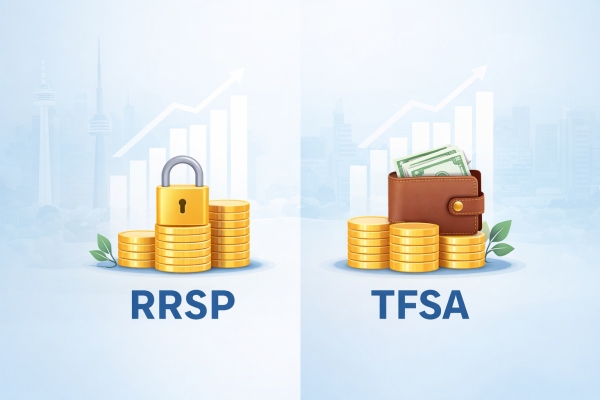
If you're a high-earning Canadian trying to build wealth, you've likely been told to "max out your RRSP" or "use your TFSA first." The advice often sounds definitive - but rarely accounts for your actual situation. Both accounts offer powerful tax advantages, yet they work in fundamentally different ways. Choosing between them isn't just a tax question; it's a behavioral and strategic one that depends on your income trajectory, spending patterns, and psychological relationship with money.
Understanding how RRSPs and TFSAs actually function - and how your brain responds to each - can help you make smarter decisions that stick.
The Registered Retirement Savings Plan (RRSP) is a tax-deferred account. Contributions reduce your taxable income in the year you make them, and your investments grow tax-free inside the account. You pay tax only when you withdraw, ideally in retirement when your income - and tax rate - are lower. For 2024, the contribution limit is 18% of your previous year's earned income, up to $31,560. [1]
The Tax-Free Savings Account (TFSA) works differently. You contribute with after-tax dollars - no immediate deduction - but all growth and withdrawals are completely tax-free, forever. The 2024 contribution limit is $7,000, with cumulative room of $95,000 if you've been eligible since the TFSA launched in 2009. [2]
Both accounts shelter investment gains from annual taxation, which is their shared superpower. The difference lies in when you pay tax and how withdrawals affect your future finances.
The classic rule of thumb: if your tax rate is higher now than it will be in retirement, the RRSP wins. If your rate will be the same or higher later, the TFSA is better. [3]
For high earning $150,000+ in provinces like Ontario, the combined federal-provincial marginal rate can exceed 43%. [4] An RRSP contribution at that rate delivers an immediate, substantial tax refund. If you withdraw in retirement at a 30% rate, you've effectively earned a permanent tax arbitrage.
But here's where it gets nuanced. RRSP withdrawals count as income, which can trigger clawbacks of Old Age Security (OAS) benefits and affect other income-tested programs. The OAS recovery tax kicks in once your income exceeds approximately $90,000, reducing benefits by 15 cents for every dollar over the threshold. [5]
TFSA withdrawals, by contrast, are invisible to the tax system. They don't affect OAS, GIS, or any means-tested benefit. For retirees who want flexibility and predictability, this can be worth more than the upfront RRSP deduction. [6]
Tax optimization assumes you'll actually invest the RRSP refund - not spend it. Research on windfall spending shows that unexpected money, including tax refunds, is often treated as "found money" and spent rather than saved. [7]
If you contribute $10,000 to your RRSP and receive a $4,000 refund, the math only works if that $4,000 goes back into investments. If it funds a vacation or lifestyle upgrade, you've diluted the RRSP's advantage significantly.
There's also the mental accounting problem. Behavioral research shows that people treat money differently depending on which "mental account" it sits in. [8] RRSP funds feel locked away (and largely are, due to withholding taxes on early withdrawal), which can be protective. TFSA funds feel more accessible, which can lead to premature withdrawals for non-emergencies.
Research from the Financial Consumer Agency of Canada found that many TFSA holders use their accounts primarily for short-term savings rather than long-term investing - missing the compounding benefits the account was designed for. [9]
Rather than treating this as an either/or question, most HENRYs benefit from using both accounts strategically. Here's a simplified decision framework:
Prioritize RRSP when: your marginal tax rate is high (above 40%), you're confident your retirement rate will be lower, and you have the discipline to reinvest the refund. Also consider RRSP contributions if you're planning to use the Home Buyers' Plan (HBP), which allows first-time buyers to withdraw up to $60,000 tax-free for a home purchase. [10]
Prioritize TFSA when: you're in a lower tax bracket now but expect higher earnings later, you want flexibility for mid-life goals (since withdrawals don't trigger tax or penalties), or you're already maximizing RRSP contributions and have additional savings capacity.
Use both when: you can afford to maximize contributions to each. The combined annual room (RRSP + TFSA + the newer FHSA for first-time home buyers) can exceed $40,000 - a powerful wealth-building engine if used consistently. [11]
Contributing to RRSP in a low-income year. If you're between jobs or earning less than usual, the deduction is worth less. Consider contributing to your TFSA instead and saving RRSP room for higher-earning years.
Ignoring employer matching. If your employer offers RRSP matching, that's an immediate 50–100% return on your contribution. Always capture the full match before directing money elsewhere.
Using TFSA as a savings account. Parking TFSA funds in a low-interest savings account wastes the tax shelter. Long-term data shows that diversified equity portfolios dramatically outperform cash over decades - and the TFSA's tax-free growth makes it ideal for higher-return investments. [12]
Over-contributing. The CRA charges a 1% monthly penalty on excess TFSA contributions. Track your room carefully, especially if you've made withdrawals (which restore room the following year, not immediately).
How PsyFi helps you optimize - and stick with - your strategy
Knowing the difference between RRSPs and TFSAs is one thing. Consistently making the right contributions - and avoiding the behavioral traps that derail good intentions - is another.
Personalized nudges: Reminders to contribute before deadlines, prompts to reinvest refunds, and alerts when you're approaching contribution limits.
Behavioral insights: Understand your money personality and how it affects decisions like "Should I tap my TFSA for this expense?"
Progress tracking: See how your registered accounts are growing over time, with visual cues that reinforce consistent behavior.
The best tax strategy is the one you actually follow. https://www.psyfiapp.com/ helps make that easier.
3: https://www.wealthsimple.com/en-ca/learn/rrsp-vs-tfsa
4: https://www.taxtips.ca/taxrates/on.htm
6: https://www.wealthsimple.com/en-ca/learn/oas-clawback-explained
7: https://www.nber.org/digest/mar09/did-2008-tax-rebates-stimulate-spending
8: https://www.behavioraleconomics.com/resources/mini-encyclopedia-of-be/mental-accounting/
12: https://www.rbcgam.com/en/ca/learn-plan/investment-basics/the-hidden-cost-of-too-much-cash/detail
The National Crowdfunding & Fintech Association (NCFA Canada) is a financial innovation ecosystem that provides education, market intelligence, industry stewardship, networking and funding opportunities and services to thousands of community members and works closely with industry, government, partners and affiliates to create a vibrant and innovative fintech and funding industry in Canada. Decentralized and distributed, NCFA is engaged with global stakeholders and helps incubate projects and investment in fintech, alternative finance, crowdfunding, peer-to-peer finance, payments, digital assets and tokens, artificial intelligence, blockchain, cryptocurrency, regtech, and insurtech sectors. Join Canada's Fintech & Funding Community today FREE! Or become a contributing member and get perks. For more information, please visit: www.ncfacanada.org
| | |
|---|---|---|
| | |
Mar 18, 2026 | NCFA Fintech Market Activity | Banking Distribution And Market Expansion

On Mar 17 2026, BMO announced a multi year expansion of new financial centers in the United States, adding more than 130 locations in California and about 15 in Arizona over the next five years. BMO already operates more than 220 financial centers in California, so the new build represents growth of more than 50% in that state.
Seven California financial centers are scheduled to open in 2026, with three in Greater Los Angeles, two in the Bay Area, and two in San Diego. In Arizona, the bank plans to expand in Phoenix and Tucson.
BMO is betting on distribution by putting more capital behind in person, advice led banking in high growth U.S. markets at a time when many firms still talk as if digital channels alone will carry the next phase of growth.
BMO describes each new site as a modern financial advice hub covering personal and business banking, commercial banking, and wealth management. It is expanding to deepen relationships, cross sell more products, and win over higher value clients who still want face to face advice for borrowing, business growth, and wealth decisions.
This also shows that branch strategy is splitting by market. Some regions still face access pressure from branch closures, which NCFA has covered in rural cash access, while banks such as BMO are still adding physical advice hubs in faster growing urban markets.
That's the strategic point. Digital tools lower servicing cost, but physical distribution remains important when banks compete for trust, complex financial needs, and local business relationships.
BMO is also signalling confidence in the long term value of U.S. regional expansion. The bank says the new network across California and Arizona is expected to support hundreds of jobs over five years, while also investing in renovations and relocations across its existing footprint.
If TradFi banks invest in physical centers for advice, trust, and higher value relationships in growing urban markets is it because digital banking plus AI services are at risk of missing the mark?
In growth markets, a physical footprint can still be a customer acquisition and advisory asset if the banking experience moves from transaction counter to relationship hub.
The National Crowdfunding & Fintech Association (NCFA Canada) is a financial innovation ecosystem that provides education, market intelligence, industry stewardship, networking and funding opportunities and services to thousands of community members and works closely with industry, government, partners and affiliates to create a vibrant and innovative fintech and funding industry in Canada. Decentralized and distributed, NCFA is engaged with global stakeholders and helps incubate projects and investment in fintech, alternative finance, crowdfunding, peer-to-peer finance, payments, digital assets and tokens, artificial intelligence, blockchain, cryptocurrency, regtech, and insurtech sectors. Join Canada's Fintech & Funding Community today FREE! Or become a contributing member and get perks. For more information, please visit: www.ncfacanada.org
| | |
|---|---|---|
| | |
Mar 16, 2026 | NCFA Insight | Consumer Fintech And Housing Payments
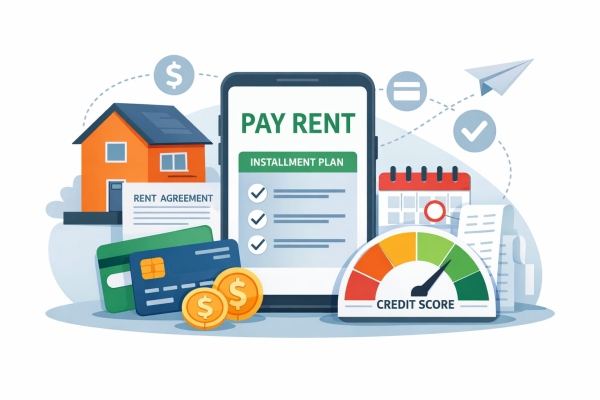
AI generated image: Rent Now Pay Later (RNPL)
On Mar 14 2026, CNN rent BNPL trend coverage in the US highlighted a new area of growth for consumer fintech, Rent Now Pay Later. BNPL providers and payment platforms are starting to move into rent payments, the largest recurring expense for many households.
Canada is already heading down this path. Fintech firms have spent several years pulling rent into the credit system through reporting and credit building services. KOHO rent credit programs allow renters to build credit history through rent payments, while rent credit history tools from Borrowell allow renters to add up to two years of past rent payments to their credit profile.
Now the model goes further.
Instead of only reporting rent payments, fintech platforms are beginning to split, finance, or route rent payments through credit rails. Rent is starting to look less like a fixed housing cost and more like a financial transaction that can generate data, fees, rewards, and short term credit exposure.
The underlying driver is housing affordability. rent burden data from Statistics Canada shows 33.0% of Canadian renter households spent 30% or more of income on shelter costs in 2022, a commonly used affordability threshold. Among private market renters who don't receive rent subsidies, the share rises slightly to 34.0%.
When roughly one third of renters already operate near an affordability limit, even small timing mismatches between income and rent payments can create pressure. Many workers receive pay every two weeks while rent is due monthly. Payment flexibility tools are now working to bridge that gap.
Several Canadian fintech firms are building products around rent payments. Zenbase offers split rent payments while reporting payment history to credit bureaus. Toronto fintech Chexy allows renters to pay rent by card, turning rent into a transaction that can generate rewards and short term credit float.
Borrowell focuses on rent reporting, allowing rent payment history to appear in an Equifax credit file. Products from KOHO, Borrowell, Zenbase, and Chexy differ in structure but share the same direction. They're moving rent deeper into payments infrastructure and credit data systems.
It's an important problem to focus on because rent is one of the largest financial flows in household budgets. Once fintech platforms innovate the payment stream, the implications extend into credit scoring, underwriting, rewards programs, and consumer debt exposure.
The benefits are straightforward. Rent reporting can help renters build credit files that traditional lending products often overlook. Payment flexibility can help align rent payments with pay cycles.
The risk emerges when flexibility substitutes for affordability. The reality is splitting rent into installments doesn't reduce the underlying cost of housing. It only spreads the obligation across time. Service fees, credit card interest, and repeated installment use can gradually turn a convenience feature into ongoing credit reliance.
This fact will likely determine how the category evolves. Products designed for occasional payment timing behave very differently from models that depend on frequent borrowing by financially stressed households.
Canadian regulators already monitor buy now pay later products as a consumer finance issue. The BNPL pilot study from the Financial Consumer Agency of Canada surveyed 1,034 Canadians to better understand how these services are used and whether consumers fully understand repayment terms and penalties.
Rent installment services raise similar questions. When the largest household bill starts moving onto credit rails, repayment discipline, fee transparency, and repeat usage patterns become key areas of concern and focus for both fintech providers and regulators.
Products that help renters manage payment timing or build credit history can deliver real value. But if rent flexibility becomes another channel for consumer borrowing, the category will face the same scrutiny that now surrounds buy now pay later services.
The National Crowdfunding & Fintech Association (NCFA Canada) is a financial innovation ecosystem that provides education, market intelligence, industry stewardship, networking and funding opportunities and services to thousands of community members and works closely with industry, government, partners and affiliates to create a vibrant and innovative fintech and funding industry in Canada. Decentralized and distributed, NCFA is engaged with global stakeholders and helps incubate projects and investment in fintech, alternative finance, crowdfunding, peer-to-peer finance, payments, digital assets and tokens, artificial intelligence, blockchain, cryptocurrency, regtech, and insurtech sectors. Join Canada's Fintech & Funding Community today FREE! Or become a contributing member and get perks. For more information, please visit: www.ncfacanada.org
| | |
|---|---|---|
| | |



August 26th, 2025

January 4th, 2024

June 1st, 2021

September 9th, 2020

July 9th, 2018

January 3rd, 2018

September 25th, 2017

June 20th, 2017

May 10th, 2017

December 14th, 2016
