





Karsten Wenzlaff, Advisor
August 26th, 2025
Karsten Wenzlaff is a Crowdfunding and Fintech Expert from Germany. He is Secretary-General of Digit[...]


May 27, 2026 | NCFA Market Activity | Funding, Risk Compliance And Regtech, Banking And Credit Infrastructure

On May 20, 2026, Toronto based Quantum Bridge Technologies announced a USD $8M Series A round to expand its quantum safe cybersecurity business for financial institutions, telecom networks, governments, and defence organizations. The University of Toronto spinout says the financing brings its total funding to USD $16M.
Quantum Bridge’s DSKE technology helps organizations create, distribute, and manage symmetric keys across existing networks. The company says customers can add the system across current vendors, security layers, and network environments without replacing core infrastructure.
The timing makes sense given that NIST released its first three post quantum encryption standards in August 2024 and urged system administrators to start moving to the new standards. In Canada, the Cyber Centre’s post quantum migration roadmap gives federal departments a planning model for transitioning non classified IT systems to post quantum cryptography.
Canada has strong, award winning quantum researchers. Buyers need tools they can audit and apply to real networks at scale. Quantum Bridge is actively pitching that to the market directly, and not asking customers to wait for a future quantum event. It's selling a migration solution for institutions that already manage long lived data, critical communications, and regulated infrastructure.
That connects directly to fintech. Payments, digital identity, custody, banking APIs, cloud security, and customer data protection all rely on cryptography. Infrastructure teams are in need of cryptographic agility before regulatory pressure and vendor bottlenecks make upgrades harder.
The Series A gives Quantum Bridge more room to sell into high trust markets where procurement takes time and credibility counts. The investor group also tells a useful story. The round brings together venture capital, telecom exposure, enterprise technology, and cross border capital. That mix fits a company selling security infrastructure into finance, telecom, government, and defence.
Mattia Montagna, Co Founder and CEO, Quantum Bridge Technologies:
“National security can’t wait for perfect conditions. We build quantum-safe systems that work inside real networks today — systems designed to keep protecting sovereign communications as the threat landscape evolves. This funding means we can meet more organizations where they are, and get them protected faster.”
Quantum Bridge’s financing shows where Canadian quantum policy needs to support execution. Canada should help qualified domestic firms prove their systems inside critical sectors before global buyers define the market without us.
 The National Crowdfunding & Fintech Association (NCFA Canada) is a financial innovation ecosystem that provides education, market intelligence, industry stewardship, networking and funding opportunities and services to thousands of community members and works closely with industry, government, partners and affiliates to create a vibrant and innovative fintech and funding industry in Canada. Decentralized and distributed, NCFA is engaged with global stakeholders and helps incubate projects and investment in fintech, alternative finance, crowdfunding, peer-to-peer finance, payments, digital assets and tokens, artificial intelligence, blockchain, cryptocurrency, regtech, and insurtech sectors. Join Canada's Fintech & Funding Community today FREE! Or become a contributing member and get perks. For more information, please visit: www.ncfacanada.org
 |  |  |
|---|---|---|
 |  |  |
May 26, 2026 | NCFA Insight | Payments And Market Infrastructure, Regulation And Policy, Digital Assets Blockchain And Tokenization

The Fed is proposing limited settlement accounts for eligible firms. The bigger question is whether the U.S. gives qualified fintechs a cleaner infrastructure advantage than Canada.
On May 26, 2026, the Federal Reserve published a Federal Register proposal for special purpose Payment Accounts. Legally eligible institutions could use them to clear and settle certain payment activity through Reserve Bank accounts. Comments are due by July 27, 2026 under Docket No. OP-1878.
The proposal isn't open access to the Fed. Payment Accounts would have no intraday credit, no discount window access, no interest on balances, no correspondent activity, and no respondent activity. Closing balances would generally be capped at $1B. The account would support approved payment settlement, not full banking privileges.
Jerome H. Powell, Fed Chair said:
“The proposed payment account would be tailored to support innovation by serving the clearing and settlement needs of certain eligible institutions while also mitigating material risks to the Reserve Banks and payment system.”
A Master Account gives an eligible institution direct access to Reserve Bank balances and Federal Reserve payment services. The proposed Payment Account is narrower in scope. Firms would not borrow from the Fed, earn interest, receive daylight overdrafts, or use the account as a correspondent banking platform.
The Fed is testing whether limited settlement access can exist without full banking access.
Fintechs, crypto firms, trust companies, and novel chartered institutions have pushed for Fed access because sponsor bank dependence affects cost, timing, liquidity, and settlement certainty. Banks have pushed back because wide access can raise compliance, liquidity, and regulatory arbitrage concerns.
In 2022, the Fed finalized Account Access Guidelines with a tiered review framework. The toughest review applies to institutions that are not federally insured and are not subject to federal prudential supervision at the institution or holding company level.
The 2026 proposal doesn't replace that framework. It creates a tighter account model inside the same access debate.
The proposal discusses use cases raised by commenters, including stablecoin issuer reserve operations, tokenized securities settlement in central bank money, tokenized assets, pay by bank checkout, B2B transfers, instant wages and refunds, and the U.S. dollar leg of cross border transactions.
Those use cases point to the same operating need, clean settlement. Stablecoin issuers need reliable reserve movement. Tokenization platforms need cash settlement closer to central bank money. PSPs need faster payment settlement. Pay by bank providers need lower cost routing. Cross border firms need cleaner dollar leg execution.
Today, many fintechs settle payments through sponsor banks. A fintech sends payment instructions, but the actual settlement usually happens through a commercial bank account connected to central bank rails.
Under the Fed proposal, an approved firm could potentially hold limited settlement balances directly at a Reserve Bank for approved payment activity. That could reduce some dependence on sponsor banks for specific flows.
For a stablecoin issuer, that could improve reserve movement and redemption settlement.
For a pay by bank provider, it could streamline payment routing.
For a tokenization platform, it could support settlement closer to central bank money instead of relying entirely on commercial bank ledger movement.
The proposal would not turn fintechs into banks. Firms would not receive deposit insurance, emergency liquidity, or unrestricted Fed access.
If eligible U.S. firms gain limited Reserve Bank settlement access while Canadian firms remain more dependent on bank intermediaries, U.S. fintechs could gain an operating edge in payment speed, settlement certainty, reserve movement, and cost control.
That edge is important for stablecoins, tokenized securities, pay by bank, B2B payments, cross border transfers, and embedded finance. These markets compete on speed, liquidity use, compliance reliability, and integration cost.
It could also change sponsor bank negotiations. A firm with a credible settlement alternative has more leverage than one with no alternative.
| Question | U.S. Fed Payment Account Proposal | Canada RPAA Registered PSP | Canada Payment Rail Participation |
|---|---|---|---|
| Live today? | No. Proposal only. | Yes | Yes |
| Can hold settlement balances at the central bank? | Only if final rules approve it and the firm qualifies. | No | No by participation alone. |
| Can settle some payments through a central bank account? | Would apply only to approved payment activity. | No | RTR may allow direct settlement for eligible participants that qualify for Bank of Canada settlement accounts. RPAA registration alone doesn't. |
| Still needs sponsor banks? | Yes, but dependence could fall for approved settlement flows. | Yes | Yes, in many cases. |
| Gets full banking powers? | No | No | No |
| Main benefit | Potentially cleaner settlement for stablecoins, tokenized assets, pay by bank, and cross border dollar flows. | Legal operation under Bank of Canada supervision. | Access to payment rails and network participation. |
Canada’s retail payments framework brings PSPs into Bank of Canada supervision. The PSP registry under the RPAA confirms registration status, required fees, and national security screening. Registration does not itself provide limited direct settlement access.
Payments Canada says the Real Time Rail will launch in Q4 2026 as Canada’s instant, data rich exchange and clearing and settlement payment system. RTR is expected to broaden access for eligible participants, including PSPs that meet applicable requirements.
Canada has also legislated a fiat backed stablecoin framework, with detailed rules and implementation still being developed. The framework helps define issuer obligations around reserves, redemption, governance, data security, and Bank of Canada oversight. It does not itself provide payment rail access or limited direct settlement access.
The competitive question is not whether Canada should copy the Fed. It's whether Canada can give qualified PSPs, stablecoin issuers, and tokenization firms a clear access ladder from supervision to rail participation to settlement. If U.S. firms gain a narrow Fed settlement lane while Canadian firms wait for comparable clarity, product speed, treasury efficiency, and sponsor bank leverage may tilt south.
If U.S. firms get limited central bank settlement access, what should Canada let supervised PSPs access once they meet higher standards?
The National Crowdfunding & Fintech Association (NCFA Canada) is a financial innovation ecosystem that provides education, market intelligence, industry stewardship, networking and funding opportunities and services to thousands of community members and works closely with industry, government, partners and affiliates to create a vibrant and innovative fintech and funding industry in Canada. Decentralized and distributed, NCFA is engaged with global stakeholders and helps incubate projects and investment in fintech, alternative finance, crowdfunding, peer-to-peer finance, payments, digital assets and tokens, artificial intelligence, blockchain, cryptocurrency, regtech, and insurtech sectors. Join Canada's Fintech & Funding Community today FREE! Or become a contributing member and get perks. For more information, please visit: www.ncfacanada.org
| | |
|---|---|---|
| | |
May 26, 2026 | NCFA Insight | Risk Compliance And Regtech, Digital Assets Blockchain And Tokenization, Payments And Money Movement

Canada’s revoked MSB registry shows where payments, crypto, FX, and money transfer compliance risk is concentrated.
On May 21, 2026, FINTRAC modeified the public revoked money services business registry, currently showing 396 revoked registrations within the broader MSB registry of 7,745 firms. These revoked registrations span multiple years, but some quick analysis shows where payments, crypto, FX, and money transfer compliance risk is concentrated.
Below we show the total number of revoked registrations (396) by revocation year:
The registry is cumulative, but 2022 and 2026 stand out with greater numbers. The 2022 spike may reflect several factors, including delayed compliance reviews, expired or inactive registrations, pandemic era business disruption, and firms failing to respond to FINTRAC requests or update operating information.
The 2026 peak shows revocations are active again, but the registry doesn't explain why each firm was removed.
Of the 151 registrations revoked in 2026:
These activity counts exceed 151 because many businesses offered multiple services under one registration. They operated across money transfer, FX, virtual currency, PSP activity, and sometimes crowdfunding or money order services at the same time. That combination can make compliance harder because one firm may need controls for several activity types at once.
Wallets, stablecoin services, remittance platforms, crypto OTC desks, merchant payout tools, and embedded finance products often cross several regulatory categories. Companies building in these areas need clearer service mapping, stronger AML controls, and faster regulatory response processes.
By Province:
By City:
The above counts simply show where revoked registrations are concentrated in the dataset. Vancouver and Toronto are also major hubs for payments, FX, crypto services, incorporation activity, and cross border commerce, so higher counts likely reflect market density as well as supervisory attention.
MSBs must keep records, verify client identity, maintain a compliance regime, report certain financial transactions, and register their business. FINTRAC can revoke registration when a business becomes ineligible, misses a clarification request deadline, fails to respond to information demands, fails to update operating information, or fails to assist the Centre.
Founders should treat MSB registration as an active regulatory relationship. Address changes, service category changes, ownership changes, agent changes, and compliance officer changes all need disciplined tracking. Compliance teams should also review whether real business activity still matches registered categories, especially where firms blend payments, crypto, FX, remittances, PSP activity, and embedded finance.
Investors should add registry hygiene, AML staffing, virtual currency exposure, PSP activity, and regulator response history to diligence checklists. Growth can hide weak compliance operations for a while, but public registries can make those weaknesses visible.
This all aligns with recent Canadian oversight changes, such as the Bank of Canada’s PSP Registry under the RPAA, new Bank of Canada guidance for PSPs, and FINTRAC’s focus on Bitcoin ATM money laundering risks.
Which crypto firm looks stronger to regulators, investors, and banking partners: one that treats compliance as paperwork, or one that builds it into the operating system?
The National Crowdfunding & Fintech Association (NCFA Canada) is a financial innovation ecosystem that provides education, market intelligence, industry stewardship, networking and funding opportunities and services to thousands of community members and works closely with industry, government, partners and affiliates to create a vibrant and innovative fintech and funding industry in Canada. Decentralized and distributed, NCFA is engaged with global stakeholders and helps incubate projects and investment in fintech, alternative finance, crowdfunding, peer-to-peer finance, payments, digital assets and tokens, artificial intelligence, blockchain, cryptocurrency, regtech, and insurtech sectors. Join Canada's Fintech & Funding Community today FREE! Or become a contributing member and get perks. For more information, please visit: www.ncfacanada.org
| | |
|---|---|---|
| | |
May 26, 2026 | NCFA Resource | Artificial Intelligence And Data, Risk Compliance And Regtech, Payments And Market Infrastructure
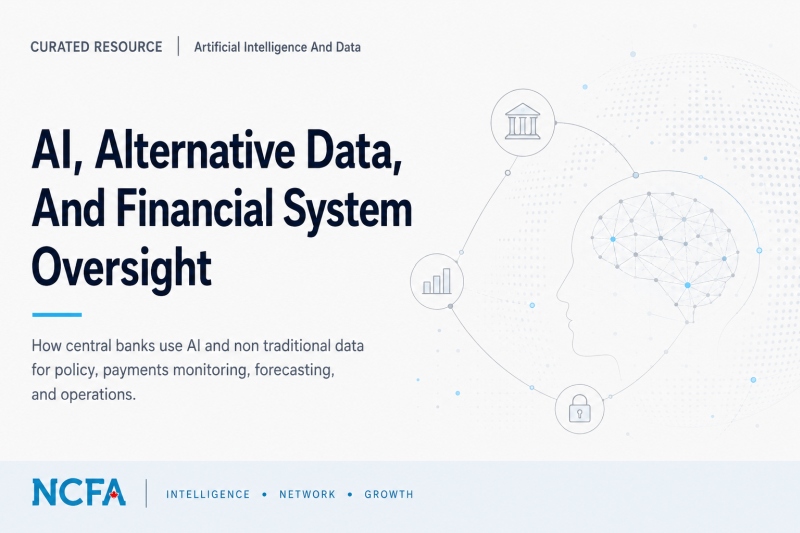
On May 15, 2026, the Bank of Canada published Integrating Non-traditional Data and AI into Central Banking. The staff paper examines how central banks use artificial intelligence and non traditional data in research, operations, payments monitoring, forecasting, and policy support.
The paper stays close to real operating problems. It focuses on data quality, model governance, human oversight, vendor risk, cybersecurity, and moving AI pilots into production.
The paper shows how central banks use non traditional data from payment transactions, earnings call transcripts, satellite images, job postings, social media, scanner data, and real time business activity. It also explains how AI supports inflation tracking, nowcasting, anomaly detection, payments monitoring, internal automation, and policy work.
One Bank of Canada automation project improved filing accuracy to 99.5% and saved about 1.25 person years of staff capacity. The paper also cites a BIS survey showing more than 90% of responding central banks are moderately or extensively discussing AI internally.
The most useful section sets out six accelerators for responsible AI adoption in central banking. They include sandbox environments, technology readiness checks, high quality data, reusable development patterns, scale planning, and risk governance. The framework also applies to regulated financial institutions that need to transition AI from experiments into controlled production, similar to broader work underway around customer due diligence controls for fintechs.
This resource is useful for fintech founders, AI governance teams, regtech providers, financial institutions, payment companies, policy teams, investors, and compliance leaders.
It is especially relevant for teams building explainable AI, payment intelligence, anomaly detection, compliance automation, model governance, and trusted workflow tools.
The strength is its operating detail and the fact that the paper doesn't treat AI as a generic productivity story. It shows why regulated financial institutions need explainability, auditability, strong data controls, and clear ownership before AI can support high stakes decisions.
The paper also points to a real market gap. Central banks may need specialized AI tools and deeper in house expertise because many commercial systems are not designed for monetary policy analysis, payments oversight, or central bank operations.
The limit is scope. This is a central banking paper, not a commercialization guide. It does not estimate vendor spending, market size, adoption timelines, or private sector demand. Its value is the framework and the operating discipline behind it.
Bank Of Canada AI And Non Traditional Data Paper (primary Bank of Canada resource)
AI Agents Enter Governed Financial Workflows (AI governance and controls)
Tokenization Starts Looking Like Financial Infrastructure (regulated financial infrastructure)
Deloitte And Stablecorp Bring QCAD To Banks (Canadian payment infrastructure)
The National Crowdfunding & Fintech Association (NCFA Canada) is a financial innovation ecosystem that provides education, market intelligence, industry stewardship, networking and funding opportunities and services to thousands of community members and works closely with industry, government, partners and affiliates to create a vibrant and innovative fintech and funding industry in Canada. Decentralized and distributed, NCFA is engaged with global stakeholders and helps incubate projects and investment in fintech, alternative finance, crowdfunding, peer-to-peer finance, payments, digital assets and tokens, artificial intelligence, blockchain, cryptocurrency, regtech, and insurtech sectors. Join Canada's Fintech & Funding Community today FREE! Or become a contributing member and get perks. For more information, please visit: www.ncfacanada.org
| | |
|---|---|---|
| | |
The National Crowdfunding & Fintech Association (NCFA Canada) is a financial innovation ecosystem that provides education, market intelligence, industry stewardship, networking and funding opportunities and services to thousands of community members and works closely with industry, government, partners and affiliates to create a vibrant and innovative fintech and funding industry in Canada. Decentralized and distributed, NCFA is engaged with global stakeholders and helps incubate projects and investment in fintech, alternative finance, crowdfunding, peer-to-peer finance, payments, digital assets and tokens, artificial intelligence, blockchain, cryptocurrency, regtech, and insurtech sectors. Join Canada's Fintech & Funding Community today FREE! Or become a contributing member and get perks. For more information, please visit: www.ncfacanada.org
| | |
|---|---|---|
| | |
May 25, 2026 | NCFA Insight | Payments And Market Infrastructure, Open Banking Open Finance And Data Sharing, Digital Assets Blockchain And Tokenization
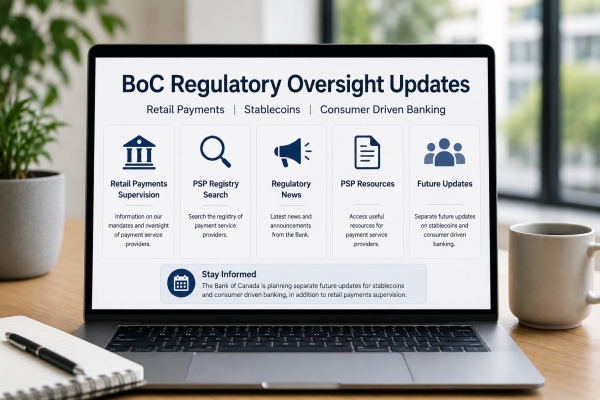
On May 25, 2026, the Bank of Canada refreshed its regulatory oversight web content and streamlined its retail payments supervision section. The update gives payment service providers a cleaner place to find key information as the Bank’s mandates expand across retail payments, stablecoins, and consumer driven banking.
The Bank says users can now more easily find information about its mandates, search the payment service provider registry, access a new regulatory news section, and browse resources for payment service providers. It's important for fintechs because RPAA supervision is evolving from policy discussion into day to day operating reality and governance.
The Bank supervises payment service providers under the Retail Payment Activities Act (NCFA covered this practical transition when the PSP registry went live under RPAA) and expects firms to meet risk management and safeguarding requirements.
In addition to retail payments supervision, the Bank of Canada also says it plans to issue separate future updates about stablecoins and consumer driven banking. It means fintechs should watch the Bank’s update streams more closely as these files progress for the latest updates and key information.
The Bank has also set up a Consumer Driven Banking Advisory Committee to provide industry perspective and advice to the Bank and the Department of Finance. The committee will focus on implementation, industry readiness, and the supervisory framework. NCFA’s open banking commercialization roadmap explains why implementation details will matter for fintech business models, data access, onboarding, and customer experience. That gives market participants a useful clue about where questions will concentrate next, such as how companies prepare, how oversight works in practice, and how consumer driven banking connects with the broader payment system.
Payment companies should use the refreshed pages as a compliance resource point. Check registry details, monitor regulatory news, review PSP resources, and make sure internal owners know where Bank updates will appear.
No new rules were announced in this email, but the Bank has made it easier to follow the official files that matter to payment companies, stablecoin operators, open banking participants. In a crowded regulatory environment, cleaner source material helps firms track changes earlier and prepare with less confusion.
The National Crowdfunding & Fintech Association (NCFA Canada) is a financial innovation ecosystem that provides education, market intelligence, industry stewardship, networking and funding opportunities and services to thousands of community members and works closely with industry, government, partners and affiliates to create a vibrant and innovative fintech and funding industry in Canada. Decentralized and distributed, NCFA is engaged with global stakeholders and helps incubate projects and investment in fintech, alternative finance, crowdfunding, peer-to-peer finance, payments, digital assets and tokens, artificial intelligence, blockchain, cryptocurrency, regtech, and insurtech sectors. Join Canada's Fintech & Funding Community today FREE! Or become a contributing member and get perks. For more information, please visit: www.ncfacanada.org
| | |
|---|---|---|
| | |
May 25, 2026 | NCFA Insight | Artificial Intelligence And Data, Capital Markets And Funding

On May 23, 2026, hundreds marched in downtown Vancouver against proposed AI data centres, concerned about electricity use, water use, and environmental impact. The protest puts Canada’s AI compute plans under pressure. Communities want to know who gets clean power, what they get back, and whether data centre operators can earn public trust.
The pressure comes from specific projects. On May 11, 2026, TELUS and the federal government announced work on a proposed Sovereign AI Factory cluster in B.C. that would expand TELUS’s Kamloops data centre and add two Vancouver facilities with Westbank and partners. TELUS says the cluster starts with 85 MW of clean renewable power secured from BC Hydro and is designed to scale to more than 60,000 GPUs and 150 MW by 2032.
After the May 23 protest, TELUS told Daily Hive that its proposed AI infrastructure is a “critical national asset” built for Canada and by Canadians. They said the project could add $9 billion to Canada’s economy, protect sensitive Canadian data, use 98% clean renewable electricity from BC Hydro, cut energy use by 80%, reduce water use by 90%, and save an estimated 300 million litres of water each year through closed loop liquid cooling.
TELUS is framing the project as sovereign AI infrastructure with climate and data benefits. Critics are asking whether those claims will be visible, measurable, and credible enough for communities that are being asked to host large AI facilities.
Ottawa wants more domestic AI compute so Canadian researchers, companies, and public institutions don't have to rely solely on foreign infrastructure. From January 15 to February 15, 2026, the federal government accepted proposals from companies and consortia seeking support to build large scale sovereign AI data centres. The federal government also said no funding has yet been committed or distributed under the process.
On January 30, 2026, the Province and BC Hydro launched a competitive electricity process for AI and data centre projects. The goal is to manage rising demand and prioritize projects with stronger economic, community, and environmental benefits.
BC Hydro’s 2026 call shows the cap constraint. Its Q&A says up to 300 MW has been allocated to storage data centres and up to 100 MW to conventional data centres. Each project site request must not exceed 145 MW. TELUS’s stated 150 MW 2032 target shows how quickly one AI project can approach the size of the current allocation.
BC Hydro says it doesn't comment on specific customer load requests. That leaves communities with headline numbers and proposed locations, but not always the full project picture on grid upgrades, water use, tax benefits, jobs, or local access to compute.
Data centres turn AI from software policy into physical infrastructure. They need land, power, cooling, permits, grid planning, and local acceptance.
Households, industry, electrification, and AI projects are all competing for clean power, which is scare ad valuable. If communities don't see clear local benefits, approvals will get harder.
Critics point to electricity demand, water use, environmental impact, and the risk that public infrastructure supports private AI capacity without enough community return.
B.C. is already choosing which projects get access to limited clean power. Canada needs compute, but scarce electricity should go first to projects that use power efficiently, protect data sovereignty, create local benefits, and make capacity available to Canadian users.
Canada wants sovereign AI compute. Can governments and operators prove that clean power used for AI will create enough local benefit, public trust, and Canadian owned value to justify the buildout?
The National Crowdfunding & Fintech Association (NCFA Canada) is a financial innovation ecosystem that provides education, market intelligence, industry stewardship, networking and funding opportunities and services to thousands of community members and works closely with industry, government, partners and affiliates to create a vibrant and innovative fintech and funding industry in Canada. Decentralized and distributed, NCFA is engaged with global stakeholders and helps incubate projects and investment in fintech, alternative finance, crowdfunding, peer-to-peer finance, payments, digital assets and tokens, artificial intelligence, blockchain, cryptocurrency, regtech, and insurtech sectors. Join Canada's Fintech & Funding Community today FREE! Or become a contributing member and get perks. For more information, please visit: www.ncfacanada.org
| | |
|---|---|---|
| | |
May 22, 2026 | NCFA Fintech Whisperer Weekly Intelligence | Digital Assets Blockchain And Tokenization, Payments And Money Movement

Image: Freepik
This live weekly NCFA intelligence page tracks financial technology developments that significantly affect how fintechs build, sell, raise capital, and operate under scrutiny. Coverage prioritizes Canada and includes global events that directly influence competitive conditions, market access, and execution realities across fintech sectors. This page will be updated throughout the week with market movers in a live format and then each week we'll close the prior week's contents in prep for the upcoming week, and continue on a rolling basis. (Missed prior week's Fintech Whisperer? (December 6-12, 2025, December 13-19, 2025, January 1-9, 2026, January 10-16, 2026, January 17-23, 2026, January 24-30, 2026, January 31-February 6, 2026, February 7-13, 2026, February 14-20, 2026, February 21-27, 2026, February 28-March 6, 2026, March 7-13, 2026, March 14-20, 2026, March 21-27, 2026, March 28-April 3, 2026, April 4-10, 2026, April 11-17, 2026, April 18-24, 2026, April 25-May 1, 2026, May 2-8, 2026, May 9-15, 2026).
Institutional digital asset infrastructure is increasingly converging around unified execution, settlement, compliance, and liquidity layers. Banks, fintechs, custodians, PSPs, brokers, and treasury teams should track how tokenized funds, stablecoin settlement, collateral movement, and onchain liquidity are becoming integrated into institutional operating environments rather than isolated crypto workflows.
Bank led stablecoins are becoming part of Europe’s regulated payment strategy. Banks, PSPs, stablecoin issuers, custodians, treasury teams, and compliance groups should track how euro denominated stablecoin infrastructure affects settlement options, liquidity design, and competition with USD stablecoins.
Stablecoin distribution is becoming a network access problem. Wallets, exchanges, PSPs, brokers, and embedded finance platforms need interoperability, regulated issuance, liquidity, and compliance controls that let users move between stablecoin networks without adding operational friction.
New York licensing remains a key test for institutional digital asset firms. Exchanges, custodians, brokers, lenders, and compliance teams should track which firms secure state level approvals because market access, client onboarding, and institutional trust still depend on regulated operating permissions.
USD account access is becoming embedded infrastructure for global platforms, not just a bank product. Fintechs, PSPs, marketplaces, payroll firms, and treasury teams should watch how account issuance, compliance controls, real time payments, and stablecoin rails converge inside programmable payment stacks.
Canadian dollar stablecoins are beginning to enter practical payment flows instead of remaining treasury or trading instruments. PSPs, banks, remittance firms, treasury teams, and compliance groups should watch how regulated stablecoin settlement changes cross border payout speed, corridor economics, liquidity management, and payment competition. CADC infrastructure continues to expand across Canadian digital payment markets.
Bitcoin reserve legislation is turning digital assets into a public balance sheet question, not just a market regulation debate. Crypto firms, custodians, exchanges, treasury teams, investors, and policymakers should track how federal reserve asset policy, seized digital asset management, and national competitiveness arguments reshape the next phase of U.S. crypto policy.
Card network economics are moving deeper into formal regulatory reporting. Merchants, acquirers, issuers, PSPs, payment networks, and embedded payment platforms should track how fee transparency, profitability evidence, and scheme oversight affect payment costs and competitive pressure across card acceptance.
The FCA is creating a clearer supervisory channel for firms that are already scaling, not just early sandbox participants. That matters because fast growth often creates new questions around controls, governance, technology, and consumer impact before a firm becomes systemically important.
Prediction markets are becoming a direct federal versus state jurisdiction fight. Exchanges, fintech platforms, compliance teams, policymakers, and investors should track how courts treat event contracts because the outcome could affect federal derivatives oversight, state gambling authority, consumer protection rules, and regulated forecasting markets.
Federal policymakers increasingly treat fintech infrastructure as part of U.S. financial competitiveness strategy. Banks, PSPs, digital asset firms, payment companies, and infrastructure providers should track how payment rail access, supervision, settlement services, and master account policy evolve as regulators face growing pressure to integrate fintech firms into core financial systems.
UK stablecoin policy is moving toward draft rule text and implementation design. Stablecoin issuers, banks, PSPs, custodians, wallets, and treasury teams should track how the Bank balances financial stability controls with usable payment products, especially around issuance limits, redemption, reserves, and access to settlement infrastructure.
Lowering community bank burden can open capacity, not just reduce paperwork. Fintechs, sponsor banks, core providers, lenders, and compliance teams should track whether tailored supervision gives smaller banks more room to partner, modernize, lend, and support local payment and deposit infrastructure.
Onchain markets need clearing and netting controls before more institutions treat them as reliable operating channels. Trading firms, custodians, brokers, stablecoin networks, and treasury teams should track how private obligation matching, liquidity savings, and counterparty controls develop across institutional digital asset markets.
Prediction markets are moving beyond politics and sports into private capital market intelligence. Exchanges, investors, fintech platforms, regulators, and market infrastructure providers should track how forecasting markets, institutional secondary market data, and tokenized trading systems increasingly converge around private company price discovery and market sentiment.
Regional exchange infrastructure competition continues to expand beyond traditional Western commodity benchmarks. Exchanges, clearing firms, commodity traders, treasury groups, and market infrastructure operators should track how Singapore based benchmarks, physical delivery systems, and digitally enabled collateral infrastructure increasingly support Asian commodity trade and price discovery.
The case is a governance and creditor risk warning for Canada’s fintech funding market. Investors, lenders, founders, and boards should keep closer watch on treasury controls, debt covenants, founder conduct, and creditor transparency as capital becomes more selective.
Canada’s MSB compliance risk is increasingly visible across multi service fintech models. Crypto firms, PSPs, FX dealers, remittance platforms, investors, and compliance teams should keep registration data current, map services accurately, and treat FINTRAC responsiveness as an operating requirement.
Payments, digital assets, AI fraud controls, and capital markets infrastructure are being rebuilt by registered firms with licenses, distribution, data, and balance sheets. Smaller fintechs can still win, but only where they solve a real operating problem and plug into the financial system with trust from day one. The opportunity is still open, but it will favour teams that move quickly, stay compliant, earn trust, and turn infrastructure change into useful products for customers, merchants, investors, and institutions.
NCFA offers various curated resources to help founders and investors stay current on developments that impact fintech markets, subscribe to NCFA weekly newsletter updates, view a rundown of current fintech news and insights, or dive into the latest fintech industry research.
The National Crowdfunding & Fintech Association (NCFA Canada) is a financial innovation ecosystem that provides education, market intelligence, industry stewardship, networking and funding opportunities and services to thousands of community members and works closely with industry, government, partners and affiliates to create a vibrant and innovative fintech and funding industry in Canada. Decentralized and distributed, NCFA is engaged with global stakeholders and helps incubate projects and investment in fintech, alternative finance, crowdfunding, peer-to-peer finance, payments, digital assets and tokens, artificial intelligence, blockchain, cryptocurrency, regtech, and insurtech sectors. Join Canada's Fintech & Funding Community today FREE! Or become a contributing member and get perks. For more information, please visit: www.ncfacanada.org
| | |
|---|---|---|
| | |



August 26th, 2025

January 4th, 2024

June 1st, 2021

September 9th, 2020

July 9th, 2018

January 3rd, 2018

September 25th, 2017

June 20th, 2017

May 10th, 2017

December 14th, 2016
