





Karsten Wenzlaff, Advisor
August 26th, 2025
Karsten Wenzlaff is a Crowdfunding and Fintech Expert from Germany. He is Secretary-General of Digit[...]


May 25, 2026 | NCFA Fintech Market Activity | Digital Assets Blockchain And Tokenization

On May 20, 2026, 3iQ selected Anchorage Digital as the infrastructure and custody partner for its Canadian product suite. Subject to regulatory approvals and required prospectus or offering document amendments, 3iQ intends to migrate a significant portion of assets under management across six TSX listed exchange traded products to Anchorage Digital.
3iQ is a Canadian digital asset investment manager with a regulated public product suite. Anchorage Digital became the first OCC approved national crypto bank in the U.S. Canada has qualified digital asset custodians, but not an equivalent national crypto bank structure at Anchorage’s scale. The decision puts a hard question in front of Canada’s digital asset sector. Can Canadian infrastructure win large institutional mandates when issuers need custody, settlement, staking support, and regulatory comfort at scale?
The warning is now showing up in market activity. Canada has already debated whether domestic digital asset infrastructure can compete with larger U.S. regulated platforms. That issue became more visible when Balance applied for a Canadian special purpose trust structure to build institutional digital asset custody capacity at home.
If Canada approves digital asset products but doesn't build trusted infrastructure at home, more of the work, jobs, and revenue may migrate south. In this case, 3iQ keeps the Canadian listed products while Anchorage Digital captures more of the custody and infrastructure work behind them.
That choice is commercial, not patriotic. Large issuers choose the stack that lowers operating risk and helps them launch better products. That’s the reality test Canadian infrastructure providers now face.
3iQ says Anchorage Digital lets funds settle trades from cold storage without relying on hot wallets. Its Atlas network also lets 3iQ settle directly with trading counterparties and remove extra wallet steps. It means custody now affects much more than safekeeping. It affects how funds trade, settle, manage risk, support staking, and protect investors.
The partnership is also expected to support 3iQ’s expanded staking capabilities. That raises the stakes. Staking needs more than token custody. It needs validator access, clean reporting, strong controls, and regulatory comfort. The right custody partner can give a fund more room to build. The wrong one can hold it back.
Tommaso Mancuso, President and CIO of 3iQ:
"3iQ needs infrastructure providers that meet “the highest standards for security, flexibility, and regulatory alignment.”
That is the standard Canadian infrastructure has to meet now. Canada has digital asset talent, regulated products, custody ambition, and a real institutional market. But the operating stack behind those products still needs more depth, if they want to compete. Fund issuers need platforms that can handle scale, connect cleanly to trading counterparties, support approved product features, and satisfy regulators without adding friction.
Canadian policymakers should treat this as a competitiveness warning. Product approvals aren't enough if the custody, settlement, staking, and fund operations work scales outside Canada. The goal should be to keep more trusted digital asset infrastructure, jobs, and revenue at home.
 The National Crowdfunding & Fintech Association (NCFA Canada) is a financial innovation ecosystem that provides education, market intelligence, industry stewardship, networking and funding opportunities and services to thousands of community members and works closely with industry, government, partners and affiliates to create a vibrant and innovative fintech and funding industry in Canada. Decentralized and distributed, NCFA is engaged with global stakeholders and helps incubate projects and investment in fintech, alternative finance, crowdfunding, peer-to-peer finance, payments, digital assets and tokens, artificial intelligence, blockchain, cryptocurrency, regtech, and insurtech sectors. Join Canada's Fintech & Funding Community today FREE! Or become a contributing member and get perks. For more information, please visit: www.ncfacanada.org
 |  |  |
|---|---|---|
 |  |  |
May 22, 2026 | NCFA Insight | Digital Assets Blockchain And Tokenization, Regulation And Policy, Capital Formation And Venture Markets

Image: Hester Peirce (aka Crypto Mom)
On May 21, 2026, reports confirmed that SEC Commissioner Hester Peirce will leave the U.S. Securities and Exchange Commission later this year to join Regent University School of Law, closing one of the most closely watched regulatory tenures in digital asset policy.
Peirce became affectionately known globally as “Crypto Mom” because she consistently argued that regulators should give digital asset markets workable rules instead of leaving companies to operate inside uncertainty. Her positions moved from controversial to increasingly mainstream as spot bitcoin ETFs launched, tokenization expanded, and major financial institutions entered digital asset infrastructure.
Her departure doesn't mean pro crypto or pro innovation momentum suddenly disappears from Washington. Digital assets no longer depend on a single regulator defending the sector. Bitcoin ETFs now trade in regulated markets. Large banks are building tokenization infrastructure. Stablecoin legislation continues advancing across major jurisdictions. Institutional adoption no longer sits at the fringe.
Still, Peirce leaves behind a clear regulatory record.
For years, she pushed back against regulation through enforcement. She argued that uncertainty weakens both innovation and investor protection because companies struggle to build compliant products when the rules remain unclear.
Many of the issues she raised directly affected fintech competition, startup capital formation, tokenization, crowdfunding, and investor participation. Her speeches consistently returned to the same core themes, such as open markets, proportional regulation, investor choice, and transparent rulemaking.
Peirce’s bluntest critique came during the long debate over regulation through enforcement, where she warned that private meetings with crypto firms cannot replace open rulemaking:
“It’s just not a good way of regulating.”
Her frustration with the SEC’s long delay on spot bitcoin funds became even clearer when spot bitcoin ETFs finally won approval after years of rejected applications:
“We squandered a decade of opportunities to do our job.”
Peirce’s Token Safe Harbor proposal became one of the most discussed crypto policy frameworks because it tried to give blockchain networks time to decentralize before full securities obligations applied.
Her public rulemaking philosophy also stood out in her University of Central Florida FinTech Summit remarks, where she urged regulators to approach innovation with both skepticism and openness instead of reflexive resistance. She later warned that poor engagement damages the relationship between regulators and innovators:
“We are scaring people off from coming in and having a conversation with us.”
Even when she defended innovation, Peirce did not argue for eliminating rules. In her statement on tokenized securities, she welcomed the promise of blockchain while drawing a hard compliance line:
“Tokenization may facilitate capital formation and enhance investors’ ability to use their assets as collateral.”
She also added the part many crypto promoters prefer to skip:
“Tokenized securities are still securities.”
That balance partly explains why Peirce maintained credibility across crypto markets and traditional finance circles. She supported innovation, but she also believed markets work best when participants understand the rules.
Her influence reached beyond crypto. Peirce consistently supported broader access to capital markets, regulatory transparency, and competition for smaller firms. Those priorities aligned closely with long standing NCFA positions on equity crowdfunding and capital markets modernization, fintech competitiveness, and proportional regulation for emerging companies.
Very few SEC commissioners become recognizable public figures outside securities law circles. Peirce did because she represented a different philosophy of regulation during one of the most contested periods in financial technology policy.
Her departure closes an important chapter at the SEC. But the larger debates around tokenization, digital asset infrastructure, market access, and programmable finance are now deeply embedded across global financial systems. Those discussions continue with or without Crypto Mom inside the building.
Peirce also engaged directly with the broader fintech and innovation community over the years, including participating in NCFA’s FFCON21: Breaking Barriers program.
On behalf of everyone at NCFA, we thank Hester Peirce for consistently contributing to open debate around innovation, competition, investor choice, and access to capital during one of the most important periods in modern financial market development. We wish her continued success in this next chapter.
The National Crowdfunding & Fintech Association (NCFA Canada) is a financial innovation ecosystem that provides education, market intelligence, industry stewardship, networking and funding opportunities and services to thousands of community members and works closely with industry, government, partners and affiliates to create a vibrant and innovative fintech and funding industry in Canada. Decentralized and distributed, NCFA is engaged with global stakeholders and helps incubate projects and investment in fintech, alternative finance, crowdfunding, peer-to-peer finance, payments, digital assets and tokens, artificial intelligence, blockchain, cryptocurrency, regtech, and insurtech sectors. Join Canada's Fintech & Funding Community today FREE! Or become a contributing member and get perks. For more information, please visit: www.ncfacanada.org
| | |
|---|---|---|
| | |
May 22, 2026 | NCFA Fintech Market Activity | Digital Assets Blockchain And Tokenization, Payments And Money Movement

On May 21, 2026, Montreal based Shakepay opened the waitlist for its physical Shakepay Visa Prepaid Card and launched a 21 day campaign that turns everyday card payments into bitcoin rewards for customers and participating local businesses. The campaign builds on Shakepay’s Virtual Card, which the company says thousands of Canadians already use every week to earn bitcoin rewards on purchases.
Here’s how it works. Customers tap the Virtual Shakepay Card in store and earn points toward early access to the physical card. Those payments can also place local businesses on Shakepay’s campaign map. Businesses that sign up for Shakepay for Business during the campaign can claim bitcoin rewards after verification.
Shakepay is using rewards, merchants, and local campaign mechanics to push bitcoin into daily payment behaviour without asking customers or businesses to use bitcoin at checkout.
Jean Amiouny, CEO, Shakepay:
“Most rewards programs give people points they can only use inside someone else's system. We think Canadians should be able to earn an asset they can actually own,”
Shakepay is reframing rewards around ownership. Customers spend from their cash balance and earn rewards paid in bitcoin. That differs from closed loyalty points, which usually keep value inside one retailer, issuer, or rewards system.
Small businesses can explore bitcoin reserves without rebuilding payment acceptance or asking customers to pay with crypto. The bitcoin reward is tied to campaign activity and business onboarding, not direct bitcoin checkout.
The top 21,000 customers on the waitlist will receive early access to the physical card. The top 2,100 will be eligible for a Launch Edition card engraved with their waitlist rank. That gamified structure gives Shakepay a way to measure demand before full rollout.
The company says it helps more than 1.5 million Canadians access and use bitcoin through everyday financial products. Shakepay is a CIRO member, an Investment Dealer registered with the AMF, and a FINTRAC registered Money Service Business. They also recently became a member of Payments Canada. The Shakepay Visa Prepaid Card is issued by Peoples Trust Company under licence from Visa International Service Association.
Shakepay is testing whether bitcoin rewards can become a daily payments wedge in Canada. If the model works, bitcoin doesn't need to replace card rails to gain utility. It can ride on top of card spending, rewards, and small business treasury behaviour.
Will bitcoin adoption in Canada grow through direct crypto payments, or through familiar card and rewards products that make bitcoin part of everyday spending?
The National Crowdfunding & Fintech Association (NCFA Canada) is a financial innovation ecosystem that provides education, market intelligence, industry stewardship, networking and funding opportunities and services to thousands of community members and works closely with industry, government, partners and affiliates to create a vibrant and innovative fintech and funding industry in Canada. Decentralized and distributed, NCFA is engaged with global stakeholders and helps incubate projects and investment in fintech, alternative finance, crowdfunding, peer-to-peer finance, payments, digital assets and tokens, artificial intelligence, blockchain, cryptocurrency, regtech, and insurtech sectors. Join Canada's Fintech & Funding Community today FREE! Or become a contributing member and get perks. For more information, please visit: www.ncfacanada.org
| | |
|---|---|---|
| | |
May 22, 2026 | NCFA Fintech Market Activity | Digital Assets Blockchain And Tokenization, Payments And Money Movement, Capital Markets And Market Infrastructure
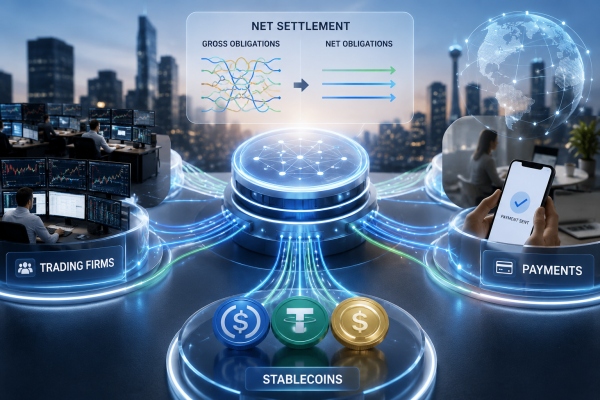
On May 21, 2026, Toronto based Cycles raised $6.4 million to build an open, privacy preserving clearing network for crypto markets and stablecoin payments. Blockchange Ventures led the round, with participation from Coinbase Ventures, Compound VC, Primitive Ventures, and angel investors. The round brings Cycles’ total funding to $8.7 million, following a $2.3 million pre seed in 2025.
Cycles is targeting one of the least glamorous but most important parts of financial infrastructure: clearing. In traditional markets, clearing reduces how much money has to move between counterparties by offsetting obligations first. Cycles wants to bring that function to on chain finance, where trading and payment flows still often require too much prefunding and too much gross settlement.
The first institutional product is Cycles Prime, which lets trading firms privately net OTC obligations across the network. Cycles says this can reduce liquidity requirements and counterparty exposure without requiring collateral, asset movement, or a change in counterparties. Cycles Prime is launching with Lynq and FalconX as anchor partners.
Ethan Buchman, Co Founder and CEO, Cycles:
“Clearing is a financial superpower that has historically only been available to large financial institutions,”
Without clearing, firms often move full payments back and forth instead of only settling the difference. That ties up capital and can increase risk when markets move quickly.
The release points to October 10, 2025, when more than $19 billion in crypto leverage was liquidated in roughly one day, with 70% of forced liquidations occurring in just 40 minutes. Cycles uses that event to show why capital efficiency matters. When markets rely on gross settlement and heavy prefunding, stress can move fast.
Cycles is betting that multilateral clearing can reduce that pressure. Meaning, many obligations can be matched against each other so less money has to move. If it works, trading firms may keep less idle capital parked across venues and counterparties.
The second product is Cycles Pay, a stablecoin payments app for individuals and businesses. Payments are routed through Cycles’ clearing engine, which nets obligations across participants to minimize capital movement. The product also includes invoicing and expense management with credit planned.
Stablecoins already help move value across networks. Clearing can make those flows more capital efficient. For businesses, the value isn't only faster payment. It's fewer trapped balances, better cash flow, and more private settlement.
Rob Schmults, General Partner at Blockchange Ventures:
"Clearing is the cornerstone of capital-efficient markets like foreign exchange allowing the movement of massive volumes of value without crippling liquidity requirements. We see Cycles providing an essential coordination layer to bring the efficiency and effectiveness of clearing to new markets. Doing this will allow businesses to clear and settle payments privately, optimize capital flow, and reduce the need for idle capital. As global adoption accelerates, Cycles can become a category defining standard for how value is settled and netted across entire ecosystems and markets."
If stablecoins are becoming payment rails, will clearing become the missing layer that turns on chain settlement from fast movement into capital efficient market infrastructure?
The National Crowdfunding & Fintech Association (NCFA Canada) is a financial innovation ecosystem that provides education, market intelligence, industry stewardship, networking and funding opportunities and services to thousands of community members and works closely with industry, government, partners and affiliates to create a vibrant and innovative fintech and funding industry in Canada. Decentralized and distributed, NCFA is engaged with global stakeholders and helps incubate projects and investment in fintech, alternative finance, crowdfunding, peer-to-peer finance, payments, digital assets and tokens, artificial intelligence, blockchain, cryptocurrency, regtech, and insurtech sectors. Join Canada's Fintech & Funding Community today FREE! Or become a contributing member and get perks. For more information, please visit: www.ncfacanada.org
| | |
|---|---|---|
| | |
May 20, 2026 | NCFA Resource | Regulation And Policy, Artificial Intelligence And Data, Digital Assets Blockchain And Tokenization

On April 20, 2026, the UK Financial Conduct Authority published its Innovation Insights 2025 report (20 page PDF). The report gives fintech founders, investors, and policy teams a practical view of where capital, regulatory testing, and market demand are concentrating across AI, digital assets, stablecoins, tokenization, RegTech, open finance, embedded finance, and operational automation.
The FCA points to a more disciplined phase of fintech, where firms need clear customer value, stronger controls, earlier regulatory engagement, and credible deployment plans.
The report combines global fintech investment data with activity across FCA innovation services, including the Regulatory Sandbox, Innovation Pathways, Digital Sandbox, AI Lab, Supercharged Sandbox, Smart Data Accelerator, and Scale Up Unit.
The overview gives operators a clean read on regulated fintech demand. AI, distributed ledger technology, open banking, and open finance ranked among the main technologies used by applicants. The FCA also launched new support channels in 2025, including a stablecoins cohort.
Regulated fintech no longer wins on novelty alone. Better products need stronger evidence, safer testing routes, sharper governance, and a realistic route from pilot to production.
This resource is useful for fintech founders, investors, compliance teams, financial institutions, policymakers, accelerators, digital asset firms, AI builders, RegTech vendors, and open finance teams tracking where regulated innovation is gaining traction.
It is especially useful for firms building around AI governance, stablecoins, tokenization, compliance automation, open finance, embedded finance, and supervised testing models.
The report is strong on investment patterns, regulatory engagement, sector demand, and FCA innovation service activity. It helps founders and investors see which fintech themes are attracting capital and which models need earlier regulator dialogue.
Its limit is the report doesn't provide a full outcomes study on sandbox firm performance, revenue growth, compliance cost reduction, productivity gains, fraud reduction, or investor returns. It works best as a regulatory market map, not proof that any one fintech category will outperform.
Canada and other jurisdictions can still use the report as a benchmark. Faster testing routes, clearer engagement models, and stronger links between experimentation and responsible deployment are becoming competitive advantages in financial innovation.
FCA Innovation Insights 2025 (primary FCA report)
AI Agents Enter Governed Financial Workflows (AI governance and controls)
Tokenization Starts Looking Like Financial Infrastructure (tokenized market infrastructure)
Deloitte And Stablecorp Bring QCAD To Banks (Canadian stablecoin infrastructure)
The National Crowdfunding & Fintech Association (NCFA Canada) is a financial innovation ecosystem that provides education, market intelligence, industry stewardship, networking and funding opportunities and services to thousands of community members and works closely with industry, government, partners and affiliates to create a vibrant and innovative fintech and funding industry in Canada. Decentralized and distributed, NCFA is engaged with global stakeholders and helps incubate projects and investment in fintech, alternative finance, crowdfunding, peer-to-peer finance, payments, digital assets and tokens, artificial intelligence, blockchain, cryptocurrency, regtech, and insurtech sectors. Join Canada's Fintech & Funding Community today FREE! Or become a contributing member and get perks. For more information, please visit: www.ncfacanada.org
| | |
|---|---|---|
| | |
May 18, 2026 | NCFA Fintech Market Activity | Payments And Money Movement, Digital Assets Blockchain And Tokenization
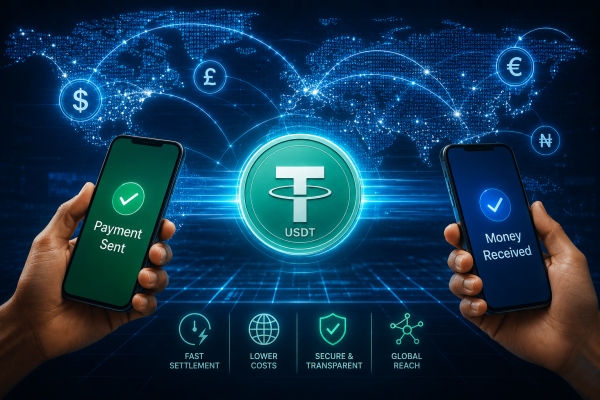
On May 18, 2026, Tether announced a strategic investment in LemFi, a cross border payments platform serving people who live and work across borders. The investment is focused on integrating USD₮ as a settlement layer across LemFi’s key corridors, especially across Africa and Asia.
This is a separate from LemFi’s USD $53 million Series B, which was announced in January 2025. Tether wants USDT deeper inside remittance infrastructure, where payment companies manage liquidity, settlement, and payout timing.
Tether says LemFi serves senders in the UK, U.S., Canada, and Europe who move money to Africa and Asia. It also says the investment aims to replace multi day SWIFT chains with near instant, lower cost settlement. That is the market issue. Remittance platforms don't compete on app design, but how quickly money arrives safely, and at a fair cost.
Paolo Ardoino, CEO, Tether:
“Our investment in LemFi reflects our shared vision on how money moves across borders, prioritizing speed, cost, and transparency. By supporting LemFi’s growth and innovation roadmap, we are helping bring the benefits of a stable digital asset to more people who rely on remittances in their daily lives.”
The practical change is settlement. USDT is not being positioned only as a crypto asset for users to hold. Tether is backing a payments platform so USDT can help move value behind the scenes across active corridors, which is valued to not only senders but to PSPs, MSBs, and banks.
Faster settlement can reduce delays and working capital pressure. But stablecoins don't solve the whole corridor. Remittance providers still need fraud controls, sanctions screening, clear FX, customer support, licensing, and reliable local payout.
Ridwan Olalere, CEO and Co Founder, LemFi:
“Integrating USD₮ into our infrastructure brings us closer to that reality, enabling faster, cheaper, and more reliable financial services for the millions of people who depend on us every day,”
While the announcement doesn't disclose the terms of the deal like Tether’s investment size or rollout timing, the business case is clear enough.
If USDT settlement shortens settlement time or reduces banking friction, LemFi could improve corridor economics. The customer impact will depend on whether those gains lead to better pricing, faster payout, or more reliable transfers.
Stablecoin issuers are actively integrating into live payment flows and partnering with platforms that have users, corridor demand, and payout networks. Traditional providers will need to build, partner, or risk losing margin.
For fintech operators and investors, the key insight is that stablecoin remittances are becoming an infrastructure strategy.
As stablecoin issuers invest directly in remittance platforms, will banks and PSPs still control the economics of cross border payments, or will stablecoin networks capture more of the settlement layer?
The National Crowdfunding & Fintech Association (NCFA Canada) is a financial innovation ecosystem that provides education, market intelligence, industry stewardship, networking and funding opportunities and services to thousands of community members and works closely with industry, government, partners and affiliates to create a vibrant and innovative fintech and funding industry in Canada. Decentralized and distributed, NCFA is engaged with global stakeholders and helps incubate projects and investment in fintech, alternative finance, crowdfunding, peer-to-peer finance, payments, digital assets and tokens, artificial intelligence, blockchain, cryptocurrency, regtech, and insurtech sectors. Join Canada's Fintech & Funding Community today FREE! Or become a contributing member and get perks. For more information, please visit: www.ncfacanada.org
| | |
|---|---|---|
| | |
May 20, 2026 | NCFA Resource | Digital Assets Blockchain And Tokenization, Payments And Market Infrastructure
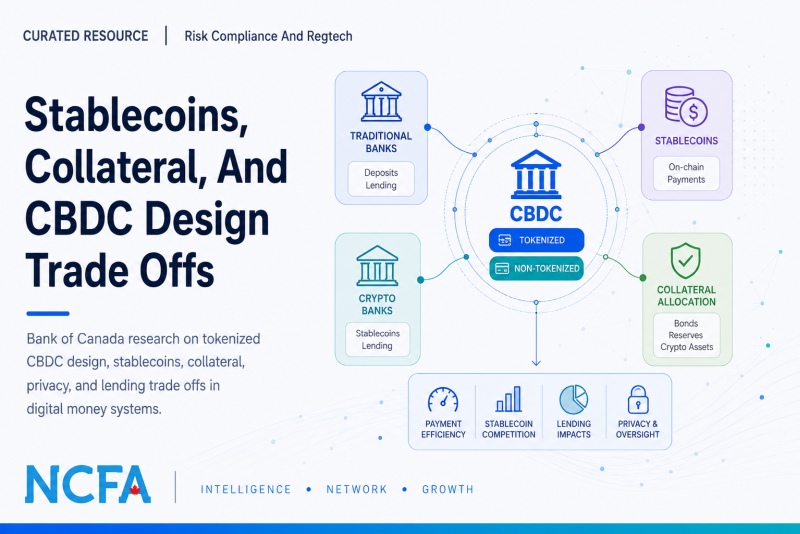
On May 7, 2026, the Bank of Canada published staff working paper 2026-14 on CBDC tokenization design. The paper looks at a financial system where traditional banks issue deposits, crypto banks issue stablecoins, and a central bank decides whether a CBDC should work through conventional accounts or programmable ledgers.
For fintechs, the useful part isn't the CBDC debate alone. The paper links tokenized money to collateral, stablecoin competition, privacy, crypto asset scarcity, and bank lending. Those issues are at the core of digital money infrastructure.
The paper compares tokenized and non tokenized CBDCs. A non tokenized CBDC competes with bank deposits in traditional payment markets. A tokenized CBDC works on programmable ledgers and competes more directly with stablecoins and tokenized settlement infrastructure in on chain markets.
The strongest finding is simple but important. Tokenization changes outcomes only when collateral use differs across sectors. The real question is which institutions hold the collateral, how reliable private money issuers are, and whether scarce reserve assets support payments or lending.
The model shows that tokenized CBDCs can crowd out stablecoins when crypto banks look less reliable and crypto assets are scarce. Non tokenized CBDCs can make more sense when crypto transactions offer less social value or when moving reserves from traditional banks to crypto banks improves the system.
The trade off is clear. CBDCs can improve payment efficiency, but they can also reduce bank lending when collateral moves away from traditional credit creation. That is where the paper becomes useful for fintech operators, not just policy teams.
The paper also raises a privacy question. A tokenized CBDC can run on a ledger that gives the central bank more visibility into transactions. That may improve oversight, but it can also reduce privacy. Digital money design is not just about speed or programmability. It also sets the rules for trust, control, and market access.
This resource is useful for fintech founders, stablecoin issuers, payment companies, banks, digital asset infrastructure providers, tokenization platforms, treasury teams, investors, and policymakers tracking the future of money.
It is especially relevant for firms building around programmable payments, stablecoin settlement, tokenized collateral, wholesale digital assets, bank issued digital money, or regulated crypto infrastructure.
The strength of this resource is the way it connects CBDC design to the financial infrastructure underneath tokenized markets. It doesn't treat CBDC as a simple retail wallet question. It looks at how money design affects collateral, settlement, stablecoins, bank deposits, crypto activity, and lending.
The paper also avoids easy answers. Tokenized CBDCs do not automatically improve the system. The result depends on collateral scarcity, crypto bank reliability, privacy settings, and the value of activity happening on programmable ledgers.
The limit is that this is an academic working paper with equations, model assumptions, and conditional results. Most operators will not read it end to end. The value is in the framework, not every technical section.
Used well, it helps fintech teams ask better questions about future money design. Who issues the money? What backs it? Where does collateral sit? What happens to lending? Who gets visibility into transactions? Those questions will matter as stablecoins, tokenized deposits, and central bank money keep moving into the same conversation.
Bank Of Canada CBDC Tokenization Paper (primary Bank of Canada working paper)
BIS Future Monetary System Blueprint (referenced framework for tokenized money and unified ledgers)
US Treasury Future Of Money Report (policy context for digital money and payment system design)
The National Crowdfunding & Fintech Association (NCFA Canada) is a financial innovation ecosystem that provides education, market intelligence, industry stewardship, networking and funding opportunities and services to thousands of community members and works closely with industry, government, partners and affiliates to create a vibrant and innovative fintech and funding industry in Canada. Decentralized and distributed, NCFA is engaged with global stakeholders and helps incubate projects and investment in fintech, alternative finance, crowdfunding, peer-to-peer finance, payments, digital assets and tokens, artificial intelligence, blockchain, cryptocurrency, regtech, and insurtech sectors. Join Canada's Fintech & Funding Community today FREE! Or become a contributing member and get perks. For more information, please visit: www.ncfacanada.org
| | |
|---|---|---|
| | |



August 26th, 2025

January 4th, 2024

June 1st, 2021

September 9th, 2020

July 9th, 2018

January 3rd, 2018

September 25th, 2017

June 20th, 2017

May 10th, 2017

December 14th, 2016
