





Karsten Wenzlaff, Advisor
August 26th, 2025
Karsten Wenzlaff is a Crowdfunding and Fintech Expert from Germany. He is Secretary-General of Digit[...]


June 30, 2026 | NCFA Story Intelligence | Digital Assets Blockchain And Tokenization, Capital Markets And Market Infrastructure
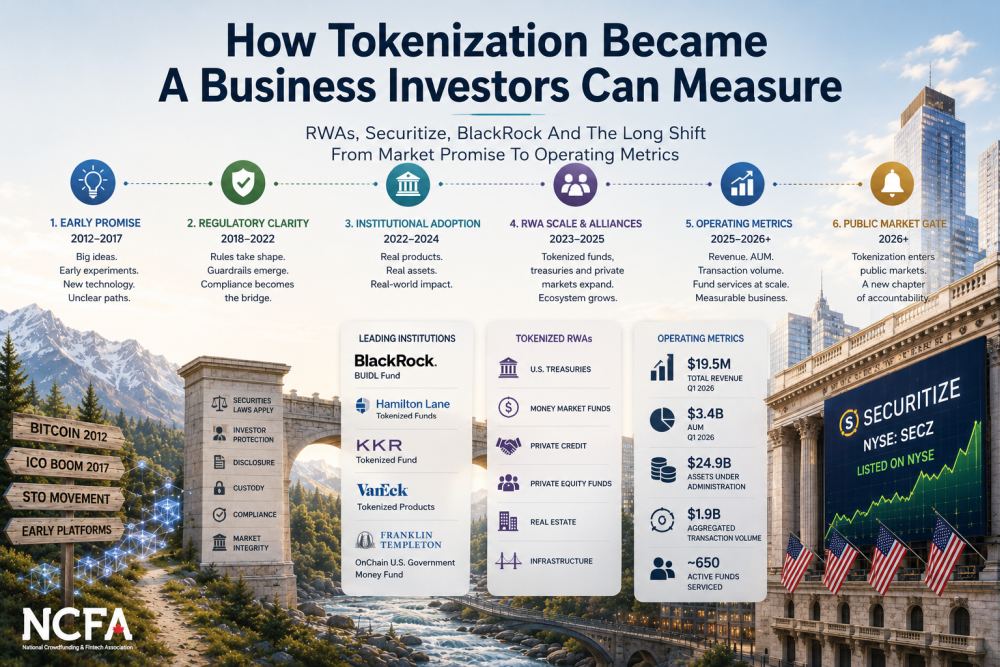
Tokenization promised to change capital markets for more than a decade.
The promise is still attractive. Put ownership on chain. Reduce paperwork. Automate compliance. Improve access. Speed up settlement. Make private assets easier to distribute, manage, and transfer.
But markets don’t run on promises. They run on operating models, regulation, distribution, controls, liquidity, and trust.
That’s why Securitize’s expected NYSE listing is the trigger. The listing isn’t the whole story. It’s the latest chapter in a longer path from tokenization as a market idea to tokenization as a business investors can measure.
The first wave sold a powerful idea. Security tokens, STOs, fractional assets, real estate tokens, private shares, and blockchain based markets promised to bring traditional securities into programmable digital form. The early security token field was framed as a more regulated answer to the ICO boom.
The market didn’t overhaul itself. Early security token projects ran into the same walls: unclear regulation, thin liquidity, limited distribution, custody questions, fragmented platforms, investor eligibility rules, and the simple reality that a tokenized security still has to behave like a security.
The hard work was never only technical. A tokenized fund still needs investor onboarding, KYC, AML, transfer rules, custody, servicing, reporting, distributions, tax records, corporate actions, and permissioned secondary transfers. Those aren’t marketing features. They’re the boring parts that make markets work.
Regulators kept reminding the market that labels don’t change obligations. Hester Peirce’s point that tokenized securities still have to follow securities laws captured the practical boundary. Faster settlement and automation don’t remove investor protection, disclosure, and market integrity requirements.
Real world assets changed the packaging. The market stopped asking whether everything should become tokenized and started asking which assets actually benefit. Treasuries, money market funds, private credit, private equity funds, and alternative assets became more practical test cases than vague claims about digitizing every market.
Private markets gave tokenization a clearer job. Citi, Wellington Management, and WisdomTree tested private market tokenization in 2024, showing how smart contracts could support operating efficiency in traditionally manual private market processes.
Hamilton Lane used tokenization to lower access friction. In 2022, Hamilton Lane and Securitize said qualified US investors would gain access to tokenized feeder funds tied to direct equity, private credit, and secondary transaction strategies.1 Securitize later said one Hamilton Lane fund reduced the minimum investment from about $5 million to $20,000.2
KKR showed that major alternatives managers would test the model. Securitize launched a tokenized fund offering exposure to KKR’s Health Care Strategic Growth Fund II in 2022, framing the product around broader access to alternative investments through digital ownership.3
BlackRock changed the market’s confidence level. BlackRock launched BUIDL, its first tokenized fund, on Ethereum in March 2024. The fund was backed by cash, US Treasury bills, and repurchase agreements, with BNY Mellon enabling interoperability between digital and traditional markets.4
BUIDL became a measurable adoption signal. In March 2025, Securitize said BUIDL surpassed $1 billion in AUM and identified itself as the tokenization provider for the fund.5 BlackRock’s BUIDL launch became one of the clearest institutional signals that tokenization was entering regulated asset management.
Securitize turned the thesis into operating data. In Q1 2026, Securitize reported $19.5 million in total revenue, up 39% year over year, $3.4 billion in AUM at quarter end, $24.9 billion in assets under administration, $1.9 billion in aggregated transaction volume, and roughly 650 active funds serviced through Securitize Fund Services.6
Those numbers change the conversation. Investors can ask normal operating questions: revenue mix, servicing fees, client concentration, transaction volume, fund growth, margins, profitability, operating leverage, customer retention, regulatory execution, and how much tokenization demand converts into durable revenue.
The listing is the trigger. Securitize and Cantor Equity Partners II said the business combination was expected to raise approximately $400 million in gross proceeds, close after shareholder approval and customary conditions, and list on the NYSE under ticker SECZ.7
The listing doesn’t settle the thesis. It exposes the thesis to market discipline. A listed tokenization company has to explain growth, losses, expenses, institutional demand, regulatory risk, competitive pressure, and whether tokenized fund adoption can become a durable public company business.
Canada has a practical watchlist. The opportunity isn’t to copy a US listing. Canadian firms can look across the tokenization value chain: custody, transfer services, fund administration, compliance, exempt market distribution, private market platforms, digital identity, investor onboarding, reporting, and secondary trading.
Regulated product design may decide the next chapter. The OSC’s long term asset fund project pointed to possible retail exposure to traditionally inaccessible assets and raised the opportunity for tokenized long term funds with embedded compliance, transparent records, fractional access, and guardrails.
Tokenization didn’t become measurable overnight. It moved through years of big claims, stalled experiments, regulatory pushback, operating layer buildout, institutional product design, and real world asset packaging before public markets had a company they could evaluate with ordinary business questions.
That may be the clearest test. The first tokenization wave asked investors to believe in a technology. The next wave will ask investors to evaluate execution. Revenue. Margins. Assets. Transactions. Clients. Losses. Retention. Market share. Operating leverage. That is a much harder test, and a much more useful one.
For Canada, the lesson is practical. The next winners may not be the firms issuing the tokens. They may be the firms solving everything around them: custody, compliance, investor onboarding, fund administration, reporting, liquidity, and regulated distribution. That’s where durable businesses are often built, and where Canada’s capital markets innovation map can help identify opportunities that are still taking shape.
What operating metric would convince you that tokenized markets have moved beyond promise?
Share this story → Explore related intelligence → Subscribe
 The National Crowdfunding & Fintech Association (NCFA Canada) is a financial innovation ecosystem that provides education, market intelligence, industry stewardship, networking and funding opportunities and services to thousands of community members and works closely with industry, government, partners and affiliates to create a vibrant and innovative fintech and funding industry in Canada. Decentralized and distributed, NCFA is engaged with global stakeholders and helps incubate projects and investment in fintech, alternative finance, crowdfunding, peer-to-peer finance, payments, digital assets and tokens, artificial intelligence, blockchain, cryptocurrency, regtech, and insurtech sectors. Join Canada's Fintech & Funding Community today FREE! Or become a contributing member and get perks. For more information, please visit: www.ncfacanada.org
 |  |  |
|---|---|---|
 |  |  |
June 22, 2026 | NCFA Fintech Market Activity | Digital Assets Blockchain And Tokenization, Payments And Money Movement, Artificial Intelligence And Data
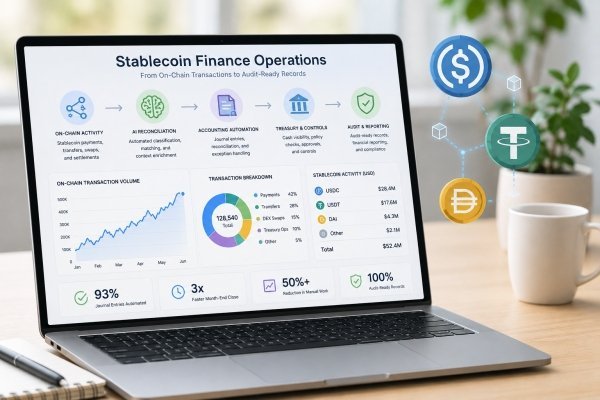
On June 22, 2026, MoonPay announced the acquisition of Entendre, an AI enabled finance operations platform built for companies moving, settling, or holding value onchain. The deal adds agentic reconciliation, bookkeeping, treasury, reporting, and close automation to MoonPay’s digital asset infrastructure stack.
Stablecoins move money. Finance teams still have to explain it.
Every payment eventually hits accounting, treasury, reporting, tax, or audit review. The faster transactions move, the more pressure finance teams face to keep records accurate and current.
MoonPay says Entendre customers include Polygon Labs, Thirdweb, Brale, Babylon Labs, Ostium, Courtyard, and DoubleZero. On average, companies on the platform manage more than 30 financial accounts, process 25,000 transactions per month, and operate across three or more legal entities.
Stablecoin activity creates accounting work that old payment tools were not built to handle. A wallet sweep, gas fee, exchange trade, vendor payment, or token transfer can pass through several systems before it reaches the general ledger.
The blockchain shows that value moved. It doesn't however explain why it moved, which entity owns it, how it should be booked, who approved it, or what an auditor needs to see.
Entendre automates transaction classification, reconciliation, journal entries, exceptions, and audit ready records. MoonPay says finance teams using the platform automate 93% of journal entries, cut manual work by more than half, and close books three times faster.
It's a visible in stablecoin infrastructure for AI agents and enterprise payment workflows. Stablecoins become more useful when they come with controls, reporting, treasury tools, and software that fits daily finance work.
MoonPay has been building across the digital asset infrastructure stack, expanding beyond payments. Earlier this year, it added key management through Sodot, trading infrastructure through DFlow, and cross chain execution through Decent.xyz. Those pieces now sit alongside MoonPay Trade and MoonPay Institutional, extending the company's reach into trading, treasury, and regulated financial services. With Entendre, it adds finance operations to a growing infrastructure stack that already spans wallets, settlement, trading, and key management.
Ivan Soto-Wright, CEO and co-founder of MoonPay, frames the deal around agentic finance:
“If businesses are going to adopt stablecoins at scale, their finance operations need the same speed, context, and automation as the payments themselves.”
That's the real market test. Stablecoins can certainly settle quickly, but finance teams still need clean records, clear approvals, accurate books, and audit trails that survive review.
That is why the acquisition fits alongside the gap between stablecoin volume and real payment use. Volume alone does not prove business utility. The repeatable use case appears when finance teams can manage the payment after it settles.
If stablecoins become business payment rails, will the real winners control the records, approvals, reporting, and audit trails behind the transaction?
The National Crowdfunding & Fintech Association (NCFA Canada) is a financial innovation ecosystem that provides education, market intelligence, industry stewardship, networking and funding opportunities and services to thousands of community members and works closely with industry, government, partners and affiliates to create a vibrant and innovative fintech and funding industry in Canada. Decentralized and distributed, NCFA is engaged with global stakeholders and helps incubate projects and investment in fintech, alternative finance, crowdfunding, peer-to-peer finance, payments, digital assets and tokens, artificial intelligence, blockchain, cryptocurrency, regtech, and insurtech sectors. Join Canada's Fintech & Funding Community today FREE! Or become a contributing member and get perks. For more information, please visit: www.ncfacanada.org
| | |
|---|---|---|
| | |
June 9, 2026 | NCFA Fintech Market Activity | Lending Consumer Credit And BNPL
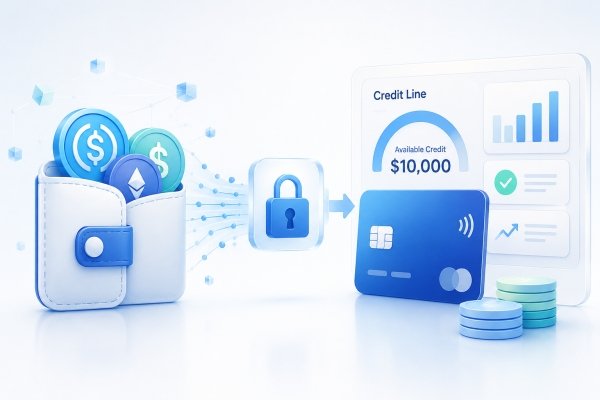
On June 9, 2026, Coinbase announced that it's expanding the role of USDC inside its financial ecosystem by a new Coinbase One Card program that allows eligible customers to secure a credit card with USDC held on the platform. Coinbase says the card can serve customers who might not qualify for a traditional unsecured credit card while continuing to participate in the Coinbase ecosystem.
The product adds another use case to a stablecoin that already supports trading, payments, transfers, rewards, and savings. Coinbase's documentation confirms the USDC security deposit model, where customers use USDC as collateral to secure their credit line.
The launch also highlights how fintech infrastructure providers are helping digital asset platforms expand into traditional financial products. According to a Cardless case study, Coinbase uses Cardless to power card program infrastructure, application workflows, servicing, and payment experiences. First Electronic Bank issues the card and American Express provides network access. The arrangement allows Coinbase to focus on customer acquisition, account balances, rewards, and product design while specialized partners handle card infrastructure and issuance.
Coinbase already has significant card activity to build from. In its Q4 2025 shareholder letter, the company reported nearly $800 million in cumulative Coinbase One Card spend and approximately $3,000 in average monthly spend per cardholder. The same filing reported $17.8 billion in average USDC balances held across Coinbase products.
The strategy aligns with the effort to make digital assets usable beyond trading. Earlier this year, Coinbase partnered with Better to bring crypto assets into mortgage workflows, allowing qualified borrowers to use digital assets during the home financing process. Together with the new card program, Coinbase is steadily expanding how digital asset balances can support borrowing, spending, and credit access.
The scale behind that strategy continues to grow across industry. Circle reported in its Q1 2026 results that USDC reached $77.0 billion in circulation and processed $21.5 trillion in onchain transaction volume during the quarter. As stablecoin infrastructure matures, questions around collateral design, credit access, and lending increasingly connect to broader discussions around tokenized collateral and cash.
If stablecoins can secure credit, platforms with large customer balances gain a new way to compete for lending relationships. The bigger question is whether consumers increasingly view stablecoin holdings as spending power, borrowing collateral, and financial reserves rather than simply digital payment assets?
The National Crowdfunding & Fintech Association (NCFA Canada) is a financial innovation ecosystem that provides education, market intelligence, industry stewardship, networking and funding opportunities and services to thousands of community members and works closely with industry, government, partners and affiliates to create a vibrant and innovative fintech and funding industry in Canada. Decentralized and distributed, NCFA is engaged with global stakeholders and helps incubate projects and investment in fintech, alternative finance, crowdfunding, peer-to-peer finance, payments, digital assets and tokens, artificial intelligence, blockchain, cryptocurrency, regtech, and insurtech sectors. Join Canada's Fintech & Funding Community today FREE! Or become a contributing member and get perks. For more information, please visit: www.ncfacanada.org
| | |
|---|---|---|
| | |
June 8, 2026 | NCFA Insight | Digital Assets Blockchain And Tokenization

On June 7, 2026, Bybit launched IPO Express, a platform that gives eligible users access to tokenized IPO allocations starting with SpaceX. The launch arrives as SpaceX prepares for a public offering expected to value the company at approximately $1.75 trillion, making it potentially one of the largest IPOs ever. While the SpaceX name grabs attention, the bigger story is what this says about investor access, capital formation, and the growing role of digital infrastructure in public markets.
While the SpaceX name grabs attention, the bigger story is how firms are competing to expand investor access and improve IPO distribution.
Traditional IPO allocations typically flow through investment banks, brokerage firms, institutional investors, and private banking networks. Retail investors often participate only after public trading begins.
Bybit's model broadens access by allowing eligible users to subscribe through exchange infrastructure before trading starts. Investors can receive allocations and subsequently trade tokenized exposure through the platform.
The model combines several functions that have historically operated through separate systems, including investor onboarding, allocation management, compliance, custody, ownership records, and trading. Companies are now competing to modernize how investors access public offerings.
Much of the discussion around how tokenization is changing markets has focused on stocks, bonds, funds, real estate, and other assets after issuance. IPO Express focuses on an earlier stage of the investment lifecycle.
For decades, financial innovation concentrated around trading efficiency, lower transaction costs, and faster settlement. Tokenized IPO access targets a different challenge related to who gets access to investment opportunities in the first place.
Investor verification and eligibility checks now matter as much as trading access. So do allocation rules, ownership records, compliance controls, and settlement. Platforms that combine these functions in one clean workflow may earn an advantage as capital markets become more digital.
Canada has already seen similar efforts to expand investor participation through equity crowdfunding, online exempt market platforms, private market technology, and digital investment platforms.
Canada already has a live comparison point. Wealthsimple’s IPO Access for Canadian retail investors broadens access through a brokerage account, while Bybit’s IPO Express adds a tokenized layer around allocation and trading. Both are aiming to solve the same pressure in capital markets: retail investors want earlier access, cleaner digital onboarding, and a fairer shot at high demand offerings.
NCFA’s Who Gets Capital As Funding Channels Multiply? asks the same core question for Canadian markets. More channels don't automatically create better access for every founder or investor.
Tokenized IPO access brings the same access and onboarding pressure to public exchange listings. For Canada, the practical question is whether regulated platforms can use digital infrastructure to make capital raising easier without weakening disclosure, custody, suitability, or investor protection. That question fits NCFA’s financial innovation market infrastructure research, where access to capital, tokenization, compliance, and investor trust now overlap.
If retail investors can access high demand offerings through faster digital channels elsewhere, how long can domestic platforms rely on slower, relationship driven distribution models?
The competitive advantage may no longer come from who controls the allocation. It may come from who makes access easiest while still meeting regulatory requirements.
The National Crowdfunding & Fintech Association (NCFA Canada) is a financial innovation ecosystem that provides education, market intelligence, industry stewardship, networking and funding opportunities and services to thousands of community members and works closely with industry, government, partners and affiliates to create a vibrant and innovative fintech and funding industry in Canada. Decentralized and distributed, NCFA is engaged with global stakeholders and helps incubate projects and investment in fintech, alternative finance, crowdfunding, peer-to-peer finance, payments, digital assets and tokens, artificial intelligence, blockchain, cryptocurrency, regtech, and insurtech sectors. Join Canada's Fintech & Funding Community today FREE! Or become a contributing member and get perks. For more information, please visit: www.ncfacanada.org
| | |
|---|---|---|
| | |
May 29, 2026 | NCFA Fintech Market Activity | Digital Assets Blockchain And Tokenization, Capital Markets And Market Infrastructure, Risk Compliance And Regtech
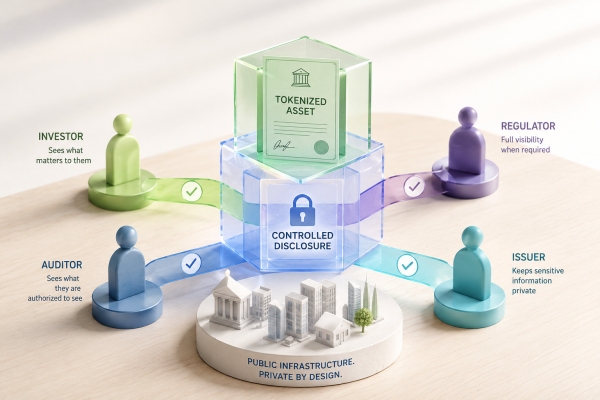
On May 27, 2026, Toronto based Polymath launched Confidential Assets on Polymesh, a protocol level privacy feature for tokenized securities and real world assets. It uses zero knowledge cryptography to keep transaction details private while preserving access for regulators, auditors, and authorized parties.
Privacy solves a practical market problem. Public blockchains can expose positions, client data, and transaction flows. Private chains can protect confidentiality, but they can also silo activity inside closed systems. Confidential Assets is Polymath aim to give regulated asset markets privacy without giving up public permissioned infrastructure.
Martin Halford, CEO, Polymath:
“The question the market has been asking is not whether assets can be tokenized -- they can. The question is whether tokenization can be done at an institutional scale, with the privacy and compliance standards that real financial infrastructure demands. Confidential Assets is our answer to that question.”
The stronger use case isn't about keeping secrets, but rather controlled disclosure. Issuers, investors, and asset managers need privacy around holdings and transfers. Yet a wide range of stakeholders from regulators to auditors, custodians, and compliance teams still need access when rules require it.
Confidential Assets is built into the Polymesh protocol, not added through a third party tool or Layer 2 solution. This allows privacy to work within the same system that handles compliance, governance, and settlement. A fund, private credit issuer, real estate platform, or broker dealer could use the feature to complete a compliant transfer without exposing position size or counterparty details to the broader market.
The ultimate goal and impact is the right mix of privacy and oversight. If Polymath gets that balance right, Confidential Assets could make Polymesh more useful for real capital markets activity, not just token issuance.
Confidential Assets is available immediately to institutions building on Polymesh. Polymath has been building regulated asset infrastructure since 2017 and contributed the ERC 1400 security token standard. Polymesh achieved SOC 2 Type 1 compliance in 2025. Polymath also says a post quantum ready version of Confidential Assets is in development for long term assets that may remain on chain for decades.
For Canadian capital markets and fintech firms, controlled disclosure is becoming core infrastructure for tokenized assets. Platforms that manage who can see what, and when, will become harder to replace in digital securities markets, over time.
Can tokenized markets reach institutional scale without protocol level privacy, or will controlled disclosure become a core requirement for regulated digital assets?
The National Crowdfunding & Fintech Association (NCFA Canada) is a financial innovation ecosystem that provides education, market intelligence, industry stewardship, networking and funding opportunities and services to thousands of community members and works closely with industry, government, partners and affiliates to create a vibrant and innovative fintech and funding industry in Canada. Decentralized and distributed, NCFA is engaged with global stakeholders and helps incubate projects and investment in fintech, alternative finance, crowdfunding, peer-to-peer finance, payments, digital assets and tokens, artificial intelligence, blockchain, cryptocurrency, regtech, and insurtech sectors. Join Canada's Fintech & Funding Community today FREE! Or become a contributing member and get perks. For more information, please visit: www.ncfacanada.org
| | |
|---|---|---|
| | |

Last Updated: May 28, 2026
Status: Strengthening
Organizations: Bank of Canada, DTCC, Broadridge, NYSE, Securitize, FCA, LSEG, BIS
The answer is yes, but only in the right legal and market structure. Tokenized real world assets are becoming usable where regulators connect them to securities, custody, fund, settlement, collateral, payment, and investor protection rules. The strongest evidence is not speculative token launches. It is regulated infrastructure that can support bonds, Treasuries, funds, repo, collateral, transfer agency, and settlement.
The practical question is not whether RWAs can be tokenized. They can. NCFA has tracked this progression from experimentation to execution. Earlier evidence showed how tokenization started looking like financial infrastructure, while more recent developments show tokenization finding scale in collateral and cash. European policymakers are also advancing a roadmap for tokenized finance infrastructure, reinforcing the view that tokenization is increasingly being evaluated as market infrastructure rather than a standalone asset class.
The firms to watch are the ones building the boring middle layer. That means custody, transfer agency, collateral management, settlement links, reporting, governance, and legal certainty. RWA growth depends on trust and operating proof, not marketing.
Strategic Takeaway
Tokenized RWAs are becoming market infrastructure where legal rights, custody, settlement, collateral, and investor protections connect. The opportunity is not just putting assets on chain. It is making regulated assets easier to hold, move, finance, and reconcile inside trusted financial systems.
Click each item to expand
The Bank of Canada, Export Development Canada, RBC, TD, and RBC Investor Services completed a tokenized bond experiment using distributed ledger technology. This gives Canada a credible domestic proof point for tokenized securities infrastructure.
DTCC is preparing tokenized real world asset services for production use. This is important because DTCC sits inside regulated post trade infrastructure, not outside the system.
Broadridge’s Distributed Ledger Repo platform shows tokenization already operating in a serious institutional workflow. Repo is market plumbing tied to collateral, liquidity, and funding.
NYSE and Securitize agreed to support tokenized securities infrastructure, including standards for digital transfer agents and tokenization agents.
The UK FCA published rules and guidance for fund tokenisation, giving asset managers a practical framework for tokenized fund operations.
Project Agorá, led by the BIS with central banks and commercial banks, tests tokenized deposits and wholesale central bank money for cross border settlement. This matters because tokenized assets need a reliable cash leg.
Do you agree the evidence is strengthening?
 2
2

The National Crowdfunding & Fintech Association (NCFA Canada) is a financial innovation ecosystem that provides education, market intelligence, industry stewardship, networking and funding opportunities and services to thousands of community members and works closely with industry, government, partners and affiliates to create a vibrant and innovative fintech and funding industry in Canada. Decentralized and distributed, NCFA is engaged with global stakeholders and helps incubate projects and investment in fintech, alternative finance, crowdfunding, peer-to-peer finance, payments, digital assets and tokens, artificial intelligence, blockchain, cryptocurrency, regtech, and insurtech sectors. Join Canada's Fintech & Funding Community today FREE! Or become a contributing member and get perks. For more information, please visit: www.ncfacanada.org
| | |
|---|---|---|
| | |
May 28, 2026 | NCFA Insight | Payments And Market Infrastructure, Digital Assets Blockchain And Tokenization, Capital Markets And Market Infrastructure

On May 26, 2026, the BIS released its 97 page Project Agorá report, detailing how a global public private prototype tested the feasibility of tokenized commercial bank deposits and wholesale central bank money for cross border payments. The report explains the project vision, who participated, what the prototype tested, what worked (or not), and what has to happen before any production system can operate at scale.
Project Agorá isn't a retail CBDC project, nor is it a stablecoin clone. It tests whether today’s correspondent banking system can use tokenized bank money and smart payment workflows to make wholesale cross border payments faster, safer, more transparent, and easier to coordinate.
Cross border payments totalled USD $195 trillion in 2024 and are projected to reach USD $320 trillion by 2032. Wholesale payments accounted for 91% of cross border payment value in 2023. These flows affect banks, PSPs, exporters, capital markets firms, treasury teams, and fintechs building around global money movement.
On May 27, 2026, the Bank of Canada joined Project Agorá, giving Canada a seat at the table and role in the next phase of testing. The Bank says the project has successfully tested the feasibility of a multi currency unified ledger that enables atomic settlement of wholesale cross border transactions.
The next phase will continue testing the prototype and examine how an Agorá type platform could operate under existing legal and regulatory frameworks, including settlement finality, anti money laundering rules, and terrorist financing rules.
Carolyn Rogers, Senior Deputy Governor, Bank of Canada:
“We know that the Canadian economy could benefit from innovation in cross-border payments. Tokenization has the potential to make these payments faster, cheaper and more efficient and secure. Project Agorá is a unique opportunity to test the technology across several jurisdictions and currencies, with the participation of private sector financial institutions.”
Project Agorá was convened by the BIS and the Institute of International Finance. It originally brought together 7 central banks and more than 40 regulated financial institutions, including banks, payment service providers, financial market infrastructures, and global payment networks.
The central bank group includes the Federal Reserve Bank of New York, Bank of England, Bank of France representing the Eurosystem, Bank of Japan, Bank of Mexico, Swiss National Bank, Bank of Korea, and now the Bank of Canada for the next phase. That makes Agorá a multi currency and multi jurisdiction test, not a single bank proof of concept.
The project keeps correspondent banking as the base model. Banks still manage customers, deposits, access, compliance, and balance sheet relationships. Central banks still control reserves and domestic policy settings. Agorá adds a shared programmable platform to coordinate the payment workflow.
The prototype uses a two layer architecture. (1) A unifying ledger records tokenized commercial bank deposits and coordinates the cross border workflow. (2) Separate jurisdictional ledgers record tokenized central bank reserves so each central bank keeps control over its own money, access rules, and policy settings.
The payment workflow has five stages. Agorá checks the payee, finds the payment route, confirms required checks, locks the needed balances, then settles the transaction. In report terms, those stages are confirmation of payee, path discovery, validation, locking, and settlement.
The order sequencing matters. Agorá checks the payment before banks lock up liquidity. It confirms the payee, route, required checks, and available balances first. Only then does settlement begin. That reduces the risk of finding a problem after money has already been committed.
 Source: Bank for International Settlements, Project Agorá, “Wholesale cross border payments today and in Project Agorá,” Figure 1.
The prototype showed that atomic settlement is achievable in a tokenized environment across the participating jurisdictions. This means that either every required balance update happens, or none of them happen. One leg of a transaction cannot settle while another fails.
The report says settlement can occur in seconds once funds or liquidity are locked. The platform is also designed to operate around the clock, which could reduce delays caused by time zones and market hours. That doesn't mean every payment becomes instant from start to finish. It means the settlement step can happen quickly after the required checks and liquidity locks are complete.
The prototype also showed that shared infrastructure doesn't require shared data by default. Participants can coordinate payment status, validation outcomes, and settlement without exposing customer data, internal risk models, or sensitive routing information to everyone on the platform.
The report identifies specific pain points in wholesale cross border payments. They include mismatched operating hours, sanctions and compliance false positives, serial processing, poor data quality, weak payment status visibility, unclear fees, liquidity pressure, settlement risk, reconciliation breaks, and client outreach.
These are practical banking problems. A false positive can stop a legitimate payment. A missing data field can trigger manual review. A payment status gap can leave banks and clients unsure where funds are stuck. A reconciliation break can create cost after settlement. Liquidity sitting in the wrong place can weaken treasury efficiency.
The report doesn't make cost reduction the main objective because many wholesale payment costs come from FX pricing and market structure. The stronger claim is narrower though. Fewer failed payments, investigations, returns, and reconciliation breaks could reduce operating drag if the model works in production.
Agorá doesn't try to centralize AML, counter terrorist financing, sanctions, fraud, or policy decisions. Each institution still performs its own checks inside its own systems. The platform coordinates only the outcomes needed to move the workflow forward.
This is important for banks who need shared infrastructure, but they don't want to expose customer information, proprietary screening logic, or internal compliance decisions to every other participant in a payment chain. Agorá uses scoped privacy and controlled information sharing so only relevant parties receive the data they need.
The result is a realistic compliance model for regulated institutions. It doesn't remove compliance work. It tries to reduce duplication, bring validations earlier in the process, and stop settlement from starting before required checks are complete.
The report’s legal analysis as tested in Agorá, found that tokenization doesn't fundamentally change the legal nature of money. Tokenized central bank reserves remain central bank reserves. Tokenized deposits remain commercial bank deposit obligations.
It suggests tokenized bank money can develop inside existing legal and regulatory frameworks instead of starting from a blank page. It also separates Agorá from private digital asset models where the legal nature of the claim can be less familiar.
The report doesn't claim every legal issue is solved however. Settlement finality is achievable across the participating jurisdictions, but production deployment would still need rulebooks, contractual frameworks, liability rules, governance, data rules, insolvency treatment, and clear legal effect across jurisdictions.
The strongest benefits are operational. Agorá could give banks better payment status visibility, earlier data checks, fewer late stage failures, faster settlement after liquidity is locked, and more predictable workflows across currencies.
Treasury teams could benefit from better liquidity coordination. Cross border payments today can require prefunding, manual investigation, and treasury allocation across time zones. Agorá’s design could reduce some of that friction by coordinating payment paths, validations, balance locks, and settlement in one workflow.
The risks are in production execution. The report says the prototype didn't prioritize production grade performance, cyber security, or liquidity saving tools. It also left FX integration and other tokenized asset classes outside scope.
A real system would need to connect with existing bank infrastructure and prove it can operate under stress. That means strong governance, resilience testing, failover, monitoring, and clear performance benchmarks.
The Bank of Canada is now involved, but commercial value depends on private sector participation. Canadian banks, PSPs, market infrastructure providers, and fintechs need a role in testing, rule design, and integration.
For fintechs, the opportunity is to build around the workflow through compliance tools, privacy technology, treasury systems, FX routing, liquidity optimization, reconciliation software, APIs, and analytics.
Agorá gives banks and central banks a regulated alternative to stablecoin settlement networks, but only if the next phase proves it can handle real value, real liquidity, and real operating rules.
If Project Agorá evolves from prototype to real value settlement, will tokenized bank deposits become the regulated answer to stablecoin driven cross border payments?
The National Crowdfunding & Fintech Association (NCFA Canada) is a financial innovation ecosystem that provides education, market intelligence, industry stewardship, networking and funding opportunities and services to thousands of community members and works closely with industry, government, partners and affiliates to create a vibrant and innovative fintech and funding industry in Canada. Decentralized and distributed, NCFA is engaged with global stakeholders and helps incubate projects and investment in fintech, alternative finance, crowdfunding, peer-to-peer finance, payments, digital assets and tokens, artificial intelligence, blockchain, cryptocurrency, regtech, and insurtech sectors. Join Canada's Fintech & Funding Community today FREE! Or become a contributing member and get perks. For more information, please visit: www.ncfacanada.org
| | |
|---|---|---|
| | |



August 26th, 2025

January 4th, 2024

June 1st, 2021

September 9th, 2020

July 9th, 2018

January 3rd, 2018

September 25th, 2017

June 20th, 2017

May 10th, 2017

December 14th, 2016
