





Karsten Wenzlaff, Advisor
August 26th, 2025
Karsten Wenzlaff is a Crowdfunding and Fintech Expert from Germany. He is Secretary-General of Digit[...]


May 22, 2026 | NCFA Fintech Whisperer Weekly Intelligence | Digital Assets Blockchain And Tokenization, Payments And Money Movement

Image: Freepik
This live weekly NCFA intelligence page tracks financial technology developments that significantly affect how fintechs build, sell, raise capital, and operate under scrutiny. Coverage prioritizes Canada and includes global events that directly influence competitive conditions, market access, and execution realities across fintech sectors. This page will be updated throughout the week with market movers in a live format and then each week we'll close the prior week's contents in prep for the upcoming week, and continue on a rolling basis. (Missed prior week's Fintech Whisperer? (December 6-12, 2025, December 13-19, 2025, January 1-9, 2026, January 10-16, 2026, January 17-23, 2026, January 24-30, 2026, January 31-February 6, 2026, February 7-13, 2026, February 14-20, 2026, February 21-27, 2026, February 28-March 6, 2026, March 7-13, 2026, March 14-20, 2026, March 21-27, 2026, March 28-April 3, 2026, April 4-10, 2026, April 11-17, 2026, April 18-24, 2026, April 25-May 1, 2026, May 2-8, 2026, May 9-15, 2026).
Institutional digital asset infrastructure is increasingly converging around unified execution, settlement, compliance, and liquidity layers. Banks, fintechs, custodians, PSPs, brokers, and treasury teams should track how tokenized funds, stablecoin settlement, collateral movement, and onchain liquidity are becoming integrated into institutional operating environments rather than isolated crypto workflows.
Bank led stablecoins are becoming part of Europe’s regulated payment strategy. Banks, PSPs, stablecoin issuers, custodians, treasury teams, and compliance groups should track how euro denominated stablecoin infrastructure affects settlement options, liquidity design, and competition with USD stablecoins.
Stablecoin distribution is becoming a network access problem. Wallets, exchanges, PSPs, brokers, and embedded finance platforms need interoperability, regulated issuance, liquidity, and compliance controls that let users move between stablecoin networks without adding operational friction.
New York licensing remains a key test for institutional digital asset firms. Exchanges, custodians, brokers, lenders, and compliance teams should track which firms secure state level approvals because market access, client onboarding, and institutional trust still depend on regulated operating permissions.
USD account access is becoming embedded infrastructure for global platforms, not just a bank product. Fintechs, PSPs, marketplaces, payroll firms, and treasury teams should watch how account issuance, compliance controls, real time payments, and stablecoin rails converge inside programmable payment stacks.
Canadian dollar stablecoins are beginning to enter practical payment flows instead of remaining treasury or trading instruments. PSPs, banks, remittance firms, treasury teams, and compliance groups should watch how regulated stablecoin settlement changes cross border payout speed, corridor economics, liquidity management, and payment competition. CADC infrastructure continues to expand across Canadian digital payment markets.
Bitcoin reserve legislation is turning digital assets into a public balance sheet question, not just a market regulation debate. Crypto firms, custodians, exchanges, treasury teams, investors, and policymakers should track how federal reserve asset policy, seized digital asset management, and national competitiveness arguments reshape the next phase of U.S. crypto policy.
Card network economics are moving deeper into formal regulatory reporting. Merchants, acquirers, issuers, PSPs, payment networks, and embedded payment platforms should track how fee transparency, profitability evidence, and scheme oversight affect payment costs and competitive pressure across card acceptance.
The FCA is creating a clearer supervisory channel for firms that are already scaling, not just early sandbox participants. That matters because fast growth often creates new questions around controls, governance, technology, and consumer impact before a firm becomes systemically important.
Prediction markets are becoming a direct federal versus state jurisdiction fight. Exchanges, fintech platforms, compliance teams, policymakers, and investors should track how courts treat event contracts because the outcome could affect federal derivatives oversight, state gambling authority, consumer protection rules, and regulated forecasting markets.
Federal policymakers increasingly treat fintech infrastructure as part of U.S. financial competitiveness strategy. Banks, PSPs, digital asset firms, payment companies, and infrastructure providers should track how payment rail access, supervision, settlement services, and master account policy evolve as regulators face growing pressure to integrate fintech firms into core financial systems.
UK stablecoin policy is moving toward draft rule text and implementation design. Stablecoin issuers, banks, PSPs, custodians, wallets, and treasury teams should track how the Bank balances financial stability controls with usable payment products, especially around issuance limits, redemption, reserves, and access to settlement infrastructure.
Lowering community bank burden can open capacity, not just reduce paperwork. Fintechs, sponsor banks, core providers, lenders, and compliance teams should track whether tailored supervision gives smaller banks more room to partner, modernize, lend, and support local payment and deposit infrastructure.
Onchain markets need clearing and netting controls before more institutions treat them as reliable operating channels. Trading firms, custodians, brokers, stablecoin networks, and treasury teams should track how private obligation matching, liquidity savings, and counterparty controls develop across institutional digital asset markets.
Prediction markets are moving beyond politics and sports into private capital market intelligence. Exchanges, investors, fintech platforms, regulators, and market infrastructure providers should track how forecasting markets, institutional secondary market data, and tokenized trading systems increasingly converge around private company price discovery and market sentiment.
Regional exchange infrastructure competition continues to expand beyond traditional Western commodity benchmarks. Exchanges, clearing firms, commodity traders, treasury groups, and market infrastructure operators should track how Singapore based benchmarks, physical delivery systems, and digitally enabled collateral infrastructure increasingly support Asian commodity trade and price discovery.
The case is a governance and creditor risk warning for Canada’s fintech funding market. Investors, lenders, founders, and boards should keep closer watch on treasury controls, debt covenants, founder conduct, and creditor transparency as capital becomes more selective.
Canada’s MSB compliance risk is increasingly visible across multi service fintech models. Crypto firms, PSPs, FX dealers, remittance platforms, investors, and compliance teams should keep registration data current, map services accurately, and treat FINTRAC responsiveness as an operating requirement.
Payments, digital assets, AI fraud controls, and capital markets infrastructure are being rebuilt by registered firms with licenses, distribution, data, and balance sheets. Smaller fintechs can still win, but only where they solve a real operating problem and plug into the financial system with trust from day one. The opportunity is still open, but it will favour teams that move quickly, stay compliant, earn trust, and turn infrastructure change into useful products for customers, merchants, investors, and institutions.
NCFA offers various curated resources to help founders and investors stay current on developments that impact fintech markets, subscribe to NCFA weekly newsletter updates, view a rundown of current fintech news and insights, or dive into the latest fintech industry research.
 The National Crowdfunding & Fintech Association (NCFA Canada) is a financial innovation ecosystem that provides education, market intelligence, industry stewardship, networking and funding opportunities and services to thousands of community members and works closely with industry, government, partners and affiliates to create a vibrant and innovative fintech and funding industry in Canada. Decentralized and distributed, NCFA is engaged with global stakeholders and helps incubate projects and investment in fintech, alternative finance, crowdfunding, peer-to-peer finance, payments, digital assets and tokens, artificial intelligence, blockchain, cryptocurrency, regtech, and insurtech sectors. Join Canada's Fintech & Funding Community today FREE! Or become a contributing member and get perks. For more information, please visit: www.ncfacanada.org
 |  |  |
|---|---|---|
 |  |  |
May 22, 2026 | NCFA Insight | Digital Assets Blockchain And Tokenization, Regulation And Policy, Capital Formation And Venture Markets

Image: Hester Peirce (aka Crypto Mom)
On May 21, 2026, reports confirmed that SEC Commissioner Hester Peirce will leave the U.S. Securities and Exchange Commission later this year to join Regent University School of Law, closing one of the most closely watched regulatory tenures in digital asset policy.
Peirce became affectionately known globally as “Crypto Mom” because she consistently argued that regulators should give digital asset markets workable rules instead of leaving companies to operate inside uncertainty. Her positions moved from controversial to increasingly mainstream as spot bitcoin ETFs launched, tokenization expanded, and major financial institutions entered digital asset infrastructure.
Her departure doesn't mean pro crypto or pro innovation momentum suddenly disappears from Washington. Digital assets no longer depend on a single regulator defending the sector. Bitcoin ETFs now trade in regulated markets. Large banks are building tokenization infrastructure. Stablecoin legislation continues advancing across major jurisdictions. Institutional adoption no longer sits at the fringe.
Still, Peirce leaves behind a clear regulatory record.
For years, she pushed back against regulation through enforcement. She argued that uncertainty weakens both innovation and investor protection because companies struggle to build compliant products when the rules remain unclear.
Many of the issues she raised directly affected fintech competition, startup capital formation, tokenization, crowdfunding, and investor participation. Her speeches consistently returned to the same core themes, such as open markets, proportional regulation, investor choice, and transparent rulemaking.
Peirce’s bluntest critique came during the long debate over regulation through enforcement, where she warned that private meetings with crypto firms cannot replace open rulemaking:
“It’s just not a good way of regulating.”
Her frustration with the SEC’s long delay on spot bitcoin funds became even clearer when spot bitcoin ETFs finally won approval after years of rejected applications:
“We squandered a decade of opportunities to do our job.”
Peirce’s Token Safe Harbor proposal became one of the most discussed crypto policy frameworks because it tried to give blockchain networks time to decentralize before full securities obligations applied.
Her public rulemaking philosophy also stood out in her University of Central Florida FinTech Summit remarks, where she urged regulators to approach innovation with both skepticism and openness instead of reflexive resistance. She later warned that poor engagement damages the relationship between regulators and innovators:
“We are scaring people off from coming in and having a conversation with us.”
Even when she defended innovation, Peirce did not argue for eliminating rules. In her statement on tokenized securities, she welcomed the promise of blockchain while drawing a hard compliance line:
“Tokenization may facilitate capital formation and enhance investors’ ability to use their assets as collateral.”
She also added the part many crypto promoters prefer to skip:
“Tokenized securities are still securities.”
That balance partly explains why Peirce maintained credibility across crypto markets and traditional finance circles. She supported innovation, but she also believed markets work best when participants understand the rules.
Her influence reached beyond crypto. Peirce consistently supported broader access to capital markets, regulatory transparency, and competition for smaller firms. Those priorities aligned closely with long standing NCFA positions on equity crowdfunding and capital markets modernization, fintech competitiveness, and proportional regulation for emerging companies.
Very few SEC commissioners become recognizable public figures outside securities law circles. Peirce did because she represented a different philosophy of regulation during one of the most contested periods in financial technology policy.
Her departure closes an important chapter at the SEC. But the larger debates around tokenization, digital asset infrastructure, market access, and programmable finance are now deeply embedded across global financial systems. Those discussions continue with or without Crypto Mom inside the building.
Peirce also engaged directly with the broader fintech and innovation community over the years, including participating in NCFA’s FFCON21: Breaking Barriers program.
On behalf of everyone at NCFA, we thank Hester Peirce for consistently contributing to open debate around innovation, competition, investor choice, and access to capital during one of the most important periods in modern financial market development. We wish her continued success in this next chapter.
The National Crowdfunding & Fintech Association (NCFA Canada) is a financial innovation ecosystem that provides education, market intelligence, industry stewardship, networking and funding opportunities and services to thousands of community members and works closely with industry, government, partners and affiliates to create a vibrant and innovative fintech and funding industry in Canada. Decentralized and distributed, NCFA is engaged with global stakeholders and helps incubate projects and investment in fintech, alternative finance, crowdfunding, peer-to-peer finance, payments, digital assets and tokens, artificial intelligence, blockchain, cryptocurrency, regtech, and insurtech sectors. Join Canada's Fintech & Funding Community today FREE! Or become a contributing member and get perks. For more information, please visit: www.ncfacanada.org
| | |
|---|---|---|
| | |
May 22, 2026 | NCFA Fintech Market Activity | Digital Assets Blockchain And Tokenization, Payments And Money Movement

On May 21, 2026, Montreal based Shakepay opened the waitlist for its physical Shakepay Visa Prepaid Card and launched a 21 day campaign that turns everyday card payments into bitcoin rewards for customers and participating local businesses. The campaign builds on Shakepay’s Virtual Card, which the company says thousands of Canadians already use every week to earn bitcoin rewards on purchases.
Here’s how it works. Customers tap the Virtual Shakepay Card in store and earn points toward early access to the physical card. Those payments can also place local businesses on Shakepay’s campaign map. Businesses that sign up for Shakepay for Business during the campaign can claim bitcoin rewards after verification.
Shakepay is using rewards, merchants, and local campaign mechanics to push bitcoin into daily payment behaviour without asking customers or businesses to use bitcoin at checkout.
Jean Amiouny, CEO, Shakepay:
“Most rewards programs give people points they can only use inside someone else's system. We think Canadians should be able to earn an asset they can actually own,”
Shakepay is reframing rewards around ownership. Customers spend from their cash balance and earn rewards paid in bitcoin. That differs from closed loyalty points, which usually keep value inside one retailer, issuer, or rewards system.
Small businesses can explore bitcoin reserves without rebuilding payment acceptance or asking customers to pay with crypto. The bitcoin reward is tied to campaign activity and business onboarding, not direct bitcoin checkout.
The top 21,000 customers on the waitlist will receive early access to the physical card. The top 2,100 will be eligible for a Launch Edition card engraved with their waitlist rank. That gamified structure gives Shakepay a way to measure demand before full rollout.
The company says it helps more than 1.5 million Canadians access and use bitcoin through everyday financial products. Shakepay is a CIRO member, an Investment Dealer registered with the AMF, and a FINTRAC registered Money Service Business. They also recently became a member of Payments Canada. The Shakepay Visa Prepaid Card is issued by Peoples Trust Company under licence from Visa International Service Association.
Shakepay is testing whether bitcoin rewards can become a daily payments wedge in Canada. If the model works, bitcoin doesn't need to replace card rails to gain utility. It can ride on top of card spending, rewards, and small business treasury behaviour.
Will bitcoin adoption in Canada grow through direct crypto payments, or through familiar card and rewards products that make bitcoin part of everyday spending?
The National Crowdfunding & Fintech Association (NCFA Canada) is a financial innovation ecosystem that provides education, market intelligence, industry stewardship, networking and funding opportunities and services to thousands of community members and works closely with industry, government, partners and affiliates to create a vibrant and innovative fintech and funding industry in Canada. Decentralized and distributed, NCFA is engaged with global stakeholders and helps incubate projects and investment in fintech, alternative finance, crowdfunding, peer-to-peer finance, payments, digital assets and tokens, artificial intelligence, blockchain, cryptocurrency, regtech, and insurtech sectors. Join Canada's Fintech & Funding Community today FREE! Or become a contributing member and get perks. For more information, please visit: www.ncfacanada.org
| | |
|---|---|---|
| | |
May 22, 2026 | NCFA Fintech Market Activity | Digital Assets Blockchain And Tokenization, Payments And Money Movement, Capital Markets And Market Infrastructure
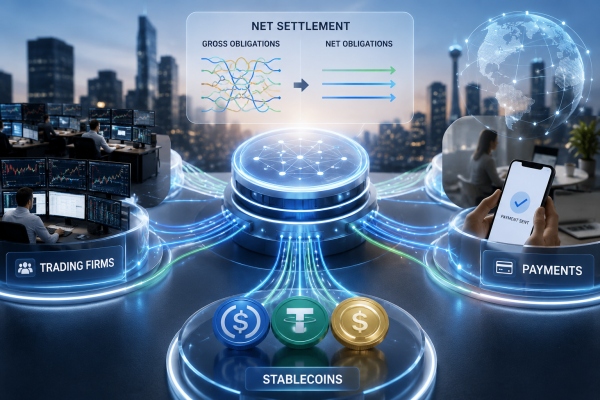
On May 21, 2026, Toronto based Cycles raised $6.4 million to build an open, privacy preserving clearing network for crypto markets and stablecoin payments. Blockchange Ventures led the round, with participation from Coinbase Ventures, Compound VC, Primitive Ventures, and angel investors. The round brings Cycles’ total funding to $8.7 million, following a $2.3 million pre seed in 2025.
Cycles is targeting one of the least glamorous but most important parts of financial infrastructure: clearing. In traditional markets, clearing reduces how much money has to move between counterparties by offsetting obligations first. Cycles wants to bring that function to on chain finance, where trading and payment flows still often require too much prefunding and too much gross settlement.
The first institutional product is Cycles Prime, which lets trading firms privately net OTC obligations across the network. Cycles says this can reduce liquidity requirements and counterparty exposure without requiring collateral, asset movement, or a change in counterparties. Cycles Prime is launching with Lynq and FalconX as anchor partners.
Ethan Buchman, Co Founder and CEO, Cycles:
“Clearing is a financial superpower that has historically only been available to large financial institutions,”
Without clearing, firms often move full payments back and forth instead of only settling the difference. That ties up capital and can increase risk when markets move quickly.
The release points to October 10, 2025, when more than $19 billion in crypto leverage was liquidated in roughly one day, with 70% of forced liquidations occurring in just 40 minutes. Cycles uses that event to show why capital efficiency matters. When markets rely on gross settlement and heavy prefunding, stress can move fast.
Cycles is betting that multilateral clearing can reduce that pressure. Meaning, many obligations can be matched against each other so less money has to move. If it works, trading firms may keep less idle capital parked across venues and counterparties.
The second product is Cycles Pay, a stablecoin payments app for individuals and businesses. Payments are routed through Cycles’ clearing engine, which nets obligations across participants to minimize capital movement. The product also includes invoicing and expense management with credit planned.
Stablecoins already help move value across networks. Clearing can make those flows more capital efficient. For businesses, the value isn't only faster payment. It's fewer trapped balances, better cash flow, and more private settlement.
Rob Schmults, General Partner at Blockchange Ventures:
"Clearing is the cornerstone of capital-efficient markets like foreign exchange allowing the movement of massive volumes of value without crippling liquidity requirements. We see Cycles providing an essential coordination layer to bring the efficiency and effectiveness of clearing to new markets. Doing this will allow businesses to clear and settle payments privately, optimize capital flow, and reduce the need for idle capital. As global adoption accelerates, Cycles can become a category defining standard for how value is settled and netted across entire ecosystems and markets."
If stablecoins are becoming payment rails, will clearing become the missing layer that turns on chain settlement from fast movement into capital efficient market infrastructure?
The National Crowdfunding & Fintech Association (NCFA Canada) is a financial innovation ecosystem that provides education, market intelligence, industry stewardship, networking and funding opportunities and services to thousands of community members and works closely with industry, government, partners and affiliates to create a vibrant and innovative fintech and funding industry in Canada. Decentralized and distributed, NCFA is engaged with global stakeholders and helps incubate projects and investment in fintech, alternative finance, crowdfunding, peer-to-peer finance, payments, digital assets and tokens, artificial intelligence, blockchain, cryptocurrency, regtech, and insurtech sectors. Join Canada's Fintech & Funding Community today FREE! Or become a contributing member and get perks. For more information, please visit: www.ncfacanada.org
| | |
|---|---|---|
| | |
May 21, 2026

Many operators in 2026 are still running on infrastructure built for a different era. Legacy architecture not designed for multi-vertical scale, modern payment rails, or real-time compliance is now the most significant operational liability a gambling business can carry.
This article breaks down what a capable platform partner must deliver: infrastructure, compliance, payments, player lifecycle management, analytics, and genuine innovation across the full platform ecosystem.
A B2B iGaming platform is the software layer between game content, payments, and players – operated by a online casino software provider whose clients are gambling businesses, not players directly. The provider builds the infrastructure; the operator runs the brand.
The two primary delivery models are turnkey solutions and white-label solutions. A turnkey platform delivers a fully operational iGaming business: game content, payment integrations, compliance tooling, CRM, and back-office management, all pre-configured. White-label solutions offer a configurable layer that operators brand and customise while the underlying infrastructure stays shared and under the provider’s license.
Most platforms support multi-brand management – a single operator running several distinct brands from one back-office – essential for expanding across jurisdictions or targeting different player segments.
The ecosystem concept separates a coherent platform from a collection of stitched-together modules. An integrated architecture connects game content, payment gateways, compliance tooling, and CRM into one environment. Most providers offer a flagship full-stack product alongside hybrid options combining shared infrastructure with operator-controlled front-end layers. The vertical scope must include online casino, sports betting, esports, iGaming lottery, and bookmaker products.
Technical debt is not an IT department problem. It is a revenue problem, a compliance problem, and an increasingly existential one.
Legacy systems create direct income and budget consequences. API incompatibility slows game provider onboarding; payment integration failures drive transaction abandonment; uptime and performance degradation during peak events translates into lost bets and churn. Each failure compounds: a game integration delay coincides with a compliance gap and a payment reconciliation issue – the management overhead erodes the capacity to grow.
Legacy architecture cannot support the real-time reporting regulators mandate. The gap widens with each update; the technical backlog becomes a licensing liability. Maintaining legacy software development on an ageing codebase consumes developer time with limited output. The algorithm logic in older systems is frequently undocumented, making changes error-prone. Performance statistics arrive as delayed batch reports rather than real-time intelligence. The complexity and risk of staying now exceeds the cost of migration for most growth-stage operators.
The right model depends on how much of the stack an operator wants to own and how quickly they need to be live. The choice is not about quality – both are viable – it is about maturity, timeline, budget, and brand complexity. The subsections below compare each across speed to market, technical overhead, cost structure, and suitability for multi-brand management at scale.
|
Criteria |
Turnkey Solution |
White-Label Solution |
| Speed to Launch | Moderate – requires setup and configuration | Fast – ready-to-go with minimal setup |
| Cost | Higher upfront investment | Lower initial cost |
| Customisation | High – full control over features and integrations | Limited – based on provider’s framework |
| Brand Scalability | Strong – built for long-term growth and expansion | Moderate – scaling depends on provider capabilities |
A turnkey solution delivers a complete, market-ready iGaming business. Compliance tooling, payment integrations, game content via an aggregator such as iGaming Deck, RNG-certified game logic, and back-office management are all pre-integrated. The operator licenses independently and owns the brand outright – the platform handles the technical stack, not the regulatory relationship.
This is the flagship delivery model for operators entering new markets under time pressure. Architecture is proven, platform scalability is built in, and provider innovation means operators access new capabilities without carrying development costs. Speed to market is measured in weeks.
A white-label solution gives operators control over brand identity and player-facing experience, built on a shared B2B backend via REST API. The operator trades under the provider's gambling license rather than obtaining one independently – reducing time to market and upfront cost, at the expense of some jurisdictional flexibility.
It suits operators who want front-end differentiation across multiple brands without building proprietary infrastructure. Platform scalability remains a B2B responsibility. A hybrid approach – white-label infrastructure with custom-built components – extends capability within budget, making it the preferred route for operators managing software development resources carefully.
Whatever the licensing model, a platform's compliance stack must support the operator's regulatory obligations actively: audit trails, reporting formats, and player data handling that meet the standards of every jurisdiction they trade in. GLI-19 certification is mandatory – it covers RNG integrity, game mathematics, and platform integrity across the full content layer. A platform without GLI-19 compliance creates exposure for any operator.
A compliant platform delivers automated KYC (Know Your Customer) workflows at registration and transaction thresholds without friction at scale. Responsible gambling tools – self-exclusion, deposit limits, intervention triggers based on behavioural algorithm outputs – are mandated under MGA and Gambling Commission frameworks. Fraud detection must operate in real time. Player fund ring-fencing ensures operator funds are legally separated from player balances, as required under MGA and Gambling Commission standards. Privacy and anonymity controls must balance GDPR obligations with the expectations of crypto-focused players.
Compliance capabilities to demand from your B2B partner:
The platform partner's licensing footprint is the operator's growth map. Curaçao offers fast gambling license timelines and is the primary gateway for crypto-focused operators; eSports Curacao covers the esports vertical specifically. MGA licensing provides European credibility and unlocks payment provider partnerships requiring MGA compliance.
The primary growth frontiers are Latin America – Brazil's regulated market is the largest single opportunity – alongside emerging frameworks across Asia and Africa. A partner who can navigate these environments is a genuine competitive asset.
Payment infrastructure is where platforms create or destroy player experience. A failed deposit does not generate a complaint – it generates churn. Multi-currency wallets, what the industry calls crypto journeys, are now a baseline expectation: seamless wallet management across fiat and cryptocurrency denominations with real-time balance visibility. Financial integrity ring-fencing must apply across all wallet types regardless of currency denomination.
The protocols a platform supports matter operationally. Bitcoin Lightning Network delivers instant, low-fee settlements for Bitcoin transfers. Tron (TRC-20) offers high throughput and near-zero costs for frequent small transactions. Ethereum supports smart contract-based payouts. Litecoin provides a cost-efficient alternative for players prioritising low fees.
For players moving between cash-based local payment methods and crypto wallets, the platform must handle both through configurable compliance thresholds – not a binary KYC-or-anonymity choice.
The game aggregator – iGaming Deck in platform terms – connects operators to hundreds of game studios through a single REST API integration. Without it, every new provider requires a separate build; with it, the operator accesses an entire catalogue through one connection.
RNG certification is required at the game level. Every slot machine, roulette variant, and virtual lottery product must carry independently verified certification.
Multi-brand management at the aggregator level allows one operator to serve distinct audiences from shared content infrastructure. Platform scalability ensures the architecture holds under simultaneous peak load across all brands. Hybrid architecture – a shared core with vertical-specific configurations – is where this becomes practical. The recommendation algorithm surfacing the right game to the right player operates here, making aggregator depth a product differentiator.
Player lifecycle management is where operators most commonly rely on disconnected third-party tools, creating data silos and delayed campaign execution. A capable B2B platform integrates CRM natively: acquisition data, deposit behaviour, game preferences, and support history visible in real time, with 24/7 service infrastructure to match.
Loyalty – as a measurable platform output, not a marketing concept – is built through consistent, personalised incentive delivery. The tooling required: a configurable jackpot club, a bonus shop where players select rewards, tournament mechanics across casino and sportsbook verticals, and gamification layers that sustain engagement. Retention tooling must enable churn prediction and automated re-engagement driven by platform behavioural data.
Legacy platforms generate data. Modern platforms generate intelligence. The difference is whether outputs are actionable in real time or require manual extraction.
Player behaviour statistics surface which game types retain players longest and which acquisition channels produce the highest lifetime value. Revenue performance dashboards provide income visibility at brand, market, and segment level. Risk management at the platform layer depends on the same data: the algorithm must flag fraud signals within the analytics environment where operators are already working. Uptime and performance metrics must be visible in real time.
CRM integration turns analytics into action: a churn-risk flag triggers a bonus offer without manual data export. User personalization – the right offer based on actual behaviour, not segment assumptions – separates a modern analytics layer from a reporting tool. Growth metrics must support operational decisions and board-level reporting.
Innovation means whether the platform's architecture can absorb change without generating the next wave of technical debt.
Platforms that add cryptocurrency as an afterthought create friction at every touchpoint: KYC workflows not built for pseudo-anonymous players, reporting that cannot handle coin-denominated revenue, wallet management requiring manual reconciliation. Building with blockchain as a native layer eliminates these problems. Technology choices made today determine what is possible in three years.
Hybrid architecture – supporting legacy formats alongside modern REST API-first development – keeps the platform accessible at different technical maturity levels. Software development investment must be continuous; the API surface area should expand with the ecosystem. The flagship indicator of innovation maturity is whether the algorithm layer – governing game recommendations, fraud detection, and bonus targeting – is actively developed. Platform scalability under that evolution is what separates credible innovation from a product announcement.
The cost of staying on an underperforming platform is compounding. In 2026, the cost of migration is predictable and finite.

1. What is a B2B iGaming platform, and how does it differ from being an operator?
A B2B provider builds and maintains the software infrastructure – game aggregation, payment gateways, compliance tooling, and CRM – and licenses it to gambling businesses. The operator runs the player-facing brand, focusing on acquisition and experience while the platform handles technical complexity.
2. What does "turnkey solution" mean in iGaming?
A turnkey solution delivers a fully operational iGaming business ready for launch – game content, payment integrations, RNG-certified logic, compliance tooling, and back-office management all pre-configured. The operator licenses independently and owns the brand. It is the fastest route to market for operators entering new jurisdictions.
3. What is a white-label iGaming solution?
A white-label solution provides a configurable platform layer on a B2B backend, accessed via REST API. The operator trades under the provider's gambling license rather than obtaining one independently. It suits operators wanting brand control across multiple demographics without the overhead of building proprietary infrastructure.
4. What compliance certifications should I demand from a B2B platform partner?
GLI-19 certification is the baseline – covering RNG integrity, game mathematics, and platform standards. Also require automated KYC workflows, player fund ring-fencing under MGA and Gambling Commission frameworks, real-time fraud monitoring, and responsible gambling tools, including self-exclusion and deposit limits.
5. How do B2B platforms support crypto and multi-currency payments?
A modern platform supports multi-currency wallets handling fiat and cryptocurrency in a single interface. Blockchain rails should include Bitcoin Lightning Network for instant settlements, Tron for micro-transactions, Ethereum for smart contract payouts, and Litecoin for low-cost transfers – with KYC and fraud monitoring preserving player anonymity where compliant.
6. What player retention tools should a B2B platform include natively?
A jackpot club, bonus shop with player-selectable rewards, tournament mechanics across casino and sportsbook, and CRM-native churn prediction. Loyalty mechanics must operate in real time from platform behavioural data, not manual campaign setup or third-party tools with delayed access.
7. How do analytics capabilities differ between modern and legacy platforms?
Legacy platforms generate historical reports. Modern platforms deliver real-time dashboards covering player behaviour statistics, revenue performance, fraud risk signals, and uptime metrics. CRM integration means a churn-risk flag automatically triggers a bonus campaign within the same environment.
8. Why does the choice of blockchain infrastructure matter for an iGaming platform?
Protocol choice determines transaction speed, cost, and compliance profile. Bitcoin Lightning Network enables instant low-fee BTC settlements; Tron handles micro-transactions; Ethereum supports smart contract payouts; Litecoin offers low-cost transfers. Native blockchain integration avoids the reconciliation and UX problems of afterthought crypto architecture.
A capable B2B iGaming platform partner in 2026 delivers an integrated ecosystem: proven infrastructure, multi-jurisdiction compliance, blockchain-native payment rails, platform-native player lifecycle tools, real-time analytics, and a software development model built for continuous evolution.
Multi-brand management, scalable architecture, and genuine innovation investment in underlying technology are what separate a platform that enables growth from one that constrains it. For operators on legacy systems, the calculation is straightforward: the cost of staying now exceeds the cost of moving. The question is how quickly you act.
The National Crowdfunding & Fintech Association (NCFA Canada) is a financial innovation ecosystem that provides education, market intelligence, industry stewardship, networking and funding opportunities and services to thousands of community members and works closely with industry, government, partners and affiliates to create a vibrant and innovative fintech and funding industry in Canada. Decentralized and distributed, NCFA is engaged with global stakeholders and helps incubate projects and investment in fintech, alternative finance, crowdfunding, peer-to-peer finance, payments, digital assets and tokens, artificial intelligence, blockchain, cryptocurrency, regtech, and insurtech sectors. Join Canada's Fintech & Funding Community today FREE! Or become a contributing member and get perks. For more information, please visit: www.ncfacanada.org
| | |
|---|---|---|
| | |
May 20, 2026 | NCFA Resource | Regulation And Policy, Artificial Intelligence And Data, Digital Assets Blockchain And Tokenization

On April 20, 2026, the UK Financial Conduct Authority published its Innovation Insights 2025 report (20 page PDF). The report gives fintech founders, investors, and policy teams a practical view of where capital, regulatory testing, and market demand are concentrating across AI, digital assets, stablecoins, tokenization, RegTech, open finance, embedded finance, and operational automation.
The FCA points to a more disciplined phase of fintech, where firms need clear customer value, stronger controls, earlier regulatory engagement, and credible deployment plans.
The report combines global fintech investment data with activity across FCA innovation services, including the Regulatory Sandbox, Innovation Pathways, Digital Sandbox, AI Lab, Supercharged Sandbox, Smart Data Accelerator, and Scale Up Unit.
The overview gives operators a clean read on regulated fintech demand. AI, distributed ledger technology, open banking, and open finance ranked among the main technologies used by applicants. The FCA also launched new support channels in 2025, including a stablecoins cohort.
Regulated fintech no longer wins on novelty alone. Better products need stronger evidence, safer testing routes, sharper governance, and a realistic route from pilot to production.
This resource is useful for fintech founders, investors, compliance teams, financial institutions, policymakers, accelerators, digital asset firms, AI builders, RegTech vendors, and open finance teams tracking where regulated innovation is gaining traction.
It is especially useful for firms building around AI governance, stablecoins, tokenization, compliance automation, open finance, embedded finance, and supervised testing models.
The report is strong on investment patterns, regulatory engagement, sector demand, and FCA innovation service activity. It helps founders and investors see which fintech themes are attracting capital and which models need earlier regulator dialogue.
Its limit is the report doesn't provide a full outcomes study on sandbox firm performance, revenue growth, compliance cost reduction, productivity gains, fraud reduction, or investor returns. It works best as a regulatory market map, not proof that any one fintech category will outperform.
Canada and other jurisdictions can still use the report as a benchmark. Faster testing routes, clearer engagement models, and stronger links between experimentation and responsible deployment are becoming competitive advantages in financial innovation.
FCA Innovation Insights 2025 (primary FCA report)
AI Agents Enter Governed Financial Workflows (AI governance and controls)
Tokenization Starts Looking Like Financial Infrastructure (tokenized market infrastructure)
Deloitte And Stablecorp Bring QCAD To Banks (Canadian stablecoin infrastructure)
The National Crowdfunding & Fintech Association (NCFA Canada) is a financial innovation ecosystem that provides education, market intelligence, industry stewardship, networking and funding opportunities and services to thousands of community members and works closely with industry, government, partners and affiliates to create a vibrant and innovative fintech and funding industry in Canada. Decentralized and distributed, NCFA is engaged with global stakeholders and helps incubate projects and investment in fintech, alternative finance, crowdfunding, peer-to-peer finance, payments, digital assets and tokens, artificial intelligence, blockchain, cryptocurrency, regtech, and insurtech sectors. Join Canada's Fintech & Funding Community today FREE! Or become a contributing member and get perks. For more information, please visit: www.ncfacanada.org
| | |
|---|---|---|
| | |
May 18, 2026 | NCFA Fintech Market Activity | Payments And Money Movement, Digital Assets Blockchain And Tokenization

On May 18, 2026, Tether announced a strategic investment in LemFi, a cross border payments platform serving people who live and work across borders. The investment is focused on integrating USD₮ as a settlement layer across LemFi’s key corridors, especially across Africa and Asia.
This is a separate from LemFi’s USD $53 million Series B, which was announced in January 2025. Tether wants USDT deeper inside remittance infrastructure, where payment companies manage liquidity, settlement, and payout timing.
Tether says LemFi serves senders in the UK, U.S., Canada, and Europe who move money to Africa and Asia. It also says the investment aims to replace multi day SWIFT chains with near instant, lower cost settlement. That is the market issue. Remittance platforms don't compete on app design, but how quickly money arrives safely, and at a fair cost.
Paolo Ardoino, CEO, Tether:
“Our investment in LemFi reflects our shared vision on how money moves across borders, prioritizing speed, cost, and transparency. By supporting LemFi’s growth and innovation roadmap, we are helping bring the benefits of a stable digital asset to more people who rely on remittances in their daily lives.”
The practical change is settlement. USDT is not being positioned only as a crypto asset for users to hold. Tether is backing a payments platform so USDT can help move value behind the scenes across active corridors, which is valued to not only senders but to PSPs, MSBs, and banks.
Faster settlement can reduce delays and working capital pressure. But stablecoins don't solve the whole corridor. Remittance providers still need fraud controls, sanctions screening, clear FX, customer support, licensing, and reliable local payout.
Ridwan Olalere, CEO and Co Founder, LemFi:
“Integrating USD₮ into our infrastructure brings us closer to that reality, enabling faster, cheaper, and more reliable financial services for the millions of people who depend on us every day,”
While the announcement doesn't disclose the terms of the deal like Tether’s investment size or rollout timing, the business case is clear enough.
If USDT settlement shortens settlement time or reduces banking friction, LemFi could improve corridor economics. The customer impact will depend on whether those gains lead to better pricing, faster payout, or more reliable transfers.
Stablecoin issuers are actively integrating into live payment flows and partnering with platforms that have users, corridor demand, and payout networks. Traditional providers will need to build, partner, or risk losing margin.
For fintech operators and investors, the key insight is that stablecoin remittances are becoming an infrastructure strategy.
As stablecoin issuers invest directly in remittance platforms, will banks and PSPs still control the economics of cross border payments, or will stablecoin networks capture more of the settlement layer?
The National Crowdfunding & Fintech Association (NCFA Canada) is a financial innovation ecosystem that provides education, market intelligence, industry stewardship, networking and funding opportunities and services to thousands of community members and works closely with industry, government, partners and affiliates to create a vibrant and innovative fintech and funding industry in Canada. Decentralized and distributed, NCFA is engaged with global stakeholders and helps incubate projects and investment in fintech, alternative finance, crowdfunding, peer-to-peer finance, payments, digital assets and tokens, artificial intelligence, blockchain, cryptocurrency, regtech, and insurtech sectors. Join Canada's Fintech & Funding Community today FREE! Or become a contributing member and get perks. For more information, please visit: www.ncfacanada.org
| | |
|---|---|---|
| | |



August 26th, 2025

January 4th, 2024

June 1st, 2021

September 9th, 2020

July 9th, 2018

January 3rd, 2018

September 25th, 2017

June 20th, 2017

May 10th, 2017

December 14th, 2016
