





Karsten Wenzlaff, Advisor
August 26th, 2025
Karsten Wenzlaff is a Crowdfunding and Fintech Expert from Germany. He is Secretary-General of Digit[...]


Apr 29, 2026 | NCFA Resource | Digital Assets Blockchain And Tokenization, Risk Compliance And Regtech
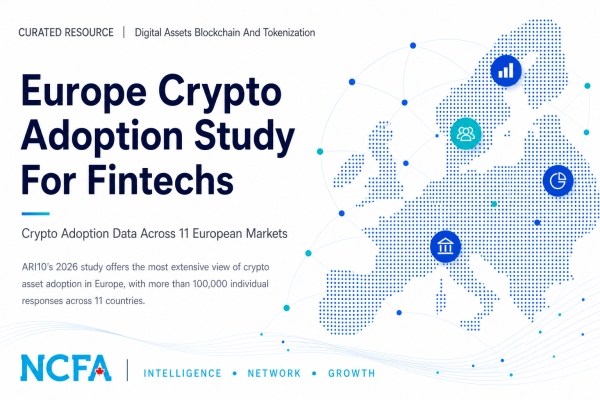
The ARI10 Cryptocurrency Adoption in Europe 2026 report provides a large scale view of crypto asset exposure, investor behaviour, regulatory concerns, and market confidence across Europe. The study draws on more than 100,000 individual responses from over 11,000 respondents across 11 European countries, including Poland, France, Italy, Germany, the Netherlands, the United Kingdom, Norway, Sweden, Hungary, Romania, and Spain. The study was developed with Dr Grzegorz Sobiecki of the Warsaw School of Economics and conducted by UCE Research.
In practice, this gives fintechs and digital asset firms a clearer view of where crypto adoption sits across European markets. The public findings point to nearly 40% of respondents having some exposure to cryptocurrencies, about 31% actively investing, and more than 56% identifying unclear regulation as a barrier to further adoption. For exchanges, wallets, payment providers, compliance teams, and investor education platforms, the report helps connect adoption demand with trust, regulation, and user experience.
This is most useful for teams that need market level evidence before making product, compliance, or expansion decisions. Crypto exchanges, payment providers, wallets, compliance teams, investors, and policy teams can use it to compare adoption patterns and trust gaps across Europe. Canadian fintechs can also use it as a reference point for how MiCA, consumer confidence, and digital asset infrastructure are influencing user behaviour in a large regulated market.
The strength is scale. This report gives operators data across 11 countries at a time when crypto adoption, regulation, and infrastructure are coming together. Poland’s 47.1% exposure rate shows how far some markets have moved, which makes the country comparisons useful for expansion decisions.
The limits sit in the data. The study covers 11 countries, not the full European market, and relies on survey responses rather than transaction level data. The methodology uses weighting to adjust for sample bias, and the report is produced by ARI10, a digital asset infrastructure provider. Treat it as a strong directional view of market behaviour, not a complete or neutral benchmark.
Launch Article (public summary and report context)
ARI10 Market Summary (key findings and business implications)
Full Report Download (gated access)
 The National Crowdfunding & Fintech Association (NCFA Canada) is a financial innovation ecosystem that provides education, market intelligence, industry stewardship, networking and funding opportunities and services to thousands of community members and works closely with industry, government, partners and affiliates to create a vibrant and innovative fintech and funding industry in Canada. Decentralized and distributed, NCFA is engaged with global stakeholders and helps incubate projects and investment in fintech, alternative finance, crowdfunding, peer-to-peer finance, payments, digital assets and tokens, artificial intelligence, blockchain, cryptocurrency, regtech, and insurtech sectors. Join Canada's Fintech & Funding Community today FREE! Or become a contributing member and get perks. For more information, please visit: www.ncfacanada.org
 |  |  |
|---|---|---|
 |  |  |
May 1, 2026 | NCFA Fintech Whisperer Weekly Intelligence | Digital Assets Blockchain And Tokenization, Payments And Market Infrastructure, Regulation And Policy, Capital Markets And Market Infrastructure

Image: Freepik
This live weekly NCFA intelligence page tracks financial technology developments that significantly affect how fintechs build, sell, raise capital, and operate under scrutiny. Coverage prioritizes Canada and includes global events that directly influence competitive conditions, market access, and execution realities across fintech sectors. This page will be updated throughout the week with market movers in a live format and then each week we'll close the prior week's contents in prep for the upcoming week, and continue on a rolling basis. (Missed prior week's Fintech Whisperer? (December 6-12, 2025, December 13-19, 2025, January 1-9, 2026, January 10-16, 2026, January 17-23, 2026, January 24-30, 2026, January 31-February 6, 2026, February 7-13, 2026, February 14-20, 2026, February 21-27, 2026, February 28-March 6, 2026, March 7-13, 2026, March 14-20, 2026, March 21-27, 2026, March 28-April 3, 2026, April 4-10, 2026, April 11-17, 2026, April 18-24, 2026).
Open banking is moving from policy design into standards governance. The next control point is who sets the technical, data, consent, and implementation standards that banks, fintechs, and payment firms will have to build against.
AI governance is now part of prudential supervision. Banks, insurers, super funds, and vendors need evidence that AI systems can be explained, challenged, monitored, and shut down without breaking critical operations.
Canada is moving financial crime policy closer to the access points where fraud enters the system. Crypto ATMs, MSBs, account funding, and platform coordination now sit inside the same risk conversation. For fintech operators, the message is practical: faster finance needs stronger onboarding, monitoring, reporting, and partner controls. Weak compliance is becoming a market access problem, not just a regulatory issue.
CSA is removing unnecessary personal data from registration filings before the formal rule amendment is complete. Registrants, dealers, advisers, and compliance vendors should update onboarding, change notice, and filing workflows to reduce data collection and privacy risk.
ESG ratings regulation is moving from consultation into reporting design. Data providers, asset managers, platforms, and compliance teams should watch what information the FCA tests now, because today’s pilot data fields can become tomorrow’s supervisory evidence.
Europe’s digital euro case is now less about payment choice and more about infrastructure control. Banks, wallets, processors, and fintechs should watch how legal tender status, offline payments, privacy, and private sector distribution are built into the final framework.
Mercury’s conditional approval shows how fintech infrastructure is moving closer to regulated bank ownership. The test now is execution: capital planning, compliance controls, risk governance, deposit insurance approval, payments operations, and regulator confidence.
Brazil is drawing a clear line inside regulated cross border payment infrastructure. eFX providers get broader investment related use cases, but crypto and stablecoins stay outside the supervised settlement flow between providers and foreign counterparties.
Stablecoin settlement is moving deeper into card network infrastructure. Visa’s multi chain expansion gives issuers and acquirers more settlement options while keeping a global payment network as the common operating layer.
AI commerce is moving beyond card rails into wallets, super apps, banking interfaces, and wearable devices. Payment providers now need agent controls, authentication, settlement, and audit trails built directly into mobile workflows.
Canada is creating a new public capital vehicle that blends nation building, private co investment, and retail participation. For fintechs, dealers, platforms, and wealth firms, the key watch item is the retail product design: distribution, disclosure, capital protection, eligibility, liquidity, and how ordinary Canadians gain access to strategic national investments.
The FCA is trying to reduce friction in UK listings. Issuers, banks, advisers, and research teams should watch this closely because research timing affects IPO execution, investor education, and how competitive London looks beside other listing venues.
The stablecoin yield fight is moving from a hard stop to a narrower fight over rewards design. Stablecoin issuers, exchanges, wallets, and banks should watch whether Congress draws the line around deposit like yield, activity based rewards, and who gets to define the difference.
Tokenized equities are being routed into existing U.S. market structure rather than a parallel venue. That makes the DTC pilot more important: the operating question is no longer whether tokenized securities can trade, but how clearing, settlement, custody, controls, and shareholder rights fit inside the national market system.
Bank led tokenized deposits are moving from experiments toward shared network infrastructure. The signal is not only the technology transfer. It is the bank roster, production launch timing, and push to keep always on settlement inside the regulated deposit perimeter.
Korea is moving bank led stablecoin infrastructure toward cross border distribution and wallet access. Stablecoin providers, banks, and payment firms should watch whether KRW backed settlement becomes a regulated bridge between domestic bank money and global digital commerce.
Simon Walls, Executive Director of Markets, Financial Conduct Authority
“Tokenisation has the potential to play an important role in asset management, and its adoption will be driven by firms and investors. We have focused on delivering what the market has asked for: a clear, practical framework that provides confidence in how fund tokenisation can operate within our rules, both now and into the future.”
Institutional Bitcoin adoption is expanding through public equity as well as direct digital asset holdings. Pension funds, asset managers, banks and capital markets participants should watch whether listed Bitcoin treasury companies become a common route for regulated institutions seeking digital asset exposure within existing investment mandates.
Tokenized equities are moving into the transfer agent layer. That matters because shareholder records, voting, dividends, and issuer controls are the plumbing that separates real tokenized securities from synthetic exposure or offshore wrappers.
Bank issued digital money is moving closer to core banking infrastructure. Lyriq gives banks a way to run tokenized deposit style money flows with controls, auditability, settlement finality, and core integration built in from the start.
Tokenized Treasury funds are moving from passive yield products into active collateral infrastructure. Exchanges, custodians, asset managers, and institutional trading desks now have a working model for combining yield, margin, custody, and counterparty risk controls in one operating stack.
This week is about ownership of core financial infrastructure. Canada introduced a sovereign wealth fund. Fintechs pursued bank charters. Global banks, exchanges, transfer agents, payment networks, and core processors advanced tokenized deposits, fund tokenization, tokenized shares, stablecoin settlement, and AI agent payments. These initiatives are about control: who owns the account, who controls settlement, who keeps custody, who sets the rules, and who earns the economics when financial assets and payments become programmable.
NCFA offers various curated resources to help founders and investors stay current on developments that impact fintech markets, subscribe to NCFA weekly newsletter updates, view a rundown of current fintech news and insights, or dive into the latest fintech industry research.
The National Crowdfunding & Fintech Association (NCFA Canada) is a financial innovation ecosystem that provides education, market intelligence, industry stewardship, networking and funding opportunities and services to thousands of community members and works closely with industry, government, partners and affiliates to create a vibrant and innovative fintech and funding industry in Canada. Decentralized and distributed, NCFA is engaged with global stakeholders and helps incubate projects and investment in fintech, alternative finance, crowdfunding, peer-to-peer finance, payments, digital assets and tokens, artificial intelligence, blockchain, cryptocurrency, regtech, and insurtech sectors. Join Canada's Fintech & Funding Community today FREE! Or become a contributing member and get perks. For more information, please visit: www.ncfacanada.org
| | |
|---|---|---|
| | |
Apr 30, 2026 | NCFA Insight | Capital Markets And Funding

Image: Unsplash/John McArthur
On Apr 30, 2026, FrontFundr released its 2025 Community Capital Report with the following top line figures:
These numbers reflect FrontFundr platform activity across multiple exempt market channels in 2025, including startup crowdfunding, offering memorandum, accredited investor, FFBA, and private market financial products such as MICs, REITs, and funds.
FrontFundr’s 2025 performance shows strong growth in both capital and usage. The platform facilitated $83.2M across 8,064 investments, marking a 23% increase in capital and a 91% increase in investment transactions year over year.
Noticeably, participation is scaling faster than capital. Average investment size declined, while the number of investors per campaign increased. That means broader access and more distributed capital formation rather than larger individual allocations.
Financial products continue to drive the majority of platform volume, accounting for 84% of total capital raised. This reflects ongoing demand from accredited investors for income oriented products such as MICs, REITs, and funds, and reinforces that the headline $83.2M figure is not purely startup funding.
At the same time, platform growth is supported by increased engagement across sectors. Technology, manufacturing, and consumer facing companies continue to attract strong investor participation, particularly where companies already have an engaged audience or customer base.
Several campaign examples highlight how the model operates at scale. Edison Motors raised $6.8M from 2,667 investors. Blossom Social raised $1.93M from 1,028 investors in approximately six hours. Gander Social raised $2.0M from 2,517 investors. These campaigns reflect a shift toward high participation rounds where capital comes from large numbers of individual investors.
The equity crowdfunding under National Instrument 45-110 is growing quickly, but remains small relative to overall private markets activity. FrontFundr reported $4.79M raised from 4,320 investors under the exemption, representing 93% market share and growth of 181% in capital and 187% in participation year over year.
Early stage capital formation is becoming more distributed, with more investors participating through smaller allocations. Campaign success increasingly depends on community engagement, distribution, and trust rather than traditional investor networks alone.
At the same time, regulatory issuer limits are starting to be hit. Several campaigns approached the $1.5M annual cap under NI 45-110, including Edison Motors and Blossom Social. When demand reaches these limits, issuers must align with other exemptions to continue raising.
Globally, the ceiling is higher than what Canada currently allows. In the United States, Regulation Crowdfunding allows eligible issuers to raise up to US$5M in a 12 month period (and there's been many petitions to increase the cap to US$20M). In Europe, policymakers are pushing to increase platform thresholds toward €12M, while the UK has removed structural barriers to larger public raises under new platform rules.
Canada’s lower cap now stands out. If investor participation continues to scale, the current limit may constrain companies with strong demand and push larger raises toward more complex and costly structures.
Early stage investing still remains illiquid and uncertain. Platform structure, disclosure quality, and regulatory oversight remain essential as participation expands.
Peter-Paul Van Hoeken, Founder and CEO, FrontFundr:
“2025 was a defining year for Canada’s private capital markets and for FrontFundr. The scale and pace of growth we saw reflects a clear shift in how capital is being formed in Canada. Community capital is no longer a niche channel—it’s becoming a core part of how companies raise and how Canadians participate in private market investing.”
FrontFundr had a solid 2025 result with expanding platform activity driven by higher participation and broader investment access. Equity crowdfunding continues to grow albeit from a small base. Community capital plays an important role in Canada's early stage private markets. The next phase of growth will depend on how well regulation, infrastructure, and investor protection evolve alongside rising participation.
The National Crowdfunding & Fintech Association (NCFA Canada) is a financial innovation ecosystem that provides education, market intelligence, industry stewardship, networking and funding opportunities and services to thousands of community members and works closely with industry, government, partners and affiliates to create a vibrant and innovative fintech and funding industry in Canada. Decentralized and distributed, NCFA is engaged with global stakeholders and helps incubate projects and investment in fintech, alternative finance, crowdfunding, peer-to-peer finance, payments, digital assets and tokens, artificial intelligence, blockchain, cryptocurrency, regtech, and insurtech sectors. Join Canada's Fintech & Funding Community today FREE! Or become a contributing member and get perks. For more information, please visit: www.ncfacanada.org
| | |
|---|---|---|
| | |
Apr 29, 2026 | NCFA Resource | Artificial Intelligence And Data, Risk Compliance And Regtech
The MIT AI Risk Repository is an open database created by researchers at MIT to bring structure to AI risk. It compiles more than 1,700 documented risks from 74 existing frameworks and studies into a single system. The aim is practical. AI risk guidance exists, but it is scattered and inconsistent across sources. This repository organizes it into a shared taxonomy, with links that show how risks connect and compound across systems.
In practice, this gives teams a consistent way to map risk across AI systems.
Teams already running AI in production will get the most from this. If you’re operating models in lending, fraud, onboarding, or customer support, it gives you a structured way to think about risk across systems. Larger fintechs and financial institutions dealing with audit and regulatory pressure will find it useful quickly. Early stage teams without deployed models will likely find it heavy and not immediately relevant.
The strength here is structure. It turns fragmented AI risk concepts into something teams can actually use, and the causal links add depth that most frameworks miss. At the same time, it does not rank risks by likelihood or impact, and it does not translate directly into controls or regulatory compliance. Some classifications reflect interpretation across sources, and emerging risks may not be fully captured. Teams still need to apply judgment and build their own control layer on top.
Repository Homepage (AI risk overview and navigation)
Full Risk Database (AI risk dataset for audits)
Causal Taxonomy (AI risk relationships mapping)
Domain Taxonomy (AI risk classification framework)
Research Paper (AI risk methodology and design)
The National Crowdfunding & Fintech Association (NCFA Canada) is a financial innovation ecosystem that provides education, market intelligence, industry stewardship, networking and funding opportunities and services to thousands of community members and works closely with industry, government, partners and affiliates to create a vibrant and innovative fintech and funding industry in Canada. Decentralized and distributed, NCFA is engaged with global stakeholders and helps incubate projects and investment in fintech, alternative finance, crowdfunding, peer-to-peer finance, payments, digital assets and tokens, artificial intelligence, blockchain, cryptocurrency, regtech, and insurtech sectors. Join Canada's Fintech & Funding Community today FREE! Or become a contributing member and get perks. For more information, please visit: www.ncfacanada.org
| | |
|---|---|---|
| | |
April 27, 2026

The growing anticipation surrounding SpaceX reflects a broader shift in how investors evaluate high-impact private companies approaching potential public listings. Unlike traditional IPO candidates, SpaceX operates at the intersection of advanced aerospace engineering, satellite communications, and long-term space infrastructure development. This evolving landscape has significantly increased interest in SpaceX stock, positioning it as a focal point for forward-looking investment discussions. This positions it uniquely within capital markets, where valuation is not solely driven by current financial disclosures but by projected industry dominance and technological scalability. As discussions around a possible IPO intensify, investors are increasingly focused on measurable indicators that signal readiness for public market entry.
This blog explores the key signals that investors analyze when assessing IPO preparedness, offering a structured and professional perspective tailored to informed financial evaluation.
One of the most critical indicators investors monitor is the evolution of financial transparency within the organization. For a company transitioning toward public markets, the shift from selective disclosure to structured, standardized reporting is essential. In the context of SpaceX stock, this involves the gradual alignment of financial practices with public market expectations, including detailed revenue segmentation, cost structures, and forward-looking guidance. Investors closely observe whether the company begins adopting reporting frameworks similar to publicly traded peers, even before an official filing. This includes clarity on recurring revenue streams such as satellite services, as well as capital expenditure patterns linked to launch infrastructure and research initiatives. Transparency not only builds investor confidence but also reduces perceived risk associated with limited visibility.
A company demonstrating consistent, disciplined financial communication signals readiness for broader market participation, as it reflects internal maturity and preparedness for regulatory scrutiny. This transformation is often incremental, yet highly indicative of IPO intent.
Operational scalability plays a decisive role in determining whether a company can sustain the demands of public market expectations. Investors evaluating SpaceX stock focus on how effectively the company expands its core operations while maintaining efficiency and reliability. This includes launch frequency, mission success rates, and the ability to scale satellite deployment without compromising quality or timelines. Equally important is revenue diversification. A company heavily reliant on a single income stream may face valuation volatility, whereas diversified revenue sources provide stability and resilience. In SpaceX’s case, the integration of satellite internet services alongside launch operations represents a strategic effort to broaden its financial base.
Investors analyze how these segments contribute to overall revenue and whether they demonstrate sustainable growth trajectories. Scalability combined with diversification indicates that the company is not only growing but doing so in a structured and balanced manner. This reinforces confidence in its ability to perform consistently under the scrutiny of public investors.
A transition toward an IPO requires a robust governance framework that aligns with regulatory standards and investor expectations. Investors closely examine the composition of leadership teams, board independence, and decision-making transparency when assessing IPO readiness. For a company like SpaceX, strengthening governance structures signals a shift from founder-driven agility to institutional accountability. This does not diminish innovation but ensures that strategic decisions are supported by oversight mechanisms suitable for public markets. Key indicators include the appointment of independent directors, the establishment of audit and compliance committees, and the implementation of clear reporting hierarchies. These elements demonstrate that the company is preparing to operate within a regulated environment where accountability is paramount.
Strong governance reassures investors that risks are managed systematically and that leadership decisions are aligned with long-term shareholder value. This structural evolution is often subtle but serves as a powerful signal of readiness for broader market participation.
Capital efficiency is another defining factor in evaluating IPO readiness. Investors assess how effectively a company utilizes its funding to generate sustainable growth. In the case of SpaceX, this involves analyzing how capital raised through private funding rounds is deployed across research, infrastructure, and operational expansion. Efficient capital allocation indicates disciplined management and reduces concerns about excessive cash burn. Additionally, investors monitor the company’s funding strategy, particularly whether it begins transitioning from reliance on private capital to preparing for public fundraising mechanisms. This includes optimizing cost structures, improving margins, and demonstrating a clear pathway to profitability.
A company that balances innovation with financial discipline is more likely to attract long-term investors in public markets. Capital efficiency also reflects the organization’s ability to scale without compromising financial stability, a critical requirement for sustaining investor confidence post-listing. These indicators collectively shape perceptions of financial readiness and strategic alignment.
Regulatory preparedness is a fundamental requirement for any company considering a public listing. Investors analyze how well the organization aligns with compliance standards, disclosure requirements, and legal frameworks governing public markets. This includes readiness for filing documentation, adherence to international operational regulations, and the ability to manage cross-border business complexities. For SpaceX, operating across multiple jurisdictions adds an additional layer of scrutiny. Investors also evaluate how the company positions itself within the competitive landscape, particularly in terms of market dominance and strategic partnerships. A strong market position enhances IPO appeal, as it signals long-term growth potential and industry leadership.
Regulatory alignment combined with strategic positioning ensures that the company is not only compliant but also competitive in a global context. These factors collectively influence how investors perceive the timing and viability of a potential public offering, making them essential components of IPO readiness analysis.
Assessing IPO readiness requires a multidimensional approach that extends beyond surface-level financial metrics. The case of SpaceX stock illustrates how investors evaluate a combination of transparency, operational strength, governance maturity, capital discipline, and regulatory alignment before forming expectations about a potential listing.
Each of these indicators provides insight into how well the company can transition into a publicly traded environment while maintaining its growth trajectory. As interest continues to build, informed analysis becomes essential for separating speculation from measurable progress.
The National Crowdfunding & Fintech Association (NCFA Canada) is a financial innovation ecosystem that provides education, market intelligence, industry stewardship, networking and funding opportunities and services to thousands of community members and works closely with industry, government, partners and affiliates to create a vibrant and innovative fintech and funding industry in Canada. Decentralized and distributed, NCFA is engaged with global stakeholders and helps incubate projects and investment in fintech, alternative finance, crowdfunding, peer-to-peer finance, payments, digital assets and tokens, artificial intelligence, blockchain, cryptocurrency, regtech, and insurtech sectors. Join Canada's Fintech & Funding Community today FREE! Or become a contributing member and get perks. For more information, please visit: www.ncfacanada.org
| | |
|---|---|---|
| | |
April 24, 2026 | NCFA Fintech Whisperer Weekly Intelligence | Payments And Market Infrastructure, Digital Assets Blockchain And Tokenization, Regulation And Policy, Artificial Intelligence And Data
Image: Freepik
This live weekly NCFA intelligence page tracks financial technology developments that significantly affect how fintechs build, sell, raise capital, and operate under scrutiny. Coverage prioritizes Canada and includes global events that directly influence competitive conditions, market access, and execution realities across fintech sectors. This page will be updated throughout the week with market movers in a live format and then each week we'll close the prior week's contents in prep for the upcoming week, and continue on a rolling basis. (Missed prior week's Fintech Whisperer? (December 6-12, 2025, December 13-19, 2025, January 1-9, 2026, January 10-16, 2026, January 17-23, 2026, January 24-30, 2026, January 31-February 6, 2026, February 7-13, 2026, February 14-20, 2026, February 21-27, 2026, February 28-March 6, 2026, March 7-13, 2026, March 14-20, 2026, March 21-27, 2026, March 28-April 3, 2026, April 4-10, 2026, April 11-17, 2026).
RBI has moved from restriction to licence cancellation. Payments banks, wallets, sponsor banks, and fintech platforms should treat this as a hard reminder that governance, compliance controls, depositor protection, and supervisory responsiveness decide whether a regulated licence survives under stress.
Instant payments are starting to add shared, rail-level risk intelligence. Banks and vendors that can plug network signals into fraud controls and payment decisioning will gain speed without giving up control.
The UK is pulling payments reform, stablecoins, open banking, and AI-agent payments into one policy agenda. That gives banks, fintechs, and infrastructure firms a clearer build direction for the next phase of digital money and payment rails.
The PACE Act would move direct rail access from a bank only model toward a supervised nonbank pathway. Payment firms, wallets, remittance providers, and crypto platforms should watch whether Congress turns scale, reserves, and OCC oversight into the price of direct Fed access.
The fee cap changes the economics of Canadian order flow in securities traded on both sides of the border. Marketplaces, brokers, and trading firms need to revisit rebate models, routing logic, and best execution analytics before Nov 2026.
The SEC and CFTC are reducing reporting load while keeping coverage of the largest funds. That lowers compliance cost for smaller firms and shifts the reporting system toward large, systemically relevant managers.
Treasury clearing is now forcing decisions on affiliate repo, cross border booking, liquidity management, and contingency planning. That puts market structure, funding, and clearing operations under live pressure ahead of the compliance dates.
Finfluencer enforcement is now coordinated across jurisdictions and aimed at the platforms as well as the promoters. That raises the compliance and monitoring burden for firms using social channels for distribution and puts more pressure on platforms to block illegal promotions at source.
Client money control failures are still drawing fast and expensive action. Firms handling safeguarded funds need clean role separation, approval controls, reconciliations, and evidence trails that hold up under review.
SMCR reform is now moving from policy into implementation. Banks, fintechs, and regulated firms need to update role mapping, certification processes, accountability records, and reporting workflows without leaving control gaps during the transition.
The rule change is now live. Fund managers, administrators, auditors, and reporting vendors need to update related party reporting workflows and disclosure logic from this reporting cycle forward.
This gives firms a live FCA pathway for AI in production. Providers building AI for payments, risk, compliance, and customer decisioning now have a clearer read on how regulators expect live testing, monitoring, and evidence to be handled.
The UK is refining its crypto framework before implementation to ensure stablecoin payments work within regulated financial systems. For fintechs, this points to a clear direction: stablecoins are moving into formal payment rules, not operating outside them.
OSFI is aligning regulatory reporting with IFRS 18. Insurers, auditors, and regtech providers will need to update reporting systems, data classification, and validation processes ahead of the 2027 transition.
Australia is moving digital asset platforms from patchwork treatment into a licensing regime with custody, settlement, market conduct, and financial resource expectations. For exchanges, brokers, custodians, and tokenised custody platforms, this raises the operating floor before the regime starts in 2027.
N3XT puts tokenized bank money directly onto blockchain rails while retaining the deposit relationship with the issuing institution. That operating model now sits beside tokenized deposits for corporate treasury being developed by much larger banks, but N3XT entered the market with a live product built around continuous settlement from the outset. The difference between bank issued deposit tokens and reserve backed stablecoins is becoming commercially relevant as both compete for institutional payments, liquidity and onchain settlement.
This puts focus on how firms log interactions, flag risk, assign review, and retain records. See related coverage on AI escalation controls and AI chat exposure in court.
Fintech execution is getting more technical and less forgiving. Payments now need network-level risk data. Markets need tighter routing, clearing, and reporting controls. AI and social distribution need evidence, safeguards, and audit trails. The advantage belongs to firms that can turn regulatory change into product, compliance, and infrastructure readiness faster than competitors. NCFA offers various curated resources to help founders and investors stay current on developments that impact fintech markets, subscribe to NCFA weekly newsletter updates, view a rundown of current fintech news and insights, or dive into the latest fintech industry research.
The National Crowdfunding & Fintech Association (NCFA Canada) is a financial innovation ecosystem that provides education, market intelligence, industry stewardship, networking and funding opportunities and services to thousands of community members and works closely with industry, government, partners and affiliates to create a vibrant and innovative fintech and funding industry in Canada. Decentralized and distributed, NCFA is engaged with global stakeholders and helps incubate projects and investment in fintech, alternative finance, crowdfunding, peer-to-peer finance, payments, digital assets and tokens, artificial intelligence, blockchain, cryptocurrency, regtech, and insurtech sectors. Join Canada's Fintech & Funding Community today FREE! Or become a contributing member and get perks. For more information, please visit: www.ncfacanada.org
| | |
|---|---|---|
| | |
April 17, 2026 | NCFA Fintech Whisperer Weekly Intelligence | Regulation And Policy, Digital Assets Blockchain And Tokenization, Capital Markets And Market Infrastructure, Risk Compliance And Regtech
Image: Freepik
This live weekly NCFA intelligence page tracks financial technology developments that significantly affect how fintechs build, sell, raise capital, and operate under scrutiny. Coverage prioritizes Canada and includes global events that directly influence competitive conditions, market access, and execution realities across fintech sectors. This page will be updated throughout the week with market movers in a live format and then each week we'll close the prior week's contents in prep for the upcoming week, and continue on a rolling basis. (Missed prior week's Fintech Whisperer? (December 6-12, 2025, December 13-19, 2025, January 1-9, 2026, January 10-16, 2026, January 17-23, 2026, January 24-30, 2026, January 31-February 6, 2026, February 7-13, 2026, February 14-20, 2026, February 21-27, 2026, February 28-March 6, 2026, March 7-13, 2026, March 14-20, 2026, March 21-27, 2026, March 28-April 3, 2026, April 4-10, 2026).
OSFI has returned non bank financial institution risk to the supervisory foreground. That puts more attention on leverage, liquidity, and credit formation outside the traditional banking perimeter.
European policymakers are now linking stablecoins, tokenized deposits, and payment sovereignty. If banks move on this, product teams will need to build for liquidity, redemption certainty, and distribution at scale.
The UK now has a clearer crypto timetable. Firms can see when the authorisation gate opens, when the regime goes live, and which business models sit inside scope. That gives exchanges, custodians, stablecoin issuers, and staking providers a more defined build and compliance window.
Pakistan has opened a formal banking channel for licensed virtual asset firms while keeping balance sheet exposure and client money handling tightly controlled. That gives the market a clearer regulated path for fiat access without relaxing the banking perimeter.
A global bank has expanded tokenized deposits into the U.S. for real treasury and liquidity use. That brings tokenized money closer to core banking and cross-border cash management, not just digital asset experimentation.
The SEC has drawn a clearer line around how crypto interfaces can operate without crossing into broker dealer registration. That gives wallet providers, front ends, and trading interfaces a more defined design perimeter, while keeping execution control, solicitation, and custody inside the regulated boundary.
Open finance now has a regulator defined build plan with a clear timeline. That gives banks and fintechs a window to develop data driven products beyond payments and reshape how credit and financial services are distributed.
Stablecoin settlement now runs through a $60 billion cross border network. Banks and existing rails face direct competition on settlement.
This gives Payward regulated U.S. clearing infrastructure that took more than a decade to build. That puts crypto-native derivatives closer to the core of U.S. market structure and gives banks, brokerages, and fintech partners a new route into regulated digital asset derivatives.
The SEC has reopened foundational questions around the main surveillance infrastructure for U.S. equity markets. That puts market structure, compliance technology, cost allocation, and data governance back into active review.
The FCA has reduced reporting friction without removing oversight. That changes daily reporting operations for trading firms and market makers, and it forces compliance, data, and regtech teams to adjust how short position data is calculated, submitted, and published.
The trade entry point is entering the social layer. X now controls how users move from conversation to market data, while brokerages plug into that flow to capture execution.
Crowdcube is linking retail private markets with regulated public market infrastructure. That gives companies a new way to raise capital and provide liquidity without waiting for an IPO, and it opens institutional demand to retail-originated share flow.
The update raises the compliance baseline across multiple financial crime domains at once. Banks, PSPs, and fintechs operating in or through UAE corridors will need to adjust risk models, monitoring systems, and correspondent banking controls.
This week tightens the real constraint on fintech execution. It is no longer access or distribution, it is whether your product can operate inside the rules of the rails it touches. Payment flows now include machine-initiated actions, reporting regimes are getting simpler but less tolerant of errors, and market infrastructure expects you to plug in cleanly from day one. If your system cannot enforce permissions at the transaction level, produce a clear audit trail, and align with regulated reporting without rework, it will slow down as the market speeds up. NCFA offers various curated resources to help founders and investors stay current on developments that impact fintech markets, subscribe to NCFA weekly newsletter updates, view a rundown of current fintech news and insights, or dive into the latest fintech industry research.
The National Crowdfunding & Fintech Association (NCFA Canada) is a financial innovation ecosystem that provides education, market intelligence, industry stewardship, networking and funding opportunities and services to thousands of community members and works closely with industry, government, partners and affiliates to create a vibrant and innovative fintech and funding industry in Canada. Decentralized and distributed, NCFA is engaged with global stakeholders and helps incubate projects and investment in fintech, alternative finance, crowdfunding, peer-to-peer finance, payments, digital assets and tokens, artificial intelligence, blockchain, cryptocurrency, regtech, and insurtech sectors. Join Canada's Fintech & Funding Community today FREE! Or become a contributing member and get perks. For more information, please visit: www.ncfacanada.org
| | |
|---|---|---|
| | |



August 26th, 2025

January 4th, 2024

June 1st, 2021

September 9th, 2020

July 9th, 2018

January 3rd, 2018

September 25th, 2017

June 20th, 2017

May 10th, 2017

December 14th, 2016
