





Karsten Wenzlaff, Advisor
August 26th, 2025
Karsten Wenzlaff is a Crowdfunding and Fintech Expert from Germany. He is Secretary-General of Digit[...]


May 15, 2026 | NCFA Fintech Whisperer Weekly Intelligence | Digital Assets Blockchain And Tokenization, Artificial Intelligence And Data, Risk Compliance And Regtech

Image: Freepik
This live weekly NCFA intelligence page tracks financial technology developments that significantly affect how fintechs build, sell, raise capital, and operate under scrutiny. Coverage prioritizes Canada and includes global events that directly influence competitive conditions, market access, and execution realities across fintech sectors. This page will be updated throughout the week with market movers in a live format and then each week we'll close the prior week's contents in prep for the upcoming week, and continue on a rolling basis. (Missed prior week's Fintech Whisperer? (December 6-12, 2025, December 13-19, 2025, January 1-9, 2026, January 10-16, 2026, January 17-23, 2026, January 24-30, 2026, January 31-February 6, 2026, February 7-13, 2026, February 14-20, 2026, February 21-27, 2026, February 28-March 6, 2026, March 7-13, 2026, March 14-20, 2026, March 21-27, 2026, March 28-April 3, 2026, April 4-10, 2026, April 11-17, 2026, April 18-24, 2026, April 25-May 1, 2026, May 2-8, 2026).
Tokenized funds need reliable exits before more institutions treat them as usable collateral or treasury assets. Asset managers, custodians, exchanges, treasury teams, and tokenization platforms should watch how redemption speed, stablecoin liquidity, and access controls become core requirements for institutional tokenized finance.
Community and regional banks are starting to package stablecoins, tokenized deposits, and digital asset lending inside bank led distribution. Banks, fintechs, core providers, custodians, and compliance teams should watch how association channels turn digital asset access into a practical banking product instead of a standalone crypto service.
Fintechs and FIs now compete on governed AI use in underwriting, fraud, servicing, and cost discipline, while security and model risk stay on the board agenda.
Voice is becoming searchable compliance evidence across more markets and languages. Banks, dealers, wealth firms, fintechs, and regtech vendors need stronger controls for recorded calls, multilingual surveillance, off channel risk, and investigation workflows.
Fraud controls are becoming more coordinated across regulators, law enforcement, platforms, and financial institutions. Banks, fintechs, PSPs, regtech vendors, and digital asset firms should expect higher expectations around intelligence sharing, scam detection, AI oversight, and real time monitoring.
Agent driven commerce needs payment controls that can handle authorization, settlement, spending permissions, dispute handling, and compliance review without slowing automated workflows. Stablecoins are increasingly being positioned as the settlement layer for machine initiated transactions.
Agent payments now need privacy, settlement, authorization, and audit controls that work together. Payment firms, wallet providers, stablecoin issuers, AI agent platforms, and compliance teams should track how machine initiated transactions create new requirements for identity, transaction monitoring, and dispute handling.
Canadian banks, credit unions, fintechs, and infrastructure providers face growing pressure to modernize customer onboarding, payments, servicing, and digital account experiences at lower operating cost. Large coordinated modernization programs can influence vendor standards, integration expectations, and competitive timing across the Canadian banking market.
Direct PSP access to Interac e Transfer gives Canadian fintechs a stronger role inside everyday money movement. Banks, PSPs, payment firms, and compliance teams should track how direct participation changes onboarding, fraud controls, settlement readiness, and product competition across Canadian payment services. Koho is a a payment service provider member of Payments Canada with direct access to payment clearing and settlement.
Digital asset lending keeps adopting operational standards from traditional securities finance. Exchanges, custodians, prime brokers, lenders, treasury teams, and compliance groups should watch how collateral controls, settlement discipline, and institutional workflow expectations become standard requirements across crypto lending markets.
Tokenized settlement is entering exchange rulebooks, not just pilot decks. Exchanges, broker dealers, custodians, transfer agents, market data teams, and compliance teams need to prepare for tokenized securities that still trade under national market system rules, surveillance, reporting, T+1 settlement, and existing investor protections.
Asset managers, exchanges, custodians, brokers, and treasury teams increasingly need infrastructure that supports tokenized funds, collateral, and yield products inside institutional operating environments. Tokenized finance is becoming part of mainstream capital markets strategy rather than a separate digital asset experiment.
Tokenization now reaches core market infrastructure, not just crypto trading activity. Exchanges, custodians, transfer agents, dealers, issuers, and infrastructure providers need operating models that support tokenized securities inside existing settlement, governance, reporting, and post trade systems.
Broker dealers, RIAs, custodians, wealth platforms, and compliance teams now have another regulated route to offer digital assets inside familiar securities account structures. That raises the bar for firms still treating crypto access as a separate product channel instead of a brokerage, custody, and supervision question.
MiCA implementation now becomes a licensing, supervision, and market access issue for crypto firms operating in Poland. Exchanges, custodians, stablecoin firms, brokers, and compliance teams should watch how national supervisors apply enforcement powers, authorization standards, and transition rules as Europe’s crypto framework enters active supervision.
Crypto exchanges, custodians, stablecoin issuers, tokenization firms, banks, compliance vendors, and capital markets platforms should track this markup closely. The bill text moves U.S. digital asset policy from broad debate into statutory architecture, with direct implications for token classification, intermediary registration, custody, disclosure, DeFi obligations, and cross border market access.
The common thread is operational readiness. Firms increasingly compete on whether they can support governed AI, tokenized assets, stablecoin settlement, and real time compliance inside production systems rather than separate innovation programs. That pressure now reaches broker dealers, PSPs, banks, treasury teams, exchanges, and compliance groups at the same time. Founders, operators, and investors tracking these changes may also want to review coverage on tokenized market infrastructure, AI agents entering governed financial workflows, and agent driven commerce and payments as these themes continue to converge across fintech markets.
NCFA offers various curated resources to help founders and investors stay current on developments that impact fintech markets, subscribe to NCFA weekly newsletter updates, view a rundown of current fintech news and insights, or dive into the latest fintech industry research.
 The National Crowdfunding & Fintech Association (NCFA Canada) is a financial innovation ecosystem that provides education, market intelligence, industry stewardship, networking and funding opportunities and services to thousands of community members and works closely with industry, government, partners and affiliates to create a vibrant and innovative fintech and funding industry in Canada. Decentralized and distributed, NCFA is engaged with global stakeholders and helps incubate projects and investment in fintech, alternative finance, crowdfunding, peer-to-peer finance, payments, digital assets and tokens, artificial intelligence, blockchain, cryptocurrency, regtech, and insurtech sectors. Join Canada's Fintech & Funding Community today FREE! Or become a contributing member and get perks. For more information, please visit: www.ncfacanada.org
 |  |  |
|---|---|---|
 |  |  |
May 15, 2026 | NCFA Resource | Digital Assets Blockchain And Tokenization, Payments Rails And Market Infrastructure, Regulation And Policy
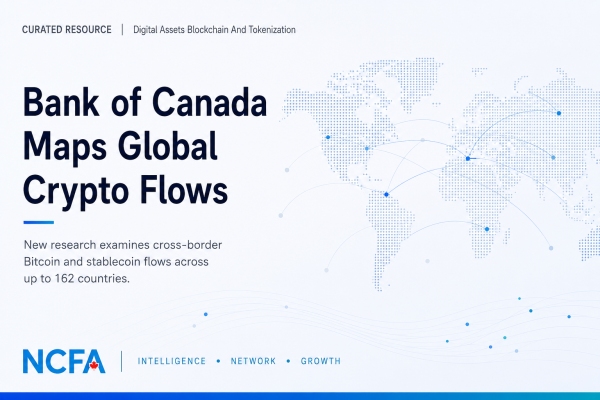
On May 7, 2026, the Bank of Canada published staff research on global cryptocurrency flows. The paper looks at why crypto moves across borders, using Bitcoin flow data across up to 162 countries and testing whether key findings also appear across major stablecoins.
It's a practical resource for fintech teams trying to understand where digital assets connect to remittances, payment friction, macro stress, capital controls, sanctions, and financial system gaps.
The paper uses Chainalysis data to study cross border crypto flows from 2020 Q3 to 2023 Q3. The authors focus on Bitcoin first, then extend the analysis to USDT, USDC, BUSD, and DAI. That makes the research useful for teams that need to separate market noise from real cross border usage patterns.
Crypto flows don't always behave like traditional capital flows. The paper finds that crypto activity can rise when macro conditions weaken, when financial systems work poorly, or when people need cheaper and faster ways to send money across borders.
Payment firms, remittance providers, banks, stablecoin companies, and compliance teams should take note. Crypto rails often gain relevance where traditional rails feel costly, slow, restricted, or unreliable.
The paper also helps explain why stablecoins are becoming more prominent in payments and treasury conversations. If stablecoin flows follow similar cross border patterns to Bitcoin in key areas, policymakers and market builders can't treat them as only crypto assets. They need to assess them as financial infrastructure.
For Canadian fintechs, if users, businesses, and institutions adopt digital rails for real cross border needs, firms need to know where those rails improve service, where they create risk, and where regulators may focus next.
This resource is useful for fintech founders, payment companies, remittance providers, stablecoin infrastructure firms, crypto platforms, banks, AML teams, policy analysts, market infrastructure providers, and investors tracking financial system modernization.
It's especially relevant for teams working on cross border settlement, digital wallets, treasury tools, programmable payments, blockchain analytics, custody, transaction monitoring, and compliance operations.
The strength of this paper is scope. It compares crypto flows across a large country sample and tests several possible drivers instead of relying on one simple adoption story. The authors look at macro conditions, financial system quality, remittances, institutional quality, capital controls, and sanctions.
The paper also avoids a common trap. It doesn't treat all crypto activity as speculation. It shows how payments, remittances, and financial stress can help explain real cross border usage.
The limit is data construction. Cross border crypto flow analysis still depends on attribution methods, exchange activity, web traffic estimates, and assumptions about where users are located. The authors discuss those limits clearly. The paper is also Bank of Canada staff research, not an official Bank of Canada policy position.
For fintech teams, the best use is practical benchmarking. Use it to understand why crypto rails gain traction, where stablecoins may keep growing, and which risks regulators are likely to monitor more closely.
Bank of Canada Staff Working Paper 2026-15 (primary research paper on global cryptocurrency flows)
Patterns And Determinants Of Global Cryptocurrency Flows PDF (full paper with methodology, data, and empirical results)
BIS Project Atlas (global work on mapping crypto and DeFi activity)
The National Crowdfunding & Fintech Association (NCFA Canada) is a financial innovation ecosystem that provides education, market intelligence, industry stewardship, networking and funding opportunities and services to thousands of community members and works closely with industry, government, partners and affiliates to create a vibrant and innovative fintech and funding industry in Canada. Decentralized and distributed, NCFA is engaged with global stakeholders and helps incubate projects and investment in fintech, alternative finance, crowdfunding, peer-to-peer finance, payments, digital assets and tokens, artificial intelligence, blockchain, cryptocurrency, regtech, and insurtech sectors. Join Canada's Fintech & Funding Community today FREE! Or become a contributing member and get perks. For more information, please visit: www.ncfacanada.org
| | |
|---|---|---|
| | |
May 13, 2026 | NCFA Resource | Risk Compliance And Regtech, Digital Identity Privacy KYC AML ATF
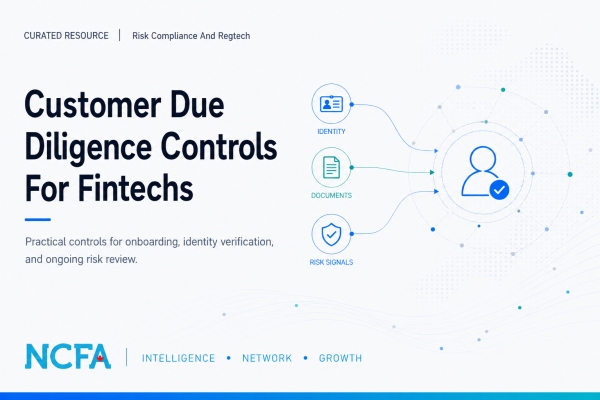
On April 8, 2026, the UK FCA published customer due diligence (CDD) findings from a multi firm review. The review covers practical weaknesses that matter to fintech teams, including thin policies, unclear review cycles, weak evidence records, poor senior approval steps, and audit gaps.
This is a UK resource, but the operating lessons travel well. Canadian fintechs still need local legal and compliance advice, including FINTRAC obligations where applicable. The FCA shows where customer checks break down when firms grow, add automation, rely on vendors, or treat onboarding as a sales funnel instead of a risk control.
The FCA review gives compliance and product teams a useful checklist for testing how customer due diligence works inside the business. It doesn't just ask whether a policy exists. It looks at whether staff know what to collect, when to escalate, how to record decisions, and how often files need review.
Stronger firms clearly separate standard CDD from enhanced due diligence (EDD) for higher risk customers. They define when senior approval is needed. They document EDD steps, keep review cycles clear, and test whether onboarding files support the risk decision made at the time.
The weaker examples are just as useful. The FCA points to firms that could not show what extra checks were completed for high risk customers, did not record key information about the purpose of a business relationship, lacked clear review schedules, or used the same people to onboard customers and review their own work.
For fintechs, fast onboarding can become a liability when the business cannot prove why a customer passed, why a file received extra review, or who approved a higher risk relationship. Policies are no longer enough, as teams need evidence.
This resource is useful for fintech founders, compliance leads, money laundering reporting officers (MLROs), onboarding teams, product managers, payments companies, lending platforms, crypto firms, crowdfunding portals, regtech providers, and financial institutions reviewing digital account opening.
It is especially relevant for firms that use automated onboarding, AI assisted reviews, third party identity vendors, risk scoring tools, or outsourced compliance support. Those tools can improve speed, but companies still needs clear accountability, review rules, exception handling, and audit trails.
The strength of this resource is its practical format. It shows good and poor practice side by side. That makes it easier for a fintech team to compare the report against its own onboarding journey, file review process, vendor controls, and board reporting.
The review also makes a simple point that many growing firms miss. Regulators want to see how decisions happen in real life. A clean policy document doesn't help much if customer files are thin, staff guidance is vague, or senior approval only exists in theory.
The limit is geography. The FCA findings reflect UK regulation and UK supervisory expectations. Canadian firms shouldn't treat this as Canadian legal guidance. They should use it as a practical benchmark, then test their own controls against Canadian requirements, sector rules, and legal advice.
FCA Customer Due Diligence Findings (primary FCA resource with good and poor practice examples)
FCA Risk Assessment Controls Findings (companion FCA review on customer and business risk assessments)
FCA 2025 To 2030 Strategy (broader strategy context for financial crime supervision)
The National Crowdfunding & Fintech Association (NCFA Canada) is a financial innovation ecosystem that provides education, market intelligence, industry stewardship, networking and funding opportunities and services to thousands of community members and works closely with industry, government, partners and affiliates to create a vibrant and innovative fintech and funding industry in Canada. Decentralized and distributed, NCFA is engaged with global stakeholders and helps incubate projects and investment in fintech, alternative finance, crowdfunding, peer-to-peer finance, payments, digital assets and tokens, artificial intelligence, blockchain, cryptocurrency, regtech, and insurtech sectors. Join Canada's Fintech & Funding Community today FREE! Or become a contributing member and get perks. For more information, please visit: www.ncfacanada.org
| | |
|---|---|---|
| | |
May 13, 2026

Image: Unsplash/Anthony Fomin
Ontario’s real estate market surprises its buyers because of its steady growth over the past few years. In today’s date, finding long-term value while keeping up with lifestyle is rare. But Ontario’s growth is the perfect balance of affordability, facilities, and momentum to cope with equity gains without a rush.
The best opportunities in Ontario’s market are not the most obvious ones. It has always been the strongest foundation with calmer neighbourhoods that promised to deliver. This article mentions five top markets in this region that are catching the eyes of buyers for their high potential.
Equity growth is conscious and comes with a clear strategy, history, improving infrastructure, local economy, and rising demand from homeowners. In Ontario, areas with good schools, transit access, and a blend of family appeal and professional living space have been the winners for years.
Promising neighbourhoods further have scope to grow, but are not heavily priced. They have a sense of community and livability. In 2026, these markets are having growing interest, which means there are chances of it being high-priced in the future.
Transit expansion is one of the biggest trends that is shaping this year. Buyers are interested in an easier commute. So, they are choosing communities with easy access to GO train lines and subway extensions. Besides, since Toronto is a high-priced area, buyers are looking more into affordable options.
Remote workers are changing places, putting more focus on good schools, outdoor spaces, and a small-town charm. Therefore, good infrastructure and healthcare facilities are top priorities too. The population growth in that area is creating more demand in the surrounding areas.

Image: Unsplash/Dillon Kydd
These are the five neighbourhoods that are the best in terms of great value and growth potential:
Chippawa is a great location, being close to Niagara Falls minus the crowd. It is a stable, family-friendly neighbourhood with established homes. The good schools and closer distance to Niagara Falls and Buffalo also attract many buyers.
Compared to other Niagara areas, Chippawa is affordable. So, retirees and families are leaning towards this area more than ever. This small town never lacks amenities. It always keeps a mix of low turnover with high value.
Danforth is one of the most resilient neighbourhoods in Ontario, with Greek heritage, walkability, close transit access to parks, and the Danforth’s commercial strip. It is appealing to young families and professionals these days.
Given its established character and ongoing revitalization, growth is expected in Danforth. It is an affordable access in terms of downtown prices and provides a steady interest for a continued appreciation in that zone.
Weston is having a high value in the market, which is rarely found. It is going through a transformation with newer retail, better transit, and more housing options for starter and affordable homes. Because of the Humber River, there is a natural appeal in this neighbourhood. Besides, the airport and downtown are close, so it serves the convenience for its residents.
Weston is rising. It is not overcrowded yet, but it has potential. When the buyers start grabbing its early benefits, there will be a splurge in new buyers and second-time buyers in this market.
The Little Lake and Grove East areas in Barrie are offering good schools, a manageable commute to the GTA, and lakefront properties that are very lucrative to buyers. It has newer infrastructure and a strong economy, adding to its demand.
Families who want a balance between space and isolation choose Barrie. It is completed with waterfront, community setups, and waterfront, complemented by a steady price growth.
Clarington has seen great development, highway access, and a good range of townhomes detached from family homes. Since it is close to Oshawa and the Durham region, residents benefit from the job growth and metro facilities. Its value proposition centers around community infrastructure, which makes it appealing to equity-focused investors.
Chippawa stands out as a smart choice in the equity growth market. It is affordable in comparison to other Niagara markets, and a strong residential identity with good schools, river access, and beautiful parks. It also has easy access to Buffalo for employment centers and better amenities. Residents have been consistently living here for years and often check Chippawa homes for sale for second-time buys.
Since the neighbourhoods have connections with LRT lines, GO expansions, and highway upgrades, the transit growth plays a great role here. It is also close to the future Niagara transit plans and QEW, and outer areas like Barrie and Clarington gain the advantage of the 401/400 corridor
On the other hand, Danforth and Weston have the TTC reliability. Because of the infrastructure improvement, it is easier to find jobs in this market. This and its accessibility further drive housing demand in this market.
Neighbourhoods with good transit, employment opportunities, good schools, and a sense of community should be considered first. Focus on communities with infrastructure improvement and stable population growth. Contrarily, avoid new development because the best equity derives from neighbourhoods that have the scope to appreciate.
Although a stabilized market, interest rates can fluctuate. Plus, there can be inventory shortages in these markets. It is also important to check the crime trends, future development plans, and school ratings before admission. Chippawa has a residential focus that prevents tourism fluctuations that are otherwise seen in Niagara.
Ontario’s promising neighbourhoods delivering equity growth are Chippawa, Danforth Village, South Barrie, and Bowmanville. They have exceptional value and appeal to live a long-term life in these markets. Chippawa has the most community strength, complemented by its affordability and location features. Buyers who are looking for reliable appreciation can pay close attention to these areas. Ontario has an ever-increasing growth story, and neighbourhoods like these help it elevate it.
The National Crowdfunding & Fintech Association (NCFA Canada) is a financial innovation ecosystem that provides education, market intelligence, industry stewardship, networking and funding opportunities and services to thousands of community members and works closely with industry, government, partners and affiliates to create a vibrant and innovative fintech and funding industry in Canada. Decentralized and distributed, NCFA is engaged with global stakeholders and helps incubate projects and investment in fintech, alternative finance, crowdfunding, peer-to-peer finance, payments, digital assets and tokens, artificial intelligence, blockchain, cryptocurrency, regtech, and insurtech sectors. Join Canada's Fintech & Funding Community today FREE! Or become a contributing member and get perks. For more information, please visit: www.ncfacanada.org
| | |
|---|---|---|
| | |
May 12, 2026 | NCFA Insight | Digital Assets Blockchain And Tokenization
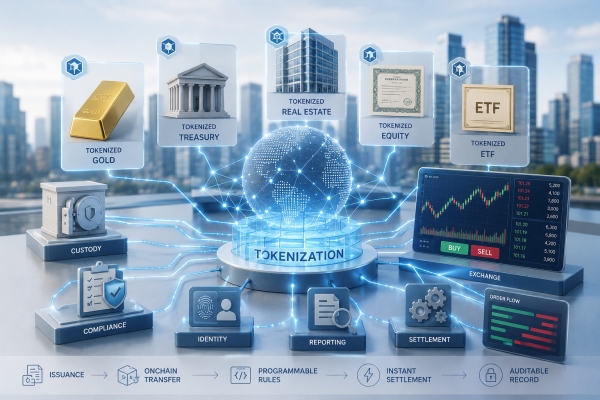
On May 4 2026, CoinGecko published its 2026 RWA Report, and the numbers tell a more interesting story than usual.
But here’s the unusual part. Most major RWA project tokens didn't benefit from that growth. CoinGecko found that six of the top seven RWA project tokens posted negative returns from January 1 2025 to March 31 2026, with losses ranging from 44.7% to 98.8%.
Tokenized assets are gaining traction, but the report shows a clear split. The market is growing around the systems that make tokenized assets useful, such as access, custody, liquidity, collateral, compliance, and distribution. It's not showing the same strength in the project tokens that investors once used to bet on the RWA theme.
Tokenized RWAs are growing quickly, but they still equal only 6.4% of the stablecoin market. Stablecoins grew from $199.77B to $301.65B during the same period.
It's a significant gap because BlackRock Targets Stablecoin Reserve Market in digital finance to help money move, settle trades, and flow collateral between platforms. Tokenized assets are building on that base, not replacing it.
The report also shows a clear preference for more institution friendly products. USDC grew 76.2% to $77.44B, while smaller regulated or compliance focused stablecoins also gained ground. That says demand is heading toward products that platforms, institutions, and regulators can actually work with.
Tokenized treasuries still lead the category, growing from $4.00B to $12.99B over the report period. But their market share fell from 73.7% to 67.2% as commodities, tokenized stocks, ETFs, and derivatives gained traction.
For much of the last cycle, Real World Assets mostly meant tokenized treasury products. Now the category is widening into broader market exposure.
Tokenized stocks scaled from $2.09M in June 2025 to $486.69M by March 2026. Tokenized ETF market capitalization reached $297.50M. The numbers are still very small compared to traditional markets, but are trending.
Tokenized commodities grew from $1.43B to $5.55B, driven mainly by gold backed products including PAXG and XAUT. The trading activity is telling. Tokenized gold recorded $90.70B in spot trading volume during Q1 2026, already higher than the full 2025 total of $84.64B.
That makes sense given gold's familiarity. It has deep global demand and already plays a role in portfolios and collateral conversations. Tokenization gives it faster movement, digital custody options, and easier access across crypto native platforms.
The report shows how quickly centralized platforms, such as Kraken, Coinbase, Crypto.com, Binance or Gate are now combining some mix of tokenized securities, stocks, ETFs, commodities, futures, perps, or licensed financial infrastructure alongside crypto trading.
The lines between crypto exchange, broker, derivatives venue, and tokenized asset marketplace are getting thinner. That raises the operating bar. It's also where major infrastructure opportunities start to appear.
RWA perps generated $524.79B in Q1 2026 trading volume alone, while daily open interest rose from $0.14B at the start of 2025 to $6.68B by March 31 2026.
The data suggests that many traders want exposure to real world asset prices without necessarily holding the underlying tokenized asset. Commodities still dominate this market, but stock and ETF perps are growing. Hyperliquid’s HIP-3 volume rose from $12.65B in Q4 2025 to $130.87B in Q1 2026.
This is trading infrastructure forming around tokenized and traditional assets at the same time.
CoinGecko’s report shows a tokenized asset market growing quickly, but unevenly. Tokenization is becoming infrastructure. Stablecoins still do the heavy lifting. Treasuries still lead. Gold trading volume has surged. Exchanges are adding capital markets functions. RWA perps are scaling quickly. At the same time, most RWA project tokens continue falling.
Tokenization is starting to look less like crypto hype and more like financial infrastructure that can make tokenized assets useful, compliant, liquid, and easy to access at scale.
The National Crowdfunding & Fintech Association (NCFA Canada) is a financial innovation ecosystem that provides education, market intelligence, industry stewardship, networking and funding opportunities and services to thousands of community members and works closely with industry, government, partners and affiliates to create a vibrant and innovative fintech and funding industry in Canada. Decentralized and distributed, NCFA is engaged with global stakeholders and helps incubate projects and investment in fintech, alternative finance, crowdfunding, peer-to-peer finance, payments, digital assets and tokens, artificial intelligence, blockchain, cryptocurrency, regtech, and insurtech sectors. Join Canada's Fintech & Funding Community today FREE! Or become a contributing member and get perks. For more information, please visit: www.ncfacanada.org
| | |
|---|---|---|
| | |
May 8, 2026 | NCFA Fintech Whisperer Weekly Intelligence | Regulation And Policy, Payments And Market Infrastructure, Digital Assets Blockchain And Tokenization, Artificial Intelligence And Data, Cybersecurity Fraud And Financial Crime
Image: Freepik
This live weekly NCFA intelligence page tracks financial technology developments that significantly affect how fintechs build, sell, raise capital, and operate under scrutiny. Coverage prioritizes Canada and includes global events that directly influence competitive conditions, market access, and execution realities across fintech sectors. This page will be updated throughout the week with market movers in a live format and then each week we'll close the prior week's contents in prep for the upcoming week, and continue on a rolling basis. (Missed prior week's Fintech Whisperer? (December 6-12, 2025, December 13-19, 2025, January 1-9, 2026, January 10-16, 2026, January 17-23, 2026, January 24-30, 2026, January 31-February 6, 2026, February 7-13, 2026, February 14-20, 2026, February 21-27, 2026, February 28-March 6, 2026, March 7-13, 2026, March 14-20, 2026, March 21-27, 2026, March 28-April 3, 2026, April 4-10, 2026, April 11-17, 2026, April 18-24, 2026, April 25-May 1, 2026).
Reduced margin rules shape leverage, dealer inventory financing, and how quickly exposure can build when markets heat up. Keeping crypto funds out of reduced margin leaves higher friction on leveraged crypto fund exposure even as crypto and tokenized market infrastructure moves closer to mainstream rails.
Canada’s stablecoin framework is moving from legislation into implementation timing. Issuers, custodians, exchanges, payment firms, and banks should plan for a 2027 rulebook while watching how reserve assets, redemption rights, supervision, and payment use cases get defined. See Canada’s First FI Issued CAD Stablecoin Launches and Stablecoins Split Into Issuance And Service Layers
Claims management is moving into a tougher conduct and perimeter review. Firms using lead generation, social ads, outsourced claims workflows, or high volume complaint models need clean consent, fair pricing, clear authority, and evidence that customers understand what they are signing.
Climate disclosure is moving from delayed implementation toward formal rollback. Public companies, reporting platforms, auditors, and ESG data providers should watch the proposal text, because the next decision point is whether climate risk disclosure becomes narrower, materiality driven, or removed from SEC rule requirements.
May 6, 2026, Canada and South Korea
Stablecoin adoption won’t only depend on reserves, licences, and payment use cases. It will also depend on how issuers protect minting, burning, settlement authority, custody permissions, and administrative controls as quantum risk becomes an infrastructure planning issue.
Regional banks are looking for third party digital asset infrastructure instead of building it from scratch. For Canadian credit unions, regional banks, and bank technology providers, stablecoins and tokenized deposits are becoming a bank distribution question, not just a crypto platform product.
Tokenized securities are moving into issuer services and transfer agency. The next control point is not only trading. It is who manages shareholder records, corporate actions, voting, dividends, custody links, and settlement between public companies and investors.
This is an early bank participation signal, not a final product launch. European banks are expanding a shared euro stablecoin effort before formal updates expected later in the year. For fintechs and payment firms, the read through is practical: euro stablecoin access may develop through regulated bank networks, not only crypto native providers.
Tokenized securities are moving into DTC’s production roadmap. That changes the question from whether tokenized assets can exist to whether brokers, custodians, issuers, and trading venues can plug tokenized ownership into existing post trade infrastructure without weakening rights, controls, or settlement discipline.
MiCA is turning stablecoin issuance into regulated service infrastructure. Circle now has a clearer European pathway for custody and transfer services tied to USDC and EURC, which raises the bar for stablecoin issuers competing on compliance, distribution, and institutional access.
Canada’s real time payments window is now coming into view. Banks, PSPs, fintechs, fraud vendors, and treasury teams need to prepare for testing, phased onboarding, ISO 20022 data, instant settlement, and new fraud controls before launch.
Canada’s payment access model keeps opening beyond incumbent financial institutions. Fintechs, PSPs, banks, and payment infrastructure providers should track which firms gain a formal seat inside payment system governance because direct participation can affect product design, compliance readiness, and competitive timing around modernized payment rails.
Stablecoin settlement is moving into Canadian payment operations, not just crypto trading. Wealthsimple now has a live route to test USDC settlement with Visa Canada, while banks, PSPs, wallets, and regulators watch how on chain settlement fits inside existing card network obligations.
Stablecoin card infrastructure is moving closer to mainstream payment networks. Canadian fintechs, issuers, and payment providers should pay attention to who controls issuance, settlement, compliance, and customer access when tokenized money connects to everyday card spending.
Banks, insurers, fintechs, regtech vendors, and AI providers operating in Europe need clearer compliance planning around governance, documentation, model oversight, and content labeling requirements. The updated timeline gives firms more preparation time while confirming the EU still intends to enforce formal AI accountability rules across regulated industries.
Private credit is evolving from private market growth story to global stability watchlist. Banks, insurers, fund managers, platforms, and risk vendors should expect more scrutiny on exposure mapping, borrower quality, valuations, leverage, liquidity terms, and private ratings.
The proposal would change the disclosure rhythm for U.S. public companies. Issuers may gain lower reporting costs and more planning room, while investors, analysts, and data providers face less frequent mandated information and a bigger premium on interim signals, voluntary updates, and market surveillance.
The findings give Canadian banks, fintechs and infrastructure operators a useful test for shared identity and cloud dependencies. Strong current availability does not resolve the risk created when authentication, payments and outsourced technology depend on a limited number of providers without proven alternatives for prolonged disruptions.
It seems like we say this every week but the competitive gap between fintechs is starting to widen. While there's still opportunities it's less about product design and more about infrastructure access, regulatory positioning, distribution control, and operational execution. Fintechs aren't just launching apps faster, but are embedding themselves deeper into payment rails, compliance systems, tokenized market infrastructure, AI governed workflows, and regulated distribution channels. Canada still has room to compete, but the advantage is increasingly going to operators that can execute inside regulated systems at scale while keeping costs, trust, and customer experience under control.
NCFA offers various curated resources to help founders and investors stay current on developments that impact fintech markets, subscribe to NCFA weekly newsletter updates, view a rundown of current fintech news and insights, or dive into the latest fintech industry research.
The National Crowdfunding & Fintech Association (NCFA Canada) is a financial innovation ecosystem that provides education, market intelligence, industry stewardship, networking and funding opportunities and services to thousands of community members and works closely with industry, government, partners and affiliates to create a vibrant and innovative fintech and funding industry in Canada. Decentralized and distributed, NCFA is engaged with global stakeholders and helps incubate projects and investment in fintech, alternative finance, crowdfunding, peer-to-peer finance, payments, digital assets and tokens, artificial intelligence, blockchain, cryptocurrency, regtech, and insurtech sectors. Join Canada's Fintech & Funding Community today FREE! Or become a contributing member and get perks. For more information, please visit: www.ncfacanada.org
| | |
|---|---|---|
| | |
May 4, 2026 | NCFA Fintech Insight | Digital Assets Blockchain And Tokenization

On Apr 29, 2026, NCFA published a resource post on crypto adoption data across 11 European markets, based on the ARI10 Report Cryptocurrency Adoption in Europe 2026. The data points to a market that's moved past early awareness but hasn’t yet settled into consistent daily use just yet. That gap is where the next phase of competition starts.
The study surveyed 11,068 respondents across 11 countries between Jan 9 and Jan 15, 2026:
Roughly four in ten respondents have already researched, owned, or traded crypto. Just over three in ten qualify as investors. People know what crypto is, and many have already touched it. Crypto is by far no longer fringe.
However, Poland’s 47.10% exposure rate and France’s 30.41% rate describe very different market conditions. Norway, Spain, and Romania also show stronger engagement than the overall average. For operators, that means Europe has different adoption curves. It breaks into local markets depending on income, education, age, product trust, and financial habits.
Single broad brushed strategies may miss the mark. A wallet, exchange, payment product, or tokenized asset platform needs to match how users actually behave in each market, not how the regional average looks in a slide deck.
Investors still participate primarily for financial gains. Nearly half point to potential value growth, and more than two thirds cite financial motives overall. That makes crypto adoption look less like daily payment adoption and more like investment market participation.
This actually strengthens the crypto infrastructure story. Exchanges, custodians, payment firms, banks, and tokenization platforms keep investing because they’re trying to move crypto from access to daily utility. But user behaviour still leans toward buying, holding, and trading. The next stage of growth and adoption depends on how useful crypto becomes inside regular financial workflows, not just easier to purchase.
Risk and volatility rank at 33.3%. Lack of funds follows at 32.1%. Technical knowledge comes in at 31%. Lack of trust in exchanges reaches 28.6%. Regulatory uncertainty ranks much lower at 9.3%.
Regulation supports trust and scale, especially for institutions. But regulation alone doesn't turn interest into everyday use. Users need clearer entry points, better risk explanations, stronger platform trust, and products that make participating in crypto feel normal and useful.
This is where the current market opportunity is in Europe. Not in chasing generic adoption, but by turning curiosity into confidence, and confidence into repeat and useful behaviour.
Crypto adoption has reached a point where awareness and regulation are no longer the main constraints (at least in Europe and based on this study). The next iteration depends on whether the industry can turn interest into trusted, useful, everyday financial behaviour. Access the full report on Crypto adoption in Europe
The National Crowdfunding & Fintech Association (NCFA Canada) is a financial innovation ecosystem that provides education, market intelligence, industry stewardship, networking and funding opportunities and services to thousands of community members and works closely with industry, government, partners and affiliates to create a vibrant and innovative fintech and funding industry in Canada. Decentralized and distributed, NCFA is engaged with global stakeholders and helps incubate projects and investment in fintech, alternative finance, crowdfunding, peer-to-peer finance, payments, digital assets and tokens, artificial intelligence, blockchain, cryptocurrency, regtech, and insurtech sectors. Join Canada's Fintech & Funding Community today FREE! Or become a contributing member and get perks. For more information, please visit: www.ncfacanada.org
| | |
|---|---|---|
| | |



August 26th, 2025

January 4th, 2024

June 1st, 2021

September 9th, 2020

July 9th, 2018

January 3rd, 2018

September 25th, 2017

June 20th, 2017

May 10th, 2017

December 14th, 2016
