





Karsten Wenzlaff, Advisor
August 26th, 2025
Karsten Wenzlaff is a Crowdfunding and Fintech Expert from Germany. He is Secretary-General of Digit[...]


May 26, 2026 | NCFA Resource | Artificial Intelligence And Data, Risk Compliance And Regtech, Payments And Market Infrastructure
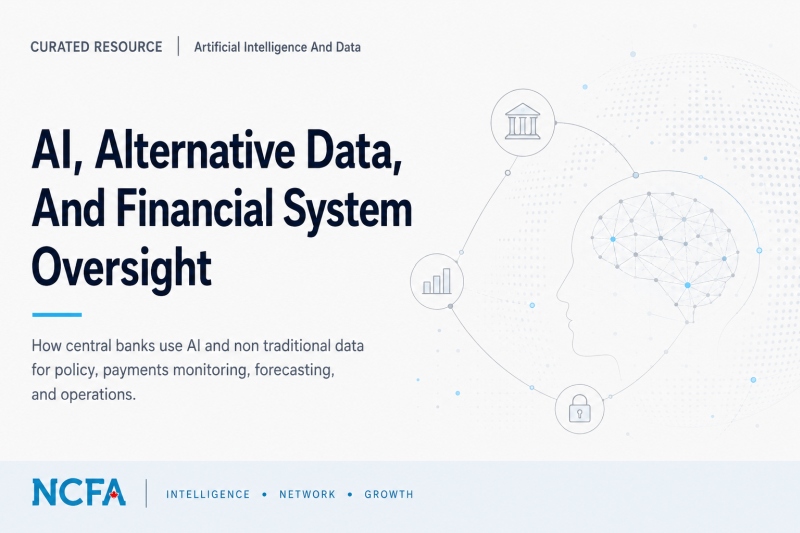
On May 15, 2026, the Bank of Canada published Integrating Non-traditional Data and AI into Central Banking. The staff paper examines how central banks use artificial intelligence and non traditional data in research, operations, payments monitoring, forecasting, and policy support.
The paper stays close to real operating problems. It focuses on data quality, model governance, human oversight, vendor risk, cybersecurity, and moving AI pilots into production.
The paper shows how central banks use non traditional data from payment transactions, earnings call transcripts, satellite images, job postings, social media, scanner data, and real time business activity. It also explains how AI supports inflation tracking, nowcasting, anomaly detection, payments monitoring, internal automation, and policy work.
One Bank of Canada automation project improved filing accuracy to 99.5% and saved about 1.25 person years of staff capacity. The paper also cites a BIS survey showing more than 90% of responding central banks are moderately or extensively discussing AI internally.
The most useful section sets out six accelerators for responsible AI adoption in central banking. They include sandbox environments, technology readiness checks, high quality data, reusable development patterns, scale planning, and risk governance. The framework also applies to regulated financial institutions that need to transition AI from experiments into controlled production, similar to broader work underway around customer due diligence controls for fintechs.
This resource is useful for fintech founders, AI governance teams, regtech providers, financial institutions, payment companies, policy teams, investors, and compliance leaders.
It is especially relevant for teams building explainable AI, payment intelligence, anomaly detection, compliance automation, model governance, and trusted workflow tools.
The strength is its operating detail and the fact that the paper doesn't treat AI as a generic productivity story. It shows why regulated financial institutions need explainability, auditability, strong data controls, and clear ownership before AI can support high stakes decisions.
The paper also points to a real market gap. Central banks may need specialized AI tools and deeper in house expertise because many commercial systems are not designed for monetary policy analysis, payments oversight, or central bank operations.
The limit is scope. This is a central banking paper, not a commercialization guide. It does not estimate vendor spending, market size, adoption timelines, or private sector demand. Its value is the framework and the operating discipline behind it.
Bank Of Canada AI And Non Traditional Data Paper (primary Bank of Canada resource)
AI Agents Enter Governed Financial Workflows (AI governance and controls)
Tokenization Starts Looking Like Financial Infrastructure (regulated financial infrastructure)
Deloitte And Stablecorp Bring QCAD To Banks (Canadian payment infrastructure)
 The National Crowdfunding & Fintech Association (NCFA Canada) is a financial innovation ecosystem that provides education, market intelligence, industry stewardship, networking and funding opportunities and services to thousands of community members and works closely with industry, government, partners and affiliates to create a vibrant and innovative fintech and funding industry in Canada. Decentralized and distributed, NCFA is engaged with global stakeholders and helps incubate projects and investment in fintech, alternative finance, crowdfunding, peer-to-peer finance, payments, digital assets and tokens, artificial intelligence, blockchain, cryptocurrency, regtech, and insurtech sectors. Join Canada's Fintech & Funding Community today FREE! Or become a contributing member and get perks. For more information, please visit: www.ncfacanada.org
 |  |  |
|---|---|---|
 |  |  |
The National Crowdfunding & Fintech Association (NCFA Canada) is a financial innovation ecosystem that provides education, market intelligence, industry stewardship, networking and funding opportunities and services to thousands of community members and works closely with industry, government, partners and affiliates to create a vibrant and innovative fintech and funding industry in Canada. Decentralized and distributed, NCFA is engaged with global stakeholders and helps incubate projects and investment in fintech, alternative finance, crowdfunding, peer-to-peer finance, payments, digital assets and tokens, artificial intelligence, blockchain, cryptocurrency, regtech, and insurtech sectors. Join Canada's Fintech & Funding Community today FREE! Or become a contributing member and get perks. For more information, please visit: www.ncfacanada.org
| | |
|---|---|---|
| | |
May 22, 2026 | NCFA Fintech Whisperer Weekly Intelligence | Digital Assets Blockchain And Tokenization, Payments And Money Movement

Image: Freepik
This live weekly NCFA intelligence page tracks financial technology developments that significantly affect how fintechs build, sell, raise capital, and operate under scrutiny. Coverage prioritizes Canada and includes global events that directly influence competitive conditions, market access, and execution realities across fintech sectors. This page will be updated throughout the week with market movers in a live format and then each week we'll close the prior week's contents in prep for the upcoming week, and continue on a rolling basis. (Missed prior week's Fintech Whisperer? (December 6-12, 2025, December 13-19, 2025, January 1-9, 2026, January 10-16, 2026, January 17-23, 2026, January 24-30, 2026, January 31-February 6, 2026, February 7-13, 2026, February 14-20, 2026, February 21-27, 2026, February 28-March 6, 2026, March 7-13, 2026, March 14-20, 2026, March 21-27, 2026, March 28-April 3, 2026, April 4-10, 2026, April 11-17, 2026, April 18-24, 2026, April 25-May 1, 2026, May 2-8, 2026, May 9-15, 2026).
Institutional digital asset infrastructure is increasingly converging around unified execution, settlement, compliance, and liquidity layers. Banks, fintechs, custodians, PSPs, brokers, and treasury teams should track how tokenized funds, stablecoin settlement, collateral movement, and onchain liquidity are becoming integrated into institutional operating environments rather than isolated crypto workflows.
Bank led stablecoins are becoming part of Europe’s regulated payment strategy. Banks, PSPs, stablecoin issuers, custodians, treasury teams, and compliance groups should track how euro denominated stablecoin infrastructure affects settlement options, liquidity design, and competition with USD stablecoins.
Stablecoin distribution is becoming a network access problem. Wallets, exchanges, PSPs, brokers, and embedded finance platforms need interoperability, regulated issuance, liquidity, and compliance controls that let users move between stablecoin networks without adding operational friction.
New York licensing remains a key test for institutional digital asset firms. Exchanges, custodians, brokers, lenders, and compliance teams should track which firms secure state level approvals because market access, client onboarding, and institutional trust still depend on regulated operating permissions.
USD account access is becoming embedded infrastructure for global platforms, not just a bank product. Fintechs, PSPs, marketplaces, payroll firms, and treasury teams should watch how account issuance, compliance controls, real time payments, and stablecoin rails converge inside programmable payment stacks.
Canadian dollar stablecoins are beginning to enter practical payment flows instead of remaining treasury or trading instruments. PSPs, banks, remittance firms, treasury teams, and compliance groups should watch how regulated stablecoin settlement changes cross border payout speed, corridor economics, liquidity management, and payment competition. CADC infrastructure continues to expand across Canadian digital payment markets.
Bitcoin reserve legislation is turning digital assets into a public balance sheet question, not just a market regulation debate. Crypto firms, custodians, exchanges, treasury teams, investors, and policymakers should track how federal reserve asset policy, seized digital asset management, and national competitiveness arguments reshape the next phase of U.S. crypto policy.
Card network economics are moving deeper into formal regulatory reporting. Merchants, acquirers, issuers, PSPs, payment networks, and embedded payment platforms should track how fee transparency, profitability evidence, and scheme oversight affect payment costs and competitive pressure across card acceptance.
The FCA is creating a clearer supervisory channel for firms that are already scaling, not just early sandbox participants. That matters because fast growth often creates new questions around controls, governance, technology, and consumer impact before a firm becomes systemically important.
Prediction markets are becoming a direct federal versus state jurisdiction fight. Exchanges, fintech platforms, compliance teams, policymakers, and investors should track how courts treat event contracts because the outcome could affect federal derivatives oversight, state gambling authority, consumer protection rules, and regulated forecasting markets.
Federal policymakers increasingly treat fintech infrastructure as part of U.S. financial competitiveness strategy. Banks, PSPs, digital asset firms, payment companies, and infrastructure providers should track how payment rail access, supervision, settlement services, and master account policy evolve as regulators face growing pressure to integrate fintech firms into core financial systems.
UK stablecoin policy is moving toward draft rule text and implementation design. Stablecoin issuers, banks, PSPs, custodians, wallets, and treasury teams should track how the Bank balances financial stability controls with usable payment products, especially around issuance limits, redemption, reserves, and access to settlement infrastructure.
Lowering community bank burden can open capacity, not just reduce paperwork. Fintechs, sponsor banks, core providers, lenders, and compliance teams should track whether tailored supervision gives smaller banks more room to partner, modernize, lend, and support local payment and deposit infrastructure.
Onchain markets need clearing and netting controls before more institutions treat them as reliable operating channels. Trading firms, custodians, brokers, stablecoin networks, and treasury teams should track how private obligation matching, liquidity savings, and counterparty controls develop across institutional digital asset markets.
Prediction markets are moving beyond politics and sports into private capital market intelligence. Exchanges, investors, fintech platforms, regulators, and market infrastructure providers should track how forecasting markets, institutional secondary market data, and tokenized trading systems increasingly converge around private company price discovery and market sentiment.
Regional exchange infrastructure competition continues to expand beyond traditional Western commodity benchmarks. Exchanges, clearing firms, commodity traders, treasury groups, and market infrastructure operators should track how Singapore based benchmarks, physical delivery systems, and digitally enabled collateral infrastructure increasingly support Asian commodity trade and price discovery.
The case is a governance and creditor risk warning for Canada’s fintech funding market. Investors, lenders, founders, and boards should keep closer watch on treasury controls, debt covenants, founder conduct, and creditor transparency as capital becomes more selective.
Canada’s MSB compliance risk is increasingly visible across multi service fintech models. Crypto firms, PSPs, FX dealers, remittance platforms, investors, and compliance teams should keep registration data current, map services accurately, and treat FINTRAC responsiveness as an operating requirement.
Payments, digital assets, AI fraud controls, and capital markets infrastructure are being rebuilt by registered firms with licenses, distribution, data, and balance sheets. Smaller fintechs can still win, but only where they solve a real operating problem and plug into the financial system with trust from day one. The opportunity is still open, but it will favour teams that move quickly, stay compliant, earn trust, and turn infrastructure change into useful products for customers, merchants, investors, and institutions.
NCFA offers various curated resources to help founders and investors stay current on developments that impact fintech markets, subscribe to NCFA weekly newsletter updates, view a rundown of current fintech news and insights, or dive into the latest fintech industry research.
The National Crowdfunding & Fintech Association (NCFA Canada) is a financial innovation ecosystem that provides education, market intelligence, industry stewardship, networking and funding opportunities and services to thousands of community members and works closely with industry, government, partners and affiliates to create a vibrant and innovative fintech and funding industry in Canada. Decentralized and distributed, NCFA is engaged with global stakeholders and helps incubate projects and investment in fintech, alternative finance, crowdfunding, peer-to-peer finance, payments, digital assets and tokens, artificial intelligence, blockchain, cryptocurrency, regtech, and insurtech sectors. Join Canada's Fintech & Funding Community today FREE! Or become a contributing member and get perks. For more information, please visit: www.ncfacanada.org
| | |
|---|---|---|
| | |
May 21, 2026

Many operators in 2026 are still running on infrastructure built for a different era. Legacy architecture not designed for multi-vertical scale, modern payment rails, or real-time compliance is now the most significant operational liability a gambling business can carry.
This article breaks down what a capable platform partner must deliver: infrastructure, compliance, payments, player lifecycle management, analytics, and genuine innovation across the full platform ecosystem.
A B2B iGaming platform is the software layer between game content, payments, and players – operated by a online casino software provider whose clients are gambling businesses, not players directly. The provider builds the infrastructure; the operator runs the brand.
The two primary delivery models are turnkey solutions and white-label solutions. A turnkey platform delivers a fully operational iGaming business: game content, payment integrations, compliance tooling, CRM, and back-office management, all pre-configured. White-label solutions offer a configurable layer that operators brand and customise while the underlying infrastructure stays shared and under the provider’s license.
Most platforms support multi-brand management – a single operator running several distinct brands from one back-office – essential for expanding across jurisdictions or targeting different player segments.
The ecosystem concept separates a coherent platform from a collection of stitched-together modules. An integrated architecture connects game content, payment gateways, compliance tooling, and CRM into one environment. Most providers offer a flagship full-stack product alongside hybrid options combining shared infrastructure with operator-controlled front-end layers. The vertical scope must include online casino, sports betting, esports, iGaming lottery, and bookmaker products.
Technical debt is not an IT department problem. It is a revenue problem, a compliance problem, and an increasingly existential one.
Legacy systems create direct income and budget consequences. API incompatibility slows game provider onboarding; payment integration failures drive transaction abandonment; uptime and performance degradation during peak events translates into lost bets and churn. Each failure compounds: a game integration delay coincides with a compliance gap and a payment reconciliation issue – the management overhead erodes the capacity to grow.
Legacy architecture cannot support the real-time reporting regulators mandate. The gap widens with each update; the technical backlog becomes a licensing liability. Maintaining legacy software development on an ageing codebase consumes developer time with limited output. The algorithm logic in older systems is frequently undocumented, making changes error-prone. Performance statistics arrive as delayed batch reports rather than real-time intelligence. The complexity and risk of staying now exceeds the cost of migration for most growth-stage operators.
The right model depends on how much of the stack an operator wants to own and how quickly they need to be live. The choice is not about quality – both are viable – it is about maturity, timeline, budget, and brand complexity. The subsections below compare each across speed to market, technical overhead, cost structure, and suitability for multi-brand management at scale.
|
Criteria |
Turnkey Solution |
White-Label Solution |
| Speed to Launch | Moderate – requires setup and configuration | Fast – ready-to-go with minimal setup |
| Cost | Higher upfront investment | Lower initial cost |
| Customisation | High – full control over features and integrations | Limited – based on provider’s framework |
| Brand Scalability | Strong – built for long-term growth and expansion | Moderate – scaling depends on provider capabilities |
A turnkey solution delivers a complete, market-ready iGaming business. Compliance tooling, payment integrations, game content via an aggregator such as iGaming Deck, RNG-certified game logic, and back-office management are all pre-integrated. The operator licenses independently and owns the brand outright – the platform handles the technical stack, not the regulatory relationship.
This is the flagship delivery model for operators entering new markets under time pressure. Architecture is proven, platform scalability is built in, and provider innovation means operators access new capabilities without carrying development costs. Speed to market is measured in weeks.
A white-label solution gives operators control over brand identity and player-facing experience, built on a shared B2B backend via REST API. The operator trades under the provider's gambling license rather than obtaining one independently – reducing time to market and upfront cost, at the expense of some jurisdictional flexibility.
It suits operators who want front-end differentiation across multiple brands without building proprietary infrastructure. Platform scalability remains a B2B responsibility. A hybrid approach – white-label infrastructure with custom-built components – extends capability within budget, making it the preferred route for operators managing software development resources carefully.
Whatever the licensing model, a platform's compliance stack must support the operator's regulatory obligations actively: audit trails, reporting formats, and player data handling that meet the standards of every jurisdiction they trade in. GLI-19 certification is mandatory – it covers RNG integrity, game mathematics, and platform integrity across the full content layer. A platform without GLI-19 compliance creates exposure for any operator.
A compliant platform delivers automated KYC (Know Your Customer) workflows at registration and transaction thresholds without friction at scale. Responsible gambling tools – self-exclusion, deposit limits, intervention triggers based on behavioural algorithm outputs – are mandated under MGA and Gambling Commission frameworks. Fraud detection must operate in real time. Player fund ring-fencing ensures operator funds are legally separated from player balances, as required under MGA and Gambling Commission standards. Privacy and anonymity controls must balance GDPR obligations with the expectations of crypto-focused players.
Compliance capabilities to demand from your B2B partner:
The platform partner's licensing footprint is the operator's growth map. Curaçao offers fast gambling license timelines and is the primary gateway for crypto-focused operators; eSports Curacao covers the esports vertical specifically. MGA licensing provides European credibility and unlocks payment provider partnerships requiring MGA compliance.
The primary growth frontiers are Latin America – Brazil's regulated market is the largest single opportunity – alongside emerging frameworks across Asia and Africa. A partner who can navigate these environments is a genuine competitive asset.
Payment infrastructure is where platforms create or destroy player experience. A failed deposit does not generate a complaint – it generates churn. Multi-currency wallets, what the industry calls crypto journeys, are now a baseline expectation: seamless wallet management across fiat and cryptocurrency denominations with real-time balance visibility. Financial integrity ring-fencing must apply across all wallet types regardless of currency denomination.
The protocols a platform supports matter operationally. Bitcoin Lightning Network delivers instant, low-fee settlements for Bitcoin transfers. Tron (TRC-20) offers high throughput and near-zero costs for frequent small transactions. Ethereum supports smart contract-based payouts. Litecoin provides a cost-efficient alternative for players prioritising low fees.
For players moving between cash-based local payment methods and crypto wallets, the platform must handle both through configurable compliance thresholds – not a binary KYC-or-anonymity choice.
The game aggregator – iGaming Deck in platform terms – connects operators to hundreds of game studios through a single REST API integration. Without it, every new provider requires a separate build; with it, the operator accesses an entire catalogue through one connection.
RNG certification is required at the game level. Every slot machine, roulette variant, and virtual lottery product must carry independently verified certification.
Multi-brand management at the aggregator level allows one operator to serve distinct audiences from shared content infrastructure. Platform scalability ensures the architecture holds under simultaneous peak load across all brands. Hybrid architecture – a shared core with vertical-specific configurations – is where this becomes practical. The recommendation algorithm surfacing the right game to the right player operates here, making aggregator depth a product differentiator.
Player lifecycle management is where operators most commonly rely on disconnected third-party tools, creating data silos and delayed campaign execution. A capable B2B platform integrates CRM natively: acquisition data, deposit behaviour, game preferences, and support history visible in real time, with 24/7 service infrastructure to match.
Loyalty – as a measurable platform output, not a marketing concept – is built through consistent, personalised incentive delivery. The tooling required: a configurable jackpot club, a bonus shop where players select rewards, tournament mechanics across casino and sportsbook verticals, and gamification layers that sustain engagement. Retention tooling must enable churn prediction and automated re-engagement driven by platform behavioural data.
Legacy platforms generate data. Modern platforms generate intelligence. The difference is whether outputs are actionable in real time or require manual extraction.
Player behaviour statistics surface which game types retain players longest and which acquisition channels produce the highest lifetime value. Revenue performance dashboards provide income visibility at brand, market, and segment level. Risk management at the platform layer depends on the same data: the algorithm must flag fraud signals within the analytics environment where operators are already working. Uptime and performance metrics must be visible in real time.
CRM integration turns analytics into action: a churn-risk flag triggers a bonus offer without manual data export. User personalization – the right offer based on actual behaviour, not segment assumptions – separates a modern analytics layer from a reporting tool. Growth metrics must support operational decisions and board-level reporting.
Innovation means whether the platform's architecture can absorb change without generating the next wave of technical debt.
Platforms that add cryptocurrency as an afterthought create friction at every touchpoint: KYC workflows not built for pseudo-anonymous players, reporting that cannot handle coin-denominated revenue, wallet management requiring manual reconciliation. Building with blockchain as a native layer eliminates these problems. Technology choices made today determine what is possible in three years.
Hybrid architecture – supporting legacy formats alongside modern REST API-first development – keeps the platform accessible at different technical maturity levels. Software development investment must be continuous; the API surface area should expand with the ecosystem. The flagship indicator of innovation maturity is whether the algorithm layer – governing game recommendations, fraud detection, and bonus targeting – is actively developed. Platform scalability under that evolution is what separates credible innovation from a product announcement.
The cost of staying on an underperforming platform is compounding. In 2026, the cost of migration is predictable and finite.

1. What is a B2B iGaming platform, and how does it differ from being an operator?
A B2B provider builds and maintains the software infrastructure – game aggregation, payment gateways, compliance tooling, and CRM – and licenses it to gambling businesses. The operator runs the player-facing brand, focusing on acquisition and experience while the platform handles technical complexity.
2. What does "turnkey solution" mean in iGaming?
A turnkey solution delivers a fully operational iGaming business ready for launch – game content, payment integrations, RNG-certified logic, compliance tooling, and back-office management all pre-configured. The operator licenses independently and owns the brand. It is the fastest route to market for operators entering new jurisdictions.
3. What is a white-label iGaming solution?
A white-label solution provides a configurable platform layer on a B2B backend, accessed via REST API. The operator trades under the provider's gambling license rather than obtaining one independently. It suits operators wanting brand control across multiple demographics without the overhead of building proprietary infrastructure.
4. What compliance certifications should I demand from a B2B platform partner?
GLI-19 certification is the baseline – covering RNG integrity, game mathematics, and platform standards. Also require automated KYC workflows, player fund ring-fencing under MGA and Gambling Commission frameworks, real-time fraud monitoring, and responsible gambling tools, including self-exclusion and deposit limits.
5. How do B2B platforms support crypto and multi-currency payments?
A modern platform supports multi-currency wallets handling fiat and cryptocurrency in a single interface. Blockchain rails should include Bitcoin Lightning Network for instant settlements, Tron for micro-transactions, Ethereum for smart contract payouts, and Litecoin for low-cost transfers – with KYC and fraud monitoring preserving player anonymity where compliant.
6. What player retention tools should a B2B platform include natively?
A jackpot club, bonus shop with player-selectable rewards, tournament mechanics across casino and sportsbook, and CRM-native churn prediction. Loyalty mechanics must operate in real time from platform behavioural data, not manual campaign setup or third-party tools with delayed access.
7. How do analytics capabilities differ between modern and legacy platforms?
Legacy platforms generate historical reports. Modern platforms deliver real-time dashboards covering player behaviour statistics, revenue performance, fraud risk signals, and uptime metrics. CRM integration means a churn-risk flag automatically triggers a bonus campaign within the same environment.
8. Why does the choice of blockchain infrastructure matter for an iGaming platform?
Protocol choice determines transaction speed, cost, and compliance profile. Bitcoin Lightning Network enables instant low-fee BTC settlements; Tron handles micro-transactions; Ethereum supports smart contract payouts; Litecoin offers low-cost transfers. Native blockchain integration avoids the reconciliation and UX problems of afterthought crypto architecture.
A capable B2B iGaming platform partner in 2026 delivers an integrated ecosystem: proven infrastructure, multi-jurisdiction compliance, blockchain-native payment rails, platform-native player lifecycle tools, real-time analytics, and a software development model built for continuous evolution.
Multi-brand management, scalable architecture, and genuine innovation investment in underlying technology are what separate a platform that enables growth from one that constrains it. For operators on legacy systems, the calculation is straightforward: the cost of staying now exceeds the cost of moving. The question is how quickly you act.
The National Crowdfunding & Fintech Association (NCFA Canada) is a financial innovation ecosystem that provides education, market intelligence, industry stewardship, networking and funding opportunities and services to thousands of community members and works closely with industry, government, partners and affiliates to create a vibrant and innovative fintech and funding industry in Canada. Decentralized and distributed, NCFA is engaged with global stakeholders and helps incubate projects and investment in fintech, alternative finance, crowdfunding, peer-to-peer finance, payments, digital assets and tokens, artificial intelligence, blockchain, cryptocurrency, regtech, and insurtech sectors. Join Canada's Fintech & Funding Community today FREE! Or become a contributing member and get perks. For more information, please visit: www.ncfacanada.org
| | |
|---|---|---|
| | |
May 20, 2026 | NCFA Resource | Regulation And Policy, Artificial Intelligence And Data, Digital Assets Blockchain And Tokenization

On April 20, 2026, the UK Financial Conduct Authority published its Innovation Insights 2025 report (20 page PDF). The report gives fintech founders, investors, and policy teams a practical view of where capital, regulatory testing, and market demand are concentrating across AI, digital assets, stablecoins, tokenization, RegTech, open finance, embedded finance, and operational automation.
The FCA points to a more disciplined phase of fintech, where firms need clear customer value, stronger controls, earlier regulatory engagement, and credible deployment plans.
The report combines global fintech investment data with activity across FCA innovation services, including the Regulatory Sandbox, Innovation Pathways, Digital Sandbox, AI Lab, Supercharged Sandbox, Smart Data Accelerator, and Scale Up Unit.
The overview gives operators a clean read on regulated fintech demand. AI, distributed ledger technology, open banking, and open finance ranked among the main technologies used by applicants. The FCA also launched new support channels in 2025, including a stablecoins cohort.
Regulated fintech no longer wins on novelty alone. Better products need stronger evidence, safer testing routes, sharper governance, and a realistic route from pilot to production.
This resource is useful for fintech founders, investors, compliance teams, financial institutions, policymakers, accelerators, digital asset firms, AI builders, RegTech vendors, and open finance teams tracking where regulated innovation is gaining traction.
It is especially useful for firms building around AI governance, stablecoins, tokenization, compliance automation, open finance, embedded finance, and supervised testing models.
The report is strong on investment patterns, regulatory engagement, sector demand, and FCA innovation service activity. It helps founders and investors see which fintech themes are attracting capital and which models need earlier regulator dialogue.
Its limit is the report doesn't provide a full outcomes study on sandbox firm performance, revenue growth, compliance cost reduction, productivity gains, fraud reduction, or investor returns. It works best as a regulatory market map, not proof that any one fintech category will outperform.
Canada and other jurisdictions can still use the report as a benchmark. Faster testing routes, clearer engagement models, and stronger links between experimentation and responsible deployment are becoming competitive advantages in financial innovation.
FCA Innovation Insights 2025 (primary FCA report)
AI Agents Enter Governed Financial Workflows (AI governance and controls)
Tokenization Starts Looking Like Financial Infrastructure (tokenized market infrastructure)
Deloitte And Stablecorp Bring QCAD To Banks (Canadian stablecoin infrastructure)
The National Crowdfunding & Fintech Association (NCFA Canada) is a financial innovation ecosystem that provides education, market intelligence, industry stewardship, networking and funding opportunities and services to thousands of community members and works closely with industry, government, partners and affiliates to create a vibrant and innovative fintech and funding industry in Canada. Decentralized and distributed, NCFA is engaged with global stakeholders and helps incubate projects and investment in fintech, alternative finance, crowdfunding, peer-to-peer finance, payments, digital assets and tokens, artificial intelligence, blockchain, cryptocurrency, regtech, and insurtech sectors. Join Canada's Fintech & Funding Community today FREE! Or become a contributing member and get perks. For more information, please visit: www.ncfacanada.org
| | |
|---|---|---|
| | |
May 20, 2026 | NCFA Resource | Digital Assets Blockchain And Tokenization, Payments And Market Infrastructure
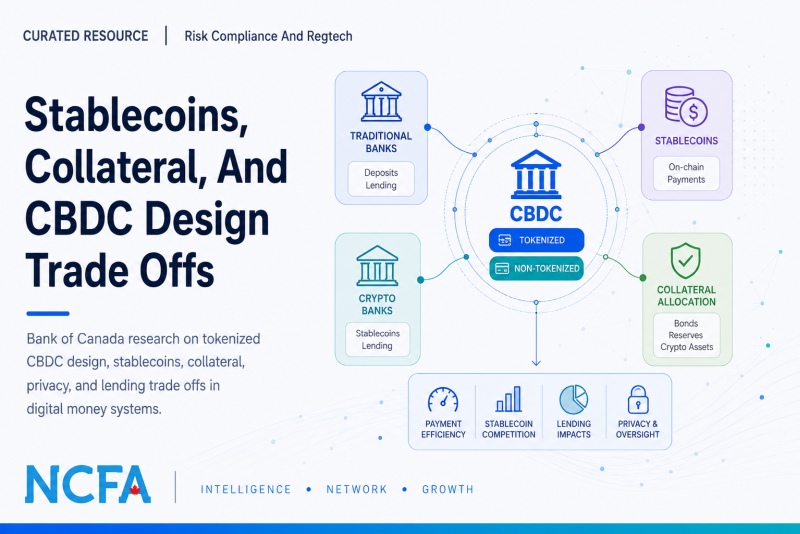
On May 7, 2026, the Bank of Canada published staff working paper 2026-14 on CBDC tokenization design. The paper looks at a financial system where traditional banks issue deposits, crypto banks issue stablecoins, and a central bank decides whether a CBDC should work through conventional accounts or programmable ledgers.
For fintechs, the useful part isn't the CBDC debate alone. The paper links tokenized money to collateral, stablecoin competition, privacy, crypto asset scarcity, and bank lending. Those issues are at the core of digital money infrastructure.
The paper compares tokenized and non tokenized CBDCs. A non tokenized CBDC competes with bank deposits in traditional payment markets. A tokenized CBDC works on programmable ledgers and competes more directly with stablecoins and tokenized settlement infrastructure in on chain markets.
The strongest finding is simple but important. Tokenization changes outcomes only when collateral use differs across sectors. The real question is which institutions hold the collateral, how reliable private money issuers are, and whether scarce reserve assets support payments or lending.
The model shows that tokenized CBDCs can crowd out stablecoins when crypto banks look less reliable and crypto assets are scarce. Non tokenized CBDCs can make more sense when crypto transactions offer less social value or when moving reserves from traditional banks to crypto banks improves the system.
The trade off is clear. CBDCs can improve payment efficiency, but they can also reduce bank lending when collateral moves away from traditional credit creation. That is where the paper becomes useful for fintech operators, not just policy teams.
The paper also raises a privacy question. A tokenized CBDC can run on a ledger that gives the central bank more visibility into transactions. That may improve oversight, but it can also reduce privacy. Digital money design is not just about speed or programmability. It also sets the rules for trust, control, and market access.
This resource is useful for fintech founders, stablecoin issuers, payment companies, banks, digital asset infrastructure providers, tokenization platforms, treasury teams, investors, and policymakers tracking the future of money.
It is especially relevant for firms building around programmable payments, stablecoin settlement, tokenized collateral, wholesale digital assets, bank issued digital money, or regulated crypto infrastructure.
The strength of this resource is the way it connects CBDC design to the financial infrastructure underneath tokenized markets. It doesn't treat CBDC as a simple retail wallet question. It looks at how money design affects collateral, settlement, stablecoins, bank deposits, crypto activity, and lending.
The paper also avoids easy answers. Tokenized CBDCs do not automatically improve the system. The result depends on collateral scarcity, crypto bank reliability, privacy settings, and the value of activity happening on programmable ledgers.
The limit is that this is an academic working paper with equations, model assumptions, and conditional results. Most operators will not read it end to end. The value is in the framework, not every technical section.
Used well, it helps fintech teams ask better questions about future money design. Who issues the money? What backs it? Where does collateral sit? What happens to lending? Who gets visibility into transactions? Those questions will matter as stablecoins, tokenized deposits, and central bank money keep moving into the same conversation.
Bank Of Canada CBDC Tokenization Paper (primary Bank of Canada working paper)
BIS Future Monetary System Blueprint (referenced framework for tokenized money and unified ledgers)
US Treasury Future Of Money Report (policy context for digital money and payment system design)
The National Crowdfunding & Fintech Association (NCFA Canada) is a financial innovation ecosystem that provides education, market intelligence, industry stewardship, networking and funding opportunities and services to thousands of community members and works closely with industry, government, partners and affiliates to create a vibrant and innovative fintech and funding industry in Canada. Decentralized and distributed, NCFA is engaged with global stakeholders and helps incubate projects and investment in fintech, alternative finance, crowdfunding, peer-to-peer finance, payments, digital assets and tokens, artificial intelligence, blockchain, cryptocurrency, regtech, and insurtech sectors. Join Canada's Fintech & Funding Community today FREE! Or become a contributing member and get perks. For more information, please visit: www.ncfacanada.org
| | |
|---|---|---|
| | |
May 19, 2026 | NCFA Insight | Capital Markets And Funding, Crowdfunding, Regulation And Policy

On May 16, 2026, U.S. Regulation Crowdfunding (Reg CF) marked 10 years since eligible companies could start raising capital under the SEC’s final crowdfunding rules. Our colleagues at Crowdfund Insider posted New 10 year Reg CF data from Crowdfund Capital Advisors (CCA) providing the market with a full decade of evidence, certainly something rare in early stage finance.
For NCFA and its community, this milestone deserves attention, since the association has supported investment crowdfunding through advocacy, education, market intelligence, and ecosystem building for well over a decade. In 2022, Fintech Fridays hosted a special episode on 10 Years of Investment Crowdfunding, focused on the JOBS Act. This 2026 anniversary is different because it's been 10 years since Reg CF actually went live.
The data suggests that a meaningful portion of companies using Reg CF were not just raising money once and disappearing. CCA reviewed 10,771 offerings by 8,955 issuers, and 6,063 issuers completed 7,459 offerings. Those numbers show a market with repeat activity, not just one off campaigns.
The revenue data sends a stronger business signal. Among issuers with three or more revenue data points, CCA reports 27% median annualized revenue growth, with 70% growing revenue and a 1.81x median revenue multiple. This means many companies with enough reporting history showed measurable operating growth after raising capital through crowdfunding. That supports the case that Reg CF financed real businesses, not only speculative startups.
Among issuers that raised multiple rounds, CCA reports a 24% median valuation CAGR, a 1.54x median valuation step up, and valuation increases for 79% of multi round issuers. That suggests many repeat issuers returned to the market with stronger investor validation and higher implied company value.
The repeat raise numbers are important too. More than 7,400 successful offerings from about 6,000 issuers suggests a meaningful number of companies returned to the market more than once. That points to crowdfunding evolving beyond one time community fundraising into an ongoing capital formation channel for some businesses.
Sherwood Neiss, Principal, Crowdfund Capital Advisors:
“A decade of actual market data tells a completely different story.”
That sentence captures why this milestone matters. Reg CF didn't replace venture capital like many suggested. It didn't solve every funding gap, but it democratized and proved that regulated online capital formation can support real issuers, real investor participation, and measurable growth over time.
The strongest data point is not only the growth metrics. It's now also about discipline. CCA separates issuers that keep reporting and return to the market from those that disappear from the data. It's important because transparency creates trust. A crowdfunding market cannot mature if investors, platforms, regulators, and researchers cannot track performance after the raise.
CCA reports that there's a large compliance gap in reporting. Among 5,077 Reg CF issuers with active annual reporting obligations, only 301, or 5.9%, are fully current. Another 32.4% are partially current, while 61.7% are not current. It's a gap that needs to be fixed. It is a reason to modernize reporting, reduce unnecessary friction, and build better data infrastructure.
Canada should use the Reg CF 10 year milestone to modernize investment crowdfunding. The current $1.5 million 12 month issuer cap under National Instrument 45-110 now acts as a real constraint for stronger companies, especially when campaigns can approach the limit before meeting full market demand. NCFA has long argued that Canada risks falling behind international peers that raised their crowdfunding limits years ago, including the U.S., which increased the Reg CF cap to USD $5 million in 2021.
Canada should raise the issuer cap, index it to inflation, and create a higher fundraising tier for issuers that meet stronger disclosure, financial reporting, and portal due diligence standards. NCFA has also previously advocated for right sized disclosure rules, including director and officer certified financial statements for smaller raises, reviewed financial statements for mid sized raises, and audited financials only for larger raises where the added cost is proportionate.
Investor participation rules also need modernization. Canada should review the current retail investment limits, allow greater participation from experienced and repeat crowdfunding investors, and explore a knowledge based or self certified investor category with appropriate safeguards. A modern private capital market should not assume that all retail investors have the same risk profile, sophistication, or investing experience.
Structural incentives would help strengthen the market further. Canada should explore clearer pathways for TFSA and RRSP eligibility where appropriate, support secondary market liquidity after holding periods, and encourage co investment structures that allow funds, angels, and retail investors to participate together in compliant online financings.
Canada needs standardized campaign data, stronger post raise reporting, issuer education, and technology enabled compliance for KYC, background checks, risk warnings, issuer updates, and ongoing disclosure. NCFA previously covered why Reg CF data quality matters. If regulators and policymakers rely on incomplete reporting data, they risk misunderstanding how capital actually forms, performs, and scales through online private markets.
A stronger crowdfunding market doesn't require weaker oversight. It requires smarter rules, better data, and a funding framework that reflects how modern private capital forms online.
The 10 year Reg CF story is evidence that digital investment markets can widen participation, support early stage companies, and create a more transparent private capital market. The next phase should focus on quality, not just volume. Better issuer readiness, clearer post raise reporting, credible data, secondary liquidity experiments, and stronger investor education can help crowdfunding move from alternative finance into core capital formation infrastructure.
For NCFA, this is also a moment to recognize the builders, platforms, lawyers, advocates, educators, investors, and founders who kept pushing when the market was dismissed as too small or too risky. Reg CF at 10 shows that the model works when policy, platforms, and market discipline move together. Canada should not watch from the sidelines at a time when more capital needs to flow.
The National Crowdfunding & Fintech Association (NCFA Canada) is a financial innovation ecosystem that provides education, market intelligence, industry stewardship, networking and funding opportunities and services to thousands of community members and works closely with industry, government, partners and affiliates to create a vibrant and innovative fintech and funding industry in Canada. Decentralized and distributed, NCFA is engaged with global stakeholders and helps incubate projects and investment in fintech, alternative finance, crowdfunding, peer-to-peer finance, payments, digital assets and tokens, artificial intelligence, blockchain, cryptocurrency, regtech, and insurtech sectors. Join Canada's Fintech & Funding Community today FREE! Or become a contributing member and get perks. For more information, please visit: www.ncfacanada.org
| | |
|---|---|---|
| | |
May 18, 2026 | NCFA Fintech Market Activity | Digital Assets Blockchain And Tokenization, Artificial Intelligence And Data, Capital Markets And Funding

Image: Unsplash/ThisisEngineering
On May 18, 2026, Vancouver based public quantum technology company BTQ Technologies provided its Q1 2026 corporate update. BTQ now has more operating data behind QSSN, but the investment case still depends on paid commercial deployment. This announcement isn't a repeat of the May 6 South Korea stablecoin pilot item covered in NCFA’s Fintech Whisperer. That item flagged the QSSN selection. The May 18 update adds validation metrics, cash position, and the commercial path.
BTQ says QSSN reached commercial grade readiness in Q1 2026. The Finger pilot processed 1,477 cumulative production transactions with a 100% transaction success rate and 0% fallback rate, improving from a 93.6% baseline. BTQ also reports more than 753,000 MCCX settled, more than 200 post quantum wallets created, and six on chain transfer routes validated.
Olivier Roussy Newton, Chief Executive Officer, BTQ Technologies:
“Q1 2026 reflected continued execution across every major area of our business as we move from foundational architecture and research into commercialization and deployment,”
QSSN is the part of BTQ’s update investors should watch first. It has pilot metrics, named partners, and a regulated digital money use case. BTQ says its South Korean ecosystem includes Danal for payments infrastructure, Finger for banking distribution, iM Bank for commercial banking deployment, Daou Data for enterprise IT and payments, and Keypair for hardware and co developed IP.
The next step is turning that ecosystem into paid deployment. BTQ points to possible revenue paths through validator node licensing, per transaction validation fees, and deployment fees. The investor test is whether those paths turn into signed terms, transaction volume, and recurring revenue.
QCIM is BTQ’s post quantum hardware and secure element platform. It is being developed for systems where software only upgrades may not be enough, including payments infrastructure, telecom equipment, defense systems, digital assets, and critical infrastructure.
QPerfect, pending completion of the acquisition, would add neutral atom software, emulation, and control systems. BTQ says QPerfect is progressing across MIMIQ, Digital Twin, and Quantum Logic Unit workstreams. The acquisition and commercial economics remain future proof points.
BTQ’s Bitcoin Quantum initiative is a proposed quantum safe fork of Bitcoin. It tests whether Bitcoin style infrastructure can be rebuilt with post quantum cryptography if today’s cryptography becomes unsafe in a quantum computing world. As of March 31, 2026, BTQ says the testnet had more than 75 miners, more than 300,000 blocks mined, and more than 150 open source contributors. That shows testnet activity, not commercial proof. The next proof points are mainnet launch, liquidity, custody support, exchange access, and repeatable revenue.
BTQ ended Q1 2026 with C$12.1 million in cash and a base shelf prospectus in place. BTQ is advancing hardware, middleware, digital asset security, and a quantum safe Bitcoin fork at the same time.
The company hasn't disclosed QSSN revenue, signed commercial deployment terms, pricing, customer contracts, Bitcoin Quantum mainnet results, or completed QPerfect acquisition economics. The next validation points are live deployment, recurring revenue, partner expansion, and evidence that post quantum security can generate revenue in regulated digital money infrastructure.
Can BTQ turn post quantum validation into recurring revenue before the market treats quantum security as a procurement requirement rather than a future risk?
The National Crowdfunding & Fintech Association (NCFA Canada) is a financial innovation ecosystem that provides education, market intelligence, industry stewardship, networking and funding opportunities and services to thousands of community members and works closely with industry, government, partners and affiliates to create a vibrant and innovative fintech and funding industry in Canada. Decentralized and distributed, NCFA is engaged with global stakeholders and helps incubate projects and investment in fintech, alternative finance, crowdfunding, peer-to-peer finance, payments, digital assets and tokens, artificial intelligence, blockchain, cryptocurrency, regtech, and insurtech sectors. Join Canada's Fintech & Funding Community today FREE! Or become a contributing member and get perks. For more information, please visit: www.ncfacanada.org
| | |
|---|---|---|
| | |



August 26th, 2025

January 4th, 2024

June 1st, 2021

September 9th, 2020

July 9th, 2018

January 3rd, 2018

September 25th, 2017

June 20th, 2017

May 10th, 2017

December 14th, 2016
