





Karsten Wenzlaff, Advisor
August 26th, 2025
Karsten Wenzlaff is a Crowdfunding and Fintech Expert from Germany. He is Secretary-General of Digit[...]


Apr 15, 2026 | NCFA Feature | SME Finance And Alternative Funding

In its April 2026 report on IP backed finance in Europe, the European Union Intellectual Property Office puts scale behind a problem that reaches well beyond Europe. IP intensive industries account for about 48% of EU GDP and around 31% of employment, yet the financing system still struggles to turn that asset base into lending and growth capital.
The report puts the EU SME credit gap at up to EUR 365 billion a year, with EUR 70-150 billion tied to IP rich firms (IPR).
Modern growth depends on intangible assets, while most lending systems still prefer hard collateral. It says better valuation, disclosure, and risk sharing could unlock EUR 30-120 billion annually.
Firms that own and use IP tend to perform better, attract more capital, and scale faster.
EUIPO and EPO research cited in the report finds that IPR active SMEs are 21% more likely to go through a growth period and 10% more likely to become high growth firms.
The same body of research finds that companies with registered IPRs generate 41% more revenue per employee than non owners, with the advantage rising to 44% for SMEs.
Another report finding says startups with a patent or trademark filing have 2.6 times higher odds of winning seed funding than peers without filings. In this context, IP is less about a legal and and more a financing story.
Canada already understands that IP matters, but now the issue is execution. Can banks, investors, valuation experts, founders, and policymakers use IP in a consistent and trusted way when companies need capital to commercialize and scale?
IP doesn't behave like ordinary collateral.
It is hard to compare, hard to price, and often hard to separate from the company that creates value from it.
Secondary markets remain thin. Recovery paths remain uncertain.
Financial statements often fail to show the full picture. Valuations cost too much for many smaller firms.
Transaction data remains sparse. Lenders respond the way lenders usually do when information stays patchy. They get conservative, apply steep discounts, or walk away.
That diagnosis fits Canada more than many people admit. Canada talks about commercialization, productivity, scale up capital, and keeping more firms anchored at home.
Those goals all get harder when a company’s most valuable assets sit in code, data, patents, brands, know how, and proprietary processes, but the financing system still wants equipment, real estate, and receivables.
WIPO’s Canada country perspective on IP backed financing says Canada has already implemented dedicated IP backed lending programs that have provided significant funding to IP rich firms since 2020.
The country also built support around strategy and capability. ElevateIP helps startups and scaling firms build IP strategy earlier in their life cycle. The Patent Collective Program continues to receive federal support proposals that aim to strengthen specialized IP support for SMEs.
That said, Canada still looks early when viewed as a full financing system.
Even the clearest dedicated lending example has narrowed. BDC Capital’s IP backed financing page now says the fund is closed to new investments and directs companies toward its Growth and Transition Capital team instead. That doesn't erase progress, but it underlines a sticky truth holding us back.
Canada has ideas, pilots, and support programs but it still needs stronger financing systems to support IP.
The EUIPO report lays out five priorities that deserve attention in Canada too.
1. Make IP visible. Companies need a practical way to disclose IP and related intangible assets so lenders and investors can actually assess them.
2. Assign credible value. That means valuation standards, trained experts, and methods that smaller firms can afford.
3. Leverage that value into lending. Risk sharing tools, guarantees, and insurance can help lenders move before the market has decades of recovery data.
4. Build the evidence base. Without transaction history, default data, recovery data, and clearer benchmarking, every deal stays bespoke and every lender stays cautious.
5. Reinforce coordination. The system only works when policy, valuation, finance, legal frameworks, and founder education line up.
None of that sounds flashy (or new to some extent) but it's important. Great financing markets often depend on boring infrastructure that people barely notice once it works. Canada has already made progress on IP awareness. The harder job now is to make IP finance repeatable, cheaper, and easier to trust.
Canada wants stronger productivity, more domestic scale ups, better commercialization, and more globally competitive firms. Those ambitions run straight into the financing problem the report describes.
If a company builds real value through software, data, designs, patents, and brands, but still cannot turn that value into growth capital on workable terms, the economy leaves a lot of productive capacity stranded. Some firms slow down. Some dilute too early. Some sell too early. Some move.
That is why the policy question has changed. Canada needs more practical answers on valuation, underwriting, recovery, disclosure, and coordination. It needs more evidence on what works. It needs more institutions that can bridge the gap between legal ownership and financeable value.
Europe’s new report doesn't hand Canada a turnkey model, but it does offer something useful. It shows the size of the opportunity, names the bottlenecks clearly, and lays out the missing pieces of a functioning market. For Canadian founders, lenders, and policymakers, that is the real takeaway. The challenge is no longer awareness. The challenge is building the tools that turn IP into capital.
 The National Crowdfunding & Fintech Association (NCFA Canada) is a financial innovation ecosystem that provides education, market intelligence, industry stewardship, networking and funding opportunities and services to thousands of community members and works closely with industry, government, partners and affiliates to create a vibrant and innovative fintech and funding industry in Canada. Decentralized and distributed, NCFA is engaged with global stakeholders and helps incubate projects and investment in fintech, alternative finance, crowdfunding, peer-to-peer finance, payments, digital assets and tokens, artificial intelligence, blockchain, cryptocurrency, regtech, and insurtech sectors. Join Canada's Fintech & Funding Community today FREE! Or become a contributing member and get perks. For more information, please visit: www.ncfacanada.org
 |  |  |
|---|---|---|
 |  |  |
April 10, 2026 | NCFA Fintech Whisperer Weekly Intelligence | Digital Assets Blockchain And Tokenization, Regulation And Policy, Payments And Market Infrastructure, Artificial Intelligence And Data

Image: Freepik
This live weekly NCFA intelligence page tracks financial technology developments that significantly affect how fintechs build, sell, raise capital, and operate under scrutiny. Coverage prioritizes Canada and includes global events that directly influence competitive conditions, market access, and execution realities across fintech sectors. This page will be updated throughout the week with market movers in a live format and then each week we'll close the prior week's contents in prep for the upcoming week, and continue on a rolling basis. (Missed prior week's Fintech Whisperer? (December 6-12, 2025, December 13-19, 2025, January 1-9, 2026, January 10-16, 2026, January 17-23, 2026, January 24-30, 2026, January 31-February 6, 2026, February 7-13, 2026, February 14-20, 2026, February 21-27, 2026, February 28-March 6, 2026, March 7-13, 2026, March 14-20, 2026, March 21-27, 2026, March 28-April 3, 2026).
Cross border bank resolution just got more executable. Legal friction around emergency bail in mechanics drops, especially where US investors hold affected securities. That gives global banks, broker dealers, and market infrastructure firms a clearer playbook for how securities conversions and investor treatment can run under stress. It also signals where the SEC may formalize exemptions, which matters for anyone structuring cross border capital, custody, or resolution workflows.
CIRO is setting the next year’s pressure points now. Dealers and vendors in compliance, cyber, complaints, registration, and market surveillance can see where regulatory work and operating expectations are headed.
Treasury is putting a government account program into market through a named bank agent, a brokerage trustee, and an app structure it still controls. That creates a new federal operating model for account access, custody, and distribution.
This gives banks, payment firms, and digital asset operators a live regulatory perimeter for fiat backed stablecoins in one of Asia’s key financial centres. It also raises the pressure on other jurisdictions to show whether they want sandbox activity, bank led issuance, or a full licensing track.
That raises the compliance bar for exchanges, issuers, and market operators, and it gives tokenized products a clearer path into a more tightly supervised investment framework.
A regulated bank is bringing stablecoin access into clearing infrastructure under MiCAR. That gives bank-led digital asset services a clearer route into the European market and narrows the gap between fiat clearing and tokenized money.
Swiss banks are testing whether domestic currency stablecoins belong inside regulated payments and settlement infrastructure. That puts local currency control, settlement design, and bank relevance into the same build decision.
The FDIC is starting to put bank level rules around stablecoin issuance, custody, reserve treatment, and tokenized deposits. Banks, vendors, and stablecoin infrastructure firms now have a clearer target for operating inside the insured deposit perimeter.
Banks are now treating frontier AI as a cyber and resilience issue, not just a productivity tool. That puts model access, vendor controls, and critical system defence closer to the core of financial risk management.
Anthropic isn't closing the door on developers, but it's separating heavy third party agent usage from consumer subscription pricing. That raises the operating cost for external Claude tools and gives Anthropic tighter control over how third party workflows consume compute.
Circle is packaging stablecoin settlement, compliance, and conversion into one managed payments layer. That lowers the barrier for institutions that want faster cross border settlement without taking on direct digital asset operations.
Visa is moving AI agent shopping from demos into payment rails. That gives merchants, issuers, and partners a clearer path to support agent led transactions inside mainstream checkout and acceptance infrastructure.
Crypto rails are moving behind mainstream checkout flows with conversion and settlement packaged into one payments stack. That lowers integration friction for operators and gives stablecoins another live payments entry point inside a regulated consumer flow.
LISE is running a live capital raise under the EU DLT Pilot Regime which had a slow start, with real pricing, subscriptions, and settlement on new rails. If this holds up through allocation and trading, it strengthens the case that SMEs and smaller issuers could reach public capital through a simpler stack with fewer legacy layers.
A tokenization platform has crossed into full FCA authorisation with real operating scale. That places tokenized asset infrastructure inside the regulated investment perimeter rather than alongside it. As more firms follow, tokenization shifts from service layer into core market infrastructure.
Trading connectivity, hosting, and market data are consolidating into fewer managed platforms. That matters for firms trying to cut complexity, lower operational drag, and keep trading infrastructure closer to production grade service levels.
This is a technical update, but it feeds directly into dealer risk models and operating controls. Trading, credit, and operations teams treat these lists as live reference data, not background guidance.
Control points are tightening. Stablecoin rules align closer with bank standards. AI commerce runs through existing payment rails. Trading and data infrastructure consolidate. LISE adds a live IPO under the EU DLT Pilot Regime. Tokenization now shows up in collateral, governance, and issuance. NCFA covered how tokenization is scaling in collateral and cash and how governance is moving onchain. This week adds primary issuance.
NCFA offers various curated resources to help founders and investors stay current on developments that impact fintech markets, subscribe to NCFA weekly newsletter updates, view a rundown of current fintech news and insights, or dive into the latest fintech industry research.
The National Crowdfunding & Fintech Association (NCFA Canada) is a financial innovation ecosystem that provides education, market intelligence, industry stewardship, networking and funding opportunities and services to thousands of community members and works closely with industry, government, partners and affiliates to create a vibrant and innovative fintech and funding industry in Canada. Decentralized and distributed, NCFA is engaged with global stakeholders and helps incubate projects and investment in fintech, alternative finance, crowdfunding, peer-to-peer finance, payments, digital assets and tokens, artificial intelligence, blockchain, cryptocurrency, regtech, and insurtech sectors. Join Canada's Fintech & Funding Community today FREE! Or become a contributing member and get perks. For more information, please visit: www.ncfacanada.org
| | |
|---|---|---|
| | |
Apr 10, 2026 | NCFA Insight | Artificial Intelligence And Data, Regulation And Policy, Risk Compliance And Regtech

On March 31, 2026, the UK Digital Regulation Cooperation Forum published a foresight paper on the future of agentic AI. It offers one of the clearest regulatory reads yet on where agentic AI is heading as it moves into consumer tasks, enterprise workflows, and regulatory supervision.
The paper draws a clear line between systems that respond and systems that act. Agentic AI can plan, pull data, use tools, and carry out actions such as making payments on a user’s behalf. Once AI moves into real workflows, the focus shifts fast to consent, accountability, cybersecurity, consumer protection, and competition. That lines up with wider NCFA analysis of AI governance gaps and the cost of weak controls once software starts operating inside regulated systems.
Everyday life admin is one of the clearest use cases. Instead of bouncing across websites, forms, logins, and support queues, a user can ask an agent to sort bills, renew a policy, or book a trip. That turns software into a delegation layer between the customer and the market.
Three benefits stand out.
Lower search costs. Agents can turn simple requests into structured comparisons across providers and calculate total cost including fees.
Better deal discovery. They can monitor prices, surface better options, and apply savings automatically.
Easier switching and cancellation. They can pre-populate forms, track deadlines, and maintain records of consent.
For users facing access barriers, including disability or language constraints, these systems could also expand participation and accessibility. But that upside depends on trust. As NCFA noted in user backlash over AI data use, convenience can disappear quickly when people no longer understand how their data is being used or who controls it.
Companies can use agentic AI across customer facing work and internal operations.
On the customer side, agents can handle support requests, guide onboarding, process refunds, and complete routine tasks before sending more complex cases to staff.
Inside the business, they can pull information from multiple systems, draft reports, create follow ups, route approvals, and take care of repetitive work that usually eats up time.
The report includes real data. A large study of AI in customer support found productivity gains of about 14% to 15% in issues resolved per hour, with the biggest improvements among less experienced staff. A UK Government Digital Service trial across 20,000 staff reported average time savings of 26 minutes per day.
These aren’t fully agentic systems, but they help explain why firms are moving in that direction.
There’s also a concrete example from Allianz. The company built a system using seven AI agents to automate food spoilage insurance claims. The agents pull evidence from multiple sources and work together on a single case.
That matters because it shows where agentic AI is likely to land first in regulated industries. Not in open ended autonomy, but in tightly defined workflows where speed, documentation, and consistency matter. It also supports NCFA’s earlier view on which fintech processes are most ready for agentic AI.
The DRCF isn’t only asking how to regulate agents. It’s also looking at how regulators can use them.
AI can help detect issues, review large volumes of documents, support analysis, and assist with drafting. The Competition and Markets Authority already uses AI tools to detect bid rigging linked to more than £300 billion in UK public procurement each year. The CMA has also deployed agentic AI to detect consumer harms like drip pricing at scale.
That matters for regulated finance. Once supervisors and watchdogs use AI to monitor conduct and review journeys, firms will need stronger controls, clearer evidence trails, and more reliable oversight. NCFA’s recent review of what regulated AI needs points in the same direction.
AI doesn’t just change the market. It changes how the market is watched.

The same features that make agentic AI useful also create new pressure points.
Accountability gets harder. Multiple agents, tools, and providers can operate inside one workflow. When something breaks, responsibility can be difficult to trace.
Action bundling raises the stakes. A simple request can trigger multiple steps at once, including data access, consent, payment, and sharing. Users may not fully understand what they handed over or when control returns to them. That risk is especially relevant in finance, where NCFA recently looked at how AI payments challenge consent rules and liability.
As agents take over comparison and decision making, users may rely on rankings they can’t see. If those rankings reflect platform incentives or partnerships, outcomes can change without users realizing it.
That also changes competition. Firms may start competing to be selected by the agent, not by the customer.
Agentic AI can improve defense by helping teams triage threats and respond faster. At the same time, it expands the attack surface.
Prompt injection becomes more serious when agents act on untrusted input. Broad permissions increase exposure. If controls are weak, emails, browsing history, and customer records can be exposed.
A recent attack used agentic AI to carry out 80% to 90% of the attack lifecycle.
That lowers the cost of scale for attackers.
The report also points to emerging ideas like Know Your Agent identity and authorization frameworks as something to watch.
Vendor lock in. As agents become embedded in workflows, firms may depend more heavily on one provider’s infrastructure, data, and orchestration layer. Without strong interoperability, markets could tilt toward a single vendor that captures most outcomes. That concern sits close to NCFA’s argument that smart data infrastructure redefines financial competition.
Algorithmic collusion. Research shows agents can converge on higher prices or coordinated behaviour in controlled settings without being told to do so.
These are experimental findings, not live markets. Still, the warning is clear. Without strong controls, hidden coordination becomes a conduct risk.
The most useful part of this report isn’t prediction. It shows where regulators already expect pressure to build as agentic AI moves into real use. There’s no regulatory gap to wait for. Existing rules already apply. Firms are expected to manage these risks now, not later.
The upside is real. Agentic AI can reduce friction, compress workflows, and lower operating costs across the stack.
But the bigger change is structural. Once systems act, not just suggest, control becomes part of the product. Who authorizes actions, what gets logged, how decisions can be explained, and how users step in or push back all become core features.
That creates a new dividing line. Some firms will bolt agentic AI onto existing systems and hope their controls hold. Others will rebuild around visibility, control, and user trust. The second group will move faster, scale more cleanly, and face fewer problems as scrutiny rises. NCFA’s earlier piece on agentic AI in banking makes the same point from the deployment side.
The National Crowdfunding & Fintech Association (NCFA Canada) is a financial innovation ecosystem that provides education, market intelligence, industry stewardship, networking and funding opportunities and services to thousands of community members and works closely with industry, government, partners and affiliates to create a vibrant and innovative fintech and funding industry in Canada. Decentralized and distributed, NCFA is engaged with global stakeholders and helps incubate projects and investment in fintech, alternative finance, crowdfunding, peer-to-peer finance, payments, digital assets and tokens, artificial intelligence, blockchain, cryptocurrency, regtech, and insurtech sectors. Join Canada's Fintech & Funding Community today FREE! Or become a contributing member and get perks. For more information, please visit: www.ncfacanada.org
| | |
|---|---|---|
| | |

On March 26, 2026, the UK Smart Data Strategy 2035 and the DRCF Smart Data Frameworks reports were published confirming that the UK's data sharing strategy is moving beyond banking into a cross sector system that covers finance, energy, telecoms, retail, property, transport, and more. The UK is planning to build it into national economic infrastructure.
The UK strategy estimates that just four smart data schemes could generate £71.2 billion in net social value from 2028 to 2043 and contribute £9.6 billion in annual GDP by 2043. It also sets a target of 5 or more active schemes by 2030 and 20 or more by 2035, backed by at least £36 million of public investment over four years. That puts smart data alongside AI, digital identity, and payments as part of the infrastructure layer that will determine how the next economy works.
This is not about better apps. It is about who controls access to data across the economy.
Open Banking already shows what happens when data becomes portable. The UK now has more than 17 million active consumers and businesses using Open Banking and processes more than 2 billion API calls a month. It's plain evidence that once standards, rules, and trust are in place, consumer and business behaviour changes.
The UK now wants a connected system where data can move securely across sectors and support better switching, lower costs, stronger competition, and more tailored services. Once that happens, the data driven moat around financial services starts to break down. Financial data can be combined with energy usage, telecom activity, property records, identity, and business data to support new products and new operating models.
The DRCF report lays out three distinct models now emerging globally.
The first is the regulator mandated model. Australia and Brazil are the clearest examples. This approach forces participation, sets standards, and can create rapid ecosystem scale. Brazil shows what that looks like. The report says Brazil’s Open Finance system had onboarded more than 940 institutions, served 40 million customers, processed more than 100 billion API calls, and managed more than 60 million active consents by 2024.
But scale alone does not guarantee success. Australia’s Consumer Data Right shows the other side of the model. The DRCF report points to high compliance costs, data quality issues, weak consumer awareness, and limited use. One review cited in the report found uptake at just 0.31% of Australian customers. That is the warning for policymakers everywhere. Mandating infrastructure is not the same as creating compelling use cases.
The second is the market facilitated model, seen in the United States and Japan. This approach allows industry to move first and can encourage experimentation. It also creates fragmentation, uneven standards, and uncertainty over liability, consent, and pricing. In the United States, the DRCF report shows how quickly a market led system can tilt back toward incumbents when access rules are unsettled and pricing power becomes a commercial negotiation.
The third is the public infrastructure led model, seen most clearly in Estonia and Singapore. These systems are built on trusted digital identity and shared national rails. That reduces friction because identity, consent, and data access work together from the start. Singapore’s SGFinDex shows the commercial upside of that approach. By the end of 2024 it had grown to more than 400,000 users, built on Singpass and a central consent architecture that gives users a consolidated view of financial data.
The third is the public infrastructure led model, seen most clearly in Estonia and Singapore. These systems are built on trusted digital identity and shared national rails. That reduces friction because identity, consent, and data access work together from the start. Singapore’s SGFinDex shows the commercial upside of that approach. By the end of 2024 it had grown to more than 400,000 users, built on Singpass and a central consent architecture that gives users a consolidated view of financial data.
This model also shows up in markets building broader digital infrastructure stacks. India’s digital public infrastructure model combines identity, payments, and data layers at national scale, showing how shared rails can support faster adoption and wider service integration across sectors.
The best approach isn't the one with the best regulation. It'll be the one with the best interoperability.
The strongest line in the UK strategy document isn't sector expansion on its own. It is the push for cross sector coordination. The government plans a Smart Data Guidebook by early 2027, a refreshed Smart Data Council, future consultation on long term governance, and stronger links to digital identity, AI, the National Data Library, and trade digitization.
And it makes perfect sense given that siloed data schemes don't create a true data economy, they create compliance burden. Advantages are realized when data can move cleanly across sectors and support services that aren't stuck inside one scheme or industry.
If interoperability fails, smart data becomes compliance. If it works, it becomes infrastructure.
That's why the UK is treating smart data as national economic infrastructure. Cross sector data improves core financial functions such as affordability assessment, underwriting, and fraud detection, while enabling real time switching, automated reporting, and AI tools that act on behalf of consumers and SMEs with better insight and cleaner data.
The UK strategy a sector specific example. In energy, the government says a smart data scheme could generate £9.5 billion in net social value between 2028 and 2043 and contribute £2.1 billion in GDP by 2043. In property, where the average home transaction still takes 120 days after an offer is accepted and about one in three transactions fail, the strategy cites modelling that suggests a homebuying smart data scheme could generate around £28.7 billion in net social value and £4.2 billion in annual GDP impact by 2043, depending on implementation.
For fintechs this is where financial services can embed into wider data flows. Mortgage journeys, affordability checks, insurance, transaction verification, and SME finance are all inside those ecosystems.
The biggest fintech opportunities may sit in data problems outside finance.
Smart Data succeeds when users trust the consent controls and can see a clear benefit in saying yes. The DRCF report highlights the point well. Brazil’s experience shows how poorly framed consent can damage trust and expose systems to misuse. India’s Account Aggregator framework points in a better direction, using regulated consent managers that are data blind and focused on facilitating transfer rather than exploiting the data itself.
Trust isn't a compliance feature. It is a growth driver.
If users don't understand or feel comfortable with the legal design and consent flow, adoption stalls. If they do, entirely new categories of service become commercially viable. It's key for onboarding, conversion, and revenue and also for privacy law.
Canada is no longer just progressing toward Open Banking. Bill C-15 received Royal Assent on March 26, 2026, enacting the revised Consumer-Driven Banking Act and advancing Canada from framework design into implementation. The next steps now sit in regulation, technical standards, and launch preparation.
It now has the legal foundation for consumer-driven banking, with the Bank of Canada taking the oversight role for the framework while the Department of Finance continues policy and regulatory development.
Canada has already positioned consumer-driven banking as the first layer of a broader data mobility system. The federal framework says it will be the first iteration of an economy-wide right to data mobility in sectors that develop secure and interoperable frameworks, while a second phase will examine broader functionality and participant scope, including write access.
The real strategic question is not direction. It is design timing.
Canada can implement a narrower banking framework first and extend it later, or it can build interoperability, identity, and governance with a broader Smart Data system in mind from the start. That choice will determine how quickly Canada can evolve from consumer-driven banking into open finance and wider cross sector data mobility.
Smart Data benefits companies that can use permissioned data better than everyone else. That changes how fintechs think about distribution, underwriting, payments, financial advice, fraud controls, and AI.
Lenders gain richer inputs for decisioning. Payment firms gain new rails tied to identity and consent. Wealth and financial wellness firms gain more insight for aggregation and guidance. AI driven services gain access to cleaner, structured, permissioned data inside trust frameworks that users can understand and control.
Data access becomes the new distribution layer.
Incumbents still hold large datasets and strong customer relationships. But once data becomes portable, that advantage weakens if it's not matched by better service, lower friction, and stronger execution.
Open Banking proved that consented data sharing can change financial services. Smart Data raises the stakes by extending that logic across the wider economy and tying it directly to growth, AI, and national competitiveness.
The National Crowdfunding & Fintech Association (NCFA Canada) is a financial innovation ecosystem that provides education, market intelligence, industry stewardship, networking and funding opportunities and services to thousands of community members and works closely with industry, government, partners and affiliates to create a vibrant and innovative fintech and funding industry in Canada. Decentralized and distributed, NCFA is engaged with global stakeholders and helps incubate projects and investment in fintech, alternative finance, crowdfunding, peer-to-peer finance, payments, digital assets and tokens, artificial intelligence, blockchain, cryptocurrency, regtech, and insurtech sectors. Join Canada's Fintech & Funding Community today FREE! Or become a contributing member and get perks. For more information, please visit: www.ncfacanada.org
| | |
|---|---|---|
| | |
Apr 3, 2026 | NCFA Insight | Digital Assets, Blockchain And Tokenization

On Mar 31, 2026, Google Quantum AI published new research on crypto security that says future quantum computers may break the elliptic curve cryptography used by cryptocurrencies with fewer qubits and gates than many people expected.
The research follows a recent hardware breakthrough of Google’s Willow quantum chip with a more practical claim about what future hardware could mean for today’s crypto security. Google’s research looks at the hard math that protects the public and private keys used by Bitcoin and Ethereum. It compiled two attack circuits, one using fewer than 1,200 logical qubits and 90 million Toffoli gates, and another using fewer than 1,450 logical qubits and 70 million Toffoli gates.
Based on the paper’s assumptions, Google estimates those circuits could run in a few minutes on a machine with fewer than 500,000 physical qubits, which is about 20 times less than earlier estimates. Google is saying the hardware threshold for breaking the cryptography behind today’s crypto keys may be much lower than the industry thought.
Bottom line is that the crypto industry may have less time than it thought to get ready for Quantum.
The paper doesn't treat every chain the same. Google says Bitcoin is more exposed to an attack during a transaction because public keys can become visible before settlement is final and the network approx. 10 minutes block gives an attacker more time to act. While Ethereum’s shorter block timing makes that specific early path less practical under the same assumptions.
The takeaway is that quantum pressure will hit networks differently, with exposure depending on key handling, wallet design, settlement timing, and how hard it is for a chain to coordinate an upgrade once the clock starts ticking.
Digital asset exchanges, custodians, wallet firms, and infrastructure providers can’t swap out cryptography overnight. They’ll need code changes, testing, governance, user education, and in some cases a messy transition across older systems that were never built for this kind of change.
Some firms have a much harder job than others. A Bitcoin holder reusing addresses and sitting on older wallet structures faces a different migration problem from a user operating through newer wallet tooling and faster transaction environments.
A custodian protecting large balances across older signing infrastructure has a bigger operational problem than a newer platform with cleaner architecture and fewer legacy constraints.
None of that is glamorous. However, it's the kind of work that determines who is will adapt clearly versus scrambling later on when the heat turns up at the risk of a user or investor base.
Google is already working towards a 2030 post quantum migration across its own systems. Google isn't getting their crystal ball out with a specific deadline for the crypto threat, but they do show it's no longer a distant research file for major infrastructure players. Teams that start early will have options. Teams that wait may end up trying to fix cryptography, user migration, and governance at the same time.
The National Crowdfunding & Fintech Association (NCFA Canada) is a financial innovation ecosystem that provides education, market intelligence, industry stewardship, networking and funding opportunities and services to thousands of community members and works closely with industry, government, partners and affiliates to create a vibrant and innovative fintech and funding industry in Canada. Decentralized and distributed, NCFA is engaged with global stakeholders and helps incubate projects and investment in fintech, alternative finance, crowdfunding, peer-to-peer finance, payments, digital assets and tokens, artificial intelligence, blockchain, cryptocurrency, regtech, and insurtech sectors. Join Canada's Fintech & Funding Community today FREE! Or become a contributing member and get perks. For more information, please visit: www.ncfacanada.org
| | |
|---|---|---|
| | |
April 3, 2026 | NCFA Fintech Whisperer Weekly Intelligence | Capital Markets And Market Infrastructure, Payments And Market Infrastructure, Digital Assets Blockchain And Tokenization, Regulation And Policy
Image: Freepik
This live weekly NCFA intelligence page tracks financial technology developments that significantly affect how fintechs build, sell, raise capital, and operate under scrutiny. Coverage prioritizes Canada and includes global events that directly influence competitive conditions, market access, and execution realities across fintech sectors. This page will be updated throughout the week with market movers in a live format and then each week we'll close the prior week's contents in prep for the upcoming week, and continue on a rolling basis. (Missed prior week's Fintech Whisperer? (December 6-12, 2025, December 13-19, 2025, January 1-9, 2026, January 10-16, 2026, January 17-23, 2026, January 24-30, 2026, January 31-February 6, 2026, February 7-13, 2026, February 14-20, 2026, February 21-27, 2026, February 28-March 6, 2026, March 7-13, 2026, March 14-20, 2026, March 21-27, 2026).
The SEC is putting options infrastructure, customer outcomes, and market growth on the table in one public process. That gives exchanges, brokers, market makers, and vendors a clear read on where scrutiny may build next.
The UK is opening a formal industry track to reduce duplication across major wholesale market reporting regimes. That puts reporting design, data standards, and regtech architecture back into play for firms that want lower operational drag in post trade infrastructure.
Lower listing friction can help venture issuers reduce cost and timing pressure, but it does not remove the need for disclosure readiness, investor demand, exchange review, governance, and financing fit. Founders, issuers, dealers, advisors, and investors should track whether public venture market access becomes more usable or whether market conditions remain the bigger constraint.
Europe is locking in how this market runs. Central bank money anchors it. Private players still have room, but they’ll need to fit inside tighter rules and real interoperability. If you’re building for enterprise payments or settlement, this isn’t abstract anymore. You’ll need to design for it now.
Japan is raising the AML/CFT baseline from policy and procedure into board level execution. Banks, brokers, payment firms, and regtech vendors now have a clearer supervisory benchmark for how risk assessment, controls, data, and technology need to work together.
Australia has moved AML reform into implementation with fixed dates and operating deadlines. Banks, remitters, VASPs, and regtech vendors now have a live timetable for travel rule compliance, customer due diligence changes, and system updates.
Canada now has a regulator run tokenization track with dates, intake, and a possible path to live testing. Builders have a direct way to shape how tokenized securities and market infrastructure are handled before rules harden.
Canada is putting financial services back into the trade relationship with China through a formal working channel. That creates a live policy lane for banks, financial institutions, and cross border market access discussions at a time when trade diversification is becoming more urgent.
The fight over prediction markets is now moving through both courts and rulemaking. That gives exchanges, brokers, and market operators a clearer read on where federal authority is likely to be enforced next.
A defined approvals launch date plus explicit capital calibration examples give new entrants and regulated partners a clearer timeline for federal licensing planning and balance sheet capacity conversations.
Claims-driven customer acquisition now faces coordinated scrutiny across conduct, privacy, and marketing rules at the same time. Firms that depend on lead generation, claims funnels, or partner-driven acquisition will need tighter controls across the full chain, not just cleaner front-end marketing.
The competitive edge is moving away from pure speed and toward execution inside the rules. This week’s signals show regulators and market operators getting more specific about how reporting works, how tokenized products may enter the market, how approvals work, and how customer facing conduct gets judged. That creates real openings for fintechs that can align product design with compliance, data architecture, and institutional grade operations earlier. It also raises the cost for firms still treating regulation as something to solve after launch.
NCFA offers various curated resources to help founders and investors stay current on developments that impact fintech markets, subscribe to NCFA weekly newsletter updates, view a rundown of current fintech news and insights, or dive into the latest fintech industry research.
The National Crowdfunding & Fintech Association (NCFA Canada) is a financial innovation ecosystem that provides education, market intelligence, industry stewardship, networking and funding opportunities and services to thousands of community members and works closely with industry, government, partners and affiliates to create a vibrant and innovative fintech and funding industry in Canada. Decentralized and distributed, NCFA is engaged with global stakeholders and helps incubate projects and investment in fintech, alternative finance, crowdfunding, peer-to-peer finance, payments, digital assets and tokens, artificial intelligence, blockchain, cryptocurrency, regtech, and insurtech sectors. Join Canada's Fintech & Funding Community today FREE! Or become a contributing member and get perks. For more information, please visit: www.ncfacanada.org
| | |
|---|---|---|
| | |
Apr 3, 2026 | NCFA Fintech Market Insight | Digital Assets Blockchain And Tokenization
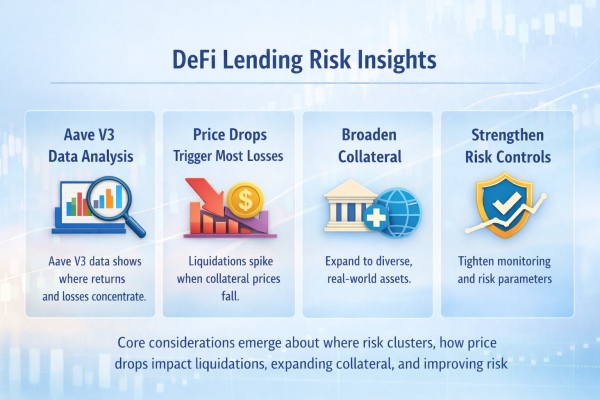
On April 2, 2026, a DeFi lending risk analysis using Aave V3 data from the Bank of Canada analyzes transaction data on Ethereum to find a market that works operationally, but depends on narrow revenue pools, heavy overcollateralization, and fast liquidation when collateral prices fall.
The paper focuses on Aave V3 because it is the largest decentralized lending protocol by total value locked. It cites about $34 billion secured in smart contracts, roughly 25% of all DeFi TVL and about 50% of lending sector TVL. The data analyzed runs from January 27, 2023 to May 6, 2025, which gives the study enough depth to study how the model behaves in live market conditions and not just theory.
The earnings base is much narrower than the deposit base. On Aave V3, WETH, USDT, and USDC generate nearly 83% of total protocol earning in the sample. That doesn't mean the same pattern holds across the entire DeFi lending market, but it does show the largest lending protocol still relies heavily on a small set of assets to produce revenue.
Supply alone does not tell you much. Utilization does. A token can hold a large share of deposits and still contribute very little if borrowing demand stays weak. So careful about judging a lending model by total deposits alone. Look at it by which assets actually generate borrow demand, spread income, and recurring usage.
The comparison with banking makes the constraint clearer. In 2024, Aave V3 posts an estimated 0.64% net interest margin, versus 2.48% for major US banks and 1.69% for major Canadian banks.
Aave V3 also shows a 40.0% loan to deposit ratio, compared with 61.2% for major US banks and 74.2% for major Canadian banks. The model runs with lower overhead, but it also runs with tighter economics and lower capital efficiency.
Repeated borrowing and redepositing of the same collateral accounts for about 20.46% of total borrowed volume and 8.20% of borrowing transactions on Aave V3.
Only about 2% of active users engage in this behaviour, but that small group borrows more often, takes larger positions, uses more flash loans, and runs closer to liquidation.
Risk isn't evenly spread across the user base, but with a relatively small group of sophisticated users who amplify exposure through repeated borrow and redeposit loops. A protocol can look healthy at the aggregate level while vulnerability builds inside a small cluster of accounts.
The largest liquidation wave in the sample reached about $258 million, and the top ten waves account for roughly 80% of total liquidated volume.
WETH, wstETH, WBTC, and weETH account for about 90% of total liquidated value. Collateral diversity on paper is not the same as resilience in practice. When account stress rises, losses still cluster around a small set of core assets.
For all liquidated users, 84.40% of health factor deterioration comes from collateral price declines. For the largest borrowers, that rises to 97.28%. Interest rate changes play only a minor role in the hour before liquidation. So do borrower actions like repaying, withdrawing, borrowing, or supplying more assets.
Immediate risk is mostly market driven. If collateral drops hard enough, the position breaks. Everything else is secondary.
Liquidation fees range from about 5% to 10% of liquidated value. When missed upside from post liquidation price recovery is added, combined borrower losses can reach roughly 10% to 30%.
Automation protects lenders and preserves solvency, but it forces borrowers out at the worst possible time. That raises a harder design question. How do you reduce forced exits before volatility does the damage?
The authors highlight tokenized real world assets as a way to broaden the collateral base and improve stability. They point to decentralized identity frameworks to support better underwriting.
They also raise the question of prudential tools such as leverage limits, capital requirements, or liquidity thresholds.
Concentration risk in DeFi isn't just exposure to a single token. It's dependence on a narrow collateral base, a narrow earnings base, and a narrow set of highly leveraged users. Broader collateral, stronger underwriting signals, and tighter limits can each address a different part of that problem.
Focus on where revenue actually comes from. If earnings depend on a small number of assets, growth is more fragile than it looks.
Track who drives leverage, not just how many users exist. A small group can shape downside risk.
Improve collateral quality, not just collateral variety. Adding assets does not reduce risk if stress still runs through the same core tokens.
Build liquidation buffers into the product. Earlier warnings, better position visibility, and automated risk controls can reduce forced selling.
The strategic takeaway is DeFi lending demand isn't the issue, but rather risk concentration is. The platforms that stand out will spread exposure across better collateral, reduce reliance on highly leveraged users, and design systems that hold up when prices drop. That's how the model can mature from access to durable growth.
The National Crowdfunding & Fintech Association (NCFA Canada) is a financial innovation ecosystem that provides education, market intelligence, industry stewardship, networking and funding opportunities and services to thousands of community members and works closely with industry, government, partners and affiliates to create a vibrant and innovative fintech and funding industry in Canada. Decentralized and distributed, NCFA is engaged with global stakeholders and helps incubate projects and investment in fintech, alternative finance, crowdfunding, peer-to-peer finance, payments, digital assets and tokens, artificial intelligence, blockchain, cryptocurrency, regtech, and insurtech sectors. Join Canada's Fintech & Funding Community today FREE! Or become a contributing member and get perks. For more information, please visit: www.ncfacanada.org
| | |
|---|---|---|
| | |



August 26th, 2025

January 4th, 2024

June 1st, 2021

September 9th, 2020

July 9th, 2018

January 3rd, 2018

September 25th, 2017

June 20th, 2017

May 10th, 2017

December 14th, 2016
