





Karsten Wenzlaff, Advisor
August 26th, 2025
Karsten Wenzlaff is a Crowdfunding and Fintech Expert from Germany. He is Secretary-General of Digit[...]


Apr 2, 2026 | NCFA Insight | Capital Markets And Market Infrastructure
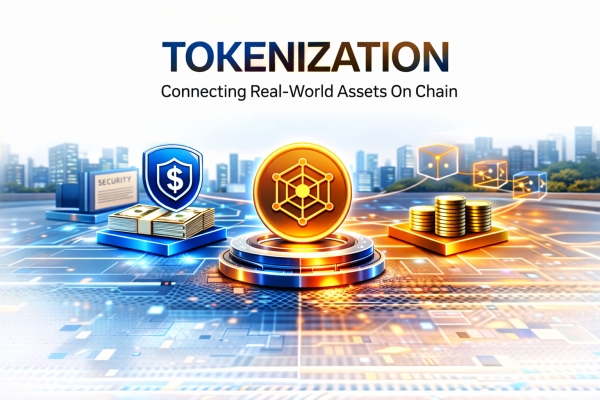
The market is no longer asking if tokenization works. It is deciding where it works first.
An OMFIF report on tokenization frameworks lays out how this market is forming. Not all tokenization is created equal. It breaks into different legal and operating models, and those models scale at different speeds. That aligns with what NCFA has already highlighted in how tokenized infrastructure is starting to change market operations.
In practice, the limits are already clear. On March 11, 2026, the European Central Bank confirmed Pontes will launch in Q3 2026 to enable central bank money settlement for DLT based transactions. The Eurosystem has also made clear that central bank money remains the anchor for settlement. Without trusted settlement, tokenized assets do not scale.
The OMFIF report separates tokenization into three models.
Most activity today sits in indirect and incomplete models. Fully native on chain markets remain limited. These structures carry different rights the affects ownership, investor protection, and how claims hold up under stress.
The spread across asset classes is now visible in real issuance and product data. As shown below, activity clusters where structure, custody, and settlement align with existing market practice.
Slovenia’s €30m sovereign issue and the World Bank’s €100m digital notes sit alongside tokenized fund products like BlackRock’s BUIDL at about $1.8bn and Franklin Templeton’s Benji fund at about $865m.
Real asset platforms such as RedSwan and Toucan extend this into real estate and carbon markets.
Infrastructure layers like Broadridge’s distributed ledger repo platform process about $385.5bn in daily volume. Adoption follows existing workflows.

Illustrative examples based on OMFIF report data and public disclosures
Most of the activity is around collateral. Assets remain with custodians while ownership records update faster, improving how collateral moves across the system. Market data supports this. RWA.xyz shows tokenized US Treasuries at about $10B and $27.57B in distributed asset value, alongside $299.32B in stablecoins.
Franklin Templeton’s off exchange collateral program shows how this works in practice. Clients use tokenized money market fund shares as collateral while assets remain in regulated custody, which is similar to what NCFA covered in institutional tokenized money market fund adoption. Collateral efficiency and usable capital drive early adoption.
According to the OMFIF report survey, faster isn't always better. Only 16% of bond market participants prefer T+0. Most prefer longer cycles to manage liquidity and funding. The target is settlement on demand, not instant settlement. That's why central banks are focusing on the money leg. Without trusted cash rails, tokenized assets don't scale cleanly.
At the same time, fragmentation still limits how far the model can go. There are 72 blockchains in use across financial services, and assets don't move easily across them without shared standards. Policy adds another constraint. In 2022, the Basel Committee set very high capital requirements for some public blockchain exposures, making them costly for banks to hold.
Even so, infrastructure is advancing. DTCC is preparing tokenization services for DTC-custodied assets, with rollout expected in the second half of 2026. The focus is on collateral mobility, continuous access, and programmable assets within existing systems.
Tokenization already works at scale in market infrastructure. Platforms like Broadridge’s distributed ledger repo solution support high volume repo activity, with reported usage reaching about $385bn in daily volume and roughly $9tn monthly across thousands of trades. It reduces friction in collateral movement and short term liquidity without requiring full market redesign. This is where adoption is already real.
The market is not converging on one model. It is dividing across designs impacted by real constraints. Products that match existing legal structures and improve workflows will adopt first. Others will take longer.
 The National Crowdfunding & Fintech Association (NCFA Canada) is a financial innovation ecosystem that provides education, market intelligence, industry stewardship, networking and funding opportunities and services to thousands of community members and works closely with industry, government, partners and affiliates to create a vibrant and innovative fintech and funding industry in Canada. Decentralized and distributed, NCFA is engaged with global stakeholders and helps incubate projects and investment in fintech, alternative finance, crowdfunding, peer-to-peer finance, payments, digital assets and tokens, artificial intelligence, blockchain, cryptocurrency, regtech, and insurtech sectors. Join Canada's Fintech & Funding Community today FREE! Or become a contributing member and get perks. For more information, please visit: www.ncfacanada.org
 |  |  |
|---|---|---|
 |  |  |
Apr 2, 2026 | NCFA Fintech Market Activity | Wealth Investing And Trading

The Trade Commissioner Service at the Consulate General of Canada in Chicago is inviting Canadian fintech companies to apply for a Fintech Showcase focused on accessing U.S. institutional wealth and asset management buyers.
The showcase takes place during Morningstar’s June 17 and 18 investment conference in Chicago. The conference brings together advisors and other investment professionals. The agenda covers AI, private markets, retirement, and portfolio strategy. Those topics line up with current demand for better research, portfolio insight, and advisor productivity tools. View the agenda.
Selected companies will present in a four minute format to a senior audience across wealth and asset management. Evaluation focuses on business model, market opportunity, impact on wealth and asset management, investor outcomes, and presentation quality. Companies need a clear wealth use case, defined buyer, and measurable impact on investor outcomes.
This is best suited for Canadian wealthtech and investment technology firms that help advisors, asset managers, and investment platforms research, manage, personalize, or report on investments, or expand access and reduce friction for investors. It is a weaker fit for broad consumer fintech, horizontal infrastructure, or products without a clear link to wealth, asset management, or investor outcomes.
The application deadline is May 17, 2026. Apply now if your product is revenue ready and built for institutional wealth and asset management buyers.
The National Crowdfunding & Fintech Association (NCFA Canada) is a financial innovation ecosystem that provides education, market intelligence, industry stewardship, networking and funding opportunities and services to thousands of community members and works closely with industry, government, partners and affiliates to create a vibrant and innovative fintech and funding industry in Canada. Decentralized and distributed, NCFA is engaged with global stakeholders and helps incubate projects and investment in fintech, alternative finance, crowdfunding, peer-to-peer finance, payments, digital assets and tokens, artificial intelligence, blockchain, cryptocurrency, regtech, and insurtech sectors. Join Canada's Fintech & Funding Community today FREE! Or become a contributing member and get perks. For more information, please visit: www.ncfacanada.org
| | |
|---|---|---|
| | |
March 27, 2026 | NCFA Fintech Whisperer Weekly Intelligence | Digital Assets Blockchain And Tokenization, Regulation And Policy, Payments And Market Infrastructure, Risk Compliance And Regtech

Image: Freepik
This live weekly NCFA intelligence page tracks financial technology developments that significantly affect how fintechs build, sell, raise capital, and operate under scrutiny. Coverage prioritizes Canada and includes global events that directly influence competitive conditions, market access, and execution realities across fintech sectors. This page will be updated throughout the week with market movers in a live format and then each week we'll close the prior week's contents in prep for the upcoming week, and continue on a rolling basis. (Missed prior week's Fintech Whisperer? (December 6-12, 2025, December 13-19, 2025, January 1-9, 2026, January 10-16, 2026, January 17-23, 2026, January 24-30, 2026, January 31-February 6, 2026, February 7-13, 2026, February 14-20, 2026, February 21-27, 2026, February 28-March 6, 2026, March 7-13, 2026, March 14-20, 2026).
The RBA is moving past short pilots. The focus now is how tokenised money works with existing settlement systems and what holds up under real use.
The SEC is narrowing one regulator facing CAT access path in the name of cost savings while keeping other query methods in place. That doesn't change trading rules, but it can change how efficiently regulators search market activity and build surveillance cases, and to that extent there are some concerns around reduced oversight.
Fully paid lending goes from exemption based programs to a standard rule set. Dealers need to update inventory funding structures and controls before the effective date.
Tokenization is now being discussed inside the core U.S. capital markets policy process, with major market infrastructure and exchange voices at the table. That raises the odds that tokenized securities will be treated as a market structure question tied to trading, clearing, settlement, and custody, not only as a digital asset issue.
Lynn Martin, President, NYSE Group: “As we explore how tokenization can enhance capital markets, it is critical that new infrastructure is developed in a way that preserves the trust, transparency, and protections investors expect. Securitize brings deep experience in digital asset infrastructure and transfer agency, making them a strong partner in helping design this next generation of market structure.”
India is moving from payment expansion to payment control. Fraud liability, cyber resilience, cross border authorisation, and switching now sit closer to the centre of the next build cycle for banks, payment firms, and fintech infrastructure providers.
Visa is getting into the infrastructure layer. Privacy has been one of the main blockers for banks and large financial institutions using shared blockchain systems. If that barrier starts to fall, onchain payments, settlement, and treasury activity can move closer to core financial market infrastructure.
FMI oversight expectations set the operating floor for payments and clearing infrastructure, which can flow through to participant requirements, vendor controls, and resilience planning.
This brings tokenized cash into live institutional money movement. It's a major Canadian bank using tokenized cash to support real margin, collateral, and settlement flows on a continuous basis. Tokenized money is moving deeper into market infrastructure and gives regulated institutions a way to move value when markets need it 24/7, not only during banking hours.
Deloitte and Stablecorp are building integration paths for financial institutions to use QCAD inside existing systems. The work targets clearing, treasury, and cross-border flows, but no deployments or pilots have been confirmed yet. Treat this as a signal that stablecoin infrastructure is being wired into bank workflows ahead of regulatory clarity.
This closes a multi phase refresh and sets a new baseline for dealer compliance interpretation across UMIR topics, which can flow into policy mapping, training, and vendor rule logic.
Bill C-15 puts stablecoins, payments, and consumer-driven banking under a more unified central bank structure. Firms now need to plan for supervision across digital money and data-sharing models, not treat them as separate tracks.
Event contracts are now included in a defined Canadian dealer framework. Firms need to clear product design, compliance, and notification before going live.
AI assisted authorisations and automated reporting feeds can shorten approval timelines and change how supervision picks up issues from live data.
Sarah Pritchard, Deputy Chief Executive, Financial Conduct Authority: “We want to see more people getting supported, who aren’t currently, and a market that innovates and offers tailored services to meet differing consumer needs.”
Dealers and fintech vendors that support eDiscovery, recordkeeping, surveillance, and investigation response workflows now have a clear CIRO baseline for data handling, metadata preservation, and production process design.
Courts are beginning to test whether engagement led product design itself can create liability at scale. If that theory survives, the impact reaches beyond social media. Any digital product that depends on compulsive use patterns, especially where minors or vulnerable users are involved, faces legal scrutiny and compliance costs.
August 6 update: A New Mexico court ordered Meta to establish a US$567M abatement fund, bringing the financial remedies in the case to US$942M, and imposed youth-safety requirements covering age assurance, teen usage and notifications, adult-minor contact controls and AI-chatbot interactions involving minors. Meta plans to appeal.
As more execution flows move through automated and intermediated channels, CIRO is making it clearer who is responsible, how orders must be marked, and what supervision has to look like. That raises the operating standard for dealers, trading desks, legal and compliance teams, and firms providing marketplace access. Electronic access remains open, but responsibility for supervision, order marking, and control cannot blur as more parties exist between the client and the marketplace.
This raises the risk that sports prediction markets face a direct statutory limit before the category settles into a stable regulatory path. Congress is now testing whether these contracts belong inside federal market infrastructure or back inside state gambling rules. Important for exchanges, prediction market operators, legal teams, and investors betting on event contracts as a durable product category.
This series puts AI governance in focus for banks and fintechs, especially around model risk, cybersecurity controls, and how supervisors assess AI driven decisioning inside core workflows.
China is using tax data, regulated data sharing, and specific technologies to push more SME credit through banks. That is a lending infrastructure signal, not just a blockchain headline.
Regulators are setting clearer boundaries, and infrastructure is moving into production at the same time. That combination raises the cost of getting it wrong and shortens the window to get it right. Teams need working controls, real vendor oversight, and systems that hold up under load before scaling anything customer facing. NCFA offers various curated resources to help founders and investors stay current on developments that impact fintech markets, subscribe to NCFA weekly newsletter updates, view a rundown of current fintech news and insights, or dive into the latest fintech industry research.
The National Crowdfunding & Fintech Association (NCFA Canada) is a financial innovation ecosystem that provides education, market intelligence, industry stewardship, networking and funding opportunities and services to thousands of community members and works closely with industry, government, partners and affiliates to create a vibrant and innovative fintech and funding industry in Canada. Decentralized and distributed, NCFA is engaged with global stakeholders and helps incubate projects and investment in fintech, alternative finance, crowdfunding, peer-to-peer finance, payments, digital assets and tokens, artificial intelligence, blockchain, cryptocurrency, regtech, and insurtech sectors. Join Canada's Fintech & Funding Community today FREE! Or become a contributing member and get perks. For more information, please visit: www.ncfacanada.org
| | |
|---|---|---|
| | |
Mar 26, 2026 | NCFA Feature | Digital Assets Blockchain And Tokenization
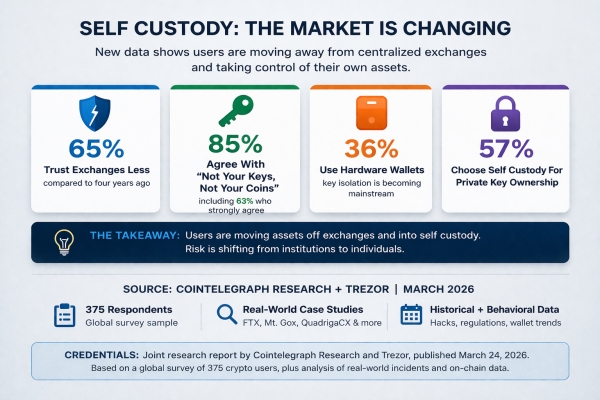
On March 24 2026, a Cointelegraph Research and Trezor report on self custody behaviour put hard numbers behind the trend that's been building for years. Trust in centralized platforms keeps falling. At the same time, self custody is moving out of the expert corner of crypto and into the mainstream for serious users.
The report draws on 375 survey responses and pairs that data with real world exchange failures, wallet design analysis, and a sober look at where users still get hurt. People have watched enough platforms fail, and now they're changing how they hold assets.
A combined 65% of respondents say they trust centralized exchanges less than they did four years ago. Of that group, 45% say they trust them much less and 20% say they trust them a bit less
33% point to exchange hacks as the main driver. 27% point to collapses such as FTX. Another 26% point to regulatory restrictions.
The trend matches the market’s recent history. FTX exposed an estimated $8B hole in customer funds. QuadrigaCX collapsed amid fraud and broken internal controls. Mt. Gox lost about 850,000 BTC after years of theft and system failures.
The deeper issue is structural. Centralized platforms gather large pools of assets behind a small number of operational and administrative control points. That concentration makes them efficient in good times, but it also makes them attractive targets when something goes wrong. One breach, one fraud, one breakdown in controls, and the damage can spread fast.
Users aren't just frustrated. They're acting on it.
A striking 85% of respondents agree with the phrase “not your keys, not your coins.” That includes 63% who strongly agree. It's becoming standard thinking for people who want lasting control over digital assets.
When asked why they use self custody, 57% say private key ownership is the main reason. Another 24% say maximum security drives the decision.
Most respondents say they would not leave assets on a custodial exchange for more than one month, even without an immediate panic event. In practice, exchanges are starting to look less like vaults and more like temporary access points.
One of the clearest data points in the report is that 36% of respondents actively use hardware wallets.
A hardware wallet keeps your private keys off your phone or computer. You set up a transaction on your device, then confirm and sign it on the hardware wallet. The keys never leave the wallet. This lowers the risk of malware, hacks, and common theft methods.
Hardware wallets protect your keys, but they don’t protect your decisions. They can confirm a transaction comes from your device, but they can’t always tell if you fully understand what you’re approving.
Phishing is still one of the biggest risks. Attackers copy real wallet brands, fake support messages, and trick users into giving up their recovery phrase. Once that’s exposed, the funds are usually gone.
Blind signing is another major issue, especially with smart contracts. Users approve transactions without fully understanding what they do. The report highlights a real case where a malicious approval led to a $1.4B loss. That alone shows self custody is not just about buying a device and feeling safe.
Supply chain risk is also real. Some people buy wallets from unofficial sellers and receive devices that have been tampered with or come with preset seed phrases. It compromises the user before self custody even begins.
Physical security is becoming more serious as well. The report cites 74 publicly reported physical attacks on crypto holders in 2025, with at least 9 already recorded in January 2026. These are real world attacks tied to visible holdings and weak operational privacy.
Then there is the quieter problem that rarely gets enough attention, which is backup failure. The report estimates that roughly 10% of circulating Bitcoin supply may already be lost because users mismanage recovery material or lose access entirely. It reminds the market that the biggest long term risk in self custody may not be theft alone. It may be preventable self inflicted loss.
Another useful part of the report is its treatment of regulatory risk. Users are not only responding to hacks and insolvencies. They are also responding to the fact that access to funds can be interrupted, such as payment rail seizures, exchange shutdowns, withdrawal suspensions, and enforcement actions that cut off access to custodial accounts. Different cases arise from different legal and operational reasons.
Users who worry about counterparty exposure, platform freezes, or policy driven restrictions increasingly want a self custody setup they can control directly.

Digital wallets are becoming core control layers in digital asset finance. That assumes customers will keep meaningful balances on platform for long periods of time.
The next real product gap is not only stronger key storage, but clearer intent verification. Users need to know what they are signing, why they are signing it, and what will happen next. That means readable transaction flows, better simulation tools, stronger warnings, clearer address handling, and far less dependence on users interpreting raw contract data on the fly.
Security is central to the user experience. The firms that reduce confusion, expose hidden risk, and make recovery practices easier to manage will offer a match better product experience than companies that assume security begins and ends with cryptography.
Finally, distribution and engagement models will keep changing as assets move off centralized platforms and into user controlled environments. Markets are evolving toward wallet centered ecosystems, service layers, and infrastructure that works with user sovereignty rather than around it.
Ownership does not create security on its own. Security comes from repeated good practice. Users need to verify transactions carefully, protect recovery material, source devices properly, and think through physical as well as digital threat models. Put differently, self custody is not a static product state. It is an operating discipline.
Self custody is no longer a niche behaviour reserved for maximalists, techies, and power users. It is becoming a natural response to broken trust in centralized custody. It moves responsibility away from institutions and toward individuals, which means the next generation of financial products must do more than secure assets. They must help people operate safely in a digital finance world.
The National Crowdfunding & Fintech Association (NCFA Canada) is a financial innovation ecosystem that provides education, market intelligence, industry stewardship, networking and funding opportunities and services to thousands of community members and works closely with industry, government, partners and affiliates to create a vibrant and innovative fintech and funding industry in Canada. Decentralized and distributed, NCFA is engaged with global stakeholders and helps incubate projects and investment in fintech, alternative finance, crowdfunding, peer-to-peer finance, payments, digital assets and tokens, artificial intelligence, blockchain, cryptocurrency, regtech, and insurtech sectors. Join Canada's Fintech & Funding Community today FREE! Or become a contributing member and get perks. For more information, please visit: www.ncfacanada.org
| | |
|---|---|---|
| | |
Mar 24, 2026 | NCFA Feature | AI Finance And Data Governance
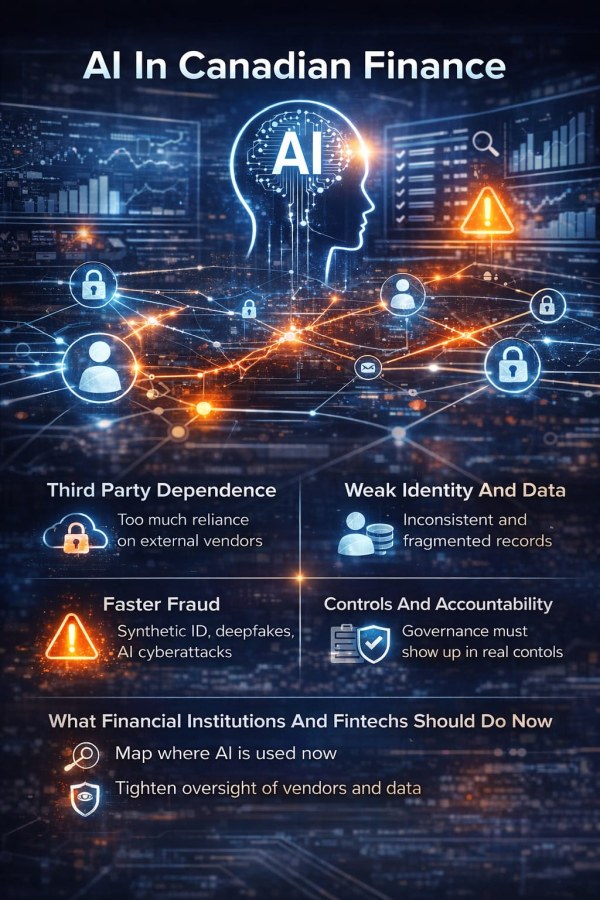
On Mar 23 2026, OSFI and the Global Risk Institute published the FIFAI II final report based on four workshops held between May and November 2025. More than 170 participants took part across banks, insurers, asset managers, fintechs, vendors, regulators, academics, and consumer voices.
The report confirms that AI adoption is here, citing 72% AI use at work in financial services and 75% organizational support for AI. While AI is already in use. The real issue is what still limits its use in regulated decisions and customer outcomes.
The series covered four areas that affect operational, prudential, consumer, and system-wide risk at the same time. Full report and framework: FIFAI II final report and AGILE framework PDF
One of the clearest takeaways is that AI will not spread across finance at the same speed. The first gains will come in internal functions such as fraud detection, surveillance, reporting, cyber defence, and operations. Those areas already have strong data, measurable outputs, and clearer accountability.
Customer-facing decisions are different. Underwriting, advice, product recommendations, and self-serve tools carry more pressure around explainability, fairness, consent, and complaints handling.
AI powered Canadian finance will likely grow faster in control functions than in customer-facing decisions.
The report treats third party AI as more than a procurement issue. It highlights growing dependence on external providers for models, infrastructure, and data, along with limited visibility into how those systems work and who sits behind them.
It's important because a failure, outage, or change in access at one provider can affect more than one function at the same time. Fraud controls, underwriting tools, customer service, and risk monitoring can all be exposed together. The financial stability workshop adds to that concern by linking third party dependency to concentration and system level risk.
Banks, insurers, and fintechs will need stronger oversight of models and providers, better audit access, tested fallback plans, and clearer visibility into the wider supply chain behind key AI services.
AI is improving both offence and defence. The final report points to synthetic identity, deepfakes, voice spoofing, AI assisted cyberattacks, fraud as a service, and disinformation. It notes a sharp rise in deepfake attacks and growing concern about voice verification as AI voice cloning improves.
This reality changes the operating environment. Static controls lose value faster when attack tools get cheaper, stronger, and easier to use. Manual review and occasional rule updates will not be enough. Firms will need faster detection, stronger identity controls, better information sharing, and systems that can adjust while attacks are happening.
Data problems come up across the whole series, but the larger issue is bigger than data quality alone. Weak identity and fragmented data still limit how far AI can go in regulated finance. The report points to inconsistent data, incomplete records, fragmented platforms, offshore storage concerns, and weak data lineage as barriers to both efficiency and safety.
The report doesn't mince words on identity. Canada still doesn't have a widely adopted secure digital identity layer. That leaves onboarding, authentication, consumer channels, remote work, and agent based systems more exposed than they should be. If identity and data remains weak, AI will keep working best in narrower internal use cases and face more limits in customer facing execution.
The final report introduces the AGILE framework as part of its overall findings, which stands for Awareness, Guardrails, Innovation, Learning, and Ecosystem Resiliency. The framework calls for stronger governance and oversight, stronger data and risk controls, continued investment in technology and talent, and deeper public private collaboration.
AI oversight cannot remain just at the strategy level. If AI is used in lending, fraud, underwriting, complaints, or customer recommendations, governance has to show up in controls, evidence, escalation, and accountability. In regulated finance, that's what turns AI use from experimentation into something firms can defend and scale.
The workshop series points to a practical sequence:
First, identify where AI already impacts decisions and controls.
Second, separate the use cases that can scale now from the ones that still need stronger explainability and customer safeguards.
Third, tighten vendor oversight before dependency grows further.
Fourth, invest more in identity, data lineage (origin and how it's used and updated), and real time fraud controls.
Fifth, show boards stronger evidence instead of high level claims and broad assurance language.
The report also carries a warning worth taking seriously. Firms that move too slowly can fall behind on productivity, resilience, and customer expectations while still facing external AI enabled threats. One participant line stands out: “The biggest risk is not doing enough.”
Canada’s national AI strategy work has focused heavily on trust, safety, and responsible adoption. That is necessary, but this workshop series adds something more useful for operators. It shows where AI use slows once it enters regulated finance: concentrated provider risk, weak identity, fragmented data, explainability pressure, fraud risk, and unclear accountability.
There's a call to action policy lesson here too. Canada doesn't just need AI ambition and adoption. It needs stronger execution layers around Digital ID, data governance, third party oversight, and information sharing if it wants regulated financial AI to scale beyond contained pilots.
The OSFI and GRI workshop series is useful because it takes a holistic approach to identifying and adapting to AI risks in finance. AI is already inside financial systems. The advantage now goes to firms that can prove control, trust, and accountability in live decisions.
The National Crowdfunding & Fintech Association (NCFA Canada) is a financial innovation ecosystem that provides education, market intelligence, industry stewardship, networking and funding opportunities and services to thousands of community members and works closely with industry, government, partners and affiliates to create a vibrant and innovative fintech and funding industry in Canada. Decentralized and distributed, NCFA is engaged with global stakeholders and helps incubate projects and investment in fintech, alternative finance, crowdfunding, peer-to-peer finance, payments, digital assets and tokens, artificial intelligence, blockchain, cryptocurrency, regtech, and insurtech sectors. Join Canada's Fintech & Funding Community today FREE! Or become a contributing member and get perks. For more information, please visit: www.ncfacanada.org
| | |
|---|---|---|
| | |
March 20, 2026 | NCFA Fintech Whisperer Weekly Intelligence | Digital Assets Blockchain And Tokenization, Capital Markets And Market Infrastructure, Regulation And Policy, Payments And Market Infrastructure
Image: Freepik
This live weekly NCFA intelligence page tracks financial technology developments that significantly affect how fintechs build, sell, raise capital, and operate under scrutiny. Coverage prioritizes Canada and includes global events that directly influence competitive conditions, market access, and execution realities across fintech sectors. This page will be updated throughout the week with market movers in a live format and then each week we'll close the prior week's contents in prep for the upcoming week, and continue on a rolling basis. (Missed prior week's Fintech Whisperer? (December 6-12, 2025, December 13-19, 2025, January 1-9, 2026, January 10-16, 2026, January 17-23, 2026, January 24-30, 2026, January 31-February 6, 2026, February 7-13, 2026, February 14-20, 2026, February 21-27, 2026, February 28-March 6, 2026, March 7-13, 2026).
This adds a new regulated counterparty node for banks, payment partners, and fintech vendors that use CIRO membership as a gating factor for onboarding, integrations, and supervised operating scope.
This puts fund distribution onchain with rules built into the asset. Transfers can enforce who can hold and trade without separate manual checks. That changes how funds issue, manage investors, and handle transfers. It points to tokenized fund infrastructure moving into live use, not pilots.
This affects crypto trading platforms, market makers, treasury teams, and regulators watching stablecoin market structure in Canada. Lower margin on eligible inventory can improve capital efficiency and balance sheet use, but only inside a tighter control framework. It means regulated treatment of stablecoins is moving deeper into prudential design, not just disclosure and registration.
A core global index now trades outside exchange hours. Price formation can start on crypto venues before futures markets reopen, which puts pressure on where liquidity shows up first. If activity builds on chain, traditional venues risk reacting instead of leading. For brokerages, exchanges, and market infrastructure providers, this is not theoretical. Firms need to decide whether to support 24/7 access, how to manage risk when markets never close, and how to compete with venues that remove time and geographic limits.
Crypto issuers, exchanges, custodians, brokers, investors, and token builders now have a clearer US reference point for token design, disclosures, and jurisdiction planning. The practical implication is significant. Firms exposed to staking, airdrops, wrapped assets, stablecoins, or token distribution models can reassess compliance, product structure, and market access strategy with more precision across SEC and CFTC lines.
This is for banks, lenders, treasury teams, and fintechs that rely on bank balance sheets and bank distribution. Capital rules affect lending capacity, pricing, and risk appetite. A lighter or more targeted framework can change how banks allocate capital and where they are willing to compete.
Banks facing margin pressure, conduct costs, and weak returns are under more pressure to lower their operating base faster. The practical implication for lenders, fintechs, and banking vendors is that AI and automation are moving from pilot projects into cost and staffing decisions. Firms that can automate servicing, operations, and control workflows without weakening customer outcomes or compliance will be in a stronger position.
This gives UK facing fintechs and suppliers a cleaner map of where supervisors focus and where firms should spend compliance and product time. Payments, retail banking, consumer finance, and wholesale market firms can now align internal control roadmaps to sector specific priorities instead of broad portfolio letters, which tightens how boards and senior managers justify investment decisions.
Federal procurement remains difficult for new entrants to access, with complexity and restrictive design favouring repeat suppliers. At the same time, the report outlines clear changes that could open participation, improve competition, and expand access for fintech, govtech, and smaller vendors seeking to sell into government.
China is widening the distribution base for state digital money inside the banking system. Analysts see the bigger role in cross-border settlement and in building a payments channel that's outside dollar-based infrastructure such as SWIFT. China is pushing public digital money deeper into bank distribution while closing space for private stablecoin models.
This expands direct access for credit unions that want to build or buy modern payment capabilities. Credit unions, processors, and fintech partners can now plan for real system participation, not just eligibility on paper.
This is for banks, cross-border payment firms, remittance providers, treasury teams, and stablecoin infrastructure players. Stablecoin payouts are moving closer to standard bank payment flows instead of sitting outside them as a separate integration project. That lowers friction for bank adoption and puts more pressure on legacy cross-border payout models.
Mastercard is building direct control over how funds move between bank accounts and stablecoin systems. That changes routing, pricing, and who captures value in cross border and treasury flows. For fintechs, payment products will increasingly need to support both fiat and digital settlement paths in the same workflow. For banks, this puts more pressure on correspondent banking and other legacy cross border revenue lines.
This changes how investor harm connects to enforcement outcomes. Dealers, registrants, and their vendors now need tighter client records and cleaner evidence trails because the process depends on what harmed investors can prove and what firms can produce quickly and accurately when claims arrive.
This lowers reporting cost and workload for smaller public companies. It changes how often new financial data enters the market. Investors and data platforms will have less frequent updates. For issuers, this improves the economics of staying public. If adopted more widely, it moves Canada toward a lighter reporting model for venture markets.
Industry participants are pushing to remove limits that keep tokenized market infrastructure in pilot mode. That pressure targets how quickly the EU can move from controlled testing toward scalable digital asset markets.
Tokenized securities into the core of exchange trading. They will trade the same way as regular shares, on the same book, with the same symbol and rules. No separate venue, no parallel system. It removes a major barrier with tokenization now aligned with the same clearing, settlement, and surveillance systems as the rest of the market.
A forward flow commitment supports predictable loan takeout capacity, which can stabilize origination volume when bank balance sheets tighten or pricing changes.
Public companies, investors, analysts, and fintech platforms that rely on earnings data will face longer gaps between official disclosures. Less frequent reporting reduces the flow of standardized financial data into the market. Firms that can generate alternative data, continuous signals, and independent performance insight will have an advantage as reliance on scheduled earnings reports declines.
When one of India's largest fintech payments company pauses an IPO, it tells founders, investors, and late stage boards that the public market window remains fragile. That affects valuation expectations, liquidity planning, and timing for other fintech listings.
NCFA offers various curated resources to help founders and investors stay current on developments that impact fintech markets, subscribe to NCFA weekly newsletter updates, view a rundown of current fintech news and insights, or dive into the latest fintech industry research.
The National Crowdfunding & Fintech Association (NCFA Canada) is a financial innovation ecosystem that provides education, market intelligence, industry stewardship, networking and funding opportunities and services to thousands of community members and works closely with industry, government, partners and affiliates to create a vibrant and innovative fintech and funding industry in Canada. Decentralized and distributed, NCFA is engaged with global stakeholders and helps incubate projects and investment in fintech, alternative finance, crowdfunding, peer-to-peer finance, payments, digital assets and tokens, artificial intelligence, blockchain, cryptocurrency, regtech, and insurtech sectors. Join Canada's Fintech & Funding Community today FREE! Or become a contributing member and get perks. For more information, please visit: www.ncfacanada.org
| | |
|---|---|---|
| | |
Mar 20, 2026 | NCFA Market Activity | Quantum Security And Digital Finance

Image: Pixabay/geralt
On Mar 18, 2026, the 2025 ACM A.M. Turing Award recognized Gilles Brassard and Charles H. Bennett for foundational work in quantum information science, including the development of quantum cryptography. The award carries a $1 million prize and marks one of the highest global honours in computing.
Brassard’s work established early methods for secure communication using quantum mechanics, a field now directly tied to the future of encryption. While he didn't develop today’s post quantum standards, his research helped define how information can be secured against quantum-enabled attacks. That body of work went from advanced research to execution in August 2024 when NIST finalized the first post quantum cryptography standards for encryption and digital signatures used across financial systems.
As ACM President Yannis Ioannidis stated:
“Their work is an important foundation for the field of quantum computing and has fundamentally changed how we process, transmit, and secure information.”
Post quantum cryptography (PQC) refers to new encryption methods designed to remain secure even if future quantum computers can break today’s widely used systems today, such as RSA and elliptic curve cryptography that currently protect payments, digital identity, secure messaging, APIs, and financial data.
On Aug 13, 2024, NIST finalized three post quantum cryptography standards and announced that organizations should begin transitioning to them as soon as possible. NIST states these standards support encryption and digital signatures used to secure electronic information, including financial transactions and sensitive data.
NIST also states that no one knows exactly when a cryptographically relevant quantum computer will arrive, but some experts estimate it could be possible in less than 10 years. That uncertainty increases the risk because encrypted data can be collected today and targeted for future decryption under the harvest now, decrypt later threat model.
Canada has already set execution timelines. The Canadian roadmap for post quantum cryptography migration requires departments to begin planning in April 2026, report progress annually, transition high priority systems by the end of 2031, and complete remaining migration by the end of 2035. Canada’s national strategy for quantum communication and cryptography states that advances in quantum computing could undermine current encryption and threaten digital systems and data security.
For financial services, encryption now affects what gets built and what gets bought. Payments, identity, onboarding, APIs, messaging, custody, and long term data all rely on encryption that may need to be replaced or upgraded.
Quantum also reaches into blockchain based finance like stablecoins, tokenized deposits, wallet infrastructure, custody controls, and smart contract connected payment flows all depend on digital signatures and key management. NCFA’s earlier coverage of quantum safe stablecoins points to a market approaching US$250 billion and highlights how quantum safe controls are already being added to stablecoin settlement systems.
Buyers are starting to ask direct questions. Where is encryption used in the product. Which parts rely on current standards. What is the plan to upgrade. These questions and decisions are part of core financial workflows now and show up across payments messaging, identity systems, API access, document signing, custody, and stored data.
Vendors that can clearly show where encryption sits in their systems and how they plan to upgrade it will have an advantage as requirements tighten.
NIST standards are finalized and Canada has set migration timelines starting in April 2026, with high priority systems due by the end of 2031 and full migration by the end of 2035. That puts a clock on encryption used across payments, identity, APIs, messaging, custody, and long term data.
The National Crowdfunding & Fintech Association (NCFA Canada) is a financial innovation ecosystem that provides education, market intelligence, industry stewardship, networking and funding opportunities and services to thousands of community members and works closely with industry, government, partners and affiliates to create a vibrant and innovative fintech and funding industry in Canada. Decentralized and distributed, NCFA is engaged with global stakeholders and helps incubate projects and investment in fintech, alternative finance, crowdfunding, peer-to-peer finance, payments, digital assets and tokens, artificial intelligence, blockchain, cryptocurrency, regtech, and insurtech sectors. Join Canada's Fintech & Funding Community today FREE! Or become a contributing member and get perks. For more information, please visit: www.ncfacanada.org
| | |
|---|---|---|
| | |



August 26th, 2025

January 4th, 2024

June 1st, 2021

September 9th, 2020

July 9th, 2018

January 3rd, 2018

September 25th, 2017

June 20th, 2017

May 10th, 2017

December 14th, 2016
