





Karsten Wenzlaff, Advisor
August 26th, 2025
Karsten Wenzlaff is a Crowdfunding and Fintech Expert from Germany. He is Secretary-General of Digit[...]


Mar 3, 2026 | NCFA Fintech Market Insight | Small Business Performance And Payments
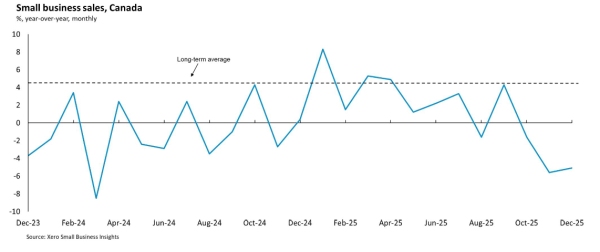
Image: Small Business Sales, Canada (Xero Small Business Insights, Canada Oct Dec 2025)
On February 26 2026, Xero released its Small Business Insights Canada Update for October to December 2025, based on aggregated and anonymized small business accounting data from its small business accounting platform, not survey responses. The dataset reflects real invoicing and payment activity captured within the Xero system. The December quarter closed with a clear revenue reversal while payment discipline strengthened. The numbers provide an operating baseline for fintech lenders, payments firms, and financial institutions serving the small business segment, as we move deeper into 2026.
Quarterly Sales Growth 2025
Q1: +5.0%
Q2: +2.8%
Q3: +2.0%
Q4: −4.1%
Q4 Monthly Breakdown
October: −1.6%
November: −5.6%
December: −5.1%
A nine percentage point swing from Q1 to Q4, with the December quarter decline the largest since September 2020. The Q4 reversal showed how fast small business demand can change. Sales moved from solid growth early in the year to a sharp contraction by December.
That kind of swing compresses reaction time. For lenders and platform providers, continuous revenue monitoring is more important than backward looking ratios. Fintechs that track live invoicing flows and cash inflows gain earlier warning signals. Banks that still rely on periodic reporting will be reactive. The risk is no longer just default, it's also speed.
During periods of weaker revenue, founders focus on cash flow and credit, but they also need to review commercial insurance coverage options as risk exposure increases.
Full Year 2025 Average: +1.4%
Long Term Average: +4.5%
A sustained three percentage point gap versus historical norms. Not a single weak month but a structural softness across the year. When growth slows, small businesses focus on managing timing. They want certainty around receivables, payables, and liquidity buffers. Expansion plans move to the background. This changes product priorities. Tools that shorten receivable cycles, automate reconciliation, and provide flexible liquidity become core operating infrastructure. Working capital solutions that assume growth acceleration may miss the mark. Fintechs that help stabilize cash flow, and not amplify growth, may align better in this cycle.
Late Payment Days
June Quarter: 11.3 days
September Quarter: 9.8 days
December Quarter: 9.7 days
Long Term Average: 11.7 days
Time To Be Paid
June Quarter: 27.7 days
September Quarter: 26.3 days
December Quarter: 26.8 days
Revenue slowed, but businesses tightened receivables management. Payment behaviour improved into year end. Settlement timing held steady despite volatility in topline growth. This means payment behaviour data may now offer stronger forward insight than topline growth alone. If a business collects faster, even during a slowdown, that tells you something about discipline, customer quality, and internal controls. Fintech lenders that weight verified payment performance can price risk more precisely.
Q4 Sales Growth By Province
British Columbia: −8.2%
Alberta: −4.0%
Ontario: −1.7%
Q4 Time To Be Paid
Ontario: 28.4 days
British Columbia: 27.5 days
Alberta: 26.6 days
Regional sales outcomes and liquidity conditions diverged materially. National averages masked local differences. The December quarter showed wide variation across provinces. Some regions contracted far more than others. That gap changes the risk profile of a portfolio. National averages smooth out reality. A lender with concentrated exposure in a weaker province carries different forward risk than one diversified across stronger regions. Regional segmentation should move from a reporting exercise to a pricing and limit setting discipline. Portfolio steering needs to reflect local operating conditions, not national headlines.
Q4 2025 showed a structural split: weaker sales, stronger collections, and widening regional differences. For fintech leaders, the opportunity is not just reacting to the decline. It's in building systems that continuously read revenue direction, payment velocity, and geographic exposure at a granular level. Firms that can master these variables in real time will support small businesses more effectively in lower growth environments.
 The National Crowdfunding & Fintech Association (NCFA Canada) is a financial innovation ecosystem that provides education, market intelligence, industry stewardship, networking and funding opportunities and services to thousands of community members and works closely with industry, government, partners and affiliates to create a vibrant and innovative fintech and funding industry in Canada. Decentralized and distributed, NCFA is engaged with global stakeholders and helps incubate projects and investment in fintech, alternative finance, crowdfunding, peer-to-peer finance, payments, digital assets and tokens, artificial intelligence, blockchain, cryptocurrency, regtech, and insurtech sectors. Join Canada's Fintech & Funding Community today FREE! Or become a contributing member and get perks. For more information, please visit: www.ncfacanada.org
 |  |  |
|---|---|---|
 |  |  |
February 27, 2026 | NCFA Fintech Whisperer Weekly Intelligence | Digital Assets Blockchain And Tokenization, Regulation And Policy, Payments And Market Infrastructure, Risk Compliance And Regtech

Image: Freepik
This live weekly NCFA intelligence page tracks financial technology developments that significantly affect how fintechs build, sell, raise capital, and operate under scrutiny. Coverage prioritizes Canada and includes global events that directly influence competitive conditions, market access, and execution realities across fintech sectors. This page will be updated throughout the week with market movers in a live format and then each week we'll close the prior week's contents in prep for the upcoming week, and continue on a rolling basis. (Missed prior week's Fintech Whisperer? (December 6-12, 2025, December 13-19, 2025, January 1-9, 2026, January 10-16, 2026, January 17-23, 2026, January 24-30, 2026, January 31-February 6, 2026, February 7-13, 2026, February 14-20, 2026).
This is early proof that capital is willing to line up behind an asset backed token model before issuance begins. It matters for tokenization platforms, digital asset builders, and market operators because demand at this level raises the stakes on what comes next, especially issuance design, trading access, settlement flow, and how real world asset tokenization earns trust beyond crypto native buyers.
This affects stablecoin issuers, wallet and exchange operators, payment firms that want stablecoin rails, and banks that can custody reserves or provide settlement accounts. The sandbox work turns authorisation readiness into near term execution, because counterparties will start asking who controls mint and burn, how reserves get safeguarded, how redemptions clear under stress, and what evidence you can produce before the September 2026 application gateway opens.
Institutional buyers tend to route flow to whoever can prove segregation, controls, and settlement certainty under supervision, and this move aims straight at that bar.
This is important for payment firms, open banking providers, digital asset infrastructure teams, and banks building new rails in the UK. A single forward plan from all four authorities makes timing harder to ignore, because product roadmaps, compliance sequencing, and partner conversations now sit against a more visible policy calendar.
This is a real infrastructure and distribution move in Canadian payments. It affects fintechs that bank through Peoples, embedded finance and sponsor bank partners, and any firm building around faster payments rails, because a stronger bank plus processor stack can tighten expectations on integration, uptime, message quality, and partner readiness well before RTR becomes fully operational.
Is this a key domino in AI finance? This is what AI looks like when it evolves from product feature to company structure. Large fintechs, payments platforms, and their investors now have a clear example of stronger results arriving alongside much smaller teams, placing more weight on execution quality, operating discipline, and how management builds from here.
This is one of the cleaner bridges between public capital, development finance, and founder scale. If you build inclusion fintech in ASEAN, expect the bar to move toward impact proof and deployment readiness, because capital now sits inside the same program that opens doors.
This is a significant turn of events for credit unions, fintechs, and crypto custody models that want a federal charter in Canada. A clearer approvals path can change when firms choose to enter the federal perimeter and how seriously investors and partners treat that option.
It affects stablecoin issuers, banks, custodians, exchanges, and fintechs that plan to distribute payment stablecoins, because reserve design, redemption handling, audits, supervision, and custody expectations start to look like core product requirements, not optional features.
This affects lenders, CRAs, and fintechs that rely on bureau data for onboarding and underwriting. Teams should expect more pressure on data completeness, dispute handling, governance, and audit evidence because mandatory sharing can reset what a clean credit file must look like.
This meeting keeps the door open to a simpler capital raising layer below broker dealer economics. Platforms, issuers, and service providers that touch private raises and secondary liquidity should watch for recommendations that tighten who can get paid, how referrals get documented, and what disclosure standard can unlock broader resale paths.
This raises the value of process maturity. If your fintech faces enforcement exposure, the timeline gives more room to assemble evidence, but it also rewards teams that keep clean records and can explain decisions fast when scrutiny hits.
Important for tokenized markets because clean settlement depends on clean reference data. Teams building custody, collateral, repo, and tokenized securities infrastructure must soon meet a higher standard on pricing integrity, entitlement controls, and auditability as institutional workflows move on-chain.
This is an immediate capital incentive change. If you sell insurer investment, treasury, or regulatory reporting tooling, expect more pressure to classify eligible exposure fast and produce clean evidence for PC4 filings while the treatment stays live.
This raises the cost of weak pre-trade controls. Teams selling OMS, EMS, surveillance, or post trade tooling into dealers should expect more demand for guardrails that prevent self matching and catch close related mistakes early, plus audit ready evidence when exceptions still occur.
The market continues to tighten where new rails are forming, and where management teams are being forced to adapt faster. Stay nimble and ahead of the curve. Be cautious about waiting for late stage confirmations. NCFA offers various curated resources to help founders and investors stay current on developments that impact fintech markets, subscribe to NCFA weekly newsletter updates, view a rundown of current fintech news and insights, or dive into the latest fintech industry research.
The National Crowdfunding & Fintech Association (NCFA Canada) is a financial innovation ecosystem that provides education, market intelligence, industry stewardship, networking and funding opportunities and services to thousands of community members and works closely with industry, government, partners and affiliates to create a vibrant and innovative fintech and funding industry in Canada. Decentralized and distributed, NCFA is engaged with global stakeholders and helps incubate projects and investment in fintech, alternative finance, crowdfunding, peer-to-peer finance, payments, digital assets and tokens, artificial intelligence, blockchain, cryptocurrency, regtech, and insurtech sectors. Join Canada's Fintech & Funding Community today FREE! Or become a contributing member and get perks. For more information, please visit: www.ncfacanada.org
| | |
|---|---|---|
| | |
February 26, 2026 | NCFA Feature | Payments And Money Movement

AI Generated Image: UK Payments Vision Delivery Committee
UK Regulatory Coordination is Clear While Canada Moves in Parallel
On February 26, 2026, the UK published a Payments Forward Plan (download 8 page PDF here)that gives fintechs something they rarely get in one place: a coordinated three year sequence for payments policy across HM Treasury, the Bank of England, the FCA, and the Payment Systems Regulator.
Great not just for regulatory coordination but for founders, operators, and investors who don't just need rules. They need timing, ownership, and a visible order of work and execution, which helps steer the ship and build market confidence for the future of payments, open banking, stablecoins, and digital money movement.
The Payments Forward Plan is a single sequenced plan with regulatory alignment from four regulatory authorities who collaborated on the Payments Vision Delivery Committee to execute the UK governments national payments vision. The roadmap covers retail payments, wholesale payments, and parts of digital assets, which means the UK is not treating payments as a narrow rails file. It is treating the next payments stack as a mix of bank rails, data sharing, digital money, and automation. That is what makes the document strategically useful. It gives the market a clearer view of what is coming, who carries which part of the file, and when firms should expect consultations, responses, gateways, and final rule work to land.
For as long as NCFA has been working in the financial technology sector, the UK has long been considered the 'gold standard'; the benchmark for fintech regulation for a simple reason. When regulators reduce uncertainty about what lands next, firms spend more time building and less time guessing. It gives the market a clearer path. That kind of visibility lowers planning friction across the sector and gives serious teams a better chance to line up product, compliance, and partnerships before the rest of the market catches up.
| Sector / Initiative | United Kingdom | Canada | Notes / Comments |
|---|---|---|---|
| Regulatory coordination and forward planning | One published cross regulator plan across HM Treasury, the Bank of England, the FCA, and the Payment Systems Regulator, with a visible three year sequence. | Canada now has active public workstreams across retail payments supervision, consumer driven banking, and the stablecoin framework, but those files still sit across separate policy pages. | Canada shows real movement across the same core layers. The main contrast is that the UK visibly puts more of the sequencing into one public roadmap. |
| Payments law and core policy sequencing | Q2 2026 HM Treasury consultation, Q4 2026 response, then FCA consultations and policy statements through 2027 and 2028. | Canada’s payments law sequencing is already live through the RPAA. Under the supervisory framework, PSP risk management and end user funds safeguarding requirements came into force on September 8, 2025, and firms that continue operating must meet ongoing supervision requirements. | Canada has moved from consultation into operating supervision. The UK gives a longer visible forward sequence, while Canada is already in live compliance mode on the PSP file. |
| Open banking and consumer directed data sharing | First live variable recurring payments under an industry led scheme in Q1 2026, FCA consultation in Q3 2026, and a policy statement in Q1 2027. | Canada’s Budget 2025 framework for consumer driven banking says the government will complete the Consumer Driven Banking Act, move quickly on phase one regulation after Royal Assent, and spend the next 12 to 18 months on a second phase that considers broader functionality, participant scope, and write access. See Canada Open Banking Commercialization Roadmap | Canada has a real public sequence here, even if it is not presented inside one cross regulator payments calendar. |
| Stablecoins, tokenised money, and tokenised deposits | Bank consultation work in H1 2026, final Bank rules by end 2026, FCA policy statement in mid 2026, authorisation gateway in Q3 2026, and broader regime live in October 2027. The plan also explicitly considers tokenised payments and tokenised deposits. | Canada’s official stablecoin framework says regulatory development starts after Royal Assent, continues over 12 to 18 months from early 2026, and is expected to come into force in 2027, with the Bank of Canada supervising issuers. | Both markets are active on stablecoins. The UK currently shows more visible choreography, while Canada already has a defined federal policy frame and implementation window. |
| Wholesale payments | The plan explicitly includes wholesale payments as part of the coordinated three year roadmap. | The Bank of Canada says its forward focus includes policy work on wholesale and retail payments infrastructure as part of broader payments system research and policy development. | Canada does have wholesale payments work in the official policy mix. What is less visible today is a single public milestone map that puts wholesale, retail, and digital assets on one page. |
| PSP oversight and supervisory perimeter | The forward plan folds payments supervision and upcoming rule work into one coordinated policy calendar across multiple authorities. | Under the RPAA mandate, the Bank of Canada supervises PSPs for operational risk, incident response, and end user fund protection, while the Minister of Finance handles national security screening. | Canada’s supervisory perimeter is already real and active. The distinction is not whether oversight exists. It is how visibly the next steps are sequenced in public. |
| Payments rail access and infrastructure participation | The UK plan covers retail and wholesale payments at a system level, including retail payments infrastructure design and short term enhancements to Faster Payments and Bacs by end 2026. | Canada’s membership expansion rules now let RPAA supervised PSPs apply for direct participation in Payments Canada systems, and five new PSPs were admitted on January 27, 2026: Wise, Float, KOHO, Paramount Commerce, and Brim. | Canada has moved from access policy to actual new entrants. That is a concrete infrastructure opening, even without one single national payments roadmap document. |
| CBDC and public digital money | The digital pound design phase remains active through 2026, with a blueprint and a decision on the future of the digital pound expected this year. | The Bank of Canada’s digital dollar page says it is scaling down work on a retail CBDC and shifting focus to broader payments system research and policy development, while continuing to monitor global retail CBDC developments and publish some related research. | Canada has stepped back from active retail CBDC build work and put payments supervision and infrastructure higher on the near term agenda. |
| Financial inclusion and emerging payment models | The plan explicitly includes financial inclusion and newer areas such as agentic AI payments inside the forward policy frame. | Canada’s consumer driven banking framework explicitly points to second phase work on write access and, beyond that, says the government is laying the foundation for broader open finance and open data that can support wider digital public infrastructure. | Canada is not mapping emerging payment models in the same broad way as the UK, but it's building policy groundwork that can widen payments and data driven product design over time. |
By publishing a 3 year future of payments roadmap, the UK is highlighting where it thinks the market is going. The plan explicitly pulls in open banking, stablecoins, tokenised payments, tokenised deposits, financial inclusion, agentic AI payments, and the digital pound design phase. Its fair to say that the UK sees the future of payments as an integrated stack where money movement, data access, programmable money, and automated decisioning increasingly sit in the same operating environment.
Payments firm may need to think about account access, stablecoin settlement, variable recurring payments, AI enabled workflows, and reporting standards as connected decisions, not separate roadmaps. The UK is effectively telling the market to plan that way now.
Canada’s issue is not a lack of movement. Open banking is moving. RPAA oversight is live. Stablecoin policy is taking shape. Payments Canada is widening access. The broader official backdrop is visible through Finance Canada’s financial sector policy hub. But firms still need to piece the sequence together from separate government pages, regulator actions, and infrastructure updates. That makes timing harder for founders, adds friction to internal planning, and creates more room for confusion in partner conversations.
The UK plan stands out because it cuts through that problem directly. It gives the market a more visible order of operations. Canada has substance, but not yet the same kind of single public sequencing document. That means more of the roadmap still has to be assembled by the private sector, which raises the execution burden on founders and operators who want to build ahead of policy instead of behind it.
For founders, if your business touches payments, open banking, stablecoins, treasury workflows, or digital money infrastructure, a visible sequence helps you decide what to build first, which approvals matter most, and when to line up counterparties. It also changes how you sell. Buyers trust teams that can point to named milestones and show how their roadmap lines up with them.
For investors, the plan gives a cleaner way to test whether a management team understands the path ahead or is still talking in broad trends. Companies that map product work to visible regulatory milestones usually carry less policy execution risk than companies that wait for each new rule to land before they react. That same test now applies in Canada too. The opportunity is real, but it rewards teams that can connect the dots across consumer driven banking, RPAA supervision, Payments Canada access, and stablecoin policy without waiting for one master roadmap to do it for them.
The UK has now published a cross regulator payments calendar with real ownership and visible sequencing for the next three years. Canada has real progress across the same core layers, but the path still takes more work to assemble. That is the real contrast. One market hands firms more of the map. The other still asks them to build more of it themselves. For on-going tracking of key impacts that matter most to markets, keep an eye on NCFA Fintech Whisperer Weekly Fintech Intelligence as the UK timeline advances and Canada’s separate pieces continue to progress.
The National Crowdfunding & Fintech Association (NCFA Canada) is a financial innovation ecosystem that provides education, market intelligence, industry stewardship, networking and funding opportunities and services to thousands of community members and works closely with industry, government, partners and affiliates to create a vibrant and innovative fintech and funding industry in Canada. Decentralized and distributed, NCFA is engaged with global stakeholders and helps incubate projects and investment in fintech, alternative finance, crowdfunding, peer-to-peer finance, payments, digital assets and tokens, artificial intelligence, blockchain, cryptocurrency, regtech, and insurtech sectors. Join Canada's Fintech & Funding Community today FREE! Or become a contributing member and get perks. For more information, please visit: www.ncfacanada.org
| | |
|---|---|---|
| | |
February 18 2026 | NCFA Market Insight | Digital Assets And Payments
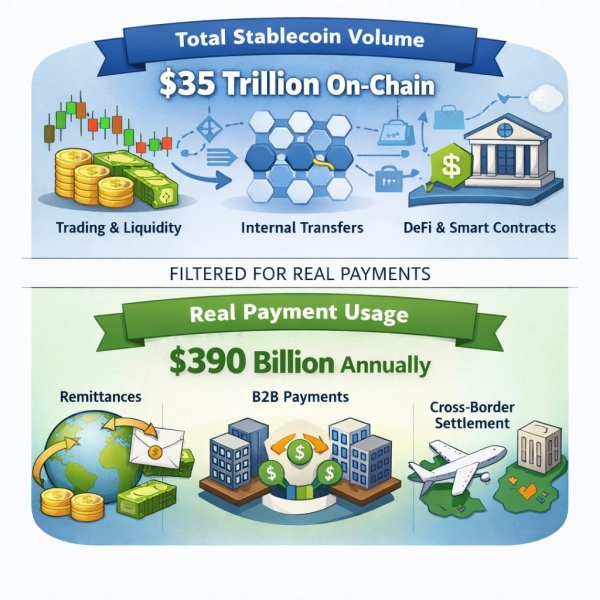
On February 18 2026, McKinsey stablecoin transaction analysis reported that stablecoins accounted for up to $35T in annual on chain transaction volume, yet most of that activity doesn't represent real world payments.
McKinsey and Artemis estimate that actual stablecoin payments run at about $390B annually (about 0.02% of global payments volume), after filtering out trading, internal exchange movements, liquidity management, and automated smart contract loops.
Public blockchains record value movement with precision, but they don't label intent. A single economic action can trigger multiple on chain steps, and large pools of stablecoins can move between wallets inside the same exchange or custodian without representing end user commerce. McKinsey uses raw volume as a starting point, not a proxy for adoption, and the methodology section explains how the team tags payment like patterns while excluding activity that reflects market structure rather than payments.
CoinDesk echoes the same measurement problem by reporting that stablecoins moved about $35T in transfers while only about 1% ties to genuine payments such as remittances and payroll. Payments industry coverage also confirms that stablecoin usage in payments is growing, yet most current activity still concentrates in internal or trading adjacent flows.
Market trackers help validate scale but they don't classify intent. CoinMarketCap aggregates stablecoin market cap and trading volume across listed tokens, which helps you track stablecoin liquidity concentration and market growth, not payments versus non payments.
Stablecoin payments represent one slice of stablecoin utility, so a payments only lens understates what stablecoins do across trading, treasury movement, DeFi collateral, and settlement workflows.
At the same time, a raw volume lens overstates payment adoption. The right reporting approach breaks stablecoin activity into functional buckets and tracks each bucket with the data source that fits it. For payments, intent classification and tagging matter. For liquidity and market structure, market cap and trading metrics matter. For payment segmentation, the underlying research partner publishes its own breakdowns that support the McKinsey approach.
If you build payment rails, you should not pitch adoption using raw on chain volume. You should show where real payment flows concentrate, how fast those flows grow, and what integration path turns that activity into revenue.
If you sell to financial institutions, you should map stablecoin opportunity to specific payment problems such as cross border B2B settlement, payroll, and corridor based remittances, then quantify addressable volume using intent filtered benchmarks like the McKinsey and Artemis estimates.
If you track policy or competitiveness, you should treat stablecoins as a measurement case study. Blockchain data looks transparent, yet it still requires more granular classification, assumptions, and cross checks to translate value movement into economic activity.
If the market keeps quoting $35T as proof of payment adoption, who sets the standard for intent based stablecoin reporting so Canada can measure real productivity and competition impact with confidence
The National Crowdfunding & Fintech Association (NCFA Canada) is a financial innovation ecosystem that provides education, market intelligence, industry stewardship, networking and funding opportunities and services to thousands of community members and works closely with industry, government, partners and affiliates to create a vibrant and innovative fintech and funding industry in Canada. Decentralized and distributed, NCFA is engaged with global stakeholders and helps incubate projects and investment in fintech, alternative finance, crowdfunding, peer-to-peer finance, payments, digital assets and tokens, artificial intelligence, blockchain, cryptocurrency, regtech, and insurtech sectors. Join Canada's Fintech & Funding Community today FREE! Or become a contributing member and get perks. For more information, please visit: www.ncfacanada.org
| | |
|---|---|---|
| | |
February 20, 2026 | NCFA Fintech Whisperer Weekly Intelligence | Regulation And Policy, Artificial Intelligence And Data, Payments And Money Movement, Digital Assets Blockchain And Tokenization, Risk Compliance And Regtech
Image: Freepik
This live weekly NCFA intelligence page tracks financial technology developments that significantly affect how fintechs build, sell, raise capital, and operate under scrutiny. Coverage prioritizes Canada and includes global events that directly influence competitive conditions, market access, and execution realities across fintech sectors. This page will be updated throughout the week with market movers in a live format and then each week we'll close the prior week's contents in prep for the upcoming week, and continue on a rolling basis. (Missed prior week's Fintech Whisperer? (December 6-12, 2025, December 13-19, 2025, January 1-9, 2026, January 10-16, 2026, January 17-23, 2026, January 24-30, 2026, January 31-February 6, 2026, February 7-13, 2026).
This is a procurement and capital boost for defence not seen in decades. Fintechs that help defence suppliers get paid faster, manage cash under milestone contracts, and prove tight controls on funds and data have a generational opportunity with real distribution next quarter. See defence push: Montreal joins provincial bids for global DSR bank platform
This is a money and proof moment for insurtech. Founders selling automation into carriers and brokers should expect buyers to ask for hard baseline metrics, verified before and after results, and fast integration plans this quarter because the market now funds teams that tie automation to combined ratio math and measurable cost takeout.
The UK is embedding crypto firms inside the existing Financial Services and Markets Act framework used for banks, investment firms, and other regulated financial institutions. Firms will likely need stronger governance, clearer business models, defined senior management accountability, and enough financial resources to pass a full authorisation assessment. This tends to favour well capitalized firms that can build institutional grade compliance and risk management from the start.
Tariff volatility shouldn't come as a surprise to anyone and still important to note that this does not take tariffs off the table. Founders and investors should assume trade cost risk still moves through other statutes and policy tools, so the teams that win next quarter make cash forecasting, FX, and settlement controls easier to run when pricing and demand change overnight.
This locks in the timeline banks plan around. Founders selling credit, underwriting, treasury, capital markets, or risk tooling into federally regulated institutions should expect earlier capital impact questions and tighter evidence requests in the next quarter because partners align product decisions to November 2026 and January 2027 effective dates long before final publication.
BoC's action should put every payments and wallet provider on notice. Partners should ask sharper questions about where customer funds sit, who controls access, how fast you can prove balances, and how you recover when something breaks. Teams that can answer those questions with evidence keep distribution moving when scrutiny rises. Feb 27, 2026 Update: The Bank of Canada issues a revised order that allows XTM to resume retail payment activities under court supervised monitoring (a controlled restart).
This can open practical opportunities into German buyers and programs, but only for teams that can pass strict security and governance reviews. Fintechs using AI should expect tougher diligence on where models run, how data moves, how vendors get controlled, and how incidents get handled. If you can show that evidence quickly, you may shorten procurement cycles and avoid months of back and forth. Large buyers tend to follow the standards governments back when they buy software at scale.
This is how stablecoins get real distribution, through bank grade plumbing that owns the hard parts. The next quarter gets more competitive for cross border payments and FX because buyers will compare everyone against always on settlement plus clean, provable books, not just a faster rail.
This is what a real time payments stack looks like when a credit union commits to execution. Vendors selling into credit unions should plan for tighter requirements on open APIs, core and digital banking integration, automated balancing, and exception handling in the next quarter because buyers now expect one platform to run multiple rails without adding operational headcount.
This partnership puts telecom scale on the same path as regulated payouts. If you want in, plan for a buyer that starts by stress testing your operations, not your pitch. Bring evidence you can trace every $ end to end, spot problems fast, reverse or recover cleanly, and keep service levels steady when volume spikes or fraud pressure rises. The teams that win make risk controls feel invisible to users while giving partners real time confidence that money moves exactly as promised.
Founders selling treasury and payments infrastructure should expect tougher questions on reconciliation, exception handling, and control ownership in the next quarter because a bundled PSP sets a higher baseline for speed and operational calm.
This is a real bridge into institutional credit rails. Founders building crypto credit, collateral, custody, and risk tooling should expect tougher questions next quarter on liquidation rules, collateral segregation, reporting, and investor grade controls, because rated structures pull crypto lending into the same discipline set as mainstream ABS.
This tightens delivery expectations for banks and their vendors. Payments and onboarding fintechs should expect stricter timelines and stronger evidence demands next quarter because partial coverage can trigger enforcement.
This week shows the market continuing to get stricter and more operational. OSFI closes the CAR 2027 consultation and puts bank capital planning on a fixed runway. The Bank of Canada order against XTM puts wallets and payments providers back under a microscope on safeguarding and access controls. Modern Treasury pushes more buyers toward one provider that owns rails, reporting, and controls. Desert Financial’s move into FedNow, RTP, and Visa Direct shows how fast credit unions now expect real time payments to work at scale. mea Platform’s $50M round reinforces that capital still rewards insurance automation when it ties directly to combined ratio math. The PSR fine in the UK makes clear that payments safety controls ship on deadline, or regulators step in.
NCFA offers various curated resources to help founders and investors stay current on developments that impact fintech markets, subscribe to NCFA weekly newsletter updates, view a rundown of current fintech news and insights, or dive into the latest fintech industry research.
The National Crowdfunding & Fintech Association (NCFA Canada) is a financial innovation ecosystem that provides education, market intelligence, industry stewardship, networking and funding opportunities and services to thousands of community members and works closely with industry, government, partners and affiliates to create a vibrant and innovative fintech and funding industry in Canada. Decentralized and distributed, NCFA is engaged with global stakeholders and helps incubate projects and investment in fintech, alternative finance, crowdfunding, peer-to-peer finance, payments, digital assets and tokens, artificial intelligence, blockchain, cryptocurrency, regtech, and insurtech sectors. Join Canada's Fintech & Funding Community today FREE! Or become a contributing member and get perks. For more information, please visit: www.ncfacanada.org
| | |
|---|---|---|
| | |
February 20, 2026 | Global Fintech Funding Research

Image: Freepik
On February 18, 2026, KPMG released Pulse of Fintech H2 2025 reporting global fintech investment reached $116B in 2025, up from $95.5B in 2024, while total deal count fell to 4,719, the lowest level in eight years. That combo tells the real story. More money shows up, but it doesn’t spread out. It stacks into fewer companies, fewer rounds, and more pressure on proof.
KPMG’s regional totals show how concentrated 2025 really was. The Americas pulled in $66.5B across 2,409 deals, with the United States at $56.6B across 1,977 deals. Canada sits inside the Americas corridor where the biggest pools of capital live, but that also means Canadian fintechs compete head to head with scaled US plays for the same investor attention.
The report shows Canadian venture capital fintech investment dropped from $9.9B in 2024 to $2.4B in 2025. A few large late stage rounds can dominate totals in a smaller market, so timing matters. Still, perception isn't great and Canada can’t rely on one breakout year to carry credibility and market confidence.
EMEA recorded $29.2B across 1,484 deals.
ASPAC came in at $9.3B across 763 deals.
Exit value more than doubled to $104.4B in 2025 from $46.8B in 2024, and exit deal count rose to 486 from 438. Stronger exits recycle capital and resets valuation benchmarks. It won’t lift every company but it can improve the mood for 2026 if momentum holds.
KPMG shows payments investment totals $19.2B in 2025 compared with $20.4B in 2024, while deal count falls from 655 to 542. The segment stayed large, but investors picked winners.
The report also flags continued payments traction in emerging markets in H2 2025, with South America standing out, supported by instant payments regimes such as Brazil’s Pix and Argentina’s Transferencias 3.
For Canadian payments firms, this isn’t about chasing every corridor. It’s about owning a clear wedge. If you can show strong fraud outcomes, fast settlement, clean reconciliation, and deep enterprise integration, you stand a chance in a market that rewards proof. If you can’t, you’ll get stuck in the crowded middle.
Digital assets and currencies investment rose from $11.2B across 1,584 deals in 2024 to $19.1B across 1,199 deals in 2025. Dollars r0se while deals fell, which usually means institutions backed fewer, larger infrastructure outcomes. KPMG points to stablecoins, corporate participation, and regulatory clarity as drivers going into 2026. KPMG also highlights growing interest in asset tokenization, including money market funds and real estate.
Canada’s opportunity sits in the infrastructure layer. Regulated custody, compliant settlement, strong controls, and enterprise tokenization tooling can travel across borders. Delays cost builders time, and time costs them market position and money.
Investment in AI driven fintech rose from $12.1B in 2024 to $16.8B in 2025, while deal count rose from 1,183 to 1,334. This is one of the few areas where both dollars and deal flow grew. Still, KPMG notes corporates often partner directly with large tech and AI providers, which raises the bar for specialist fintechs.
Canadian AI fintech teams can’t just say they use AI. They’ve got to show what it changes. Lower fraud losses, faster underwriting, better collections, fewer false positives, and lower service cost. If the numbers don’t move, the story won’t land with investors/buyers.
Insurtech rebounded from $2.9B in 2024 to $8.6B in 2025 while deal volume slipped to a 10 year low of 291 deals. KPMG linked much of the rebound to two outlier transactions, including the $2.6B acquisition of Next Insurance and the $2.5B take private of Sapiens International. That’s the lesson. A handful of transactions can drive the headline while most companies still fight for small checks.
Cybersecurity investment fell to $0.7B in 2025 from $0.9B in 2024, and deal count fell to 72 from 93. At the same time, rapid change driven by AI is increasing the focus on data security because automation depends on trusted data. Banks are consolidating data into protected lakes to support advanced automation and exploring new security models to reduce operating cost while improving outcomes.
This funding dip means larger buyers and platforms are taking more control. Canadian security focused fintechs need to sell enterprise outcomes that tie directly to risk reduction and operational cost.
Regtech investment dropped from $6.8B in 2024 to $4.9B in 2025 while deal count rose from 431 to 519. That pattern often means smaller rounds and cautious checks. The report also describes large banks investing more in internal AI driven compliance tools, which can reduce third party budgets for point solutions.
Canadian regtech firms should focus on selling what banks can’t build quickly, such as shared utilities, cross institution data networks, workflow embedded reporting, and tooling that reduces total compliance cost at scale.
Wealthtech investment fell to $1.4B in 2025 from $4.9B in 2024 while deal count stayed almost flat at 57 in 2025 versus 58 in 2024. KPMG highlights a Canadian bright spot in Wealthsimple who secured about US $538M (CAD $750M) in an equity funding round in H2 2025, and was just awarded CIX Summit's 2026 Innovator of the Year award. That shows global capital still backs Canadian category leaders when they reach scale and earn trust.
Canada faces the challenge of global capital concentrating while Canada’s totals reset from $9.9B to $2.4B. That creates a narrative risk if Canada doesn’t produce repeatable scale outcomes. The upside sits in the same places global capital is leaning into. Payments still attracts large dollars even as investors consolidate. Digital assets funding returns through stablecoins and tokenization infrastructure. AI fintech attracts both dollars and deal flow when it improves real operating results.
Canada needs to stay focused and practical. Build infrastructure grade companies, prove measurable outcomes early, and tie growth to regulated adoption. That’s where the bigger checks go when fewer companies are getting funded.
The National Crowdfunding & Fintech Association (NCFA Canada) is a financial innovation ecosystem that provides education, market intelligence, industry stewardship, networking and funding opportunities and services to thousands of community members and works closely with industry, government, partners and affiliates to create a vibrant and innovative fintech and funding industry in Canada. Decentralized and distributed, NCFA is engaged with global stakeholders and helps incubate projects and investment in fintech, alternative finance, crowdfunding, peer-to-peer finance, payments, digital assets and tokens, artificial intelligence, blockchain, cryptocurrency, regtech, and insurtech sectors. Join Canada's Fintech & Funding Community today FREE! Or become a contributing member and get perks. For more information, please visit: www.ncfacanada.org
| | |
|---|---|---|
| | |
February 13, 2026 | NCFA Fintech Whisperer Weekly Intelligence | Regulation And Policy, Digital Assets Blockchain And Tokenization, Risk Compliance And Regtech, Payments And Money Movement, Digital Banking And BaaS
Image: Freepik
This live weekly NCFA intelligence page tracks financial technology developments that significantly affect how fintechs build, sell, raise capital, and operate under scrutiny. Coverage prioritizes Canada and includes global events that directly influence competitive conditions, market access, and execution realities across fintech sectors. This page will be updated throughout the week with market movers in a live format and then each week we'll close the prior week's contents in prep for the upcoming week, and continue on a rolling basis. (Missed prior week's Fintech Whisperer? (December 6-12, 2025, December 13-19, 2025, January 1-9, 2026, January 10-16, 2026, January 17-23, 2026, January 24-30, 2026, January 31-February 6, 2026).
If Congress moves in the spring, US partners will start asking harder questions now on stablecoin rewards, reserve treatment, and how customer funds and disclosures work across the full stack. Canadian fintechs that sell into US banks, issuers, brokers, or payment programs should treat this as a near term diligence trigger and tighten their positioning on governance, controls, and commercial terms before counterparties freeze decisions waiting for clarity.
This can tighten the enforcement loop for fintech ecosystems that touch payments, onboarding, compliance tooling, crypto rails, and cross border flows. Expect more partner questions on how you detect red flags, how you document decisions, and how quickly you can freeze, unwind, and report activity when a credible tip lands. Teams that treat case management and audit trails as part of the product will move faster in enterprise sales and face fewer surprises when an investigation starts.
This matters because sandbox access only helps when it reduces time and uncertainty. Teams that show strong governance, clear client protections, and clean reporting will move faster than teams that treat testing as a demo day. Learn about eligibility of the application process.
When a major hub ties tokenization to competitiveness, it raises the stakes for everyone else. Canadian fintechs that sell tokenized rails, custody, compliance, or payments infrastructure should watch how Hong Kong turns policy into approvals, because global buyers will compare jurisdictions and pick the one that reduces execution risk. The winners will package governance, controls, and reporting into the product so expansion doesn't turn into a compliance rebuild.
If the UK market truly removes practical caps for platform led raises, UK equity crowdfunding starts to compete more directly with later stage private rounds, not just seed. Canadian issuers and Canadian investors who already treat the UK as a secondary capital lane should watch how this affects round structure, disclosure burden, investor protections, and the cost of running a raise at scale.
This opens a practical channel for policy and market alignment with a top tier global finance hub. Fintechs that sell into banks, asset managers, or capital markets should track what this dialogue prioritizes, because it can influence what partners will fund, which standards they adopt, and where they source talent. Teams that can show real solutions in sustainable finance workflows, regulated innovation, and cross border market plumbing can use this moment to get in front of the right officials and decision makers early.
This matters because institutional adoption follows clarity. If your product cannot explain who holds control, who reconciles records, and how disputes get resolved, distribution will slow down no matter how good the tech looks.
Competition under the microscope, and it matters far beyond chatbots. If regulators treat access to high reach consumer channels as a competition issue, fintechs and financial institutions that rely on dominant platforms for onboarding, support, commerce, and embedded services should expect tighter questions about platform dependency, partner lock in, and contingency plans when a gatekeeper changes the rules.
Pakistan has moved a fully digital Islamic bank from pilot to commercial operations. The market test is now whether API-first banking and Shariah-compliant products can expand formal financial access at scale while meeting the control, resilience and trust expectations attached to a newly licensed bank.
The DIGIT pilot forces a few hard questions that every tokenized issuance vendor will face next. Who carries legal finality at each step. How participants reconcile token records with existing books without creating mismatches in stress. How the platform handles failed settlement, partial fills, and corporate actions without manual fire drills. HSBC’s selection also sets a benchmark for what UK buyers treat as table stakes, clean integration into current dealer and custodian workflows, clear control over keys and permissions, and audit ready evidence for every movement. If you sell issuance tooling, custody, post trade automation, or compliance workflows, you should map your roadmap to those practical asks now, because this pilot will shape the next wave of due diligence questions across wholesale markets.
This puts distribution and settlement on the same track as liquidity. Fintechs selling custody, treasury, payments, or compliance tooling should expect tougher buyer questions on how funds move end to end, how controls stay intact through banking rails, and how settlement risk gets boxed in when volume spikes.
If Malaysia standardizes supervised testing around wholesale payments and asset settlement, builders should track what the regulator expects around issuance controls, settlement finality, and operational risk. For banks and fintech partners, the fastest path to scale usually comes from proving how the money behaves under stress, not from polishing the user interface.
Fintech teams that rely on paid social, affiliates, influencers, or embedded widgets should treat marketing controls as part of the product. Buyers and partners will ask who approves copy, how teams prove UK targeting rules, and how fast they can pull campaigns across every channel. The teams that answer those questions cleanly keep momentum. The teams that cannot will watch growth stall at the trust layer. On a similar vein in Canada, the CSA and CIRO Set Clear Rules for Finfluencers.
This kind of operational failure rarely stays a one day headline in regulated markets. It turns into tougher questions from banks, insurers, and regulators about change controls, payout logic, segregation, and how quickly a platform can prove what happened. Fintech teams should treat payment engines and automated transfers like critical infrastructure, with tight permissions, clear audit trails, and hard stops that prevent a bad config from turning into a balance sheet event.
LSEG putting its name behind on chain settlement changes the competitive map, where regulators, CCPs, CSDs, custodians, and major brokers set the rules of the road. Interoperability becomes the make or break issue, not chain choice, because participants will demand one operating model that works across traditional settlement, collateral, corporate actions, and reporting. Fintechs that want to matter here should lean into the hard parts, how they reconcile token and legacy records without gaps, how they manage permissions and key control at institutional scale, and how they keep settlement predictable during spikes, outages, and exceptions. The winners will look like the safest pair of hands in the room, with proof that their tooling reduces manual breaks and shrinks settlement risk for real participants, not just pilot users.
This matters because cross border money movement often breaks first when liquidity gets tight. A stronger euro backstop can reduce settlement fear for banks that route Europe linked flows, and it can change how counterparties price risk in FX, trade finance, and payouts. Fintechs that sell treasury, FX, and cross border payment tooling can stand out when they show how their rails behave under stress and how they keep funds moving when funding markets turn ugly.
Stablecoin reward design sits on the desk of banks and lawmakers. CIRO custody expectations raise the standard for how platforms document segregation and access. The UK payments plan turns into real requirements that land inside onboarding, fraud controls, and settlement resilience. Tokenized assets, including tokenized gold, now face the same demand from buyers, show custody, show redemption, and show who owns the problem when something goes wrong. NCFA offers various curated resources to help founders and investors stay current on developments that impact fintech markets, subscribe to NCFA weekly newsletter updates, view a rundown of current fintech news and insights, or dive into the latest fintech industry research.
The National Crowdfunding & Fintech Association (NCFA Canada) is a financial innovation ecosystem that provides education, market intelligence, industry stewardship, networking and funding opportunities and services to thousands of community members and works closely with industry, government, partners and affiliates to create a vibrant and innovative fintech and funding industry in Canada. Decentralized and distributed, NCFA is engaged with global stakeholders and helps incubate projects and investment in fintech, alternative finance, crowdfunding, peer-to-peer finance, payments, digital assets and tokens, artificial intelligence, blockchain, cryptocurrency, regtech, and insurtech sectors. Join Canada's Fintech & Funding Community today FREE! Or become a contributing member and get perks. For more information, please visit: www.ncfacanada.org
| | |
|---|---|---|
| | |



August 26th, 2025

January 4th, 2024

June 1st, 2021

September 9th, 2020

July 9th, 2018

January 3rd, 2018

September 25th, 2017

June 20th, 2017

May 10th, 2017

December 14th, 2016
