





Karsten Wenzlaff, Advisor
August 26th, 2025
Karsten Wenzlaff is a Crowdfunding and Fintech Expert from Germany. He is Secretary-General of Digit[...]


Social Finance | Nov 3, 2025

Image: Freepik
The Centre for Social Innovation (CSI) confirmed in its August 2025 update that its 2025 Community Bond campaign, targeting $6 million in total investment, was nearly full following strong participation since launch in May. The funds are being raised to transition CSI to 100% community financing, retire remaining bank debt, and strengthen ownership of its 192 Spadina Avenue property, ensuring long-term stability for its social innovation mission.
CSI’s 2025 Community Bond offering includes three verified bond options as listed on its official campaign page: Series L (4.25% annual simple interest, 3-year term), Series M (5% annual compound interest, 5-year term), and Series N (6% annual compound interest, 5-year term).
Minimum investments range from $1,000 to $25,000. According to CSI’s 2025 Offering Statement, the bonds are secured by registered charges on CSI’s Toronto properties, and the organization states it has “never missed an interest payment” since the first issuance.
Community bonds occupy a growing space in Canada’s impact-finance ecosystem. They allow individuals and institutions to earn predictable returns while funding community-owned infrastructure and social enterprises.
For Canada’s fintech and alternative finance community, CSI’s community bond initiative dates back years and provides a verified model of how mission-aligned investors can contribute to measurable social and economic outcomes. It also complements national efforts to broaden retail investor participation through investment crowdfunding and exempt-market modernization.
It demonstrates that capital formation and public benefit can work together when accountability, collateral, and investor confidence are clearly defined. As policymakers explore pathways to inclusive capital access, the community-bond structure is a practical example of responsible innovation in finance. Those interested in learning more about the model and its broader impact can visit socialinnovation.ca.
This article is for informational purposes only and does not constitute an offer to sell or a solicitation to buy any security. Readers should consult the official issuer documents for full details.
 The National Crowdfunding & Fintech Association (NCFA Canada) is a financial innovation ecosystem that provides education, market intelligence, industry stewardship, networking and funding opportunities and services to thousands of community members and works closely with industry, government, partners and affiliates to create a vibrant and innovative fintech and funding industry in Canada. Decentralized and distributed, NCFA is engaged with global stakeholders and helps incubate projects and investment in fintech, alternative finance, crowdfunding, peer-to-peer finance, payments, digital assets and tokens, artificial intelligence, blockchain, cryptocurrency, regtech, and insurtech sectors. Join Canada's Fintech & Funding Community today FREE! Or become a contributing member and get perks. For more information, please visit: www.ncfacanada.org
 |  |  |
|---|---|---|
 |  |  |
Fintech Event | Oct 23, 2025

Image; Wealthsimple For Nerds 2025, Michael Katchen
On October 22, 2025, Wealthsimple held its For Nerds Only showcase in Toronto, launching a bevy of new products and milestones that highlight the major changes happening in Canada's retail investing market.
Over 220,000 Canadians registered for the livestream which is double the audience size at WS's event held last June. The company splashed some big news in that it officially surpassed $100 billion in assets under administration, reaching the milestone 3 years ahead of its original 2028 target!
Alongside the product updates, Wealthsimple shared results from a June 2025 survey of clients aged 25 to 45 with more than $50,000 in assets that confirm there's demand for digital control when paired with trusted guidance:
Wealthsimple introduced what it calls Canada’s first zero commission options platform with no per-contract fees. By eliminating traditional contract costs that major bank brokerages still charge, the firm aims to make options more accessible to retail investors with zero fee options rolling out to all clients in phases in 2026. Users should monitor fee transparency and execution quality as adoption scales.
WS’s zero fee options will disrupt the pricing structures of Canada’s largest bank brokerages, such as RBC Direct Investing, TD Direct Investing, BMO InvestorLine, and Scotia iTRADE who all still charge between $1.25 and $2.50 per contract, a model that has long supported their retail trading revenue. By removing per contract costs entirely, WS sets a new benchmark that will pressure banks to justify higher fees or cut them to stay competitive.
As more and more investors move to lower cost platforms, traditional banks risk losing up/cross selling opportunities in savings, credit, and advisory products. For younger retail investors and clients who value cost transparency and mobile-first design, zero fee options trading is the way to go.
Wealthsimple also launched real gold trading (See: support guide) directly in client accounts, making it available around the clock and backed by the Royal Canadian Mint. Investors can buy fractional amounts starting at one dollar and will be able to redeem for physical one ounce and tenth ounce coins beginning in November 2025.
The new feature combines online convenience with real ownership of gold, appealing to people who want something tangible instead of investing in gold ETFs. If trading costs stay low, it could change how Canadians buy and hold gold in their accounts.
Wealthsimple introduced a Mutual Fund Exchange to help investors transition from high-fee mutual funds to lower-cost managed portfolios, covering transfer fees and offering personalized guidance.
The firm also previewed its flagship Summit portfolio, a new managed offering that blends public equities with private equity, private credit, infrastructure, and gold exposure.
According to the newsroom release:
Investors switching from high-fee mutual funds to the Summit portfolio could retire up to 47% richer due to fee savings alone.
Wealthsimple confirmed that direct indexing portfolios are now available, offering the same tax saving tools used by large institutions. The service automates daily tax loss harvesting across individual stocks and charges a 0.15% management fee, as shown on the direct indexing page.
It lets investors mirror an index while owning each company directly, which can improve after-tax results and give more control over what they hold. The system automatically sells losing stocks to offset gains and reinvests the money to keep market exposure.
Wealthsimple previewed upcoming AI powered research and trading tools that will generate market summaries, identify trends, and deliver event alerts. Also scheduled for release are secured puts, multi-leg option strategies, and a built-in Norbert’s Gambit function for more efficient currency conversion.
These new tools showcase how automation and personalized data analysis are converging on the platform.
Wealthsimple introduced a new full service wealth management tier that combines digital access with human advice via text and proactive tax and contribution planning. Management fees start at 0.5% for higher balances.
The 2025 event reinforced Wealthsimple’s ambition to democratize sophisticated investing while lowering costs for Canadians. From zero fee options and physical gold to direct indexing and hybrid advice, the company’s strategy blends accessibility with innovation. As its AI tools and private market portfolios scale through 2026, the balance between automation, transparency, and client empowerment will remain key measures of success.
The National Crowdfunding & Fintech Association (NCFA Canada) is a financial innovation ecosystem that provides education, market intelligence, industry stewardship, networking and funding opportunities and services to thousands of community members and works closely with industry, government, partners and affiliates to create aa vibrant and innovative fintech and funding industry in Canada. Decentralized and distributed, NCFA is engaged with global stakeholders and helps incubate projects and investment in fintech, alternative finance, crowdfunding, peer-to-peer finance, payments, digital assets and tokens, artificial intelligence, blockchain, cryptocurrency, regtech, and insurtech sectors. Join Canada's Fintech & Funding Community today FREE! Or become a contributing member and get perks. For more information, please visit: www.ncfacanada.org
| | |
|---|---|---|
| | |
OurCrowd | Oct 22, 2025
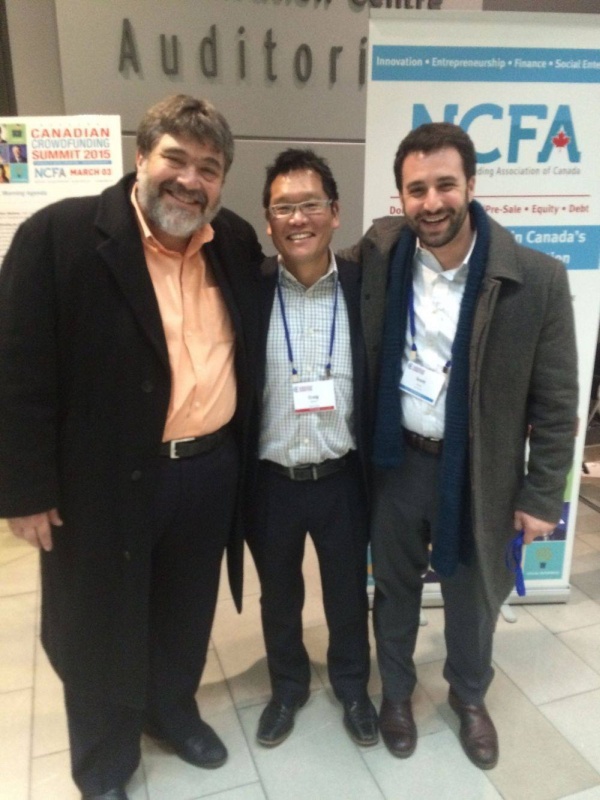
Image: Inaugural Canadian Crowdfinance Summit 2015, NCFA Craig Asano with Jon Medved CEO OurCrowd
On October 21 2025, as reported by several news outlets, OurCrowd announced on Tuesday that Founding CEO Jon Medved will move into the role of Chairman after being diagnosed with ALS, also known as Lou Gherig’s disease. OurCrowd named Cali Chill as Acting CEO and COO, a long-time executive who has led investment operations. Medved will stay active by focusing on strategy, global partnerships, and support for portfolio companies.
In his conversation with Calcalist, Medved said that after thirteen years leading the company this change was necessary but that he continues to work full days.
“A few months ago, I was hospitalized and diagnosed with ALS, a serious and terrible disease. Everything still works, but it’s very difficult for me to breathe. I’m improving and fighting it, and I still work eight to ten hours a day, which allows me to continue treatment.”
OurCrowd began in 2013 when new rules under the JOBS Act opened doors for online investment. The platform connected smaller accredited investors with venture deals that were once limited to big institutions. Under Medved’s leadership, it grew into one of the world’s largest tech investment networks, backing companies such as Anthropic, Databricks, Groq, and SpaceX.
As reported by Crowdfund Insider, OurCrowd now reports more than 2.6 billion USD in commitments across 500 portfolio companies and 68 funds with 240,000 registered investors from 195 countries.
Cali Chill said he is honoured to lead at this time and credited Medved for building the culture that drives the company. He said that by offering curated access to venture opportunities, OurCrowd bridges the gap between institutional investors and individuals who want professional access to global startups. Medved said he will keep pushing to democratize venture investing and use artificial intelligence to reach a wider community of investors.
Medved has been a returning keynote speaker at NCFA Canada events over the years, such as the 2015 Canadian Crowdfinance Summit and FFCON19: Fearless. He was known for his inspiring energy, storytelling, and ability to connect people. After his talks, crowds would often follow him as he handed out business cards and traded ideas with founders and investors. He was highly sought after and a regular guest in leading media outlets where he spoke about Israel’s technology ecosystem, global venture markets, and innovation trends. His stories about Israel’s startup culture and how necessity sparked resilience left a strong mark on the Canadian innovation community.
One memorable example came during his keynote at CCS 2015, when Medved made a spontaneous commitment on stage to open a Canadian office for OurCrowd. Within months, the firm delivered on that promise, establishing operations in Toronto and announcing a 1 million USD investment in Influitive, a Toronto-based advocate marketing leader. Ontario’s Minister of Economic Development at the time, Brad Duguid, described the move as "a landmark step for Canada’s growing technology and venture capital scene".
Even now as Jon manages ALS, he continues to work and inspire others. He remains a powerful voice for founders, investors, and countries building inclusive capital markets. His determination to keep working through adversity shows the same spirit that made OurCrowd a global success. On behalf of NCFA, we wish all the best for Jon and his team during this time.
The National Crowdfunding & Fintech Association (NCFA Canada) is a financial innovation ecosystem that provides education, market intelligence, industry stewardship, networking and funding opportunities and services to thousands of community members and works closely with industry, government, partners and affiliates to create aa vibrant and innovative fintech and funding industry in Canada. Decentralized and distributed, NCFA is engaged with global stakeholders and helps incubate projects and investment in fintech, alternative finance, crowdfunding, peer-to-peer finance, payments, digital assets and tokens, artificial intelligence, blockchain, cryptocurrency, regtech, and insurtech sectors. Join Canada's Fintech & Funding Community today FREE! Or become a contributing member and get perks. For more information, please visit: www.ncfacanada.org
| | |
|---|---|---|
| | |
Fintech Risks | Oct 20, 2025

Image: Freepik/Rawpixel.com
On October 16, 2025, Bank of Canada (BoC) Governor Tiff Macklem joined Adam Posen at the Peterson Institute for International Economics (PIIE) in Washington for a public conversation about Canada’s economic outlook and global trade. Macklem said new tariffs, slower trade, and changing supply chains are impacting the Canadian economy.
As a result, he explained that the BoC is now using several possible economic paths instead of one fixed forecast because global uncertainty has become constant. The new approach was outlined in the Bank’s July 2025 Monetary Policy Report and compares what could happen if tariffs stay the same, ease, or rise, and indicates the impact of each option on inflation, output, and interest rates.
Macklem described four forces that will impact the next 10 years for Canada:
1. Trade now clusters around three main hubs led by the United States, China, and the European Union. The United States still dominates world finance even as investors question its safe haven status, and other countries like Singpore pushing above their weight.
2. Global trade and money flows are becoming uneven again (a recurring structural issue). Some regions keep running big surpluses while others, including North America, rely more on borrowing. Macklem said this growing imbalance adds risk to the global financial system and limits how much small economies like Canada can control their outcomes.
3. He said higher tariffs and unpredictable policy weaken demand, raise costs, and reduce the efficiency of supply.
4. Canada is feeling these pressures through weaker exports, slower investment, and lower productivity growth, outcomes that no interest rate decision can reverse.
Traditional forecasts assume one view of the world. Macklem explained that the Bank now works with three possible paths. One assumes current tariffs remain. One assumes tensions ease. One assumes further escalation.
The aim is to keep inflation expectations stable while helping households and businesses adjust to uncertainty. For fintechs and lenders, strategic business planning must now be built around several credible economic futures too, and not rely on a single base case. Funding, pricing, and credit policies should be tested against each path to stay resilient no matter which reality unfolds.
Macklem explained that new tariffs and complex rules are adding cost and delay at the Canada–U.S. border, disrupting supply chains. Firms that once relied on integrated supply chains now need new suppliers, new routes, and stricter compliance to maintain trade eligibility. That adds cost and delays that ripple across sectors. Even service firms are affected through their clients and vendors.
For fintechs offering trade finance, payments, or working capital products, this environment creates opportunity but also exposure to new risks. There is demand for tools that make international transactions faster and more transparent, but also new risks tied to client sectors under pressure.
The Governor stressed that raising productivity is now essential. He pointed to faster project approvals, fewer internal trade barriers, and stronger transport links as priorities to open new pathways.
The Bank’s recent reports say that fixing long-term barriers in the economy like slow project approvals or weak competition can improve growth more than changing interest rates (aka, monetary policy).
Fintechs can build solutions that help reduce administrative frictions, such as digital identity and onboarding tools can eliminate duplication between provinces. Compliance automation and regulatory technology can shorten approval times. Procurement platforms can help smaller firms reach national customers. These are examples of direct responses to the barriers that Macklem said must be addressed.
Macklem also spoke about the neutral interest rate which is the level that keeps inflation stable without stimulating or slowing the economy. He said it may not align between Canada and the United States because productivity growth and fiscal policies differ. That divergence affects long term funding costs and the flow of investment capital.
For fintechs that borrow in U.S. dollars or rely on foreign investors, funding costs and access to cash can change even if central banks don’t move rates. The safest approach is to plan for different interest rate outcomes instead of assuming Canada and the U.S. will always move together.
When asked about digital assets, Macklem said the Bank’s work on stablecoins and a possible central bank digital currency focuses on preserving trust and value. The principle of the singleness of money means that one Canadian dollar must hold the same worth everywhere, whether in cash or digital form.
Stablecoin systems must avoid runs and guarantee convertibility. For fintech developers and innovators, it means creating systems that work within the regulated financial system, not outside. The most promising area is making international payments faster, cheaper, and clearer, while ensuring every digital dollar is fully backed and can always be redeemed.
Uncertainty is no longer an exception but a normal condition for business and policy. Every possible trade path changes inflation, growth, and the cost of capital. Fintech founders, investors, and lenders must build this thinking into their models and operations. That includes ready plans for each scenario, triggers for risk adjustments, and playbooks for client support when tariffs or rates move unexpectedly.
The firms that incorporate this discipline and governance will not only manage volatility better but also build trust with investors and customers who highly value predictability in uncertain times.
It's time for Canada to demonstrate adaptability, and treat uncertainty as a given design factor instead of a sudden surprise. Canada’s financial ecosystem, from established lenders to digital innovators, must treat uncertainty as a normal part of planning. Fintechs that adopt scenario planning, streamline processes, and improve real economy efficiency can help Canada compete globally even as the trading system fragments.
The National Crowdfunding & Fintech Association (NCFA Canada) is a financial innovation ecosystem that provides education, market intelligence, industry stewardship, networking and funding opportunities and services to thousands of community members and works closely with industry, government, partners and affiliates to create aa vibrant and innovative fintech and funding industry in Canada. Decentralized and distributed, NCFA is engaged with global stakeholders and helps incubate projects and investment in fintech, alternative finance, crowdfunding, peer-to-peer finance, payments, digital assets and tokens, artificial intelligence, blockchain, cryptocurrency, regtech, and insurtech sectors. Join Canada's Fintech & Funding Community today FREE! Or become a contributing member and get perks. For more information, please visit: www.ncfacanada.org
| | |
|---|---|---|
| | |
Crypto Asset Policy | Oct 15, 2025

Image: Freepik AI
In August 2025, Quebec’s Financial Markets Administrative Tribunal issued its decision in AMF v. Gagnon et al. that examined whether tokens linked to a crypto trading signal subscription service were investment contracts under Quebec’s Securities Act or not. The respondents ran an online business that sold memberships through social media and a Telegram group, offering automated buy and sell recommendations for digital currencies such as bitcoin. Investors paid recurring fees to receive trading alerts and access private chat rooms.
The tribunal found that the respondents misled subscribers and exaggerated claims about profit potential without proper registration. However, it also ruled that the tokens and the trading signals themselves weren't securities. Investors acted independently (i.e., placing their own trades), and there was no pooling of funds or shared enterprise that would meet the legal test for an investment contract in Quebec.
It's an important ruling because it draws a clear line between activities that require securities registration and those that do not. The decision has prompted discussion across Canada about how regulators should evaluate crypto asset business models (subscription required).
The tribunal focused on how the Gagnon business actually worked, not how the business is described or the types of tokens involved. The respondents sold subscriptions to a crypto signal service through social media and Telegram. Members paid recurring fees (usually in crypto) to access automated trading alerts and private discussion groups. The tribunal found that subscribers of the service acted independently because they placed their own trades, used their own accounts, and there was no pooling of funds or shared enterprise.
Because the respondents did not issue tokens, manage capital, or control investor profits, the activity did not meet the legal test for an investment contract. The tribunal said speculation alone does not make a trading service or token a security.
David Durand, Founder Durand Lawyers and NCFA Advisor, was interviewed for the Law360 article on legal classification of crypto assets, who argued that each crypto asset and business model must be assessed on its economic reality, not through one universal rule.
“The fact that securities regulations would have scant effect in protecting users on decentralized networks makes it evident that defining crypto assets as a security would provide ineffective regulatory enforcement in this respect. "[Overreaching securities regulation on the crypto asset regime would] likely create a system where onerous requirements are placed on users of such assets, with an end result of suppressing innovation [in financial technology and financial capital to leave Canada seeking more favourable environments]."
“The important point here is that the tribunal says a crypto asset is not an investment contract. However, when we criticize the act of trading an asset, we are referring to the investment contract in relation to the person and not the object or the very nature of the crypto asset. The implications are that we are moving in the right direction in terms of the fact that crypto assets were not an investment contract.”
Although the decision applies only in Quebec, its reasoning may influence regulators across Canada. The Canadian Securities Administrators have been moving toward coordinated rules for crypto trading platforms, but this ruling highlights the limits of the CSAs current approach when activities vary so widely in design.
The tribunal also said regulators need stronger evidence before using enforcement tools like freezing orders. It ruled that authorities must show clear proof before stopping a business from operating. This could set a new standard for fairness in future crypto cases.
For fintech founders, the ruling gives clearer guidance on what falls inside or outside securities law. Businesses that offer decentralized tools, such as trading signal services, software systems, or network platforms are less likely to be treated as securities, if users of those tools remain in control of their own money and avoid profit sharing and collective investment components.
For regulators, the case is a reminder to focus on real misconduct instead of labelling all crypto activity as securities by default.
The Gagnon reasoning parallels the SEC v. Ripple Labs decision in the United States, where a U.S. court drew a line between tokens sold directly by a company and those traded later on the open market. The court said that how and where a token is sold makes a difference. When people buy directly from the issuer based on its efforts, the sale can fall under securities law, but trades between independent buyers and sellers on exchanges may not.
Europe’s Markets in Crypto-Assets (MiCA) regulation offers another useful example. MiCA builds specific legal categories for utility tokens, payment tokens, and asset-referenced tokens, instead of applying one framework to all.
Canada has yet to create a similar set of purpose-based rules, leaving courts and tribunals to fill the gaps through case law.
The Quebec tribunal ruling strengthens NCFA's call for a coordinated national digital asset framework that distinguishes between token types and activities. Further, Canada can draw from both MiCA’s structured taxonomy and the functional reasoning used in Ripple and Gagnon. NCFA continues to recommend that policymakers should now focus on:
The Gagnon ruling challenges Canada’s regulatory system to evolve beyond the one-size-fits-all treatment of crypto assets. The tribunal recognized that each digital asset and business model carries distinct risks and economic activities.
One brush does not fit all. Crypto assets differ in structure, function, and purpose. Regulation must be designed for growth, not just enforcement. As NCFA recently argued in “Regulating for Growth by Understanding Innovation”, good regulation should reward experimentation, promote competition, and provide safe entry points for new entrants, not block innovators out of fear.
If Canada wants to compete in digital finance, it must build laws that reflect how crypto businesses actually work, support new ideas, and focus on misconduct, not label everything a security first.
The National Crowdfunding & Fintech Association (NCFA Canada) is a financial innovation ecosystem that provides education, market intelligence, industry stewardship, networking and funding opportunities and services to thousands of community members and works closely with industry, government, partners and affiliates to create aa vibrant and innovative fintech and funding industry in Canada. Decentralized and distributed, NCFA is engaged with global stakeholders and helps incubate projects and investment in fintech, alternative finance, crowdfunding, peer-to-peer finance, payments, digital assets and tokens, artificial intelligence, blockchain, cryptocurrency, regtech, and insurtech sectors. Join Canada's Fintech & Funding Community today FREE! Or become a contributing member and get perks. For more information, please visit: www.ncfacanada.org
| | |
|---|---|---|
| | |
CZ | Oct 14, 2025

Image: Freepik/wirestock
Changpeng Zhao (known as CZ) pleaded guilty in November 2023 to a single count of violating the Bank Secrecy Act after U.S. authorities found Binance had failed to maintain effective anti-money laundering controls. He stepped down as CEO and was sentenced in April 2024 to four months in federal prison while paying a $50 million fine. Binance also paid $4.3 billion to settle related charges with the Department of Justice and other agencies.
In May 2025, Zhao stated publicly that he had applied for a presidential pardon from Donald Trump. The U.S. Senate Banking Committee confirmed the filing’s existence in a letter dated May 15, 2025, asking the Department of Justice and the White House to clarify whether the request was being considered. The senators cited potential conflicts of interest tied to Trump family business ventures connected to crypto ventures associated with Binance.
On October 10, 2025, journalist Charles Gasparino reported on X that White House discussions about a possible pardon were “heating up.” The New York Post followed with a story two days later describing alleged internal debates over optics as the Trump administration manages several crypto-related policy files.
The article references unnamed sources close to both Zhao and Trump, who claim the president is sympathetic to Zhao’s case but mindful of potential conflicts due to family business interests in the crypto sector.
No formal statement from the White House, the Department of Justice, Binance, or Zhao’s legal team has confirmed these discussions. The White House press office maintains a standard position of not commenting on active or potential pardons. Therefore, these claims remain based only on Gasparino's report and subsequent media coverage.
Even without confirmation, the story matters because a pardon could erase Zhao’s criminal record, reopening the possibility for U.S. financial institutions to engage with Binance or its affiliates under less restrictive compliance terms.
It could also influence broader perceptions of how the U.S. balances enforcement with innovation across the $4 trillion global digital asset market. The Senate Banking Committee’s letter highlights bipartisan concern about transparency in how executive clemency intersects with crypto business interests, and spotlights growing concerns between pro-market reform vs accountability for compliance gaps in digital finance.
As of October 14, 2025, verified information is limited to Zhao’s conviction, sentencing, fines, and his publicly acknowledged pardon petition. Otherwise, there is no public record or filing in the Office of the Pardon Attorney showing that any pardon has been granted or is under formal review.
Until official confirmation appears, the case stands as a reminder that anonymous political reporting must be treated cautiously, especially if it could affect markets and trust in financial governance.
The National Crowdfunding & Fintech Association (NCFA Canada) is a financial innovation ecosystem that provides education, market intelligence, industry stewardship, networking and funding opportunities and services to thousands of community members and works closely with industry, government, partners and affiliates to create aa vibrant and innovative fintech and funding industry in Canada. Decentralized and distributed, NCFA is engaged with global stakeholders and helps incubate projects and investment in fintech, alternative finance, crowdfunding, peer-to-peer finance, payments, digital assets and tokens, artificial intelligence, blockchain, cryptocurrency, regtech, and insurtech sectors. Join Canada's Fintech & Funding Community today FREE! Or become a contributing member and get perks. For more information, please visit: www.ncfacanada.org
| | |
|---|---|---|
| | |
Cybersecurity | Oct 14, 2025

Image: Freepik
The 2025 Nobel Prize in Economics was awarded to Joel Mokyr, Philippe Aghion, and Peter Howitt for showing that economies grow when they reward new ideas, open competition, and constant renewal. Their work (and recognition) explains why some economies continue to grow while others stall, or how innovation drives prosperity.
Joel Mokyr’s research reveals that progress depends on how societies treat knowledge. When Europe opened up to new ideas, rulers across Europe competed to attract inventors, scientists, and thinkers. They funded experiments, founded academies, and allowed freedom to publish and debate. This open culture created trust and collaboration, which led to faster discovery. Insight is that innovation takes off when knowledge is shared, incentives are aligned with progress, and institutions reward learning rather than control.
Philippe Aghion and Peter Howitt built the modern model that explains how this process sustains itself. Their work on creative destruction shows that growth happens when new firms and technologies replace outdated ones. Productivity increases even as some firms exit the market. They demonstrated that competition and innovation are not opposites but partners. Economies that encourage entry and tolerate failure grow faster because resources move to better ideas. Insight is that protection slows progress, but experimentation drives renewal.
Sounds familiar, right?
A popular LinkedIn post by a specialist in regulatory policy Martyn Hopper, interpreted these Nobel insights into a practical framework for today's economies. In his aptly titled LinkedIn post, “Regulating for Growth”.
Hopper explained that innovation only turns into prosperity when three things work together:
When these conditions are in place, disruption becomes productive renewal. When they are missing, it produces dislocation, stagnation, and political frustration.
Hopper’s key insight reframes regulation itself. He says the real challenge is not cutting rules but designing them to direct energy toward innovation rather than rent-extraction (read: siphoning off profits for benefit).
Regulation is the architecture that decides who can participate, how capital flows, and whether progress is rewarded or resisted. It determines whether a system produces creation or protection, renewal or capture. This makes regulation one of the most powerful economic tools for growth.
As Canada has it's back up against the wall in terms of innovation and competition policy (despite recent shifting winds), the Nobel findings and Hopper's sensibilities, business leaders and policymakers have clear takeways.
The best performing economies are those that combine competitive markets with policies that support transition. For policymakers, the lesson is that regulation must make innovation easier, not riskier. It must reward entry and experimentation, ensure fair access to finance, and help communities absorb change. Sustained success comes from openness, agility, and willingness to reinvest in new ideas. Remember, a system without the ability to expel old and add new will eventually die on the vine.
Growth is designed through the choices made about who can compete, how ideas are financed, and how regulation treats innovation. When those choices are right, economies attract investment, scale technology faster, and sustain higher productivity.
For Canada’s fintech and financial innovation community, these insights are especially timely. NCFA’s advocacy for proportionate rules, open and fair competition, and technology-driven productivity and inclusion innovation aligns directly with the Nobel research and Hopper’s interpretation.
Canada's challenge is evolving from purely risk management towards opportunity design. Regulators can accelerate innovation by creating flexible entry routes for new players, supporting data-driven compliance, and directing finance toward startups and scale-ups that drive transformation.
It's about injecting newness and opportunity which in turn will build resilience. When innovation is supported by sound regulation, it strengthens the economy’s ability to adapt, protects consumers, and expands access to capital.
Fintech, open banking, and AI can be powerful enablers of this change if the regulatory system is built for learning and collaboration rather than delay and protectionism.
The Nobel Committee recognized that growth doesn't happen by accident. It's built through systems that enable innovation, reward competition, and manage transition. Martyn Hopper’s framework shows what that looks like in practice. Smart regulation channels capital to new ideas, supports those affected by change, and keeps markets open for renewal. For Canada’s fintech sector, this is the roadmap to back that turns creative disruption into long-term competitiveness, productivity, and inclusion.
The National Crowdfunding & Fintech Association (NCFA Canada) is a financial innovation ecosystem that provides education, market intelligence, industry stewardship, networking and funding opportunities and services to thousands of community members and works closely with industry, government, partners and affiliates to create aa vibrant and innovative fintech and funding industry in Canada. Decentralized and distributed, NCFA is engaged with global stakeholders and helps incubate projects and investment in fintech, alternative finance, crowdfunding, peer-to-peer finance, payments, digital assets and tokens, artificial intelligence, blockchain, cryptocurrency, regtech, and insurtech sectors. Join Canada's Fintech & Funding Community today FREE! Or become a contributing member and get perks. For more information, please visit: www.ncfacanada.org
| | |
|---|---|---|
| | |



August 26th, 2025

January 4th, 2024

June 1st, 2021

September 9th, 2020

July 9th, 2018

January 3rd, 2018

September 25th, 2017

June 20th, 2017

May 10th, 2017

December 14th, 2016
