





Karsten Wenzlaff, Advisor
August 26th, 2025
Karsten Wenzlaff is a Crowdfunding and Fintech Expert from Germany. He is Secretary-General of Digit[...]


Payments | Oct 2, 2025
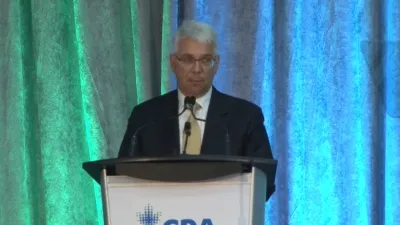
Image: Ron Morrow, Executive Director, Bank of Canada (CPA The One Conference Sep 18, 2025)
On September 18, 2025, Ron Morrow, Executive Director of Payments Supervision at the Bank of Canada, delivered a speech at the CPA The One conference titled, "Making change Accelerating payments innovation". He spoke about a vision for Canada’s payments future, one where innovation, oversight, and competition intersect. Stronger oversight and modern payment rails will make the system more competitive and inclusive.
This article unpacks select key quotes and and highlights two sides of the coin for stakeholders to see both sides and the trade-offs that come with it. For Canada, the task now is not whether to act, but how to add momentum and keep pace in a global race.
“Almost 1,500 payment service providers are now required to register with the Bank under the Retail Payment Activities Act.”
For the first time, nearly fifteen hundred retail Payment Service Providers (PSPs) are being pulled into the regulatory fold. Supporters argue that this gives consumers and businesses more confidence when using new services and helps fintechs compete on equal footing with banks. By ending the perception that startups operate in a grey zone, it could make investment in the sector more attractive.
But compliance comes with costs, and many small firms run lean without a large legal or regulatory staff like banks. What may feel like light reporting to a large bank can feel like a heavy lift for a ten person startup. In the worst case, it could drive consolidation that narrows competition instead of expanding it.
“Our job is to make sure that innovation in the payments system can proceed in a way that is safe, sound and reliable.”
Safe to say that Canadians will only embrace new forms of payments if they trust them to work without interruption and to protect their money. Regulation that sets clear expectations can provide certainty for innovators, giving them a stable foundation to build on.
Yet safety can lead to an abundance of caution that could slow innovation. Other countries, from the UK to Singapore, have shown that regulators can allow pilots and sandboxes to move quickly while still managing risk. If Canada puts too much emphasis on stability, we'll fall behind in a global race where trust and speed both matter.
“We are working to expand access so that more providers can offer services directly through Canada’s core payment systems.”
Direct access to national infrastructure is potentially transformational. If fintechs can gain access without going through a big bank, they can offer faster and cheaper payments. This would lower costs for consumers, ignite competition, and open the door for creative new services in areas like cross border transactions.
The flip side is that these core systems were designed with large, well capitalized institutions in mind. Smaller entrants may not have the same buffers to handle liquidity shocks or technical breakdowns. One major failure could undermine confidence across the entire network. The challenge is designing an access model that widens competition without weakening stability. Payments Canada who is overseeing Canada's payments modernization has delayed implementation numerous times, and industry is frustrated. In May 2025 however, they announced that the technical build will be completed by Q3 2025 and they plan to test the system throughout 2026.
“Through our work with the BIS Innovation Hub, we are exploring the potential of new technologies such as tokenization and artificial intelligence.”
Engaging with international financial innovation hubs allows Canada to stay connected to the latest fintech and payments research, including stablecoins and tokenization. It also helps Canadian fintechs align with emerging global standards, making cross border scaling easier. Last June 2024, the BIS and Bank of Canada Launched the BIS Toronto Innovation Centre.
The real risk lies in harmonization at home. Canada’s financial system is driven by a concentrated banking sector and diverse regional economies, where inter-provincial differences can create barriers to trade and investment. If newly adopted financial technologies and related reforms aren't designed to work seamlessly across all provinces and territories, Canadian markets could become further fragmented with unwanted barriers and compliance costs. Canada needs to strengthen its internal market with more competition and innovation to be able to complete with strength globally.
“Payments innovation cannot be separated from broader efforts like open banking.”
If Canada completes payments modernization while also enabling consumers to share their financial data securely (open banking, consumer driven finance), the market could see a boon of new service models and tools that bring real competition to a system long dominated by incumbents.
Skepticism is very real though with Canada lacking the political will to finally implement open banking after promising it and studying it for years. Without binding timelines, many in the industry hear speeches like this one but actions speak louder the words. For fintechs, the question remains whether it is worth investing in solutions that depend on open banking when political momentum has not yet delivered results, or opt for new pathways. The latest is that open banking in Canada will land in 2026., with further delays will have significant consequences for innovation and consumer choice in Canada.
Ron Morrow’s speech delivers a clear vision and direction for modernizing Canada’s payments landscape. Expanded oversight, broader access to rails, and participation in global innovation networks all point to a more open and competitive future. If open banking also arrives in 2026, these reforms could unlock real benefits for consumers and fintechs alike. But the devil’s advocate cannot be ignored. Here's a streamlined version of Morrow's speech, 'Cashing in on Payments Innovation' (fingers crossed)
 The National Crowdfunding & Fintech Association (NCFA Canada) is a financial innovation ecosystem that provides education, market intelligence, industry stewardship, networking and funding opportunities and services to thousands of community members and works closely with industry, government, partners and affiliates to create aa vibrant and innovative fintech and funding industry in Canada. Decentralized and distributed, NCFA is engaged with global stakeholders and helps incubate projects and investment in fintech, alternative finance, crowdfunding, peer-to-peer finance, payments, digital assets and tokens, artificial intelligence, blockchain, cryptocurrency, regtech, and insurtech sectors. Join Canada's Fintech & Funding Community today FREE! Or become a contributing member and get perks. For more information, please visit: www.ncfacanada.org
 |  |  |
|---|---|---|
 |  |  |
Crowdfunding | Oct 1, 2025

Image courtesy of AI
On March 7, 2025, Rugby Canada announced a bold public campaign to fund its women’s high performance team to England 2025. The campaign laid out a $1 million shortfall to cover the full season's program that costs $3.6 million (but the union's budget fell short). So to close the funding gap, they opened the doors to fans, alumni, and corporate donors and launched a dedicated donation portal for this effort: Mission: Win Rugby World Cup 2025 donation portal.
That night, the campaign thermometer sat at zero. By morning, it was alive as part financing tool and part storytelling engine that sparked a national movement in Canadian sport.
Rugby Canada needed more than dollars. They needed narrative. The early campaign push did three essential things well:
They didn't just ask for support but described the exact dollars missing and how each contributed dollar would map to camps, nutrition, recovery, and test matches.
Supporters weren’t just donors but they were treated as 'partners' in getting the Canadian Women's Rugby team ready for the World Cup 2025, a massive global sporting event.
Independent rugby media tracked progress. In April, RugbyPass ran a report noting the still‑open funding hole and provided key updates in how far along the drive had come, and how much further they still needed to go to achieve their mission.
As the 2025 Women's Rugby World Cup (hosted in England) drew closer and closer, media narratives framed Canada not just as underfunded underdogs but as gritty, scrappy, and deserving contenders. Sky Sports ran a feature titled “How non‑professional Canada crowdfunded its way to the final push,” saying pledges “reached 95 percent.”
Meanwhile, ESPN ran a narrative piece under the banner “Canada crowdfunded their way to the World Cup” juxtaposing the team’s funding shortfall with their on‑field ambitions.
Kudus to participating media that helped raise awareness for such an important Canadian funding drive. It really shows what's possible when the full ecosystem gets behind an initiative and drives momentum forward. There's a natural connection between executing a well timed and focused financing campaign and executing a key sports performance, and the public knows it. #ElbowsUp
When England 2025 kicked off, Canada stepped onto the pitch motivated by even greater purpose, not a team suffering by funding shortfall anxiety.
In pool play they went undefeated, carving out physical, disciplined performances that turned heads.
In the quarter final, they defeated a powerful Australia squad.
In the semi final, they shocked the rugby world by defeating New Zealand (perennial favourites) to reach their first Women’s Rugby World Cup final.
On September 27, before a packed Twickenham, Canada faced hosts England. They lost but not meekly. In the aftermath, coach Kevin Rouet and captain stressed that the match was decided on performance, not excuses, a point that resonates in Reuters’ coverage of the final.
Crowdfunding bought the players the chance to compete on equal footing, free of resource excuses. The lesson for Canada as a sporting nation was significant. When supports and fans step in to close gaps, institutions can't ignore the demand for sustainable, professionalized backing of women’s rugby.
Players adjusted their off season budgets and personal spending to show they were all in on the campaign narrative.
Coaching staff scheduled extra camps contingent on fundraising milestones, keeping the team in lockstep with the thermometer.
Each media checkpoint (50%, 80%, 95%) became a moment of drama as the story unfolded. Would the final stretch succeed or stall? That tension made the campaign itself a parallel storyline to the competition.
Critics wondered whether public fundraising blurred lines between sport and fandom but supporters embraced the risk, seeing their dollars as equity in national ambition at a time when Canada needs to buckle down and drive through the line.
When everyone's in the same boat, the winds will sail.
This was more than just a funding story. If you want one of those, feel free to read the real story of access to capital. It was about turning a resource gap (a modern day limitation) into shared ownership.
Canada’s women made their financial constraints visible, linked every dollar to performance outcomes, and invited supporters to become backers in the journey. That transparency changed how Canadians see women’s sport funding not as charity, but as investment with real returns.
The campaign also created accountability. Once the thermometer went public, the team owed backers results, not just thanks.
The story will not always be this dramatic, but the connections and motivations are real, and crowdfunding amplifies that blueprint. Define the gap, own the narrative, attach every contribution to a tangible outcome, and treat supporters as true partners.
Collaboration was at the core! Players, fans, alumni, sponsors, and media all carried their share of the work. As Canada’s women look beyond 2025, the responsibility now shifts to institutions, national sport bodies, sponsors, and public agencies to ensure future generations no longer need to crowdfund their path to the world stage, or maybe they should! #GoCanada
The National Crowdfunding & Fintech Association (NCFA Canada) is a financial innovation ecosystem that provides education, market intelligence, industry stewardship, networking and funding opportunities and services to thousands of community members and works closely with industry, government, partners and affiliates to create aa vibrant and innovative fintech and funding industry in Canada. Decentralized and distributed, NCFA is engaged with global stakeholders and helps incubate projects and investment in fintech, alternative finance, crowdfunding, peer-to-peer finance, payments, digital assets and tokens, artificial intelligence, blockchain, cryptocurrency, regtech, and insurtech sectors. Join Canada's Fintech & Funding Community today FREE! Or become a contributing member and get perks. For more information, please visit: www.ncfacanada.org
| | |
|---|---|---|
| | |
Consultation | Sep 30, 2025

Image: Freepik/prostooleh
On September 25, 2025 the Canadian Securities Administrators (CSA) released for comment a proposal to harmonized Self-Certified Investor Prospectus Exemption (See: Notice and Request for Comment on Multilateral Instrument 45-111) that aims to replace a patchwork of provincial exemptions with a framework that makes it easier for more Canadians to participate in private markets and businesses to raise capital.
The comment period runs until January 5, 2026, giving NCFA members and stakeholders the opportunity contribute to one of the most important reforms for retail investor access in years.
The new rule would harmonize exemptions across multiple provinces and territories, replacing existing orders that had created pilot programs in each province. It sets an across the board investment cap of $50,000 per calendar year that can be spread across multiple issuers.
By consolidating exemptions into a single instrument, the CSA hopes to reduce legal and compliance duplication that has added cost and complexity for issuers.
This proposal builds on a broader modernization trend in Canada’s markets, including reforms such as the expansion of the Listed Issuer Financing Exemption (LIFE), which NCFA has reported as a material change for retail access to public capital raising.
Ontario has been one of the provinces piloting the model through Ontario Instrument 45-507 Self-Certified Investor Prospectus Exemption. The criteria in that order provide a clear picture of who could qualify:
To participate, an investor must complete both a Confirmation of Qualifying Criteria and an Acknowledgement of Risks form, certifying they understand the nature of exempt market securities and the absence of prospectus protections.
Notably, the Ontario pilot set the limit at $30,000 annually across issuers, while the new CSA proposal raises this cap to $50,000 across multiple jurisdictions. For the full consultation record, see the CSA Multilateral Notice for MI 45-111.
The combined effect of the newly harmonized rule would open up private markets to knowledgeable professionals who may not meet accredited investor wealth thresholds.
This includes financial analysts, accountants, valuators, and lawyers with corporate finance experience, as well as entrepreneurs and senior executives who have led companies in sectors where their industry knowledge helps them evaluate business risk. By broadening access, the exemption is intended to channel new pools of informed capital into early stage and growth businesses.
The CSA consultation does not provide any projections on the number of new investors or volume of new capital inflows that may result from these changes, and Ontario’s pilot program didn't publish any participation data. However, harmonization is expected to expand the eligible investor base and reduce administrative burdens on issuers.
For startups and small businesses, this can lower the cost of fundraising and increase the number of investors able to participate.
For investors, the proposed exemption enables participation based on knowledge and experience rather than wealth, while maintaining safeguards such as certification requirements and annual limits.
The proposed change is part of a wider trend of policy changes aimed at growing early stage financing in Canada, including Ontario's interim class orders that support early stage capital formation. More transparent reporting on participation and capital raised will be important for assessing outcomes and balancing investor protections over time.
Canada has long faced criticism for fragmented securities rules that make capital raising inefficient. By harmonizing exemptions across multiple provinces and territories, the CSA is addressing structural barriers that have limited access to early stage funding. If adopted, Multilateral Instrument 45-111 would give more Canadians the ability to participate in investment growth opportunities while providing businesses with a clearer path to attract more capital.
The comment period deadline is January 5, 2025. NCFA encourages its community to participate in this consultation by reviewing the CSA consultation materials, consider operational and investor protection details that should be refined, and submit data-driven and/or evidence-based feedback to regulators.
For background on Ontario’s pilot approach, see NCFA’s coverage of the OSC pilot self-certified investor exemption which provides additional context on the origins and mechanics of the model in Ontario. Also for further context, see the CSA consultation news release.
The National Crowdfunding & Fintech Association (NCFA Canada) is a financial innovation ecosystem that provides education, market intelligence, industry stewardship, networking and funding opportunities and services to thousands of community members and works closely with industry, government, partners and affiliates to create aa vibrant and innovative fintech and funding industry in Canada. Decentralized and distributed, NCFA is engaged with global stakeholders and helps incubate projects and investment in fintech, alternative finance, crowdfunding, peer-to-peer finance, payments, digital assets and tokens, artificial intelligence, blockchain, cryptocurrency, regtech, and insurtech sectors. Join Canada's Fintech & Funding Community today FREE! Or become a contributing member and get perks. For more information, please visit: www.ncfacanada.org
| | |
|---|---|---|
| | |
Advocacy | Sep 26, 2025
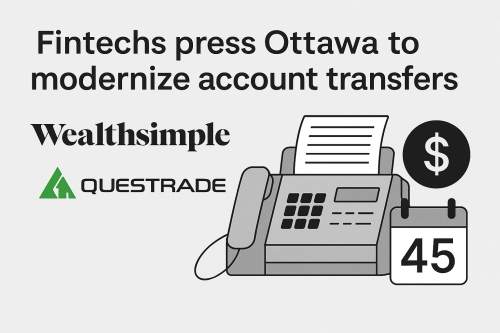
On August 12, 2025, Wealthsimple submitted its recommendations to the federal pre budget consultation, urging Ottawa to regulate how registered accounts such as RRSPs and TFSAs are transferred between financial institutions. The submission says rising transfer fees and weeks long delays undermines Canadians’ ability to manage their savings. Wealthsimple’s call was echoed by Questrade, which also urged stronger federal oversight.
Wealthsimple reported that between late 2024 and early 2025, the average transfer time was 19 days once paperwork was received. More than 13,000 transfers took longer than 45 days, and at any given time over $1 billion of client funds were stuck in transit, peaking at $2 billion in March. During this period, 45% of transfers were executed manually by the sending institution, specifically by fax and mailed cheques.
This outdated reliance on fax machines creates long delays that benefit incumbents. During this delay period, client capital is removed from their accounts by sending institutions (Read: Canadian incumbent banks), so it can be redeployed without clients receiving any benefit.
In fact, 15% of transfer requests were cancelled by clients due to the delays. Another way of putting this is investors are effectively providing interest free loans (to institutions) while paying more than $35 million in transfer fees.
Exit and transfer fees have grown from $0 to $75 a decade ago to an average of $150 per account in 2025.
With more than 40 million registered accounts in Canada, that adds up to hundreds of millions in annual costs.
Flat fees disproportionately harm younger Canadians. CRA data shows that the average TFSA balance for Canadians in their twenties is under $11,000, meaning a $150 fee can take more than 1% of their entire account.
By contrast, Canadians over 50, with TFSA balances above $25,000, are more likely to qualify for reimbursement programs offered by some institutions. Wealthsimple argues that this is a regressive structure that penalizes the very Canadians struggling most with affordability pressures.
The company itself does not charge clients who close or transfer out, and it has urged Ottawa to follow the example of other sectors such as telecom and air travel where hidden exit fees have been capped or eliminated.
The Canadian Investment Regulatory Organization (CIRO) has been studying the issue for years. CIRO's July 2025 White Paper on account transfers found that investor complaints over transfer delays have increased more than fivefold since 2015.
The paper reports widespread allegations that financial institutions intentionally slow transfers to retain business or to keep earning interest on client funds, with many investors stating that charges are too high or reimbursements are not honoured. This unnecessary friction harms consumers (and businesses alike).
CIRO has proposed modernizing the process with mandatory timelines, wider use of automation, and clearer requirements for firms to act diligently.
Wealthsimple’s pre-budget submission asks Ottawa the federal government who already regulates registered plans under the Income Tax Act to take similar steps in other industries to curb hidden fees.
From NCFA's perspective, fax machines and paper cheques are more than an inconvenience; they're systemic barriers to competition. Reform would not only protect consumers but also level the playing field for fintechs that rely on timely transfers to onboard new clients.
Why do Canadians and the government continue to accept an investment transfer system that still depends on fax machines, and why it takes pressure from fintechs to put the issue on the national agenda?
Other industries have modernized. Why has finance been allowed to remain stuck in the past? As Prime Minister Mark Carney puts it, “The premiers and I want to make Canada a global energy superpower and build the strongest economy in the G7.”
The National Crowdfunding & Fintech Association (NCFA Canada) is a financial innovation ecosystem that provides education, market intelligence, industry stewardship, networking and funding opportunities and services to thousands of community members and works closely with industry, government, partners and affiliates to create aa vibrant and innovative fintech and funding industry in Canada. Decentralized and distributed, NCFA is engaged with global stakeholders and helps incubate projects and investment in fintech, alternative finance, crowdfunding, peer-to-peer finance, payments, digital assets and tokens, artificial intelligence, blockchain, cryptocurrency, regtech, and insurtech sectors. Join Canada's Fintech & Funding Community today FREE! Or become a contributing member and get perks. For more information, please visit: www.ncfacanada.org
| | |
|---|---|---|
| | |
Crypto | Sep 22, 2025

Image: Freepik/krakenimages.com
On September 20, 2025, Coinbase CEO Brian Armstrong announced that NBA star Kevin Durant had regained access to his Coinbase account nearly ten years after first buying Bitcoin, and then initially purchasing it for around $650 per Bitcoin in 2015, implying a whopping gain of more than 17,000% ten years later.
Armstrong confirmed the recovery on X, which followed Durant’s story earlier in the week at the CNBC x Boardroom Game Plan summit in Santa Monica. Durant described how he first bought Bitcoin in 2014–2015
We got this fixed. Account recovery complete! https://t.co/TWYFpQkXsb
— Brian Armstrong (@brian_armstrong) September 19, 2025
Durant’s first exposure to Bitcoin came around 2014–2015, when he says he “started watching YouTube videos” about the emerging digital asset. Intrigued, he encouraged his agent, Rich Kleiman, to take a closer look. Their enthusiasm was quickly cooled when, according to Kleiman, their business manager “said, ‘No, don’t do that.’ So we didn’t.”
That might have been the end of the story if not for a party hosted by venture capitalist Ben Horowitz. Kleiman recounted how they heard Bitcoin mentioned repeatedly that night, and “we woke up the next day and said, ‘We have to do this.’” From there, they invested in Bitcoin and later became early backers of Coinbase through their firm Thirty Five Ventures.
According to Coindesk, Durant’s entry point was near $650 per Bitcoin in 2015, a level that makes his eventual recovery especially striking. With Bitcoin trading above $115,000 in September 2025, that original purchase reflects a gain of more than 17,000%, a staggering return on investment that Durant could only access once his Coinbase account was unlocked nearly a decade later.
Durant’s lost account access resulted in type of “forced hodling” through multiple market cycles. Chainalysis-based research on permanently lost Bitcoin estimates millions of crypto assets are out of reach because people have lost their passwords or recovery keys. That reduces the amount available to trade and makes the asset more scarce. Durant’s case shows that being locked out by accident can sometimes lead to big gains, but it also reveals the real danger for everyday users who may never regain access to their accounts.
Coinbase outlines strict processes for regaining access if emails or two factor devices are lost. Users may need to reset forgotten passwords, recover two factor authentication, or provide identity documents through account access troubleshooting. Many users report challenges completing these steps. After Durant’s recovery, social media threads filled with complaints from customers who have been locked out for years.
In response, Armstrong reposted a detailed thread from his support team on X, promising product improvements and faster support. Coinbase also maintains VIP service tiers for high volume traders. Reuters published an article in August 2025 about widespread user frustration with locked accounts and the Verge covered investigations into delays in customer support. Clearly more work needs to be done by Coinbase to support all customers, and not just celebrities that might be prioritized for obvious reasons.
Durant's experience of lost keys and account access can happen to even the most sophisticated investors, causing an incredible amount of frustration. Prevention is the best protection. Coinbase advises enabling multiple two factor authentication methods, including hardware keys, and updating recovery emails and phone numbers regularly.
Also, users should evaluate the benefits and risks of storing crypto on exchanges versus self custody options using a secure wallet. Digital asset investors should only work with crypto exchanges that offer reliable recovery workflows and strong customer support.
Thanks to Durant's celebrity status, consumer protection from lost keys and account access is back in the news. For Durant, it's another story and a drop in the bucket but for regulators and industry leaders it's a recurring lessons that equitable account recovery and strong consumer support is essential to wider adoption. While new trading features are also being developed and released, crypto exchanges and leaders need to prioritize safeguarding access for all users.
The National Crowdfunding & Fintech Association (NCFA Canada) is a financial innovation ecosystem that provides education, market intelligence, industry stewardship, networking and funding opportunities and services to thousands of community members and works closely with industry, government, partners and affiliates to create aa vibrant and innovative fintech and funding industry in Canada. Decentralized and distributed, NCFA is engaged with global stakeholders and helps incubate projects and investment in fintech, alternative finance, crowdfunding, peer-to-peer finance, payments, digital assets and tokens, artificial intelligence, blockchain, cryptocurrency, regtech, and insurtech sectors. Join Canada's Fintech & Funding Community today FREE! Or become a contributing member and get perks. For more information, please visit: www.ncfacanada.org
| | |
|---|---|---|
| | |
Regulation | Sep 15, 2025

Image: Paul Atkins, SEC Chair
On September 10, 2025, SEC Chair Paul S. Atkins delivered a keynote address in Paris at the OECD Roundtable on Global Financial Markets, resetting the tone for U.S. capital markets. His speech positioned the SEC not as an adversary to entrepreneurs but as an enabler of growth, advancing Project Crypto, a broad modernization initiative aimed at bringing securities regulation into the blockchain era.
Paul S. Atkins, SEC Chair:
“It is a new day at the SEC. Policy will no longer be set by ad hoc enforcement actions. We will provide clear, predictable rules of the road so that innovators can thrive in the United States.”
One of the most significant parts of Atkins' remarks was his (the SEC's) endorsement of “super-app” platforms. This vision is a welcomed 180 after years of a type of regulate by enforcement approach that drove many U.S. crypto companies overseas.
For fintechs, it means a future where integrated platforms can grow under clear oversight, with investors able to choose from multiple custody models.
For Canadian innovators and regulators, it further raises urgent questions about how Canada will remain competitive if the U.S. creates a friendlier landscape for capital formation and digital asset services.
“We must allow for ‘super-app’ trading platform innovation that increases choice for market participants. Platforms should be able to offer trading, lending, and staking under a single regulatory umbrella.”
Atkins acknowledged that Europe has already moved ahead with the Markets in Crypto Assets regulation, praising the framework as a first attempt at comprehensive digital asset oversight while stressing that the U.S. will not fall behind. By declaring that America must be “second to none” in fostering innovation, he more or less confirmed that the competitive race was on.
For Canadian fintechs, this accelerates the competition challenge with Europe and the U.S. both moving towards clarity, while Canada’s rules remain relatively limited. This moment calls for proportionate approaches to policy that reduce friction for innovators while protecting investors, as highlighted in NCFA’s Canadian Banks and Fintechs Back Regulated Stablecoin post.
Beyond crypto, Atkins described the changes coming in the era of “agentic finance” where autonomous AI agents execute trades, allocate capital, and manage risk with compliance built directly into their code.
Coupled with blockchain, he argued, AI could democratize access to advanced strategies and lower costs for individuals.
The challenge for regulators is to install commonsense guardrails without overreacting.
Fintech builders heard that AI in finance is not only here to stay but will be supported if developed responsibly.
Atkins’ Paris keynote can be taken as a statement of intent. He placed crypto super apps, AI finance, and tokenized markets front and center of U.S. strategy. Fintechs and investors have immediate takeaways. That is regulatory clarity is coming, and the players and markets that adapt quickly will benefit most.
As U.S. and Europe continue to advance crypto regulatory frameworks, it's more critical than ever that Canada expeditiously create proportionate regulation, double down on enabling frameworks, and collaborate with global peers. Canada would benefit from positioning itself as a jurisdiction that rewards responsible experimentation. As Atkins put it, “crypto’s time has come.”
The National Crowdfunding & Fintech Association (NCFA Canada) is a financial innovation ecosystem that provides education, market intelligence, industry stewardship, networking and funding opportunities and services to thousands of community members and works closely with industry, government, partners and affiliates to create aa vibrant and innovative fintech and funding industry in Canada. Decentralized and distributed, NCFA is engaged with global stakeholders and helps incubate projects and investment in fintech, alternative finance, crowdfunding, peer-to-peer finance, payments, digital assets and tokens, artificial intelligence, blockchain, cryptocurrency, regtech, and insurtech sectors. Join Canada's Fintech & Funding Community today FREE! Or become a contributing member and get perks. For more information, please visit: www.ncfacanada.org
| | |
|---|---|---|
| | |
European Fintech | Sep 8, 2025

Image: Navigating the Future of Finance magazine (Point Zero Forum)
The 2025 Point Zero Forum (Jun 24-26) in Zurich drew 1,350 participants from 66 countries, including over 20% from public sector institutions. Across 121 sessions spanning 95 hours, 329 speakers explored the future of finance and technology. These numbers matter because the forum is where central banks, regulators, and institutions compare notes on what is implementable now, not just what's aspirational.
For Canadian fintechs, the conversations in Zurich are a warning and an opportunity. Europe is moving quickly to reset its financial infrastructure. Canada risks lagging unless it adapts. Read the post 2025 Point Zero Forum magazine, "A Critical Call for Policy Action in Europe and Beyond" (24 page PDF)
Offline payments and infrastructure security were considered a matter of national sovereignty, not just technology. Danmarks Nationalbank warned: “Without power, many offline payments methods aren’t viable,” linking payments directly to energy security.
The world’s largest stablecoin Tether confirmed it will leave Europe because of reserve and regulatory requirements. This shows that Europe is treating payments, AI, and data as part of its sovereignty strategy.
Canada has its own domestic payment systems operated by Payments Canada, but Canada still doesn't have live operating real-time retail payment rails. In cloud services, Canadian banks and fintechs are still dependent on American providers like AWS, Microsoft, and Google.
Central banks are now focused on tokenized settlement. The Swiss National Bank said: “Price stability is our main focus also in challenging times,” while the European Central Bank stressed that central bank money must remain “available and useful” in tokenized markets.
The Bank of England suggested that oversight of stablecoins may evolve as the “singleness of money” assumption is tested.
The Bank of Canada paused it's digital dollar research initiative. Europe and the U.K. are moving faster. Canadian fintechs should design tokenized solutions that can connect to global settlement networks, not just domestic payment systems.
The Basel framework assigns a 1,250% risk weight to exposures on public blockchains compared to standard weights for permissioned systems. That number explains why institutions are cautious about public chains even as liquidity scale requires them.
Solana’s Lily Liu argued that “the 5.5bn people on the internet” can only be reached through open infrastructure, while regulators noted that immutability makes reversals and sanctions enforcement difficult. The likely outcome is a dual architecture with permissioned networks for issuance and compliance, and public networks for liquidity and settlement.
Canadian institutions face the same Basel capital rules as peers in other markets. Without clear guidance on the use of public versus permissioned networks, Canadian fintechs may find it harder to connect to global liquidity pools.
68% of EU businesses say they struggle to understand their obligations under the EU AI Act, holding back investment. Global wealth manager, Julius Baer’s COO estimated that customer focused AI tools could generate revenue within 6 to 12 months.
At the forum, agentic AI systems were demoed handling insurance claims with observability features allowing human review. The key issue is still accountability with policymakers worrying about loss of control as AI systems become more autonomous.
Canada has not finalized its AI regulation but offers a voluntary AI code of conduct, giving fintechs some near term flexibility. But any deployment that scales internationally will need to comply with EU and U.S. standards. The strategic opportunity is to pilot auditable AI now while preparing for global regulatory alignment.
S&P projects global private equity will grow from $15 trillion in 2025 to $18 trillion by 2027. Citi and SIX Digital Exchange announced tokenized access to late-stage pre-IPO equities on SDX, launching in Q3 2025.
Tokenization will improve collateral usability and ownership visibility, but not resolve fundamental illiquidity or opaque valuations.
Canada has a growing private capital market but no regulated digital exchange on the scale of SIX. Canadian fintechs could position themselves as infrastructure providers for tokenized funds and secondary liquidity, complementing global platforms instead of competing directly.
At the forum, speakers pointed out that some carbon credits were issued for projects expected to reduce emissions over 30 years, even though the land rights lasted only 10 years. That kind of mismatch reduces trust in the market.
Bringing carbon credits into mainstream finance could help spread risk and attract more investment. But for the market to work, credits must be backed by strong certification, insurance to cover project failures, and common standards that everyone follows.
Canada has compliance carbon pricing systems, but its voluntary carbon credit market is smaller and less standardized compared to Europe and Asia. Canadian fintechs could carve out a leadership role by building platforms that prioritize data integrity and risk coverage.
Canada must decide whether to keep pace with progressing markets in Europe and Asia or risk being shut out of global settlement networks. If Europe can move from pilots to architecture, Canadian fintechs must not stand still.
The National Crowdfunding & Fintech Association (NCFA Canada) is a financial innovation ecosystem that provides education, market intelligence, industry stewardship, networking and funding opportunities and services to thousands of community members and works closely with industry, government, partners and affiliates to create a vibrant and innovative fintech and funding industry in Canada. Decentralized and distributed, NCFA is engaged with global stakeholders and helps incubate projects and investment in fintech, alternative finance, crowdfunding, peer-to-peer finance, payments, digital assets and tokens, artificial intelligence, blockchain, cryptocurrency, regtech, and insurtech sectors. Join Canada's Fintech & Funding Community today FREE! Or become a contributing member and get perks. For more information, please visit: www.ncfacanada.org
| | |
|---|---|---|
| | |



August 26th, 2025

January 4th, 2024

June 1st, 2021

September 9th, 2020

July 9th, 2018

January 3rd, 2018

September 25th, 2017

June 20th, 2017

May 10th, 2017

December 14th, 2016
