





Karsten Wenzlaff, Advisor
August 26th, 2025
Karsten Wenzlaff is a Crowdfunding and Fintech Expert from Germany. He is Secretary-General of Digit[...]


Fintech Signal | May 2, 2025

Image: Larry Fink, Chair of BlackRock (Website, 2025 letter to investors)
Last month, Larry Fink the Chairman of BlackRock delivered his vision for unlocking private markets and the future of capital markets innovation in his 2025 annual letter to investors. His letter essentially outlines a strategy and roadmap that fintech players, especially in Canada can see it as a call to action. In his own words, Fink discusses areas of focus that have the potential to democratize private markets that traditionally have been seen as opaque and harder to value with less liquidity, less regulation and limited participation by institutional and high-net worth individual investors.
Below are five direct quotes that should excite fintech builders and investors and signals a turning point and window of opportunity, especially when they hear it from the head of the world's largest asset manager directly.
1 “Private markets don’t have to be as risky, or opaque, or out of reach. Not if the investment industry is willing to innovate.”
Fink says private markets need to become easier for more people to access. In the past, only large funds and institutions could invest in things like private equity or credit (loans), but that is starting to change. New tools are helping to open the door with automated data platforms, risk analysis engines, and tokenization infrastructure that turn investments into digital tokens that are easier to buy and sell.
In practical terms, this means fintech firms that can bring transparency, indexing, or fractional access to private assets will gain investor and consumer interest. BlackRock itself acquired Preqin, a leading private markets data provider to drive this data led transformation.
According to McKinsey's 2025 private equity (PE) report, global private equity AUM remains well above $13 trillion and 2024 deal values rebounded by 14% to $2 trillion, for the third highest year on record for PE activity.
2. “Every stock, every bond, every fund—every asset—can be tokenized.”
This may sound speculative but it's not. Fink is laying down the gauntlet for a future where asset ownership is digitized and real time. Why? Because the big unlock here is yield. If tokenization allows $100 investment plays of private equity or infrastructure deals, then platforms can create products that serve both retail and institutional climates using much of the same structure.
Boston Conulsting Group's 2024 whitepaper "Tokenized Funds: The Third Revolution in Asset Management Decoded" forecasts that tokenized funds could reach over $600 billion AUM by 2030, especially if the growth pattern is similar to exchange-traded funds (ETFs).
3. “Artificial intelligence will transform how we understand markets and allocate capital.”
This isn't about chatbots. Finks talking about artificial intelligence (AI) as a capital allocation engine. Using AI to assess and predict risks, identify high potential assets, and help funds build and maintain more resilient portfolios. AI is already being used to evaluate startups, monitor compliance, and optimize the underwriting of private credit.
In February, the World Economic Forum wrote that only 2% of private equity firms will realize significant value from AI investments in 2025, however 93% anticipate moderate to significant benefits within a three to five year outlook.
The opportunity is clear at this point, such that Canadian platforms that integrate AI to automate deal flow and optimize investor matching will have a competitive offering and advantage in the near future.
4. “We're great at extending people's lives, yet we hardly spend any effort helping them afford those extra years.”
Fink knows that retirement is a crisis waiting to happen. In Canada by way of an example, the 2023 Canadian Retirement Survey by the Healthcare of Ontario Pension Plan (HOOPP) unveiled that 44% of non-retired Canadians between 55 and 64 had less than $5,000 in savings, and 75% had $100,000 or less saved for retirement.
Fink’s answer is a to help retirees by providing a predictable retirement paycheck model, which BlackRock is launching with their LifePath product in the U.S.
This is an area that fintechs can build on by creating digital retirement wallets with automated income streams. How about a syndicated annuity structure or micro investment portfolio that can mimic a steady paycheck. With a proper structure, these models could scale to serve the self-employed and gig economy workers who need retirement planning options, and the earlier the better.
5. “Capitalism did work—just for too few people.”
Fink is talking about allowing more investors into the tent, more geographic and social inclusion. Capital markets must be both global and local at the same time, and talks about enabling global partnerships like their joint venture Jio-BlackRock India, to help them scale their own capital markets.
For Canadian fintechs, this means working to provide smart and modern solutions for underserved regions, including Indigenous communities, rural investors, and newcomers to Canada. Prosper Canada's learning hub cites approx 15% of over 5 million Canadians are underbanked or without access to traditional financial services. That's why it makes initiatives like Koho's postal banking partnership with Canada Post exciting and important at the same time.
BlackRock led by Larry Fink is investing real money and a long term focus on financial technology innovation in capital markets, including tokenization, AI decisioning tools, and an expansion of private capital markets that is already afoot. Fintechs and investment platforms that align with these opportunities stand to benefit from the next iteration of financial infrastructure that will be more inclusive, more data driven, and more robust to deliver long term value for more people.
 The National Crowdfunding & Fintech Association (NCFA Canada) is a financial innovation ecosystem that provides education, market intelligence, industry stewardship, networking and funding opportunities and services to thousands of community members and works closely with industry, government, partners and affiliates to create a vibrant and innovative fintech and funding industry in Canada. Decentralized and distributed, NCFA is engaged with global stakeholders and helps incubate projects and investment in fintech, alternative finance, crowdfunding, peer-to-peer finance, payments, digital assets and tokens, artificial intelligence, blockchain, cryptocurrency, regtech, and insurtech sectors. Join Canada's Fintech & Funding Community today FREE! Or become a contributing member and get perks. For more information, please visit: www.ncfacanada.org
 |  |  |
|---|---|---|
 |  |  |
Payments Regulation | May 1, 2025
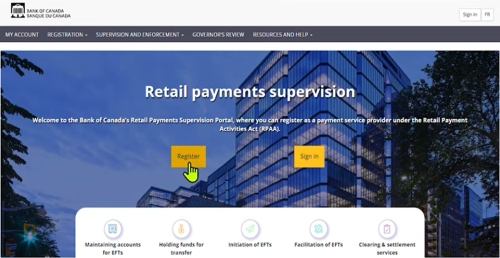
Image: PSP Connect, Retail Payments Supervision (Bank of Canada)
On April 30, 2025, the Bank of Canada (BoC) shared a new update on how it will enforce the Retail Payment Activities Act (RPAA). Payment service providers, known as PSPs, had until November 15, 2024 to register. Those who failed to do so are now being urged to act immediately or face enforcement.
BoC message:
“If you missed this deadline, you must apply immediately and at least 60 days before starting any retail payment activities. Failure to register may result in enforcement action,” the Bank stated in its April 30 message.
The Bank has updated its enforcement process outlining they may contact a PSP that is under investigation. Communication methods may include phone calls, encrypted email, courier delivery, and other secure channels. The approach is inline with the enforcement tools at their disposal published in June 2024, which include monetary penalties and compliance orders.
The BoC is also sending a reminder of how to submit a registration application through PSP Connect, the Bank's secure online portal.
1. Create a PSP Connect account
Here's a handy step by step tutorial and video available on the Bank of Canada's website to help you with the process.
2. Enter the required information and upload all documents
You can save your progress and return later if needed.
3. Submit your completed application and pay the fee
There's a $2500 application fee that must be paid in full by either credit card or debit. Alternative payment arrangements such as direct deposit or wire transfer may be arranged if several card payment attempts fail.
If you are new to the process or need further help, and have missed the workshops/tutorials, the Bank encourages PSPs to use its general inquiries form.
This update signals that the BoC is shifting from education to enforcement, as they are making it clear they are ready to take action against unregistered PSPs. Regulatory oversight of retail payments will only become more structured from here, and payment providers must meet their legal obligations or face financial and operational consequences.
The National Crowdfunding & Fintech Association (NCFA Canada) is a financial innovation ecosystem that provides education, market intelligence, industry stewardship, networking and funding opportunities and services to thousands of community members and works closely with industry, government, partners and affiliates to create a vibrant and innovative fintech and funding industry in Canada. Decentralized and distributed, NCFA is engaged with global stakeholders and helps incubate projects and investment in fintech, alternative finance, crowdfunding, peer-to-peer finance, payments, digital assets and tokens, artificial intelligence, blockchain, cryptocurrency, regtech, and insurtech sectors. Join Canada's Fintech & Funding Community today FREE! Or become a contributing member and get perks. For more information, please visit: www.ncfacanada.org
| | |
|---|---|---|
| | |
Innovation Economy | April 29, 2025

Image: Freepik
Mark Carney has been elected as Canada's 24th Prime Minister after leading the Liberal Party to win the 2025 federal election. The Liberals secured 168 seats (just shy of a majority), and are expected to form a minority government. Prime Minister Mark Carney has already spoken with President Trump about the pressing issues of tariffs, trade war and 51st state rhetoric, and the two leaders have agreed to meet in person.
While those issues are of critical importance to Canada's sovereignty, this article looks at Carney's past public comments and Liberals 2025 platform to get a sense for the implications for Canada's fintech sector under his expected leadership.
In 2019, Carney was the Governor of the Bank of England (BoE) and said the following at the Innovate Finance Global Summit:
“A new economy requires a new finance... to serve the digital economy, to support the major transitions underway across the globe and to increase the sector’s resilience”.
The newly elected Prime Minister of Canada has a deep background in finance, global networks, and a steady hand at innovation. He's expected to speed up payments modernization, support the responsible AI development, foster fintech investment, tighten crypto rules, and open more global markets to Canadian companies. The Liberal Party commitments that support innovation include financial technologies and sustainable finance, infrastructure investment, internal trade reform, red tape reduction, and a patent box regime, all told would help strengthen the economy and fintech growth.
When Carney was leading the BoE, he signalled strong support for opening payments infrastructure to non-bank providers, helping to boost innovation and competition. In Canada, the implementation of open banking and payment modernization initiatives (i.e. Real Time Rail System) have sadly faced prolonged delays. Carney is expected to speed up these rollouts to benefit consumers and competition. Open banking will give consumers control over their financial data and allow fintech companies to create new services, while the operating firms must meet high security and operational standards.
As part of its 2025 platform, the Liberal government committed to eliminating federal barriers to interprovincial trade and labour mobility by Canada Day. Reducing costs and aligning standards could benefit fintech companies that must constantly track and adjust to changing and inconsistent provincial compliance requirements, in sectors like payments, insurtech, wealthtech, and others. Streamlining trade and regulatory barriers would help fintechs expand nationally more effectively, reduce legal and operational costs, and also contribute to offering consistent services to customers and businesses from coast to coast.
Carney spoke about how emerging technologies are game-changing finance in a 2018 Mansion House speech “New Economy, New Finance, New Bank”, where he acknowledged AI's growing impact on credit and risk systems.
Under his government, Canada is expected to advance the Artificial Intelligence and Data Act to regulate high impact AI systems including financial firms using AI for credit scoring, fraud detection, or robo advising to ensure responsible AI standards are met for fairness, explainability, and consumer protection.
Immediately after securing Liberal leadership, Carney axed the controversial capital gains tax hike, directly supporting Canada's innovation economy. Under his leadership, Carney could expand access to venture capital, innovation incentives, and encourage national regulatory alignment for startups operating across multiple provinces. The Liberal platform also supports a patent box regime, focused on scaling high growth firms, retaining intellectual property in Canada, and improving commercialization outcomes from public and private R&D. The Liberal 2025 Platform outlines efforts to increase business investment and create a more competitive innovation environment, especially for sectors like fintech and AI.
Although Carney previously showed openness towards regulated forms of crypto innovation, in 2018, he spoke critically of unbacked crypto assets and called Bitcoin “neither a store of value nor a useful means of exchange”. It's expected that he'll tighten oversight of crypto exchanges, stablecoin issuance, and asset custody. Lastly, while Carney hasn't explicitly endorsed a Canadian CBDC, he has called for central banks to explore sovereign digital currencies as tools to support monetary policy and financial stability. During a 2019 speech at the Jackson Hole Economic Symposium, for example, Carney proposed the idea of a "synthetic hegemonic currency" (SHC) as a potential solution to the destabilizing dominance of the U.S. dollar in the global financial system.
Mark Carney is one of the most prominent global figures in sustainable finance. He co-founded the Glasgow Financial Alliance for Net Zero (GFANZ) and served as the UN Special Envoy on Climate Action and Finance. His leadership brings a strong focus on aligning financial systems with climate goals. The 2025 Liberal platform commits to supporting green innovation and transitioning Canada toward a low-carbon economy. This creates opportunities for fintechs in areas like ESG data services, green lending, climate risk modeling, and carbon trading infrastructure.
Carney is expected to support broader digital financial access across Canada. In his 2018 “Future of Money” speech, he emphasized the role of digital identity, financial modernization, and infrastructure in improving inclusion. While he has't directly addressed digital ID for Canada, the Liberal platform’s national digital readiness strategy includes high speed rail and northern connectivity projects that could help bring digital banking and fintech services to underserved and remote communities.
| Opportunities | Challenges |
| Launch of real time payments and open banking | Meeting tougher compliance and risk standards |
| New funding for AI, fintech innovation, and green finance | Higher expectations for responsible AI and cybersecurity |
| Stronger startup investment environment and patent box incentives | Adapting to stricter crypto and stablecoin rules |
| Global trade partnerships and reduced internal trade barriers | Competition from international fintech firms |
| Possible leadership in digital identity and CBDC projects | Regulatory complexity for multi jurisdictional firms |
| Growth in sustainable finance and ESG fintech | Evolving global standards for ESG data and disclosures |
| Growth in digital access through national infrastructure | Uneven fintech access in rural and remote communities |
Mark Carney's credentials offer an elite tier of credibility in global finance, climate leadership, and modernization of financial systems. Together with the Liberal 2025 Platform's strategic commitments to innovation, interprovincial trade liberalization, red tape reduction, and IP commercialization, his leadership is desperately needed to improve Canada's flailing productivity, upgrade its financial ecosystem, build public trust and international competitiveness.
His background also positions Canada to lead in sustainable finance, aligning innovation with global climate goals. For fintech entrepreneurs, investors, and policymakers, the Carney era is underpinned by stable governance and a clear vision, offering a mix of opportunity and responsibility.
The National Crowdfunding & Fintech Association (NCFA Canada) is a financial innovation ecosystem that provides education, market intelligence, industry stewardship, networking and funding opportunities and services to thousands of community members and works closely with industry, government, partners and affiliates to create a vibrant and innovative fintech and funding industry in Canada. Decentralized and distributed, NCFA is engaged with global stakeholders and helps incubate projects and investment in fintech, alternative finance, crowdfunding, peer-to-peer finance, payments, digital assets and tokens, artificial intelligence, blockchain, cryptocurrency, regtech, and insurtech sectors. Join Canada's Fintech & Funding Community today FREE! Or become a contributing member and get perks. For more information, please visit: www.ncfacanada.org
| | |
|---|---|---|
| | |
Regulation | April 29, 2025

Image: Freepik/brgfx
On April 25, 2025, the U.S. Securities and Exchange Commission (SEC) hosted a crypto roundtable discussion together with select industry experts and legal participants, "Know Your Custodian: Key Considerations for Crypto Custody" at the SEC's headquarters in Washington, D.C.
The opening session included remarks from Crypto Task Force Chief of Staff Richard Gabbert and SEC Chair Paul Atkins, followed by Commissioners Hester Peirce, Caroline Crenshaw, and Mark Uyeda.
Chairman Paul Atkins emphasized the importance of finally fixing long standing regulatory problems for digital assets and blockchain technology. He thanked Commissioner Hester Peirce for her leadership and described her as the right person to push forward a 'common sense' approach to crypto markets. Atkins made it clear that he wants the agency to end the uncertainty that has stifled innovation in the sector for years. He essentially confirmed what industry has been saying for years. That is that entrepreneurs across the country are building better, safer, and cheaper financial services using blockchain tech but regulatory confusion has held them back. He committed to working with Congress and the Trump Administration to set up a fit for purpose regulatory framework for crypto assets. Read his remarks here.
Commissioner Hester Peirce compared the current U.S. regulatory approach of crypto custody to a children’s game called “the floor is lava” except that regulators are making it much harder by leaving the room dark and not providing clear guidance. She said today’s rules make it very difficult for brokers, investment advisers, and investment funds to engage with crypto assets safely or legally. The SEC should make the rules clearer and recognize that not all crypto assets are the same, and in some cases using blockchain technology could even make custody safer than traditional systems. She also stressed that investors should be allowed to self-custody their assets without having to go through intermediaries like banks or broker-dealers, warning that the rules should not force unnecessary middlemen onto investors who prefer to manage their own assets securely. Regulation should encourage safer crypto markets without crushing innovation or forcing outdated models onto new technology.
Commissioner Caroline Crenshaw said that the lack of robust custody standards for crypto assets is a serious gap, and that the current environment is a risk for both retail and institutional investors. She mentioned the collapse of FTX and mismanagement in several crypto lending firms as examples of what can go wrong without the appropriate oversight, and questioned whether existing broker-dealer and advisory regimes were sufficient. Crenshaw said that any framework for custody must be technologically sound and legally enforceable to avoid paper compliance without real safeguards.
Commissioner Mark Uyeda stressed that regulatory requirements must be clear or they'll drive companies offshore and that innovation was important. Cautioned against applying a single rule in a digital asset sector where one size doesn't fit all and could stifle experimentation. He asked whether digital custodians should be assessed like their traditional counterparts, if they meet the equivalent operational and risk controls.
While the roundtable had two different focused panel discussions, here are five key challenges that were discussed when trying to apply traditional custody regulations to crypto assets.
Takeaway: Some consensus that federal securities laws need to be modernized to support custody models for crypto assets, and compliant innovation.
Takeaway: The SEC must recognize that crypto custody involves new forms of risk that current frameworks do not address (nor were they designed to).
Takeaway: SAB 121 may have made it harder for trusted firms to offer crypto custody, which could reduce investor protection.
Takeaway: Broker dealer models need updated guidance to allow more participation in digital asset custody while still protecting investors.
Takeaway: Custodial frameworks must guarantee client protections to the equivalent of traditional systems (expectations) to support long term growth.
The SEC roundtable series is a clear sign that key SEC regulators are open to revisiting current rules. As more investors and institutions enter crypto markets, the need for clear rules on how to safely hold these assets is becoming urgent.
The collaboration and engagement with industry should move the U.S. closer to having a practical crypto framework that supports both innovation and safety.
The National Crowdfunding & Fintech Association (NCFA Canada) is a financial innovation ecosystem that provides education, market intelligence, industry stewardship, networking and funding opportunities and services to thousands of community members and works closely with industry, government, partners and affiliates to create a vibrant and innovative fintech and funding industry in Canada. Decentralized and distributed, NCFA is engaged with global stakeholders and helps incubate projects and investment in fintech, alternative finance, crowdfunding, peer-to-peer finance, payments, digital assets and tokens, artificial intelligence, blockchain, cryptocurrency, regtech, and insurtech sectors. Join Canada's Fintech & Funding Community today FREE! Or become a contributing member and get perks. For more information, please visit: www.ncfacanada.org
| | |
|---|---|---|
| | |
Crypto | April 28, 2025

Image: Freepik/pikisuperstar
Never a dull moment. Last week, Trump announced a special dinner with the President for the top 220 token holders (see gamified leaderboard) of his $TRUMP meme coin. The event is scheduled to take place May 22, 2025 at the at Trump National Golf Club near Washington, D.C.
Following the news the token surged more than 50% in value, however the presidential self-promotion has triggered more ethical concerns including calls for impeachment by U.S. Democratic Senator Jon Ossoff who warns that selling access to a sitting president via a crypto contest could constitute 'an impeachable offense'.
Historically, political donations are highly regulated with disclosure rules, donation caps, and transparency requirements but Trump's meme coin crypto model offers anyone who buys his $TRUMP token and holds it during the contest (no political donation required), can get access to a sitting president without any sort of formal tracking or financial reporting.
The Federal Election Commission regulates official campaign fundraising but crypto tokens tied to personal brands or unofficial committees fall outside of their oversight.
The contest fuelled interpretation rumours that a minimum of $300,000 would be required to get on the list, however Trump's meme coin social team clarified on x.com that anyone could join the dinner if they are one of the top 220 token holders. As of April 28, the 220th on the leaderboard is holding about 898 tokens or a value of approx 13k USD. Participants in the contest must register their rankings which are based on time weighted holdings for the duration of the contest period.
The $TRUMP team also clarified that insider held tokens will remain locked for an additional 90 days to avoid concerns of a rug pull where early holders dump tokens after promotional events.
Offering personal access to a sitting president in exchange to boost their personal token value has alarmed lawmakers. As reported by Decrypto, Senator Elizabeth Warren and Representative Adam Schiff have called for a federal ethics investigation. Senator Jon Ossoff went further, suggesting that the arrangement could justify impeachment if it is found that Trump broke the rules of how public officials and sitting presidents are supposed to behave.
President Trump is sidestepping rules of how politicians are meant to act, and at the same time, cryptocurrencies are enabling politicians to raise money directly with fewer rules.
The National Crowdfunding & Fintech Association (NCFA Canada) is a financial innovation ecosystem that provides education, market intelligence, industry stewardship, networking and funding opportunities and services to thousands of community members and works closely with industry, government, partners and affiliates to create a vibrant and innovative fintech and funding industry in Canada. Decentralized and distributed, NCFA is engaged with global stakeholders and helps incubate projects and investment in fintech, alternative finance, crowdfunding, peer-to-peer finance, payments, digital assets and tokens, artificial intelligence, blockchain, cryptocurrency, regtech, and insurtech sectors. Join Canada's Fintech & Funding Community today FREE! Or become a contributing member and get perks. For more information, please visit: www.ncfacanada.org
| | |
|---|---|---|
| | |
AI Licensing | April 24, 2025

Image: Freepik
As reported by the Guardian, the Copyright Licensing Agency (CLA), a collaboration between the Authors' Licensing and Collecting Society (ALCS) and Publishers' Licensing Services, is currently developing a licensing model to launch in Q3 2025 to ensure authors get paid when their books, articles, and other creative assets are used to train generative artificial intelligence (GenAI) models. The CLA's goal is to provide a legal framework that will allow AI developers to access copyrighted content while ensuring that authors and publishers receive fair compensation.
For fintechs, digital content platforms, writers creatives, and key stakeholders, this move signals a step towards regulated, rights-based access to data. A test case for how governments and publishers globally may seek to regulate AI development with existing copyright frameworks. As AI adoption grows so will the hunger for data and the need to resolve the conflict between innovation and copyright law.
The National Crowdfunding & Fintech Association (NCFA Canada) is a financial innovation ecosystem that provides education, market intelligence, industry stewardship, networking and funding opportunities and services to thousands of community members and works closely with industry, government, partners and affiliates to create a vibrant and innovative fintech and funding industry in Canada. Decentralized and distributed, NCFA is engaged with global stakeholders and helps incubate projects and investment in fintech, alternative finance, crowdfunding, peer-to-peer finance, payments, digital assets and tokens, artificial intelligence, blockchain, cryptocurrency, regtech, and insurtech sectors. Join Canada's Fintech & Funding Community today FREE! Or become a contributing member and get perks. For more information, please visit: www.ncfacanada.org
| | |
|---|---|---|
| | |
DeFi | April 24, 2025

Image: Freepik/fullvector
In April 2025, the Bank for International Settlements (BIS) published a new report called 'Cryptocurrencies and decentralised finance: functions and financial stability implications' that could impact how regulators approach decentralized finance (DeFi). For the first time, the BIS explores the idea that smart contracts could help enforce certain regulatory rules within the code itself. To be clear, the BIS doesn't say that smart contract algorithms will replace oversight but it suggests that certain protections like disclosure requirements or prohibiting (or limiting) risk transactions could be built directly into the code.
At the same time, the BIS makes it clear that code alone is not enough. Behind every protocol is a developer, a team, or a group of people in-real-life (IRL) that makes decisions when designing or maintaining the system. These people often manage access, risk settings and upgrades. The BIS is saying that if DeFi is going to be safe and trusted then regulators must consider both the smart contract system and the people who develop and influence it.
Self-executing smart contracts are at the heart of DeFi. They allow users to lend, borrow, trade, and stake assets without relying on intermediaries like a centralized financial institution. Once a smart contract is deployed to the blockchain, it executes transactions exactly as coded, without exceptions. This fact makes them potentially powerful tools for embedding and enforcing basic safeguards to protect stakeholders that interact with these contracts like investors.
The BIS seems to support this concept (BIS Paper No. 156, page 22):
“Regulation could then be embedded in smart contracts to make sure that rules were met. Examples… include ensuring that smart contracts were executed in line with the status of the ledger, that the disclosure of information took place or that ‘best execution’ requirements have been met.”
What this means is that if a smart contract fails to meet a preset condition, such as price fairness or a collateral threshold requirement, it could automatically trigger a manual review. This would reduce the need for full manual checks on all transactions, and the smart contracts could require public disclosures are met before transactions were allowed. These types of technical safeguards would run automatically and help reduce fraud, bias, or delay. But the BIS says, automation has limits.
The BIS highlights that smart contracts do not govern themselves. That is, behind every DeFi protocol is a group of developers (tech/business/legal/investor or otherwise) that decides how the code will work, who can update it, and affect the direction it takes.
BIS quotes on Page 21:
“It would be useful to analyse the entities (and persons) exerting de facto control of a DeFi protocol…”
In many DeFi systems, the people involved are often anonymous or semi-anonymous, yet they can often have administrative access or governance power. Given the high stakes in such a financial system, it raises serious questions about accountability. Who is on the hook when problems arise?
Canada has a strong, innovative, and growing DeFi community with many projects being launched and experimented with. These project teams often create complex and secure smart contracts but may lack a clear acc0untability structure so users can face real risks. The BIS's report outlines two layers of protection related to governance.
1. The first is technical. Smart contracts could/should enforce baseline rules around transparency, fairness, and market integrity, without human intervention.
2. The second is organizational. Developers and governance teams must be identifiable, transparent, and where appropriate, regulated. That could mean setting minimum standards, requiring disclosures, or creating a new legal category for protocol operators.
The HM Treasury in the United Kingdom released a paper in February 2023 titled "Future financial services regulatory regime for cryptoassets" that discusses various options for bringing DeFi activities into the regulatory perimeter - section 11.6:
"One option for regulating DeFi is to define a set of DeFi-specific activities – e.g. 'establishing or operating a protocol' – as regulated activities under the RAO (or DAR). The persons carrying out those activities would then require authorisation, and the FCA could design a bespoke regime around these regulated activities."
The BIS report covers a range of updated views on cryptocurrency topics, as adoption continues to grow globally. The BIS is looking for a path that DeFi can grow (not advocating to centralize or shut it down) but with guardrails to protect users and the financial system. Smarter regulation is where 'code and community' can collaborate with a novel system pushing boundaries.
The National Crowdfunding & Fintech Association (NCFA Canada) is a financial innovation ecosystem that provides education, market intelligence, industry stewardship, networking and funding opportunities and services to thousands of community members and works closely with industry, government, partners and affiliates to create a vibrant and innovative fintech and funding industry in Canada. Decentralized and distributed, NCFA is engaged with global stakeholders and helps incubate projects and investment in fintech, alternative finance, crowdfunding, peer-to-peer finance, payments, digital assets and tokens, artificial intelligence, blockchain, cryptocurrency, regtech, and insurtech sectors. Join Canada's Fintech & Funding Community today FREE! Or become a contributing member and get perks. For more information, please visit: www.ncfacanada.org
| | |
|---|---|---|
| | |



August 26th, 2025

January 4th, 2024

June 1st, 2021

September 9th, 2020

July 9th, 2018

January 3rd, 2018

September 25th, 2017

June 20th, 2017

May 10th, 2017

December 14th, 2016
