





Karsten Wenzlaff, Advisor
August 26th, 2025
Karsten Wenzlaff is a Crowdfunding and Fintech Expert from Germany. He is Secretary-General of Digit[...]


July 8, 2026 | NCFA Market Activity | SME Finance And Business Banking, Artificial Intelligence And Data, Digital Identity And Trust, Cybersecurity And Fraud, Fintech And Innovation

On July 7, 2026, Equifax announced a definitive agreement to acquire Círculo de Crédito, a Mexican credit information services company, for a $750 million enterprise value. The companies expect the transaction to close in the fourth quarter of 2026, subject to closing conditions and regulatory review.
Círculo de Crédito operates consumer and commercial credit bureau services in Mexico. Equifax says the company serves more than 1,700 bank, retail, fintech, small business lending, microfinance and telecommunications customers, with 2 billion tradelines covering 80 million validated identities.
The deal expands Equifax’s international credit data footprint in Mexico, which Equifax describes as one of the fastest growing credit markets globally. Círculo de Crédito generated an estimated $134 million in revenue for the 12 months ended June 30, 2026, up 31%, with $62 million of adjusted EBITDA.
Equifax says Círculo de Crédito uses alternative data, including gig economy transactions, utility payment history and telecommunications payment history. Mexico has a large underbanked population. Mexico is a market where more than 25% of the population lacks access to formal financial products and nearly 44% does not have a bank account.
Alternative data can help lenders assess thin file borrowers, informal workers, microbusinesses and consumers without deep traditional credit histories. It can also help challenge questions about consent, data quality, explainability, model governance and consumer protection when credit access depends on broader data signals.
More data can widen access, but only if lenders can show how the data is collected, governed, explained and challenged.
Equifax says the acquisition gives Círculo de Crédito customers access to Equifax cloud native capabilities, EFX.AI technology, identity protection and fraud prevention offerings.
Following closing, Círculo de Crédito will join the Equifax International business. Juan Manuel Ruiz Palmieri and the existing Círculo de Crédito team are expected to continue leading the company.
The acquisition also continues Equifax’s expansion strategy. CEO Mark W. Begor said Círculo de Crédito would be Equifax’s 17th bolt on acquisition in the past six years, bringing the total for that period to nearly $5 billion.
Lenders increasingly rely on identity coverage, alternative data, fraud controls and AI assisted underwriting to expand credit access. That same data quality issue appears in AI Won't Solve SME Finance Without Better Data, where the core problem is not model ambition, but whether business data is trusted, verified and usable.
That connects directly to Canada’s own SME finance debate. NCFA recently examined why SME loan competition in Canada is under review, including lender concentration, switching friction and access barriers for smaller firms.
It also fits the Open Finance SME Capital Access opportunity area, where SME data, credit access and open finance are already linked.
More data can support credit access. The hard part is proving that expanded data use remains accurate, explainable and fair.
Can alternative data expand credit access without creating new blind spots in consent, model governance and borrower recourse?
 The National Crowdfunding & Fintech Association (NCFA Canada) is a financial innovation ecosystem that provides education, market intelligence, industry stewardship, networking and funding opportunities and services to thousands of community members and works closely with industry, government, partners and affiliates to create a vibrant and innovative fintech and funding industry in Canada. Decentralized and distributed, NCFA is engaged with global stakeholders and helps incubate projects and investment in fintech, alternative finance, crowdfunding, peer to peer finance, payments, digital assets and tokens, artificial intelligence, blockchain, cryptocurrency, regtech, and insurtech sectors. Join Canada's Fintech & Funding Community today FREE! Or become a contributing member and get perks. For more information, please visit: [www.ncfacanada.org](http://www.ncfacanada.org)
 |  |  |
|---|---|---|
 |  |  |
July 8, 2026 | NCFA Market Activity | SME Finance And Business Banking, Artificial Intelligence And Data, Payments And Money Movement, Digital Identity And Trust, Risk Compliance And Regtech

On July 7, 2026, Vancouver-based Canadian fintech company FintechWerx International Software Services Inc. announced that it entered an intellectual property and technology asset purchase agreement to acquire Ruby Loans, a small and medium sized Canadian business lending platform.
FintechWerx agrees to acquire the technology from 1431575 B.C. Ltd., an arm’s length vendor. Closing is still subject to the usual conditions, including corporate, regulatory and Canadian Securities Exchange approvals.
FintechWerx is paying up to $825,000. The package includes $100,000 in cash on closing, 728,862 common shares at a deemed price of $0.6174 per share, and up to $275,000 in milestone payments through additional shares.
Ruby Loans is positioned as an AI native loan origination infrastructure for credit unions and other financial institutions, helping prepare decision ready SME loan files before human underwriting review.
While the purchase price is modest, the operating problem is not.
The OECD’s 2026 Canada SME financing profile says small business lending in Canada reached $160.1 billion in 2024, up from $134.8 billion in 2023. Small businesses represented 11.7% of total outstanding business loans.
Statistics Canada reported that 25.7% of Canadian SMEs requested debt financing in 2023. The most common products were business credit cards, lines of credit and term loans.
SME finance is often judged by capital availability, while the borrower experience depends on workflow. A lender can have capital and still lose time to incomplete files. A business can need liquidity and still get stuck in repeated document requests. Also worth noting that SME loan competition in Canada is currently under review.
That kind of friction is costly in the current climate. Tariffs, input costs and uncertain demand are putting pressure on many Canadian SMEs. CFIB reported in March 2026 that 68% of Canadian small business owners continued to say they were negatively affected by U.S. tariffs.
FintechWerx already provides merchant onboarding, payment processing, identity verification, fraud mitigation and data services. Ruby Loans adds AI native SME loan origination technology to that platform.
Ruby Loans automates borrower intake, document collection and policy based pre screening before a lending officer reviews an application. The platform includes a configurable policy rules engine, automated applicant interview and Accept, Review or Decline dashboard.
George Hofsink, CEO of FintechWerx, said about the acquisition:
"Represents a strategic expansion of our financial infrastructure capabilities" and "creates significant opportunities to enhance the Ruby Loans platform through our data, analytics and AI initiatives."
Credit unions have local relationships and member trust. They also face capacity limits. Small business lending can take time because the files are messy, the borrower story is specific and the final human oversight credit judgment takes time.
Ruby Loans targets the file preparation burden at the credit union level. The borrower starts the inquiry. The platform collects information, applies the institution’s policy rules and prepares a more complete file before the lending officer reviews it.
NCFA recently covered a similar partnership with Conexus backing JUDI.AI for credit union SME lending. JUDI.AI is a separate company, but the signal is aligned. Canadian credit union channels are looking for SME lending tools that improve speed without weakening underwriting discipline.
Fred Zdan, founder of Ruby Loans, said he built the platform to simplify a lending process that has been complex and time consuming for borrowers and lenders. FintechWerx also plans discussions to appoint Zdan as executive chair and CEO of FinanceWerx Solutions Inc., a wholly owned subsidiary.
The agentic AI claim only is only as good as the data and evidence given to lenders. The opportunity is decision support, not autonomous credit approval (yet).
AI won't fix a poor intake workflow either. Missing documents, weak identity checks and scattered borrower data make analytics less reliable. Structured borrower files give lenders a better base to work from.
For regulated lenders, AI can help flag gaps, apply policy rules and route files. Human review still has to carry the credit judgment.
FintechWerx’s existing fraud and identity capabilities could become relevant here. Online SME lending needs speed, but it also needs trust. NCFA unveiled this in How Fraud Broke The Old Rules Of Trust And Verification, which looks at how digital fraud is forcing financial firms to strengthen identity checks, transaction monitoring and verification controls. SME lending faces the same challenge as more borrower activity shifts online.
Can Canadian credit unions use AI native loan origination to speed up SME credit while keeping human judgment at the centre of underwriting?
The National Crowdfunding & Fintech Association (NCFA Canada) is a financial innovation ecosystem that provides education, market intelligence, industry stewardship, networking and funding opportunities and services to thousands of community members and works closely with industry, government, partners and affiliates to create a vibrant and innovative fintech and funding industry in Canada. Decentralized and distributed, NCFA is engaged with global stakeholders and helps incubate projects and investment in fintech, alternative finance, crowdfunding, peer to peer finance, payments, digital assets and tokens, artificial intelligence, blockchain, cryptocurrency, regtech, and insurtech sectors. Join Canada's Fintech & Funding Community today FREE! Or become a contributing member and get perks. For more information, please visit: [www.ncfacanada.org](http://www.ncfacanada.org)
| | |
|---|---|---|
| | |
July 8, 2026 | NCFA Insight | Artificial Intelligence And Data, Risk Compliance And Regtech, Digital Identity And Trust, Cybersecurity And Fraud, Fintech And Innovation

On July 7, 2026, Lightworks, Scotiabank, Sun Life and TELUS launched The AI Consortium to jointly build critical AI control infrastructure in Canada. Lightworks will operate the consortium’s infrastructure and coordinate deployment across members.
The first project is an Agentic Control Plane, described as a system for enterprise visibility and control across models, agents, users and inference pipelines (think regulated enterprises). Future projects named in the release include an AI Operations Center and AI Token Exchange.
The announcement points to the reality that Canadian regulated enterprises are beginning to pool the control systems they’ll need before agentic AI reaches banking, insurance, telecom, compliance, fraud, advice and operations at scale.
The consortium model solves a practical problem. AI control infrastructure is expensive to build alone. Banks, insurers and telecom firms have similar needs around agent visibility, permissioning, audit trails, inference monitoring, incident response, cyber controls, governance evidence and internal authority.
Building those controls separately inside every firm creates duplicated cost and slower learning.
Pooling engineering, research and governance resources can lower build costs, spread deployment lessons across members and create shared IP that Canadian firms can improve together.
There is also a competitive angle. Large U.S. AI firms are already building control points around cloud platforms, chips, data centres, model access, enterprise tools and distribution. The AI Infrastructure Partnership from BlackRock, Global Infrastructure Partners, Microsoft and MGX was designed to invest in data centres and supporting power infrastructure, with a stated goal of mobilizing up to $100 billion including debt financing.
Canadian firms can buy AI tools from global providers, but the risk is eroding domestic sovereignty as buying isn't the same as control.
If banks, insurers and telecom firms rely entirely on outside platforms for agent permissions, runtime monitoring, audit evidence and governance records, they risk becoming downstream users of systems they can't shape and certainly not control. Shared Canadian infrastructure gives them a way to build capability, retain control knowledge and compete before foreign platforms define how enterprise AI is governed.
Collaboration also creates governance questions. If member firms rely on common systems for agent permissions, policy enforcement, monitoring, logging and deployment standards, that shared system becomes important infrastructure. Governance, failure handling, evidence retention, security incidents, membership, commercialization and Canadian IP will all shape whether the model becomes durable.
Those questions come with any shared system that becomes strategically important.
Traditional AI tools may summarize documents, classify records or support customer service. Agentic systems can act across tools, workflows and data environments, which alters the risk profile.
Companies need to know which agents are active, which models they use, which users can deploy them, what systems they can touch, what actions need human approval, how outputs are logged and how failures are detected.
The consortium’s Agentic Control Plane directly targets that problem by focusing on visibility and control across models, agents, users and inference pipelines.
The UK FCA’s Mills Review examines how AI may affect retail financial services, consumers, firms, markets and regulation. Reuters reported that the review raised concerns around AI driven financial advice, customer harm, fraud, cyber risk and reliance on a small number of technology providers.
Singapore is already more specific on agentic finance. The Monetary Authority of Singapore’s Safeguards for Agentic Finance at Runtime work focuses on how AI agents in financial services can operate safely, securely and reliably.
Regulated firms need more than AI principles. They need controls that define what agents can do, how human oversight is triggered, what gets recorded and how firms respond when something goes wrong.
Scotiabank and Sun Life's participation make this financially relevant.
Agentic AI could eventually support customer service, claims handling, fraud monitoring, compliance workflows, credit support, treasury operations, internal software development and employee productivity. Those are implications, not confirmed consortium use cases.
AI agents in financial services may touch sensitive data, regulated advice boundaries, customer records, third party tools, payment workflows, fraud controls and internal decision processes. The more useful agents become, the more important it becomes to know who approved them, what they accessed, what they did and how exceptions are handled.
Control infrastructure needs to come before wider spread deployment.
The consortium also fits a wider Canadian AI infrastructure theme.
In May 2026, the Government of Canada and TELUS advanced work on sovereign AI infrastructure. That project is separate from the consortium and should not be conflated with it.
Still, the direction is consistent. Canada is trying to build more domestic AI capability rather than rely only on external platforms.
Sovereign AI is not only compute. For regulated sectors, it also means governance systems, audit evidence, agent controls, security practices and operational knowledge that Canadian firms can shape directly.
Industry consortiums usually appear when a problem is too expensive, risky or systemically important for firms to solve alone. Financial services has seen this pattern before in shared utilities, payment systems, identity programs, fraud controls, standards bodies and market infrastructure. AI is entering similar territory because the costs and risks are common across regulated firms.
The consortium structure could create practical benefits, such as common controls, faster security learning, better incident response patterns, shared governance evidence and stronger procurement leverage with external AI providers.
This trend aligns with agentic AI risk and governance, where the core issue isn't only what agents can do, but who controls them. It also connects to regulated AI control gaps around data, vendors, fraud and operational risk.
The financial crime angle is important too. AI, programmable finance and financial crime are converging as bad actors use automation while regulated firms try to strengthen controls.
For NCFA's Financial Innovation Map, the relevant nodes include Agentic Finance, AI Governance, Digital Identity And Trust, Regtech, Cybersecurity And Fraud, Operational Risk, permissioned agents, auditability and sovereign AI infrastructure.
Follow-up questions are whether additional regulated firms join, whether regulators reference the model, whether the AI Operations Center is launched, and how the AI Token Exchange is defined in practical terms.
Will the consortium publish standards, audit methods or governance patterns? Does it commercialize infrastructure beyond founding members? Does it create shared security practices? Does it become a Canadian regulated sector AI utility?
If Canadian firms build shared AI control infrastructure to reduce cost, learn faster and compete with global platforms, who governs the control system once agentic AI becomes critical to banking, insurance and telecom operations?
The National Crowdfunding & Fintech Association (NCFA Canada) is a financial innovation ecosystem that provides education, market intelligence, industry stewardship, networking and funding opportunities and services to thousands of community members and works closely with industry, government, partners and affiliates to create a vibrant and innovative fintech and funding industry in Canada. Decentralized and distributed, NCFA is engaged with global stakeholders and helps incubate projects and investment in fintech, alternative finance, crowdfunding, peer to peer finance, payments, digital assets and tokens, artificial intelligence, blockchain, cryptocurrency, regtech, and insurtech sectors. Join Canada's Fintech & Funding Community today FREE! Or become a contributing member and get perks. For more information, please visit: [www.ncfacanada.org](http://www.ncfacanada.org)
| | |
|---|---|---|
| | |
June 27, 2026 | NCFA Fintech Whisperer | Payments And Market Infrastructure, Digital Assets Blockchain And Tokenization, Capital Markets And Market Infrastructure, Artificial Intelligence And Data, Risk Compliance And Regtech, Wealth And Asset Management

Image: Freepik
This live weekly NCFA intelligence page tracks financial technology developments that significantly affect how fintechs build, sell, raise capital, and operate under scrutiny. Coverage prioritizes Canada and includes global events that directly influence competitive conditions, market access, and execution realities across fintech sectors. This page will be updated throughout the week with market movers in a live format and then each week we'll close the prior week's contents in prep for the upcoming week, and continue on a rolling basis. (Missed prior week's Fintech Whisperer? (December 6-12, 2025, December 13-19, 2025, January 1-9, 2026, January 10-16, 2026, January 17-23, 2026, January 24-30, 2026, January 31-February 6, 2026, February 7-13, 2026, February 14-20, 2026, February 21-27, 2026, February 28-March 6, 2026, March 7-13, 2026, March 14-20, 2026, March 21-27, 2026, March 28-April 3, 2026, April 4-10, 2026, April 11-17, 2026, April 18-24, 2026, April 25-May 1, 2026, May 2-8, 2026, May 9-15, 2026, May 16-22, 2026, May 23-29, 2026, May 30-June 5, 2026, June 6-12, 2026, June 13-19, 2026, June 20-26, 2026).
Cross border payments are getting clearer operating standards for retail and SME use cases. Banks, payment firms, remittance providers, fintechs and SME platforms should watch how fee disclosure, FX transparency, delivery certainty and last-mile processing become competitive requirements.
The connection gives Singapore users direct access to Vietnam’s domestic QR acceptance network without requiring merchants to install separate terminals. Singapore becomes the fourth ASEAN market and sixth jurisdiction connected to NAPAS, with outbound payments from Vietnam to Singapore planned later in 2026.
Agentic payments are moving into live financial infrastructure. Banks, payment networks, merchants, PSPs, AI providers and fraud teams should watch how consent, authentication, agent identity and liability controls evolve for AI-initiated transactions, including the broader question of whether fintechs should design for people or AI agents.
Agentic commerce needs payment controls that work inside the buying flow. Merchants, payment networks, fintechs, issuers, fraud teams and AI platforms should watch how tokenized credentials, spend limits, approved categories, agent identity and audit trails define the next payment interface. NCFA's Financial Innovation Map tracks agent commerce infrastructure as an emerging opportunity.
Canada’s instant payments system now has the legal foundation needed for launch preparation. Banks, payment service providers, fintechs, merchants and compliance teams should track how RTR rules, access, fraud controls, ISO 20022 messaging and 24/7 operations change payment product design and competition.
Wholesale CBDC work is concentrating on settlement infrastructure rather than retail money. Central banks, banks, market infrastructure firms, custodians and payment providers should watch how tokenised settlement, securities delivery and cross border liquidity use cases shape the next phase of central bank money innovation.
Canada's retail payments regime is shifting from registration into active supervision. PSPs, fintechs, payment processors, compliance teams and investors should track how incident reporting, safeguarding information, annual reports and PSP Connect submissions become part of the operating cost of regulated payment activity.
Canada's open banking framework is entering the implementation phase. Banks, fintechs, payment service providers, credit unions and technology providers should prepare for accreditation, technical integration and operational requirements as consumer driven banking moves toward production. See NCFA's Open Banking in Canada opportunity brief for the market gaps, adoption signals and infrastructure questions this framework is meant to address.
Stablecoin payment firms are building through combined cryptoasset and e-money permissions. Fintechs, banks, treasury teams, payment providers and stablecoin issuers should watch how MiCA, EMI licences, IBAN access and euro stablecoin services define regulated market entry in Europe.
Regulated retail crypto platforms are adding on-chain access while changing how custody, disclosure, risk controls and investor responsibility work. Brokers, crypto platforms, wallets, regulators and compliance teams should watch how self-custody DEX trading inside mainstream apps affects token access, suitability controls, tax reporting and Canadian crypto regulation and investor safeguards.
The case combines a licensing exit with a failed liquidity transaction, withdrawal uncertainty and possible insolvency. Regulators and users can assess the effectiveness of the wind down through access to account records, withdrawal processing, financial disclosure and the treatment of unreturned balances. Canada’s registered crypto platforms operate under different rules. The same questions apply to custody, liquidity, capital, governance and orderly customer exits. NCFA’s comparison of MiCA and UK crypto rules explains how demanding authorization standards can favour firms with stronger operating infrastructure.
MiCA is becoming the operating gateway for institutional digital asset firms. Trading firms, custodians, prime brokers, exchanges, asset managers and compliance teams should watch how authorization under a harmonized EU framework expands regulated cross-border crypto services.
Retail investing is extending into onchain financial infrastructure. Brokers, crypto platforms, wallets, custodians, exchanges, wealth platforms and regulators should watch how tokenized equities, Layer 2 networks, onchain lending and AI directed trading reshape product access, market supervision and investor protection.
Stablecoin regulation is starting to look like payment system supervision. Issuers, banks, custodians, payment firms, exchanges and compliance teams should watch how systemic designation, transition planning and cross-regulator supervision affect market access for regulated digital money.
The UK crypto market is getting a clearer operating perimeter. Crypto platforms, custodians, stablecoin issuers, intermediaries and staking firms should prepare for authorisation, capital planning, market conduct controls and compliance standards that bring crypto closer to mainstream financial regulation.
Stablecoin competition is shifting toward scale, governance and distribution. Banks, payment networks, wallets, merchants, fintechs and stablecoin issuers should watch whether shared economics, partner governance and broad platform participation become a stronger model for digital money adoption.
Tokenized securities need regulated payment and custody rails, not only issuance technology. Asset managers, administrators, custodians, stablecoin providers and tokenization platforms should watch how CASP and payment licences shape the full transaction lifecycle from subscription to redemption and payout.
Institutional stablecoin adoption is becoming part of regulated banking infrastructure. Banks, custodians, asset managers, payment firms and stablecoin issuers should watch how custody, minting, redemption and settlement services expand across institutional digital asset workflows.
Stablecoin payments are starting to connect settlement with spending controls. Merchants, payment networks, wallets, stablecoin issuers, compliance teams and fintechs should watch how programmable rules, item level controls and point of sale integration expand programmable stablecoin payments in commerce.
Agentic finance needs controls at the point of action. Banks, fintechs, payment firms, wealth platforms and compliance teams should watch how agent identity, authority, escalation, audit trails and transaction limits become core requirements for AI systems that can act on behalf of users.
Agentic finance is becoming a supervisory design question. Banks, fintechs, payment systems, trading firms, AI vendors and regulators should watch how consent, liability, agent identity, market controls, cyber resilience and accountability standards develop as autonomous systems enter financial workflows.
Market transparency increasingly depends on shared data infrastructure. Exchanges, trading venues, fixed income dealers, market data providers, asset managers and regulators should watch how consolidated bond market data improves price discovery, execution quality and market oversight.
Tokenised capital markets need legal certainty as much as technology. Issuers, investors, custodians, exchanges, fund managers and regulators should watch how bond issuance, record keeping, settlement and transfer rules adapt as fixed income markets move onto distributed ledger infrastructure.
Crypto regulation is expanding beyond market access into enforcement. Cryptoasset firms, trading venues, brokers, compliance teams and market participants should prepare for enforcement policies that increasingly align digital asset markets with established financial market conduct standards.
Crypto regulation can create financial crime pressure during market transition. CASPs, VASPs, banks, payment firms, exchanges and compliance teams should watch how licensing deadlines, customer migration and supervisory coordination affect AML controls across Europe.
Investment regulation increasingly focuses on communication as well as compliance. Asset managers, wealth platforms, advisers, fintechs and product manufacturers should prepare for disclosure requirements that prioritize clarity, comparability and consumer understanding alongside regulatory obligations.
Event contract regulation is moving from listing debates into market surveillance and data reporting. Prediction markets, exchanges, brokers, compliance teams and regulators should watch how reporting rules shape the boundary between derivatives, event markets, gambling and retail speculation.
The strongest fintech companies don't wait for certainty. They recognize patterns early, build where demand is growing and stay ready when regulation catches up. That's the value of watching the evidence, not just the headlines. NCFA offers various curated resources to help founders and investors stay current on developments that impact fintech markets, subscribe to NCFA weekly newsletter updates, view the latest fintech insights, industry research, or launch into emerging financial innovation opportunities.
The National Crowdfunding & Fintech Association (NCFA Canada) is a financial innovation ecosystem that provides education, market intelligence, industry stewardship, networking and funding opportunities and services to thousands of community members and works closely with industry, government, partners and affiliates to create a vibrant and innovative fintech and funding industry in Canada. Decentralized and distributed, NCFA is engaged with global stakeholders and helps incubate projects and investment in fintech, alternative finance, crowdfunding, peer-to-peer finance, payments, digital assets and tokens, artificial intelligence, blockchain, cryptocurrency, regtech, and insurtech sectors. Join Canada's Fintech & Funding Community today FREE! Or become a contributing member and get perks. For more information, please visit: www.ncfacanada.org
| | |
|---|---|---|
| | |
Jul 2, 2026 | NCFA Resource | Artificial Intelligence And Data, Digital Assets Blockchain And Tokenization, Risk Compliance And Regtech
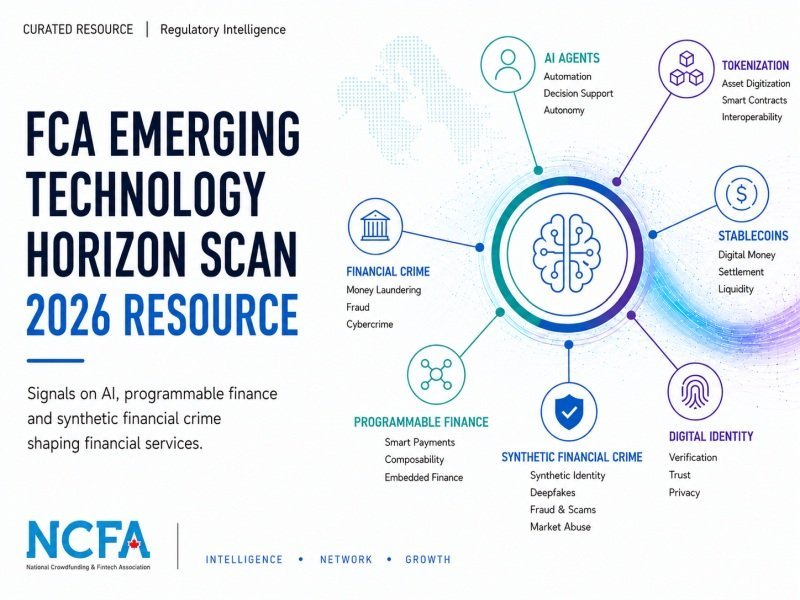
On June 10, 2026, the UK Financial Conduct Authority published the FCA Emerging Technology Horizon Scan 2026. The report examines how AI agents, synthetic financial crime and programmable finance could affect consumers, firms, markets and financial infrastructure through 2030.
NCFA's FCA Emerging Technology Horizon Scan guide turns the report into an interactive regulatory foresight resource. It separates the FCA's findings from implementation considerations, NCFA interpretation and Canadian relevance.
The FCA organizes the Horizon Scan around three technology convergence themes:
The guide also connects the Horizon Scan with later FCA work, including the Mills Review, the Supercharged Sandbox and the joint frontier AI cyber resilience statement.
The resource helps fintech leaders assess technology combinations rather than treating AI, distributed ledgers, identity, data, payments and cyber risk as separate issues.
Readers can use the interactive explorer to review:
The FCA Horizon Scan sits before formal regulation. It identifies early indicators that may affect product governance, consumer protection, financial crime controls, market surveillance, operational resilience and infrastructure design.
This resource is useful for fintech founders, financial institutions, AI developers, digital asset firms, regtech providers, compliance teams, cybersecurity leaders, investors, policymakers and market infrastructure firms.
It is especially relevant to teams assessing AI agent governance, synthetic identity, deepfake risk, automated financial crime, tokenized finance, programmable payments, stablecoins, digital identity, smart data and operational resilience.
The resource's main strength is its focus on convergence. It shows how AI agents, identity systems, synthetic media, tokenized assets, smart contracts and payment infrastructure may operate together.
It also supports practical planning. Firms can use it to test product assumptions, fraud controls, data strategy, identity plans, tokenized financial infrastructure and board level governance.
The FCA Horizon Scan is not regulatory guidance, a rulebook or a prediction. It does not create requirements or confirm that its scenarios will occur. Readers should use the guide for regulatory intelligence, scenario planning and strategic review, not as legal, financial, investment, compliance or professional advice.
FCA Emerging Technology Horizon Scan (interactive NCFA Regulatory Intelligence guide)
FCA Emerging Technology Horizon Scan 2026 (primary FCA source)
The Mills Review (FCA review of AI and retail financial services through 2030)
Frontier AI And Cyber Resilience (FCA, Bank of England and UK Treasury statement)
AI Agents Enter Governed Financial Workflows (AI governance and controls)
Tokenization Starts Looking Like Financial Infrastructure (programmable finance context)
MIT AI Risk Repository For Fintech Governance (AI risk taxonomy resource)
The National Crowdfunding & Fintech Association (NCFA Canada) is a financial innovation ecosystem that provides education, market intelligence, industry stewardship, networking and funding opportunities and services to thousands of community members and works closely with industry, government, partners and affiliates to create a vibrant and innovative fintech and funding industry in Canada. Decentralized and distributed, NCFA is engaged with global stakeholders and helps incubate projects and investment in fintech, alternative finance, crowdfunding, peer to peer finance, payments, digital assets and tokens, artificial intelligence, blockchain, cryptocurrency, regtech and insurtech sectors. Join Canada's Fintech & Funding Community today FREE! Or become a contributing member and get perks. For more information, please visit www.ncfacanada.org.
| | |
|---|---|---|
| | |

The FCA Emerging Technology Horizon Scan 2026 sets out three plausible ways emerging technologies could combine across financial services. It focuses on early indicators, potential risks and strategic questions rather than binding rules.
Use this guide to understand how the FCA frames technology convergence across Personalised Intelligence, Synthetic Insecurity and Programmable Finance, how later FCA work develops those themes, and what they may mean for fintech strategy, supervision and financial infrastructure.
Coverage includes AI agents, digital twins, proxy economy risks, synthetic identity, deepfakes, autonomous financial crime, synthetic market abuse, operational resilience, tokenization, stablecoins, CBDCs, digital identity, smart data, Finternet, cross border interoperability and current FCA developments.
The Horizon Scan sits before formal regulation. It identifies plausible technology pathways that could affect consumer protection, financial crime prevention, operational resilience, infrastructure modernization and future supervisory focus.
The FCA report is organized around three technology convergence themes that cut across AI, fraud, cyber, digital assets, payments and infrastructure modernization.
Navigate the FCA Horizon Scan by strategic theme. Each section separates what the FCA says, implementation considerations and NCFA perspective.
The FCA says the Horizon Scan is its first external publication of this kind. It is not a prediction report or regulatory guidance. It presents three plausible ways emerging technologies could combine to affect consumers, firms and markets, and it highlights early signals of new risks.
Firms should treat the report as a strategic risk and opportunity map. It can inform board horizon scanning, innovation planning, product governance, cyber risk, fraud controls, data strategy, digital identity planning, tokenization strategy and operational resilience assessment.
This is an upstream regulatory strategy signal. It shows where future supervision may focus before formal rules appear. For NCFA, it connects directly to AI, digital identity, fraud, open finance, tokenization, stablecoins, CBDCs, cybersecurity, payments modernization and programmable market infrastructure.
The FCA frames emerging technology against broader global pressures, including AI competition, geopolitical tension, trade disputes, energy demand, critical materials, data centre growth, environmental pressure and divergent regulatory approaches. It notes that AI debate often runs faster than measurable evidence, while practical adoption is already taking root in customer engagement and agentic payments.
Boards should connect technology strategy to geopolitical supply chains, energy exposure, cloud concentration, vendor dependency, AI model access, regulatory divergence and cross border interoperability. Technology adoption should be assessed against measurable outcomes rather than hype.
The FCA is treating technology strategy as market structure strategy. The signals are not only about tools. They are about who controls interfaces, identity, compute, data, payment rails, settlement and trust verification.
Personalised Intelligence examines how AI, personal data, edge computing, digital twins and adaptive interfaces could change consumer outcomes. AI agents could become the main interface between consumers and firms, making financial services more personalized, automated and embedded in daily life.
Firms need to decide whether they are designing for human users, AI representatives or both. Product governance, disclosure, consent, suitability, accessibility, fair value and complaints processes may need to reflect agent-mediated consumer journeys.
The key question is whether AI increases consumer capability or quietly transfers decision power to opaque systems. The opportunity is strong, but consumer agency, privacy, accessibility and accountability become central design requirements.
The report describes escalating cognitive delegation, progressing from assistive mode to advisory mode and then autonomous action mode. In autonomous action models, proxies may negotiate, transact, optimize bills, reallocate investments or dispute charges within dynamic constraints.
Firms should assess how products appear to AI agents, how consent is collected, how human review is triggered and how agent decisions can be audited. Customer support should anticipate cases where consumers do not understand actions taken by their AI representatives.
AI agents could become the next distribution layer in financial services. The competitive question is not only who has the best app, but whose product is selected, negotiated and trusted by a consumer's agent.
The report describes digital twins as AI representations that could draw on financial data, device data, behavioural signals, wearables and broader preferences. Firms could use these tools to offer more personalized products and support by interacting with a consumer's digital twin or AI agent.
Digital twin use raises data minimization, consent, explainability, vulnerability, discrimination, product governance and audit questions. Firms need controls to avoid overfitting products to sensitive traits or creating exclusion through complexity.
Digital twins may support inclusion and better advice, but they could also create high-risk personalization. The market will need guardrails around what data should be used, who controls the twin and how decisions can be challenged.
The FCA describes a potential proxy economy where AI proxies act for consumers and competition shifts from human attention to algorithmic negotiation. The report warns that consumers may accept proxy permissions casually, similar to how web cookies are often accepted today.
Consumer protection may need to account for proxy choice architecture, permission design, escalation rules, audit trails and agent conflicts. Firms should review whether their own AI interfaces favour the firm over the consumer.
The proxy economy could rewrite financial distribution. It may reduce consumer inertia, but it may also create a new layer of algorithmic gatekeeping. This is a high value area for future NCFA question posts and opportunity analysis.
Synthetic Insecurity examines how AI expansion of human thought, labour, value chains and digital infrastructure could make simulated data difficult to distinguish from real data. The FCA describes a future where fabricated truth becomes harder to separate from actual truth.
Financial crime, fraud, onboarding, audit, dispute resolution and supervisory evidence processes should be assessed against synthetic documents, synthetic identities, narrative laundering, deepfakes and coordinated AI agent activity.
This is one of the most important sections for fintech and regulators. If evidence itself can be fabricated at scale, financial services need stronger verification layers, not only better detection of obvious fakes.
The report says deepfake risks are progressing from manipulation of the senses to manipulation of sense-making. AI may generate credible synthetic narratives, evidence trails and interactions that bypass both human and algorithmic judgment.
Firms need layered authentication, source verification, provenance controls, document forensics, voice and video verification, separate channel confirmations and controls for high-risk actions. Regulators may also need tools to assess evidentiary integrity.
Trust infrastructure is becoming a market opportunity. Identity, provenance, verification, secure communications and evidence integrity could become core financial infrastructure rather than operational controls.
The FCA warns that agentic AI could democratize high-complexity crime. A single individual may be able to deploy, manage and scale a global criminal organization through software, with AI agents performing phishing, scams, cyberattacks and manipulation.
Fraud and cyber teams should model autonomous attackers, not only human fraud rings. Controls need to detect rapid, adaptive, multilingual, personalized and multiple channel attacks that may operate continuously.
This section points to an arms race in financial crime operations. The opportunity is not only fraud prevention. It is coordinated intelligence sharing, AI defensive assessment and cross-sector resilience.
The report describes synthetic market abuse risks where autonomous multiple agent systems may engage in insider trading, collusion, spoofing, pump and dump activity, sentiment manipulation or synthetic consensus cascades.
Market surveillance should expand beyond order book and transaction data to include social sentiment, agentic behavior, synthetic content, coordinated narratives and cross-platform activity. Governance should define accountability when autonomous systems create abusive outcomes.
Synthetic market abuse links directly to crypto, tokenized markets and digital investor communities. This is a strong candidate for future Question Intelligence and regulatory comparison work.
The FCA describes adaptive and invisible threats to firms' operational resilience. Frontier AI models may identify zero-day vulnerabilities, while adaptive malware may rewrite itself, imitate normal activity and operate inside systems in real time.
Firms should assess AI-enabled cyber scenarios, cloud concentration risk, third-party software compromise, adaptive malware, rapid vulnerability response, model provider dependency and coordinated sector response. Resilience planning should assume faster attack cycles.
Operational resilience and AI risk are converging. The firms best positioned for the next phase will combine cybersecurity, vendor governance, model risk, incident response and trusted information sharing.
Programmable Finance examines the convergence of DLT and financial concepts. The FCA says financial infrastructure is becoming more modular, with shared ledgers, tokenisation, programmable money and smart contracts contributing to protocol-based financial systems.
Firms should map how programmable finance affects products, settlement, custody, compliance, legal documentation, data sharing, identity, payment triggers and risk controls. The question is how to design programmable systems that are interoperable, auditable and commercially usable.
This is the strongest bridge to NCFA's existing tokenization, stablecoin, payments and open finance work. The FCA is describing a transition from digitized services to programmable financial infrastructure.
The report situates tokenisation within programmable finance and protocol-based infrastructure. Tokenized assets are part of the transition toward financial instruments that can settle, execute and interact through software rather than manual reconciliation.
Tokenization projects should identify the real workflow being improved, the settlement asset, custody model, legal rights, data permissions, interoperability approach, compliance logic and operational fallback process.
The report supports NCFA's existing view that tokenization is becoming measurable financial infrastructure. The market opportunity is not token issuance alone. It is regulated rails, data, custody, liquidity, compliance and settlement.
The Horizon Scan links stablecoins, CBDCs, digital assets and programmable money to changes in international financial architecture. It notes that cross border CBDC pilots such as mBridge are reaching minimum viable product scale in some regions.
Payment and stablecoin projects should evaluate settlement finality, reserve or backing structure, redemption, interoperability, AML controls, sanction screening, user protection, data standards and integration with domestic payment systems.
This connects directly to the UK Cryptoasset Regulations And FCA Final Rules and NCFA's Programmable Stablecoin Payments Opportunity Brief. The strategic opportunity is compliant stablecoin infrastructure that can operate across regulated payment, settlement and tokenized asset systems.
The report identifies smart data and digital identity as interlocking layers in the UK's infrastructure-first strategy. Smart data, identity and payments may support more context-aware and programmable financial services.
Firms should assess consent, data portability, identity assurance, verifiable credentials, cross-sector data standards, fraud risk, agent access and consumer control. Smart data strategy should be linked to product design and consumer protection.
Smart data is the bridge between open banking and programmable finance. Canada should treat consumer-driven banking, digital identity and payment modernization as connected infrastructure, not isolated files.
The FCA highlights the BIS Unified Ledger and Finternet concepts alongside mBridge and sovereign programmable financial stacks. It describes two possible futures: a more unified global ledger approach, or interoperable islands of domestic programmable ecosystems.
Interoperability planning should address legal finality, messaging standards, identity, compliance, settlement assets, cross border controls, dispute handling, data governance and resilience across networks.
The Finternet discussion is highly relevant for NCFA's global intelligence work. It creates a framework for comparing Canada, the UK, EU, India, Singapore, Brazil and other jurisdictions by infrastructure readiness rather than only by regulation.
The FCA report is UK-focused, but many themes are transferable because the same technologies, fraud risks and infrastructure choices are appearing across major financial markets.
The FCA Horizon Scan gives Canada a useful external reference. It connects AI, digital identity, fraud, open finance, payments and tokenization into one strategic view of financial infrastructure change. These files should not be treated as isolated policy tracks.
The FCA Horizon Scan does not impose obligations, but it raises strategic questions firms and policymakers should consider before technology adoption outpaces governance.
The FCA Emerging Technology Horizon Scan now sits within a larger programme on AI adoption, agentic systems, cyber resilience and regulatory capability.
It is the FCA's first external technology horizon scan. The 2026 report examines plausible combinations of emerging technologies across Personalised Intelligence, Synthetic Insecurity and Programmable Finance.
No. The FCA states that it is not regulatory guidance or a prediction. It is a foresight document intended to support discussion, planning and early risk assessment.
Synthetic financial crime uses generated identities, documents, voices, images, narratives or transaction evidence to commit fraud, evade controls or manipulate financial systems.
Programmable finance combines technologies such as tokenization, smart contracts, stablecoins, digital identity and smart data to automate financial transactions and infrastructure functions.
It has no direct legal effect in Canada, but its scenarios are useful for Canadian work involving AI governance, synthetic identity, fraud prevention, consumer driven banking, payments modernization, stablecoins, tokenization and operational resilience.
The FCA Horizon Scan points to practical innovation themes across AI agents, identity, cyber resilience, fraud prevention, programmable finance, tokenization, stablecoins and interoperable financial infrastructure.
The National Crowdfunding & Fintech Association (NCFA Canada) is a financial innovation ecosystem that provides education, market intelligence, industry stewardship, networking and funding opportunities and services to thousands of community members and works closely with industry, government, partners and affiliates to create a vibrant and innovative fintech and funding industry in Canada. Decentralized and distributed, NCFA is engaged with global stakeholders and helps incubate projects and investment in fintech, alternative finance, crowdfunding, peer-to-peer finance, payments, digital assets and tokens, artificial intelligence, blockchain, cryptocurrency, regtech, and insurtech sectors. Join Canada's Fintech & Funding Community today FREE! Or become a contributing member and get perks. For more information, please visit: www.ncfacanada.org
| | |
|---|---|---|
| | |
July 2, 2026

Picture the moment a Canadian fintech dreads most. A regulator's letter arrives. A customer in Quebec, or in a newcomer community you were proud to serve, relied on a disclosure written in their own language, and that disclosure said something the English original did not. Now you are explaining to a supervisor how the wording was produced, who checked it, and why a fee, a risk, or an obligation came out wrong. There is no comfortable answer, because the honest one is this: a single AI model wrote it, and nobody verified it.
That scenario is no longer rare or hypothetical. As fintechs scale into new markets and serve multilingual communities at home, more and more compliance language, terms of service, risk disclosures, consent flows, regulatory filings, is being produced by one AI model with no accuracy standard behind it. It feels efficient. It looks clean. And it quietly builds a liability that only reveals its price later, at the point where it is most expensive to fix.
What makes this gap so dangerous is that its cost stays invisible until it is realized. A mistaken clause does not throw an error message. It sits inside your disclosure reading perfectly, right up until an audit, a customer complaint, or an enforcement review turns it into a remediation project, a forced re-disclosure, a penalty, or a stalled market launch. Regulators do not distinguish between an error a person made and one a machine made. Across Canada's framework, from FINTRAC's obligations under the PCMLTFA, to provincial securities disclosure rules, to the Retail Payment Activities Act, the accuracy of what a customer is told is a supervised matter, not a marketing preference. For firms serving official-language communities, bilingual accuracy is frequently a legal expectation rather than a courtesy.
Every one of those outcomes carries a number. Legal hours. Remediation. Re-issued documents. Delayed revenue while a launch is held. And the quiet, compounding cost of a regulator who now watches you more closely than your competitors. The bill for one wrong word is rarely small, and it almost never arrives on your schedule.
Here is what most teams have not priced in: AI models disagree with one another, and they disagree most on the language that matters most. Independent testing makes this concrete. In Intento's State of Translation Automation 2025, baseline machine systems averaged roughly 10 to 15 errors per text before customization, and synthesized industry data places single top-tier large language model hallucination rates in translation tasks between 10% and 18%. On a marketing tagline, a 12% error band is a style problem. On a regulatory disclosure, it is a liability with a dollar figure attached.
Those errors are idiosyncratic to each model: one engine mishandles a defined term, another drops a conditional clause, a third invents a plausible equivalent that does not exist in the target jurisdiction's regulatory vocabulary. And the risk compounds with length, so the longer the document, a prospectus, a payment services agreement, a full disclosure set, the more independent points of failure a single model introduces. Then there is the cost even a correct-looking output creates. Someone still has to check it. Every hour a compliance lead spends re-reading machine output they cannot fully trust is an hour billed to the single-model shortcut, a verification backlog that never appears on the invoice but is paid every single week.
The way out is architectural, not aspirational. If individual models fail idiosyncratically, then running many at once and keeping only what most of them independently produce turns disagreement into a filter. Intento's own findings point the same way: Slator's reporting on that study noted that a multi-agent workflow explicitly designed to avoid compounding hallucinations delivered the highest quality across nine of eleven language pairs, outperforming any single engine.
This is the principle behind MachineTranslation.com, an AI translation platform built for exactly this failure mode. Its SMART mechanism runs a text through 22 AI models simultaneously, evaluates the source context to determine the most accurate rendering, and returns the output the majority of those models agree on. Because hallucinations are model-specific, cross-model agreement functions as an automated audit: the outlier renderings that shift what an obligation means are structurally filtered out before anyone sees the result. Internal benchmarks put the effect at roughly a 90% reduction in critical error risk, with agreed errors falling below 2% and up to 85% of outputs reaching professional-quality standard. The point is not speed. The point is certainty, and certainty is precisely what removes the hidden costs: fewer errors to remediate, and far less of the verification backlog that quietly drains a compliance team's time.
Cross-model agreement handles accuracy at scale. For the documents where a single error is unthinkable, a regulator-facing filing, a signed customer agreement, a prospectus, certainty has to be absolute, and that is where a second pillar matters. On the same platform, human verification escalates any output to a professional reviewer, adding a validated final check on top of the machine layer. This is not theoretical. Tomedes, the language company behind the platform, documents its high-stakes work in a library of recent translation case studies spanning certified legal filings, court-ready documents, and financial materials handled under confidentiality and delivered to compliance standards. The economics are blunt: the cost of one professional reviewer is trivial next to the cost of one enforcement action. Consensus for accuracy across volume, human verification for certainty on the documents that cannot be wrong.
None of this asks Canadian fintechs to become linguists. It asks them to govern this control the way they already govern every other one. Regulators are moving in exactly that direction on AI more broadly. NCFA's own coverage of the IOSCO AI supervisory toolkit for capital markets frames the expectation plainly: where AI touches a supervised process, firms are expected to show governance, oversight, and accountability for how the system behaves.
Translating compliance content is one of those processes, and today it is often the least governed one in the building. The practical steps are small. Add multilingual accuracy to the risk register. Ask who verified the language a customer relied on, and how. Replace a single ungoverned model with an architecture that removes the error by design and validates the highest-stakes content with a human. The cost of getting the language right the first time is a rounding error next to the cost of explaining why you did not. For a Canadian fintech scaling across markets or serving communities in more than one language, that is the whole choice: money spent on prevention, or money lost to a disclosure you have to defend.
The National Crowdfunding & Fintech Association (NCFA Canada) is a financial innovation ecosystem that provides education, market intelligence, industry stewardship, networking and funding opportunities and services to thousands of community members and works closely with industry, government, partners and affiliates to create a vibrant and innovative fintech and funding industry in Canada. Decentralized and distributed, NCFA is engaged with global stakeholders and helps incubate projects and investment in fintech, alternative finance, crowdfunding, peer-to-peer finance, payments, digital assets and tokens, artificial intelligence, blockchain, cryptocurrency, regtech, and insurtech sectors. Join Canada's Fintech & Funding Community today FREE! Or become a contributing member and get perks. For more information, please visit: www.ncfacanada.org
| | |
|---|---|---|
| | |



August 26th, 2025

January 4th, 2024

June 1st, 2021

September 9th, 2020

July 9th, 2018

January 3rd, 2018

September 25th, 2017

June 20th, 2017

May 10th, 2017

December 14th, 2016
