



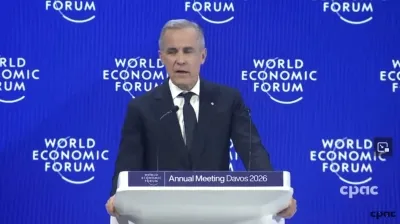

Karsten Wenzlaff, Advisor
August 26th, 2025
Karsten Wenzlaff is a Crowdfunding and Fintech Expert from Germany. He is Secretary-General of Digit[...]


M&A | June 16, 2025

Image: Freepik
Another high growth Canadian founded tech startup exits on foreign soil. U.S. giant Qualcomm has agreed to acquire Toronto-founded semiconductor designer Alphawave Semi (Alphawave) for US$2.4 billion. The acquisition strengthens Qualcomm's data center and AI capabilities but also raises recurring questions about Canada's ability to retain and scale its homegrown innovators.
Alphawave was founded in Toronto in 2017 by Canadian engineer Tony Pialis. The company builds technology that helps computers move large amounts of data quickly and efficiently. Qualcomm plans to use Alphawave's technology alongside its own processors to support the growing demand for AI and energy efficient data centers.
In 2021, Alphawave chose to go public on the London Stock Exchange instead of listing on a Canadian stock exchange like the TSX. The decision was widely viewed as a sign that Canada's capital markets were not deep enough to support large scale semiconductor or hardware IPOs. At the time, Alphawave raised roughly US$500 million in its debut, validating London as a preferred launchpad for global visibility.
Alphawave is legally incorporated in the United Kingdom as Alphawave IP Group plc (AWE.L), with its official registered office in Leeds, England. The company is listed on the London Stock Exchange and governed by UK corporate law.
However, since the firm was founded in 2017 in Toronto, it maintains significant operations in Canada. Its main office still remains in Toronto, and it continues to operate major engineering and R&D facilities in Kanata, Ottawa, employing over 250 staff in the country. Alphawave recently opened a 20,000 square foot R&D lab in Kanata and actively recruits from Canadian universities.
So, while the public listing and legal structure are based in the UK, Alphawave's tech development and leadership talent are deeply rooted in Canada. The decision to list in London was based on the availability of semiconductor capital and deeper markets for advanced technology, according the company's leadership.
Alphawave is one of the most prominent Canadian-founded technology firms to exit internationally in recent years. The company's core IP and chiplet designs power data centers, AI infrastructure, and cloud platforms, foundations for fintech, e-commerce, and cybersecurity services, which are increasingly built with low latency, high performance hardware.
For policymakers and Canadian fintech leaders, it's clear that without stronger later stage funding mechanisms, global scale listings, and/or targeted supports, more Canadian firms are at risk of scaling elsewhere and being acquired prematurely.
Alphawave's story is another wake up call that Canada needs to continue to invest in Canadian tech companies to be globally competitive, from capital to commercialization, or risk a further drain of companies that need to look elsewhere to support their growth and success.
 The National Crowdfunding & Fintech Association (NCFA Canada) is a financial innovation ecosystem that provides education, market intelligence, industry stewardship, networking and funding opportunities and services to thousands of community members and works closely with industry, government, partners and affiliates to create a vibrant and innovative fintech and funding industry in Canada. Decentralized and distributed, NCFA is engaged with global stakeholders and helps incubate projects and investment in fintech, alternative finance, crowdfunding, peer-to-peer finance, payments, digital assets and tokens, artificial intelligence, blockchain, cryptocurrency, regtech, and insurtech sectors. Join Canada's Fintech & Funding Community today FREE! Or become a contributing member and get perks. For more information, please visit: www.ncfacanada.org
 |  |  |
|---|---|---|
 |  |  |
Regulation | June 13, 2025

Image: Freepik/marymarkevich
Canadian regulators joined a coordinated global crackdown last week targeting unlawful finfluencers, or social media personalities promoting investments without registration or oversight. While enforcement activity is increasingly in focus, global experts and finfluencer advocates are warning that overly restrictive approaches will harm innovation, reduce access to financial education, and weaken digital financial literacy efforts.
As part of the Global Week of Action Against Unlawful Finfluencers, the Ontario Securities Commission (OSC) collaborated with regulators from the UK, Australia, the United Arab Emirates, Italy, and Hong Kong to investigate unlawful influencer activity.
The OSC reviewed 87 finfluencers and 9 issuers that used influencer promotions, and found some were offering unregistered investment advice or sharing misleading content, especially in the crypto sector. In-person warnings, gathering of evidence, and educational outreach were used to prevent retail investors being harmed.
Bonnie Lysyk, Executive Vice President of Enforcement at the OSC:
“International relationships are vital in countering this growing issue. The OSC’s recent research highlights the substantial influence social media personalities have on investor behaviour.”
In May 2025, the International Organization of Securities Commissions - IOSCO published its final report on finfluencers, to address online retail investor safety. Both the OSC and IOSCO's research on the impact of finfluencers were aligned, highlighting risks such as gamification and how social media and trading platforms can blur the line between general information and regulated investment advice.
IOSCO doesn't advocate for bans but rather outlines a series of good practices for regulators, platforms, market intermediaries, and finfluencers:
Jean-Paul Servais, Chair of IOSCO and FSMA Belgium:
“These reports set out globally aligned expectations for ethical conduct and effective oversight... ensuring that technology enhances trust, rather than undermining it,”
Not all creators are breaking the rules. According to the CFA Institute’s 2024 finfluencers appeal report, many finfluencers are filling educational gaps and helping demystify investing and financial planning for younger and underserved audiences. They create digestible and accessible content, often without commercial promotion or investment recommendations. Some are careful to include disclaimers and avoid offering specific advice.
A Wealth Professional Canada article cited Tangerine survey that discovered 60% of Canadians who follow finfluencers said they had benefited from their content. At the same time, those who acted on influencer tips were found to be 12 times more likely to experience scams.
Advocates argue that regulation should distinguish between financial education and commercial promotion. They are calling for clarity on how to remain compliant, not for the removal of content that informs and empowers.
“Most of us want to educate and uplift. But we need the rules to be clear and fair, not just fear-based.”
While Canada takes a proactive, data driven approach to enforcement of finfluencers while increasing public awareness for finfluencer risks, how do we shape up to our peer countries?
In Australia, the Australian Securities and Investments Commission - ASIC released guidance for social media influencers through INFO 269. ASIC warns that creators discussing financial products may be in breach of the law if they are unlicensed and don't follow compliance standards. The guidance supports financial literacy content as long as it avoids over promotion and includes proper disclosures.
In the United Kingdom, the Financial Conduct Authority (FCA) has focused on financial promotions. The FCA targets firms that pay finfluencers to promote investments without regulatory approval and has updated the financial promotions regime to apply to social media content.
Italy’s CONSOB and other European and Middle Eastern regulators also participated in the coordinated enforcement week. These jurisdictions are enhancing joint oversight of social media investment promotions, especially in the context of crypto and speculative assets.
In the United States, regulators such as the SEC and FINRA have pursued enforcement through existing anti-fraud provisions. While there is no finfluencer-specific guidance, recent actions have targeted offside celebrity crypto endorsements and undisclosed paid promotions.
Importantly, none of the major jurisdictions have called for bans, so global consensus is aligning with regulators to build frameworks that promote compliance, transparency, and public awareness instead.
Finfluencers are becoming as influential as traditional advisors, even more so for digitally native and younger investors. So oversight is warranted but the focus should be on compliance that doesn't undermine financial literacy and inclusion. Regulatory consensus shows that with clear rules, good practices, and global cooperation that clear rules and strategic oversight can protect investors while empowering open access to useful financial content online.
Want to stay ahead of regulatory shifts affecting digital finance and investor education? Subscribe to the NCFA newsletter for updates, insights, and expert analysis.
The National Crowdfunding & Fintech Association (NCFA Canada) is a financial innovation ecosystem that provides education, market intelligence, industry stewardship, networking and funding opportunities and services to thousands of community members and works closely with industry, government, partners and affiliates to create a vibrant and innovative fintech and funding industry in Canada. Decentralized and distributed, NCFA is engaged with global stakeholders and helps incubate projects and investment in fintech, alternative finance, crowdfunding, peer-to-peer finance, payments, digital assets and tokens, artificial intelligence, blockchain, cryptocurrency, regtech, and insurtech sectors. Join Canada's Fintech & Funding Community today FREE! Or become a contributing member and get perks. For more information, please visit: www.ncfacanada.org
| | |
|---|---|---|
| | |
Fintech Product Launch | June 12, 2025
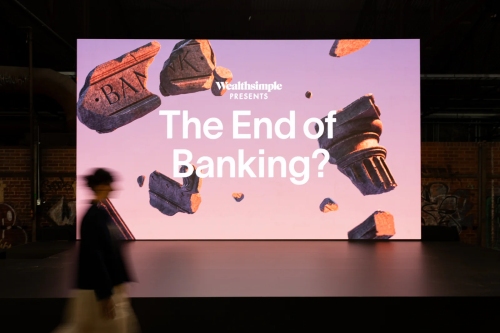
Image: Wealthsimple Presents: The End of Banking (WS Newsroom)
On June 11, 2025, Wealthsimple hosted their first 'Wealthsimple Presents: The End of Banking?" public event in Toronto where they announced the launch of two new financial products that will compete head-on with Canada's largest banks and financial institutions. (1) No fee 2% cashback credit card; and (2) Instant access low rate line of credit starting as low as 4.45%.
These offerings are for anyone who is currently paying banks and credit card companies higher interest rates and fees for the same services, and everything is online and available without having to visit a physical branch. This is healthy competition that will only benefit consumers, and the Canadian government and regulators should take notice.
The company also highlighted a series of upgrades to its hybrid chequing/spending account and teased new cash delivery pilots that could soon offer same day cash drop-offs to users' doorsteps.
Michael Katchen, Co-founder and CEO of Wealthsimple:
“Canadians don’t need another bank. They need something better. We’re removing friction, fees, and outdated experiences.”
The new Wealthsimple credit card is the most requested product in the company’s history. It offers:
Sam Newman-Bremang, Senior Product Director at Wealthsimple:
“This isn’t just another credit card, it’s the one Canadians have been asking for. As the most requested product in our history, it’s clear people want a smarter and more rewarding way to use credit. So that’s what we built: a card that puts humans first, with unlimited cashback, no foreign transaction fees, and no hidden charges.”
Wealthsimple will also roll out a line of credit product by the end of 2025 with rates starting at 4.45%, depending on collateral and client profile. The current Bank of Canada prime rate is 4.95% source, which means Wealthsimple’s offering could undercut many traditional unsecured personal loan products, such as unsecured credit card APRs (20-24%+) or home equity LOC rates (typically 5.5-5.7%).
Unlike typical credit lines, Wealthsimple clients will be able to use their investment or chequing balances at Wealthsimple as collateral, enabling lower risk and faster approval.
Plus, because Wealthsimple is not a federally regulated bank, it partners with 10 Canadian banks to hold deposits and qualify customers for up to $1 million in CDIC protection, which is much more than the standard $100,000 protection one would get by banking at a single institution.
Wealthsimple now offers a type of chequing account that pays 2.75% interest, 1% cashback on debit purchases, no monthly fees, and no ATM or FX fees. Over one million clients or approx 33% of Wealthsimple’s user base has already adopted the spending account.
The company estimates that in 2024, its users saved more than $100 million in fees they would have paid to traditional banks source.
Recent additions include:
Wealthsimple’s growth strategy is grounded in public dissatisfaction with incumbent financial institutions. In a 2025 Angus Reid survey commissioned by Wealthsimple:
Despite this, the Big Six banks still dominate with over 90% of banking assets under management in Canada. But no doubt that Wealthsimple is on a growth pathway that will chip away at the bank's dominant share by competing with seamless design, lower fees, higher yielding accounts and integrated financial tools built for mobile first customers.
Canada's fintech sector continues to face significant barriers to scale, including regulatory delays around open banking and digital ID. Despite that, leading scale-up fintechs like Wealthsimple are demonstrating how digital platforms can expand their value propositions without becoming a formal bank or acquiring a banking license.
Its model has scaled without a banking licence by partnering with regulated banks and embedding services within a single mobile platform. Wealthsimple now has over 3 million clients and manages over $70 billion in assets, up from $18 billion in 2021. If/when opening banking arrives in Canada, platforms that blend investments, borrowing, payments on a single interface will be game-changing for Canada's financial economy.
The National Crowdfunding & Fintech Association (NCFA Canada) is a financial innovation ecosystem that provides education, market intelligence, industry stewardship, networking and funding opportunities and services to thousands of community members and works closely with industry, government, partners and affiliates to create a vibrant and innovative fintech and funding industry in Canada. Decentralized and distributed, NCFA is engaged with global stakeholders and helps incubate projects and investment in fintech, alternative finance, crowdfunding, peer-to-peer finance, payments, digital assets and tokens, artificial intelligence, blockchain, cryptocurrency, regtech, and insurtech sectors. Join Canada's Fintech & Funding Community today FREE! Or become a contributing member and get perks. For more information, please visit: www.ncfacanada.org
| | |
|---|---|---|
| | |
Crypto Policy | June 11, 2025
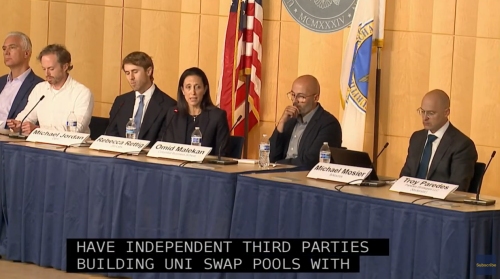
Image: June 9, 2025 DeFi Crypto Roundtable (Coindesk via youtube)
On June 9, the U.S. Securities and Exchange Commission (SEC) hosted another crypto task force roundtable series session called, "DeFi and the American Spirit", bringing together together regulators, legal experts, DeFi protocol developers, and investors to discuss how to the potential of regulating decentralized financial systems in ways that protects users without stifling innovation.
From the get-go, Chair Paul Atkins set the tone by opening the event by clearly stating that publishing code should not be treated as a crime:
“We will not regulate the act of writing open-source software. We do not prosecute the author of a hammer manual when someone misuses a hammer.”
The rest of the session built on this idea and focused on how the SEC can provide safe ways for DeFi projects to operate legally while still addressing investor risks.
In his remarks, Chair Atkins introduced the idea of a “conditional exemptive relief framework” which would allow DeFi innovators to build and launch on-chain products under limited conditions without triggering enforcement right away. This type of framework is similar to a regulatory sandbox that provides time-bound relief as long as participants meet specific safeguards.
“We are exploring a conditional exemptive relief framework that would allow experimentation under defined boundaries, similar to an innovation safe harbor.”
Commissioner Hester Peirce (aka Crypto mom) echoed this sentiment saying without a structured pathways to compliance, many innovators will either operate in legal uncertainty or offshore their projects out of the United States.
“Without a clear, conditional pathway, we are telling innovators you are on your own. That is not a message we want to send if we value the benefits of decentralized systems.”
In addition to the DeFi safe harbour, Chair Atkins also called upon his staff to modernize the current SEC rules to accommodate traditional issuers and intermediaries who want to use on-chain infrastructure.
This move shows that the SEC is looking to facilitate both new DeFi entrants and existing market players who are building tokenized products or using smart contracts to manage trading, issuance, or custody.
“I have asked the staff to consider whether amendments to the Commission’s rules and regulations would be better suited to provide needed accommodation for issuers and intermediaries who seek to administer on-chain financial systems.”
Atkins also discussed that on-chain systems can bring real benefits to the market, such as lower transaction costs, faster settlement, broader access, and the ability to create entirely new asset classes.
“I also am excited about the use of on-chain software systems by issuers and intermediaries to eliminate economic frictions, increase capital efficiency, enable new types of financial products, and enhance liquidity.”
It's clear support and endorsement of blockchain as a tool for economic growth, not just a solution for compliance challenges.
Several panelists, including Rebecca Rettig of Polygon Labs, warned that some of the most serious risks in DeFi happen off-chain. These include hidden liquidity deals, token allocations to insiders, or governance control partnerships.
“It is not always what is on-chain that creates the risk. It is often what is not disclosed, like side agreements, control over governance tokens, or preferential liquidity deals.”
Panelists argued that DeFi projects need better disclosure on how protocols are governed, how tokens are distributed, and whether any third parties receive special treatment or not.
Legal and industry experts said regulators should stop focusing on whether a token is a security and start regulating based on what the product or service actually does.
Angela Angelovska-Wilson of DLx Law said:
“We waste enormous energy litigating over whether X token is a security. The better path is regulating the activity, such as staking, custody, or lending, regardless of the label.”
Michael Jordan of the Digital Dollar Foundation agreed, saying:
“If we regulate the technology, someone will build around it. If we regulate the activity, we have a chance at real consumer protection.”
Important to understand the growing consensus that rules should distinguish between different types of financial behaviour even when the technology is similar.
Josh Garcia of Ketsal pointed out that some interfaces like custodial front ends that take custody of user funds or routes trades on behalf of users may require stricter oversight whereas protocols without admin control may require lighter regulation. Advocating for a layered regulatory approach that differentiates on function and control.
“A protocol with no privileged admin keys is not the same as a custodial front end that routes retail funds. The obligations differ, and so should the rules.”
After several Crypto Task force roundtable sessions, the SEC and participants are finally getting on the same page while focusing on conditional exemptions, regulatory modernization, and functional oversight. All together, it's a series effort to balance investor protection with lawful DeFi innovation. For fintech founders and digital asset platforms in Canada and globally, it's an important benchmark. If the U.S. begins providing clear compliance pathways and policy support for tokenized systems, then other jurisdictions will need to keep up or risk flight of builders and capital.
The National Crowdfunding & Fintech Association (NCFA Canada) is a financial innovation ecosystem that provides education, market intelligence, industry stewardship, networking and funding opportunities and services to thousands of community members and works closely with industry, government, partners and affiliates to create a vibrant and innovative fintech and funding industry in Canada. Decentralized and distributed, NCFA is engaged with global stakeholders and helps incubate projects and investment in fintech, alternative finance, crowdfunding, peer-to-peer finance, payments, digital assets and tokens, artificial intelligence, blockchain, cryptocurrency, regtech, and insurtech sectors. Join Canada's Fintech & Funding Community today FREE! Or become a contributing member and get perks. For more information, please visit: www.ncfacanada.org
| | |
|---|---|---|
| | |
AI Policy | June 11, 2025
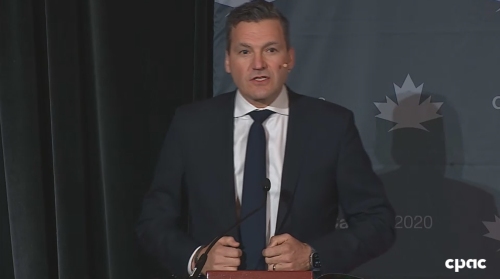
Image: Canada's Minister of AI and Digital Innovation, Solomon Evans Keynote at Canada 2020 event Ottawa (CPAC)
Prime Minister Mark Carney recently appointed Solomon Evans as Canada's first ever Minister of artificial intelligence and digital innovation to lead AI policy development and scale industry, trust and adoption. Solomon just delivered his first public remarks saying that the federal government will prioritize economic growth from artificial intelligence over advancing strict new rules. This new approach follows the collapse of Bill C-27’s AI framework, which failed to pass before the election and left Canada without a federal AI law.
Delivering a key note at a Canada 2020 event in Ottawa on June 10, 2025, Solomon said regulation must protect privacy and personal data but should not constrain innovation. Solomon confirmed that the previous governments AI regulation bill is currently under review.
“We’re not here to throw a saddle on the bucking bronco of AI but we do need to make sure it doesn’t kick anyone in the face.”
Feeling the heat of competition, even governments feel FOMO, and the global trend currently is moving from AI safety messaging towards AI adoption strategies. At the AI Action Summit in Paris, U.S. Vice President JD Vance pushed back on Europe’s regulatory overreach, while President Trump’s draft 'One Big Beautiful Bill' includes a proposed ten-year ban on state-level AI rules. Solomon seems aligned with this shift suggesting that global coordination is difficult, and Canada “won’t go it alone”.
NCFA Canada supports a speedy, focused rollout of AI investments that prioritize open access and trust, especially for smaller firms. Without clear guidance, shared tools and integrate support, SMEs will fall behind. Most do not have the internal capacity to evaluate or safely integrate AI, and that puts Canada’s productivity and innovation milestones in jeopardy. Canada's new AI czar, Solomon, acknowledged this gap, saying big companies are adopting AI, but “small and medium enterprises are not.”
Solomon also emphasized government support for Canadian champions like Cohere. In cases where specialized technical leadership is required to build national AI infrastructure, such as secure compute environments, working with proven domestic firms can make strategic sense. But NCFA cautions that these partnerships must be transparent, based on merit, and designed to benefit the broader ecosystem. The priority must remain funding open infrastructure and access, not enabling a sustainable advantage to a select few. Without transparency on this front, Canada risks loss of investment, talent, and IP.
The reality is that Canada’s innovation economy simply can't afford red tape bottlenecks or further restrictions that slow AI growth, especially since its hoping that broad adoption of the technology will turn the countries productivity woes around.
Canada also can't afford regulatory ambiguity that raises red flags for domestic and global firms alike. Solomon says he wants to “crank up commercialization” and support IP protection. That will only work if firms trust the environment they’re entering. For that, Canada needs smart policy, not just encouragement.
Canada is in a global race to lead in responsible AI and having a dedicated AI minister is a positive step, but evolving Canada into a trusted AI economy depends on speed, clarity and inclusion among other things. NCFA calls for the government to boost support for SME adoption, ensure rules are clear and fair, and build national infrastructure that attracts global innovators without sidelining local ones.
The National Crowdfunding & Fintech Association (NCFA Canada) is a financial innovation ecosystem that provides education, market intelligence, industry stewardship, networking and funding opportunities and services to thousands of community members and works closely with industry, government, partners and affiliates to create a vibrant and innovative fintech and funding industry in Canada. Decentralized and distributed, NCFA is engaged with global stakeholders and helps incubate projects and investment in fintech, alternative finance, crowdfunding, peer-to-peer finance, payments, digital assets and tokens, artificial intelligence, blockchain, cryptocurrency, regtech, and insurtech sectors. Join Canada's Fintech & Funding Community today FREE! Or become a contributing member and get perks. For more information, please visit: www.ncfacanada.org
| | |
|---|---|---|
| | |
AI | June 9, 2025

Image: Freepik
On June 4, 2025, Reddit filed a lawsuit against Anthropic, alleging that the AI tech system conducted more than than 100,000 unauthorized data scraping events since last July, violating Reddit's user terms. It comes at a time when Anthropic is expanding the reach of Claude, its AI model family, across enterprise and government sectors. The legal, ethical, and commercial stakes are high.
Reddit's lawsuit is a critical test of Anthropic’s values and the public credibility of responsible AI branding. As Claude advances deeper into sensitive sectors like national security, it'll be more important than ever to define what real accountability with regards to data use looks like, and for Claude/Amodei to deliver on his ethical promise.
The National Crowdfunding & Fintech Association (NCFA Canada) is a financial innovation ecosystem that provides education, market intelligence, industry stewardship, networking and funding opportunities and services to thousands of community members and works closely with industry, government, partners and affiliates to create a vibrant and innovative fintech and funding industry in Canada. Decentralized and distributed, NCFA is engaged with global stakeholders and helps incubate projects and investment in fintech, alternative finance, crowdfunding, peer-to-peer finance, payments, digital assets and tokens, artificial intelligence, blockchain, cryptocurrency, regtech, and insurtech sectors. Join Canada's Fintech & Funding Community today FREE! Or become a contributing member and get perks. For more information, please visit: www.ncfacanada.org
| | |
|---|---|---|
| | |
AI | June 9, 2025
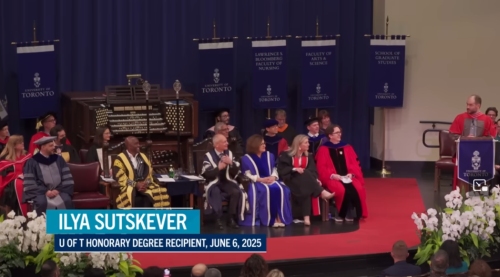
Image: Ilya Sutskever at University of Toronto convocation June 6, 2025 via Youtube
On June 6, 2025 at the University of Toronto’s convocation, Ilya Sutskever, cofounder of OpenAI and lead innovator of ChatGPT, delivered a powerful message while accepting an honorary degree in Doctor of Science (actually his fourth UoT degree). He warned that artificial intelligence (AI) is quickly advancing to a point where it will do everything humans can do, and we're not ready for what comes next.
Once a machine can learn anything a person can learn, no task is out of reach. This idea is central to Sutskever’s argument that AI will eventually match all human abilities. “We have a brain, and the brain is a biological computer… So why can't a digital brain do the same things?”
“The day will come when AI will do all of the things that we can do, not just some of them, but all of them.”
The timeline is uncertain but the direction is clear. Whether it takes 3, 5 or 10 years, general purpose AI will change how the economy functions and how people define and measure productivity.
Sutskever warns that even efforts to retrain workers may fall short because as technology marches forward, the very jobs people train for could vanish before they are ready to take them on.
“Many will find that the new job they were training for no longer exists by the time they finish retraining.”
He also said that while some will turn to universal basic income but it may not hold up because people may be seen as no longer economically productive.
Sutskever predicts two long-term outcomes. If humans find a way to offer lasting value, we may be treated as companions to AI systems. If not, we risk becoming irrelevant or extinct.
“In the best-case scenario, humanity will become like pets or the microbiome of artificial intelligence. In the worst-case scenario, humanity will become obsolete or even extinct.”
“The challenge that AI poses is the greatest challenge of humanity ever. And overcoming it will bring the greatest reward.”
He stresses that the response cannot be passive. Every person and institution will need to participate in what this technology becomes.
“Accept reality as it is, try not to regret the past, and try to improve the situation.”
Meeting this moment requires emotional resilience. He says people should remain focused on the present instead of looking backward and encouraged others to adopt the same mindset.
Sutskever’s speech is measured insight into the future, and governments, industry, innovators globally need to take his message as a direct challenge to act now (if you're not already sweating the pace of change in 2025). At NCFA Canada, we believe his message carries the kind of disruption that financial leaders must (anticipate and) respond to with urgency.
Canada cannot afford to be unprepared. While the changes can be guided with responsible AI efforts, they seemingly cannot be stopped, and so we must act with urgency to be prepared as new AI powered systems will influence financial markets, education, investment models, employment pathways, human mobility and more. the fintech sector needs to become more agile, more connected, and more willing to build for what's coming next.
"Innovating and adapting at the speed of AI development means building solutions and platforms that help people create value alongside AI, not behind or beneath it. It also means designing incentives and safeguards that match the reality of a hybrid workforce where humans and machines co-exist, and to embolden the leadership and collaboration needed to work together to solve problems." Craig Asano, NCFA
Canada cannot rely on other jurisdictions to define what safe and responsible AI looks like, and Canadian fintechs and institutions should play a direct role in developing policies, models, and frameworks that ensure AI serves the public interest.
This is not just a technology issue. It is a national competitiveness issue. It is also a question of whether we will help define the rules of the future or simply be beholden to them.
The National Crowdfunding & Fintech Association (NCFA Canada) is a financial innovation ecosystem that provides education, market intelligence, industry stewardship, networking and funding opportunities and services to thousands of community members and works closely with industry, government, partners and affiliates to create a vibrant and innovative fintech and funding industry in Canada. Decentralized and distributed, NCFA is engaged with global stakeholders and helps incubate projects and investment in fintech, alternative finance, crowdfunding, peer-to-peer finance, payments, digital assets and tokens, artificial intelligence, blockchain, cryptocurrency, regtech, and insurtech sectors. Join Canada's Fintech & Funding Community today FREE! Or become a contributing member and get perks. For more information, please visit: www.ncfacanada.org
| | |
|---|---|---|
| | |


August 26th, 2025

January 4th, 2024

June 1st, 2021

September 9th, 2020

July 9th, 2018

January 3rd, 2018

September 25th, 2017

June 20th, 2017

May 10th, 2017

December 14th, 2016
