




Karsten Wenzlaff, Advisor
August 26th, 2025
Karsten Wenzlaff is a Crowdfunding and Fintech Expert from Germany. He is Secretary-General of Digit[...]


June 27, 2026 | NCFA Fintech Whisperer | Payments And Market Infrastructure, Digital Assets Blockchain And Tokenization, Capital Markets And Market Infrastructure, Artificial Intelligence And Data, Risk Compliance And Regtech, Wealth And Asset Management

Image: Freepik
This live weekly NCFA intelligence page tracks financial technology developments that significantly affect how fintechs build, sell, raise capital, and operate under scrutiny. Coverage prioritizes Canada and includes global events that directly influence competitive conditions, market access, and execution realities across fintech sectors. This page will be updated throughout the week with market movers in a live format and then each week we'll close the prior week's contents in prep for the upcoming week, and continue on a rolling basis. (Missed prior week's Fintech Whisperer? (December 6-12, 2025, December 13-19, 2025, January 1-9, 2026, January 10-16, 2026, January 17-23, 2026, January 24-30, 2026, January 31-February 6, 2026, February 7-13, 2026, February 14-20, 2026, February 21-27, 2026, February 28-March 6, 2026, March 7-13, 2026, March 14-20, 2026, March 21-27, 2026, March 28-April 3, 2026, April 4-10, 2026, April 11-17, 2026, April 18-24, 2026, April 25-May 1, 2026, May 2-8, 2026, May 9-15, 2026, May 16-22, 2026, May 23-29, 2026, May 30-June 5, 2026, June 6-12, 2026, June 13-19, 2026, June 20-26, 2026).
Cross border payments are getting clearer operating standards for retail and SME use cases. Banks, payment firms, remittance providers, fintechs and SME platforms should watch how fee disclosure, FX transparency, delivery certainty and last-mile processing become competitive requirements.
The connection gives Singapore users direct access to Vietnam’s domestic QR acceptance network without requiring merchants to install separate terminals. Singapore becomes the fourth ASEAN market and sixth jurisdiction connected to NAPAS, with outbound payments from Vietnam to Singapore planned later in 2026.
Agentic payments are moving into live financial infrastructure. Banks, payment networks, merchants, PSPs, AI providers and fraud teams should watch how consent, authentication, agent identity and liability controls evolve for AI-initiated transactions, including the broader question of whether fintechs should design for people or AI agents.
Agentic commerce needs payment controls that work inside the buying flow. Merchants, payment networks, fintechs, issuers, fraud teams and AI platforms should watch how tokenized credentials, spend limits, approved categories, agent identity and audit trails define the next payment interface. NCFA's Financial Innovation Map tracks agent commerce infrastructure as an emerging opportunity.
Canada’s instant payments system now has the legal foundation needed for launch preparation. Banks, payment service providers, fintechs, merchants and compliance teams should track how RTR rules, access, fraud controls, ISO 20022 messaging and 24/7 operations change payment product design and competition.
Wholesale CBDC work is concentrating on settlement infrastructure rather than retail money. Central banks, banks, market infrastructure firms, custodians and payment providers should watch how tokenised settlement, securities delivery and cross border liquidity use cases shape the next phase of central bank money innovation.
Canada's retail payments regime is shifting from registration into active supervision. PSPs, fintechs, payment processors, compliance teams and investors should track how incident reporting, safeguarding information, annual reports and PSP Connect submissions become part of the operating cost of regulated payment activity.
Canada's open banking framework is entering the implementation phase. Banks, fintechs, payment service providers, credit unions and technology providers should prepare for accreditation, technical integration and operational requirements as consumer driven banking moves toward production. See NCFA's Open Banking in Canada opportunity brief for the market gaps, adoption signals and infrastructure questions this framework is meant to address.
Stablecoin payment firms are building through combined cryptoasset and e-money permissions. Fintechs, banks, treasury teams, payment providers and stablecoin issuers should watch how MiCA, EMI licences, IBAN access and euro stablecoin services define regulated market entry in Europe.
Regulated retail crypto platforms are adding on-chain access while changing how custody, disclosure, risk controls and investor responsibility work. Brokers, crypto platforms, wallets, regulators and compliance teams should watch how self-custody DEX trading inside mainstream apps affects token access, suitability controls, tax reporting and Canadian crypto regulation and investor safeguards.
The case combines a licensing exit with a failed liquidity transaction, withdrawal uncertainty and possible insolvency. Regulators and users can assess the effectiveness of the wind down through access to account records, withdrawal processing, financial disclosure and the treatment of unreturned balances. Canada’s registered crypto platforms operate under different rules. The same questions apply to custody, liquidity, capital, governance and orderly customer exits. NCFA’s comparison of MiCA and UK crypto rules explains how demanding authorization standards can favour firms with stronger operating infrastructure.
MiCA is becoming the operating gateway for institutional digital asset firms. Trading firms, custodians, prime brokers, exchanges, asset managers and compliance teams should watch how authorization under a harmonized EU framework expands regulated cross-border crypto services.
Retail investing is extending into onchain financial infrastructure. Brokers, crypto platforms, wallets, custodians, exchanges, wealth platforms and regulators should watch how tokenized equities, Layer 2 networks, onchain lending and AI directed trading reshape product access, market supervision and investor protection.
Stablecoin regulation is starting to look like payment system supervision. Issuers, banks, custodians, payment firms, exchanges and compliance teams should watch how systemic designation, transition planning and cross-regulator supervision affect market access for regulated digital money.
The UK crypto market is getting a clearer operating perimeter. Crypto platforms, custodians, stablecoin issuers, intermediaries and staking firms should prepare for authorisation, capital planning, market conduct controls and compliance standards that bring crypto closer to mainstream financial regulation.
Stablecoin competition is shifting toward scale, governance and distribution. Banks, payment networks, wallets, merchants, fintechs and stablecoin issuers should watch whether shared economics, partner governance and broad platform participation become a stronger model for digital money adoption.
Tokenized securities need regulated payment and custody rails, not only issuance technology. Asset managers, administrators, custodians, stablecoin providers and tokenization platforms should watch how CASP and payment licences shape the full transaction lifecycle from subscription to redemption and payout.
Institutional stablecoin adoption is becoming part of regulated banking infrastructure. Banks, custodians, asset managers, payment firms and stablecoin issuers should watch how custody, minting, redemption and settlement services expand across institutional digital asset workflows.
Stablecoin payments are starting to connect settlement with spending controls. Merchants, payment networks, wallets, stablecoin issuers, compliance teams and fintechs should watch how programmable rules, item level controls and point of sale integration expand programmable stablecoin payments in commerce.
Agentic finance needs controls at the point of action. Banks, fintechs, payment firms, wealth platforms and compliance teams should watch how agent identity, authority, escalation, audit trails and transaction limits become core requirements for AI systems that can act on behalf of users.
Agentic finance is becoming a supervisory design question. Banks, fintechs, payment systems, trading firms, AI vendors and regulators should watch how consent, liability, agent identity, market controls, cyber resilience and accountability standards develop as autonomous systems enter financial workflows.
Market transparency increasingly depends on shared data infrastructure. Exchanges, trading venues, fixed income dealers, market data providers, asset managers and regulators should watch how consolidated bond market data improves price discovery, execution quality and market oversight.
Tokenised capital markets need legal certainty as much as technology. Issuers, investors, custodians, exchanges, fund managers and regulators should watch how bond issuance, record keeping, settlement and transfer rules adapt as fixed income markets move onto distributed ledger infrastructure.
Crypto regulation is expanding beyond market access into enforcement. Cryptoasset firms, trading venues, brokers, compliance teams and market participants should prepare for enforcement policies that increasingly align digital asset markets with established financial market conduct standards.
Crypto regulation can create financial crime pressure during market transition. CASPs, VASPs, banks, payment firms, exchanges and compliance teams should watch how licensing deadlines, customer migration and supervisory coordination affect AML controls across Europe.
Investment regulation increasingly focuses on communication as well as compliance. Asset managers, wealth platforms, advisers, fintechs and product manufacturers should prepare for disclosure requirements that prioritize clarity, comparability and consumer understanding alongside regulatory obligations.
Event contract regulation is moving from listing debates into market surveillance and data reporting. Prediction markets, exchanges, brokers, compliance teams and regulators should watch how reporting rules shape the boundary between derivatives, event markets, gambling and retail speculation.
The strongest fintech companies don't wait for certainty. They recognize patterns early, build where demand is growing and stay ready when regulation catches up. That's the value of watching the evidence, not just the headlines. NCFA offers various curated resources to help founders and investors stay current on developments that impact fintech markets, subscribe to NCFA weekly newsletter updates, view the latest fintech insights, industry research, or launch into emerging financial innovation opportunities.
 The National Crowdfunding & Fintech Association (NCFA Canada) is a financial innovation ecosystem that provides education, market intelligence, industry stewardship, networking and funding opportunities and services to thousands of community members and works closely with industry, government, partners and affiliates to create a vibrant and innovative fintech and funding industry in Canada. Decentralized and distributed, NCFA is engaged with global stakeholders and helps incubate projects and investment in fintech, alternative finance, crowdfunding, peer-to-peer finance, payments, digital assets and tokens, artificial intelligence, blockchain, cryptocurrency, regtech, and insurtech sectors. Join Canada's Fintech & Funding Community today FREE! Or become a contributing member and get perks. For more information, please visit: www.ncfacanada.org
 |  |  |
|---|---|---|
 |  |  |
July 2, 2026 | NCFA Fintech Market Activity | Digital Assets Blockchain And Tokenization, Wealthtech And Investing, Digital Identity And Trust, Risk Compliance And Regtech, Fintech And Innovation
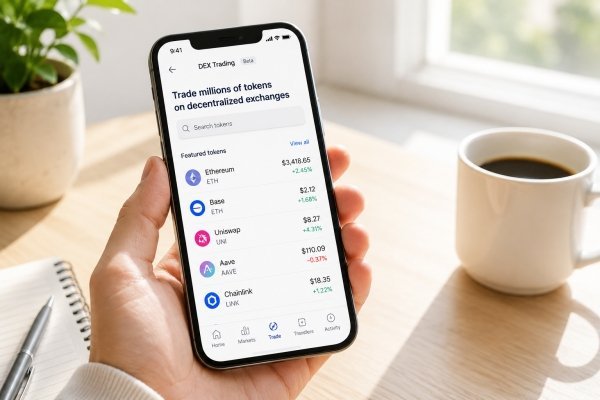
On July 2, 2026, Wealthsimple launched DEX trading in beta, giving eligible clients a way to trade on-chain tokens directly inside the Wealthsimple app.
The beta gives clients access to millions of tokens, starting with Ethereum-based assets. Base and Solana support are planned. The service charges a flat 0.85% trading fee and currently includes $0 network fees, which Wealthsimple Web3 Inc. covers during the early release.
This isn't the same product as Wealthsimple's centralized crypto account. When a client makes a first DEX trade, the app creates a separate self-custody wallet. The app holds DEX assets separately from centralized crypto holdings. They aren't insured, and don't have the same regulatory oversight as Wealthsimple's listed crypto offering.
A normal DEX user has to manage a wallet, fund it, connect it to a decentralized exchange, check token contracts, manage network fees, understand slippage, approve transactions, and protect private keys. As a result, there are a lot of steps that add complexity.
The beta removes much of that setup from the user experience. Its help guide says clients can search for DEX-labelled assets in the Discover tab, create a DEX wallet during the first trade, and buy or sell eligible DEX tokens directly in the app.
Behind the scenes, the app converts the funding asset into USDC. It then withdraws the funds to the self-custody wallet and routes the order through a third-party DEX aggregator before executing the trade.
Centralized crypto assets go through the platform's listing process, and the platform holds them on behalf of clients. DEX assets haven't gone through that centralized listing process.
Wealthsimple says a third-party vendor flags malicious tokens, and the app automatically filters them, and asset pages can display risk flags such as new asset history, top holder concentration, low holder count, low liquidity, sketchy token permissions, and artificial trading patterns.
Those flags are useful, but they aren't a safety guarantee. The help guide tells users to research tokens before trading and notes that blockchain transactions can't be reversed. If a client buys a scam or fraudulent token, the transaction can't be undone.
While the product lowers the operational barrier to on-chain markets, users still face risks that don't exist in the same way inside a curated centralized exchange custodial account.
Clients hold WS DEX assets in a self-custody wallet. They aren't covered by insurance, don't have government-backed loss protection, and aren't held by Wealthsimple on the client's behalf.
The support team can't recover the wallet or reverse transactions if something goes wrong. The user authorizes trades, and the wallet sits outside Wealthsimple's centralized crypto infrastructure.
There are also product limits during early release.
At the end of the day, there are limits to what the beta product is at this point. Embedded self-custody trading inside a controlled retail app, not a full open-wallet DeFi experience.
Wealthsimple's IPO Access launch gave eligible retail investors a way to request shares in selected Canadian and U.S. IPOs before public trading. Wealthsimple's 2025 product event added zero fee options, real gold, and private market portfolios. Wealthsimple's Fey acquisition added AI research and trading tools to the roadmap.
DEX trading adds another access layer. Clients can use one app for listed securities, crypto, IPO access, options, gold, private market portfolios, and now on-chain token trading.
Most clients won't need millions of tokens. The acid test is whether the app can make on-chain trading simple enough to try without making the risks feel smaller than they are.
One path is regulated centralized crypto access, where platforms list a smaller set of assets, hold assets through custodial arrangements, follow dealer rules, and provide clearer investor protections. Canadian crypto regulation has pushed platforms toward stronger custody, registration, and operating controls.
The other path is on-chain access, where users reach a broader token universe but also take on more responsibility for token risk, wallet access, tax tracking, execution, and irreversible transactions.
The beta sits between those paths. It keeps the user inside a mainstream Canadian app, but the assets trade through decentralized markets and sit in a self-custody wallet. That's different from both a traditional crypto exchange and a fully independent DeFi wallet.
Wallet usability becomes a core feature. Token risk intelligence becomes part of the trading interface. Slippage controls, routing quality, transaction monitoring, tax tooling, scam detection, and user education become operating requirements rather than extras.
Those areas connect directly to NCFA's Financial Innovation Map, including self-custody wallets, retail digital asset access, token risk analytics, on-chain finance, digital identity and trust, and compliance technology.
The opportunity isn't only trading more tokens. It's building the trust, data, user experience, and risk tools that let mainstream investors interact with on-chain markets without pretending those markets are safe by default.
If mainstream investing apps make self-custody DEX trading feel simple, will the next phase of retail crypto adoption depend more on token access or risk intelligence?
The National Crowdfunding & Fintech Association (NCFA Canada) is a financial innovation ecosystem that provides education, market intelligence, industry stewardship, networking and funding opportunities and services to thousands of community members and works closely with industry, government, partners and affiliates to create a vibrant and innovative fintech and funding industry in Canada. Decentralized and distributed, NCFA is engaged with global stakeholders and helps incubate projects and investment in fintech, alternative finance, crowdfunding, peer-to-peer finance, payments, digital assets and tokens, artificial intelligence, blockchain, cryptocurrency, regtech, and insurtech sectors. Join Canada's Fintech & Funding Community today FREE! Or become a contributing member and get perks. For more information, please visit: [www.ncfacanada.org](http://www.ncfacanada.org)
| | |
|---|---|---|
| | |
July 2, 2026 | NCFA Fintech Market Activity | Digital Assets Blockchain And Crypto, Wealthtech, Capital Markets And Funding, Fintech And Innovation

On June 30, 2026, Webull Canada Crypto announced it will begin offering cryptocurrency trading after receiving approval from the Canadian Investment Regulatory Organization.
The approval gives Webull another asset class inside its Canadian investing platform, which already supports U.S. and Canadian stocks, ETFs, options, margin accounts, cash accounts, TFSAs, and RRSPs through Webull Securities Canada.
Beta access for selected clients is expected to start soon, with a wider rollout planned in the coming weeks. Webull says the crypto experience will include 24/7 trading for assets such as Bitcoin, Ethereum, Solana, XRP, Cardano, and Litecoin.
This is another regulated online brokerage aligning digital assets among the same customer experience as traditional investing.
Webull Canada Crypto Limited is regulated by CIRO. Webull Securities Canada Limited is also regulated by CIRO and is a member of CIPF.
That structure is important because crypto trading and traditional securities accounts don't carry the same investor protections. Webull's disclosure says crypto assets are not protected by CIPF, although CIPF protection may be available for eligible cash held in a crypto trading account, subject to applicable limits and policy terms.
The approval arrives after Canadian regulators spent several years moving crypto platforms toward dealer registration and CIRO membership, custody expectations, risk disclosure, and stronger client asset controls.
Regulated access is becoming the path for retail crypto distribution in Canada.
When Webull expanded brokerage services to Canada in early 2024, the initial story was low cost access to Canadian and U.S. listed equities.
The platform has since expanded around commission free trading, advanced charting, market data, options access, registered accounts, and now crypto.
Webull is building toward a multi asset retail investing platform where users can fund accounts, monitor portfolios, review reporting, and trade across asset classes without leaving the ecosystem.
Crypto increasingly looks less like a standalone destination and more like another investing capability inside regulated financial apps.
Canadian online brokers used to compete heavily on commissions, execution, research tools, and account access. In 2026, competition is about platform depth as investors want fewer disconnected accounts. Platforms want more customer activity, better retention, more data, and a wider share of the investor relationship, and eventually more personalized portfolio features.
Webull is entering a market where Wealthsimple already combines investing, crypto, cash, tax, and other financial services. KOHO adding regulated crypto trading inside its money app flashing the same pattern from a consumer finance angle.
The Canadian crypto market has gone through enforcement, registration pressure, custody scrutiny, stablecoin restrictions, and platform exits. Yet regulated distribution keeps expanding.
Canada hasn't treated retail crypto as an unregulated free for all. It also hasn't eliminated retail access. Oversight of the market is evolving toward regulated firms, clearer disclosures, tighter custody controls, and platforms that can operate within securities rules.
Webull's entry adds another regulated access point for Canadian investors and increases pressure on every platform that wants to be a primary investing destination.
The approval gives Webull permission to compete, but it doesn't guarantee adoption.
Crypto also brings higher volatility, suitability questions, security expectations, and investor education demands. A smooth user experience can't hide the risk profile of the asset class.
The advantage for Webull is that crypto can now be offered alongside the rest of its investing platform. The challenge is that investors will compare the experience not only with crypto exchanges, but with every brokerage and fintech app trying to become the main place Canadians manage investments.
Crypto trading platforms moving toward CIRO oversight shows how Canadian regulation is reshaping digital asset distribution.
Crypto custody rules are becoming a core operating issue for dealer members and digital asset platforms.
KOHO's regulated crypto rollout shows digital assets moving into broader consumer finance platforms.
Tokenization becoming a measurable business shows how digital assets are moving deeper into regulated capital markets infrastructure.
NCFA's Financial Innovation Map tracks digital assets, wealthtech, brokerage competition, capital markets infrastructure, custody, and investor access opportunities.
If every major investing platform eventually offers stocks, ETFs, options, registered accounts, and crypto, what becomes the next competitive advantage?
The National Crowdfunding & Fintech Association (NCFA Canada) is a financial innovation ecosystem that provides education, market intelligence, industry stewardship, networking and funding opportunities and services to thousands of community members and works closely with industry, government, partners and affiliates to create a vibrant and innovative fintech and funding industry in Canada. Decentralized and distributed, NCFA is engaged with global stakeholders and helps incubate projects and investment in fintech, alternative finance, crowdfunding, peer-to-peer finance, payments, digital assets and tokens, artificial intelligence, blockchain, cryptocurrency, regtech, and insurtech sectors. Join Canada's Fintech & Funding Community today FREE! Or become a contributing member and get perks. For more information, please visit: www.ncfacanada.org
| | |
|---|---|---|
| | |
July 2, 2026

image: Magnific/DC Studio
When a province opens a private online gambling market, the headlines tend to chase the money: tax points, operator counts, and the size of the prize. The quieter story, and the one that matters more to the people who actually log in, is how the rules try to keep play from sliding into harm. Alberta's shift to a regulated online casino market is, underneath the commercial framing, a player-protection project. The design choices that decide whether a customer can set a hard deposit cap, lock themselves out across every site at once, or get flagged before a bad week becomes a worse one are buried in standards documents, not press releases.
That angle fits readers who follow how Canadian regulation, payments, and consumer safeguards lock together rather than chasing the latest welcome offer. The interesting question is not which brand has the loudest promotion. It is whether the protections written into the law and the regulator's standards are strong enough to hold once real money starts moving through licensed platforms.
Plenty of attention has already gone to who is lining up to operate. Data and comparison publishers such as Lineups keep running directories of the online casino options in Alberta, which gives outside observers a useful map of which brands are entering under the new framework. This piece takes the other side of that map and audits the safeguards instead: what each protection is meant to do, how it functions in practice, and who carries the duty to enforce it.
Alberta is not inventing online gambling. Residents have placed bets through offshore and grey-market sites for years, usually with no Canadian oversight, no local self-exclusion option, and no recourse when something went wrong. The case for a regulated market rests less on novelty and more on control. Once play happens on licensed platforms, the province can attach conditions to it: verified identity, mandatory limit tools, a shared exclusion list, and a regulator with the power to pull a license.
So the honest way to read this market is as a safeguards audit. A new framework is only as good as the protections it forces operators to build and the body willing to test them. The rest of this article walks each guardrail in turn, asks how it is supposed to work, and names the party on the hook when it fails. That structure matters because responsible-gaming language is easy to print on a homepage and hard to operate at scale.
Alberta split the job in two, which is a useful tell about how the province thinks risk should be managed. The Alberta Gaming, Liquor and Cannabis commission, known as AGLC, is the regulator. It registers operators and suppliers, writes and publishes the standards, audits compliance, and runs the centralized self-exclusion system. A separate body, the Alberta iGaming Corporation, holds the commercial agreements that operators need before they can legally take a bet in the province.
The point of separating the regulator from the conduct-and-manage entity is to keep the referee away from the revenue. The body chasing market growth is not the same body deciding whether an operator broke the rules. For a consumer-protection reader, that division is one of the more reassuring features of the design, because it reduces the pressure to look away from a profitable but non-compliant brand. It is also the structure the regulator can point to when a customer complaint needs an independent path that does not run through the operator's own support desk.
This dual model echoes the approach Ontario used when it launched its commercial market in 2022, which has since registered dozens of operators. Alberta watched that rollout closely and borrowed the parts that worked while trying to tighten the parts that drew criticism, including how exclusions and advertising are handled.
The safeguard with the most practical weight is the centralized self-exclusion program, and it is meant to be live from the first day of the regulated market. The mechanics are simple to describe and surprisingly hard to deliver. A person who wants to stop signs up once, and the exclusion then applies across every licensed online platform in the province at the same time. Timeframes run from six months to permanent, with options in between.
Compare that to the offshore status quo, where excluding yourself from one site does nothing on any other. Under the old arrangement, a person in a bad spiral could close one account and open three more by lunchtime. A shared list closes that gap, at least within the licensed perimeter. The regulator operates the program, and operators are required to integrate with it as a condition of registration, which is what turns a good intention into an enforceable obligation rather than a marketing badge.
The honest caveat is that a self-exclusion list only covers the sites inside it. A determined person can still reach unlicensed offshore platforms that ignore Alberta entirely. That limit is not a flaw in the design so much as a boundary on what any single province can reach, and it is one reason the market opening is paired with messaging that steers players toward licensed sites in the first place.
Self-exclusion is the emergency brake. The day-to-day controls are the limit tools every licensed operator has to offer from launch. The required set covers deposit limits, spending limits, and session time controls, plus regular activity statements that summarize a player's history so the picture is harder to ignore. The design logic is that most harm does not arrive as a single dramatic event. It accumulates quietly across many ordinary sessions, and friction introduced early is cheaper than intervention introduced late.
Limit tools work best when they are easy to set and slow to loosen. The detail that matters is the direction of friction: tightening a limit should take effect quickly, while raising one should carry a cooling-off delay so a heated moment cannot instantly undo a careful decision. Activity statements add a second layer by putting real numbers in front of a player who might otherwise round their losses down in their own memory. None of this stops a person who is determined to chase, but it narrows the path and creates record-keeping the regulator can later inspect.
For an audience that thinks about product design and payments, these controls are essentially consumer-finance guardrails applied to entertainment spending. They borrow the same logic as deposit caps and spending alerts in digital banking, and they live or die on the same question: are they switched on by default and built into the flow, or buried three menus deep where almost no one finds them.
The audit is easier to read as a table. Each row pairs a protection with how it is meant to operate and the party responsible for making it stick.
| Safeguard | How it works | Who enforces |
| Centralized self-exclusion | One sign-up blocks access across every licensed site, from six months to permanent | AGLC operates the list; operators must integrate |
| Deposit and spending limits | Player-set caps with fast tightening and delayed loosening | Operators build the tools; AGLC sets the standard |
| Session time controls | Reminders and limits on continuous play length | Operators implement; AGLC audits |
| Activity statements | Periodic summaries of deposits, wagers, and net results | Operators generate; player reviews |
| Identity and age verification | Account checks confirm the customer is of legal age and who they claim to be | Operators run checks under AGLC rules |
| Intervention duties | Staff and systems flag signs of problem play and act on them | Operators monitor; AGLC can sanction |
| Independent accreditation | Third-party review of responsible-gaming programs | Responsible Gambling Council |
| Advertising limits | Restrictions on inducements, targeting, and athlete imagery | AGLC writes and enforces the rules |
The pattern in that final column is the point. Almost every safeguard depends on a division of labor, where the operator builds and runs the tool while the regulator sets the floor and keeps the power to punish a brand that cuts corners. Protections without an enforcer are suggestions, and the structure here is built to avoid that trap.
For a fintech-minded reader, the most underrated safeguard is the one that happens before a single game loads. Verified identity and age checks are the gate. A licensed operator has to confirm that the person opening an account is a real, of-age resident rather than a minor borrowing a card or a fabricated profile. That single requirement does more quiet work than most flashy responsible-gaming features, because it anchors every later protection to a confirmed person rather than an anonymous login.
The payments trail extends that anchor. When deposits and withdrawals run through regulated channels, the money becomes traceable, limits become enforceable against a verified account, and patterns become visible. A customer who suddenly raises deposits and plays at odd hours leaves a record that a monitoring system can read. The same plumbing that supports anti-money-laundering checks also supports harm-reduction, since both depend on knowing who is transacting and being able to see the shape of their activity over time.
This is where Alberta's market intersects with the broader push for safer digital finance. The tools are familiar to anyone working in payments or regtech: identity proofing, transaction monitoring, and configurable limits. NCFA's own explainer on how Canadian online casino regulations work sets out how these checks, betting limits, and help resources fit into the national context, which is useful background for anyone weighing Alberta against other provinces. Applying the tools to gambling does not require new invention so much as honest implementation, and the regulated framework is what forces that implementation to be more than a checkbox.
The framework does not leave the burden entirely on the player to ask for help. Licensed operators carry a duty to look for signs of problem gambling and to act on what they find, rather than waiting for a customer to come forward. In practice that means behavioral monitoring: flagging sharp escalation in deposits, chasing patterns, marathon sessions, and other markers that research links to harm, then triggering an intervention such as a message, a prompt to set a limit, or a referral to support.
Active monitoring is the difference between a passive set of tools and a system that reaches toward people who would never click a help link on their own. The people most at risk are often the least likely to self-identify, so a safeguard that depends on the player raising a hand will miss them. By making intervention an operator obligation, the standards shift part of the responsibility onto the business that profits from the activity, which is the correct place for it to sit.
The unavoidable tension is that the operator is being asked to gently slow down its own best customers. That conflict of interest is exactly why an independent regulator with audit powers and an outside accreditation body both sit in the structure. Trust-but-verify only works if someone is actually verifying.
One more layer sits above the operator's own programs. The Responsible Gambling Council, a long-standing Canadian non-profit based in Toronto, runs an accreditation program that reviews whether a gambling operation actually meets recognized responsible-gaming standards rather than just claiming to. Independent review is what separates a genuine program from a glossy policy page, because the reviewer has no stake in the operator's revenue and no reason to grade on a curve.
Bringing an external standard into the framework matters for credibility. A regulator can write rules and audit against them, but a third-party accreditation adds a second set of eyes with its own published criteria. For consumers, the practical value is a signal they can read from outside the company: a program that has passed independent review has at least been measured against something firmer than its own marketing.
Safeguards inside the product only help people who are already playing. The advertising rules try to control how many people get pulled in and how aggressively. Alberta's standards restrict where operators can promote inducements and bonuses, generally limiting them to a brand's own site or to direct marketing that a player has explicitly consented to receive. Operators are also barred from targeting minors, high-risk individuals, and vulnerable groups.
One detail drew particular notice: advertisements cannot feature current or retired athletes. That choice is a direct response to a complaint heard across several markets, where celebrity and athlete endorsements were seen as normalizing betting for younger audiences who follow sports. Pulling familiar faces out of gambling ads is a blunt instrument, but it reflects a view that the supply of temptation deserves regulation alongside the tools that manage demand.
A fair audit ends with the gaps, not a victory lap. None of these safeguards eliminate harm, and pretending otherwise would undercut the whole exercise. The centralized exclusion list only governs licensed sites, so the offshore market remains a leak in the wall. Limit tools depend on default settings and honest design, and a tool that is technically present but practically hidden protects almost no one. Intervention duties ask operators to act against their own short-term incentives, which is why ongoing audits matter more than launch-day promises.
There is also the simple reality that regulation lags behavior. New payment methods, new game formats, and new marketing channels will test the rules faster than the rules can be rewritten. The honest verdict on Alberta's market will not come from the standards as written in 2025 and 2026 but from how seriously they are enforced two and three years on, when the novelty has worn off and the pressure to relax inconvenient rules has set in. A framework like this is best judged by its worst enforcement case, not its best brochure.
Anyone who wants to see how the entry bar was actually built can read this legal analysis of Alberta's Bill 48 iGaming framework, which lays out the registration structure and consumer-protection duties that form the practical floor every licensed brand must clear before taking a bet. The Alberta model is one experiment among several, and the provinces are quietly learning from each other's mistakes.
The takeaway is not that the new market is risk-free. It is that a regulated market with verified identity, a shared exclusion list, mandatory limit tools, intervention duties, and an independent regulator is a meaningful upgrade over an offshore status quo that offered none of those things. The safeguards are real. Their value depends entirely on whether the bodies named in that enforcement column keep doing the unglamorous work of checking.
When does Alberta's regulated online casino market open?
The province set a launch for its competitive online gambling market in 2026, with the legal foundation laid by legislation passed in 2025. Exact timing has shifted during the rollout, so the safest approach is to check the regulator's current guidance rather than rely on a date quoted in an older article.
Can I exclude myself from every Alberta site at once?
Yes. The centralized self-exclusion program is designed so a single sign-up applies across all licensed online platforms in the province at the same time, with durations from six months up to permanent. This is a deliberate improvement over excluding yourself from one site, which previously had no effect on any other.
What responsible-gaming tools are operators required to offer?
Licensed operators must provide deposit limits, spending limits, and session time controls from launch, along with periodic activity statements that summarize a player's history. They are also required to verify identity and age and to monitor for signs of problem gambling rather than waiting for players to ask for help.
Are online casinos legal everywhere in Canada now?
No. Gambling regulation in Canada is provincial, so the rules differ by province, and a framework like Alberta's does not change the law elsewhere. Several provinces still rely on a single government-run platform, while others, including Ontario and now Alberta, have opened competitive private markets under their own conditions.
Where can someone in Alberta find gambling-harm support?
Alberta's GameSense program and the Alberta Health Services Addiction Helpline offer free and confidential support around the clock. Licensed operators are also required to surface responsible-gaming resources and self-exclusion options directly within their platforms, so help is reachable from inside the account rather than only through an outside search.
The National Crowdfunding & Fintech Association (NCFA Canada) is a financial innovation ecosystem that provides education, market intelligence, industry stewardship, networking and funding opportunities and services to thousands of community members and works closely with industry, government, partners and affiliates to create a vibrant and innovative fintech and funding industry in Canada. Decentralized and distributed, NCFA is engaged with global stakeholders and helps incubate projects and investment in fintech, alternative finance, crowdfunding, peer-to-peer finance, payments, digital assets and tokens, artificial intelligence, blockchain, cryptocurrency, regtech, and insurtech sectors. Join Canada's Fintech & Funding Community today FREE! Or become a contributing member and get perks. For more information, please visit: www.ncfacanada.org
| | |
|---|---|---|
| | |
July 1, 2026 | NCFA Fintech Market Activity | Capital Markets And Funding, Consumer Finance And Lending, SME Finance And Business Banking, Fintech And Innovation

On June 25, 2026, Financeit closed a C$201 million term ABS transaction backed by home improvement loans, issuing Series 2026-1 notes through Financeit Securitization Limited Partnership.
Financeit says the deal is the first Canadian term asset backed securitization backed by home improvement loans. Morningstar DBRS rated the notes from AAA(sf) to BBB(low)(sf). Goldman Sachs acted as structuring and joint lead placement agent, CIBC Capital Markets acted as joint lead placement agent, and BMO Capital Markets acted as co manager.
The transaction is a capital markets milestone for Canadian fintech lending. Financeit is turning point of sale home improvement loans into rated institutional paper, giving the company another funding channel as annual loan originations approach C$2 billion.
Financeit already had warehouse and lending facilities. The new ABS deal adds longer term institutional funding to support loan growth.
VersaBank's real time funding pilot with Financeit showed how point of sale receivables can be funded closer to origination, while this ABS transaction moves the loan book into rated capital markets paper.
The company says the transaction, combined with existing lending facilities, gives it approximately C$2.5 billion in annual loan funding capacity, a reliable volume of capital.
Casper Wong, co founder and CEO of Financeit, said the transaction reflects the scale and performance of the platform:
"Over the last four years, we have grown at a 33% compounded annual growth rate, fueled by strong execution in our home improvement business and continued expansion across multiple verticals."
Home improvement lending is at the intersection of consumer finance, merchant finance, and household infrastructure spending. Borrowers want payment flexibility. Contractors and dealers want higher close rates. Lenders need repeatable underwriting, servicing, funding, and loss performance.
Financeit built its model through merchant and dealer networks rather than a branch based lending channel. The company says it has funded more than C$10 billion in loans since inception, serves nearly one million Canadians, and works with more than 10,000 dealers across Canada.
That scale gives securitization investors a pool of receivables large enough to analyze. It also gives Financeit a path to recycle capital more efficiently as originations rise.
Securitization rewards platforms that can show repeatable underwriting, clean servicing, predictable cash flows, and enough data for rating agencies and institutional buyers.
The ABS market gives lenders access to deeper capital, but it also increases scrutiny. Investors will watch delinquencies, prepayments, losses, dealer performance, borrower quality, and whether loan growth stays disciplined.
For Canadian fintech lenders, that scrutiny is healthy. It separates platforms that can originate loans from platforms that can fund, service, monitor, and report credit at institutional scale.
Float's $85 million Series C shows Canadian business finance platforms raising growth capital to expand payments, cash management, credit, and AI finance workflows.
Conexus backing JUDI.AI highlights how AI cash flow underwriting is entering credit union and community bank lending.
EQ Bank's Business Card launch shows digital banking moving deeper into business spending, cash flow, and operating accounts.
Better banking options for Canadian SMEs remain a live competition issue as businesses seek faster credit, lower friction, and more useful financial tools.
NCFA's Financial Innovation Map tracks lending, securitization, capital formation, SME finance, embedded finance, and credit infrastructure opportunities.
If Canadian fintech lenders can turn specialized loan books into rated ABS transactions, which lending categories become large enough for institutional capital next?
The National Crowdfunding & Fintech Association (NCFA Canada) is a financial innovation ecosystem that provides education, market intelligence, industry stewardship, networking and funding opportunities and services to thousands of community members and works closely with industry, government, partners and affiliates to create a vibrant and innovative fintech and funding industry in Canada. Decentralized and distributed, NCFA is engaged with global stakeholders and helps incubate projects and investment in fintech, alternative finance, crowdfunding, peer-to-peer finance, payments, digital assets and tokens, artificial intelligence, blockchain, cryptocurrency, regtech, and insurtech sectors. Join Canada's Fintech & Funding Community today FREE! Or become a contributing member and get perks. For more information, please visit: www.ncfacanada.org
| | |
|---|---|---|
| | |
June 30, 2026 | NCFA Story Intelligence | Digital Assets Blockchain And Tokenization, Capital Markets And Market Infrastructure
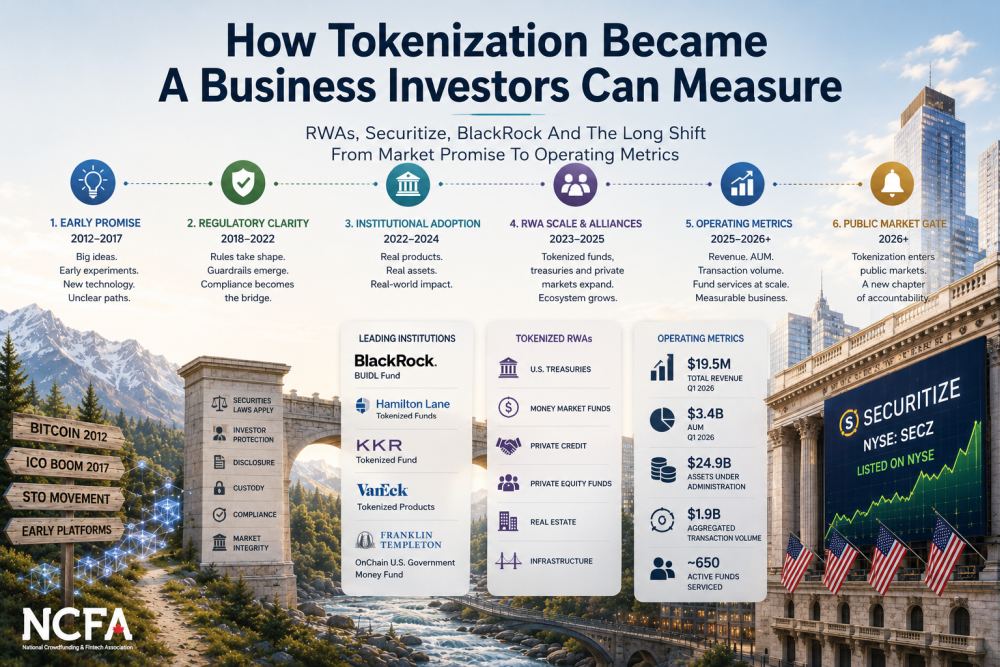
Tokenization promised to change capital markets for more than a decade.
The promise is still attractive. Put ownership on chain. Reduce paperwork. Automate compliance. Improve access. Speed up settlement. Make private assets easier to distribute, manage, and transfer.
But markets don’t run on promises. They run on operating models, regulation, distribution, controls, liquidity, and trust.
That’s why Securitize’s expected NYSE listing is the trigger. The listing isn’t the whole story. It’s the latest chapter in a longer path from tokenization as a market idea to tokenization as a business investors can measure.
The first wave sold a powerful idea. Security tokens, STOs, fractional assets, real estate tokens, private shares, and blockchain based markets promised to bring traditional securities into programmable digital form. The early security token field was framed as a more regulated answer to the ICO boom.
The market didn’t overhaul itself. Early security token projects ran into the same walls: unclear regulation, thin liquidity, limited distribution, custody questions, fragmented platforms, investor eligibility rules, and the simple reality that a tokenized security still has to behave like a security.
The hard work was never only technical. A tokenized fund still needs investor onboarding, KYC, AML, transfer rules, custody, servicing, reporting, distributions, tax records, corporate actions, and permissioned secondary transfers. Those aren’t marketing features. They’re the boring parts that make markets work.
Regulators kept reminding the market that labels don’t change obligations. Hester Peirce’s point that tokenized securities still have to follow securities laws captured the practical boundary. Faster settlement and automation don’t remove investor protection, disclosure, and market integrity requirements.
Real world assets changed the packaging. The market stopped asking whether everything should become tokenized and started asking which assets actually benefit. Treasuries, money market funds, private credit, private equity funds, and alternative assets became more practical test cases than vague claims about digitizing every market.
Private markets gave tokenization a clearer job. Citi, Wellington Management, and WisdomTree tested private market tokenization in 2024, showing how smart contracts could support operating efficiency in traditionally manual private market processes.
Hamilton Lane used tokenization to lower access friction. In 2022, Hamilton Lane and Securitize said qualified US investors would gain access to tokenized feeder funds tied to direct equity, private credit, and secondary transaction strategies.1 Securitize later said one Hamilton Lane fund reduced the minimum investment from about $5 million to $20,000.2
KKR showed that major alternatives managers would test the model. Securitize launched a tokenized fund offering exposure to KKR’s Health Care Strategic Growth Fund II in 2022, framing the product around broader access to alternative investments through digital ownership.3
BlackRock changed the market’s confidence level. BlackRock launched BUIDL, its first tokenized fund, on Ethereum in March 2024. The fund was backed by cash, US Treasury bills, and repurchase agreements, with BNY Mellon enabling interoperability between digital and traditional markets.4
BUIDL became a measurable adoption signal. In March 2025, Securitize said BUIDL surpassed $1 billion in AUM and identified itself as the tokenization provider for the fund.5 BlackRock’s BUIDL launch became one of the clearest institutional signals that tokenization was entering regulated asset management.
Securitize turned the thesis into operating data. In Q1 2026, Securitize reported $19.5 million in total revenue, up 39% year over year, $3.4 billion in AUM at quarter end, $24.9 billion in assets under administration, $1.9 billion in aggregated transaction volume, and roughly 650 active funds serviced through Securitize Fund Services.6
Those numbers change the conversation. Investors can ask normal operating questions: revenue mix, servicing fees, client concentration, transaction volume, fund growth, margins, profitability, operating leverage, customer retention, regulatory execution, and how much tokenization demand converts into durable revenue.
The listing is the trigger. Securitize and Cantor Equity Partners II said the business combination was expected to raise approximately $400 million in gross proceeds, close after shareholder approval and customary conditions, and list on the NYSE under ticker SECZ.7
The listing doesn’t settle the thesis. It exposes the thesis to market discipline. A listed tokenization company has to explain growth, losses, expenses, institutional demand, regulatory risk, competitive pressure, and whether tokenized fund adoption can become a durable public company business.
Canada has a practical watchlist. The opportunity isn’t to copy a US listing. Canadian firms can look across the tokenization value chain: custody, transfer services, fund administration, compliance, exempt market distribution, private market platforms, digital identity, investor onboarding, reporting, and secondary trading.
Regulated product design may decide the next chapter. The OSC’s long term asset fund project pointed to possible retail exposure to traditionally inaccessible assets and raised the opportunity for tokenized long term funds with embedded compliance, transparent records, fractional access, and guardrails.
Tokenization didn’t become measurable overnight. It moved through years of big claims, stalled experiments, regulatory pushback, operating layer buildout, institutional product design, and real world asset packaging before public markets had a company they could evaluate with ordinary business questions.
That may be the clearest test. The first tokenization wave asked investors to believe in a technology. The next wave will ask investors to evaluate execution. Revenue. Margins. Assets. Transactions. Clients. Losses. Retention. Market share. Operating leverage. That is a much harder test, and a much more useful one.
For Canada, the lesson is practical. The next winners may not be the firms issuing the tokens. They may be the firms solving everything around them: custody, compliance, investor onboarding, fund administration, reporting, liquidity, and regulated distribution. That’s where durable businesses are often built, and where Canada’s capital markets innovation map can help identify opportunities that are still taking shape.
What operating metric would convince you that tokenized markets have moved beyond promise?
Share this story → Explore related intelligence → Subscribe
The National Crowdfunding & Fintech Association (NCFA Canada) is a financial innovation ecosystem that provides education, market intelligence, industry stewardship, networking and funding opportunities and services to thousands of community members and works closely with industry, government, partners and affiliates to create a vibrant and innovative fintech and funding industry in Canada. Decentralized and distributed, NCFA is engaged with global stakeholders and helps incubate projects and investment in fintech, alternative finance, crowdfunding, peer-to-peer finance, payments, digital assets and tokens, artificial intelligence, blockchain, cryptocurrency, regtech, and insurtech sectors. Join Canada's Fintech & Funding Community today FREE! Or become a contributing member and get perks. For more information, please visit: www.ncfacanada.org
| | |
|---|---|---|
| | |
Jun 30, 2026

For those exploring a fresh online entertainment experience, this platform offers an impressive array of functionalities that cater to diverse preferences. Take advantage of the enticing welcome bonuses designed to give newcomers a robust start, enhancing their initial experience significantly.
The interactive environment features a user-friendly interface that simplifies navigation, making gameplay intuitive for both novices and seasoned players. Real-time statistics and analytics allow participants to track their performances and adjust their strategies accordingly, leading to tailored gaming sessions.
Additionally, engagement opportunities abound through community-driven events and tournaments that encourage friendly competition. Loyalty programs reward consistent players with perks and incentives, fostering a welcoming atmosphere. All these elements contribute to a dynamic and enjoyable online experience that is hard to resist.
An extensive array of gaming options caters to various preferences, ensuring that players can find something that suits their style. Unique titles often feature inventive gameplay mechanics, elevating the overall experience. Look out for offerings that combine traditional casino elements with modern twists, such as skill-based components or story-driven adventures, especially when exploring platforms in the crypto casino Canada segment.
Live-action games have transformed the entertainment landscape, allowing players to engage with real dealers in real-time. This format delivers an immersive atmosphere that mimics the ambiance of a physical venue, fostering social interaction. Consider trying out themed live shows, which blend popular culture elements into classic formats for an added layer of enjoyment.
Add-on features like progressive jackpots or customizable game settings enhance user engagement and provide opportunities for increased rewards. These options encourage diverse play styles, appealing to both casual gamers and high rollers. Regularly updated libraries help maintain interest, as new titles are introduced frequently, offering fresh and exciting challenges to explore.
To enhance the gaming experience, consider engaging with various limited-time offers and promotional events. Often, these promotions come in the form of deposit bonuses, where additional funds are credited to your account upon making a qualifying deposit. Pay attention to the details, as each promotion may have specific requirements.
Another attractive option is the referral program. By inviting friends to join, players can earn bonuses or free credits for each successful signup. This not only provides rewards but also creates a sense of community among users, fostering interaction and competition.
Loyalty schemes are designed to recognize and reward consistent participation. Players accumulate points based on their activities, which can later be exchanged for bonuses, gifts, or even exclusive experiences. Regularly check the loyalty program tiers to maximize benefits as you advance through levels.
Seasonal promotions often bring additional excitement, aligning offers with holidays or significant events. Participating during these times can lead to substantial bonuses and unique prizes. Ensure to monitor announcements for these opportunities, as they can significantly boost the gaming experience.
Lastly, subscribing to newsletters or notifications is a practical way to stay informed about the latest campaigns. This ensures that players never miss an opportunity to take advantage of exclusive offers, enhancing both engagement and rewards in the long run.
To enhance your engagement, the platform offers an intuitive layout designed for seamless interaction. Clear navigation bars and organized menus ensure that all available activities are easily accessible, minimizing time spent searching for options.
The color scheme is soothing, with a modern aesthetic that enhances visibility. Users can quickly identify sections such as betting options, account management, and help resources. This thoughtful design allows users to focus on their gaming experience without distractions.
Customer support is easily accessible, with a dedicated help center and live chat functionality. This feature enables users to receive assistance quickly, contributing to a positive overall experience.
Regular updates and user feedback integration demonstrate commitment to enhancing the interface. Continuous monitoring and tweaks based on popular user requests foster a community-focused environment, where player satisfaction is prioritized.
A wide range of multi-currency wallets is recommended for seamless and secure financial transfers. Look for options that support popular coins including Bitcoin, Ethereum, and various altcoins, enabling users to deposit, withdraw, and place bets with their preferred digital assets.
Security measures play a critical role in the reliability of online transactions. Implementing two-factor authentication (2FA) adds an extra layer of protection for users. Always ensure that the platform utilizes encryption protocols (like SSL) to keep personal and financial data secure from unauthorized access.
Consider utilizing platforms that offer blockchain technology for transparency. Each transaction is recorded on a public ledger, making it easier to verify and trace payments. This not only enhances privacy but also builds trust between users and the service provider.
For enhanced convenience, many users prefer platforms that enable direct cryptocurrency payments without the need for currency conversion. This can mitigate the risk associated with volatile exchange rates and hidden fees during conversions.
| Cryptocurrency | Transaction Speed | Typical Transaction Fees |
| Bitcoin | 10 minutes | $1-10 |
| Ethereum | 15 seconds | $0.50-5 |
| Litecoin | 2.5 minutes | $0.01-0.05 |
| Ripple | 3-5 seconds | Minimal |
Evaluate the transaction limits imposed by the service. Understanding the minimum and maximum deposit and withdrawal thresholds can help manage your gameplay or betting strategy. This information is often available in the FAQ section or customer support.
Regularly monitor the platform’s policy on transaction discrepancies. A responsive customer support team is beneficial in resolving any issues swiftly, ensuring a hassle-free gaming experience. Always choose platforms that offer clear communication channels for such concerns.
The National Crowdfunding & Fintech Association (NCFA Canada) is a financial innovation ecosystem that provides education, market intelligence, industry stewardship, networking and funding opportunities and services to thousands of community members and works closely with industry, government, partners and affiliates to create a vibrant and innovative fintech and funding industry in Canada. Decentralized and distributed, NCFA is engaged with global stakeholders and helps incubate projects and investment in fintech, alternative finance, crowdfunding, peer-to-peer finance, payments, digital assets and tokens, artificial intelligence, blockchain, cryptocurrency, regtech, and insurtech sectors. Join Canada's Fintech & Funding Community today FREE! Or become a contributing member and get perks. For more information, please visit: www.ncfacanada.org
| | |
|---|---|---|
| | |


August 26th, 2025

January 4th, 2024

June 1st, 2021

September 9th, 2020

July 9th, 2018

January 3rd, 2018

September 25th, 2017

June 20th, 2017

May 10th, 2017

December 14th, 2016