





Karsten Wenzlaff, Advisor
August 26th, 2025
Karsten Wenzlaff is a Crowdfunding and Fintech Expert from Germany. He is Secretary-General of Digit[...]


Apr 1, 2026 | NCFA Fintech Market Activity | Cross Border Payments And FX
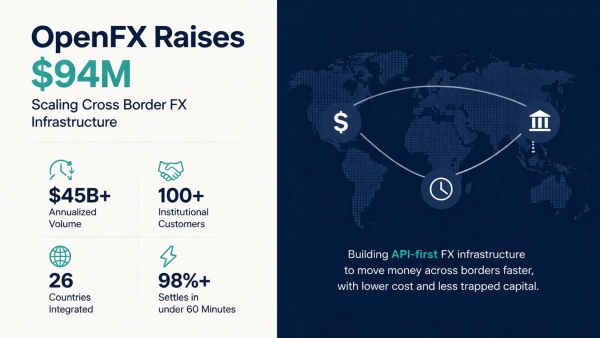
On March 31, 2026, OpenFX raised $94M to expand across Southeast Asia and Latin America. Two years after launch, the company says it now has 105 employees across four continents, handles more than $45B a year in cross border volume, and has onboarded more than 100 institutional customers.
The operating numbers are hard to ignore. OpenFX says 98% of transactions settle in under 60 minutes. In May 2025 the company said it had already integrated 26 countries and 7 major FX pairs, and that one newly onboarded client reached $100M in transaction volume in 17 days, with all of that settling within 60 minutes.
The product vision is more specific than a generic stablecoin pitch. Founder and CEO Prabhakar Reddy wrote that OpenFX didn't want to be “a crypto company moving Stablecoins,” but “a FX company moving money across the globe.”
OpenFX has built the hardest part of cross border payments first, including liquidity, cost, and settlement mechanics. It's tech stack offers collections, FX, payouts, banking, yield, compliance, and liquidity, delivered through API based infrastructure that runs 24/7.
That focus helps explain the customer base. OpenFX says it serves fintechs, neobanks, remittance providers, and payroll platforms, including MoneyGram, Yellow Card, and alfred. The company also says there's more than $200T in money movement that still relies on slow and fragmented cross border infrastructure.
OpenFX isn't selling speed on its own. Its announcement post argues that legacy cross border payments still hide fees inside exchange rates, trap capital in pre funded accounts, and leave businesses waiting days for settlement. OpenFX says stablecoins let value cross borders in seconds while sender and recipient still use local fiat. That reduces idle capital, compresses settlement time, and gives payment firms a cleaner way to handle large transfers.
There is a useful lesson here for founders and investors. OpenFX didn't try to fix every payment problem at once. It picked a part of the market where delay is expensive, built around API access and 24/7 settlement, then pushed that model into live institutional volume. If that keeps working, expect pressure to build around flows based on old economics andslow settlement, trapped liquidity, and wide spreads on large transfers.
If large ticket FX settles in under an hour, which parts of the old cross border fee stack get hardest to defend?
 The National Crowdfunding & Fintech Association (NCFA Canada) is a financial innovation ecosystem that provides education, market intelligence, industry stewardship, networking and funding opportunities and services to thousands of community members and works closely with industry, government, partners and affiliates to create a vibrant and innovative fintech and funding industry in Canada. Decentralized and distributed, NCFA is engaged with global stakeholders and helps incubate projects and investment in fintech, alternative finance, crowdfunding, peer-to-peer finance, payments, digital assets and tokens, artificial intelligence, blockchain, cryptocurrency, regtech, and insurtech sectors. Join Canada's Fintech & Funding Community today FREE! Or become a contributing member and get perks. For more information, please visit: www.ncfacanada.org
 |  |  |
|---|---|---|
 |  |  |
Mar 31, 2026 | NCFA Fintech Market Activity | Payments And Money Movement

On March 30, 2026, RBC and HTS launched a long term travel collaboration that brings Hopper Technology Solutions into Avion Rewards. The new booking portal goes live later this year for all Avion Rewards members, including Avion credit cardholders.
RBC is not just adding another travel partner. It's bringing search, booking, pricing, and redemption deeper into its own rewards product. Members will be able to use points across flights, accommodations, car rentals, activities, and packages. The platform also adds price insights built on historical and predictive data. Avion cardholders keep fixed points pricing on any airline, any flight, any time, with no blackout dates or seating restrictions.
That's the fintech angle. Travel stops being only a redemption feature at the end of the card relationship. It becomes part of the card experience itself. The bank gets more control over where travel spend happens, how rewards get used, and what it learns from search, booking, and redemption behaviour.
Avion Rewards already describes itself as Canada’s largest bank owned loyalty program. HTS brings the software behind the experience. Its 2026 travel commerce report draws on $6B in travel sales, 410M reachable cardholders, and 2.2M annual fintech purchases. RBC is adding travel commerce software, pricing intelligence, and a tighter booking flow to a large existing rewards base.
If other banks follow, rewards programs will start competing on more than points. Cardholders may start comparing how easy it is to search, book, and use rewards, not just how many points they earn. Customers stand to benefit if booking gets easier, pricing gets clearer, and redemption works with less friction. Banks benefit if more travel activity stays inside their own platform.
The booking layer may be just the start. Once search and rewards are part of the same experience, the bank can add instalments, insurance, trip support, and targeted offers at the point of booking. Ultimately, that turns travel rewards into more than a marketing perk. It starts to look like a real financial service channel.
If banks bring booking deeper into rewards, what's more important over time: the points currency, the booking layer, or the customer data that sits between them?
The National Crowdfunding & Fintech Association (NCFA Canada) is a financial innovation ecosystem that provides education, market intelligence, industry stewardship, networking and funding opportunities and services to thousands of community members and works closely with industry, government, partners and affiliates to create a vibrant and innovative fintech and funding industry in Canada. Decentralized and distributed, NCFA is engaged with global stakeholders and helps incubate projects and investment in fintech, alternative finance, crowdfunding, peer-to-peer finance, payments, digital assets and tokens, artificial intelligence, blockchain, cryptocurrency, regtech, and insurtech sectors. Join Canada's Fintech & Funding Community today FREE! Or become a contributing member and get perks. For more information, please visit: www.ncfacanada.org
| | |
|---|---|---|
| | |
Mar 30, 2026 | NCFA Insight | Regulation And Policy, Digital Assets

On Mar 26, 2026, Bill C-25 was introduced to amend the Canada Elections Act (download 45 page Bill C-25 PDF). The bill blocks third parties from accepting contributions made in cryptoassets, prepaid payment products, or money orders for partisan activity, election advertising, or surveys. If received, those funds must be returned, destroyed, or converted and handed to the Receiver General.
Anonymous contributions are prohibited. Foreign sourced funds, property, and services are prohibited. Regulated expenses must be funded by Canadian individuals, with a limited exception allowing a third party to use its own funds only when prior year contributions are 10% or less of revenue. Disclosure also tightens. Once a contributor exceeds $200, reporting must include name, address, amount, and timing.
In practice, this closes most of the remaining paths for political money that cannot be clearly attributed.
The bill does not regulate crypto markets. It removes funding methods that make source of funds and identity harder to verify. Crypto sits alongside instruments that break clean audit trails.
This is consistent with how Canadian regulators already handle higher risk flows. When identity or intent cannot be confirmed, access gets restricted. That same pressure showed up in rules applied to donation crowdfunding platforms and in guidance on bitcoin ATMs, where operators are expected to treat even smaller transactions within a broader AML framework.
Political finance applies that standard without exception.
This is a political funding rule, and doesn't apply to general payments or everyday crypto use.
It does show how regulators act when attribution cannot be optional. Funding must be tied to identifiable sources, supported by records, and capable of audit.
Failures to meet that bar already carry real consequences. Major AML breakdowns at large institutions and advances in detection, including AI driven money laundering techniques and shell company structures, show how quickly expectations are rising.
Bill C-25 is focused on political funding. Money used in elections must be attributable, traceable, and tied to identifiable Canadian sources. Fintech and financial institutions dealing with Canadian election flows must be able to prove who sent the money, where it came from, and how it moved, otherwise they'll soon be under pressure.
The National Crowdfunding & Fintech Association (NCFA Canada) is a financial innovation ecosystem that provides education, market intelligence, industry stewardship, networking and funding opportunities and services to thousands of community members and works closely with industry, government, partners and affiliates to create a vibrant and innovative fintech and funding industry in Canada. Decentralized and distributed, NCFA is engaged with global stakeholders and helps incubate projects and investment in fintech, alternative finance, crowdfunding, peer-to-peer finance, payments, digital assets and tokens, artificial intelligence, blockchain, cryptocurrency, regtech, and insurtech sectors. Join Canada's Fintech & Funding Community today FREE! Or become a contributing member and get perks. For more information, please visit: www.ncfacanada.org
| | |
|---|---|---|
| | |
Mar 30, 2026 | NCFA Insight | Payments And Money Movement

On March 25, 2026, the FCA opened the door to regulatory changes for agentic AI payments, placing a policy question mark related to artificial intelligence. If software can autonomously initiate and execute payments, the industry needs to better understand the answer to a basic legal question. Who actually gives consent?
Under UK payment consent requirements, a payment transaction counts as authorized only if the payer has given consent, and that starts from a human payer. The FCA’s approach to payment services goes further and requires that consent is clear, specific, and informed. That framework works for card payments, standing orders, recurring mandates, and merchant initiated transactions. It becomes much harder to apply when an AI agent interprets a goal, selects a payee, and decides when to act.
The real question is whether current rules can still pinpoint when consent actually happens. Today’s framework assumes a person is involved at the moment a payment is made. The FCA says authentication confirms the user is legitimate and has approved the transaction. It also requires strong customer authentication when someone initiates a payment or takes an action that could increase fraud risk. That logic breaks down when software makes decisions on its own. Current payment authentication guidance does not fit well with autonomous AI agents.
This becomes clearer when you look at how mandates work today.
Once a user sets up a mandate, some payments can go through without repeated authentication. But there is a limit. If a payment falls outside what the user originally approved, it becomes unauthorized unless the user steps in and updates the mandate. That gives fintech builders a clear boundary. The safest near term model for agentic payments is not full autonomy. It is controlled delegation. Users set the rules, and the AI operates inside them.
If a payment goes beyond what the user approved, it is treated as unauthorized. Under UK payment consent requirements, a payment provider needs the customer’s consent. Under unauthorized payment refund rules, providers must refund those transactions quickly, usually by the next business day, unless they have reason to suspect fraud. That puts pressure on payment firms, wallets, and embedded finance providers. If the approval model is weak, liability grows quickly and these rules leave very little room for error.
This affects Canadian fintech operators too. The UK is not just talking about AI in payments. It is updating the rules around it. In February 2026, the UK published a three year UK payments modernization plan, and UK payments roadmap for fintechs shows how regulators are lining up changes across retail payments, open banking, and digital assets. Agentic AI payments are now part of that wider regulatory perimeter push.
What's the takeaway for founders and product leaders? Don't present agentic AI as something that can give consent on its own. Build systems where the user sets clear limits, can cancel approval easily, and can trigger extra checks when a payment falls outside the rules. That fits much better with how regulators already treat mandates, authentication, and unauthorized payments. It also lowers risk as these systems grow.
For regulators, as AI agents start handling payments, the issue is not the activity itself, but how decisions are made. The FCA is now considering whether existing rules need to change, as some uses fit within current frameworks, while others raise questions around consent, authentication, and liability.
First, consent. Today’s framework requires a clear moment where the user approves a payment. If an AI decides when and how to pay, that moment becomes unclear. Regulators need to define what counts as valid consent when software acts on its own.
Second, authentication. Strong customer authentication is built around a user actively approving a transaction. If payments happen without that step each time, regulators need to decide when authentication still applies and when it can rely on pre-approved rules in the age of agentic payments.
Third, liability. If a payment goes wrong, current rules say the provider must refund unauthorized transactions quickly. But if an AI acts within a system the user set up, it is not always clear who is responsible. Regulators need to decide who pays when an agent acts outside what the user intended.
If AI agents start making payments at scale, who actually controls the money flow? The user, the platform, or the system that defines the rules behind it?
The National Crowdfunding & Fintech Association (NCFA Canada) is a financial innovation ecosystem that provides education, market intelligence, industry stewardship, networking and funding opportunities and services to thousands of community members and works closely with industry, government, partners and affiliates to create a vibrant and innovative fintech and funding industry in Canada. Decentralized and distributed, NCFA is engaged with global stakeholders and helps incubate projects and investment in fintech, alternative finance, crowdfunding, peer-to-peer finance, payments, digital assets and tokens, artificial intelligence, blockchain, cryptocurrency, regtech, and insurtech sectors. Join Canada's Fintech & Funding Community today FREE! Or become a contributing member and get perks. For more information, please visit: www.ncfacanada.org
| | |
|---|---|---|
| | |
Mar 30, 2026 | NCFA Fintech Market Activity | Payments And Money Movement

On March 30, 2026, Wirex and Crossmint launched an integrated stablecoin card stack. The product connects stablecoin wallets to card spending in one setup. According to the companies, crypto card volume has grown 106% a year since 2023 and reached an $18B annualized market by late 2025.
The bigger market is still early. Real stablecoin payments ran at about $390B annualized in 2025, or roughly 0.02% of global payments volume. That leaves a lot of room for growth, but it also shows how far the market still has to go before stablecoin spending becomes mainstream.
The main problem isn't demand alone. Stablecoin card programs usually need separate wallet, card, and compliance infrastructure. In earlier work with Wirex, Crossmint said it cut six months of internal development time, opened a path toward support for 20+ networks, and helped support a platform serving more than 7 million customers, processing more than $20B annually across 130 countries.
Daniel Rowlands, General Manager, Onchain Finance at Wirex:
"This is what it looks like when two pieces of infrastructure are built to fit together. Fintechs can now give their users a Wirex debit card funded directly from a Crossmint wallet, and as they grow, the full BaaS stack is there when they need it."
That is the stronger business case behind this launch. Stablecoin balances are getting easier to hold. The harder part is turning them into everyday spend in a product that launches fast, works across markets, and stays compliant. This stack goes after that build problem directly.
For founders and investors, the commercial question is straightforward. If stablecoin cards keep growing, the advantage may sit less with another wallet feature and more with the firms that can package wallet infrastructure, card issuance, compliance, and distribution into one launch path.
How big is the real stablecoin payments market?
Most headline stablecoin volume does not reflect real payments. A recent stablecoin payments reality gap analysis shows why the market needs more careful measurement. The best current estimate for actual stablecoin payments is about $390B annualized in 2025.
Why do stablecoin cards matter?
They turn wallet balances into spend at existing merchant acceptance points. That makes cards a clear current solution to go from holding stablecoins to using them in daily payments.
What slows product launches today?
Fintechs often have to assemble the wallet layer, card program, and compliance stack separately. That adds engineering time, raises launch cost, and slows distribution.
Why does this launch stand out?
It does not start from zero. Wirex already has user scale and card infrastructure. Crossmint already cut build time in its earlier Wirex integration. That gives the launch a stronger operating base than a typical partnership announcement.
As stablecoin cards grow, which layer gains the stronger position: the wallet, the issuer, or the firm that can package both into one launch stack?
The National Crowdfunding & Fintech Association (NCFA Canada) is a financial innovation ecosystem that provides education, market intelligence, industry stewardship, networking and funding opportunities and services to thousands of community members and works closely with industry, government, partners and affiliates to create a vibrant and innovative fintech and funding industry in Canada. Decentralized and distributed, NCFA is engaged with global stakeholders and helps incubate projects and investment in fintech, alternative finance, crowdfunding, peer-to-peer finance, payments, digital assets and tokens, artificial intelligence, blockchain, cryptocurrency, regtech, and insurtech sectors. Join Canada's Fintech & Funding Community today FREE! Or become a contributing member and get perks. For more information, please visit: www.ncfacanada.org
| | |
|---|---|---|
| | |
March 29, 2026

Image: Unsplash/Priscilla Du Preez
Retail shrinkage — the industry term for inventory loss through theft, fraud, and administrative error — costs global retailers hundreds of billions of dollars annually. Within that figure, return fraud has grown into one of the most consistently underestimated line items. Unlike shoplifting, which is immediately visible and operationally disruptive, return fraud is quiet. It enters through the customer service desk, processed by a staff member under time pressure, usually accepted to maintain a positive customer interaction, and absorbed as a cost of doing business. Organized retail crime operations have identified this as a reliable revenue stream, and the scale of exploitation has grown accordingly.
The technology capable of changing this dynamic is retail identity verification: a systematic process of confirming the identity of customers at specific transaction touchpoints — most critically the returns desk — using automated document scanning rather than relying on staff judgment or paper-based log systems. When a fraudulent returner knows their identity is captured and matched against a return history database, the economics of the fraud change. The deterrent effect operates before any individual transaction is evaluated, and the audit trail it creates enables pattern detection that no manual system can replicate at the speed or scale required.
What is also important here is that return fraud does not operate in isolation. The same individuals and organized groups responsible for fraudulent returns are frequently responsible for the theft that enables those returns. Stolen merchandise returned for cash or store credit creates a clean revenue cycle for organized retail crime. That’s why identity verification at the returns desk intercepts not just the return itself but the downstream incentive that makes the preceding theft financially worthwhile.
Retail identity verification is the practice of confirming a customer’s identity at a point-of-sale or service transaction using a machine-readable identity document. In the returns context specifically, it means capturing the returning customer’s name and identity document details — typically via OCR, or Optical Character Recognition, the technology that extracts text from photographed documents — and recording that data against the return transaction in the retailer’s system.
In other words, it replaces the manual alternative — a staff member writing a customer’s name and address on a paper return form, or typing it into a terminal — with an automated scan that is faster, more accurate, and creates a structured, searchable record. The identity data captured is not used to authorize or deny the individual transaction in isolation. Its value lies in the cumulative pattern it reveals: a single customer attempting multiple no-receipt returns across locations, or a rotating group of individuals returning the same high-value items across store clusters.
Apart from this, retail identity verification in the age-restricted sales context serves a different but related function. Capturing identity at the point of sale for alcohol, tobacco, vaping products, or lottery tickets creates a documented compliance record that protects the retailer in the event of a licensing inspection or underage sale allegation. Thanks to this, a single scanning infrastructure can serve both loss prevention and compliance functions simultaneously, reducing the cost per use case when deployed across a multi-function retail operation.
The most widely used document capture methods are MRZ reading — the Machine Readable Zone, a standardized two-line strip at the bottom of passports and many national identity cards — PDF417 barcode scanning from the reverse of driving licences, and front-of-card OCR for documents without machine-readable zones. A capable retail scanning solution should handle all three, covering the range of documents customers are likely to present across the retailer’s operating region.
Understanding why manual return controls consistently fail is essential context for designing an effective automated alternative. The failure modes are structural, not simply the result of inadequate staff training.
The majority of return fraud operates through the no-receipt return pathway. Retailers offering goodwill returns without a receipt — a policy designed to serve legitimate customers who have lost their proof of purchase — inadvertently create a channel through which stolen merchandise can be converted to cash or credit without any connection to the original transaction. From a financial perspective, restricting no-receipt returns too aggressively damages customer satisfaction and increases returns friction for honest customers. Capturing identity at the no-receipt return point resolves the dilemma: the policy can remain customer-friendly while the identity record creates the accountability that deters systematic abuse.
Organized retail crime groups exploit the siloed nature of most retail loss prevention systems. An individual executing multiple returns at different store locations generates no alert in any single store’s records, even if their cumulative return volume is clearly abusive. Identity capture linked to a centralized return history database changes this dynamic entirely: the pattern that is invisible store-by-store becomes immediately visible at the network level. These mechanics boost the detection rate for organized cross-location fraud without requiring any change to individual store return policies.
Return desk staff are typically trained to prioritise customer experience and process transactions efficiently. Challenging a customer on a suspicious return requires judgment, confidence, and a willingness to create conflict — qualities that vary significantly across individuals and that diminish under queue pressure. Automated identity capture removes the judgment element: the scan is a standard part of the process applied to every return, not a discretionary challenge that a staff member must decide to initiate. This positively affects consistency and removes the interpersonal friction that causes staff to avoid challenging transactions they should be questioning.
Identity verification at the point of sale delivers its strongest returns in specific retail contexts. Here’s when the investment is most clearly justified:
When evaluating identity verification solutions for retail deployment, pay attention to the following criteria:
Implementing identity verification in a retail returns workflow requires attention to three dimensions simultaneously: the technical integration, the operational process design, and the customer communication approach. Neglecting any one of these dimensions will limit the effectiveness of the others.

Image Unsplash, Simon Hattinga Verschure
Before any technology is deployed, it is crucial to define precisely when identity capture is required: all returns without a receipt, all returns above a defined transaction value, all returns in specific high-risk product categories, or some combination. This policy decision shapes the entire implementation — the workflow design, the staff training, and the customer communication. We recommend starting with a narrowly defined scope — no-receipt returns above a value threshold — rather than attempting to capture identity on every return transaction from the outset, as this allows the team to refine the process before extending it.
The most operationally sensitive element of identity verification at the returns desk is not the technology — it is how staff present the requirement to customers. A customer who understands that identity capture is a standard policy applied consistently to all no-receipt returns is significantly more likely to comply without conflict than one who perceives it as a personal accusation. Staff training should include a specific, practiced script for introducing the scan request, handling common objections, and escalating to a supervisor when a customer refuses. It will be helpful to role-play these interactions during training rather than relying on written guidance alone.
Displaying clear signage at the returns desk indicating that identity may be required for no-receipt returns serves two functions simultaneously. First of all, it sets customer expectations before the interaction begins, reducing the likelihood of conflict when the scan is requested. Secondly, it functions as a deterrent in its own right: a fraudulent returner who sees that identity will be captured may elect not to proceed with the transaction before any staff interaction occurs. Given this, the signage itself delivers measurable loss prevention value at zero incremental operational cost.
Return fraud and organized retail theft are not problems that goodwill policies and staff vigilance can solve at scale. The economics favour the fraudster in any system where returns are processed on trust, where no identity record is created, and where pattern detection requires manual cross-referencing of paper logs. Retail identity verification changes those economics by creating a structured identity record at the transaction point, aggregating that data centrally, and making cross-location and cross-time patterns immediately visible to loss prevention teams.
The implementation investment is modest relative to the shrinkage it addresses. A well-deployed system pays for itself within the first promotional season it covers by reducing the no-receipt return abuse that concentrates around high-value product launches and seasonal promotions. Apart from this, the compliance value it delivers for age-restricted product categories converts what might otherwise be a single-purpose loss prevention tool into a shared infrastructure investment with returns across multiple operational functions. Given this, retailers evaluating their loss prevention strategy should treat identity verification at the returns desk not as a future consideration but as a near-term priority.
The National Crowdfunding & Fintech Association (NCFA Canada) is a financial innovation ecosystem that provides education, market intelligence, industry stewardship, networking and funding opportunities and services to thousands of community members and works closely with industry, government, partners and affiliates to create a vibrant and innovative fintech and funding industry in Canada. Decentralized and distributed, NCFA is engaged with global stakeholders and helps incubate projects and investment in fintech, alternative finance, crowdfunding, peer-to-peer finance, payments, digital assets and tokens, artificial intelligence, blockchain, cryptocurrency, regtech, and insurtech sectors. Join Canada's Fintech & Funding Community today FREE! Or become a contributing member and get perks. For more information, please visit: www.ncfacanada.org
| | |
|---|---|---|
| | |
March 27, 2026 | NCFA Fintech Whisperer Weekly Intelligence | Digital Assets Blockchain And Tokenization, Regulation And Policy, Payments And Market Infrastructure, Risk Compliance And Regtech

Image: Freepik
This live weekly NCFA intelligence page tracks financial technology developments that significantly affect how fintechs build, sell, raise capital, and operate under scrutiny. Coverage prioritizes Canada and includes global events that directly influence competitive conditions, market access, and execution realities across fintech sectors. This page will be updated throughout the week with market movers in a live format and then each week we'll close the prior week's contents in prep for the upcoming week, and continue on a rolling basis. (Missed prior week's Fintech Whisperer? (December 6-12, 2025, December 13-19, 2025, January 1-9, 2026, January 10-16, 2026, January 17-23, 2026, January 24-30, 2026, January 31-February 6, 2026, February 7-13, 2026, February 14-20, 2026, February 21-27, 2026, February 28-March 6, 2026, March 7-13, 2026, March 14-20, 2026).
The RBA is moving past short pilots. The focus now is how tokenised money works with existing settlement systems and what holds up under real use.
The SEC is narrowing one regulator facing CAT access path in the name of cost savings while keeping other query methods in place. That doesn't change trading rules, but it can change how efficiently regulators search market activity and build surveillance cases, and to that extent there are some concerns around reduced oversight.
Fully paid lending goes from exemption based programs to a standard rule set. Dealers need to update inventory funding structures and controls before the effective date.
Tokenization is now being discussed inside the core U.S. capital markets policy process, with major market infrastructure and exchange voices at the table. That raises the odds that tokenized securities will be treated as a market structure question tied to trading, clearing, settlement, and custody, not only as a digital asset issue.
Lynn Martin, President, NYSE Group: “As we explore how tokenization can enhance capital markets, it is critical that new infrastructure is developed in a way that preserves the trust, transparency, and protections investors expect. Securitize brings deep experience in digital asset infrastructure and transfer agency, making them a strong partner in helping design this next generation of market structure.”
India is moving from payment expansion to payment control. Fraud liability, cyber resilience, cross border authorisation, and switching now sit closer to the centre of the next build cycle for banks, payment firms, and fintech infrastructure providers.
Visa is getting into the infrastructure layer. Privacy has been one of the main blockers for banks and large financial institutions using shared blockchain systems. If that barrier starts to fall, onchain payments, settlement, and treasury activity can move closer to core financial market infrastructure.
FMI oversight expectations set the operating floor for payments and clearing infrastructure, which can flow through to participant requirements, vendor controls, and resilience planning.
This brings tokenized cash into live institutional money movement. It's a major Canadian bank using tokenized cash to support real margin, collateral, and settlement flows on a continuous basis. Tokenized money is moving deeper into market infrastructure and gives regulated institutions a way to move value when markets need it 24/7, not only during banking hours.
Deloitte and Stablecorp are building integration paths for financial institutions to use QCAD inside existing systems. The work targets clearing, treasury, and cross-border flows, but no deployments or pilots have been confirmed yet. Treat this as a signal that stablecoin infrastructure is being wired into bank workflows ahead of regulatory clarity.
This closes a multi phase refresh and sets a new baseline for dealer compliance interpretation across UMIR topics, which can flow into policy mapping, training, and vendor rule logic.
Bill C-15 puts stablecoins, payments, and consumer-driven banking under a more unified central bank structure. Firms now need to plan for supervision across digital money and data-sharing models, not treat them as separate tracks.
Event contracts are now included in a defined Canadian dealer framework. Firms need to clear product design, compliance, and notification before going live.
AI assisted authorisations and automated reporting feeds can shorten approval timelines and change how supervision picks up issues from live data.
Sarah Pritchard, Deputy Chief Executive, Financial Conduct Authority: “We want to see more people getting supported, who aren’t currently, and a market that innovates and offers tailored services to meet differing consumer needs.”
Dealers and fintech vendors that support eDiscovery, recordkeeping, surveillance, and investigation response workflows now have a clear CIRO baseline for data handling, metadata preservation, and production process design.
Courts are beginning to test whether engagement led product design itself can create liability at scale. If that theory survives, the impact reaches beyond social media. Any digital product that depends on compulsive use patterns, especially where minors or vulnerable users are involved, faces legal scrutiny and compliance costs.
August 6 update: A New Mexico court ordered Meta to establish a US$567M abatement fund, bringing the financial remedies in the case to US$942M, and imposed youth-safety requirements covering age assurance, teen usage and notifications, adult-minor contact controls and AI-chatbot interactions involving minors. Meta plans to appeal.
As more execution flows move through automated and intermediated channels, CIRO is making it clearer who is responsible, how orders must be marked, and what supervision has to look like. That raises the operating standard for dealers, trading desks, legal and compliance teams, and firms providing marketplace access. Electronic access remains open, but responsibility for supervision, order marking, and control cannot blur as more parties exist between the client and the marketplace.
This raises the risk that sports prediction markets face a direct statutory limit before the category settles into a stable regulatory path. Congress is now testing whether these contracts belong inside federal market infrastructure or back inside state gambling rules. Important for exchanges, prediction market operators, legal teams, and investors betting on event contracts as a durable product category.
This series puts AI governance in focus for banks and fintechs, especially around model risk, cybersecurity controls, and how supervisors assess AI driven decisioning inside core workflows.
China is using tax data, regulated data sharing, and specific technologies to push more SME credit through banks. That is a lending infrastructure signal, not just a blockchain headline.
Regulators are setting clearer boundaries, and infrastructure is moving into production at the same time. That combination raises the cost of getting it wrong and shortens the window to get it right. Teams need working controls, real vendor oversight, and systems that hold up under load before scaling anything customer facing. NCFA offers various curated resources to help founders and investors stay current on developments that impact fintech markets, subscribe to NCFA weekly newsletter updates, view a rundown of current fintech news and insights, or dive into the latest fintech industry research.
The National Crowdfunding & Fintech Association (NCFA Canada) is a financial innovation ecosystem that provides education, market intelligence, industry stewardship, networking and funding opportunities and services to thousands of community members and works closely with industry, government, partners and affiliates to create a vibrant and innovative fintech and funding industry in Canada. Decentralized and distributed, NCFA is engaged with global stakeholders and helps incubate projects and investment in fintech, alternative finance, crowdfunding, peer-to-peer finance, payments, digital assets and tokens, artificial intelligence, blockchain, cryptocurrency, regtech, and insurtech sectors. Join Canada's Fintech & Funding Community today FREE! Or become a contributing member and get perks. For more information, please visit: www.ncfacanada.org
| | |
|---|---|---|
| | |



August 26th, 2025

January 4th, 2024

June 1st, 2021

September 9th, 2020

July 9th, 2018

January 3rd, 2018

September 25th, 2017

June 20th, 2017

May 10th, 2017

December 14th, 2016
