





Karsten Wenzlaff, Advisor
August 26th, 2025
Karsten Wenzlaff is a Crowdfunding and Fintech Expert from Germany. He is Secretary-General of Digit[...]


Mar 27, 2026 | NCFA Fintech Market Activity | Payments And Money Movement

Image: Freepik
On March 27, 2026, CoinPayments partnered with OSL Group to expand in APAC. The deal gives CoinPayments access to local payment rails and fiat off ramps across the region.
APAC is already a large and fast growing crypto market. Chainalysis' 2025 global crypto adoption reported that APAC transaction volume increased to $2.36T, up from $1.4T in a 12 month period ending June 2025. Crypto payments need merchants for local conversion, payout, and settlement that works in the market they serve.
CoinPayments brings real scale into that push. The company said earlier this month that it has processed more than $50B in crypto transactions and supports more than 250,000 merchants globally.
OSL brings a different advantage. After completing its Banxa acquisition in January 2026, OSL said its regulatory footprint expanded to more than 40 trading and payment licenses and registrations across the United States, Canada, the European Union, the United Kingdom, and Australia.
That gives the partnership a clear commercial logic. CoinPayments brings merchant reach. OSL brings regulated payout and conversion infrastructure. The March 27 announcement also builds on CoinPayments’ existing work with Banxa, so the operating link was already there before this APAC push.
In crypto payments, which creates more leverage over time: merchant reach or control of local payout and off ramp infrastructure?
 The National Crowdfunding & Fintech Association (NCFA Canada) is a financial innovation ecosystem that provides education, market intelligence, industry stewardship, networking and funding opportunities and services to thousands of community members and works closely with industry, government, partners and affiliates to create a vibrant and innovative fintech and funding industry in Canada. Decentralized and distributed, NCFA is engaged with global stakeholders and helps incubate projects and investment in fintech, alternative finance, crowdfunding, peer-to-peer finance, payments, digital assets and tokens, artificial intelligence, blockchain, cryptocurrency, regtech, and insurtech sectors. Join Canada's Fintech & Funding Community today FREE! Or become a contributing member and get perks. For more information, please visit: www.ncfacanada.org
 |  |  |
|---|---|---|
 |  |  |
Mar 25, 2026 | NCFA Fintech Market Activity | Payments And Money Movement

On March 25, 2026, Chexy closed a $14M Series A led by Khosla Ventures. Co-founder and CEO Liza Akhvledziani Carew said the company started by helping renters earn rewards on their biggest monthly expense, then grew into “something much bigger: a new way for money to move in Canada.”
Chexy’s own numbers speak for themselves. The company says it now supports 5,000+ businesses, $1B+ in annual payments, and $20M in rewards value. That's certainly not a narrow rent rewards story and points to a scaling payments company for businesses.
The company has already shown that rent can work as an entry point. In its first year, the company said it processed $30M in rental payments and generated $1M in rewards value. Now Chexy’s business offering has expanded considerably, including supplier payments, commercial rent, payroll, corporate tax, GST and HST remittance, payroll remittance, and property tax. This wider mix of recurring payments gives the company more ways to increase usage and build a deeper payments relationship.
While Chexy is part of the trend where rent and housing payments pull more fintech models into consumer finance, it's broadening it's model built around payments rather than point of sale credit. And the capital gives the fintech more runway to build and grow.
If rent brings users in, which payment flows give Chexy the best chance to become a durable Canadian money product?
The National Crowdfunding & Fintech Association (NCFA Canada) is a financial innovation ecosystem that provides education, market intelligence, industry stewardship, networking and funding opportunities and services to thousands of community members and works closely with industry, government, partners and affiliates to create a vibrant and innovative fintech and funding industry in Canada. Decentralized and distributed, NCFA is engaged with global stakeholders and helps incubate projects and investment in fintech, alternative finance, crowdfunding, peer-to-peer finance, payments, digital assets and tokens, artificial intelligence, blockchain, cryptocurrency, regtech, and insurtech sectors. Join Canada's Fintech & Funding Community today FREE! Or become a contributing member and get perks. For more information, please visit: www.ncfacanada.org
| | |
|---|---|---|
| | |
Mar 24, 2026 | NCFA Fintech Market Activity | Payments And Money Movement

On March 23, 2026, Deloitte Canada and Stablecorp launched a QCAD infrastructure collaboration for Canadian financial institutions. Deloitte identified QCAD as a “first-to-market Canadian compliant” stablecoin and linked the collaboration to expected progress on Canada’s federal stablecoin framework and Bill C-15.
The release targets major financial institution clients and positions the offer around payment, value transfer, traceability, and operational efficiency. Deloitte also ties the work to meet the demands of a “24/7 economy” where projects operate real world payment, treasury, and settlement use cases rather than retail crypto activity.
Soumak Chatterjee, Deloitte partner said:
“Stablecoins present a significant opportunity for Canada’s payments landscape. This collaboration helps us enable capabilities that are critical for our banking sector to lead this change, unlock greater innovation in Canadian payments, and ensure global competitiveness. We’re excited to work with Stablecorp to drive impact for our clients and the broader Canadian financial services industry.”
This is a major advisory and implementation firm putting Canadian dollar stablecoin infrastructure in front of institutional clients now, not waiting for the market to mature on its own.
QCAD has been pursuing institutional use for some time, from a banking relationship with VersaBank to Stablecorp’s $5M+ raise. The Deloitte collaboration brings that effort closer to financial institution implementation.
For banks, credit unions, payment processors, treasury platforms, and enterprise fintechs, the pressure point is implementation. If regulated institutions start adopting CAD stablecoin rails through established integration and scale partners, the advantage moves to the firms that handle the setup, compliance work, workflow integration, and client access.
If QCAD enters institutional payment and treasury workflows through established implementation channels, who captures the long term value in Canada: the issuer, the integrator, or the platform that owns client distribution?
The National Crowdfunding & Fintech Association (NCFA Canada) is a financial innovation ecosystem that provides education, market intelligence, industry stewardship, networking and funding opportunities and services to thousands of community members and works closely with industry, government, partners and affiliates to create a vibrant and innovative fintech and funding industry in Canada. Decentralized and distributed, NCFA is engaged with global stakeholders and helps incubate projects and investment in fintech, alternative finance, crowdfunding, peer-to-peer finance, payments, digital assets and tokens, artificial intelligence, blockchain, cryptocurrency, regtech, and insurtech sectors. Join Canada's Fintech & Funding Community today FREE! Or become a contributing member and get perks. For more information, please visit: www.ncfacanada.org
| | |
|---|---|---|
| | |
March 23, 2026

Image: Pexels/Towfiqu barbhuiya
Most people say they want more features, but what they usually reward is a system they can read. Trust rarely begins with maximum capability. It begins with knowing what the product is doing, what choices are available, and what happens after each action. That matters even more when a product handles money. A clean structure, a visible rule, and feedback that arrives right after the action can build more confidence than a long list of extras that only appear useful on paper.
Researchers increasingly describe digital trust in similar terms. In an open-access survey, transparency is defined as open and clear information about how a service functions, alongside auditability and traceability, which is another way of saying users trust systems they can inspect, rather than merely admire from a distance. That idea helps explain why simpler, more legible products often feel more credible than feature-heavy ones that demand constant interpretation. It also reframes transparency as a working property of the product, not a slogan added after launch.
One of the clearest ways to see this principle is inside rule-based games, where trust does not come from vague promises. It comes from stable mechanics, familiar options, and immediate feedback. A practical example is when online players play blackjack with bitcoin. Many sites list multiple versions, including classic blackjack, European blackjack, multi-hand blackjack, and live dealer tables, but the core objective stays steady: make decisions within a known structure and see the outcome without delay.
That consistency matters. When the rule space stays readable, people spend less energy decoding the environment and more energy understanding cause and effect. Seen that way, trust grows because the system behaves the same way twice, then 10 times, then 50 times. If you want to play blackjack with bitcoin after learning the basics, the value is not novelty. It is the chance to observe how confidence forms when actions are bounded, options are clear, and each result connects cleanly to the choice that came before it.
A short video on how memory limits in gaming shaped level design in the past carries the same idea forward because early console designers had so little memory that every tile, sprite, sound, and obstacle had to justify its place. The result was not just smaller worlds. It was clearer communication. Players learned one rule, then saw it repeated and remixed until the system felt readable. That is still a useful model for digital products now. Constraint often builds confidence because it strips away decorative noise and leaves the user with a structure they can understand.
This is where many digital products get the balance wrong. Teams assume trust comes from abundance, so they keep adding tabs, modes, settings, prompts, badges, and layered explanations. Some of those additions may be useful later, but they often arrive before the base logic is clear. The user then has to interpret the product before they can use it. That is a costly first impression. It also creates a subtle mismatch between what the interface promises and what the user can confidently predict, which is often where doubt begins.
Legibility works differently. It reduces the mental workload. It lets people answer a few quiet questions almost immediately: What can I do here? What happens if I do it? What changed because I acted?
When those questions become easy to answer, the product starts to feel honest. It is not trying to wow the user. It is showing its logic through behavior. That honesty compounds over time because repeated clarity is easier to remember than occasional brilliance.
That same theme shows up in broader discussions of transparency in digital entertainment and finance-adjacent systems, where clearer signals and measurable parameters are increasingly treated as part of the experience rather than a technical afterthought.
Visible rules do not mean shallow systems. They mean systems that reveal their logic early enough for users to form a stable mental model. Once that model is in place, depth feels earned instead of confusing. More features can still matter, but only after the foundation is clear. Otherwise, added capability behaves like noise. A product does not need to expose everything at once. It needs to make each next decision understandable enough that the user wants to continue.
That is why transparent rule sets often earn confidence faster than feature bloat. They reduce doubt at the exact moment doubt is highest. They tell users, in effect, this is how the system works, this is what your options mean, and this is how outcomes connect to inputs. In a crowded market, that kind of clarity is not cosmetic. It is operational. And it is increasingly supported by empirical work showing that greater recommendation-system transparency can raise consumer trust by improving perceived effectiveness and lowering discomfort.
The National Crowdfunding & Fintech Association (NCFA Canada) is a financial innovation ecosystem that provides education, market intelligence, industry stewardship, networking and funding opportunities and services to thousands of community members and works closely with industry, government, partners and affiliates to create a vibrant and innovative fintech and funding industry in Canada. Decentralized and distributed, NCFA is engaged with global stakeholders and helps incubate projects and investment in fintech, alternative finance, crowdfunding, peer-to-peer finance, payments, digital assets and tokens, artificial intelligence, blockchain, cryptocurrency, regtech, and insurtech sectors. Join Canada's Fintech & Funding Community today FREE! Or become a contributing member and get perks. For more information, please visit: www.ncfacanada.org
| | |
|---|---|---|
| | |
March 20, 2026 | NCFA Fintech Whisperer Weekly Intelligence | Digital Assets Blockchain And Tokenization, Capital Markets And Market Infrastructure, Regulation And Policy, Payments And Market Infrastructure

Image: Freepik
This live weekly NCFA intelligence page tracks financial technology developments that significantly affect how fintechs build, sell, raise capital, and operate under scrutiny. Coverage prioritizes Canada and includes global events that directly influence competitive conditions, market access, and execution realities across fintech sectors. This page will be updated throughout the week with market movers in a live format and then each week we'll close the prior week's contents in prep for the upcoming week, and continue on a rolling basis. (Missed prior week's Fintech Whisperer? (December 6-12, 2025, December 13-19, 2025, January 1-9, 2026, January 10-16, 2026, January 17-23, 2026, January 24-30, 2026, January 31-February 6, 2026, February 7-13, 2026, February 14-20, 2026, February 21-27, 2026, February 28-March 6, 2026, March 7-13, 2026).
This adds a new regulated counterparty node for banks, payment partners, and fintech vendors that use CIRO membership as a gating factor for onboarding, integrations, and supervised operating scope.
This puts fund distribution onchain with rules built into the asset. Transfers can enforce who can hold and trade without separate manual checks. That changes how funds issue, manage investors, and handle transfers. It points to tokenized fund infrastructure moving into live use, not pilots.
This affects crypto trading platforms, market makers, treasury teams, and regulators watching stablecoin market structure in Canada. Lower margin on eligible inventory can improve capital efficiency and balance sheet use, but only inside a tighter control framework. It means regulated treatment of stablecoins is moving deeper into prudential design, not just disclosure and registration.
A core global index now trades outside exchange hours. Price formation can start on crypto venues before futures markets reopen, which puts pressure on where liquidity shows up first. If activity builds on chain, traditional venues risk reacting instead of leading. For brokerages, exchanges, and market infrastructure providers, this is not theoretical. Firms need to decide whether to support 24/7 access, how to manage risk when markets never close, and how to compete with venues that remove time and geographic limits.
Crypto issuers, exchanges, custodians, brokers, investors, and token builders now have a clearer US reference point for token design, disclosures, and jurisdiction planning. The practical implication is significant. Firms exposed to staking, airdrops, wrapped assets, stablecoins, or token distribution models can reassess compliance, product structure, and market access strategy with more precision across SEC and CFTC lines.
This is for banks, lenders, treasury teams, and fintechs that rely on bank balance sheets and bank distribution. Capital rules affect lending capacity, pricing, and risk appetite. A lighter or more targeted framework can change how banks allocate capital and where they are willing to compete.
Banks facing margin pressure, conduct costs, and weak returns are under more pressure to lower their operating base faster. The practical implication for lenders, fintechs, and banking vendors is that AI and automation are moving from pilot projects into cost and staffing decisions. Firms that can automate servicing, operations, and control workflows without weakening customer outcomes or compliance will be in a stronger position.
This gives UK facing fintechs and suppliers a cleaner map of where supervisors focus and where firms should spend compliance and product time. Payments, retail banking, consumer finance, and wholesale market firms can now align internal control roadmaps to sector specific priorities instead of broad portfolio letters, which tightens how boards and senior managers justify investment decisions.
Federal procurement remains difficult for new entrants to access, with complexity and restrictive design favouring repeat suppliers. At the same time, the report outlines clear changes that could open participation, improve competition, and expand access for fintech, govtech, and smaller vendors seeking to sell into government.
China is widening the distribution base for state digital money inside the banking system. Analysts see the bigger role in cross-border settlement and in building a payments channel that's outside dollar-based infrastructure such as SWIFT. China is pushing public digital money deeper into bank distribution while closing space for private stablecoin models.
This expands direct access for credit unions that want to build or buy modern payment capabilities. Credit unions, processors, and fintech partners can now plan for real system participation, not just eligibility on paper.
This is for banks, cross-border payment firms, remittance providers, treasury teams, and stablecoin infrastructure players. Stablecoin payouts are moving closer to standard bank payment flows instead of sitting outside them as a separate integration project. That lowers friction for bank adoption and puts more pressure on legacy cross-border payout models.
Mastercard is building direct control over how funds move between bank accounts and stablecoin systems. That changes routing, pricing, and who captures value in cross border and treasury flows. For fintechs, payment products will increasingly need to support both fiat and digital settlement paths in the same workflow. For banks, this puts more pressure on correspondent banking and other legacy cross border revenue lines.
This changes how investor harm connects to enforcement outcomes. Dealers, registrants, and their vendors now need tighter client records and cleaner evidence trails because the process depends on what harmed investors can prove and what firms can produce quickly and accurately when claims arrive.
This lowers reporting cost and workload for smaller public companies. It changes how often new financial data enters the market. Investors and data platforms will have less frequent updates. For issuers, this improves the economics of staying public. If adopted more widely, it moves Canada toward a lighter reporting model for venture markets.
Industry participants are pushing to remove limits that keep tokenized market infrastructure in pilot mode. That pressure targets how quickly the EU can move from controlled testing toward scalable digital asset markets.
Tokenized securities into the core of exchange trading. They will trade the same way as regular shares, on the same book, with the same symbol and rules. No separate venue, no parallel system. It removes a major barrier with tokenization now aligned with the same clearing, settlement, and surveillance systems as the rest of the market.
A forward flow commitment supports predictable loan takeout capacity, which can stabilize origination volume when bank balance sheets tighten or pricing changes.
Public companies, investors, analysts, and fintech platforms that rely on earnings data will face longer gaps between official disclosures. Less frequent reporting reduces the flow of standardized financial data into the market. Firms that can generate alternative data, continuous signals, and independent performance insight will have an advantage as reliance on scheduled earnings reports declines.
When one of India's largest fintech payments company pauses an IPO, it tells founders, investors, and late stage boards that the public market window remains fragile. That affects valuation expectations, liquidity planning, and timing for other fintech listings.
NCFA offers various curated resources to help founders and investors stay current on developments that impact fintech markets, subscribe to NCFA weekly newsletter updates, view a rundown of current fintech news and insights, or dive into the latest fintech industry research.
The National Crowdfunding & Fintech Association (NCFA Canada) is a financial innovation ecosystem that provides education, market intelligence, industry stewardship, networking and funding opportunities and services to thousands of community members and works closely with industry, government, partners and affiliates to create a vibrant and innovative fintech and funding industry in Canada. Decentralized and distributed, NCFA is engaged with global stakeholders and helps incubate projects and investment in fintech, alternative finance, crowdfunding, peer-to-peer finance, payments, digital assets and tokens, artificial intelligence, blockchain, cryptocurrency, regtech, and insurtech sectors. Join Canada's Fintech & Funding Community today FREE! Or become a contributing member and get perks. For more information, please visit: www.ncfacanada.org
| | |
|---|---|---|
| | |
Mar 20, 2026 | NCFA Market Activity | Quantum Security And Digital Finance

Image: Pixabay/geralt
On Mar 18, 2026, the 2025 ACM A.M. Turing Award recognized Gilles Brassard and Charles H. Bennett for foundational work in quantum information science, including the development of quantum cryptography. The award carries a $1 million prize and marks one of the highest global honours in computing.
Brassard’s work established early methods for secure communication using quantum mechanics, a field now directly tied to the future of encryption. While he didn't develop today’s post quantum standards, his research helped define how information can be secured against quantum-enabled attacks. That body of work went from advanced research to execution in August 2024 when NIST finalized the first post quantum cryptography standards for encryption and digital signatures used across financial systems.
As ACM President Yannis Ioannidis stated:
“Their work is an important foundation for the field of quantum computing and has fundamentally changed how we process, transmit, and secure information.”
Post quantum cryptography (PQC) refers to new encryption methods designed to remain secure even if future quantum computers can break today’s widely used systems today, such as RSA and elliptic curve cryptography that currently protect payments, digital identity, secure messaging, APIs, and financial data.
On Aug 13, 2024, NIST finalized three post quantum cryptography standards and announced that organizations should begin transitioning to them as soon as possible. NIST states these standards support encryption and digital signatures used to secure electronic information, including financial transactions and sensitive data.
NIST also states that no one knows exactly when a cryptographically relevant quantum computer will arrive, but some experts estimate it could be possible in less than 10 years. That uncertainty increases the risk because encrypted data can be collected today and targeted for future decryption under the harvest now, decrypt later threat model.
Canada has already set execution timelines. The Canadian roadmap for post quantum cryptography migration requires departments to begin planning in April 2026, report progress annually, transition high priority systems by the end of 2031, and complete remaining migration by the end of 2035. Canada’s national strategy for quantum communication and cryptography states that advances in quantum computing could undermine current encryption and threaten digital systems and data security.
For financial services, encryption now affects what gets built and what gets bought. Payments, identity, onboarding, APIs, messaging, custody, and long term data all rely on encryption that may need to be replaced or upgraded.
Quantum also reaches into blockchain based finance like stablecoins, tokenized deposits, wallet infrastructure, custody controls, and smart contract connected payment flows all depend on digital signatures and key management. NCFA’s earlier coverage of quantum safe stablecoins points to a market approaching US$250 billion and highlights how quantum safe controls are already being added to stablecoin settlement systems.
Buyers are starting to ask direct questions. Where is encryption used in the product. Which parts rely on current standards. What is the plan to upgrade. These questions and decisions are part of core financial workflows now and show up across payments messaging, identity systems, API access, document signing, custody, and stored data.
Vendors that can clearly show where encryption sits in their systems and how they plan to upgrade it will have an advantage as requirements tighten.
NIST standards are finalized and Canada has set migration timelines starting in April 2026, with high priority systems due by the end of 2031 and full migration by the end of 2035. That puts a clock on encryption used across payments, identity, APIs, messaging, custody, and long term data.
The National Crowdfunding & Fintech Association (NCFA Canada) is a financial innovation ecosystem that provides education, market intelligence, industry stewardship, networking and funding opportunities and services to thousands of community members and works closely with industry, government, partners and affiliates to create a vibrant and innovative fintech and funding industry in Canada. Decentralized and distributed, NCFA is engaged with global stakeholders and helps incubate projects and investment in fintech, alternative finance, crowdfunding, peer-to-peer finance, payments, digital assets and tokens, artificial intelligence, blockchain, cryptocurrency, regtech, and insurtech sectors. Join Canada's Fintech & Funding Community today FREE! Or become a contributing member and get perks. For more information, please visit: www.ncfacanada.org
| | |
|---|---|---|
| | |
Mar 19, 2026 | NCFA Fintech Market Activity | Payments Operations And AI
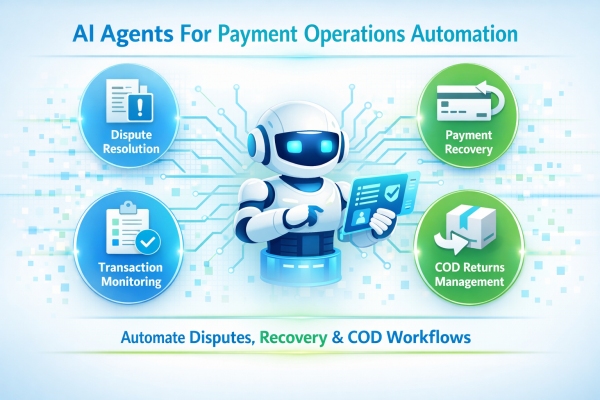
On Mar 12 2026, Razorpay launched Agent Studio, a product it says lets businesses build and run AI agents across payment and post payment workflows. Razorpay says the system is built on Anthropic’s Claude Agent SDK.
Based in Bengaluru, India, Razorpay was founded in 2014 and has grown into one of India’s largest payment platforms. The company says it supports millions of businesses, reaches more than 300 million end consumers, and processes about $180 billion in annualized payment volume. Its stack spans payment acceptance, processing, disbursements, payouts, and business banking through RazorpayX.
Agent Studio targets the operational layer that sits around those flows. In its launch post, Razorpay lists agents for dispute response, subscription recovery, abandoned cart follow up through WhatsApp or email, settlement summaries delivered through messaging, and cashflow forecasting over a 3 to 7 day window. It also includes tools for cash on delivery orders, such as identifying and analyzing returns sent back to the seller.
These workflows cost merchants and payment teams money every day. Disputes create losses and take time to resolve. Failed recurring payments reduce revenue. Abandoned carts lower completed purchases. Cash on delivery returns add shipping and handling costs. Razorpay is building automation around these problem areas, not just the payment itself.
The company is also introducing a no code agent builder in beta and plans to open the system to third party agents. That points to a setup where merchants choose automation for specific tasks across the payment lifecycle, instead of relying only on bundled platform features.
This extends Razorpay’s recent work on AI driven payments, including its earlier work with NPCI on agentic payments to enable AI driven transaction flows. The focus now moves to what happens after a payment, where recovery, customer support, and problem cases still rely heavily on manual work.
Acceptance rates and pricing are still important for PSPs and merchant platforms. Operational efficiency is becoming part of the core value proposition, especially where it directly improves recovery and reduces cost.
If agents handle disputes, recovery, reporting, and cash on delivery losses, does competition start to favour the provider that cuts the most cost for merchants, not just the one with the lowest processing price?
The National Crowdfunding & Fintech Association (NCFA Canada) is a financial innovation ecosystem that provides education, market intelligence, industry stewardship, networking and funding opportunities and services to thousands of community members and works closely with industry, government, partners and affiliates to create a vibrant and innovative fintech and funding industry in Canada. Decentralized and distributed, NCFA is engaged with global stakeholders and helps incubate projects and investment in fintech, alternative finance, crowdfunding, peer-to-peer finance, payments, digital assets and tokens, artificial intelligence, blockchain, cryptocurrency, regtech, and insurtech sectors. Join Canada's Fintech & Funding Community today FREE! Or become a contributing member and get perks. For more information, please visit: www.ncfacanada.org
| | |
|---|---|---|
| | |



August 26th, 2025

January 4th, 2024

June 1st, 2021

September 9th, 2020

July 9th, 2018

January 3rd, 2018

September 25th, 2017

June 20th, 2017

May 10th, 2017

December 14th, 2016
