





Karsten Wenzlaff, Advisor
August 26th, 2025
Karsten Wenzlaff is a Crowdfunding and Fintech Expert from Germany. He is Secretary-General of Digit[...]


May 30, 2026 | NCFA Fintech Whisperer | Payments And Market Infrastructure, Digital Assets Blockchain And Tokenization, Artificial Intelligence And Data, Regulation and Policy, Risk Compliance And Regtech

Image: Freepik
This live weekly NCFA intelligence page tracks financial technology developments that significantly affect how fintechs build, sell, raise capital, and operate under scrutiny. Coverage prioritizes Canada and includes global events that directly influence competitive conditions, market access, and execution realities across fintech sectors. This page will be updated throughout the week with market movers in a live format and then each week we'll close the prior week's contents in prep for the upcoming week, and continue on a rolling basis. (Missed prior week's Fintech Whisperer? (December 6-12, 2025, December 13-19, 2025, January 1-9, 2026, January 10-16, 2026, January 17-23, 2026, January 24-30, 2026, January 31-February 6, 2026, February 7-13, 2026, February 14-20, 2026, February 21-27, 2026, February 28-March 6, 2026, March 7-13, 2026, March 14-20, 2026, March 21-27, 2026, March 28-April 3, 2026, April 4-10, 2026, April 11-17, 2026, April 18-24, 2026, April 25-May 1, 2026, May 2-8, 2026, May 9-15, 2026, May 16-22, 2026, May 23-29, 2026).
Tokenized bonds are moving from pilots into market structure work. Issuers, dealers, custodians, infrastructure providers, and regulators need practical answers on issuance, settlement, custody, disclosure, and secondary liquidity before tokenized fixed income can scale.
The value of cross chain infrastructure comes down to whether developers can route liquidity without exposing users to bridge complexity. The $230M private beta gives 0x early usage evidence, but the larger test is reliability across payments, RWAs, trading, and agent workflows when volumes move beyond controlled integrations.
Stablecoin licensing is becoming a competitive infrastructure tool for financial centres. Issuers, banks, PSPs, custodians, and regulators should track which jurisdictions turn stablecoin rules into live market access rather than policy design alone.
Tokenized money market funds are becoming part of institutional onchain liquidity infrastructure. Asset managers, custodians, PSPs, stablecoin issuers, and treasury teams should track how stablecoins connect with regulated fund products, redemption workflows, and stablecoin payment infrastructure.
Institutional DeFi is shifting toward custody controlled access models. Asset managers, custodians, exchanges, advisers, and compliance teams should track whether qualified custody plus curated onchain strategies becomes the operating model that brings DeFi exposure into regulated portfolios.
The useful signal is not simply another crypto loan product. It is committed buyer capital behind crypto backed credit, which can make the product more repeatable. The key risks remain collateral volatility, liquidation design, borrower suitability, and whether digital asset wealth can support credit access without turning into hidden leverage.
Crypto collateral can help asset rich borrowers avoid selling Bitcoin or USDC, but housing finance brings stricter expectations around suitability, custody, volatility buffers, and borrower protection. The product will need to prove it expands access without importing crypto market risk into mortgage underwriting.
Large banks are moving from stablecoin observation into direct tokenized money infrastructure. Treasury teams, payment providers, fintechs, custodians, and infrastructure operators now need to track whether commercial bank money becomes a regulated settlement layer for high value payments, liquidity management, and cross border transactions.
Western Union’s stablecoin entering a major crypto exchange channel adds another proof point for stablecoins becoming payment infrastructure. PSPs, exchanges, banks, remittance firms, and compliance teams should track how regulated issuers, fiat channels, and global payout networks connect. This adds a distribution proof point for regulated stablecoins. Western Union brings the remittance brand and global currency footprint, while Bybit brings crypto exchange access. The open question is whether USDPT becomes a settlement asset customers actually use, or another branded stablecoin competing for scarce transaction depth.
Central bank money settlement is being designed for programmable markets. Banks, FMIs, tokenized asset platforms, and settlement operators need to understand how RTGS synchronisation could connect central bank money with external asset ledgers and reduce settlement risk in digital markets.
Domestic real time payment systems are becoming exportable cross border infrastructure. Payment networks, banks, wallets, tourism merchants, and regulators are building direct QR payment links that reduce card dependence and make national payment rails usable outside their home markets.
Access to Canada’s payment infrastructure continues to widen beyond traditional banks and large financial institutions. Fintechs, payment providers, credit unions, foreign exchange firms, and digital finance companies are gaining a larger role in the systems and governance discussions that shape payment modernization.
Open banking is moving from one off payments into repeatable payment schemes with shared rules and commercial terms. Banks, PSPs, merchants, fintech platforms, and regulators should track whether recurring account to account payments become a real alternative to cards, direct debit, and closed wallet systems.
Card settlement is no longer limited to traditional banking hours or traditional settlement assets. Banks, acquirers, PSPs, stablecoin issuers, and fintech platforms should track how major payment networks use regulated stablecoins to support faster settlement, lower liquidity friction, and always on money movement.
Stablecoin remittances are moving from fintech experiments into established money transfer networks. Banks, PSPs, remittance firms, stablecoin issuers, and compliance teams should track how large networks use tokenized dollars to reduce settlement friction while staying inside regulated payment flows.
Pay by bank is becoming a practical payment rail strategy, not just a checkout concept. PSPs, banks, merchants, and fintech platforms should track how instant payment routing, risk controls, and settlement access shape competition against cards and traditional ACH flows.
Stablecoins are gaining traction in regulated payment flows, not just trading markets. Remittances remain one of the clearest real world use cases because settlement speed, foreign exchange costs, and cross border reach matter more than speculative activity. Canadian fintechs, PSPs, banks, and regulators should watch whether stablecoin based remittance models can scale while meeting compliance, safeguarding, and consumer protection requirements.
OpenPayd’s planned Nasdaq listing puts programmable money movement under public market scrutiny. PSPs, banks, stablecoin firms, embedded finance platforms, investors, and regulators should track how the listing exposes the economics, licensing footprint, transaction volume, and risk controls behind global payment infrastructure.
Crypto sanctions enforcement is moving deeper into exchange infrastructure and stablecoin flows. Exchanges, custodians, PSPs, blockchain analytics firms, and compliance teams should track how sanctions screening, stablecoin monitoring, and cross border counterparty controls become core operating requirements.
Technology policy is increasingly becoming infrastructure policy. As governments focus on AI capacity, cloud services, strategic data assets, semiconductor supply chains, and digital resilience, firms may face growing pressure to evaluate technology dependencies, procurement choices, hosting arrangements, and infrastructure risk. The result could be a more fragmented global technology environment shaped by competing sovereignty frameworks.
Consumer AI policy is moving toward practical controls for trust, consent and accountability. Banks, fintechs, AI firms, platforms and regulators should watch how user controls, complaint routes, audit trails and outcomes based duties apply when AI systems influence financial decisions or act for consumers.
The operating change is where AI work happens. If capable agents can run locally, more sensitive analysis, file handling, audio processing, and workflow automation can stay on device instead of moving through cloud APIs. That could change enterprise AI design, human oversight, privacy controls, and bot to bot workflows.
The United States is testing a lighter regulatory model for frontier AI that relies on voluntary participation, security evaluation, and industry cooperation. Financial institutions, fintechs, infrastructure providers, and AI developers should watch whether this approach accelerates deployment while maintaining confidence in systems that increasingly influence payments, capital markets, fraud controls, and critical infrastructure.
Revolut’s U.S. strategy shows why bank charters are becoming infrastructure plays for global fintechs. FDIC insured products, payment rail access, stablecoin services, and securities trading under one app could raise the competitive bar for sponsor bank dependent fintech models.
Stablecoin regulation is becoming a competitiveness question, not only a risk control exercise. Issuers, banks, PSPs, custodians, and policymakers should track whether the UK loosens its approach or keeps tougher safeguards that could limit domestic stablecoin scale.
Stablecoin supervision is becoming cross border supervision. Issuers, exchanges, custodians, payment firms, and compliance teams should expect more information sharing between regulators as stablecoin activity crosses jurisdictions, banking systems, and payment networks.
The word of the week is 'control'. Banks, payment networks, fintechs, custodians, stablecoin issuers, and AI providers are competing closer to the infrastructure layer, where settlement, custody, compliance, data, and distribution decisions get made. Which rails, licenses, partners, and operating models create durable access before the next layer of financial infrastructure gets locked in?
NCFA offers various curated resources to help founders and investors stay current on developments that impact fintech markets, subscribe to NCFA weekly newsletter updates, view a rundown of current fintech news and insights, or dive into the latest fintech industry research.
 The National Crowdfunding & Fintech Association (NCFA Canada) is a financial innovation ecosystem that provides education, market intelligence, industry stewardship, networking and funding opportunities and services to thousands of community members and works closely with industry, government, partners and affiliates to create a vibrant and innovative fintech and funding industry in Canada. Decentralized and distributed, NCFA is engaged with global stakeholders and helps incubate projects and investment in fintech, alternative finance, crowdfunding, peer-to-peer finance, payments, digital assets and tokens, artificial intelligence, blockchain, cryptocurrency, regtech, and insurtech sectors. Join Canada's Fintech & Funding Community today FREE! Or become a contributing member and get perks. For more information, please visit: www.ncfacanada.org
 |  |  |
|---|---|---|
 |  |  |
June 2, 2026 | NCFA Feature | Capital Markets And Funding, Open Banking Open Finance And Data Sharing, Digital Assets Blockchain And Tokenization

On May 28, 2026, Wealthsimple announced IPO Access for Canadian retail investors, giving eligible clients a way to request shares in select Canadian and US initial public offerings at the offering price before public trading begins. Four days later, Robinhood completed its WonderFi acquisition and entered Canada with a regulated crypto base.
Canada’s retail finance market is turning into a contest over access, loyalty, status, and who owns the customer relationship.
Wealthsimple says IPO Access lets eligible clients review available IPOs inside the platform, submit a conditional offer to buy before public trading begins, and receive shares at the offering price if an allocation is available. Canadian IPOs and US IPOs marketed in Canada by prospectus are open to eligible clients, while US only IPOs require accredited investor status.
Clients don't automatically receive shares. Wealthsimple can only distribute the IPO shares it receives through participating investment banks, so investors may receive all, some, or none of the shares requested. IPO Access opens the door to a process long dominated by institutions and high net worth investors. Allocation size, issuer quality, investor suitability, disclosure, and demand will decide whether it becomes meaningful market access or a loyalty feature with thin supply.
If Wealthsimple ever pursued its own public listing, IPO Access would face its most visible credibility check. Can retail investors receive meaningful allocation in a high demand Canadian IPO, or only permission to submit a request?
Robinhood’s WonderFi acquisition gives it Canadian market entry through regulated crypto infrastructure. WonderFi operates Bitbuy and Coinsquare, two long running Canadian crypto platforms. When Robinhood announced the WonderFi deal in May 2025, WonderFi reported more than C$2.1B in assets under custody. The all cash transaction valued WonderFi at about C$250M, with shareholders receiving C$0.36 per share.
Robinhood is entering Canada with a larger consumer finance model (not just crypto trading). Its US strategy already reaches beyond trading into managed portfolios, premium membership, family accounts, credit products, AI tools, and lifestyle finance. Robinhood’s wealthtech and lifestyle finance push lays out the direction clearly. The company wants a larger share of the customer relationship, extending beyond trading into crypto, cash, credit, rewards, and everyday financial activity.
Wealthsimple already owns the local bank challenger position. Robinhood now has regulated crypto distribution and global brand recognition. Banks have the widest financial relationships. The competitive question is who can turn access, trust, price, rewards, and habit into the primary customer relationship.
Canadian banks still dominate deposits, lending, mortgages, advice, card relationships, business banking, and full service wealth management. Their brokerage arms have responded with lower cost trading offers, ETF promotions, digital tools, and stronger wealth integration.
Wealthsimple’s three year Billy Bishop airport partnership puts a fintech brand inside a premium travel moment that banks and card issuers have historically owned through lounges, rewards, and status. The June 1 to August 31 pop up is brand marketing. The broader agreement is more strategic, linking financial products to membership, identity, and lifestyle.
Banks can match prices, bundle accounts, and improve digital apps. Cultural relevance is harder to buy. Wealthsimple and Robinhood sell access, control, status, simplicity, and participation. Banks sell security, breadth, advice, and balance sheet strength. The winner will combine both without making the customer feel trapped.
IPO Access now has to prove allocation quality, not only product demand.
Robinhood has to show whether WonderFi becomes a crypto foothold or the base for a broader Canadian wealth and money platform.
Banks have to decide whether to respond with better access and pricing or mainly protect existing margins. They now have to defend the relationship, not just the account.
Regulators have to keep investor protection strong without blocking access models that could improve capital formation.
For NCFA's community, the capital markets innovation angle is interesting. Canada needs more public market participation, deeper retail access, stronger fintech competition, and clearer rules for digital investing. Wealthsimple’s IPO Access launch puts a practical test in the market. Robinhood’s Canada entry raises the competitive stakes.
If fintechs can give Canadians better access to IPOs, crypto, investing, rewards, and everyday money tools, will banks respond by opening up the customer relationship or by making their existing bundles harder to leave?
The National Crowdfunding & Fintech Association (NCFA Canada) is a financial innovation ecosystem that provides education, market intelligence, industry stewardship, networking and funding opportunities and services to thousands of community members and works closely with industry, government, partners and affiliates to create a vibrant and innovative fintech and funding industry in Canada. Decentralized and distributed, NCFA is engaged with global stakeholders and helps incubate projects and investment in fintech, alternative finance, crowdfunding, peer-to-peer finance, payments, digital assets and tokens, artificial intelligence, blockchain, cryptocurrency, regtech, and insurtech sectors. Join Canada's Fintech & Funding Community today FREE! Or become a contributing member and get perks. For more information, please visit: www.ncfacanada.org
| | |
|---|---|---|
| | |
June 2, 2026 | NCFA Insight | Payments And Market Infrastructure, Open Banking Open Finance And Data Sharing, Digital Assets Blockchain And Tokenization, Regulation And Policy

On June 2, 2026, Thunes and Juniper Research released the 2026 Cross Border Payments Interoperability Index, a 50 country benchmark that measures how easily money moves across borders. Canada ranks 22nd with an overall score of 6.4. That result doesn't simply mean Canada lacks financial infrastructure. It points to a harder problem for maturer markets. That is strong domestic systems don't automatically create cheaper, faster, more open cross border payments.
But that's starting to change now that Canada is incentivizing more competition in fintech and now some key policy files open. Real-Time Rail, broader payment service provider access, Interac e-Transfer access for qualifying PSPs, consumer driven banking, and stablecoin rules all point in the same direction. Global benchmarks now judge whether those components are working in live markets or are being left behind.
Canada's scorecard below shows the gap clearly. Solid on economic strength, digital infrastructure, financial inclusion, and cross border connectivity. However, according to the ranking Canada is weak on market dynamics and progress, the category that tracks whether regulation, mandates, open banking, crypto rules, and public payment initiatives create usable momentum (or not).
| Canada Index Category | Score | Reader Takeaway |
|---|---|---|
| Economic Health | 7.5 | Canada has a strong base for financial activity |
| Digital Infrastructure | 7.0 | The country has meaningful digital capacity |
| Financial Inclusion | 6.7 | Formal access is broad, but gaps remain |
| Cross Border Connectivity | 6.3 | Cost, speed, and reach still limit performance |
| Market Dynamics And Progress | 4.0 | Canada’s weakest score and the core execution gap |
| Overall Rank | 22nd Of 50 | Middle of the pack for a G7 market |
The low score of 4.0 on market dynamics needs immediate attention. Canada doesn't lack ambition, but it still needs more proof that payment modernization has changed market behaviour, access, pricing, product design, and cross border reach. Otherwise, smoke and mirrors.
Real-Time Rail could become Canada’s most important domestic payment upgrade in years. Payments Canada says the Real-Time Rail payment system will support instant, data rich account to account payments for eligible participants. Payments Canada also published a PSP participation guide for RTR, which helps payment service providers prepare for access under Canada’s retail payments regime.
The next 18 months will be verytelling, given that the execution timing window is a practical test. Real-Time Rail and Canada’s productivity test comes down to access, fraud controls, pricing, resilience, and product adoption. Faster rails help only when firms can build real workflows on top of them.
Interac has opened another route into mainstream payments. In September 2025, Interac said qualifying PSPs can access Interac e-Transfer if they meet requirements tied to RPAA registration, FINTRAC money services business registration, sponsorship, and risk controls. Interac reports 1.4 billion e-Transfer transactions in 2024, so access to this network gives fintechs a path into a payment habit Canadians already use at scale.
Open banking is also in implementation. Canada’s consumer driven banking framework gives consumers and small businesses secure control over financial data, with future write access expected to support payment initiation. That turns open banking from comparison infrastructure into payment infrastructure. Canada’s open banking commercialization roadmap is now in rollout and about real API usage, accreditation, liability, and business model design.
And then there's Stablecoins. Finance Canada says Canada’s stablecoin framework will regulate fiat backed stablecoins issued by non financial institutions and place issuers under Bank of Canada supervision. That connects directly to the cross border pain measured by Thunes. Bill C-15 gives Canada a digital finance framework, but execution will decide whether stablecoins become trusted payment infrastructure or another narrow product category.
The Thunes report gives Canada a useful benchmark because cross border payments still fail basic user tests. The global average remittance cost sits at 6.36 percent, more than double the UN target of less than 3 percent by 2030. The same report finds that 38 percent of surveyed users typically pay more than 3 percent to send a cross border payment.
| Global Friction Point | Thunes Finding | Why It Counts |
|---|---|---|
| Remittance Cost | 6.36 percent global average | More than double the UN target |
| High Fee Exposure | 38 percent pay more than 3 percent | Users still face avoidable cost pressure |
| Payment Delay | 27 percent wait two or more days | Slow payouts hurt household and business cash flow |
| Price Transparency | 41 percent do not always see the final amount upfront | Users cannot compare true cost easily |
| User Priority | 50 percent rank instant transfers first | Speed now beats fees as the top feature |
RTR can improve domestic speed. Open banking can improve data access and future payment initiation. Interac PSP access can widen domestic participation. Stablecoin rules can support regulated digital settlement.
None of those pieces improves cross border outcomes on its own. The gap is not a lack of providers. It is how well banks, fintechs, PSPs, wallets, FX, fraud controls, compliance systems, and payout networks connect across domestic and international payment flows.
Brazil and India offer Canada the most useful comparison. Both markets show how live domestic payment rails can change user behaviour. They also show why domestic success doesn't automatically solve international payments.
| Market | Thunes Rank Or Score | Domestic Payment Behaviour | Cross Border Lesson |
|---|---|---|---|
| Canada | 22nd overall, 6.4 score, 4.0 market dynamics | Strong infrastructure, but RTR, open banking, PSP access, and stablecoin rules still need market proof | Canada must turn policy design into live interoperability |
| Brazil | 14th overall, 6.7 score, 8.0 market dynamics | Pix helped make instant bank transfers a daily habit. Thunes reports 59 percent of surveyed respondents in Brazil use bank transfers daily or weekly | Live rails can change behaviour, but 71 percent of Brazilian recipients still wait two or more days for international payments |
| India | High domestic bank transfer use in the surveyed group | UPI made account to account payments central to daily digital finance | Cross border costs remain high. Thunes reports 54 percent of surveyed users in India typically pay more than 3 percent for cross border transfers |
The lesson is that working rails change expectations. Once consumers and businesses experience instant domestic payments, delays and hidden costs in international payments become harder to defend. Canada has not yet had that market wide real time payment moment. RTR can help create it if access, fraud controls, pricing, and use cases land together.
The stablecoin section of the Thunes report is stronger when read as infrastructure analysis. Stablecoins can settle quickly at low on chain cost, but users still need practical conversion into bank accounts, wallets, cards, or cash. That last mile problem limits mainstream use.
| Stablecoin Data Point | What Thunes Found | Policy Read For Canada |
|---|---|---|
| Core Benefit | Immediate settlement at low on chain cost | Useful for cross border settlement if rules, custody, and redemption work |
| Main Constraint | Local currency conversion remains challenging | Stablecoins need connections to banks, PSPs, wallets, and payout networks |
| Nigeria Usage | 29 percent of surveyed respondents used stablecoins | Demand rises where currency pressure and payment friction are higher |
| Top Nigeria Use Case | 58 percent used stablecoins to store value | Stablecoins do not start only as payment products |
| Nigeria Payments Use | 9 percent used stablecoins for domestic payments and 39 percent used them for international payments | Cross border utility looks stronger than domestic merchant use in this sample |
Canada now has domestic stablecoin proof points. Tetra’s CADD launch brought a Canadian dollar payment stablecoin issued through a regulated financial institution. Stablecorp’s QCAD work has added regulatory, bank custody, and exchange access milestones. Loon’s CADC acquisition gives Canada another Canadian dollar stablecoin initiative with existing transaction history. These examples make Canada’s stablecoin debate more practical. The issue is no longer whether Canadian dollar stablecoin projects exist. It is whether they can earn trusted roles in payment and settlement workflows.
The Thunes report doesn't frame stablecoins as an immediate replacement for banks or remittance brands. Stablecoins may work first as a middle leg settlement layer inside money transfer operators, banks, wallets, and payment platforms. That fits Canada’s policy challenge. Rules for reserves, redemption, supervision, governance, and AML controls matter, but market value comes from trusted use inside real payment flows.
Canada’s retail market still looks early. FCAC stablecoin survey findings show that 4% of Canadian adults hold stablecoins and 5% held them in the past. That gap between infrastructure activity and consumer adoption should guide policy design. Canada should not build stablecoin rules only around today’s retail ownership. It should test whether regulated Canadian dollar stablecoins can support remittances, merchant settlement, marketplace payouts, treasury use, and business to business payments across domestic and international corridors.
Can Canada turn payment modernization into live cross border advantage before faster markets pull further ahead?
Better outcomes will come from live RTR access, PSP onboarding that works in market, open banking with payment initiation, stablecoin rules tied to real payment use cases, and fraud controls that scale across real time flows. The Canadian pieces are coming together, but the test will be whether they work together fast enough to improve cost, speed, transparency, and cross border reach.
The National Crowdfunding & Fintech Association (NCFA Canada) is a financial innovation ecosystem that provides education, market intelligence, industry stewardship, networking and funding opportunities and services to thousands of community members and works closely with industry, government, partners and affiliates to create a vibrant and innovative fintech and funding industry in Canada. Decentralized and distributed, NCFA is engaged with global stakeholders and helps incubate projects and investment in fintech, alternative finance, crowdfunding, peer-to-peer finance, payments, digital assets and tokens, artificial intelligence, blockchain, cryptocurrency, regtech, and insurtech sectors. Join Canada's Fintech & Funding Community today FREE! Or become a contributing member and get perks. For more information, please visit: www.ncfacanada.org
| | |
|---|---|---|
| | |

Last Updated: June 3, 2026
Status: Strengthening
Organizations: CIRO, CSA, OSFI, OCC, SEC, TSXV, CSE
The answer is yes. Regulators are opening parts of finance to more firms, lighter processes, and new digital models, but the tradeoff is a higher bar for records, controls, reporting quality, investor protection, supervision, and evidence. Access is getting better for some firms. Operating without strong compliance proof is getting harder.
This is why the market access question isn't only about reducing red tape. It's about whether firms can use simpler rules, new approvals, and digital distribution without creating weak records, unclear accountability, or avoidable investor harm.
The firms to watch are the ones that can turn compliance evidence into a growth asset. Think clean data, fast records production, clear supervision, tested controls, and product design that can withstand review before a problem appears.
Strategic Takeaway
Regulators are trading old friction for stronger proof. Companies that want faster access need better evidence, cleaner controls, and stronger investor protection built into the operating model.
Click each item to expand
The Canadian Securities Administrators adopted a semi annual financial reporting pilot for eligible venture issuers listed on the TSXV and CSE.
OSFI says its streamlined approvals framework will launch in June 2026 for eligible applicants. The framework is intended to create efficiencies for targeted new entrants.
CIRO launched a review of rules for affordable tailored online investment advice, including online and hybrid advisory models.
The SEC Small Business Capital Formation Advisory Committee continued discussion on the regulatory framework for finders and private market liquidity.
Click each item to expand
CIRO launched a Disgorgement Distribution Program to return funds collected through disgorgement orders to harmed investors.
CIRO published an Enforcement Document Production Guide that takes effect May 1, 2026.
CIRO published guidance on third party electronic access to marketplaces, including order execution accounts and related gatekeeper obligations.
The evidence table also tracks counter examples where market access remains fragile, including delayed IPO timing and private market liquidity constraints.
Click each item to expand
The OCC says it is tailoring supervision for community banks by size, complexity, and risk profile, with more focus on material financial risks.
Do you agree the evidence is strengthening?
 2
2
 1
1
The National Crowdfunding & Fintech Association (NCFA Canada) is a financial innovation ecosystem that provides education, market intelligence, industry stewardship, networking and funding opportunities and services to thousands of community members and works closely with industry, government, partners and affiliates to create a vibrant and innovative fintech and funding industry in Canada. Decentralized and distributed, NCFA is engaged with global stakeholders and helps incubate projects and investment in fintech, alternative finance, crowdfunding, peer-to-peer finance, payments, digital assets and tokens, artificial intelligence, blockchain, cryptocurrency, regtech, and insurtech sectors. Join Canada's Fintech & Funding Community today FREE! Or become a contributing member and get perks. For more information, please visit: www.ncfacanada.org
| | |
|---|---|---|
| | |
June 1, 2026 | NCFA Fintech Market Activity | Digital Assets Blockchain And Tokenization, Capital Markets And Funding, Capital Markets And Market Infrastructure

On June 1, 2026, Further and 3iQ introduced USD Class II for the Further x 3iQ Alpha Digital Fund, adding a new share class for USD investors who want long Bitcoin exposure plus digital asset alpha without buying, converting, or custodying BTC directly.
3iQ and Further aren't just selling Bitcoin exposure. They are separating investor needs by base currency, custody preference, and risk objective. The fund now has three share classes:
Tommaso Mancuso, President and CIO, 3iQ:
“USD Class II combines two things institutional investors increasingly want in the same product. It pairs disciplined alpha generation across liquid digital asset markets with long exposure to Bitcoin's scarcity and convexity. Delivering both within a USD-denominated, institutionally risk-managed structure is what makes this share class distinctive.”
The useful part is the share class design. Allocators are not all trying to solve the same objective. Some want USD Class I focused on active digital asset returns with less reliance on Bitcoin’s price direction. Some want Bitcoin exposure but need to fund and redeem in USD. Others already hold BTC and want to stay in BTC instead of selling first.
USD Class II reduces one operational problem. It gives USD investors Bitcoin linked exposure without asking them to source or custody BTC themselves (which can slow adoption even when investors already believe in the asset class).
3iQ brings a longer Canadian product history into this launch. The company was founded in 2012 and says it launched the world’s first Digital Assets Managed Account Platform. It also points to earlier Bitcoin and Ethereum ETP launches, staking integration in Ethereum and Solana ETPs, and other regulated ETPs.
In February 2026, Coincheck completed its 3iQ acquisition, including 3iQ’s regulated product track record in Canada. The question now is whether this share class design attracts allocator demand, not whether Bitcoin access exists.
Will institutional digital asset adoption grow more through broad Bitcoin exposure, or through fund structures that let allocators choose currency, custody, alpha, and beta on their own terms?
The National Crowdfunding & Fintech Association (NCFA Canada) is a financial innovation ecosystem that provides education, market intelligence, industry stewardship, networking and funding opportunities and services to thousands of community members and works closely with industry, government, partners and affiliates to create a vibrant and innovative fintech and funding industry in Canada. Decentralized and distributed, NCFA is engaged with global stakeholders and helps incubate projects and investment in fintech, alternative finance, crowdfunding, peer-to-peer finance, payments, digital assets and tokens, artificial intelligence, blockchain, cryptocurrency, regtech, and insurtech sectors. Join Canada's Fintech & Funding Community today FREE! Or become a contributing member and get perks. For more information, please visit: www.ncfacanada.org
| | |
|---|---|---|
| | |
May 29, 2026 | NCFA Fintech Whisperer Weekly Intelligence | Payments And Market Infrastructure, Artificial Intelligence And Data, Digital Assets Blockchain And Tokenization, Capital Markets And Market Infrastructure
Image: Freepik
This live weekly NCFA intelligence page tracks financial technology developments that significantly affect how fintechs build, sell, raise capital, and operate under scrutiny. Coverage prioritizes Canada and includes global events that directly influence competitive conditions, market access, and execution realities across fintech sectors. This page will be updated throughout the week with market movers in a live format and then each week we'll close the prior week's contents in prep for the upcoming week, and continue on a rolling basis. (Missed prior week's Fintech Whisperer? (December 6-12, 2025, December 13-19, 2025, January 1-9, 2026, January 10-16, 2026, January 17-23, 2026, January 24-30, 2026, January 31-February 6, 2026, February 7-13, 2026, February 14-20, 2026, February 21-27, 2026, February 28-March 6, 2026, March 7-13, 2026, March 14-20, 2026, March 21-27, 2026, March 28-April 3, 2026, April 4-10, 2026, April 11-17, 2026, April 18-24, 2026, April 25-May 1, 2026, May 2-8, 2026, May 9-15, 2026, May 16-22, 2026).
AI compliance is moving from broad principles into operating guidance for agents, automated decisions, procurement, and personal data use. Fintechs, banks, insurers, regtech firms, and AI vendors should track how privacy rules shape AI product design, governance, and customer trust.
Project Agorá's focus is not retail crypto speculation. It is wholesale financial infrastructure, cross border settlement efficiency, programmable payments, and institutional control over tokenized money movement. Go deeper, visit NCFA's curated fintech reports and research library, where the BIS Project Agorá report is listed.
This is not open access to the Fed system. It is a narrower settlement pathway for legally eligible firms operating outside the traditional bank model. Stablecoin issuers, PSPs, crypto firms, tokenization platforms, and embedded finance providers should track whether limited Reserve Bank account access becomes a practical alternative to sponsor bank dependence. This connects to NCFA’s analysis of Fed Payment Accounts and fintech settlement access.
Onchain finance needs shared coordination standards before institutional adoption can scale cleanly. Banks, wallets, PSPs, exchanges, tokenization platforms, and agentic payment builders should track whether identity, messaging, and transaction standards become competitive infrastructure rather than optional middleware.
Large payment networks are adding regulated digital asset permissions to support stablecoin, tokenized settlement, and digital asset infrastructure at institutional scale. Banks, PSPs, exchanges, custodians, and fintech platforms should track which firms secure licences that let crypto services connect with mainstream payment networks.
Stablecoins are moving deeper into consumer banking distribution, not just crypto infrastructure. Banks, fintechs, PSPs, and regulators should watch whether regulated bank issued stablecoins begin competing directly with cards, deposits, remittance products, and embedded payment flows. Also supports this analysis of stablecoins becoming payment infrastructure.
National currency stablecoins are expanding beyond major economies. Stablecoin issuers, banks, PSPs, regulators, and treasury teams should track how smaller jurisdictions use digital fiat infrastructure to compete for payment flows, fintech investment, and cross border settlement.
Climate disclosure is moving back toward company specific materiality rather than a dedicated SEC climate reporting regime. Public companies, fintech lenders, ESG data providers, regtech firms, investors, and capital markets platforms should track how climate risk reporting moves across U.S. federal rules, state rules, EU requirements, and voluntary investor expectations.
Bank charter strategy is becoming part of digital asset and payment infrastructure competition. Banks, fintechs, stablecoin firms, custodians, and compliance teams should track which institutions secure federal supervision, stronger operating permissions, and clearer access to national banking infrastructure.
MiCA is moving from licensing theory into enforcement risk. Crypto exchanges, custodians, wallet providers, brokers, and compliance teams should treat EU authorization, local regulator engagement, and operating perimeter checks as immediate market access priorities.
Prediction markets are moving deeper into conflict with gambling, derivatives, and securities frameworks. Exchanges, fintechs, tokenization firms, and prediction market operators should expect more pressure around licensing, market surveillance, consumer protection, and jurisdictional authority as these platforms expand globally.
USMCA risk is now back inside Canada’s competitiveness file. Fintech lenders, payment firms, investors, marketplaces, and platforms serving SMEs should watch how tariff uncertainty affects customer margins, capital demand, foreign exchange exposure, supplier payments, and cross border expansion.
Crypto sanctions enforcement now reaches deeper into financial infrastructure networks, not just individual wallets or isolated actors. Exchanges, custodians, PSPs, banks, compliance teams, and blockchain monitoring firms should expect more scrutiny around transaction tracing, counterparty checks, and sanctions controls tied to digital asset flows.
Post trading rules are becoming more important as Europe modernizes settlement operations, CSD messaging, and market infrastructure controls. CSDs, brokers, banks, custodians, tokenization platforms, and compliance teams should track how messaging standards affect settlement efficiency, operational risk, and future market infrastructure integration.
Blockchain based settlement is moving into formal U.S. market infrastructure permissions. Brokers, custodians, tokenization platforms, exchanges, and asset managers should track how SEC registered clearing models affect securities settlement, custody design, and tokenized market structure.
Retail investing scale increasingly depends on back end clearing and custody infrastructure. Fintech platforms, brokers, clearing firms, embedded finance providers, and regulators should track how large consumer apps choose clearing partners that can support faster launches, broader products, and stronger operational controls.
This week was less about crypto adoption and more about who gets trusted access to the pipes. The Fed tested a narrow settlement account, Paxos received SEC clearing agency registration, Mastercard secured a BitLicense, SoFi launched a bank issued stablecoin, and Project Agorá moved wholesale tokenized settlement into deeper testing. The fresh lesson is that access is becoming tiered. Firms won’t all get the same rails, licences, or settlement rights.
NCFA offers various curated resources to help founders and investors stay current on developments that impact fintech markets, subscribe to NCFA weekly newsletter updates, view a rundown of current fintech news and insights, or dive into the latest fintech industry research.
The National Crowdfunding & Fintech Association (NCFA Canada) is a financial innovation ecosystem that provides education, market intelligence, industry stewardship, networking and funding opportunities and services to thousands of community members and works closely with industry, government, partners and affiliates to create a vibrant and innovative fintech and funding industry in Canada. Decentralized and distributed, NCFA is engaged with global stakeholders and helps incubate projects and investment in fintech, alternative finance, crowdfunding, peer-to-peer finance, payments, digital assets and tokens, artificial intelligence, blockchain, cryptocurrency, regtech, and insurtech sectors. Join Canada's Fintech & Funding Community today FREE! Or become a contributing member and get perks. For more information, please visit: www.ncfacanada.org
| | |
|---|---|---|
| | |
May 29, 2026 | NCFA Fintech Market Activity | Digital Assets Blockchain And Tokenization, Capital Markets And Market Infrastructure, Risk Compliance And Regtech
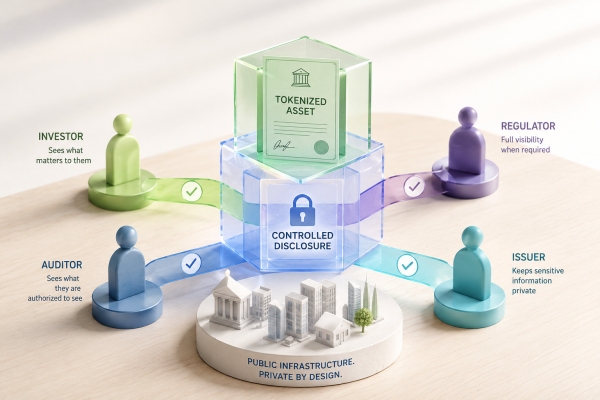
On May 27, 2026, Toronto based Polymath launched Confidential Assets on Polymesh, a protocol level privacy feature for tokenized securities and real world assets. It uses zero knowledge cryptography to keep transaction details private while preserving access for regulators, auditors, and authorized parties.
Privacy solves a practical market problem. Public blockchains can expose positions, client data, and transaction flows. Private chains can protect confidentiality, but they can also silo activity inside closed systems. Confidential Assets is Polymath aim to give regulated asset markets privacy without giving up public permissioned infrastructure.
Martin Halford, CEO, Polymath:
“The question the market has been asking is not whether assets can be tokenized -- they can. The question is whether tokenization can be done at an institutional scale, with the privacy and compliance standards that real financial infrastructure demands. Confidential Assets is our answer to that question.”
The stronger use case isn't about keeping secrets, but rather controlled disclosure. Issuers, investors, and asset managers need privacy around holdings and transfers. Yet a wide range of stakeholders from regulators to auditors, custodians, and compliance teams still need access when rules require it.
Confidential Assets is built into the Polymesh protocol, not added through a third party tool or Layer 2 solution. This allows privacy to work within the same system that handles compliance, governance, and settlement. A fund, private credit issuer, real estate platform, or broker dealer could use the feature to complete a compliant transfer without exposing position size or counterparty details to the broader market.
The ultimate goal and impact is the right mix of privacy and oversight. If Polymath gets that balance right, Confidential Assets could make Polymesh more useful for real capital markets activity, not just token issuance.
Confidential Assets is available immediately to institutions building on Polymesh. Polymath has been building regulated asset infrastructure since 2017 and contributed the ERC 1400 security token standard. Polymesh achieved SOC 2 Type 1 compliance in 2025. Polymath also says a post quantum ready version of Confidential Assets is in development for long term assets that may remain on chain for decades.
For Canadian capital markets and fintech firms, controlled disclosure is becoming core infrastructure for tokenized assets. Platforms that manage who can see what, and when, will become harder to replace in digital securities markets, over time.
Can tokenized markets reach institutional scale without protocol level privacy, or will controlled disclosure become a core requirement for regulated digital assets?
The National Crowdfunding & Fintech Association (NCFA Canada) is a financial innovation ecosystem that provides education, market intelligence, industry stewardship, networking and funding opportunities and services to thousands of community members and works closely with industry, government, partners and affiliates to create a vibrant and innovative fintech and funding industry in Canada. Decentralized and distributed, NCFA is engaged with global stakeholders and helps incubate projects and investment in fintech, alternative finance, crowdfunding, peer-to-peer finance, payments, digital assets and tokens, artificial intelligence, blockchain, cryptocurrency, regtech, and insurtech sectors. Join Canada's Fintech & Funding Community today FREE! Or become a contributing member and get perks. For more information, please visit: www.ncfacanada.org
| | |
|---|---|---|
| | |



August 26th, 2025

January 4th, 2024

June 1st, 2021

September 9th, 2020

July 9th, 2018

January 3rd, 2018

September 25th, 2017

June 20th, 2017

May 10th, 2017

December 14th, 2016
