





Karsten Wenzlaff, Advisor
August 26th, 2025
Karsten Wenzlaff is a Crowdfunding and Fintech Expert from Germany. He is Secretary-General of Digit[...]


July 16, 2026 | NCFA Market Activity | Capital Markets And Market Infrastructure, Artificial Intelligence And Data, Digital Assets

On July 16, 2026, Alpaca raised US$135 million in new equity led by Peak XV, with participation from Elefund, Opera Tech Ventures and Unbound.
The announced financing totals US$435 million, including debt financing primarily from Payward, the parent company of Kraken, and BMO. Alpaca didn’t disclose how that debt was structured or allocated between the lenders.
The financing reflects a larger change inside the company. Alpaca started by helping developers connect applications to U.S. brokerage accounts. It now clears more trades itself, holds securities in custody, operates regulated businesses in several markets and supports companies offering tokenized stocks.
That business needs more than product capital. Brokers need liquidity, regulatory capital and operations that can settle trades and protect customer assets during volatile markets.
A software company can add customers without holding their assets or settling their trades. A broker cannot.
Alpaca clears U.S. equities through the Depository Trust & Clearing Corporation. It has also secured memberships with the Options Clearing Corporation and Fixed Income Clearing Corporation and joined Nasdaq.
Those connections reduce its reliance on outside clearing brokers and give Alpaca more control over execution, settlement and the economics attached to each account. They also bring higher capital, liquidity and operating requirements.
The lenders fit that business. Payward brings Kraken’s digital asset market experience and an existing Nasdaq tokenization partnership. BMO brings a global banking and capital markets balance sheet and is already working with CME Group and Google Cloud on tokenized cash for margin and settlement.
Both are financing a broker that connects conventional securities with tokenized markets.
Alpaca’s first pitch was simple. A fintech could add investing without becoming a broker.
The company now supports stocks, ETFs, options, fixed income and crypto for more than 300 fintech and institutional partners across more than 40 countries. It reported more than 9 million brokerage accounts in January 2026.
Self clearing, custody, securities lending, cash products and wider market access let Alpaca handle more of each account relationship. That can improve product flexibility and give the company access to more of the revenue generated after an account opens.
Its international expansion follows the same pattern. The WealthKernel acquisition added regulated brokerage and custody businesses in the United Kingdom and Europe. Alpaca later completed passporting across the European Economic Area and began adding European equities. In India, it acquired an IFSCA regulated broker dealer and payment service provider in GIFT City.
Alpaca is buying regulated market access rather than trying to export one U.S. brokerage model everywhere.
That can simplify expansion for its partners. It also leaves Alpaca managing different legal entities, customer protections and operating requirements across jurisdictions.
The company says revenue has doubled annually for three consecutive years. Revenue, profitability and product level economics remain private.
Alpaca says it now holds more than US$1.5 billion in assets backing tokenized U.S. stocks and ETFs.
Alpaca doesn't issue those tokens. It holds the underlying securities while other companies create digital representations for their own platforms. The rights attached to each token depend on its issuer and legal structure.
Tokenized stocks therefore do not remove brokerage, custody or corporate actions. Someone still has to hold the shares, settle transactions and reconcile the token with the underlying asset.
That is Alpaca’s commercial role. Its Instant Tokenization Network connects custody with minting, redemption and liquidity across token issuers and trading venues.
The same model is entering regulated markets. Nasdaq’s tokenized stock proposal retains exchange trading and clearing while adding a tokenized representation.
Tokenization becomes a measurable business when firms can handle custody, settlement, reporting and corporate actions at scale. Issuing more tokens is the easy part.
Alpaca is also making brokerage functions easier for software to use directly. Its command line interface exposes 108 functions covering orders, accounts, positions, market data and crypto. The company also offers an MCP server and an AI agent skills library.
Brokerage APIs are not new. What is changing is how much of the workflow software can complete before a person intervenes.
A financial institution can allow software to retrieve account information, assess opportunities and prepare or submit orders. The institution still sets permissions, limits, approvals and exception rules. Responsibility for the trade remains with the firm and account owner.
Alpaca says monthly active API users nearly quadrupled during the six months before the financing. It hasn't disclosed the starting number or how much of that activity came from AI agents rather than conventional algorithmic trading.
The tools are available. Institutions will decide how much authority to give them.
Alpaca already supports a Canadian use case through Manzil’s embedded brokerage launch. Manzil owns the customer proposition while Alpaca provides U.S. brokerage accounts, custody, clearing and fractional share access. That arrangement lets a Canadian fintech build for a defined customer segment without becoming a U.S. broker dealer.
BMO’s financing participation adds an institutional connection. The bank is backing a company that holds securities behind tokenized equities and is taking on more clearing and custody work.
Payward adds another Canadian connection through Kraken. Kraken operates nationally through Payward Canada’s restricted dealer registration, while its parent company is also working with Nasdaq on tokenization.
Canada has broker dealers, custodians, wealth platforms and digital asset firms. Few combine developer brokerage APIs, self clearing, tokenized equity custody and regulated businesses across several markets.
Alpaca shows Canadian firms what a more integrated brokerage business can look like. The practical decision is which functions to own and which to source from a specialist.
Alpaca started by helping developers connect to a broker. Today it is taking on more of the brokerage itself.
The company clears trades, holds securities, operates regulated businesses across several jurisdictions and supports tokenized stock platforms. Its AI tools extend those same functions to software.
The latest financing belongs in that progression. The Company Intelligence Snapshot below shows how Alpaca added those capabilities and where the new equity and debt fit.
How much of the brokerage business can Alpaca bring under one company before regulatory and operating complexity begins to offset the advantage?
Yoshi Yokokawa and Hitoshi Harada founded Alpaca in 2015. The company began with market data and machine learning tools, then built a commission free brokerage API that developers could use for algorithmic trading.
AlpacaDBFounded by Yoshi Yokokawa and Hitoshi Harada
LaunchDeveloper trading and brokerage APIs
Early VentureMore than US$6 million reported by the 2018 API launch
United StatesU.S. equities and algorithmic trading
DevelopersAlgorithmic traders and financial application builders
API AccessBrokerage functions exposed through developer tools
Alpaca entered brokerage through developers rather than a consumer trading app. That distribution choice later gave financial companies a way to build their own investing products on the same brokerage connection.
 The National Crowdfunding & Fintech Association (NCFA Canada) is a financial innovation ecosystem that provides education, market intelligence, industry stewardship, networking and funding opportunities and services to thousands of community members and works closely with industry, government, partners and affiliates to create a vibrant and innovative fintech and funding industry in Canada. Decentralized and distributed, NCFA is engaged with global stakeholders and helps incubate projects and investment in fintech, alternative finance, crowdfunding, peer-to-peer finance, payments, digital assets and tokens, artificial intelligence, blockchain, cryptocurrency, regtech, and insurtech sectors. Join Canada's Fintech & Funding Community today FREE! Or become a contributing member and get perks. For more information, please visit: www.ncfacanada.org
 |  |  |
|---|---|---|
 |  |  |
Jul 16, 2026 | NCFA Resource | Digital Assets, Capital Markets And Market Infrastructure
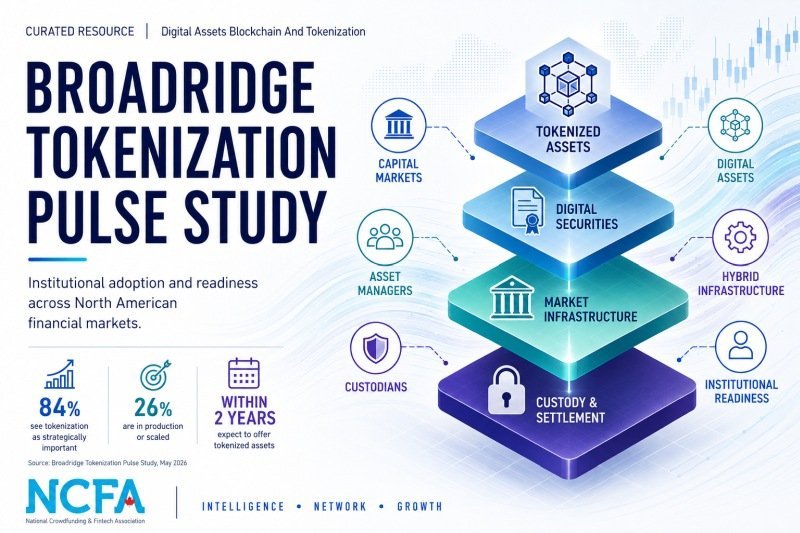
On July 16, 2026, Broadridge released its Tokenization Pulse Study, a survey of 200 senior financial services decision makers in Canada and the United States. The report examines adoption, investment, operating models, asset class priorities, and the practical barriers institutions face as tokenized assets enter production.
The findings show strong institutional interest with a wide gap between strategy and execution. While 84% of respondents consider tokenization strategically important, only 26% report being in production or operating at scale.
The study covers capital markets firms, asset managers, wealth managers, and digital asset firms. It compares their current activity, planned investment, expected adoption timelines, preferred infrastructure models, and reasons for pursuing tokenization.
Capital markets firms are furthest ahead, with 44% reporting production or scaled operations. That compares with 20% of asset managers and 9% of wealth managers. Nearly two thirds of all respondents expect to be ready to offer tokenized assets within two years.
The expected operating model is mainly hybrid. 92% believe traditional and digital assets will coexist for an extended period, while 69% plan to adapt existing infrastructure instead of building separate systems. This supports the view that tokenized financial infrastructure will need to connect with established market processes, governance, custody, distribution, and recordkeeping.
Asset classes are also developing at different rates. 80% expect tokenized mutual funds and money market funds to play a meaningful role within five years. Expectations for equities and private companies are closer to half of respondents.
This resource is useful for banks, custodians, dealers, exchanges, asset managers, wealth firms, market infrastructure providers, digital asset companies, investors, regulators, and technology teams.
It’s especially useful for organizations deciding whether to build, partner, integrate, or continue monitoring the market. The sector comparisons help readers judge how their own plans compare with North American institutions.
Strategy teams can use the report to compare stated priorities with actual production. The 84% strategic importance figure looks very different beside the 26% production rate. That gap helps identify where budgets, operating capacity, governance, and commercial demand still need work.
Product and infrastructure teams can use the asset class timelines to decide where near term demand is more credible. Mutual funds, money markets, and capital markets infrastructure currently show stronger institutional expectations than equities, private companies, or wealth distribution.
Canadian firms can also compare the findings with Canada’s stablecoin regulatory framework, securities regulation, custody requirements, and domestic market infrastructure. The survey includes Canadian respondents, but it doesn’t publish a separate Canadian data set.
The study’s main strength is its operating detail. It separates strategic interest from production, compares financial sectors, identifies preferred infrastructure models, and ranks regulatory, operational, commercial, budget, security, and organizational barriers.
Regulatory uncertainty was the most cited barrier at 33%. Operational complexity was especially important for capital markets firms, asset managers, and institutions managing more than US$250 billion. The results show that institutional interest alone isn’t enough. Firms still need workable governance, standards, controls, distribution, and a business case.
The study is commissioned by Broadridge, which provides tokenization infrastructure and related services. Readers should consider that commercial context when interpreting its conclusions. The sample is also limited to 200 North American decision makers, and the report does not provide country level results or independently test projected adoption timelines.
Broadridge Tokenization Pulse Survey Release (study findings and methodology)
Tokenization Starts Looking Like Financial Infrastructure (institutional market context)
Canada’s Stablecoin Regulatory Framework (Canadian regulatory context)
UK FCA Final Cryptoasset Rules (international regulatory comparison)
The National Crowdfunding & Fintech Association (NCFA Canada) is a financial innovation ecosystem that provides education, market intelligence, industry stewardship, networking and funding opportunities and services to thousands of community members and works closely with industry, government, partners and affiliates to create a vibrant and innovative fintech and funding industry in Canada. Decentralized and distributed, NCFA is engaged with global stakeholders and helps incubate projects and investment in fintech, alternative finance, crowdfunding, peer-to-peer finance, payments, digital assets and tokens, artificial intelligence, blockchain, cryptocurrency, regtech, and insurtech sectors. Join Canada's Fintech & Funding Community today FREE! Or become a contributing member and get perks. For more information, please visit: www.ncfacanada.org
| | |
|---|---|---|
| | |
```
July 15, 2026 | NCFA Market Activity | Cross Border Payments And FX, Banking And Credit, Digital Assets

On July 14, 2026, Flex raised US$70 million in a Series B1 led by Halo Fund and launched Flex Global, a cross border financial platform for internationally active business owners. The service combines multi currency accounts, payments, cards, private credit and stablecoin settlement while keeping the underlying digital asset infrastructure out of the customer experience.
The financing came six months after Flex raised a US$60 million Series B. Flex says it has now secured US$180 million in equity and US$300 million in debt. Reuters reported that the new round valued the company at about US$1.2 billion, based on information from a person close to the transaction. Flex didn’t disclose the valuation.
Flex Global extends the company’s private credit, business finance, personal finance, payments and financial operations platform into international accounts, currency conversion and stablecoin settlement. Flex says the service will support 32 currencies across more than 100 countries.
The customer doesn’t need to understand or manage the digital asset infrastructure. Stablecoins operate beneath a conventional financial interface while the business owner sees accounts, balances, payments and financial tools.
That design addresses a persistent gap between stablecoin payment potential and business adoption. Most companies aren’t looking for a token product. They want faster settlement, usable currencies, predictable access to funds and one record of what happened.
Flex is trying to make the underlying rail invisible while expanding the amount of the owner’s financial relationship it can control.
Flex Global is designed to let business owners hold and transfer value across markets through the same platform they use for credit, cards, payments and financial operations.
Stablecoins can provide a common settlement asset between two financial endpoints. The platform still needs to handle customer verification, currency conversion, transaction monitoring, liquidity, local payout access and reconciliation.
That operating bundle is more important than the token transfer itself. NCFA has seen the same model in Levl’s connection between bank and stablecoin rails, where the commercial product joins digital settlement with accounts, payment access and financial infrastructure.
Flex applies that mechanism to a direct owner relationship rather than selling infrastructure to another bank or payment company.
The customer value proposition is straightforward. An internationally active owner may currently use separate providers for business accounts, cards, foreign exchange, payments, working capital, expense management and personal finance. Flex wants to consolidate those products around one customer record and one financial interface.
Flex targets profitable middle market business owners whose needs often sit between small business banking and institutional private banking.
Founder and CEO Zaid Rahman has described the customer group as owners of businesses earning millions or tens of millions of dollars in annual revenue. They may manage several companies, international suppliers, personal investments, employees and private credit needs without the finance department of a large corporation.
The firm says it has onboarded a few thousand customers and is growing at roughly four times its prior year level. Reuters reported a nine figure annualized revenue run rate. The company plans to increase its team from about 110 people to more than 200 by the end of 2026.
Its platform brings several financial functions into the same commercial relationship:
Private credit gives Flex a different economic position from a payment application that earns mainly from transaction fees. The company can potentially earn across lending, interchange, payment services and software while using one product to distribute another.
Flex’s AI products support that integration. Beacon is positioned as a financial intelligence tool for owners, while the wider platform is designed to use customer financial data across credit and operating workflows.
Public disclosures don’t provide enough information to determine how much work its AI systems complete independently, how human review is applied or whether the tools improve financial outcomes. Those questions become more important as Flex handles more credit and payment activity.
The competitive group spans several fintech categories. Flex overlaps with:
The strategic difference is customer scope. Many competitors specialize in one financial job. Flex is trying to serve a narrow customer segment across several jobs.
That can improve distribution economics because the company doesn’t need to acquire a new customer for every product. It can also create operating complexity as more credit, payment, compliance and personal finance responsibilities sit inside one interface.
Stablecoin infrastructure is finding its clearest commercial role where conventional payment systems are slow, fragmented or unavailable outside banking hours.
Cross border business payments fit that profile. A company may need to coordinate foreign exchange, correspondent banks, payment cut off times, local accounts, compliance checks and reconciliation before the recipient can use the funds.
A stablecoin can shorten the settlement portion. It doesn’t complete the entire payment job.
The Noah and Cedar trade payment model shows how compliance, virtual accounts, foreign exchange and payout access must operate around stablecoin settlement before businesses have a usable product.
Flex is assembling similar functions inside an owner finance platform. The user may never hold a private key or choose a blockchain. Stablecoins become one part of treasury and payment execution rather than a separate asset decision.
That abstraction has commercial value because most businesses care about cost, speed, reliability and access to funds. They don’t necessarily care which settlement system transfers value between providers.
The model also creates dependencies. Flex must coordinate banking partners, stablecoin issuers, payment networks, liquidity providers and local market access. Customers will need clear information about where funds are held, which entity provides each service and what happens when a payment can’t be completed.
Canada’s regulatory position is becoming clearer after the enactment of its federal stablecoin framework. Implementation still depends on regulations, Bank of Canada supervision and alignment with payments, AML, securities and prudential requirements.
Canadian founders with international operations often assemble banking, cards, currency conversion, lending and treasury through separate providers. That challenge is consistent with Canada’s cross border interoperability gap, where strong domestic infrastructure hasn’t yet produced equally strong international payment performance.
Flex Global shows what a consolidated alternative could look like. It also creates a competitive question for Canadian banks and fintechs. Who owns the customer relationship when the payment rail becomes invisible and the platform spans both the business and its owner?
Flex is betting that middle market owners form a concentrated and valuable segment that conventional fintech platforms haven’t served as a complete financial category.
Cross border payments can become an entry point for accounts, cards, treasury, private credit and personal finance. Each product can supply more operating information and make the wider platform harder to replace.
The tension is execution. A product covering more than 100 countries can’t rely on one uniform banking, regulatory or liquidity structure. Availability may differ by customer location, business type, payment corridor, currency and partner.
Flex has raised enough capital to expand the platform, hire staff and acquire customers. The next proof is whether it can deliver reliable international financial services without passing the complexity underneath them back to the customer.
Will internationally active business owners consolidate banking, payments, credit and personal finance with one platform, or continue separating those services across specialized providers?
Zaid Rahman founded Flex to provide financial products for profitable middle market business owners whose business and personal needs often fall between small business fintech and institutional private banking.
FlexFinancial platform founded by Zaid Rahman
LaunchOwner focused financial products
Venture BackedInstitutional equity supports product development
United StatesProfitable middle market businesses
Business OwnersOwners with complex company and personal finances
Segment FocusPositioned between small business fintech and private banking
Flex began with a defined customer segment rather than one narrow product. That customer focus created room to add credit, payments, business finance and personal finance around the same owner relationship.
The National Crowdfunding & Fintech Association (NCFA Canada) is a financial innovation ecosystem that provides education, market intelligence, industry stewardship, networking and funding opportunities and services to thousands of community members and works closely with industry, government, partners and affiliates to create a vibrant and innovative fintech and funding industry in Canada. Decentralized and distributed, NCFA is engaged with global stakeholders and helps incubate projects and investment in fintech, alternative finance, crowdfunding, peer to peer finance, payments, digital assets and tokens, artificial intelligence, blockchain, cryptocurrency, regtech, and insurtech sectors. Join Canada's Fintech & Funding Community today FREE! Or become a contributing member and get perks. For more information, please visit: [www.ncfacanada.org](http://www.ncfacanada.org)
| | |
|---|---|---|
| | |
July 4, 2026 | NCFA Fintech Whisperer | Artificial Intelligence And Data, Lending Consumer Credit And BNPL, Digital Assets Blockchain And Tokenization, Cybersecurity Fraud And Financial Crime, SME Finance And Business Banking, Capital Markets And Market Infrastructure, Policy Regulation And Governance, Risk Compliance And Regtech, Data Privacy And Governance

Image: Freepik
This live weekly NCFA intelligence page tracks financial technology developments that significantly affect how fintechs build, sell, raise capital, and operate under scrutiny. Coverage prioritizes Canada and includes global events that directly influence competitive conditions, market access, and execution realities across fintech sectors. This page will be updated throughout the week with market movers in a live format and then each week we'll close the prior week's contents in prep for the upcoming week, and continue on a rolling basis. (Missed prior week's Fintech Whisperer? (December 6-12, 2025, December 13-19, 2025, January 1-9, 2026, January 10-16, 2026, January 17-23, 2026, January 24-30, 2026, January 31-February 6, 2026, February 7-13, 2026, February 14-20, 2026, February 21-27, 2026, February 28-March 6, 2026, March 7-13, 2026, March 14-20, 2026, March 21-27, 2026, March 28-April 3, 2026, April 4-10, 2026, April 11-17, 2026, April 18-24, 2026, April 25-May 1, 2026, May 2-8, 2026, May 9-15, 2026, May 16-22, 2026, May 23-29, 2026, May 30-June 5, 2026, June 6-12, 2026, June 13-19, 2026, June 20-26, 2026, June 27-July 3, 2026).
AI training data now carries an auditable collection burden across source choice, legal basis, sensitive data and model output controls. Canadian fintechs using European personal data should map what is scraped, why it is needed, who controls the processing and how records can be filtered or removed before consultation language becomes supervisory practice.
Fund innovation depends on regulatory speed as well as product design. Asset managers, exchanges, fintechs, wealth platforms and regulators should watch how dedicated approval pathways and product specific guardrails influence the pace of retail investment innovation without reducing investor protection.
Swift is testing whether tokenized deposits can extend today's banking infrastructure into always available cross border payments without replacing existing settlement systems. The pilot results will provide an early benchmark for bank led tokenized payment networks.
Always on market design is moving beyond crypto. Exchanges, brokers, clearing firms, liquidity providers, risk teams and regulators should watch how 24/7 trading changes oversight, operations, margin, surveillance and market resilience.
Credit infrastructure is consolidating around data depth, identity coverage and alternative underwriting. Lenders, fintechs, credit bureaus, SME finance platforms and regulators should watch how alternative data, fraud controls and AI assisted decisioning affect credit access for thin file borrowers and small businesses.
Hong Kong is replacing a widely used authentication method across online securities and regulated virtual asset trading. Brokers and platforms also need stronger monitoring, client notifications and incident response procedures, while senior management may be held accountable for losses caused by inadequate controls.
The findings connect payment design directly to fraud exposure, customer friction and trust. Lower fraud by transaction count is encouraging, but higher losses by value and rising first-quarter fraud show why scale requires stronger authentication, transaction risk data and coordinated controls. These operating results add important context to the UK’s payment milestone and Canada’s trust framework.
Financial institutions and technology providers will gain a structured environment for testing AI security tools against European requirements. Firms serving the European market should prepare to demonstrate model safety, operational resilience and secure deployment before advanced systems enter critical financial operations.
AI cyber risk is now a financial stability issue. Banks, fintechs, payment firms, infrastructure operators, software vendors and supervisors should watch how AI vulnerability discovery, third party concentration, open source dependencies and cyber resilience planning become part of financial sector oversight.
Circle's trust charter places a major stablecoin issuer inside the U.S. federal banking framework. The pace of implementation, custody adoption and any future expansion into reserve management will show whether trust banks become the preferred operating model for regulated stablecoin infrastructure.
The paired licences let one regulated provider connect crypto conversion, asset transfers, conventional payments and payment accounts. Firms pursuing similar models across Europe will need to determine when MiCA authorization must be combined with payment permissions as their products cross from digital assets into fiat payment execution.
Crypto platforms are moving toward regulated multi-asset investment access. Exchanges, brokers, dealers, crypto platforms, regulators and investors should watch how derivatives, equities and crypto converge inside licensed investment platforms.
MiCA is becoming a market access gate for global digital asset firms. Banks, payment companies, custodians, stablecoin issuers, exchanges and compliance teams should watch how full EU authorizations shape cross-border crypto services, institutional distribution and regulated stablecoin infrastructure.
Eltropy is turning agentic banking into a platform market rather than a closed vendor product. The commercial question is whether shared controls, integrations and distribution can make specialized financial agents easier for smaller institutions to adopt.
Regulated AI adoption needs control infrastructure, not only models. Banks, insurers, telecoms, fintechs and compliance teams should watch how agent oversight, inference monitoring, shared IP and enterprise control planes become part of Canadian AI governance.
AI in retail finance is becoming a competition, consumer protection and fraud issue at the same time. Banks, fintechs, wealth platforms, insurers, lenders and compliance teams should prepare for AI agents, personalization, delegation, identity controls and new forms of consumer harm.
Large fintechs are testing direct charter strategies again. Lenders, BNPL firms, embedded finance platforms, banks, investors and regulators should watch whether major payment and credit firms choose bank partnerships, owned charters or hybrid models for the next stage of regulated growth.
Regulators are increasing both the reach and speed of financial misconduct enforcement. Firms now face faster detection, coordinated action across jurisdictions and far less time to correct weak promotion, reporting and compliance controls.
This week’s intelligence points to a more mature phase of financial innovation. Stablecoins are entering regulated banking structures, tokenized deposits are nearing live payment use, regulators are setting terms for continuous markets, and AI governance is becoming a practical operating requirement. In Canada, the Real Time Rail rules, PSP access model and planned Q4 launch show how domestic payment modernization is entering the same execution stage. Advantage will favour institutions that can combine trust, regulatory readiness and delivery at scale.
NCFA offers various curated resources to help founders and investors stay current on developments that impact fintech markets, subscribe to NCFA weekly newsletter updates, view the latest fintech insights, industry research, or launch into emerging financial innovation opportunities.
The National Crowdfunding & Fintech Association (NCFA Canada) is a financial innovation ecosystem that provides education, market intelligence, industry stewardship, networking and funding opportunities and services to thousands of community members and works closely with industry, government, partners and affiliates to create a vibrant and innovative fintech and funding industry in Canada. Decentralized and distributed, NCFA is engaged with global stakeholders and helps incubate projects and investment in fintech, alternative finance, crowdfunding, peer-to-peer finance, payments, digital assets and tokens, artificial intelligence, blockchain, cryptocurrency, regtech, and insurtech sectors. Join Canada's Fintech & Funding Community today FREE! Or become a contributing member and get perks. For more information, please visit: www.ncfacanada.org
| | |
|---|---|---|
| | |
July 10, 2026

AI Image: Cryptocurrencies give us a chance to get closer to the action
The way that digital finance and mainstream entertainment have come together has given us a variety of new ways to enjoy our favorite activities. Sports fans are among the people who can most appreciate these changes, so let’s take a look at how cryptocurrencies are enhancing the way they interact with their chosen teams and sports.
The arrival of online sportsbooks was one of the most notable events for sports in recent times. Being able to find the latest, updated odds from events around the planet was a massive step forward. It means that we can now just as easily bet on the NHL, the NBA, or a table tennis tournament from the other side of the world. Many sportsbooks also provide casino games, ensuring they offer fans a well-rounded platform with lots of options.
Of course, finding a fast and safe way of moving funds in and out of these platforms was the next big challenge. Since it’s a fast-moving industry, fans need to be able to make deposits swiftly and securely, while they also want the security of being able to make rapid withdrawals with complete safety. Traditional fiat methods have been used to good effect, but the growing use of cryptocurrencies allows fans to take advantage of a highly secure and almost instant transfer process.
Looking at this online casino in Canada, we can see that Bitcoin (BTC), Ethereum (ETH), and Tether (USDT) are among the tokens accepted. These are some of the biggest cryptocurrencies in the market, meaning that they offer deep liquidity. Transfer times vary across networks, although most are completed almost instantly. Fees also vary, with most offering an extremely cost-effective approach.
The transfer process is simple once you understand the basics. Fans need to buy their chosen token first, which is usually done through an exchange. The next step is to send the cryptocurrencies to a self-custody wallet, and from there to the sportsbook’s wallet.
Given the added privacy with digital assets, this could also be viewed as a way to ensure that there is a buffer between the user’s main bank account and their gambling account. Some folks like to have a layer of separation, and cryptocurrencies make this significantly easier.
Fan tokens have emerged as one of the most interesting uses of cryptocurrencies. Soccer teams like Manchester City and PSG are among the top options for anyone looking for fan tokens. With fan tokens recently getting the green light in the US, Chiliz has an agreement with the NFL and NBA that lets them offer digital perks without minting any specific team tokens.
The right to vote on fan matters is one of the key aspects of fan tokens, since the holders of these tokens are offered the chance to vote on issues such as team outfits and fan chants. Arguably the first example came from Italy in 2019, when fans of Juventus voted for Song 2 by Blur as the team’s goal celebration music. Barcelona and PSG token holders have also successfully voted on their teams’ music choices in recent years.
In North America, the Professional Fighter League has used fan tokens to help choose the entrance anthems for fighters and also to set the questions to be asked at official press conferences. In the NASCAR world, Roush Fenway Racing (now RFK Racing) launched the first fan token and gave holders the opportunity to vote on various themes and designs.
The UFC went a step further by giving its token holders the chance to attend weigh-ins as VIP guests. This token also has a mechanism where the user’s number of tokens is applied to work out their exact voting power.
Digital assets can also be used to carry out real-world matchday transactions. The first example of Bitcoin being used by a major sports franchise came from the Sacramento Kings in 2014, when they teamed up with the BitPay payment processor. As well as entrance tickets, fans were able to use BTC to pay for official team merchandise at the store.
The NFL has also moved in the same direction. The Tennessee Titans provide a good example, as this franchise accepts BTC for season tickets and corporate sponsorship payments. We can also see the example of the Houston Texans, who accept BTC for the booking of luxury suites at games. In the wider sports world, FIFA naming Kraken their Official Crypto Exchange Supporter of the FIFA World Cup 2026 is a clear sign of how deeply embedded crypto has become in sports.
Whether you want to place a bet, buy a ticket, or help make fan decisions, cryptocurrencies have been playing an increasingly large role in the way you enjoy your favorite sports. By choosing the right tokens and determining how to use them, you can get more out of your sports-based entertainment.
The National Crowdfunding & Fintech Association (NCFA Canada) is a financial innovation ecosystem that provides education, market intelligence, industry stewardship, networking and funding opportunities and services to thousands of community members and works closely with industry, government, partners and affiliates to create a vibrant and innovative fintech and funding industry in Canada. Decentralized and distributed, NCFA is engaged with global stakeholders and helps incubate projects and investment in fintech, alternative finance, crowdfunding, peer-to-peer finance, payments, digital assets and tokens, artificial intelligence, blockchain, cryptocurrency, regtech, and insurtech sectors. Join Canada's Fintech & Funding Community today FREE! Or become a contributing member and get perks. For more information, please visit: www.ncfacanada.org
| | |
|---|---|---|
| | |
July 7, 2026 | NCFA Feature | Digital Assets Blockchain And Tokenization, Capital Markets And Market Infrastructure, Wealthtech And Investing, Risk Compliance And Regtech, Fintech And Innovation

Tokenized funds are past the easy headline.
The first question was whether fund shares could be represented onchain. That answer is already visible across tokenized treasuries, money market funds, private credit, institutional credit, and fund wrappers.
The harder question is whether regulated fund shares can work across chains, collateral markets, stablecoin reserves, DeFi venues, and treasury workflows without breaking the fund rules that make them investable in the first place.
A June 2026 LayerZero and Centrifuge report frames that next milestone around composability. The report argues that issuance is largely done and the next phase is whether tokenized funds can preserve NAV discipline, settlement rules, compliance controls, fund accounting, and transfer restrictions while reaching more onchain markets.
That is the real tokenized fund story. It's not about the token, but the operating model.
Stablecoins are built around continuous pricing. A dollar backed token is supposed to hold close to one dollar, and market participants can usually observe pricing in real time.
Fund shares work differently.
A tokenized treasury fund, private credit fund, institutional credit product, or equity index fund depends on net asset value. NAV may be calculated daily, weekly, monthly, or on another cycle. Investors subscribe and redeem through fund processes. Redemptions can be queued. Pricing can be batch based. Transferability can depend on investor status, jurisdiction, holding periods, and fund documents.
That difference may sound technical, but it changes everything.
A tokenized fund share cannot be treated like a freely transferable stablecoin if the fund still has to respect pricing cycles, investor eligibility, compliance limits, and accounting rules. A transfer across chains isn't just a simple token movement from A to B. It's also a fund record, a compliance event, and a possible accounting update among other future requirements.
The report’s strongest section is its discussion of NAV and pricing across chains.
If a fund share exists on several chains, every venue needs the same fund state. NAV updates have to reach each chain. Subscription and redemption requests need to flow into one fund process. Assets in transit between chains must not distort the fund’s accounting.
The report warns that a tokenized fund can technically travel across chains and still be mispriced if the operating controls are weak. It also points to stale price risk, where investors could receive different economics depending on which chain has the current NAV and which one still has old pricing.
That's why tokenized fund composability is harder than basic bridging.
A fund issuer isnt only asking whether the token can appear on Ethereum, Base, Arbitrum, Solana, or another network. The issuer has to ask whether pricing, compliance, settlement, and fund records stay synchronized when investors use different chains.
That is the kind of detail most tokenization commentary skips.
Regulated fund shares come with rules.
LayerZero and Centrifuge propose a hub and spoke model. One hub chain holds the authoritative fund state. Spoke chains handle local distribution. The hub handles functions such as accounting, pricing, share class management, investment processing, redemption processing, and policy enforcement.
That design is useful because it describes a problem the market has to solve, even if another provider uses a different architecture.
If compliance updates have to be manually replicated across every chain, the operating burden grows quickly. If a fund manager can update rules once and have NAV, transfer restrictions, allowlists, and accounting propagate from one source of truth, multi chain fund distribution becomes easier to manage.
RWA.xyz lists tokenized U.S. government debt at about $14.86 billion. The LayerZero and Centrifuge report cites broader RWA assets above $30 billion, with U.S. Treasuries around $15 billion and private credit near $6 billion.
Franklin Templeton’s OnChain U.S. Government Money Fund provides another reference point. Franklin says the fund invests at least 99.5% of assets in U.S. government securities, cash, and fully collateralized repurchase agreements. The fund listed $813.5 million in total net assets as of May 31, 2026.
WisdomTree is also testing fund liquidity in a new way. WisdomTree said SEC exemptive relief lets it support 24/7 trading and instant settlement for tokenized money market fund shares against USDC.
These are examples of a wider trend. Tokenization is finding scale in collateral and cash, where fund shares, money market products, and tokenized treasuries can support treasury management, collateral mobility, and settlement use cases rather than simply sit in a wallet.
Tokenized funds are no longer only about representing assets onchain. They are testing liquidity, settlement, collateral, treasury, and distribution models that conventional fund systems were not designed to support.
The LayerZero and Centrifuge report identifies stablecoin reserve strategies as one of the clearest use cases for tokenized funds.
Stablecoin issuers need reserve assets that are liquid, low risk, auditable, and productive enough to support yield strategies where permitted. Tokenized treasury and institutional credit funds can exist closer to the onchain systems where stablecoins already circulate.
While it doesn't mean every stablecoin reserve should become a DeFi strategy, it means tokenized funds are becoming more relevant where cash, collateral, settlement, and yield meet.
BlackRock’s stablecoin reserve push shows the same market pull from another direction. Institutional asset managers want tokenized cash products to serve digital dollar users who need regulated yield and liquidity rather than idle balances.
This is where fund composability becomes a business issue. A tokenized fund that can’t support reserve operations, collateral use, redemption timing, and compliance controls will struggle to serve the markets now asking for it.
Open DeFi composability clashes with regulated fund controls.
A fund cannot simply let any wallet hold, transfer, pledge, wrap, or trade its shares if those shares remain subject to securities rules, investor restrictions, transfer limits, or fund documents.
The report describes two ways to manage the tension.
The first is permissioned market structures. The fund share stays inside a controlled environment, while approved participants build lending, repo, collateral, or liquidity functions around it.
The second is deRWA style wrapping. A compliant fund share can sit inside a controlled wrapper, while another token gives DeFi users exposure to the economic position. That structure can separate compliant origination from wider DeFi distribution, but it also creates new questions about risk, transparency, liquidity, and investor understanding.
If wrappers make regulated fund exposure more usable, they may expand distribution. If wrappers hide too much complexity, they may create new conduct and disclosure problems. The market needs clarity on what investors hold, who controls redemption, how NAV is calculated, and what happens when liquidity disappears.
IOSCO’s 2025 tokenization report provides useful balance. It says tokenization may improve settlement, collateral mobility, transparency, and operational efficiency, but it also identifies risks tied to market integrity, investor protection, settlement assets, token representation, DLT dependency, and links with crypto markets.
Tokenized funds aren't automatically safer because they are onchain. They may reduce some frictions while introducing others. Smart contracts can improve automation, but fund administration still needs legal accuracy, investor records, custody, valuation controls, reporting, redemption rules, and oversight.
IOSCO also notes that adoption remains limited and that efficiency gains are uneven. That is a good reality check of the hype. Tokenized funds may be entering a more serious phase, but they still need credible settlement assets, interoperability, and operating controls before they can scale across mainstream capital markets.
The practical question for regulators is not whether tokenization is good or bad. The question is which parts of the fund process can become programmable without weakening investor protection or market integrity.
Canada’s tokenization discussion often starts with issuance, digital securities, and investor access.
But there's a deeper question for Canadian capital markets to answer. Can fund operations keep up?
That includes transfer agency, dealer controls, exempt market distribution, custody, compliance records, NAV operations, stablecoin settlement, investor reporting, tax records, and secondary liquidity. If those pieces remain fragmented, tokenized funds may exist onchain without becoming more useful to issuers or investors.
This also fits existing NCFA question work around tokenized RWAs and market infrastructure. The next advancement is whether regulated fund shares can become usable across venues while preserving the rules that make them credible.
It also fits NCFA’s Financial Innovation Map, including tokenized funds, transfer agents, compliant distribution, fund administration, tokenized collateral, stablecoin reserves, and capital markets technology.
The next phase of tokenized funds will be less glamorous than issuance.
It will involve NAV propagation, compliance messages, investor record synchronization, redemption queues, settlement timing, chain specific distribution, custody controls, and fund accounting.
That is where real opportunity is currently.
Tokenized funds will scale if the fund machinery underneath them can support pricing, settlement, compliance, and investor protection across the places where demand is forming.
If tokenized funds now need NAV, compliance, settlement, and investor records to work across chains, will the biggest opportunity belong to issuers or to the companies building the fund plumbing underneath them?
The National Crowdfunding & Fintech Association (NCFA Canada) is a financial innovation ecosystem that provides education, market intelligence, industry stewardship, networking and funding opportunities and services to thousands of community members and works closely with industry, government, partners and affiliates to create a vibrant and innovative fintech and funding industry in Canada. Decentralized and distributed, NCFA is engaged with global stakeholders and helps incubate projects and investment in fintech, alternative finance, crowdfunding, peer to peer finance, payments, digital assets and tokens, artificial intelligence, blockchain, cryptocurrency, regtech, and insurtech sectors. Join Canada's Fintech & Funding Community today FREE! Or become a contributing member and get perks. For more information, please visit: www.ncfacanada.org
| | |
|---|---|---|
| | |
July 6, 2026

Image by Karina Kensington
Payments infrastructure tends to stay invisible until someone follows the money through it. For readers who track fintech from a Canadian vantage point, the more interesting story in US online gaming right now is not the marketing noise around free coins. It is the settlement plumbing underneath those offers, and how much of it now runs on the same stablecoin and crypto rails that fintech builders argue about every week. A promotion that looks like a giveaway is, on the back end, a payments product with a specific cost structure.
That structure is worth understanding before assuming the free part is where the value sits. US sweepstakes operators advertise no-deposit signup rewards heavily, and consumer-facing guides such as PlayUSA keep a running rundown of no deposit sweepstakes options across US-facing brands, which is a useful reference for seeing how the promotions are packaged and what the terms actually say. Read a few of those listings closely and a pattern shows up: the free coin at the front is the cheap part, and the real engineering sits in the rails that move value when a player buys an optional coin package or cashes out a prize.
This piece treats the no-deposit sweepstakes offer as a payments object rather than a gambling one. We will take the model apart layer by layer, from the two-currency design at the surface down to the settlement rails at the base, and look at where stablecoins and crypto payment networks have become load-bearing. The goal is accuracy, not promotion, because the questions this raises for payment processors and fintech vendors are turning into real regulatory exposure quickly.
A no-deposit sweepstakes offer is free coins credited to a new account after signup and identity checks, with no payment required to claim them. It is the front door to a free-to-play model, and it is genuinely free at that door. No crypto, card, or bank transfer is needed to receive the bonus itself, which is exactly why it works as an acquisition tool.
This model is not a real-money online casino. Real-money iGaming is licensed and legal in only a small group of US states, and it takes wagers denominated in dollars that pay out in dollars. Sweepstakes brands run on a different legal footing. They lean on promotional sweepstakes law, which requires a free method of entry and no purchase necessary to win, and that is what lets them operate across a much wider set of states than licensed casinos can reach.

Image by Karina Kensington
For a fintech audience, the key point is that the no-deposit coin is a customer acquisition cost, not a prize. The operator gives away something with no cash value to bring a verified user into the funnel. What happens after that first session, when a share of those users decide to buy more play or attempt to redeem winnings, is where actual money movement begins and where the payment rails start to matter.
Almost every US sweepstakes brand runs a dual-currency system. The first currency is usually called Gold Coins, which have no monetary value and exist only for entertainment play. You cannot redeem Gold Coins for anything. The second currency, often labeled Sweeps Coins, is the one that carries redeemable value, and it is the currency a no-deposit bonus quietly hands you a small amount of.
The design is deliberate. Because Gold Coins are what players nominally buy in the paid packages, the operator can say purchases are for entertainment currency. The Sweeps Coins arrive as a free promotional bonus attached to those purchases, or through no-deposit rewards, daily login credits, and mail-in requests. That separation is the legal hinge the whole model swings on, and it is also the reason payment flows split into two distinct directions.
Sweeps Coins generally redeem at roughly one coin to one dollar, though rates and thresholds vary by brand, and most operators require that a Sweeps Coin be played through at least once before it can be redeemed. A player cannot take the no-deposit bonus and cash it straight out. That playthrough condition, plus identity verification, is what stands between the free coin and the redemption rail, and it shapes how and when crypto settlement actually gets used.
Here is the honest version of the headline claim. Crypto rails do not power the free bonus itself, because nothing is paid to claim it. They power the two paid edges of the model: the optional purchase of coin packages, and the redemption of prizes. Those two edges are where value crosses between the operator and the outside financial system, and they are increasingly settled with cryptocurrency rather than only cards and bank transfers.
On the purchase side, a growing number of sweepstakes and crypto-adjacent social brands accept stablecoins and other tokens for optional coin packages. On the redemption side, several offer payouts in cryptocurrency alongside bank transfers and gift cards. For a US operator, both edges are attractive because card processing for anything gambling-adjacent is expensive, prone to declines, and often blocked outright by issuers who flag the merchant category.

Image by Karina Kensington
Crypto payment rails route around several of those problems at once. They do not depend on a card network approving the merchant, they clear without a chargeback mechanism, and they settle in near real time. When the goal is to move a redeemed prize to a player within minutes instead of days, or to accept an optional purchase without a declined transaction, the appeal is practical rather than ideological.
Bitcoin was the first crypto option most gambling-adjacent sites accepted, but stablecoins are what turned crypto into a serious settlement layer for this model. A prize denominated in dollars loses its meaning if it is paid in an asset that can drop ten percent before it reaches a wallet. Dollar-pegged stablecoins such as USDT and USDC remove that volatility, so a redemption stays close to its dollar value between the operator and the player.
The volumes involved are large enough that fintech observers stopped treating them as a curiosity. Chainalysis data covering mid-2024 to mid-2025 put USDT transfer volume at hundreds of billions of dollars per month, with total stablecoin activity peaking above a trillion in some months. Not all of that is payments, and a recent breakdown of stablecoin payment volumes on this site is a useful corrective, since a large share of on-chain movement is trading and liquidity flow rather than genuine commerce. Prize payouts are a thin slice of that total, but they are a slice that behaves like a payment.
Layer-2 networks and payment channels have pushed the economics further. Operators using networks like Polygon or Lightning have reported cutting per-transaction fees by most of what a card or older on-chain transfer would cost. For a business paying out many small redemptions, a fee that drops from a dollar or more to a fraction of a cent changes what is worth paying out at all, and it makes small, frequent prize redemptions viable in a way card rails never allowed.
It helps to see the whole thing as a stack, because the no-deposit offer only touches the top of it while the crypto rails sit near the bottom. The table below maps each layer to its function, the rail that typically carries it, and where the financial and compliance exposure lands.
| Layer | What it does | Typical rail | Where the exposure sits |
| Acquisition | Free no-deposit coins bring in a verified user | None, no money moves | Marketing and identity checks |
| Optional purchase | Player buys Gold Coin packages for more play | Card, bank transfer, or stablecoin | Card declines, processor risk |
| In-game credit | Coins move inside the operator ledger | Internal database, off-chain | Operator solvency, terms |
| Redemption | Sweeps Coins convert to a prize | Bank payout, gift card, or crypto | Fraud, playthrough abuse |
| Settlement | Value clears to the player wallet | Stablecoin on layer-1 or layer-2 | Peg risk, wallet errors |
| Compliance | Identity, source of funds, sanctions | KYC and AML tooling | Regulatory liability |
Reading the stack from top to bottom shows why the free coin is not the point. The acquisition layer moves no money, so it carries almost no cost per user beyond verification. Everything expensive and everything regulated lives below it, in the purchase, redemption, and settlement layers, which is precisely where stablecoin rails have taken hold. A fintech reader looking for the risk should look at the bottom three rows, not the giveaway at the top.
Speed at the redemption layer feeds back into acquisition in a way that is easy to miss. When a player believes a prize will actually arrive, and arrive quickly, the free coin at the front becomes more persuasive. A no-deposit offer is only as convincing as the payout experience behind it, and slow or failed redemptions are the fastest way to lose the trust that the free coin was meant to build.
This is where crypto settlement does quiet work. A redemption that clears in minutes, at a fee measured in cents, lets an operator honor small prizes without eating a card processor markup on every payout. That in turn lets marketing promise fast redemption without the finance team objecting, and the promise of fast redemption makes the no-deposit funnel convert better. The rails at the base of the stack become a marketing feature at the top.
Retention runs on the same logic. A player who receives a fast, correct payout once is far more likely to come back, refer a friend, and eventually buy an optional package, so the redemption layer is not just a cost center but the main driver of lifetime value. Operators that settle prizes on stablecoin rails can advertise redemption speed as a differentiator, and in a market crowded with near-identical no-deposit offers, the reliability of the payout is often what separates a brand players trust from one they abandon after a single cashout attempt.
There is a harder edge to this too. Faster, cheaper, harder-to-reverse rails also make abuse cheaper to attempt, since a bonus farmed across many fake accounts can be swept out through the same fast redemption path. Operators answer with playthrough requirements, stricter identity verification, and payout thresholds, which is why the free coin never redeems instantly. The friction that annoys legitimate players is the same friction holding the fraud math together.
For a Canadian fintech and crowdfunding audience, the interesting exposure is not the gambling question but the money-movement question. The moment a US sweepstakes brand accepts stablecoins and pays out crypto, it starts to look like a business that handles value transfer, and value transfer is regulated territory on both sides of the border. Payment processors and vendors sitting between the operator and the chain inherit part of that exposure.

Image by Karina Kensington
The questions worth asking mirror the ones fintech regulators already ask of any crypto-touching payment firm. Who performs know-your-customer checks on the player, and are they strong enough to satisfy anti-money-laundering rules on the redemption side? How is source of funds handled when a purchase arrives as a stablecoin from an unhosted wallet? What sanctions screening runs before a crypto payout leaves the operator? In Canada, a firm doing this kind of value transfer would be pushed toward money-services-business registration and FINTRAC reporting, and US operators face a parallel set of obligations.
None of this is hypothetical for the vendors. Geolocation providers, payment processors, and affiliates are increasingly named as parties who share liability when a model runs afoul of state law, which changes the risk calculation for any fintech firm considering the sweepstakes sector as a client. The payment rail is not a neutral pipe. It is a regulated activity wearing a promotional coat.
Two policy currents are now running straight at this model, one from gaming law and one from payments law. On the gaming side, California passed Assembly Bill 831, signed in October 2025 and effective January 1, 2026, which bans dual-currency online sweepstakes games in the state. It reportedly passed both chambers without a dissenting vote, and it extends liability beyond operators to the vendors and partners who support them, including payment processors, geolocation providers, and media affiliates, with penalties described as misdemeanor-level and reaching into the tens of thousands of dollars per violation.
That vendor liability is the part fintech firms should read twice. A payment processor that clears stablecoin redemptions for a banned dual-currency product in California is no longer a bystander under this framing. The law treats the rail operator as a knowing participant, which is a meaningful shift for anyone who assumed payment infrastructure sat outside gambling enforcement.
California is also unlikely to be the last state to move. Several legislatures have weighed similar restrictions on dual-currency sweepstakes, and a handful already limit or block the model, so a vendor building rails for these operators is underwriting a product whose legal footprint may shrink state by state. That is a different risk profile from a stable, licensed payments client, and it deserves to be priced as such.
On the payments side, the federal GENIUS Act, enacted in 2025, set out a tiered framework for payment stablecoins in the United States. That regime governs exactly the dollar-pegged assets sweepstakes operators use for settlement, and as issuers come under clearer supervision, the rails those operators depend on inherit new compliance expectations around reserves, redemption rights, and disclosures. The two currents together mean the model is being squeezed from the gaming side and formalized from the payments side at the same time.
It is tempting to describe all of this as crypto revolutionizing an industry, and that framing would be wrong in both directions. Stablecoins have not created the no-deposit sweepstakes model, which existed for years on card and bank rails, and they are not the reason the offers are generous. What they have done is lower the cost and raise the speed of the two paid edges, which quietly improves the unit economics of the whole funnel and lets the free coin at the front stay generous.
The measured view lines up with what payments researchers already found about these rails in general. One Bank of Canada staff paper on stablecoins as a means of payment concluded that they can increase transaction speed and support innovation, while offering weaker consumer fraud protection and posing higher payment-system risk, and that they currently serve niche use cases rather than replacing mainstream payment methods. A sweepstakes prize payout is exactly that kind of niche use case: a place where speed and low cost matter enough to accept the trade-offs.
For fintech readers, the takeaway is not to chase the sweepstakes boom or to dismiss it. It is to recognize that a promotional product most people file under entertainment has become a live demonstration of stablecoin settlement at consumer scale, complete with the fraud, compliance, and regulatory tensions that the payments industry has been debating in the abstract. The free coin is a distraction. The rails underneath it are the story, and they are being written into law in real time.
Do you need cryptocurrency to claim a no-deposit sweepstakes offer?
No. A no-deposit offer is free coins credited after signup and identity verification, with no payment of any kind required. Crypto only becomes relevant later, if a player chooses to buy an optional coin package or redeem a prize, and even then most brands still offer card, bank, and gift-card options alongside crypto.
How are Gold Coins different from Sweeps Coins?
Gold Coins have no cash value and exist only for entertainment play, so they cannot be redeemed for anything. Sweeps Coins carry redeemable value at roughly one coin to one dollar and can be exchanged for prizes after being played through at least once. A no-deposit bonus typically includes a small amount of both.
Why do sweepstakes operators prefer stablecoins over Bitcoin for payouts?
A prize is denominated in dollars, so paying it in a volatile asset risks the value moving before it reaches the player. Dollar-pegged stablecoins such as USDT and USDC hold their value between the operator and the wallet, which keeps a payout close to its stated amount. They also settle quickly and at low cost on layer-2 networks.
Does the California AB 831 ban affect payment processors?
Yes, according to reporting on the law. AB 831 bans dual-currency online sweepstakes in California from January 1, 2026, and extends liability to vendors that support them, a category that includes payment processors, geolocation providers, and media affiliates. That makes the payment rail a named party rather than a neutral intermediary.
Are sweepstakes casinos the same as legal online casinos?
No. Real-money online casinos are licensed and legal in only a small number of US states and take wagers in dollars. Sweepstakes brands run a free-to-play model under promotional sweepstakes law, which is what lets them operate more widely, though several states now restrict or ban the dual-currency version outright.
The National Crowdfunding & Fintech Association (NCFA Canada) is a financial innovation ecosystem that provides education, market intelligence, industry stewardship, networking and funding opportunities and services to thousands of community members and works closely with industry, government, partners and affiliates to create a vibrant and innovative fintech and funding industry in Canada. Decentralized and distributed, NCFA is engaged with global stakeholders and helps incubate projects and investment in fintech, alternative finance, crowdfunding, peer-to-peer finance, payments, digital assets and tokens, artificial intelligence, blockchain, cryptocurrency, regtech, and insurtech sectors. Join Canada's Fintech & Funding Community today FREE! Or become a contributing member and get perks. For more information, please visit: www.ncfacanada.org
| | |
|---|---|---|
| | |



August 26th, 2025

January 4th, 2024

June 1st, 2021

September 9th, 2020

July 9th, 2018

January 3rd, 2018

September 25th, 2017

June 20th, 2017

May 10th, 2017

December 14th, 2016
