





Karsten Wenzlaff, Advisor
August 26th, 2025
Karsten Wenzlaff is a Crowdfunding and Fintech Expert from Germany. He is Secretary-General of Digit[...]


June 30, 2026 | NCFA Story Intelligence | Digital Assets Blockchain And Tokenization, Capital Markets And Market Infrastructure
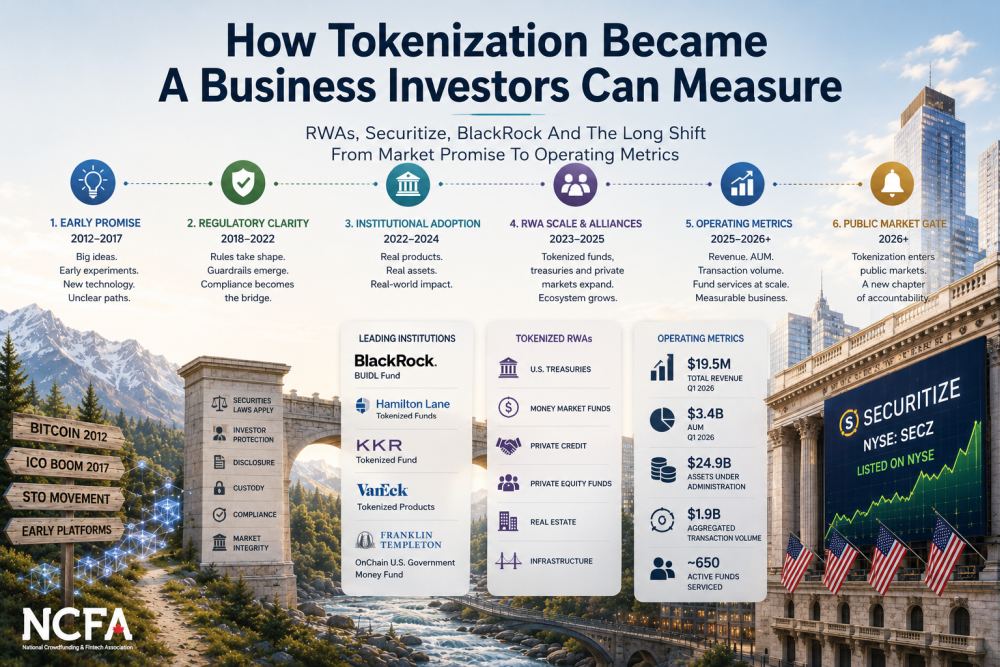
Tokenization promised to change capital markets for more than a decade.
The promise is still attractive. Put ownership on chain. Reduce paperwork. Automate compliance. Improve access. Speed up settlement. Make private assets easier to distribute, manage, and transfer.
But markets don’t run on promises. They run on operating models, regulation, distribution, controls, liquidity, and trust.
That’s why Securitize’s expected NYSE listing is the trigger. The listing isn’t the whole story. It’s the latest chapter in a longer path from tokenization as a market idea to tokenization as a business investors can measure.
The first wave sold a powerful idea. Security tokens, STOs, fractional assets, real estate tokens, private shares, and blockchain based markets promised to bring traditional securities into programmable digital form. The early security token field was framed as a more regulated answer to the ICO boom.
The market didn’t overhaul itself. Early security token projects ran into the same walls: unclear regulation, thin liquidity, limited distribution, custody questions, fragmented platforms, investor eligibility rules, and the simple reality that a tokenized security still has to behave like a security.
The hard work was never only technical. A tokenized fund still needs investor onboarding, KYC, AML, transfer rules, custody, servicing, reporting, distributions, tax records, corporate actions, and permissioned secondary transfers. Those aren’t marketing features. They’re the boring parts that make markets work.
Regulators kept reminding the market that labels don’t change obligations. Hester Peirce’s point that tokenized securities still have to follow securities laws captured the practical boundary. Faster settlement and automation don’t remove investor protection, disclosure, and market integrity requirements.
Real world assets changed the packaging. The market stopped asking whether everything should become tokenized and started asking which assets actually benefit. Treasuries, money market funds, private credit, private equity funds, and alternative assets became more practical test cases than vague claims about digitizing every market.
Private markets gave tokenization a clearer job. Citi, Wellington Management, and WisdomTree tested private market tokenization in 2024, showing how smart contracts could support operating efficiency in traditionally manual private market processes.
Hamilton Lane used tokenization to lower access friction. In 2022, Hamilton Lane and Securitize said qualified US investors would gain access to tokenized feeder funds tied to direct equity, private credit, and secondary transaction strategies.1 Securitize later said one Hamilton Lane fund reduced the minimum investment from about $5 million to $20,000.2
KKR showed that major alternatives managers would test the model. Securitize launched a tokenized fund offering exposure to KKR’s Health Care Strategic Growth Fund II in 2022, framing the product around broader access to alternative investments through digital ownership.3
BlackRock changed the market’s confidence level. BlackRock launched BUIDL, its first tokenized fund, on Ethereum in March 2024. The fund was backed by cash, US Treasury bills, and repurchase agreements, with BNY Mellon enabling interoperability between digital and traditional markets.4
BUIDL became a measurable adoption signal. In March 2025, Securitize said BUIDL surpassed $1 billion in AUM and identified itself as the tokenization provider for the fund.5 BlackRock’s BUIDL launch became one of the clearest institutional signals that tokenization was entering regulated asset management.
Securitize turned the thesis into operating data. In Q1 2026, Securitize reported $19.5 million in total revenue, up 39% year over year, $3.4 billion in AUM at quarter end, $24.9 billion in assets under administration, $1.9 billion in aggregated transaction volume, and roughly 650 active funds serviced through Securitize Fund Services.6
Those numbers change the conversation. Investors can ask normal operating questions: revenue mix, servicing fees, client concentration, transaction volume, fund growth, margins, profitability, operating leverage, customer retention, regulatory execution, and how much tokenization demand converts into durable revenue.
The listing is the trigger. Securitize and Cantor Equity Partners II said the business combination was expected to raise approximately $400 million in gross proceeds, close after shareholder approval and customary conditions, and list on the NYSE under ticker SECZ.7
The listing doesn’t settle the thesis. It exposes the thesis to market discipline. A listed tokenization company has to explain growth, losses, expenses, institutional demand, regulatory risk, competitive pressure, and whether tokenized fund adoption can become a durable public company business.
Canada has a practical watchlist. The opportunity isn’t to copy a US listing. Canadian firms can look across the tokenization value chain: custody, transfer services, fund administration, compliance, exempt market distribution, private market platforms, digital identity, investor onboarding, reporting, and secondary trading.
Regulated product design may decide the next chapter. The OSC’s long term asset fund project pointed to possible retail exposure to traditionally inaccessible assets and raised the opportunity for tokenized long term funds with embedded compliance, transparent records, fractional access, and guardrails.
Tokenization didn’t become measurable overnight. It moved through years of big claims, stalled experiments, regulatory pushback, operating layer buildout, institutional product design, and real world asset packaging before public markets had a company they could evaluate with ordinary business questions.
That may be the clearest test. The first tokenization wave asked investors to believe in a technology. The next wave will ask investors to evaluate execution. Revenue. Margins. Assets. Transactions. Clients. Losses. Retention. Market share. Operating leverage. That is a much harder test, and a much more useful one.
For Canada, the lesson is practical. The next winners may not be the firms issuing the tokens. They may be the firms solving everything around them: custody, compliance, investor onboarding, fund administration, reporting, liquidity, and regulated distribution. That’s where durable businesses are often built, and where Canada’s capital markets innovation map can help identify opportunities that are still taking shape.
What operating metric would convince you that tokenized markets have moved beyond promise?
Share this story → Explore related intelligence → Subscribe
 The National Crowdfunding & Fintech Association (NCFA Canada) is a financial innovation ecosystem that provides education, market intelligence, industry stewardship, networking and funding opportunities and services to thousands of community members and works closely with industry, government, partners and affiliates to create a vibrant and innovative fintech and funding industry in Canada. Decentralized and distributed, NCFA is engaged with global stakeholders and helps incubate projects and investment in fintech, alternative finance, crowdfunding, peer-to-peer finance, payments, digital assets and tokens, artificial intelligence, blockchain, cryptocurrency, regtech, and insurtech sectors. Join Canada's Fintech & Funding Community today FREE! Or become a contributing member and get perks. For more information, please visit: www.ncfacanada.org
 |  |  |
|---|---|---|
 |  |  |
June 26, 2026 | NCFA Fintech Whisperer | Digital Assets Blockchain And Tokenization, Capital Markets And Market Infrastructure, Artificial Intelligence And Data, Lending Consumer Credit And BNPL, Risk Compliance And Regtech, Payments And Market Infrastructure, Regulation And Policy, Treasury Liquidity And Cash Management

Image: Freepik
This live weekly NCFA intelligence page tracks financial technology developments that significantly affect how fintechs build, sell, raise capital, and operate under scrutiny. Coverage prioritizes Canada and includes global events that directly influence competitive conditions, market access, and execution realities across fintech sectors. This page will be updated throughout the week with market movers in a live format and then each week we'll close the prior week's contents in prep for the upcoming week, and continue on a rolling basis. (Missed prior week's Fintech Whisperer? (December 6-12, 2025, December 13-19, 2025, January 1-9, 2026, January 10-16, 2026, January 17-23, 2026, January 24-30, 2026, January 31-February 6, 2026, February 7-13, 2026, February 14-20, 2026, February 21-27, 2026, February 28-March 6, 2026, March 7-13, 2026, March 14-20, 2026, March 21-27, 2026, March 28-April 3, 2026, April 4-10, 2026, April 11-17, 2026, April 18-24, 2026, April 25-May 1, 2026, May 2-8, 2026, May 9-15, 2026, May 16-22, 2026, May 23-29, 2026, May 30-Jun 5, 2026, Jun 6-12, 2026, Jun 13-19, 2026).
Credit unions now have a clearer way to test stablecoins, tokenized deposits and digital asset accounts inside member owned financial institutions. Banks, core providers, payments firms, fintechs and regulators should watch whether these early programmes become production deployments for real time settlement, deposit tokens and broader member access to digital assets.
Stablecoin issuer regulation is becoming an AML and identity control issue, not only a reserve or redemption issue. Issuers, banks, custodians, wallets, exchanges and compliance teams should prepare for customer identification, verification, recordkeeping and risk controls as payment stablecoin frameworks mature.
Stablecoin regulation is moving from policy design into operating rules for payment infrastructure. Issuers, banks, custodians, payment firms, exchanges, and fintechs should watch how reserve design, redemption rights, safeguarding, and systemic supervision shape market access for regulated digital money.
Tokenization platforms are entering public capital markets. Asset managers, broker dealers, transfer agents, custodians, exchanges and investors should watch how public company access, regulated ATS infrastructure and cross border digital securities permissions shape the next phase of tokenized fund and real world asset distribution.
Event contract markets are facing a sharper boundary test. Exchanges, brokers, prediction market platforms, sports leagues, tribal gaming authorities and regulators should watch whether Congress narrows the line between federally regulated event contracts and state regulated gambling.
Private market trading infrastructure needs audit rules that firms can apply before transactions scale. Companies, auditors, advisers, venues and investors should watch how PISCES treatment affects independence checks, audit committee planning, transaction readiness and the operating model for periodic private share trading.
Canadian issuer disclosure is becoming more digital by default. Public companies, transfer agents, investor relations teams, legal advisers and compliance staff need to adjust delivery controls, SEDAR+ workflows, investor notices and request handling before the new access model takes effect.
Canadian equity market structure remains tied to US implementation timelines. Trading venues, brokers, market makers, and technology teams need more time to adjust routing logic, fee models, tick increments, compliance controls, and systems that support trading in interlisted securities.
Tokenization is moving closer to regulated market infrastructure. Exchanges, brokers, clearing firms, custodians, digital asset platforms, and regulators should watch how traditional market operators and crypto venues build permissioned pathways for tokenized securities, futures access, custody, execution, and compliance. Similar infrastructure questions are also emerging in event contract markets as new regulated venues, distribution channels, and contract frameworks develop.
Bank AI adoption is moving from pilots to operating metrics. Financial institutions, fintech vendors, compliance teams, investors, and regulators should watch how large banks measure AI value, scale employee access, govern automation agents, and connect AI deployment to fraud control, onboarding, productivity, risk operations, and compute infrastructure markets.
Cross border payments are becoming a regulated corridor strategy. Exporters, payment firms, banks, compliance teams and fintechs should watch how RPAA registration, money services business obligations, local payout capability and bank account connectivity affect competition in Canada India payment flows.
Digital euro policy is becoming payment infrastructure design. The next test is how offline use, privacy controls, holding limits, fees, PSP distribution, and cash protection fit into a system that has to work across public money, private payment providers, and existing rails.
Mortgage distribution is becoming a stronger fraud, licensing, and consumer protection issue. Brokers, lenders, fintech mortgage platforms, compliance teams, and investors should watch how higher penalties, clearer licensing rules, and stronger supervision reshape risk controls in mortgage services.
Financial crime detection no longer depends only on what individual institutions can see. Banks, credit unions, payment service providers, securities dealers, fintechs and other reporting entities can now strengthen risk detection by sharing designated information, creating new opportunities for collaborative fraud controls, network analysis and anti money laundering investigations.
Regulatory enforcement is becoming more incentive driven. Banks, insurers, investment firms, credit unions and compliance teams should review how early investigation strategy, breach assessment, remediation evidence and senior accountability affect enforcement outcomes.
Audit reporting is becoming more focused on useful disclosure, controls evidence and investor readability. Companies, audit committees, auditors, governance advisers and compliance teams should prepare for updated report content, Provision 29 controls statements and revised audit workflows before the December effective date.
Firms need to know where encryption is used, which vendors are exposed, which systems protect high value data, and how long migration will take. Crypto inventory, procurement language, vendor assurance, and roadmap planning should start before compliance dates become delivery pressure.
A regulated operating company is using a tokenized money market fund for its own liquidity rather than presenting it as a future client product. That moves tokenization into daily treasury operations, where continuous access, settlement speed, custody controls and balance-sheet utility can be tested against conventional cash-management infrastructure.
Approval processes are becoming more transparent and predictable for eligible applicants entering or expanding within Canada's federally regulated financial sector. Banks, fintechs, federal credit union applicants and regulated financial institutions should watch how the framework affects application timelines, market entry, organizational changes and future supervisory expectations. For background, see NCFA's earlier coverage of the Streamlined Approvals Framework proposal.
Manitoba has put AI governance and cybersecurity inside the same statutory control structure for the public sector. The next test is implementation. Regulations will determine how far the province goes on human oversight, technical standards, incident reporting and vendor procurement, and whether those requirements become a practical benchmark for other Canadian governments.
Every week brings hundreds of announcements. Only a small number signal meaningful change. This week's developments point to new opportunities across payments, digital assets, AI, capital markets and regulation that could influence where innovation accelerates, investment flows and new business models emerge next.
NCFA offers various curated resources to help founders and investors stay current on developments that impact fintech markets, subscribe to NCFA weekly newsletter updates, view the latest fintech insights, industry research, or launch into emerging financial innovation opportunities.
The National Crowdfunding & Fintech Association (NCFA Canada) is a financial innovation ecosystem that provides education, market intelligence, industry stewardship, networking and funding opportunities and services to thousands of community members and works closely with industry, government, partners and affiliates to create a vibrant and innovative fintech and funding industry in Canada. Decentralized and distributed, NCFA is engaged with global stakeholders and helps incubate projects and investment in fintech, alternative finance, crowdfunding, peer-to-peer finance, payments, digital assets and tokens, artificial intelligence, blockchain, cryptocurrency, regtech, and insurtech sectors. Join Canada's Fintech & Funding Community today FREE! Or become a contributing member and get perks. For more information, please visit: www.ncfacanada.org
| | |
|---|---|---|
| | |
Jan 23, 2026
The global iGaming market processes over $500 billion in transactions every year. Yet most of that money moves through payment infrastructure built in the 1990s. Credit cards charge 3 to 5 percent per transaction, bank wire settlements take 3 to 5 business days, and currency conversion fees add another 2 to 4 percent to cross-border transfers.
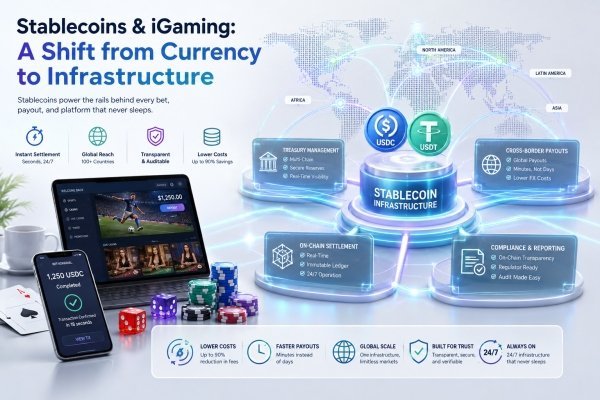
Some platforms have stopped treating this as a cost of doing business. Instead of adding stablecoins as another checkout option alongside Visa and PayPal, they have rebuilt their entire financial backend on USDC and USDT rails. Settlement, treasury management, cross-border payouts, and regulatory reporting now run on blockchain infrastructure that operates 24/7.
Stablecoins are replacing the entire payment infrastructure stack in iGaming, and fintech investors watching this space are getting an early look at the future of digital commerce.
Credit card processors treat gambling transactions like fraud risk. Visa and Mastercard classify deposits as cash advances, which means players pay immediate interest charges on top of 3 to 5 percent processing fees. Chargeback fraud compounds the problem, costing the industry over $500 million annually. Platforms absorb these losses even when they have already paid out winnings.
The problem continues at the banking level. Many retail banks refuse to process gambling-related transfers, even in jurisdictions where iGaming is fully regulated. Platforms maintain relationships with multiple payment processors just to cover different card issuers. Integrating a single payment method for a new market can take six to twelve months of regulatory paperwork.
Cross-border settlement adds another layer of cost and delay. Traditional wire transfers clear through correspondent banking networks over three to seven business days. Currency conversion fees stack on top, meaning a Canadian player withdrawing winnings to a European bank account waits a week and loses 5 to 7 percent to fees and FX spreads.
Payment processing is the single biggest operational cost and growth bottleneck for iGaming platforms trying to scale internationally.
Between 2014 and 2020, platforms added Bitcoin as a payment option alongside credit cards. It attracted crypto enthusiasts, but volatility made it impractical for mainstream use.
The stablecoin shift that started around 2021 is fundamentally different. USDT and USDC are programmable money that settle on blockchain networks operating around the clock. Platforms building on stablecoin rails are not adding a new payment method. They are replacing their entire financial backend.
Three infrastructure layers have changed.
Transactions finalize in seconds on networks like Tron or Solana, compared to three to five days for ACH bank settlements. Platforms like Moonbet process withdrawals in under five minutes using stablecoin rails. Traditional platforms take three to five business days for the same transaction.
Platforms can hold reserves in USDC across Ethereum, Solana, and Polygon without opening bank accounts in every jurisdiction they serve. Treasury management goes from months of bank onboarding and compliance paperwork to hours of wallet setup. A platform serving players in 40 countries does not need 40 banking relationships. It needs one stablecoin treasury across multiple chains.
Every stablecoin transaction is recorded on a public, immutable ledger. This creates a real-time, auditable financial record that exceeds what traditional payment processors provide. Regulators can verify transaction history without requesting data from the platform. The blockchain is the audit report.
iGaming stress tests payment infrastructure in ways no other vertical does.
Transaction volume is massive. Millions of micro-transactions happen daily across deposits, bets, payouts, and bonuses. Every transaction needs sub-second confirmation.
The user base is global by default. Players in over 100 countries transact simultaneously. Cross-border is the norm, not the exception. Settlement infrastructure must work across time zones, currencies, and regulatory regimes without degradation.
Real-time settlement is not a nice-to-have. Players expect instant deposits and withdrawals that process in minutes, not days.
Regulatory complexity adds another layer. Every jurisdiction has different payment regulations. Ontario, Curaçao, Malta, and the UK all require different compliance frameworks. Traditional banking requires separate integrations for each market. Stablecoin rails bypass most of this by operating outside correspondent banking networks while maintaining full on-chain transparency.
If stablecoin infrastructure can meet iGaming's demands, it can handle remittances, gig-economy payouts, creator platforms, and e-commerce. iGaming is the leading indicator for stablecoin adoption across digital commerce.
Regulators are not blocking stablecoins from iGaming. They are building frameworks to accommodate them.
In Canada, Ontario's AGCO currently requires licensed platforms to use regulated payment processors. Stablecoins exist in a compliance grey area. However, FINTRAC's guidance on virtual currency service providers is evolving. Crypto platforms operating in Canada must register as money services businesses and comply with AML reporting obligations. The regulatory pathway is forming.
The European Union provides more clarity. The Markets in Crypto-Assets regulation, effective 2024 and 2025, creates regulatory certainty for iGaming platforms using USDC and USDT in European markets.
Curaçao has moved even faster. The jurisdiction's updated gambling license framework now explicitly addresses cryptocurrency operations and recognizes stablecoin payment infrastructure as legitimate.
The direction across jurisdictions is consistent. Platforms that build on stablecoin infrastructure today will be positioned to meet compliance standards as they formalize.
The crypto gambling sector processes over $250 billion in annual wagers. This is the largest live deployment of stablecoin payment infrastructure in any vertical.
For fintech builders, iGaming platforms are solving problems every digital commerce business will eventually face. Real-time settlement, multi-currency treasury management, and on-chain compliance are being tested at scale. The solutions developed here will migrate to other verticals.
For regulators, stablecoin-powered platforms generate more transparent, auditable transaction data than traditional platforms. Regulation should leverage this transparency rather than restrict it.
Platforms like Moonbet represent the emerging model. Built entirely on stablecoin rails from day one, instead of retrofitting crypto onto legacy banking infrastructure.
Stablecoins in iGaming have moved past the experimental phase. They are now the infrastructure layer for settlement, treasury, accounting, and compliance.
For the Canadian fintech ecosystem, this creates both an opportunity and a policy question. How do we build regulatory frameworks that capture the benefits of stablecoin infrastructure while maintaining consumer protection?
The platforms building on stablecoin rails today are defining the financial architecture of digital entertainment for the next decade. The question is which jurisdictions will create the frameworks that allow it to scale within their borders.
The National Crowdfunding & Fintech Association (NCFA Canada) is a financial innovation ecosystem that provides education, market intelligence, industry stewardship, networking and funding opportunities and services to thousands of community members and works closely with industry, government, partners and affiliates to create a vibrant and innovative fintech and funding industry in Canada. Decentralized and distributed, NCFA is engaged with global stakeholders and helps incubate projects and investment in fintech, alternative finance, crowdfunding, peer-to-peer finance, payments, digital assets and tokens, artificial intelligence, blockchain, cryptocurrency, regtech, and insurtech sectors. Join Canada's Fintech & Funding Community today FREE! Or become a contributing member and get perks. For more information, please visit: www.ncfacanada.org
| | |
|---|---|---|
| | |
Stablecoins are moving from speculative crypto activity toward operating money for settlement, cross border payments, treasury workflows, merchant settlement and tokenized asset cash legs. The strongest opening is not launching another stablecoin. It is building the payment, treasury, reconciliation and compliance layer that lets businesses use stablecoins safely.
Stablecoin market size is difficult to measure cleanly. Market cap and daily trading volume show scale, but they do not equal payment adoption. For this opportunity, the better signal is the mix of adjusted onchain activity, issuer supply, network settlement pilots, merchant acceptance, treasury workflows and bank or PSP integration.
The strongest opening is the operating layer above stablecoin issuance: routing, acceptance, settlement, treasury controls, reconciliation, compliance workflows, and bank or network integration. The buyer may be a PSP, merchant platform, marketplace, treasury team, bank, issuer or tokenized asset platform that needs faster settlement without weaker controls.
Canada stablecoin framework implementation, US payment stablecoin rules, Bank of England and FCA stablecoin policy, network integrations, merchant settlement pilots, treasury adoption and tokenized asset cash leg use.
Evidence supports five product paths. These are product directions inside the parent opportunity, not automatic child Opportunity Briefs.
Compliant payouts, supplier payments and remittances
Cross border payments remain slow and costly for many businesses. Stablecoins can reduce settlement friction when compliance, liquidity and redemption controls are reliable.
This path has the clearest buyer pain because businesses already pay for speed, transparency, lower cost and better payout coverage.
Existing remittance networks, banks and PSPs bundle stablecoin rails before specialists establish durable wedges.
Can the product reduce cost, failed payments, settlement delay or FX friction enough to win recurring payment budget?
Move, hold and reconcile digital dollar liquidity
Global firms increasingly need to move funds across platforms, wallets, banks and jurisdictions. Stablecoins can support liquidity timing, payout automation, reconciliation and treasury controls.
This path is close to the strongest path because treasury teams have recurring operational problems, but adoption depends on accounting, audit and banking integration.
Treasury teams avoid stablecoins unless accounting, risk, custody and bank integration become routine.
Will treasury teams pay for stablecoin workflow, controls and reconciliation rather than wait for bank or PSP bundles?
Faster access to funds and programmable reconciliation
Merchants and platforms want faster settlement and lower friction. Stablecoin settlement could support niche and cross border cases where volatility, risk and compliance concerns are controlled.
This path is commercially attractive but may remain hidden inside PSP, acquirer or platform workflows rather than appearing as a consumer facing product.
Card networks, acquirers and PSPs improve settlement enough that merchants do not care which rail is used.
Which merchant segments experience settlement delay or cross border payout pain strongly enough to change providers?
Settlement money for tokenized assets
Tokenized assets need reliable payment legs for settlement, redemption, collateral movement and asset servicing. Stablecoins may support these workflows when bank money or central bank money is not available on the same rails.
This path connects stablecoins to tokenized funds, digital securities and market infrastructure, but regulatory and institutional adoption remain uneven.
Tokenized deposits, central bank money or private bank led networks become the preferred settlement asset for regulated institutions.
Which tokenized asset workflows need stablecoins rather than bank money, and who controls the cash leg?
Monitoring, screening, reporting and audit workflows
Business use of stablecoins depends on controls for AML, sanctions, wallet screening, reserve reporting, reconciliation, travel rule, issuer oversight and auditability.
This path may become the most durable horizontal layer if stablecoin payments expand across banks, PSPs, issuers and platforms.
Compliance tools remain bundled inside issuer, bank or PSP platforms, leaving little room for standalone vendors.
Can controls reduce compliance cost or operational risk enough to win bank, issuer, PSP or platform budget?
Each row shows the evidence date, post type, linked topic, why it matters to this opportunity, and the signal category used for filtering. Evidence type classifies the signal, not the publisher. Evidence is sorted newest to oldest.
Share your perspective, research, case study or video response. You can also express interest in future discussions, collaboration opportunities and innovation activities related to this topic.
Learn how NCFA identifies, validates and tracks innovation opportunities →NCFA Opportunity Briefs track evidence-backed financial innovation opportunities as they move from early signals toward practical commercialization. Public pages show the current assessment and supporting evidence for founders, investors, operators and ecosystem participants.
The National Crowdfunding & Fintech Association (NCFA Canada) is a financial innovation ecosystem that provides education, market intelligence, industry stewardship, networking and funding opportunities and services to thousands of community members and works closely with industry, government, partners and affiliates to create a vibrant and innovative fintech and funding industry in Canada. Decentralized and distributed, NCFA is engaged with global stakeholders and helps incubate projects and investment in fintech, alternative finance, crowdfunding, peer-to-peer finance, payments, digital assets and tokens, artificial intelligence, blockchain, cryptocurrency, regtech, and insurtech sectors. Join Canada's Fintech & Funding Community today FREE! Or become a contributing member and get perks. For more information, please visit: www.ncfacanada.org
| | |
|---|---|---|
| | |
June 22, 2026 | NCFA Fintech Market Activity | Digital Assets Blockchain And Tokenization, Payments And Money Movement, Artificial Intelligence And Data
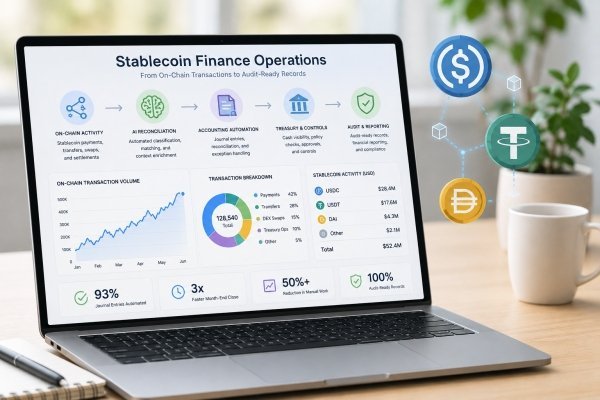
On June 22, 2026, MoonPay announced the acquisition of Entendre, an AI enabled finance operations platform built for companies moving, settling, or holding value onchain. The deal adds agentic reconciliation, bookkeeping, treasury, reporting, and close automation to MoonPay’s digital asset infrastructure stack.
Stablecoins move money. Finance teams still have to explain it.
Every payment eventually hits accounting, treasury, reporting, tax, or audit review. The faster transactions move, the more pressure finance teams face to keep records accurate and current.
MoonPay says Entendre customers include Polygon Labs, Thirdweb, Brale, Babylon Labs, Ostium, Courtyard, and DoubleZero. On average, companies on the platform manage more than 30 financial accounts, process 25,000 transactions per month, and operate across three or more legal entities.
Stablecoin activity creates accounting work that old payment tools were not built to handle. A wallet sweep, gas fee, exchange trade, vendor payment, or token transfer can pass through several systems before it reaches the general ledger.
The blockchain shows that value moved. It doesn't however explain why it moved, which entity owns it, how it should be booked, who approved it, or what an auditor needs to see.
Entendre automates transaction classification, reconciliation, journal entries, exceptions, and audit ready records. MoonPay says finance teams using the platform automate 93% of journal entries, cut manual work by more than half, and close books three times faster.
It's a visible in stablecoin infrastructure for AI agents and enterprise payment workflows. Stablecoins become more useful when they come with controls, reporting, treasury tools, and software that fits daily finance work.
MoonPay has been building across the digital asset infrastructure stack, expanding beyond payments. Earlier this year, it added key management through Sodot, trading infrastructure through DFlow, and cross chain execution through Decent.xyz. Those pieces now sit alongside MoonPay Trade and MoonPay Institutional, extending the company's reach into trading, treasury, and regulated financial services. With Entendre, it adds finance operations to a growing infrastructure stack that already spans wallets, settlement, trading, and key management.
Ivan Soto-Wright, CEO and co-founder of MoonPay, frames the deal around agentic finance:
“If businesses are going to adopt stablecoins at scale, their finance operations need the same speed, context, and automation as the payments themselves.”
That's the real market test. Stablecoins can certainly settle quickly, but finance teams still need clean records, clear approvals, accurate books, and audit trails that survive review.
That is why the acquisition fits alongside the gap between stablecoin volume and real payment use. Volume alone does not prove business utility. The repeatable use case appears when finance teams can manage the payment after it settles.
If stablecoins become business payment rails, will the real winners control the records, approvals, reporting, and audit trails behind the transaction?
The National Crowdfunding & Fintech Association (NCFA Canada) is a financial innovation ecosystem that provides education, market intelligence, industry stewardship, networking and funding opportunities and services to thousands of community members and works closely with industry, government, partners and affiliates to create a vibrant and innovative fintech and funding industry in Canada. Decentralized and distributed, NCFA is engaged with global stakeholders and helps incubate projects and investment in fintech, alternative finance, crowdfunding, peer-to-peer finance, payments, digital assets and tokens, artificial intelligence, blockchain, cryptocurrency, regtech, and insurtech sectors. Join Canada's Fintech & Funding Community today FREE! Or become a contributing member and get perks. For more information, please visit: www.ncfacanada.org
| | |
|---|---|---|
| | |
June 13, 2026 | NCFA Fintech Whisperer | Capital Markets And Market Infrastructure, Lending Consumer Credit And BNPL, Regulation And Policy, Risk Compliance And Regtech, Payments And Market Infrastructure, Digital Assets Blockchain And Tokenization, Artificial Intelligence And Data
Image: Freepik
This live weekly NCFA intelligence page tracks financial technology developments that significantly affect how fintechs build, sell, raise capital, and operate under scrutiny. Coverage prioritizes Canada and includes global events that directly influence competitive conditions, market access, and execution realities across fintech sectors. This page will be updated throughout the week with market movers in a live format and then each week we'll close the prior week's contents in prep for the upcoming week, and continue on a rolling basis. (Missed prior week's Fintech Whisperer? (December 6-12, 2025, December 13-19, 2025, January 1-9, 2026, January 10-16, 2026, January 17-23, 2026, January 24-30, 2026, January 31-February 6, 2026, February 7-13, 2026, February 14-20, 2026, February 21-27, 2026, February 28-March 6, 2026, March 7-13, 2026, March 14-20, 2026, March 21-27, 2026, March 28-April 3, 2026, April 4-10, 2026, April 11-17, 2026, April 18-24, 2026, April 25-May 1, 2026, May 2-8, 2026, May 9-15, 2026, May 16-22, 2026, May 23-29, 2026, May 30-Jun 5, 2026, Jun 6-12, 2026).
European supervision is becoming more operational and technology focused. Banks, fintechs, crypto asset firms, infrastructure providers, and compliance teams should watch how DORA, MiCA, and EMIR oversight changes vendor governance, resilience testing, supervisory reporting, third party risk management, and regulatory accountability.
Supervision is becoming more data driven, technology enabled and cross border. Securities regulators are building stronger tools for market surveillance, fraud detection, investor protection and digital asset oversight, which raises the operating bar for firms whose compliance, reporting and risk controls still depend on slow manual processes.
Prediction markets are moving from niche trading communities toward mainstream financial distribution. Retail platforms, exchanges, regulators, investors, and market operators should watch how event contracts evolve as a new information, forecasting, hedging, and market intelligence layer. Distribution may become as important as market design in determining adoption. See: Innovation Opportunities In Regulated Event Contract Infrastructure.
Post trade risk reduction is becoming part of capital markets infrastructure. Dealers, clearing participants, platforms, and regulators should watch how compression, optimization, exposure reduction, and capital efficiency tools are treated as supervised infrastructure rather than back office utilities.
Bond transparency reform is creating demand for new market data infrastructure. Trading venues, asset managers, dealers, data providers, and regulators should watch how fixed income reporting, consolidated data, and transparency tools reshape price discovery and execution quality across European bond markets.
Agentic AI is moving into capital markets workflow. For dealers, asset managers, pension funds, and credit trading desks, the issue is no longer only faster market search. The next phase is how supervised AI tools support pricing, liquidity discovery, execution preparation, and workflow decisions inside regulated markets.
Natural language tools tied to pricing, trade data, and workflow systems could change how institutional traders search markets, compare bonds, assess liquidity, and act on data inside regulated trading environments.
Stablecoins are being embedded directly into payment and remittance infrastructure. Payment firms, PSPs, remittance operators, banks, liquidity providers, and compliance teams should watch how regulated stablecoin settlement, API connectivity, and cross border liquidity become part of the operating stack for high volume regional payment networks.
Search is becoming regulated digital infrastructure. Publishers, fintechs, platforms, marketplaces, advertisers, AI search providers, and compliance teams should watch how ranking rules, data portability, publisher protections, and user choice requirements change discovery, distribution, and competition across search and AI enabled information access.
Institutional digital asset infrastructure is entering bank charter channels. Banks, custodians, wealth platforms, crypto firms and regulators should watch how national trust bank approvals shape custody, staking, lending support, capital requirements and supervisory expectations for digital asset services.
MiCAR is shifting crypto firms from fragmented national registrations toward regulated infrastructure choices. VASPs, exchanges, brokers, fintechs, custodians, and compliance teams should watch how licensing pressure turns custody, wallet services, settlement, liquidity, and operating controls into market access requirements across Europe.
AI linked lending platforms continue to connect consumer credit origination with capital markets distribution. Pagaya’s latest transaction shows how underwriting models, loan supply, securitization channels, and institutional demand are combining into repeatable credit infrastructure.
Canadian bank capital policy is shifting from maximum conservation toward controlled lending capacity. Banks, lenders, fintech partners, investors, and policymakers should watch how lower buffer requirements affect credit availability, capital planning, risk appetite, and competitive conditions across the financial system.
Canada is moving privacy, AI, consumer data, and platform accountability into the same regulatory agenda. Financial institutions, fintechs, AI vendors, data brokers, and digital platforms should watch how consent, deletion rights, automated decision transparency, children’s data protections, and guidance for onboarding, data use, AI and partnerships affect product design and data governance.
The review could affect how fintechs, derivatives firms and market infrastructure providers engage with US regulated markets. Firms should watch for changes that reduce unnecessary compliance friction while maintaining market integrity, customer protection and risk oversight.
The useful evidence is the transmission channel, not a prediction that CBDC will launch. Digital money competition affects deposits, funding costs, liquidity treatment, lending capacity, and central bank balance sheet operations. Operators, founders, and investors should watch how CBDC, fintech deposits, stablecoins, and payment infrastructure reforms change competition for bank funding.
The week's strongest market and regulatory signals weren't new products. They were changes to the infrastructure underneath financial markets. Bank capital rules, prediction market access, stablecoin rails, and compute markets all point to the same outcome. Firms that control access, distribution, liquidity, and critical infrastructure may increasingly determine who can compete and who cannot.
NCFA offers various curated resources to help founders and investors stay current on developments that impact fintech markets, subscribe to NCFA weekly newsletter updates, view the latest fintech insights, industry research, or launch into emerging financial innovation opportunities.
The National Crowdfunding & Fintech Association (NCFA Canada) is a financial innovation ecosystem that provides education, market intelligence, industry stewardship, networking and funding opportunities and services to thousands of community members and works closely with industry, government, partners and affiliates to create a vibrant and innovative fintech and funding industry in Canada. Decentralized and distributed, NCFA is engaged with global stakeholders and helps incubate projects and investment in fintech, alternative finance, crowdfunding, peer-to-peer finance, payments, digital assets and tokens, artificial intelligence, blockchain, cryptocurrency, regtech, and insurtech sectors. Join Canada's Fintech & Funding Community today FREE! Or become a contributing member and get perks. For more information, please visit: www.ncfacanada.org
| | |
|---|---|---|
| | |

Last Updated: June 19, 2026
Status: Strong
Organizations: CIRO, FCA, DTCC, DTC, NYDFS, Prometheum Capital, BitGo, Anchorage Digital, Circle France, AMF, Citi, Cross River, Figure
Crypto custody regulation is changing from asset safekeeping into market infrastructure control. The answer is no longer only about who holds private keys. It is about who can support client asset segregation, stablecoin reserves, broker dealer workflows, tokenized securities, DeFi access, collateral controls, audits, and recoverability when something breaks.
Canada is already part of the pattern. CIRO’s custody guidance builds on the wider Canadian platform supervision path outlined in regulatory updates for crypto asset trading platforms. The global direction is similar. Crypto custody is becoming a gatekeeper for regulated market access.
The same pattern appears in tokenized markets. If real world assets, stablecoins, tokenized funds, and private market instruments are becoming infrastructure, then custody becomes part of the operating layer. That is why the evidence connects directly to tokenization as financial infrastructure, not only crypto storage.
Click each item to expand
CIRO issued guidance on custody expectations for Dealer Members operating crypto asset trading platforms. The framework is effective immediately and uses a tiered, risk based structure.
The FCA’s CP26/8 consultation proposed amendments to client asset and market rules so they work for cryptoasset activities and the wider UK crypto regime.
NYDFS proposed updates to align its stablecoin regime with the federal GENIUS Act framework while maintaining New York’s stablecoin standards.
Click each item to expand
DTCC said DTC’s tokenization service plans initial limited production trades in July 2026, with launch planned for October 2026.
Citi launched tokenized depositary receipts to connect private companies and investors.
Circle France received approval to provide custody and transfer services for USDC and EURC across the European Economic Area under MiCA.
Click each item to expand
Prometheum Capital launched Digital Brokerage Solutions for broker dealers and RIAs using traditional brokerage account workflows.
Anchorage Digital launched Stablecoin Solutions for Banks, combining minting, redemption, custody, fiat treasury management, and settlement.
Cross River committed up to $250M in asset purchases to support Figure’s crypto backed loans.
Click each item to expand
BitGo announced pricing of its IPO, with shares expected to trade on the New York Stock Exchange under the ticker BTGO.
Canadian crypto platform registration evidence shows that custody remains part of market access, not a separate technical service.
NCFA’s tokenization evidence shows that custody is becoming part of the same market infrastructure stack as settlement, collateral, cash movement, and ownership records.
Do you agree the evidence is strengthening?


Click Agree or Disagree. Your vote is recorded anonymously and aggregate totals tracked.
The National Crowdfunding & Fintech Association (NCFA Canada) is a financial innovation ecosystem that provides education, market intelligence, industry stewardship, networking and funding opportunities and services to thousands of community members and works closely with industry, government, partners and affiliates to create a vibrant and innovative fintech and funding industry in Canada. Decentralized and distributed, NCFA is engaged with global stakeholders and helps incubate projects and investment in fintech, alternative finance, crowdfunding, peer-to-peer finance, payments, digital assets and tokens, artificial intelligence, blockchain, cryptocurrency, regtech, and insurtech sectors. Join Canada's Fintech & Funding Community today FREE! Or become a contributing member and get perks. For more information, please visit: www.ncfacanada.org
| | |
|---|---|---|
| | |



August 26th, 2025

January 4th, 2024

June 1st, 2021

September 9th, 2020

July 9th, 2018

January 3rd, 2018

September 25th, 2017

June 20th, 2017

May 10th, 2017

December 14th, 2016
