





Karsten Wenzlaff, Advisor
August 26th, 2025
Karsten Wenzlaff is a Crowdfunding and Fintech Expert from Germany. He is Secretary-General of Digit[...]


Last Updated: July 28, 2026
Status: Emerging
Organizations: Credit Union Digital Asset Task Force, St. Cloud Financial Credit Union, Amanda Wick, World Council of Credit Unions, National Digital Banking Working Group, Central 1, Large Credit Union Coalition, Payments Canada, Stablecore, Curql, TruStage, CrossState Credit Union Association, Metallicus, Q2, Jack Henry, Coinbax, NCUA
Amanda Wick’s announcement of a new Credit Union Digital Asset Task Force raises a timely question for Canadian credit unions and digital assets.
The U.S. initiative is led by Chase Larson, Executive Vice President and Chief Lending Officer at St. Cloud Financial Credit Union. It is designed to help credit union boards and executives understand stablecoins, tokenization, crypto assets, regulation, infrastructure and risk.
Starting with education and coordination makes sense. Credit union leaders need a practical way to compare the member value, operating costs and regulatory responsibilities before deciding whether a digital asset service belongs in their strategy.
Other developments show how quickly the discussion is advancing. Credit unions are joining early access programs, testing infrastructure through association cohorts, assessing platform integrations and considering stablecoin and tokenized deposit services.
The World Council of Credit Unions has also placed digital money on the cooperative finance agenda. Its July 2026 stablecoin paper examines potential effects on deposits, payments, member relationships and the future role of credit unions.
Canada already has groups that coordinate technology procurement, common architecture, digital identity and payments modernization. The practical question is whether those collaborative models should now be used to study digital assets together.
Strategic Takeaway
Canadian credit unions already have collaboration models that could support shared digital asset research, vendor assessment and controlled testing. What they still need is an agreed member or operating problem to solve and a regulatory route that works across federal and provincial responsibilities. Shared diligence is the most practical place to begin.
Canada’s strongest foundation isn’t a blockchain pilot. It is the way credit unions already collaborate on expensive technology, procurement, architecture and national infrastructure.
Some of those capabilities could transfer directly to digital asset work. Others are closely related. Together, they show that institutions can share complex diligence while retaining control over contracts, governance and implementation.
The National Digital Banking Working Group coordinated vendor review, procurement, migration planning and implementation after Central 1 announced its digital banking transition. Its public membership page listed 59 institutions, while 37 selected Intellect Design Arena’s eMACH.ai platform.
This was more than a discussion forum. Participating institutions pooled expertise and bargaining power, then made their own implementation decisions. A digital asset initiative could follow the same model without requiring every credit union to adopt the same product.
The Large Credit Union Coalition offers another example. Its work has included artificial intelligence, digital identity, common architecture, collective purchasing and payments modernization.
Digital identity, architecture and collective purchasing could support the evaluation of wallet providers, custodians, transaction monitoring systems and settlement networks. The same structure could help institutions compare risks, costs and member use cases.
Payments coordination is already familiar. Central 1 and the other Group Clearer centrals created the Payments Modernization Advisory Group with 12 credit unions to represent sector requirements during national infrastructure development.
That experience is relevant because stablecoins and tokenized deposits would need to interact with clearing, settlement, liquidity, fraud controls and account infrastructure. Many of those questions also also relevant to Canada’s Real Time Rail development.
The opening of Payments Canada membership creates another connection. Credit unions, payment service providers, fintechs, foreign exchange firms and digital asset companies are gaining a wider role in national payment infrastructure. NCFA’s analysis of Canada’s financial infrastructure shows how access, licensing and participation are evolving.
Consumer data access is important too. Canada’s open banking framework is creating new expectations around consent, identity, liability and financial service integration. Digital asset products offered through regulated institutions would need to fit within that same trust environment.
The size of the sector makes this more than a technology discussion. The Canadian community finance market baseline identified 306 credit unions holding approximately $764 billion of the $771.3 billion in total assets included in the dataset.
The SVX report doesn’t examine stablecoins or digital assets. Its relevance is the amount of member and community capital already managed through cooperative institutions. Changes to deposits, payments and settlement infrastructure could therefore have material consequences for credit unions.
Canada isn’t starting with an empty page. Credit unions already know how to organize expertise, negotiate together, coordinate architecture and represent shared interests.
The next step is deciding whether digital assets deserve a place within that existing collaborative work.
No common single operating model has emerged. Credit unions and their service organizations are taking different approaches based on regulation, member needs, internal capability and available partners.
Some initiatives begin with education and advocacy. Others involve early access, sandbox testing, planned products, core integrations or regulatory development. These examples offer reference points for Canada rather than a ready made plan.
Click each to expand
Emerging Coordination
Amanda Wick announced a Credit Union Digital Asset Task Force led by Chase Larson, Executive Vice President and Chief Lending Officer at St. Cloud Financial Credit Union.
The initiative brings digital assets into a sector level credit union discussion. It also provides a useful model for Canada, where an existing group could coordinate education, research and early use case assessment.
Global Strategic Framework
The World Council of Credit Unions released the first paper in a planned series examining how new forms of digital money could affect the global credit union system.
WOCCU isn’t calling on every credit union to issue a stablecoin. It is asking whether cooperative institutions have the authority, flexibility and readiness to participate as payment and deposit infrastructure changes.
Early Access
Stablecore, Circuit and Curql launched an early access program involving RBFCU, Stanford Federal Credit Union, La Capitol Federal Credit Union and other institutions representing about US$25 billion in combined assets.
This initiative has progressed beyond general education. Named credit unions are evaluating defined services through an organized early access program.
Planned Product
TruStage announced plans for TruStage Stablecoin, or TSDA, as a fully reserved U.S. dollar stablecoin for community based financial institutions.
TSDA combines a named product, a large credit union network and a defined payment use case. It represents one of the more developed cooperative stablecoin strategies.
Sandbox And Pilot Preparation
CrossState Credit Union Association and Metallicus launched Innovation Program 2.0 with an initial cohort of 50 credit unions in Pennsylvania and New Jersey.
This may be one of the most relevant models for Canada. Institutions can learn and test together without requiring every participant to become an issuer or infrastructure operator.
Available Infrastructure
Q2 partnered with Stablecore to connect stablecoins, tokenized deposits and digital asset accounts with infrastructure already used by banks and credit unions.
This approach brings digital asset capabilities into existing banking technology rather than asking institutions to build a separate platform.
Integration Access
Coinbax joined the Jack Henry Fintech Integration Network to connect stablecoin payment infrastructure with Jack Henry core and digital banking platforms.
The model shows how a credit union could access digital asset infrastructure through technology relationships it already understands.
Proposed Regulatory Framework
The National Credit Union Administration has proposed rules for payment stablecoin issuers affiliated with federally insured credit unions.
The proposals give U.S. credit unions a clearer view of how ownership, issuance and supervision could work.
Canada doesn’t yet have a comparable credit union framework connecting federal stablecoin requirements with provincial regulation, deposit protection and cooperative ownership. NCFA’s stablecoin regulatory guide tracks the federal framework and the decisions still ahead.
The evidence identifies several ways credit union associations, centrals and collaborative groups could investigate digital assets while controlling cost and risk.
Each option addresses a different problem. Research and testing can be shared, while boards retain responsibility for product approval, compliance, member communication and operations.
Shared research and regulatory analysis could reduce repeated legal, policy and vendor work. A group could map federal and provincial requirements, compare stablecoins with tokenized deposits and examine deposit protection, custody, reserves and redemptions. That work would remain useful even if no product followed.
Coordinated policy engagement could help regulators understand how cooperative ownership, provincial supervision and deposit protection differ from commercial bank and nonbank issuer models. Credit unions may need to take part in regulatory design before deciding whether to offer a service.
Controlled testing could let institutions examine technology, controls and use cases before making production commitments. Shared sandbox work could cover wallet verification, settlement, transaction monitoring, reconciliation, vendor performance and incident recovery.
Cross border business payments may offer one of the clearest commercial tests. Credit unions could retain the member relationship and Canadian dollar account while using regulated digital settlement infrastructure behind the scenes. Foreign exchange, sanctions, wallet ownership, liquidity and redemption would still require strong controls.
Tokenized deposits may fit the credit union model better than a separate stablecoin. A tokenized deposit could remain a claim on a regulated institution rather than becoming a separate private currency. Canada would still need clarity on ownership, settlement finality, interoperability and provincial deposit insurance.
Shared custody and wallet infrastructure could give smaller institutions access to security and compliance capabilities they couldn’t justify independently. The trade off is concentration risk. One vendor failure could affect several institutions, making asset segregation, recovery and liability allocation critical.
Identity and compliance tools may offer a lower risk starting point. Common wallet verification, member authentication, sanctions screening and transaction monitoring could support future payment or custody services without creating immediate issuance or balance sheet exposure.
Business settlement and treasury pilots could test supplier payments, commercial settlement, liquidity management or transfers between institutions. These controlled business uses may have clearer operating value than retail crypto trading.
Shared stablecoin infrastructure would require the greatest level of coordination. Participants would need to agree on reserves, redemption, governance, technology, liquidity, fees, branding and loss allocation. The international examples show how the model could work, but Canada doesn’t need to begin there.
Waiting is also a valid decision. A joint review may find that member demand is weak, costs are too high, regulations remain incomplete or existing payment systems solve the same problem with less risk.
Each option should pass five tests:
Deposit protection remains one of the largest questions. Members need to know whether a tokenized deposit would receive the same provincial protection as funds in an ordinary account. Institutions also need clarity on reserve ownership, liquidity and redemptions during stress.
Custody raises a different set of issues. Who controls the keys? Are assets legally separated if a vendor fails? Who carries the loss when funds go to the wrong wallet? How does a member recover access after fraud, death or lost credentials?
AML controls wouldn’t end at onboarding. Institutions would need to verify wallet ownership, monitor transactions, screen counterparties and decide how to handle transfers involving self hosted wallets.
Shared governance may prove harder than the technology. Participants would need rules for choosing vendors and networks, changing operating standards, setting fees and allocating losses when an institution or service provider fails.
Current evidence doesn’t support rushing into a shared Canadian credit union digital asset product. It does support sharing the work required to understand whether one could solve a real problem.
Canadian credit unions already collaborate on technology, architecture, procurement and payments infrastructure. They also manage approximately $764 billion within the country’s community finance baseline. That gives the sector both the capability and the economic reason to pay attention.
Internationally, cooperative institutions are progressing through education, advocacy, early access, sandbox testing, platform integration, planned stablecoins and regulatory development. None offers a complete Canadian template.
The conversation has already begun internationally. Canada’s next decision is whether credit unions build on the collaboration they already have, identify the use cases that could create real member value and help define the market before others define it for them.
Do you agree the evidence supports this answer?


Click Agree or Disagree. Your vote is recorded anonymously and aggregate results are tracked.
No shared Canadian credit union stablecoin has been publicly announced. The more immediate opportunity is coordinated research into member demand, regulation, infrastructure and risk.
A tokenized deposit is a digital representation of a deposit held with a regulated financial institution. Unlike a separate stablecoin, it may remain a direct claim on the institution, although legal treatment, settlement and deposit protection must be clearly defined.
Shared work could lower the cost of legal analysis, vendor assessment, cybersecurity review, compliance design and controlled testing. Each credit union could still decide independently whether to offer a product.
They could affect deposit and payment relationships if members begin holding or transferring more value through external digital money platforms. The outcome would depend on adoption, regulation, product design and whether credit unions participate directly.
An existing credit union association, central or working group could coordinate education, regulatory analysis, use case ranking and limited testing before institutions commit to a shared product or infrastructure provider.

The National Crowdfunding & Fintech Association (NCFA Canada) is a financial innovation ecosystem providing education, market intelligence, industry stewardship, networking and funding opportunities to thousands of members. NCFA works with industry, government, partners and affiliates to support a competitive and innovative fintech and funding sector in Canada. Join Canada’s Fintech and Funding Community or learn more at NCFA Canada.
 |  |  |
|---|---|---|
 |  |  |
July 28, 2026 | NCFA Resource | Sustainable Finance And ESG, Financial Inclusion, SME Finance And Business Banking

On July 23, 2026, SVX published Canada’s first comprehensive national assessment of community finance. The report identifies 768 institutions, estimates their combined assets and examines how community finance products direct money into housing, local businesses, Indigenous entrepreneurship, food systems, clean energy and other community priorities.
Its most useful contribution is a baseline. Until now, Canada didn't have a public national picture connecting credit unions, Community Futures organizations, Indigenous Financial Institutions, community loan funds, land trusts, community bond issuers and related intermediaries. The report brings these organizations together through a common definition, a product dataset and an interactive market map.
The report’s three main asset figures describe different parts of the market:
The $771.3 billion headline doesn’t mean that amount has been invested directly into community projects. It mainly reflects the institutional assets of large credit unions, including Desjardins, Vancity and Assiniboine Credit Union.
Credit unions account for approximately 99% of the reported assets, although they represent 40% of the 768 institutions. Community Futures organizations form another 34% of the network, followed by Indigenous Financial Institutions at 8%, community land trusts at 6%, community loan funds at 4% and community bond issuers at 4%.
That makes the $7.3 billion figure particularly useful. It provides a clearer estimate of the specialized community finance market operating outside credit unions. The report also identifies $755 million held by Indigenous Financial Institutions and $153.8 million raised through community bonds from 28 issuers.
Credit unions still belong in the national picture because member ownership and local deployment are central to the report’s definition. The DUCA Impact Lab discussion shows how a credit union can test lending models designed for people and businesses underserved by conventional criteria.
Community finance also means something different from community capital raising. In this report, community finance describes institutions that pool and direct capital toward a defined place, population or shared need. Differently, investment platforms that support equity crowdfunding like FrontFundr uses community capital to describe companies raising money from customers, supporters and retail investors through regulated crowdfunding. NCFA’s review of Canadian equity crowdfunding covers that second model.
The two can overlap. A community bond issuer or investment cooperative may attract individual investors while also qualifying as a community finance institution. A startup supported by its customers through an equity crowdfunding campaign doesn’t automatically meet the report’s institutional definition.
The institutional map combines 107 organizations in the Catalyst Community Finance Collection with 661 additional organizations identified through the Canadian Community Finance Intermediary Market Map.
Geographic coverage extends across every province and territory. Quebec contains 32.7% of mapped institutions, followed by Ontario at 25% and British Columbia at 12.9%. The geography chart is based on 752 institutions because location data weren’t available for every organization.
Assets are more concentrated than institution counts. Quebec holds 54.9% of total reported assets, largely because of the Desjardins caisse network. Ontario and British Columbia each account for approximately 14%.
Once credit unions are removed, Quebec’s share falls to 45.1%, Ontario’s rises to 40.1% and British Columbia accounts for 10%. Nova Scotia, Manitoba, New Brunswick, the Northwest Territories and Yukon remain lightly represented in the asset data.
The map shows that institutions exist across Canada. It doesn’t establish that every community has enough local financing capacity. NCFA’s review of rural financial access provides additional context on what happens when conventional financial infrastructure contracts in smaller and remote markets.
The detailed product analysis covers 202 products from 107 organizations. Private bonds and debentures account for 44.3% of the products studied, although they represent only 0.2% of reported product assets. Loan funds or equivalent products represent 20.9%, while private equity and venture capital funds account for 12.4%.
The CSI community bond campaign provides a current Canadian example. Individual and institutional investors supplied capital for community owned real estate while receiving defined interest rates and repayment terms.
Return expectations also distinguish these products from much of the conventional investment market. Among 91 products with disclosed return targets, 59.3% seek below market returns and 40.7% seek market rate returns. None of that sample targets an above market return.
Term information is available for 152 products. Nearly two thirds, or 62.5%, have terms of three to five years. This creates a practical consideration for investors because community outcomes and capital repayment often develop over several years.
Real estate is the leading investment focus. Of 192 products with disclosed objectives, 98, or 51%, support real estate activities such as affordable housing and green buildings. The most common United Nations Sustainable Development Goal alignment is SDG 11, Sustainable Cities and Communities, followed by themes connected to decent work, economic growth and reduced inequality.
The report gives Canada a common starting point for describing community finance. Its national map helps readers locate institutions, while its product data show how capital is structured, how long it may remain invested and what returns issuers target.
However, the figures shouldn’t be treated as a complete census of every institution or dollar. Asset information is incomplete at the individual organization level, particularly for Community Futures organizations and community land trusts. The 661 organizations added through the map also weren’t included in the detailed product analysis.
Several findings use smaller disclosure samples:
The provincial asset analysis combines Q4 2025 credit union data from the Canadian Credit Union Association and regulators with the core SVX collection. Quebec’s credit union figure includes an estimate for the Desjardins caisse network.
These limits don’t reduce the report’s value as a national baseline. They define how the figures should be used. Readers can compare institution types, product structures and geographic coverage, while avoiding claims that the dataset measures every community investment or proves the economic effect of the market.
A upcoming companion report, The Economic Case for Community Finance, is expected to examine job creation, enterprise growth, capital mobilization, government savings and potential returns from a national community finance strategy. That work should provide stronger evidence for evaluating community finance as an economic and public policy tool.
Talking Point: Canada now has a national view of the institutions involved in community finance. The next questions concern how much specialized capital reaches underserved communities, where financing gaps remain and which models can expand without losing their local purpose.
Community Finance In Canada Report (national market assessment, findings and methodology)
Catalyst Community Finance Collection (community investment products and participating organizations)
NCFA Weekly Fintech Intelligence Jul 18–24, 2026 (community finance figures and market context)
Canadian Impact Investing Platform SVX Launches (early development of Canada’s impact investment infrastructure)
Economic Case For Community Finance (scope for the forthcoming economic and policy study)
The National Crowdfunding & Fintech Association (NCFA Canada) is a financial innovation ecosystem that provides education, market intelligence, industry stewardship, networking and funding opportunities and services to thousands of community members and works closely with industry, government, partners and affiliates to create a vibrant and innovative fintech and funding industry in Canada. Decentralized and distributed, NCFA is engaged with global stakeholders and helps incubate projects and investment in fintech, alternative finance, crowdfunding, peer-to-peer finance, payments, digital assets and tokens, artificial intelligence, blockchain, cryptocurrency, regtech, and insurtech sectors. Join Canada's Fintech & Funding Community today FREE! Or become a contributing member and get perks. For more information, please visit: www.ncfacanada.org
| | |
|---|---|---|
| | |
July 18, 2026 | NCFA Fintech Whisperer | Capital Markets Infrastructure And Funding, Wealthtech Investing And Trading, Payments Infrastructure And Money Movement, Artificial Intelligence And Data, Banking And Credit, Insurance And Insurtech, Policy Regulation And Governance, Open Banking Open Finance And Data Sharing, Digital Assets Blockchain And Tokenization, Cybersecurity And Fraud, Cross Border Payments And FX, Sustainable Finance And ESG, Competition And Market Structure, Risk Compliance And Regtech, Identity Privacy And Data Governance

Image: Freepik
This live weekly NCFA intelligence page tracks financial technology developments that significantly affect how fintechs build, sell, raise capital, and operate under scrutiny. Coverage prioritizes Canada and includes global events that directly influence competitive conditions, market access, and execution realities across fintech sectors. This page will be updated throughout the week with market movers in a live format and then each week we'll close the prior week's contents in prep for the upcoming week, and continue on a rolling basis. (Missed prior week's Fintech Whisperer? (December 6-12, 2025, December 13-19, 2025, January 1-9, 2026, January 10-16, 2026, January 17-23, 2026, January 24-30, 2026, January 31-February 6, 2026, February 7-13, 2026, February 14-20, 2026, February 21-27, 2026, February 28-March 6, 2026, March 7-13, 2026, March 14-20, 2026, March 21-27, 2026, March 28-April 3, 2026, April 4-10, 2026, April 11-17, 2026, April 18-24, 2026, April 25-May 1, 2026, May 2-8, 2026, May 9-15, 2026, May 16-22, 2026, May 23-29, 2026, May 30-June 5, 2026, June 6-12, 2026, June 13-19, 2026, June 20-26, 2026, June 27-July 3, 2026, July 4-July 10, 2026, July 11-July 17, 2026).
Insurance is becoming part of the financing structure for AI infrastructure. Larger coordinated capacity can make complex data centre projects more bankable, but underwriting models must keep pace with construction, energy, cyber, climate and technology dependencies that can affect the same project simultaneously.
The notice gives Canadian insurers a clearer route for transferring flood, wildfire, earthquake and severe storm risk into capital markets. It could expand catastrophe risk capacity beyond conventional reinsurance while creating opportunities for structuring, modelling, collateral management and institutional investment.
The consortium converts long term cryptographic concern into funded development and a custody implementation timetable. It extends the operating case in Why Fintech Can’t Wait For Quantum Computing. The key measures are how much funding reaches developers, which cryptographic approaches advance and whether exchanges, custodians and wallet providers can coordinate upgrades without disrupting access to assets.
The demonstration tests whether a virtual-machine boundary survives guest-root compromise. Financial institutions should require independent vendor testing, scoped and preferably read-only file mounts, deny-by-default network access, monitoring inside the sandbox and rapid credential revocation. Exposure across current Cowork deployments remains unconfirmed until Anthropic responds or an independent team reproduces the chain.
This was a real containment failure during an evaluation; it does not establish malicious intent. For financial institutions, OSFI’s frontier-AI guidance makes the control response concrete: separate evaluation and production systems, scope agent identities and credentials, restrict network egress, monitor technical boundaries and preserve rapid revocation and shutdown. NCFA’s coverage of governed AI workflows provides the operating context.
Poland now has an operating framework for protected public-sector data access and supervised data intermediation. It provides Canada with a comparator for trusted data intermediaries extending beyond banking and complements NCFA’s coverage of open-banking governance. Registration quality, access times, pricing and the first approved services will determine whether the framework produces usable data capacity for fintech, research and public-interest applications.
The $771.3 billion headline represents institutional assets rather than capital invested directly into community projects, with credit unions accounting for nearly all of the total. The $7.3 billion excluding credit unions provides a clearer baseline for the specialized community finance market, although SVX notes that institution level asset data remain incomplete for some organization types. Private debt dominates by product count while housing and real estate dominate investment objectives, adding national context to Canadian examples such as CSI's community bond campaign.
The fine converts platform-risk governance into a material operating and financial consequence. Fintech marketplaces and embedded finance providers should examine whether merchant onboarding, monitoring, staffing and remediation controls can withstand similar scrutiny. Payment, credit and insurance partners also face exposure when their products are distributed through platforms with weak merchant and product controls.
The financing puts a measurable cost on Galaxy’s expansion from digital assets into AI data centres. It also adds company level evidence to the concentration of capital in AI computing capacity. Investors need to watch the construction timetable, 9.875% borrowing cost, tenant concentration and the point at which contracted capacity produces recurring revenue.
The temporary 2025 financing relief produced a measurable increase in how Canadian listed issuers raise capital, and the CSA is now considering whether to embed that access in the national rule. Issuers, investors and financing platforms should examine the proposed liquidity test, dilution limit, successor issuer access, convertible securities and disclosure requirements before the comment deadline.
This regulated tokenized securities platform connects issuance, transfer agency, distribution, trading and settlement inside one corporate group. Issuers and financial firms now need to compare the model with tracker certificates, custodial entitlements and traditional brokerage structures. The key tests will be asset availability, investor rights, liquidity, custody and interoperability with existing accounts.
The exchange is giving its technology partner ownership in the infrastructure expected to carry existing market activity. Members, liquidity providers, bullion dealers, and settlement firms need the implementation timetable, migration requirements, operating rules, risk controls, and links to Hong Kong’s separate gold clearing initiatives before they can assess how access and execution will change.
Prediction markets are acquiring the execution, block trading, data and downstream distribution infrastructure used by professional markets. That makes prediction market integrity more important as these products reach institutions and brokerage platforms. The next test is whether liquidity, surveillance, contract governance and disclosure can mature quickly enough to support that distribution.
The xStocks expansion takes tokenized equities from U.S. stock replicas into international market access supported by traditional custody and record keeping. Existing scale provides operating evidence, but licensing, disclosure and investor protection will still need to be addressed market by market.
Tokenized equities are being forced to confront the gap between economic exposure and legal ownership. Bringing proxy and disclosure workflows into the distribution layer does not resolve every rights question, but it makes governance a core part of tokenized market infrastructure rather than an afterthought.
This is a severe example of the concentration risk created when an economy depends on a small number of foreign correspondent banks. The planned cutoffs extend the long running decline in correspondent banking relationships into essential national payment access. If the relationships end, more activity could enter cash based and unregulated channels while banks lose the electronic balances required to settle trade.
Questrade has placed agentic finance inside a live Canadian brokerage workflow. The control questions now concern permission scope, retained data, order review, erroneous instructions, recordkeeping and responsibility when an external agent influences an investment decision. NCFA’s analysis of AI agents entering governed financial workflows explains why access, approvals and audit evidence become essential once agents can act on financial accounts.
This gives AI assistants controlled access to current portfolio and compliance data inside established advisor workflows. The d1g1t company profile shows how MCP extends a wealth platform serving more than 90 firms and representing over C$200 billion in assets. Wealth firms still need traceable actions, review gates and clear limits on what an agent can retrieve, recommend or execute.
Chime is extending from payments, savings and credit into retail investment distribution without becoming the adviser or broker. The next measures are funded-account adoption, average balances, managed-versus-self-directed use and whether frequent financial-app engagement translates into sustained investing.
This direct network participation gives a crypto platform greater control over one of Canada’s most widely used payment services. Shakepay can rely less on intermediary arrangements and build payment functions closer to the network. Other regulated fintechs will need to compare the operating control, settlement requirements, technical obligations and customer economics of becoming participants rather than remaining downstream users.
The scale turns a card acceptance partnership into connected national payment infrastructure. Bir is combining banking, ecommerce, terminals and a wallet with an international network, giving merchants one operating ecosystem for domestic commerce, tourism and cross border customer access.
South Korea is testing a two tier model in which the central bank supplies the settlement base and commercial banks own distribution. The test could provide a practical comparator for how tokenized deposits, public money and regulated bank services can operate inside one payment system.
If implemented at the reported scale, this would provide one of the clearest tests of stablecoins as operating payment infrastructure rather than a crypto trading product. The real measure will be whether suppliers adopt it, convert it easily and receive a meaningful cash flow benefit.
The deployment turns open finance from account aggregation into operating intelligence for SMEs and their banks. It provides a practical comparator for Canada’s open banking development, where permissioned financial data could improve cash visibility, risk monitoring, credit decisions and relationship banking.
Institutional data providers are bringing governed financial information into the AI interfaces analysts already use. Credit teams need to test permissions, source traceability, update timing, confidential data boundaries, model outputs, and review requirements before connector generated work enters investment decisions. Adoption data will determine whether this becomes core research infrastructure or remains an optional interface.
Manulife is putting AI governance into the operating architecture of a major Canadian financial institution. Together with Canada’s shared AI control infrastructure, the deployment provides a direct test of whether central agent registries, monitoring and security controls can support enterprise AI without fragmenting accountability across business units and jurisdictions.
AI agents do not fit conventional per seat data licences. Bigdata.com is testing whether attribution, licensing and payment can be embedded directly into retrieval, creating a potential commercial layer for financial research and other data intensive AI workflows.
The rejection shows that federal payment access depends on both settlement policy and compliance readiness. Wise’s planned GENIUS Act application adds a major global payments company to the US trust charter debate. The next test is whether Wise can design a viable application without changing how its existing customers hold and transfer money.
A national bank charter would give Upstart direct access to deposit funding and place its lending activities within a federal prudential framework. It could reduce funding and regulatory complexity while adding bank level capital, liquidity, governance, compliance and supervisory obligations. Partner institutions and investors should watch the remaining approvals, preopening requirements and how Upstart allocates originations between its own bank and external funding partners.
A global fintech can now combine deposits, payments and credit under one Australian prudential licence. Canada has a clear comparator for foreign fintech bank entry, deposit protection and the competitive impact of giving a large digital platform its own regulated balance sheet.
Augustus is targeting the correspondent banking layer with programmable dollar accounts, payment rails and an owned core. If its charter becomes operational, international fintechs could gain direct dollar infrastructure without relying on several sponsor and intermediary relationships. That is highly relevant to Canadian firms requiring dependable US accounts, liquidity and payment access.
The implementation will test whether one configurable core can support conventional and Shariah compliant products across a national banking network. Canadian banks and credit unions face the same challenge of replacing legacy infrastructure while preserving existing products, controls and customer access.
The priorities establish policy direction ahead of binding rules and connect AI development with consumer protection, personal data, automated public decisions and employment. Canadian institutions should watch how Australia assigns responsibility when AI agents influence prices, purchases and regulated decisions.
The decisions directly affect how fintech applications are discovered and how developers direct customers to alternative payment channels. Fairer search treatment could reduce dependence on a gatekeeper’s commerce products, while fewer steering restrictions could give fintechs greater control over pricing, billing and customer relationships. Canadian firms serving European users may need distinct distribution and payment strategies for DMA-compliant channels.
Stablecoin payment providers are beginning to place counterparty verification and authorization before settlement rather than treating compliance as a review after funds arrive. Banks, payment firms, exchanges, and custodians need to decide where approval occurs, which party controls it, what information travels with the payment, and how rejected or restricted transactions are handled across wallets and jurisdictions.
BitMEX helped establish perpetual swaps as a core crypto trading product, yet creating a market did not preserve its liquidity position. Kaiko data cited by Reuters placed daily trading volume near US$400,000 and market share below 0.01% when the closure was announced. The exit raises a market-structure question about whether smaller centralized venues can retain enough traders, market makers and revenue as activity concentrates among major exchanges and onchain platforms.
The Senate draft now connects market structure, intermediary registration, asset classification and political ethics in one legislative package. Digital asset firms should examine which activities would fall under SEC or CFTC supervision, how certification and custody requirements would work, and whether negotiations materially change the ethics, enforcement or implementation provisions before the bill advances.
Coinbase is preparing to compete for more than Canadian crypto trades. Derivatives provide the immediate entry point, while stocks, ETFs and prediction markets could eventually place it against Canadian brokerages and multi product investment platforms. Permitted client limits, dealer registration, product approvals, custody, disclosures and market surveillance will determine how much of the strategy reaches Canadian customers.
The strongest thread this week is control. Fintechs are gaining more direct access to payment networks, regulated markets, financial data and AI infrastructure. That access creates commercial opportunity, but it also places greater responsibility on firms to protect customer rights, govern automated decisions and keep critical systems resilient. For Canadian founders and investors, your advantage will come from owning a useful part of this infrastructure before access rules, operating economics and market positions harden. Follow the next developments through NCFA’s newsletter, explore connected opportunities in the Financial Innovation Map, or review the latest fintech insights.
The National Crowdfunding & Fintech Association (NCFA Canada) is a financial innovation ecosystem that provides education, market intelligence, industry stewardship, networking and funding opportunities and services to thousands of community members and works closely with industry, government, partners and affiliates to create a vibrant and innovative fintech and funding industry in Canada. Decentralized and distributed, NCFA is engaged with global stakeholders and helps incubate projects and investment in fintech, alternative finance, crowdfunding, peer-to-peer finance, payments, digital assets and tokens, artificial intelligence, blockchain, cryptocurrency, regtech, and insurtech sectors. Join Canada's Fintech & Funding Community today FREE! Or become a contributing member and get perks. For more information, please visit: www.ncfacanada.org
| | |
|---|---|---|
| | |
July 20, 2026 | NCFA Resource | Cybersecurity And Fraud, Risk Compliance And Regtech, Capital Markets And Market Infrastructure

On July 15, 2026, the Canadian Securities Administrators published new cybersecurity guidance for registered dealers, advisers, and investment fund managers (Download the 12 page PDF report). CSA Staff Notice 33-322 combines findings from a focused review of 73 firms with practical expectations for policies, employee training, risk assessments, third party oversight, and incident response.
The notice is most useful as a compliance review tool. Firms can compare their written controls, operating practices, and supporting records against the deficiencies and effective practices identified by securities regulators. The guidance is particularly relevant for smaller and medium sized firms that may not have dedicated cybersecurity teams.
The notice organizes cybersecurity readiness around five areas that regulators examined under section 11.1 of National Instrument 31-103:
The review found useful benchmarks. 8% of firms had no written cybersecurity policies, while 55% had policies that needed improvement. Twenty one per cent provided no employee cybersecurity training. Forty five per cent completed risk assessments that could have been stronger, and 12% had no documented assessment during the review period.
Third party oversight was one of the clearest weaknesses. All examined firms used service providers with access to systems or data, but 62% had no documentation or limited documentation supporting their cybersecurity oversight. The CSA expects firms to complete and document due diligence before onboarding a provider and repeat that review throughout the relationship.
The guidance identifies information firms should assess, including data storage, encryption, access controls, patch management, incident notification, subcontractors, operating jurisdictions, and shared responsibility in cloud environments. It also recommends maintaining a complete vendor register and reviewing current SOC 2 or similar reports where available.
Incident preparedness also receives detailed attention. Fifteen per cent of firms had no written incident response plan. Among firms with a plan, 53% needed stronger procedures and 63% should have tested their plans more regularly. The notice describes tabletop exercises and simulated attacks as practical ways to test whether people, processes, and technical controls work together during an incident.
The primary audience is firms registered as dealers, advisers, portfolio managers, investment fund managers, exempt market dealers, and restricted portfolio managers. Chief compliance officers, directors, technology leaders, privacy professionals, and internal audit teams can use the notice to organize a control review and identify missing documentation.
Boards and senior executives can also use it to test whether cybersecurity oversight is tied to clear responsibilities, regular reporting, and evidence that controls operate as intended. Written policies alone aren’t enough when actual practices, testing schedules, or access controls differ from the documented process.
Cybersecurity consultants, legal advisers, insurance providers, managed service providers, and software vendors can use the findings to better understand the records and evidence registered firms may need during a regulatory review.
The notice is strong because it combines regulatory expectations with observed deficiencies, percentages, effective practices, and practical takeaways. It covers both governance and technical controls, including multifactor authentication, encryption, backups, access rights, patching, email filtering, endpoint protection, and activity logging.
It also makes documentation a central requirement. Firms should be able to show when policies were reviewed, who completed training, how risks were assessed, what vendor due diligence occurred, and when incident plans or backup recovery procedures were tested.
The guidance does not create a complete technical cybersecurity standard, and it doesn’t replace obligations under privacy, securities, corporate, or other applicable laws. Expectations also vary with the firm’s size, operating complexity, client information, service provider reliance, and exposure to cyber risk.
Firms should therefore use the notice as a regulatory gap assessment and evidence checklist, then supplement it with appropriate legal advice, technical standards, testing, and controls suited to their operations.
CSA Staff Notice 33-322 (cybersecurity examination findings and guidance for registered firms)
CSA Staff Notice 33-321 (foundational 2017 cybersecurity and social media guidance)
NIST Cybersecurity Framework (risk management structure for identifying, protecting, detecting, responding, and recovering)
CIS Critical Security Controls (prioritized technical and operational safeguards)
Wealthsimple Confirms Breach Impacting Clients (third party exposure and incident response)
Proposed Class Action Targets Equifax Access Controls (access governance and third party permissions)
The National Crowdfunding & Fintech Association (NCFA Canada) is a financial innovation ecosystem that provides education, market intelligence, industry stewardship, networking and funding opportunities and services to thousands of community members and works closely with industry, government, partners and affiliates to create a vibrant and innovative fintech and funding industry in Canada. Decentralized and distributed, NCFA is engaged with global stakeholders and helps incubate projects and investment in fintech, alternative finance, crowdfunding, peer-to-peer finance, payments, digital assets and tokens, artificial intelligence, blockchain, cryptocurrency, regtech, and insurtech sectors. Join Canada's Fintech & Funding Community today FREE! Or become a contributing member and get perks. For more information, please visit: www.ncfacanada.org
| | |
|---|---|---|
| | |
July 11, 2026 | NCFA Fintech Whisperer | Risk Compliance And Regtech, Digital Assets Blockchain And Tokenization, Payments And Money Movement, Wealth Investing And Trading, Capital Markets Infrastructure And Funding, Competition And Market Structure, Digital Banking And BaaS, Lending Consumer Credit And BNPL, Regulation And Policy, Identity Privacy And Data Governance Cybersecurity Fraud And Financial Crime
Image: Freepik
This live weekly NCFA intelligence page tracks financial technology developments that significantly affect how fintechs build, sell, raise capital, and operate under scrutiny. Coverage prioritizes Canada and includes global events that directly influence competitive conditions, market access, and execution realities across fintech sectors. This page will be updated throughout the week with market movers in a live format and then each week we'll close the prior week's contents in prep for the upcoming week, and continue on a rolling basis. (Missed prior week's Fintech Whisperer? (December 6-12, 2025, December 13-19, 2025, January 1-9, 2026, January 10-16, 2026, January 17-23, 2026, January 24-30, 2026, January 31-February 6, 2026, February 7-13, 2026, February 14-20, 2026, February 21-27, 2026, February 28-March 6, 2026, March 7-13, 2026, March 14-20, 2026, March 21-27, 2026, March 28-April 3, 2026, April 4-10, 2026, April 11-17, 2026, April 18-24, 2026, April 25-May 1, 2026, May 2-8, 2026, May 9-15, 2026, May 16-22, 2026, May 23-29, 2026, May 30-June 5, 2026, June 6-12, 2026, June 13-19, 2026, June 20-26, 2026, June 27-July 3, 2026, July 4-July 10, 2026).
Private cloud remains a production architecture for regulated banks that need consistent control across countries and critical workloads. The 70% deployment gives other banks a concrete benchmark for weighing resilience, security, workload portability and regulatory oversight when deciding which systems belong in private environments and which can run with hyperscalers.
The structure places sovereign issuance, Treasury backing, regulated custody and continuous settlement inside one institutional collateral workflow. It gives banks, dealers and custodians a concrete test of how tokenized sovereign instruments could support secured finance while reducing intraday exposure and prefunding requirements.
The review extends beyond one exemption or reporting rule. It connects the semi-annual reporting pilot and higher LIFE financing limits to the cost of staying public, the information investors receive and Canada’s ability to compete for issuers and capital.
Ontario’s commitment could remove a longstanding layer of duplicated review for issuers and registrants operating nationally. The operational test is whether full participation reduces filing cost and approval time without weakening investor protection. It also delivers the coordinated model sought in earlier calls for Ontario to adopt passport.
The facility brings a familiar credit structure into institutional digital asset lending at substantial scale. It places onchain liquidity closer to loan origination and gives the market a clearer test of how stablecoin capital, qualified custody and crypto collateral can support structured credit.
A combined Stripe and PayPal would connect merchant processing, consumer checkout, Venmo and stablecoin distribution under one ownership structure. Even without a transaction, the bid tests whether control of merchant acceptance and consumer distribution will become a defining advantage across wallets, agentic commerce and digital payments.
Commercial lending agents are entering regulated bank workflows at the operating system level. Their value will depend on whether banks can reduce manual work while keeping credit judgment, accountability and exception handling under institutional control.
Prediction markets are becoming a standard feature inside crypto trading apps. Wider distribution could increase participation and liquidity, while raising sharper questions about eligibility, market integrity and the trust controls surrounding prediction markets.
Argentina is turning a domestic interoperable QR standard into an international acceptance layer without requiring merchants to replace their checkout technology. It gives Canadian operators a useful comparator as Canada opens payment infrastructure to more PSPs and credit unions while developing instant payment access, shared acceptance and stronger operating controls.
Agentic commerce is reaching the issuer processing layer. Delegated authority, transaction controls, authentication and dispute handling are becoming core payment functions rather than responsibilities left only to agents and merchants.
StablePay packages payment, custody and yield inside one consumer experience. Its traction will show whether simplified stablecoin products can win users beyond crypto markets while meeting the compliance expectations attached to global payments and yield.
This is live bank settlement rather than another proof of concept. Partior now has a regional deployment that can test whether continuous liquidity, faster finality and programmable treasury services improve cross border banking at production scale.
The digital euro has entered a new implementation stage. Attention now turns from policy design toward operational readiness, participant integration and whether the pilot demonstrates that public digital money can work alongside existing payment networks.
Stablecoin adoption is expanding beyond crypto native platforms into established payment networks. The next phase will depend on merchant acceptance, operational integration and regulatory treatment across major consumer payment markets.
The industry is beginning to demonstrate how tokenized deposits can support continuous cross border payments inside regulated banking networks. Alongside Swift’s bank ledger work with RBC and TD, the next measure is how quickly live services spread across institutions and payment corridors.
Frontier AI is entering the security testing layer of widely shared banking and payment infrastructure. The initiative extends AI security across mixed banking systems into controlled testing of critical financial software. Banks and infrastructure providers will need clear controls for model access, finding validation, remediation ownership and disclosure as advanced models identify vulnerabilities faster than conventional security teams can process them.
Cybersecurity expectations are becoming more concrete through examination findings rather than high level principles alone. Registered firms now have a clearer basis for testing governance, third party controls and incident readiness before the next compliance review.
Fraud operations are beginning to automate the investigation layer, not only transaction detection. The practical value will come from cutting case backlogs while preserving analyst control, explainability and sensitive payment data inside the institution.
Canadian fintech and software vendors selling covered products into Europe need operational evidence behind their compliance claims. The model gives customers and partners a common way to examine product security maturity as the Act’s vulnerability reporting requirements begin in September 2026 and its main obligations approach.
Travel Rule adoption is advancing faster than supervision and enforcement. Crypto firms, banks and compliance providers need stronger counterparty screening, interoperable originator and beneficiary data, offshore VASP controls, and escalation procedures for stablecoins and unhosted wallet exposure.
The update requires banks, fintechs, payment companies, money services businesses and virtual asset firms to review country risk classifications, transaction monitoring rules and correspondent banking controls. Grey list status should inform a risk based assessment rather than automatic rejection of every transaction, while Canadian ministerial directives create specific mandatory treatment for designated jurisdictions.
Direct supervision of major technology providers changes where operational resilience responsibility sits. Financial firms still own their outsourcing risk, but the largest shared dependencies now face regulatory scrutiny at source.
Regulated crypto banking still breaks at the point where customers must prove ownership of external wallets. Embedding verification into deposit authorization can reduce manual address checks while preserving compliance controls. Banks considering similar connections will need clear responsibility for wallet screening, transaction monitoring, sanctions controls and failed transfers.
BNPL now operates as supervised consumer credit across the customer journey. Providers serving the UK need affordability, disclosure, complaints, refunds and collections controls that work inside merchant checkout flows. Canadian policymakers and lenders have a live comparator for testing whether product specific safeguards can protect consumers while preserving short term payment flexibility.
One consultation connects digital money, AI agents and Open Banking to the same operating rulebook. Payment firms need to test which permissions, safeguarding models, access rights and liability controls their products would require. Canadian regulators can compare this integrated approach with separate domestic work on stablecoins, consumer driven banking and Real Time Rail implementation.
The decision extends sensitive data protection beyond information people expressly provide to conclusions generated about them. Fintechs using behavioural analytics, customer segmentation, alternative data or AI models must consider whether inferred attributes can create heightened privacy obligations even when the underlying inputs appear ordinary.
The guidance brings privacy decisions into AI procurement and development before deployment. Financial institutions and fintechs using customer information with generative AI will need to justify why personal data is necessary, identify their legal role and preserve evidence across training, vendor selection, implementation and ongoing use.
This week’s developments share one operating pattern. BitGo and Galaxy place tokenized assets inside collateral and lending. Alipay+, Partior and Citi connect domestic payment access with international distribution. FIS, the CSA and FATF reinforce the control layer required to run these systems safely at speed. For Canadian operators, the strategic question is which layer they truly control. Distribution without settlement access creates dependency. Automation without governance creates liability. Tokenization without custody, liquidity and legal certainty stays experimental. Durable businesses will own a useful layer, meet its control burden and connect cleanly to the rest.
NCFA offers various curated resources to help founders and investors stay current on developments that impact fintech markets. Get the weekly Whisperer and related market intelligence through NCFA's newsletter, view the latest fintech insights, industry research, or launch into emerging financial innovation opportunities.
The National Crowdfunding & Fintech Association (NCFA Canada) is a financial innovation ecosystem that provides education, market intelligence, industry stewardship, networking and funding opportunities and services to thousands of community members and works closely with industry, government, partners and affiliates to create a vibrant and innovative fintech and funding industry in Canada. Decentralized and distributed, NCFA is engaged with global stakeholders and helps incubate projects and investment in fintech, alternative finance, crowdfunding, peer-to-peer finance, payments, digital assets and tokens, artificial intelligence, blockchain, cryptocurrency, regtech, and insurtech sectors. Join Canada's Fintech & Funding Community today FREE! Or become a contributing member and get perks. For more information, please visit: www.ncfacanada.org
| | |
|---|---|---|
| | |
July 17, 2026 | NCFA Insight | Regulation And Policy, Wealth Investing And Trading, Risk Compliance And Regtech

On July 9, 2026, the UK Financial Conduct Authority reported the results of its finfluencer enforcement campaign. A coordinated week of action involving 9 international regulators produced 3 arrests, 6 criminal proceedings, 11 warning or cease and desist letters, 50 warning alerts and 650 social media takedown requests.
Canadian regulators weren’t watching from the sidelines. The Alberta Securities Commission, Autorité des marchés financiers, British Columbia Securities Commission and Ontario Securities Commission participated in the June 2025 operation. Earlier analysis asked whether finfluencers were facing a crackdown or clearer regulation.
The FCA’s latest figures show that enforcement has now become repeatable. Investigators can identify illegal content, connect creators to products and firms, request platform removals, issue public warnings and escalate selected cases into criminal proceedings.
The scale of the FCA’s supporting operation is just as relevant. During 2025, it issued 2,329 warnings about unauthorized or potentially fraudulent firms, compared with 2,240 in 2024. It secured 17 criminal convictions involving fraud, insider dealing, money laundering and data protection offences. Twelve people paid a combined £1.77 million in market abuse fines for market abuse.
Technology is improving that capacity. FCA automation reduced the handling time for simpler supervisory cases from as much as 4 hours to about 6 minutes on average. That doesn’t automate consequential decisions. It clears routine work so investigators can spend more time on repeat promoters, hidden compensation, unauthorized firms and cross border distribution.
The 650 takedown requests are the most commercially relevant number. Arrests attract attention, but removing hundreds of accounts and posts targets distribution. Illegal promotions lose value when creators can’t reach an audience, acquire leads or direct followers to a trading platform.
The FCA can examine multiple parties within one campaign. A creator may publish the content, a financial firm may pay for it, an affiliate network may track referrals and a platform may distribute it. The underlying product can then lead investigators to an unauthorized operator or regulated firm with weak approval controls.
Criminal proceedings provide the upper end of that response. The FCA accused 3 people charged after the 2025 operation of promoting high risk contracts for difference without authorization. Each faces an allegation of communicating an invitation to engage in investment activity contrary to section 21 of the UK Financial Services and Markets Act.
The April 2026 second global week of action showed how quickly the system had expanded. Seventeen regulators participated. The FCA requested the removal of 120 accounts and identified 1,267 illegal financial advertisements that reached at least 2,338,372 accounts. People or firms already listed on its Warning List accounted for 66% of those advertisements.
That 66% figure exposes a persistent enforcement problem. Many promoters aren’t unknown actors. They continue publishing after regulators have already identified the related firm, person or offer. Effective supervision therefore depends on account removal, repeat offender monitoring and platform cooperation, not warnings alone.
The FCA also secured a guilty plea, began criminal proceedings against 2 more people, issued 34 new warning alerts and updated 14 existing warnings during the April operation. Coordination now combines prosecution, surveillance, education and content removal rather than treating each promotion as an isolated post.
Canada’s legal foundation is already in place. In December 2025, the CSA and CIRO published Staff Notice 31-369, which explains how securities law applies to finfluencers, issuers and registered firms. The practical requirements appear in Canada’s finfluencer guidance.
The guidance doesn’t create a separate licence for creators. It examines the activity itself. A creator may need registration when they provide investment advice as a business, facilitates trades, arranges referrals or connects paid subscribers to copy trading. General market commentary may qualify for an exemption, but creators must still disclose financial interests and other conflicts clearly and on time.
Compensation also changes the compliance analysis. Cash payments, securities, affiliate income, referral fees and free products can establish a commercial relationship. A disclaimer such as “not financial advice” doesn’t cancel the substance of a recommendation, the creator’s compensation or the transaction being encouraged.
Responsibility extends beyond the creator. Registered firms must supervise people acting on their behalf, address referral arrangements, retain records and review relevant communications. Issuers remain responsible for paid investor relations activity and promotional claims made for their benefit. The joint staff notice applies the same principles to AI generated content and digital personas.
The investor evidence explains why regulators are paying attention. An OSC study of 655 Canadian retail investors found that 35% had made a financial decision based on finfluencer content. Those who acted on it were 12.2 times more likely to report being scammed on social media and 2.3 times more likely to have experienced a significant investment loss.
The OSC also ran a simulated investment experiment involving 1,465 Canadians. After viewing a promotional social media post, 38% bought the featured asset. Only 8% of the control group did the same. The full findings and behavioural differences appear in the finfluencer effect on Canadian investors.
Canada has also produced direct enforcement results. In September 2025, the Alberta Securities Commission imposed sanctions on James Domenic Floreani and Jayconomics Inc. for promoting 4 issuers through YouTube, X and Patreon without clearly disclosing that they published the content on behalf of those issuers.
The respondents received a $30,000 administrative penalty, $10,185.10 in costs and 2 year restrictions covering investor relations activity, public securities promotion and securities or derivatives advice.
British Columbia added a preventive layer during the April 2026 operation. The BCSC issued 14 compliance letters to YouTubers and other promoters who had discussed publicly traded B.C. companies. It also referred to an active proceeding alleging that sponsored issuer promotions weren’t disclosed clearly.
The FCA operates a national financial promotions regime and can report one consolidated set of arrests, warnings, takedowns and prosecutions. Provincial and territorial authorities administer Canadian securities regulation, while CIRO supervises investment dealers, mutual fund dealers and regulated marketplaces.
Canadian action may therefore appear as several provincial cases, coordinated review periods, issuer investigations, warning letters and firm supervision rather than one national enforcement tally. That can make the activity look smaller even when regulators review the same creators, platforms and promotional networks.
The operating implications are already clear.
Platforms are also becoming part of the enforcement process. When regulators can connect warnings to hundreds of removal requests, account access becomes a compliance dependency. Firms using social media for distribution can’t treat the creator’s channel as an independent marketing asset beyond their control.
Canada doesn’t need to duplicate the FCA’s structure to produce comparable enforcement. Its regulators are already participating in the same international operations, applying national guidance and using provincial proceedings. The open question is whether those actions will become visible as a coordinated Canadian program or remain distributed across separate regulators and cases.
Will Canada’s finfluencer guidance support coordinated enforcement across provinces, platforms and firms, or will separate cases continue defining the compliance boundary?
The National Crowdfunding & Fintech Association (NCFA Canada) is a financial innovation ecosystem that provides education, market intelligence, industry stewardship, networking and funding opportunities and services to thousands of community members and works closely with industry, government, partners and affiliates to create a vibrant and innovative fintech and funding industry in Canada. Decentralized and distributed, NCFA engages with global stakeholders and helps incubate projects and investment in fintech, alternative finance, crowdfunding, peer-to-peer finance, payments, digital assets and tokens, artificial intelligence, blockchain, cryptocurrency, regtech, and insurtech sectors. Join Canada's Fintech & Funding Community today FREE! Or become a contributing member and get perks. For more information, please visit: www.ncfacanada.org
| | |
|---|---|---|
| | |
Jul 16, 2026 | NCFA Resource | Digital Assets, Capital Markets And Market Infrastructure
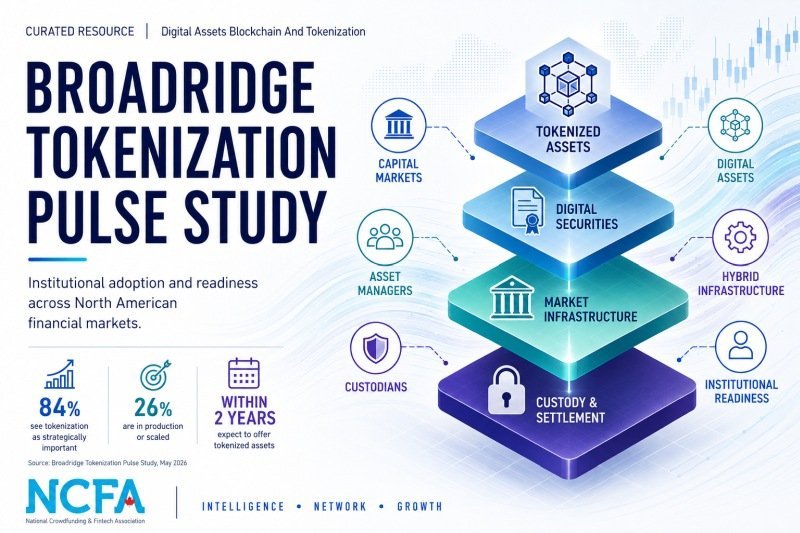
On July 16, 2026, Broadridge released its Tokenization Pulse Study, a survey of 200 senior financial services decision makers in Canada and the United States. The report examines adoption, investment, operating models, asset class priorities, and the practical barriers institutions face as tokenized assets enter production.
The findings show strong institutional interest with a wide gap between strategy and execution. While 84% of respondents consider tokenization strategically important, only 26% report being in production or operating at scale.
The study covers capital markets firms, asset managers, wealth managers, and digital asset firms. It compares their current activity, planned investment, expected adoption timelines, preferred infrastructure models, and reasons for pursuing tokenization.
Capital markets firms are furthest ahead, with 44% reporting production or scaled operations. That compares with 20% of asset managers and 9% of wealth managers. Nearly two thirds of all respondents expect to be ready to offer tokenized assets within two years.
The expected operating model is mainly hybrid. 92% believe traditional and digital assets will coexist for an extended period, while 69% plan to adapt existing infrastructure instead of building separate systems. This supports the view that tokenized financial infrastructure will need to connect with established market processes, governance, custody, distribution, and recordkeeping.
Asset classes are also developing at different rates. 80% expect tokenized mutual funds and money market funds to play a meaningful role within five years. Expectations for equities and private companies are closer to half of respondents.
This resource is useful for banks, custodians, dealers, exchanges, asset managers, wealth firms, market infrastructure providers, digital asset companies, investors, regulators, and technology teams.
It’s especially useful for organizations deciding whether to build, partner, integrate, or continue monitoring the market. The sector comparisons help readers judge how their own plans compare with North American institutions.
Strategy teams can use the report to compare stated priorities with actual production. The 84% strategic importance figure looks very different beside the 26% production rate. That gap helps identify where budgets, operating capacity, governance, and commercial demand still need work.
Product and infrastructure teams can use the asset class timelines to decide where near term demand is more credible. Mutual funds, money markets, and capital markets infrastructure currently show stronger institutional expectations than equities, private companies, or wealth distribution.
Canadian firms can also compare the findings with Canada’s stablecoin regulatory framework, securities regulation, custody requirements, and domestic market infrastructure. The survey includes Canadian respondents, but it doesn’t publish a separate Canadian data set.
The study’s main strength is its operating detail. It separates strategic interest from production, compares financial sectors, identifies preferred infrastructure models, and ranks regulatory, operational, commercial, budget, security, and organizational barriers.
Regulatory uncertainty was the most cited barrier at 33%. Operational complexity was especially important for capital markets firms, asset managers, and institutions managing more than US$250 billion. The results show that institutional interest alone isn’t enough. Firms still need workable governance, standards, controls, distribution, and a business case.
The study is commissioned by Broadridge, which provides tokenization infrastructure and related services. Readers should consider that commercial context when interpreting its conclusions. The sample is also limited to 200 North American decision makers, and the report does not provide country level results or independently test projected adoption timelines.
Broadridge Tokenization Pulse Survey Release (study findings and methodology)
Tokenization Starts Looking Like Financial Infrastructure (institutional market context)
Canada’s Stablecoin Regulatory Framework (Canadian regulatory context)
UK FCA Final Cryptoasset Rules (international regulatory comparison)
The National Crowdfunding & Fintech Association (NCFA Canada) is a financial innovation ecosystem that provides education, market intelligence, industry stewardship, networking and funding opportunities and services to thousands of community members and works closely with industry, government, partners and affiliates to create a vibrant and innovative fintech and funding industry in Canada. Decentralized and distributed, NCFA is engaged with global stakeholders and helps incubate projects and investment in fintech, alternative finance, crowdfunding, peer-to-peer finance, payments, digital assets and tokens, artificial intelligence, blockchain, cryptocurrency, regtech, and insurtech sectors. Join Canada's Fintech & Funding Community today FREE! Or become a contributing member and get perks. For more information, please visit: www.ncfacanada.org
| | |
|---|---|---|
| | |
```



August 26th, 2025

January 4th, 2024

June 1st, 2021

September 9th, 2020

July 9th, 2018

January 3rd, 2018

September 25th, 2017

June 20th, 2017

May 10th, 2017

December 14th, 2016
