





Karsten Wenzlaff, Advisor
August 26th, 2025
Karsten Wenzlaff is a Crowdfunding and Fintech Expert from Germany. He is Secretary-General of Digit[...]


February 27, 2026 | NCFA Fintech Whisperer Weekly Intelligence | Digital Assets Blockchain And Tokenization, Regulation And Policy, Payments And Market Infrastructure, Risk Compliance And Regtech

Image: Freepik
This live weekly NCFA intelligence page tracks financial technology developments that significantly affect how fintechs build, sell, raise capital, and operate under scrutiny. Coverage prioritizes Canada and includes global events that directly influence competitive conditions, market access, and execution realities across fintech sectors. This page will be updated throughout the week with market movers in a live format and then each week we'll close the prior week's contents in prep for the upcoming week, and continue on a rolling basis. (Missed prior week's Fintech Whisperer? (December 6-12, 2025, December 13-19, 2025, January 1-9, 2026, January 10-16, 2026, January 17-23, 2026, January 24-30, 2026, January 31-February 6, 2026, February 7-13, 2026, February 14-20, 2026).
This is early proof that capital is willing to line up behind an asset backed token model before issuance begins. It matters for tokenization platforms, digital asset builders, and market operators because demand at this level raises the stakes on what comes next, especially issuance design, trading access, settlement flow, and how real world asset tokenization earns trust beyond crypto native buyers.
This affects stablecoin issuers, wallet and exchange operators, payment firms that want stablecoin rails, and banks that can custody reserves or provide settlement accounts. The sandbox work turns authorisation readiness into near term execution, because counterparties will start asking who controls mint and burn, how reserves get safeguarded, how redemptions clear under stress, and what evidence you can produce before the September 2026 application gateway opens.
Institutional buyers tend to route flow to whoever can prove segregation, controls, and settlement certainty under supervision, and this move aims straight at that bar.
This is important for payment firms, open banking providers, digital asset infrastructure teams, and banks building new rails in the UK. A single forward plan from all four authorities makes timing harder to ignore, because product roadmaps, compliance sequencing, and partner conversations now sit against a more visible policy calendar.
This is a real infrastructure and distribution move in Canadian payments. It affects fintechs that bank through Peoples, embedded finance and sponsor bank partners, and any firm building around faster payments rails, because a stronger bank plus processor stack can tighten expectations on integration, uptime, message quality, and partner readiness well before RTR becomes fully operational.
Is this a key domino in AI finance? This is what AI looks like when it evolves from product feature to company structure. Large fintechs, payments platforms, and their investors now have a clear example of stronger results arriving alongside much smaller teams, placing more weight on execution quality, operating discipline, and how management builds from here.
This is one of the cleaner bridges between public capital, development finance, and founder scale. If you build inclusion fintech in ASEAN, expect the bar to move toward impact proof and deployment readiness, because capital now sits inside the same program that opens doors.
This is a significant turn of events for credit unions, fintechs, and crypto custody models that want a federal charter in Canada. A clearer approvals path can change when firms choose to enter the federal perimeter and how seriously investors and partners treat that option.
It affects stablecoin issuers, banks, custodians, exchanges, and fintechs that plan to distribute payment stablecoins, because reserve design, redemption handling, audits, supervision, and custody expectations start to look like core product requirements, not optional features.
This affects lenders, CRAs, and fintechs that rely on bureau data for onboarding and underwriting. Teams should expect more pressure on data completeness, dispute handling, governance, and audit evidence because mandatory sharing can reset what a clean credit file must look like.
This meeting keeps the door open to a simpler capital raising layer below broker dealer economics. Platforms, issuers, and service providers that touch private raises and secondary liquidity should watch for recommendations that tighten who can get paid, how referrals get documented, and what disclosure standard can unlock broader resale paths.
This raises the value of process maturity. If your fintech faces enforcement exposure, the timeline gives more room to assemble evidence, but it also rewards teams that keep clean records and can explain decisions fast when scrutiny hits.
Important for tokenized markets because clean settlement depends on clean reference data. Teams building custody, collateral, repo, and tokenized securities infrastructure must soon meet a higher standard on pricing integrity, entitlement controls, and auditability as institutional workflows move on-chain.
This is an immediate capital incentive change. If you sell insurer investment, treasury, or regulatory reporting tooling, expect more pressure to classify eligible exposure fast and produce clean evidence for PC4 filings while the treatment stays live.
This raises the cost of weak pre-trade controls. Teams selling OMS, EMS, surveillance, or post trade tooling into dealers should expect more demand for guardrails that prevent self matching and catch close related mistakes early, plus audit ready evidence when exceptions still occur.
The market continues to tighten where new rails are forming, and where management teams are being forced to adapt faster. Stay nimble and ahead of the curve. Be cautious about waiting for late stage confirmations. NCFA offers various curated resources to help founders and investors stay current on developments that impact fintech markets, subscribe to NCFA weekly newsletter updates, view a rundown of current fintech news and insights, or dive into the latest fintech industry research.
 The National Crowdfunding & Fintech Association (NCFA Canada) is a financial innovation ecosystem that provides education, market intelligence, industry stewardship, networking and funding opportunities and services to thousands of community members and works closely with industry, government, partners and affiliates to create a vibrant and innovative fintech and funding industry in Canada. Decentralized and distributed, NCFA is engaged with global stakeholders and helps incubate projects and investment in fintech, alternative finance, crowdfunding, peer-to-peer finance, payments, digital assets and tokens, artificial intelligence, blockchain, cryptocurrency, regtech, and insurtech sectors. Join Canada's Fintech & Funding Community today FREE! Or become a contributing member and get perks. For more information, please visit: www.ncfacanada.org
 |  |  |
|---|---|---|
 |  |  |
Feb 27, 2026 | NCFA Fintech Market Activity | Capital Markets And Market Structure
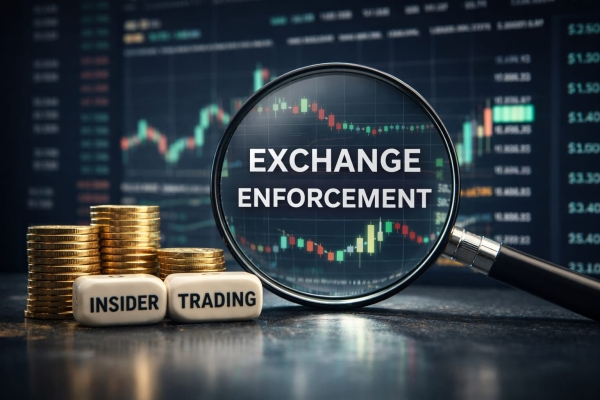
On February 25 2026, prediction market Kalshi disclosed two closed insider trading cases, including one tied to a YouTube editor linked to MrBeast content and one tied to a California political candidate. The same post records 200 investigations in the past year, with more than a dozen active cases.
The CFTC’s enforcement division confirmed the penalties, stating that illegal trading on prediction markets listed on designated contract markets falls within federal derivatives enforcement. Insider trading, misuse of non-public information, and market abuse now sit inside a framework that looks much closer to mainstream market oversight than novelty betting.
1. The MrBeast YouTube editor case carries a $20,397.58 financial penalty and a 2 year suspension from direct or indirect access to Kalshi.
The enforcement post describes trading tied to a popular creator’s videos. Kalshi’s surveillance tools flagged near perfect results in low odds markets, and user reports flagged the same account. The record concludes there was enough evidence to close the matter as an insider trading case and freeze the account.
2. The political candidate case carries a $2,246.36 financial penalty and a 5 year suspension
The second case covers a California political candidate who traded on his own election. The enforcement record treats that conduct as a direct rule breach. Public promotion of those trades made the violation even more visible.
For operators, the takeaway is direct. Once a platform lists contracts tied to events, information control becomes core infrastructure. Monitoring, escalation, account freezes, documented penalties, and regulator coordination all move from compliance overhead to essential operating systems.
For investors, the numbers point to the real test. Volume can scale fast, but conduct failures can damage credibility even faster. The platforms that manage to sustain long term value will be required to run a fair market, enforce their own rules, and stay inside a clear regulatory perimeter. Prediction markets already price geopolitics. The next hurdle is showing they can police information risk with the same seriousness as any other exchange.
When a prediction market issues fines, suspensions, and CFTC backed enforcement over insider trading, does it still trade as a betting product, or does it start operating like exchange infrastructure?
The National Crowdfunding & Fintech Association (NCFA Canada) is a financial innovation ecosystem that provides education, market intelligence, industry stewardship, networking and funding opportunities and services to thousands of community members and works closely with industry, government, partners and affiliates to create a vibrant and innovative fintech and funding industry in Canada. Decentralized and distributed, NCFA is engaged with global stakeholders and helps incubate projects and investment in fintech, alternative finance, crowdfunding, peer-to-peer finance, payments, digital assets and tokens, artificial intelligence, blockchain, cryptocurrency, regtech, and insurtech sectors. Join Canada's Fintech & Funding Community today FREE! Or become a contributing member and get perks. For more information, please visit: www.ncfacanada.org
| | |
|---|---|---|
| | |
Feb 27, 2026 | NCFA Fintech Market Activity | Digital Assets And Market Structure

On February 24 2026, a complaint filed in the Southern District of New York (83 page PDF) by Terraform plan administrator Todd R. Snyder accuses Jane Street and named employees of insider trading, fraud, and market manipulation tied to the May 2022 collapse of the Terra ecosystem.
The filing names Jane Street Group, Jane Street Capital, Bryce Pratt, Robert Granieri, and Michael Huang as defendants. It alleges that Jane Street used confidential information from Terraform insiders, including communications in a group chat identified in the complaint as “Bryce’s Secret”, to gather material non-public information and trade ahead of the UST depeg.
Do Kwon’s guilty plea on fraud charges thrust Terraform in the legal spotlight and forced the scale of the TerraUSD collapse. This lawsuit goes beyond Terraform’s own conduct and asks whether outside trading activity also helped deepen the damage.
The plan administrator was appointed through Terraform’s wind down to pursue recovery claims and maximize value for creditors. The complaint states that the administrator has authority to bring claims on behalf of Terraform, the wind down trust, Luna Foundation Guard, and certain individual victims who assigned claims tied to the collapse. This is a recovery action. The plaintiff is seeking disgorgement and other remedies from parties alleged to have profited from, and contributed to, Terraform’s collapse.
This case now tests whether a major trading firm used information and timing to reduce its own risk while the broader market absorbed the losses.
The complaint alleges that Jane Street sold UST on May 7 2022 after gaining an information edge, then benefited as UST lost its $1 peg within hours and the Terraform ecosystem entered a death spiral. It says those trades allowed Jane Street to unwind hundreds of millions of dollars of potential exposure at a critical point in the collapse.
The filing also points to the scale of emergency support during the crisis. It says Terraform bought more than 250 million UST on May 7, more than 200 million UST on May 8, and more than 1.9 billion UST between May 8 and May 10. It also says Luna Foundation Guard and third parties acting on its behalf used reserves to buy additional UST as the peg failed.
This case puts one of the best known trading firms in global markets into a fresh crypto market integrity fight tied to one of the sector’s biggest failures. If the case moves forward and more evidence enters the public record, scrutiny may increase around how large market makers operate in digital assets, how private information moves between token issuers and trading firms, and how courts apply insider trading and market manipulation theories to crypto markets.
The complaint also underlines the scale of the defendant it targets. It describes Jane Street as responsible for more than 10% of all equity trades in North America and says net trading revenue rose above $24 billion in the first three quarters of 2025. Those figures are allegations in the filing, not court findings, but they help explain why this lawsuit will draw attention well beyond crypto.
For exchanges, brokers, lenders, and digital asset platforms, the immediate issue is control. A case built on alleged private chats, relationship networks, and trade timing puts information barriers, surveillance, and counterparty oversight back at the center of market risk.
If crypto markets face more lawsuits built on insider trading and manipulation claims, does the next major pressure point move from token design to trading conduct?
For investors, the Terra collapse already changed how the market views stablecoins. This lawsuit may force more attention toward trading conduct, information asymmetry, and whether crypto market structure is ready for the same legal standards applied in traditional markets.
The National Crowdfunding & Fintech Association (NCFA Canada) is a financial innovation ecosystem that provides education, market intelligence, industry stewardship, networking and funding opportunities and services to thousands of community members and works closely with industry, government, partners and affiliates to create a vibrant and innovative fintech and funding industry in Canada. Decentralized and distributed, NCFA is engaged with global stakeholders and helps incubate projects and investment in fintech, alternative finance, crowdfunding, peer-to-peer finance, payments, digital assets and tokens, artificial intelligence, blockchain, cryptocurrency, regtech, and insurtech sectors. Join Canada's Fintech & Funding Community today FREE! Or become a contributing member and get perks. For more information, please visit: www.ncfacanada.org
| | |
|---|---|---|
| | |
February 17 2026 | Market Insight | Artificial Intelligence Governance

Image: Freepik
On February 17 2026, a New York federal court ruled in United States v. Heppner that written exchanges between a defendant and Anthropic’s Claude are not protected by attorney client privilege or the work product doctrine.
The case centred on about 31 documents that recorded the defendant’s interactions with Claude. Investigators collected the files during a search after the defendant received a grand jury subpoena and understood he was under investigation. He used Claude to generate reports that outlined possible defence strategy and potential legal and factual arguments. He did this on his own rather than at the direction of his lawyer.
The court applied standard privilege rules and found the documents fell outside protection. Judge Jed S. Rakoff explained that discussions between non-lawyers were not privileged and that privilege depended on a confidential relationship with licensed counsel. The court also found the Claude conversations were not confidential because they involved a third party platform and the platform’s privacy policy alerted users that data could be collected and disclosed.
HSF Kramer’s analysis of the ruling explains how client side use of public generative AI tools could weaken privilege claims. The defendant argued that he created the Claude reports to prepare for conversations with his lawyer and later shared them with counsel. The court rejected that argument. Because the defendant used the tool independently and Claude disclaimed providing legal advice, the documents did not become privileged simply because counsel received them later.
The court reached the same result under the work product doctrine. That doctrine protects materials prepared by or at a lawyer’s direction to safeguard legal strategy. Since the defendant created the documents himself, the court found they did not reflect counsel’s mental impressions or strategy.
The defendant’s approach reflected a workflow many teams now follow. People often use generative AI to organize facts, test arguments, or prepare notes before speaking with a lawyer. In practice, AI can feel like a private drafting space. The Heppner ruling shows that this assumption creates risk because privilege depends on lawyer involvement and confidentiality at the time material is created, not later.
This decision shows how everyday AI use can create governance risk. Fintech teams often rely on generative AI to draft internal notes, explore regulatory interpretations, test legal arguments, and shape product thinking.
When teams create prompts and outputs outside privileged workflows, those materials may be treated like ordinary internal documents and may surface in litigation, investigations, or regulatory reviews.
The Heppner outcome also challenges a common assumption that AI drafts become privileged once shared with a lawyer. Timing and intent matter. If teams generate strategy or legal framing before counsel becomes involved, privilege arguments may already weaken. Enterprise AI environments may offer stronger confidentiality controls, but the decision shows privilege still depends on lawyer involvement and clear intent to obtain legal advice.
If generative AI captures early legal and strategic thinking, should fintech governance treat AI prompts with the same care as internal legal memos and executive communications?
Privilege depends on how and when material is created, not what you do with it later.
The National Crowdfunding & Fintech Association (NCFA Canada) is a financial innovation ecosystem that provides education, market intelligence, industry stewardship, networking and funding opportunities and services to thousands of community members and works closely with industry, government, partners and affiliates to create a vibrant and innovative fintech and funding industry in Canada. Decentralized and distributed, NCFA is engaged with global stakeholders and helps incubate projects and investment in fintech, alternative finance, crowdfunding, peer-to-peer finance, payments, digital assets and tokens, artificial intelligence, blockchain, cryptocurrency, regtech, and insurtech sectors. Join Canada's Fintech & Funding Community today FREE! Or become a contributing member and get perks. For more information, please visit: www.ncfacanada.org
| | |
|---|---|---|
| | |
Feb 25, 2026 | NCFA Fintech Market Activity | Identity Privacy And Data Governance

Image: Freepik
On February 24 2026, SLC Digital and Tracer Labs announced a partnership that links SIM or eSIM backed device proof with portable digital identity and consent credentials.
The goal is to reduce account takeover exposure and strengthen approvals for high risk actions by proving the authorized device is present and the right person approves the action. SLC Digital says it anchors device trust to the SIM or eSIM and mobile network signals. Tracer Labs says its Trust ID layer supports identity verification, consent, and authorization workflows without repeatedly exposing personal data.
The FBI Internet Crime Complaint Center says that since January 2025 it has received more than 5,100 complaints reporting account takeover fraud, with losses exceeding $262 million
It's an interesting partnership because many platforms still separate identity from authorization. Identity checks often happen at onboarding while authorization often relies on an in app prompt or an SMS one time code. The solution describes a combined workflow that ties a sensitive action to a trusted device and a verified identity and consent credential, so the platform can show stronger evidence that the real user approved the change.
It fits best where one compromised session creates immediate damage. Think bank account changes, payout destination edits, payroll modifications, admin role changes, high value transfers, and merchant settlement rerouting. Those flows also create regulatory and audit exposure when firms cannot clearly prove who approved what and from which trusted endpoint.
Travis McGregor, CEO, SLC Digital:
“This partnership strengthens how organizations defend against modern digital fraud,”
Pete Hayes, CEO, Tracer Labs:
“Digital ecosystems can’t rely on one-time authentication in a world of autonomous agents and sophisticated threats,”
The companies will begin with a joint pilot and expand into enterprise deployments. It also lists SLC Digital partnerships and affiliations that signal an infrastructure grade route to market, including work with GSMA, IDEMIA, and Monogoto, plus membership in the NVIDIA Inception program.
If account takeover losses keep climbing, do banks and fintechs start treating device rooted authorization plus portable consent credentials as a baseline requirement for high risk actions, not an optional upgrade?
The National Crowdfunding & Fintech Association (NCFA Canada) is a financial innovation ecosystem that provides education, market intelligence, industry stewardship, networking and funding opportunities and services to thousands of community members and works closely with industry, government, partners and affiliates to create a vibrant and innovative fintech and funding industry in Canada. Decentralized and distributed, NCFA is engaged with global stakeholders and helps incubate projects and investment in fintech, alternative finance, crowdfunding, peer-to-peer finance, payments, digital assets and tokens, artificial intelligence, blockchain, cryptocurrency, regtech, and insurtech sectors. Join Canada's Fintech & Funding Community today FREE! Or become a contributing member and get perks. For more information, please visit: www.ncfacanada.org
| | |
|---|---|---|
| | |
February 23, 2026 | NCFA Market Activity | Artificial Intelligence And Data

On February 21, 2026, B.C.’s premier says police are pursuing preservation orders for potential evidence held by digital services companies, including social media platforms and AI companies, after media reports tied OpenAI to the case. This isn't a new fintech policy just yet, but it puts evidence readiness into the open. If a partner asks what you can preserve and produce under lawful process, you can’t appear like a 'deer in headlights'. You need a working path.
BC Government, Office of the Premier, Media Relations:
“Reports that allege OpenAI had related intelligence before the shootings in Tumbler Ridge took place are profoundly disturbing for the victims’ families and all British Columbians. We will use all powers of government to ensure that police have the tools they need to investigate every aspect of this horrific tragedy.”
RCMP report said that the active shooter call came in at about 1:20 p.m. on February 10 and the public alert ended at 5:45 p.m. Six victims were found deceased inside the school, two victims were airlifted with serious or life threatening injuries, a third victim died during transport, and about 25 others were assessed for non life threatening injuries. RCMP also reports two additional victims were found deceased at a connected residence.
On February 13, RCMP reports more than 80 interviews took place with students, educators, and first responders, while forensic teams continued processing two scenes and a vehicle connected to the suspect. The investigative update also reported digital evidence work including witness images and videos, CCTV, and body worn camera video, and it says RCMP launched an online portal to collect more evidence, including phone footage captured inside the school.
In a BBC report, OpenAI spokesperson said that they didn't alert authorities about the account because its usage didn't meet its threshold of credible or imminent plan for serious physical harm to others...
"In June 2025, we proactively identified an account associated with this individual [Jesse Van Rootselaar] via our abuse detection and enforcement efforts, which include automated tools and human investigations to identify misuses of our models in furtherance of violent activities."
Evan Solomon, Minister of Artificial Intelligence and Digital Innovation per Globe and Mail reporting:
"Canadians expect online platforms, including OpenAI, to have robust safety protocols and escalation practices in place to protect online safety and ensure law enforcement are warned about potential violence,"
This story turns AI governance into an evidence workflow. If your product runs AI in onboarding, fraud triage, collections, or support, partners need clear answers on what the system records, what it retains, who can access it, and how the team preserves and produces records under lawful process without breaking integrity. A stakeholder may accept model error but they won’t accept uncertainty about records, access, and escalation ownership when scrutiny rises.
Financial technology companies should define escalation triggers in plain language. Name an accountable owner and a backup. Restrict log access. Set retention windows you can defend. Test a short runbook for preservation and production so the team can execute it without debate when the question lands, an be sure to provide suitable ongoing training.
If preservation orders become a more common tool when AI enters an incident, does Canada need a shared baseline for AI logging, retention, and escalation handoffs so every regulated buyer does not rebuild the same checklist from scratch?
Reuters reported that OpenAI reps have been summoned to Ottawa urgently to discuss AI safety.
Update per CTV article: Following the meeting in Ottawa with OpenAI safety leaders, federal officials said they were “deeply disturbed” and ultimately “disappointed” that warning signals tied to the Tumbler Ridge shooter were not escalated to police earlier, with AI Minister Evan Solomon stressing Canadians expect platforms to maintain “robust safety protocols and escalation practices.” OpenAI is cooperating with the RCMP but produced no immediate new safeguards, leaving ministers to seek concrete follow-up proposals.
The National Crowdfunding & Fintech Association (NCFA Canada) is a financial innovation ecosystem that provides education, market intelligence, industry stewardship, networking and funding opportunities and services to thousands of community members and works closely with industry, government, partners and affiliates to create a vibrant and innovative fintech and funding industry in Canada. Decentralized and distributed, NCFA is engaged with global stakeholders and helps incubate projects and investment in fintech, alternative finance, crowdfunding, peer-to-peer finance, payments, digital assets and tokens, artificial intelligence, blockchain, cryptocurrency, regtech, and insurtech sectors. Join Canada's Fintech & Funding Community today FREE! Or become a contributing member and get perks. For more information, please visit: www.ncfacanada.org
| | |
|---|---|---|
| | |
February 20, 2026 | NCFA Fintech Whisperer Weekly Intelligence | Regulation And Policy, Artificial Intelligence And Data, Payments And Money Movement, Digital Assets Blockchain And Tokenization, Risk Compliance And Regtech
Image: Freepik
This live weekly NCFA intelligence page tracks financial technology developments that significantly affect how fintechs build, sell, raise capital, and operate under scrutiny. Coverage prioritizes Canada and includes global events that directly influence competitive conditions, market access, and execution realities across fintech sectors. This page will be updated throughout the week with market movers in a live format and then each week we'll close the prior week's contents in prep for the upcoming week, and continue on a rolling basis. (Missed prior week's Fintech Whisperer? (December 6-12, 2025, December 13-19, 2025, January 1-9, 2026, January 10-16, 2026, January 17-23, 2026, January 24-30, 2026, January 31-February 6, 2026, February 7-13, 2026).
This is a procurement and capital boost for defence not seen in decades. Fintechs that help defence suppliers get paid faster, manage cash under milestone contracts, and prove tight controls on funds and data have a generational opportunity with real distribution next quarter. See defence push: Montreal joins provincial bids for global DSR bank platform
This is a money and proof moment for insurtech. Founders selling automation into carriers and brokers should expect buyers to ask for hard baseline metrics, verified before and after results, and fast integration plans this quarter because the market now funds teams that tie automation to combined ratio math and measurable cost takeout.
The UK is embedding crypto firms inside the existing Financial Services and Markets Act framework used for banks, investment firms, and other regulated financial institutions. Firms will likely need stronger governance, clearer business models, defined senior management accountability, and enough financial resources to pass a full authorisation assessment. This tends to favour well capitalized firms that can build institutional grade compliance and risk management from the start.
Tariff volatility shouldn't come as a surprise to anyone and still important to note that this does not take tariffs off the table. Founders and investors should assume trade cost risk still moves through other statutes and policy tools, so the teams that win next quarter make cash forecasting, FX, and settlement controls easier to run when pricing and demand change overnight.
This locks in the timeline banks plan around. Founders selling credit, underwriting, treasury, capital markets, or risk tooling into federally regulated institutions should expect earlier capital impact questions and tighter evidence requests in the next quarter because partners align product decisions to November 2026 and January 2027 effective dates long before final publication.
BoC's action should put every payments and wallet provider on notice. Partners should ask sharper questions about where customer funds sit, who controls access, how fast you can prove balances, and how you recover when something breaks. Teams that can answer those questions with evidence keep distribution moving when scrutiny rises. Feb 27, 2026 Update: The Bank of Canada issues a revised order that allows XTM to resume retail payment activities under court supervised monitoring (a controlled restart).
This can open practical opportunities into German buyers and programs, but only for teams that can pass strict security and governance reviews. Fintechs using AI should expect tougher diligence on where models run, how data moves, how vendors get controlled, and how incidents get handled. If you can show that evidence quickly, you may shorten procurement cycles and avoid months of back and forth. Large buyers tend to follow the standards governments back when they buy software at scale.
This is how stablecoins get real distribution, through bank grade plumbing that owns the hard parts. The next quarter gets more competitive for cross border payments and FX because buyers will compare everyone against always on settlement plus clean, provable books, not just a faster rail.
This is what a real time payments stack looks like when a credit union commits to execution. Vendors selling into credit unions should plan for tighter requirements on open APIs, core and digital banking integration, automated balancing, and exception handling in the next quarter because buyers now expect one platform to run multiple rails without adding operational headcount.
This partnership puts telecom scale on the same path as regulated payouts. If you want in, plan for a buyer that starts by stress testing your operations, not your pitch. Bring evidence you can trace every $ end to end, spot problems fast, reverse or recover cleanly, and keep service levels steady when volume spikes or fraud pressure rises. The teams that win make risk controls feel invisible to users while giving partners real time confidence that money moves exactly as promised.
Founders selling treasury and payments infrastructure should expect tougher questions on reconciliation, exception handling, and control ownership in the next quarter because a bundled PSP sets a higher baseline for speed and operational calm.
This is a real bridge into institutional credit rails. Founders building crypto credit, collateral, custody, and risk tooling should expect tougher questions next quarter on liquidation rules, collateral segregation, reporting, and investor grade controls, because rated structures pull crypto lending into the same discipline set as mainstream ABS.
This tightens delivery expectations for banks and their vendors. Payments and onboarding fintechs should expect stricter timelines and stronger evidence demands next quarter because partial coverage can trigger enforcement.
This week shows the market continuing to get stricter and more operational. OSFI closes the CAR 2027 consultation and puts bank capital planning on a fixed runway. The Bank of Canada order against XTM puts wallets and payments providers back under a microscope on safeguarding and access controls. Modern Treasury pushes more buyers toward one provider that owns rails, reporting, and controls. Desert Financial’s move into FedNow, RTP, and Visa Direct shows how fast credit unions now expect real time payments to work at scale. mea Platform’s $50M round reinforces that capital still rewards insurance automation when it ties directly to combined ratio math. The PSR fine in the UK makes clear that payments safety controls ship on deadline, or regulators step in.
NCFA offers various curated resources to help founders and investors stay current on developments that impact fintech markets, subscribe to NCFA weekly newsletter updates, view a rundown of current fintech news and insights, or dive into the latest fintech industry research.
The National Crowdfunding & Fintech Association (NCFA Canada) is a financial innovation ecosystem that provides education, market intelligence, industry stewardship, networking and funding opportunities and services to thousands of community members and works closely with industry, government, partners and affiliates to create a vibrant and innovative fintech and funding industry in Canada. Decentralized and distributed, NCFA is engaged with global stakeholders and helps incubate projects and investment in fintech, alternative finance, crowdfunding, peer-to-peer finance, payments, digital assets and tokens, artificial intelligence, blockchain, cryptocurrency, regtech, and insurtech sectors. Join Canada's Fintech & Funding Community today FREE! Or become a contributing member and get perks. For more information, please visit: www.ncfacanada.org
| | |
|---|---|---|
| | |



August 26th, 2025

January 4th, 2024

June 1st, 2021

September 9th, 2020

July 9th, 2018

January 3rd, 2018

September 25th, 2017

June 20th, 2017

May 10th, 2017

December 14th, 2016
