





Karsten Wenzlaff, Advisor
August 26th, 2025
Karsten Wenzlaff is a Crowdfunding and Fintech Expert from Germany. He is Secretary-General of Digit[...]


March 6, 2026 | NCFA Fintech Whisperer Weekly Intelligence | Artificial Intelligence And Data, Digital Assets Blockchain And Tokenization, Regulation And Policy, Lending Consumer Credit And BNPL, Sustainable Finance And ESG

Image: Freepik
This live weekly NCFA intelligence page tracks financial technology developments that significantly affect how fintechs build, sell, raise capital, and operate under scrutiny. Coverage prioritizes Canada and includes global events that directly influence competitive conditions, market access, and execution realities across fintech sectors. This page will be updated throughout the week with market movers in a live format and then each week we'll close the prior week's contents in prep for the upcoming week, and continue on a rolling basis. (Missed prior week's Fintech Whisperer? (December 6-12, 2025, December 13-19, 2025, January 1-9, 2026, January 10-16, 2026, January 17-23, 2026, January 24-30, 2026, January 31-February 6, 2026, February 7-13, 2026, February 14-20, 2026, February 21-27, 2026).
This is for AI first fintechs, SaaS platforms, and builders selling usage heavy products because AI cost recovery is moving out of finance spreadsheets and into the billing stack itself. This means markup, model pricing, and token usage can all be baked directly into a single workflow.
This affects crypto custody, brokerage, and compliance tooling teams, plus firms that run secondary market controls, because it pushes more of the crypto perimeter into client asset rule design while tightening where firms must look for core market mechanics requirements.
This changes the operating timetable for lenders, brokers, and claims handling firms, and it pulls more pressure onto complaint intake, identity checks, fraud controls, and customer communications. Fintechs offering claims workflow solutions, onboarding checks, and redress automation now need to map product readiness to the late March rules and the 3 to 5 month build window.
This opens an official lane that matters for remittance firms, merchant payments providers, instant payments infrastructure teams, and institutions building Canada India payment flows. Once payment system operators are invited into the file, the discussion moves closer to real operating design, not just diplomacy.
This opens a new regulated advice lane between generic guidance and individual advice. It affects banks, pension providers, wealth platforms, and fintechs building support flows, because firms now have a near term path to turn customer guidance into a permissioned product with real conduct and authorisation consequences.
This is important for issuers, dealers, custodians, and market infrastructure teams because a central bank backed trial now shows how tokenized bonds and central bank settlement money can run through an on chain workflow, which raises expectations on governance, auditability, and integration before this model can scale beyond pilots.
A major exchange operator is tying its regulated futures roadmap to crypto spot reference prices while pushing tokenized equities distribution through a large crypto customer base.
This is for banks, payment infrastructure firms, tokenization platforms, and securities settlement providers. The BOJ is linking blockchain, tokenized central bank money, and core settlement design to active pilots, sandbox work, and future upgrades to BOJ NET, which raises the bar for how seriously the market should treat settlement infrastructure moving on chain.
This raises the enforcement baseline for broker dealers and their vendors. If you create or sell onboarding, surveillance, AML, or case management tooling, expect more pressure to prove risk based controls, faster SAR decisioning, and audit ready evidence because regulators are treating gaps in thinly traded securities monitoring as a serious control failure.
This is a positive announcement for fintech vendors that sell to government, defence, banks, and critical infrastructure. AI evaluation, cybercrime response, and resilience checks start to converge across buyers.
As Canada and Australia open the door to more pension investment, investors will want simple, auditable reporting and quick due diligence, especially for payments, AI, and critical supply chain projects.
This delay ties up cash for importers and their banks. When refunds take weeks to process, treasury teams need tighter visibility into duty exposure, eligibility tracking, and cash forecasting, and that opens room for fintech tools that automate reconciliation and working capital decisions created by policy whiplash.
This could impact how payments teams operate. If merchants can query verified payments events in natural language and automate workflows on top of unified data, AI payments will run the operating layer for routing, fraud, disputes, and cost control, which raises expectations on data quality, lineage, and accountability across the payments stack.
The Fed is opening a controlled access point for a crypto linked institution inside the U.S. payments system. That sets a live precedent for how non bank and digital asset firms may be handled under account access rules, even where service scope stays tightly constrained.
This for issuers, acquirers, sponsor banks, card fintechs, and treasury teams because stablecoins are moving closer to core network settlement, not just crypto side rails. Once a global card network starts wiring a bank issued stablecoin into settlement flow, teams need a clearer view on treasury design, reconciliation, network rules, and what faster money movement looks like in practice.
This pushes stablecoins deeper into everyday card economics, not just niche crypto wallets. It matters for issuers, program managers, fintech developers, and infrastructure teams because card issuance, settlement, and reconciliation are starting to move into the same onchain operating stack at global scale.
Singapore is placing climate transition planning inside supervised financial risk management rather than limiting it to public reporting. The approach gives Canadian regulators and institutions a comparator for connecting climate data, portfolio decisions, customer engagement and governance while avoiding blunt exclusions that could restrict financing without reducing underlying risk.
Core financial infrastructure continues to move closer to programmable systems while regulators tighten the rules around how firms operate and protect customers. Stablecoins are entering card settlement, tokenized bonds are moving through central bank backed pilots, and AI usage is starting to show up directly inside billing and payments operations. At the same time, regulators are opening new product lanes and expanding oversight of crypto custody, advice models, and consumer finance practices. NCFA offers various curated resources to help founders and investors stay current on developments that impact fintech markets, subscribe to NCFA weekly newsletter updates, view a rundown of current fintech news and insights, or dive into the latest fintech industry research.
 The National Crowdfunding & Fintech Association (NCFA Canada) is a financial innovation ecosystem that provides education, market intelligence, industry stewardship, networking and funding opportunities and services to thousands of community members and works closely with industry, government, partners and affiliates to create a vibrant and innovative fintech and funding industry in Canada. Decentralized and distributed, NCFA is engaged with global stakeholders and helps incubate projects and investment in fintech, alternative finance, crowdfunding, peer-to-peer finance, payments, digital assets and tokens, artificial intelligence, blockchain, cryptocurrency, regtech, and insurtech sectors. Join Canada's Fintech & Funding Community today FREE! Or become a contributing member and get perks. For more information, please visit: www.ncfacanada.org
 |  |  |
|---|---|---|
 |  |  |
Mar 6, 2026 | NCFA Fintech Market Activity | Consumer Credit And Identity And Data Governance

Image: Freepik/fabrikasimf
Per an Investment Executive article, on February 22, 2026, a proposed class action application was filed in Quebec alleging that repeated access to a consumer credit file data occurred without authorization through a third party platform account that the applicant says he never opened or approved.
The application says an unauthorized party created an account on Borrowell and used it to access the applicant’s Equifax credit file. It alleges the matching and authentication process accepted partial, inaccurate, or outdated personal information without enhanced identity verification and without effective controls to detect inconsistencies.
The filing describes a series of inquiries and access events through Borrowell at almost weekly frequency over roughly four months. It alleges the access did not affect the applicant’s credit score, but harmful with unauthorized disclosure of highly sensitive personal and financial information.
The application also alleges that Equifax uses a similar access model with multiple third party partner platforms in Canada, and it names examples including KOHO Financial Inc., Credit Karma Canada, Mogo Inc., and Chexy, among others.
This is a market structure issue inside consumer credit. Credit file access is part of many modern onboarding and underwriting flows across lending, banking, payments, and personal finance apps. If a court accepts the argument that matching and authentication rules allowed unauthorized access through partner channels, it will raise scrutiny for how bureaus and partner platforms handle identity verification, monitoring, and anomaly detection for credit file requests.
Both the credit bureau and third party partners need tighter identity checks, clearer consent proof, and better alerts for repeat access. Canadian regulators already expect financial institutions to manage these risks. For example, OSFI’s Third Party Risk Management Guideline B-10 requires federally regulated institutions to remain accountable for services delivered through partners and to maintain strong due diligence, monitoring, and control frameworks across the full lifecycle of third party relationships.
If partner platforms can trigger credit file access using partial or outdated identifiers, what standard should govern consent checks, anomaly detection, and step up verification for repeat inquiries?
The National Crowdfunding & Fintech Association (NCFA Canada) is a financial innovation ecosystem that provides education, market intelligence, industry stewardship, networking and funding opportunities and services to thousands of community members and works closely with industry, government, partners and affiliates to create a vibrant and innovative fintech and funding industry in Canada. Decentralized and distributed, NCFA is engaged with global stakeholders and helps incubate projects and investment in fintech, alternative finance, crowdfunding, peer-to-peer finance, payments, digital assets and tokens, artificial intelligence, blockchain, cryptocurrency, regtech, and insurtech sectors. Join Canada's Fintech & Funding Community today FREE! Or become a contributing member and get perks. For more information, please visit: www.ncfacanada.org
| | |
|---|---|---|
| | |
March 5, 2026 | NCFA Feature | Capital Markets And Policy And Regulation
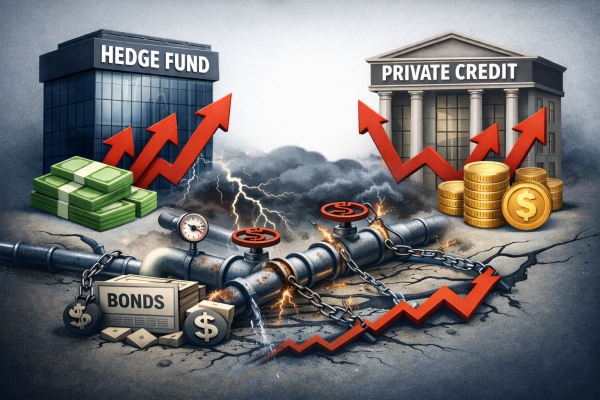
On March 4 2026, Bank of Canada Governor Tiff Macklem discussed how non bank finance can amplify stress in debt markets during remarks at the Global Risk Institute in Toronto. He pointed at two pressure points that matter for Canada right now:
Macklem puts a clear number on hedge fund demand in Canada:
"In Canada, they purchase up to 50% of Government of Canada bonds sold at auction and account for a big portion of secondary market trading.”
Hedge funds aren't just active in Canada. Similar patterns show up across many major economies. Hedge funds now hold a significant share of government debt outside central banks and large institutions. When government bond markets become unstable, the effects spread quickly. Mortgage rates, business loans, and corporate borrowing costs all move with government bond yields, so shifts in that market ripple through the entire economy.
The Bank highlights the repo market because repo borrowing funds many leveraged bond trades. A repo (repurchase agreement), works like a very short term loan. An investor borrows cash and posts government bonds as collateral, then agrees to buy those bonds back a day or a few days later.
Macklem says many hedge fund bond positions rely on this type of borrowing and are often highly leveraged. The structure makes markets sensitive to sudden changes in funding conditions.
He explains that “globally, about half have an overnight maturity. And haircuts are low zero or negative more than 80% of the time.” If lenders raise collateral requirements or reduce lending, investors may need to sell bonds quickly to reduce leverage.
When several large investors unwind positions at the same time, liquidity can vanish and prices can fall sharply. Macklem points to past episodes where this dynamic played out, including the global dash for cash at the start of the pandemic, the United Kingdom gilt crisis in 2022, and stress in the United States Treasury market in 2023.
Macklem also focuses on private credit because transparency is more difficult than in public markets:
“The opacity of private credit means investors may not have enough information about the quality of loans held in their funds.”
If defaults rise and investors rush for exits, he warns that the strain can spill into public credit markets. Canada connects to this risk because Canadian institutions invest in private credit globally, and funding links can pull stress back into the regulated system through liquidity needs and cross border channels.
The Bank of Canada is also changing how it plans to conduct its repo transactions. In a market notice, the Bank says it will join the Canadian Collateral Management Service tri party platform for its domestic repo operations by early 2027. CCMS is a market utility launched by TMX Group and Clearstream that helps participants move collateral, manage substitutions, and automate settlement for repo trades.
The Bank also says it intends to clear its repo operations through the Canadian Derivatives Clearing Corporation once TMX completes upgrades to expand central clearing services. CDCC acts as a central counterparty that guarantees settlement if one side of a trade fails.
The goal is to support stronger collateral management, reduce counterparty risk, and encourage broader use of modern repo infrastructure in Canada.
More lending and market activity now happens via non-bank firms who often use short term funding that can tighten quickly, not just traditional banks. When that happens, pressure in debt markets can build fast. Canadian institutions need better visibility into funding conditions, leverage, and collateral movement across markets. Fintech companies that help banks monitor liquidity, collateral, and repo exposures in near real time can fill an important gap.
At the same time, stronger market infrastructure matters for Canada’s competitiveness. Investors and dealers gravitate to markets that settle trades smoothly and manage collateral efficiently, especially during periods of stress.
The National Crowdfunding & Fintech Association (NCFA Canada) is a financial innovation ecosystem that provides education, market intelligence, industry stewardship, networking and funding opportunities and services to thousands of community members and works closely with industry, government, partners and affiliates to create a vibrant and innovative fintech and funding industry in Canada. Decentralized and distributed, NCFA is engaged with global stakeholders and helps incubate projects and investment in fintech, alternative finance, crowdfunding, peer-to-peer finance, payments, digital assets and tokens, artificial intelligence, blockchain, cryptocurrency, regtech, and insurtech sectors. Join Canada's Fintech & Funding Community today FREE! Or become a contributing member and get perks. For more information, please visit: www.ncfacanada.org
| | |
|---|---|---|
| | |
March 5, 2026 | NCFA Advocacy | Data Governance

Sent by email:
Dear Minister
Power of Data
We (the undersigned – data driven tech and policy experts) very much support the letter of 4 Feb 2026 to you from CCPA – https://www.policyalternatives.ca/news-research/open-letter-to-the-honourable-melanie-joly-minister-responsible-for-statistics-canada/.
We add to that letter the following points:
1. At a time when we need more data, not less, to support evidence-based decision making and community engagement in Canada, the staffing and other cuts already started at StatsCan are misguided. Even if the cuts will “have a ‘low’ or ‘limited’ impact on existing service levels” (a position which is contestable), we echo concerns about the long-term impact on data collection, statistical reliability, and public trust in government institutions.
We ask StatsCan to outline how core programs, release schedules, and quality standards will be maintained. How do we reconcile the cuts with the Digital Research Infrastructure Strategy - https://ised-isde.canada.ca/site/ised/en/programs-and-initiatives/digital-research-infrastructure? Clarifying how “modernization” will offset reductions would strengthen confidence in the transition.
2. Our need for data is magnified by the attacks on data collection in the US, keeping in mind that in the past we have relied on much of that data. The attacks show how quickly statistical capacity can erode and how difficult it is to rebuild.
3. StatsCan plays an important coordinating role in maintaining statistical standards. Although StatsCan is not necessarily the body that should be collecting all the data we need in Canada, we suggest that StatsCan should be the body to oversee an inventory of what Canada does collect (or should be collecting) and to consult on and publish best practices for collection and governance. However, the cuts will clearly constrain an expanded governance role for StatsCan for the foreseeable future.
To provide some examples of data that is sorely needed:
(a) commercialization from Canadian universities, along the lines of the UKRI spinout registry (https://www.ukri.org/news/world-leading-register-of-uk-university-spin-outs-published); *
(b) data on emerging tech commercialization for defence (https://www.nato-pa.int/document/2024-dual-use-technologies-report-baldwin-051-esc and https://www.cigionline.org/publications/intellectual-property-is-economic-and-national-security/); and
(c) data on the outcomes of research spending.
4. Under the World Bank’s Statistical Performance Indicators, Canada’s statistical system ranks highly – https://www.worldbank.org/en/programs/statistical-performance-indicators. While we do not doubt that reform of StatsCan is needed in an increasingly tech-driven economy, wholesale cuts are not the way to do it. Expertise will be lost, collaborative connections across organizations will be lost, mistakes will be made, there will be loss of morale, and direct costs of “redundancy” will be high, when strong statistical capacity is even more essential to support productivity and competitiveness.
5. The timing could not be worse. We are facing enormous challenges, and Canada’s need for reliable data is increasing as the economy evolves. To provide but one example, Canada is increasing defence spending under a new defence industrial strategy and engaging in “nation-building” projects. As noted in the Institute for Research in Public Policy report (https://irpp.org/research-studies/how-industrial-policy-can-strengthen-canada/), these projects must be “accompanied by rigorous evaluation and good governance practices” which can only be effective when Canadian institutions, including StatsCan, collect high quality data and use it to connect action to outcomes.
6. Rebuild or shred? (‘The Doom Loop’ and the future of the global order – https://www.youtube.com/watch?v=6ULm87aidxM). This is a moment for careful planning to ensure institutional capacity is preserved and to plan for rebuilding, not shredding.
Respectfully
Signed
Kyle Briggs - https://www.linkedin.com/in/kyle-briggs/
David Durand – https://www.linkedin.com/in/daviddurandavocat/
Craig Asano, CEO National Crowdfunding & Fintech Assn of Canada - https://ncfacanada.org/
Robin Ford, Robin Ford Consulting - https://www.linkedin.com/in/robinericaford/
Peter Morand, Past President of the Natural Sciences and Engineering Research Council of Canada (NSERC)
Patrick Leblond, CN-Paul M. Tellier Chair on Business and Public Policy, University of Ottawa
José Carlos Marques, Associate Professor, Telfer School of Management, University of Ottawa
* While Canada invests billions in research, we translate very little of the value created into long-term economic and social benefit for Canadians. StatsCan recently attempted to survey Canadian universities on their commercialization activities but was unsuccessful. StatsCan removed the report from the website following complaints that the data was incomplete.
In contrast, the UK recently created a “spin-out register” of all startups commercializing IP created during publicly funded research (https://www.ukri.org/blog/university-spin-out-register-a-step-change-in-insights-for-all/). This register is already providing valuable insights that are helping UK policy makers make better funding decisions.
Canada’s world-class research institutions could contribute far more to Canada’s economy and economic security (https://www.cigionline.org/publications/intellectual-property-is-economic-and-national-security/), but without high-quality data, we struggle to identify and fix the problems.
The National Crowdfunding & Fintech Association (NCFA Canada) is a financial innovation ecosystem that provides education, market intelligence, industry stewardship, networking and funding opportunities and services to thousands of community members and works closely with industry, government, partners and affiliates to create a vibrant and innovative fintech and funding industry in Canada. Decentralized and distributed, NCFA is engaged with global stakeholders and helps incubate projects and investment in fintech, alternative finance, crowdfunding, peer-to-peer finance, payments, digital assets and tokens, artificial intelligence, blockchain, cryptocurrency, regtech, and insurtech sectors. Join Canada's Fintech & Funding Community today FREE! Or become a contributing member and get perks. For more information, please visit: www.ncfacanada.org
| | |
|---|---|---|
| | |
Mar 4, 2026 | NCFA Fintech Market Insight | Regtech And Identity And Privacy

On Feb 16 2026, an interesting post at The Local Stack conducted a recent LinkedIn identity verification analysis via a real user experience of a larger fintech issue: modern identity checks now collect far more than most people expect, and the privacy tradeoff is becoming harder to ignore as regulated onboarding expands across financial services, platforms, and digital marketplaces.
Persona’s identity verification policy shows the scale of that collection. The policy lists government ID images, selfies, biometric information, NFC chip data, device data, geolocation, usage data, and checks against third party data sources. It also states that uploaded ID images may be used to train or improve the service, and that information may be shared with service providers, data partners, affiliates, and government authorities in some circumstances.
1. Identity verification now reaches well beyond document review. A current verification flow can combine document capture, face matching, biometric analysis, device signals, location data, and external database checks in one session. That means the onboarding event is no longer just a fraud control. It is a multi layer data collection workflow that carries legal, operational, and reputational risk.
2. The trust layer often sits with a specialist vendor, not the brand the user sees. A customer may think they are verifying with LinkedIn, a bank, or a fintech app. In practice, the verification is often run by a third party with its own privacy terms, data sources, subcontractors, retention rules, and model improvement rights. That gap between front end trust and back end processing is where privacy friction starts.
3. Privacy design now affects conversion. When users feel overexposed, abandonment risk rises. Firms that explain what's collected, why it's needed, who processes it, and how long it's kept are more likely to keep trust intact through onboarding. In identity verification, transparency is becoming part of product design.
Map every data field in the verification flow, not just the front end prompts. Disclose which vendor runs the check and what that vendor can do with the data. Remove optional collection that doesn't improve the actual risk decision. Review training, retention, and subcontractor clauses in vendor contracts. Put the plain language explanation before the scan starts, not after the user has already submitted a passport and selfie.
These steps become more important as Canada moves toward broader data portability and consumer directed finance. NCFA has already covered the wider privacy backdrop in North America privacy trends and the policy direction in CSA data portability consultation. Canada’s consumer-driven banking framework and the Consumer-Driven Banking Act push the market toward safer, permissioned data sharing. As that framework matures, identity credentials may become more reusable across providers, which could reduce repeated document collection while increasing pressure for stricter consent controls, narrower data use, and clearer liability when verification vendors sit in the middle.
Identity verification is moving from a hidden compliance step to a visible trust product. More onboarding flows will combine biometrics, device intelligence, and third party data. More enterprise buyers will ask whether vendors can use customer data to improve models. More regulators will look at whether the scope of collection matches the actual risk being assessed. The firms that win will not be the ones that collect the most data. They will be the ones that collect the least data needed to deliver a defensible result.
When identity checks collect more than most users expect, do the firms with the clearest privacy design earn more trust than the firms with the most aggressive control stack?
The National Crowdfunding & Fintech Association (NCFA Canada) is a financial innovation ecosystem that provides education, market intelligence, industry stewardship, networking and funding opportunities and services to thousands of community members and works closely with industry, government, partners and affiliates to create a vibrant and innovative fintech and funding industry in Canada. Decentralized and distributed, NCFA is engaged with global stakeholders and helps incubate projects and investment in fintech, alternative finance, crowdfunding, peer-to-peer finance, payments, digital assets and tokens, artificial intelligence, blockchain, cryptocurrency, regtech, and insurtech sectors. Join Canada's Fintech & Funding Community today FREE! Or become a contributing member and get perks. For more information, please visit: www.ncfacanada.org
| | |
|---|---|---|
| | |
Mar 4, 2026 | NCFA Fintech Market Activity | Regtech And Financial Crime Compliance

AI image robot analyzing financial data in office
On March 4 2026, UK based Vivox AI raised £1.3 million to scale AI agents built for AML, KYB, and KYC workflows inside regulated financial institutions.
Vivox AI ties the raise to current deployment claims across enterprise customers operating in more than 100 countries, including the UK, Europe, the United States, and Singapore. The release says complex compliance case processing time falls from about six hours to about 30 minutes, false positive screening alerts fall by up to 86%, and straight through processing reaches up to 50% for selected onboarding and due diligence workflows.
AML, KYC, and KYB work is repetitive, document heavy, and costly. Time per case, alert volume, and exception handling drive staffing levels and backlog risk. The goal is to target those exact cost drivers. Less time per case reduces analyst hours. Lower false positive rates reduce review load. Higher clean through processing reduces manual touch rates.
The product is described as separate task agents rather than one general AI layer. That design fits regulated workflows more closely because onboarding, due diligence, screening, and case handling can be controlled, tested, monitored, and audited as separate processes. In practice, compliance teams need faster file handling, cleaner audit trails, and fewer manual reviews that do not add risk insight.
Canada recently updated its Canada anti fraud policy and continues to raise expectations on prevention, detection, and reporting. That pushes more pressure through AML, KYC, and KYB operations while boosting financial crime compliance innovation.
Vivox AI is entering a category where established Canadian and Canada connected firms already cover adjacent parts of the stack. Trulioo identity verification supports global KYC and KYB onboarding. iComply compliance automation covers modular AML, KYC, KYB, and KYT workflows. Nasdaq Verafin financial crime controls serves financial institutions with AML, fraud, and investigation tools. Vivox AI’s stated position is narrower and more execution focused: task specific agents inside case work, screening, and due diligence workflows.
For operators key metrics such as time saved per case, false positive rates, exception rates, audit evidence quality, and post approval error rates will determine whether automation lowers cost or adds a second layer of review.
If compliance automation cuts a six hour case to 30 minutes and reduces false positives by up to 86%, does workflow design replace compliance team size as the main scaling lever?
The National Crowdfunding & Fintech Association (NCFA Canada) is a financial innovation ecosystem that provides education, market intelligence, industry stewardship, networking and funding opportunities and services to thousands of community members and works closely with industry, government, partners and affiliates to create a vibrant and innovative fintech and funding industry in Canada. Decentralized and distributed, NCFA is engaged with global stakeholders and helps incubate projects and investment in fintech, alternative finance, crowdfunding, peer-to-peer finance, payments, digital assets and tokens, artificial intelligence, blockchain, cryptocurrency, regtech, and insurtech sectors. Join Canada's Fintech & Funding Community today FREE! Or become a contributing member and get perks. For more information, please visit: www.ncfacanada.org
| | |
|---|---|---|
| | |
March 2 2026 | Feature | AI Governance And Public Safety

AI Image: Conceptual illustration of AI ethics, defense contracts, and public accountability
On February 26 2026, Anthropic said it wouldn't allow two Pentagon use cases in its contracts: mass domestic surveillance and fully autonomous weapons. Two days later, OpenAI said it reached a Pentagon deal for classified AI deployments and argued its safeguards could still hold inside the agreement. The split exposes the real issue now facing AI vendors, governments, and regulated buyers. That is should ethics limits block deals or be enforced from inside it?
Anthropic wasn't on the outside looking in. It said Claude was extensively deployed across the Department of War and other national security agencies and that the company had already put models into classified U.S. government networks. Anthropic also said two use cases, mass surveillance (including of the public), and fully autonomous weapons, we're never included in its contracts. Those cases are the fault lines in the dispute with Trump's Pentagon and US government.
Anthropic framed the issue as a narrow refusal, not a broad rejection of national security work. Dario Amodei said Anthropic supported “98% or 99%” of Pentagon use cases, but the company would not give up the remaining two limits. In its own words, Anthropic said, “we cannot in good conscience accede to their request.” Reuters reported that stance put a defense contract worth up to $200 million at risk.
The dispute escalated when President Trump directed the government to stop work with Anthropic and ordered a six month phase out of Anthropic technology across government. The Pentagon also moved to treat Anthropic as a supply chain risk. That raised the cost of holding hard limits when the customer is the government.
OpenAI took a different approach. In its own statement titled, 'Our agreement with the department of war', the company said its agreement had “more guardrails than any previous agreement for classified AI deployments, including Anthropic’s.” OpenAI also said, “We were—and remain—unwilling to remove key technical safeguards.” That is the core tension in this story.
Anthropic refused the terms it saw as too open. OpenAI signed and argued that stronger controls inside the agreement could still hold the line.
The details matter. OpenAI said the Department of War may use its system for all lawful purposes, but the same published terms say the system cannot independently direct autonomous weapons where law or policy requires human control, cannot make high stakes automated decisions that require human approval, and cannot be used for unconstrained monitoring of U.S. persons’ private information. OpenAI also said it keeps its safety stack in place, limits deployment to cloud infrastructure, keeps cleared personnel in the loop, and could terminate the contract if the government violates the terms.
The two companies are close on headline principles but not identical in practice. Anthropic draws two hard exclusions and refuses to move them. OpenAI accepts a broader legal framework, then relies on contract language, technical controls, and operational oversight to make similar limits enforceable inside the deal. That is a narrower and more conditional ethics model than refusing the agreement outright.
North of the border, the same trust question is already under pressure. After the Tumbler Ridge school shooting, Ottawa’s focus was whether AI evidence and escalation controls hold when governments ask for proof that safeguards, response rules, and accountability processes actually work under pressure. That's different than the Pentagon story that's testing how AI companies react and accept to full on defense contracts.
For fintechs, banks, and infrastructure providers, the lesson is practical. Buyers in regulated markets now ask more than whether a model performs well. They ask who can audit it, who can override it, what records exist, how long they are kept, and whether a vendor can prove that a stated limit still holds when a regulator, a court, or a government agency pushes hard.
On one hand, Anthropic's founders' moral compass highlights one method by maintaining hard limits even at the risk of losing a major federal contract. On the other hand, OpenAI's deal with the department of war is betting that contract terms, technical safeguards, and human oversight can preserve similar limits inside the agreement. Washington shows how quickly the state can force the issue. Ottawa shows what happens when public safety puts the same claims under direct scrutiny. In the next phase of AI adoption, trust rests less on capability claims and more on what a company can prove when the pressure rises.
The National Crowdfunding & Fintech Association (NCFA Canada) is a financial innovation ecosystem that provides education, market intelligence, industry stewardship, networking and funding opportunities and services to thousands of community members and works closely with industry, government, partners and affiliates to create a vibrant and innovative fintech and funding industry in Canada. Decentralized and distributed, NCFA is engaged with global stakeholders and helps incubate projects and investment in fintech, alternative finance, crowdfunding, peer-to-peer finance, payments, digital assets and tokens, artificial intelligence, blockchain, cryptocurrency, regtech, and insurtech sectors. Join Canada's Fintech & Funding Community today FREE! Or become a contributing member and get perks. For more information, please visit: www.ncfacanada.org
| | |
|---|---|---|
| | |



August 26th, 2025

January 4th, 2024

June 1st, 2021

September 9th, 2020

July 9th, 2018

January 3rd, 2018

September 25th, 2017

June 20th, 2017

May 10th, 2017

December 14th, 2016
