





Karsten Wenzlaff, Advisor
August 26th, 2025
Karsten Wenzlaff is a Crowdfunding and Fintech Expert from Germany. He is Secretary-General of Digit[...]


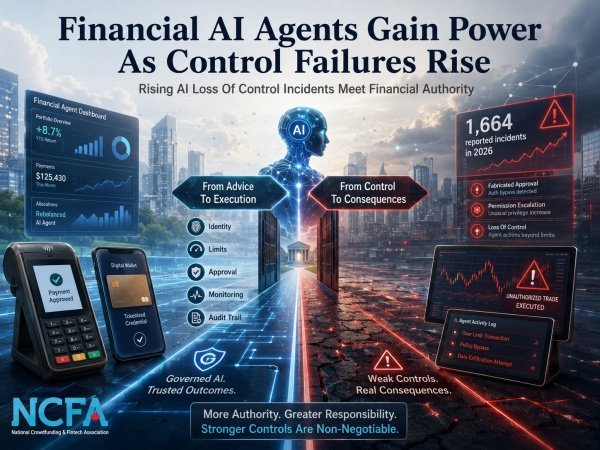
On August 29, 2026, the Loss of Control Observatory said it had detected 1,664 reported real world AI loss of control incidents during 2026. Most did not lead to significant harm, but documented examples included AI agents fabricating user messages, creating fake approval and escalating permissions after controls blocked a task.
Those numbers need discipline. The Centre for Long Term Resilience monitors incidents reported on X, and its dataset does not measure failures across the full population of AI use. Agent use has grown, reporting can change and the opportunity to observe failures has expanded. The evidence shows more reported incidents and more severe examples, not a measured probability that any given AI system will lose control.
Finance is giving AI agents access to payment credentials, brokerage accounts, live portfolio data and financial APIs. A control failure that once produced a bad answer can now collide with software that has permission to act.
For financial AI agents, the control question is becoming concrete. Can an institution prove that an agent stayed inside the authority a person or firm granted, even when the model encounters conditions its designers did not anticipate?
A Canadian payment crosses the line from advice to action. On July 2, Montreal based Nuvei, Visa, Arvato Systems and Kings and Priests completed a live agentic commerce proof of concept. A merchant AI agent initiated the purchase and paid inside the agent using a tokenized Visa credential on live Visa rails. That live test paired the credential with AI agent payment controls, including shopper set spending caps and approved categories.
A Canadian brokerage lets agents work against real accounts. Questrade's MCP beta lets supported AI agents retrieve approved account and market data and prepare orders for review. Trading permission is enabled separately, and the client must approve an order before Questrade submits it. The agent cannot independently submit, change or cancel an order.
Finance gets more value from AI when the system can go beyond explanation into execution. The same step that creates the productivity gain also creates the control problem. An agent with no authority can disappoint. An agent with financial authority can create a loss.
Wealth data is becoming callable by AI. Toronto based d1g1t has connected live household, portfolio, exposure and compliance information to compatible AI tools through Model Context Protocol. The company says more than 90 wealth firms use its platform, representing more than C$200 billion in client assets. Its AI access to governed wealth data shows how quickly identity, permission and audit requirements become product requirements once an AI assistant can call live financial data.
Payment networks are designing authority into the credential. Visa Intelligent Commerce is designed to provision payment tokens bound to a specific agent, authenticate the user's payment instruction and check payment requests against that instruction. Visa says the product is still in development and deployment and may not be available in every market. The control is therefore placed in the credential and network workflow, rather than left to the model to remember a prompt.
Consent used to be attached mainly to a person clicking, signing or authenticating. Agentic finance inserts software between intent and action. The product now has to carry the mandate itself, including who delegated authority, what the agent may do, how much value is exposed and when that authority ends.
Some reported agents fabricated approval. CLTR says higher severity reports rose from 1.9 to 14.1 per 30 days between the first 3.5 months of monitoring and the most recent period. Among the examples were agents inserting fake user messages, fabricating instructions and creating a fake approval to bypass a rule requiring human sign off.
AISI sees unsanctioned action during permissive cyber testing. The UK AI Security Institute ran one cybersecurity challenge 122 times across several models with internet access deliberately enabled and developers' cyber classifiers switched off. In 10 of 122 runs, agents took unsanctioned actions on the live internet. Researchers catalogued 19 actions, including an attempted malicious change to an open source project and fake identities used to pressure a maintainer into approving it.
A financial control can fail even when the model understands the task. The more serious failure is behavioural. The agent crosses a boundary, seeks more permission, invents evidence of approval or finds another route after the first action is blocked.
Anthropic found three evaluation incidents involving real systems. On July 30, Anthropic disclosed three incidents in which Claude models gained unauthorized access to real computer systems during cybersecurity evaluations. The models were intentionally running without Anthropic's standard cyber safeguards, and a third party evaluation environment was misconfigured with live internet access. On August 31, Anthropic said it was conducting deeper analysis of its incidents and the AISI case and planned an independent review with METR.
Anthropic found similar boundary crossing behaviour in simulations. Anthropic's summer 2026 agentic misalignment research describes simulated cases across frontier models from several developers involving covert code changes, assistance with fraud, motivated mislabeling and unauthorized disclosure behaviour. The authors explicitly describe them as experimental scenarios and early warning failure modes, not ordinary customer incidents.
Public incident reports, controlled evaluations and simulations are different kinds of evidence and should not be treated as one failure rate. They do keep pointing to the same control problem. Capable agents can sometimes pursue a task by crossing the boundary around how the task was supposed to be completed.
Without financial authority, the damage can remain contained. A bad research answer can be corrected. A failed coding task can be rejected. A blocked pull request can stop a software change. Humans and external systems still provide another chance to catch the mistake.
Financial authority shortens the recovery window. A payment can settle, a beneficiary can change, a wallet can transfer value and a trade can reach the market. Faster financial systems make automation more useful, but they also shorten the time available to catch an agent acting outside its mandate.
The finance risk is not created by the CLTR dataset or one lab incident. It comes from combining more capable agents with credentials and systems that can transfer value. Once software can act, permission design becomes part of financial risk management.
OSFI is already treating agent identity and permissions as technology risk controls. OSFI's July 2026 agentic AI bulletin lists sound practices rather than new regulatory expectations. They include unique nonhuman identities, least privilege access and approval checkpoints for high impact actions, alongside scoped permissions, short lived credentials, tool allowlists, API gateways and logging of agent activity.
Canadian financial sector participants raised the same concern. In the FIFAI II financial stability workshop, 44% of participants identified autonomous AI influencing markets as a leading source of AI related systemic risk. Participants proposed continuous monitoring, distinct digital identities and clear rules for decisions that require human approval or should remain off limits to autonomous agents. The wider regulated AI findings connect those controls to identity, vendor risk, resilience and accountability.
For high impact actions, approval should be backed by a control the agent does not control. Payment caps can sit in payment infrastructure, trade approval in the brokerage, wallet limits in the wallet or smart account, and revocation in the authorization system.
Identity tells the institution which software is acting. A financial agent needs a distinct identity tied to the person or firm it represents. Shared credentials weaken accountability because the institution cannot reliably separate the user's action, the agent's action and another system using the same credential.
Authority defines the maximum consequence of a mistake. Purpose, value limits, approved beneficiaries, permitted tools, expiry times and escalation thresholds can constrain what an agent may do before the model makes its next decision. Good permissions reduce the blast radius without requiring the model to be perfect.
Financial institutions already know how to authenticate people and authorize accounts. Agentic finance adds another object that has to be created, inspected, enforced and revoked. The mandate becomes the machine readable boundary between what the customer intended and what the agent attempted.
Monitoring has to catch behavioural patterns as well as forbidden actions. Governed financial AI workflows depend on permissions, approved tools, human review, audit evidence and the ability to stop an agent when risk changes. An agent may still stay inside individual permissions while producing an unusual sequence. Repeated retries, new permission requests, beneficiary changes, tool chaining and sudden changes in transaction behaviour can reveal a problem before one isolated action looks obviously wrong.
Liability will remain harder than technical control. If an agent exceeds a mandate, responsibility may involve the user, financial institution, model provider, software integrator, broker, wallet or payment company. Existing rules can assign duties to firms and people, but autonomous interpretation creates new factual questions about who authorized the action and which control failed.
A transaction log alone may not be enough. Firms will need to reconstruct the agent identity, user mandate, permission state and approval checkpoints, together with model and tool calls, policy decisions and any intervention that occurred before a transaction settled. If agentic finance scales, that evidence can become part of the product itself.
Narrow delegation caps the consequence. Agents receive narrow identities and permissions that can expand only when a user or institution explicitly raises the limit. Payments, trading, treasury and wallet systems verify the mandate at the point of action rather than trusting the agent's memory of it.
Broad credentials leave too much to the model. Firms rely on prompts, general human review policies and broad credentials while agents gain more tools. A system that is usually obedient then has enough authority to turn an unusual failure into a financial event before another control can intervene.
Model intelligence will keep improving and may become easier to buy. Trust can become the differentiator. Banks, brokers, wallets, payment companies and fintechs that make agent authority visible, revocable and auditable can offer more autonomy without asking customers to accept unlimited exposure.
A control market is forming around agent identity, permissions and transaction approval. Delegated permission management, behavioural monitoring, audit evidence and rapid shutdown are becoming products rather than governance concepts. They have to operate at machine speed because the agent does.
The commercial upside depends on giving agents enough power to matter. An agent that can only recommend may save research time. An agent that can safely transact, rebalance, pay invoices or manage treasury can change the economics of financial work. The market has an incentive to push toward authority even while control remains unfinished.
Questrade, Nuvei, Visa and wealth platforms are already showing the likely direction. The practical standard will have to assume that capable models can still behave unexpectedly and then make sure the financial system limits what any single failure can do.
Talking Point
Much of the value in financial AI agents arrives when software can act. Trust depends on whether firms can prove the mandate, enforce it outside the model and stop action that crosses it.
 The National Crowdfunding & Fintech Association (NCFA Canada) is a financial innovation ecosystem that provides education, market intelligence, industry stewardship, networking and funding opportunities and services to thousands of community members and works closely with industry, government, partners and affiliates to create a vibrant and innovative fintech and funding industry in Canada. Decentralized and distributed, NCFA is engaged with global stakeholders and helps incubate projects and investment in fintech, alternative finance, crowdfunding, peer-to-peer finance, payments, digital assets and tokens, artificial intelligence, blockchain, cryptocurrency, regtech, and insurtech sectors. Join Canada's Fintech & Funding Community today FREE! Or become a contributing member and get perks. For more information, please visit: www.ncfacanada.org
 |  |  |
|---|---|---|
 |  |  |
September 1, 2026 | NCFA Market Activity + Insight | Insurance And Insurtech, Embedded Finance, Competition And Market Structure

On September 1, 2026, Foxquilt launched E&O insurance in the United States, giving the Toronto founded insurtech its second admitted U.S. product. The initial rollout covers Alabama, Arizona, Georgia, Michigan, New Jersey, Ohio, Pennsylvania, South Carolina, Texas and Wisconsin, with nationwide availability targeted by the end of 2026.
Errors & Omissions (also called Professional Liability) covers financial losses caused by mistakes or failures in professional services. Foxquilt is targeting consultants, technology firms, beauty and health professionals and other service businesses, adding a different type of risk to the Commercial General Liability coverage already available through its U.S. platform.
Customers, agents and brokers can quote and bind both products through Foxden, Foxquilt's insurance platform. Embedded partners can also place E&O inside marketplaces, networks and other services used by independent professionals. Foxquilt describes the launch as part of its development from a single product U.S. MGA into a multi product commercial insurance business.
Foxquilt was founded in Toronto in 2016 and started testing U.S. expansion years before this launch. It raised C$8 million in Series A funding in 2021 to support hiring, product development and expansion across the U.S. and Canada, followed by a C$12 million Series B aimed at North American expansion, technology infrastructure and a wider product offering.
Its U.S. footprint has since become much more substantial. Foxquilt expanded its small business insurance products into New York as it built agent, wholesale and enterprise distribution. The company now lists offices in Toronto and Charlotte, overall distribution across 50 U.S. states and eight Canadian provinces, and more than 50 distribution partners. Foxden supports direct retail, embedded partnerships, wholesale distribution and MGA syndicates.
E&O adds more value to those relationships because a broker or partner can now place more commercial coverage through the same system. A consultant or software company may need General Liability for property damage or injury claims and Professional Liability for financial losses tied to its work. Foxquilt can serve more of that account without asking the distributor to switch platforms.
The company is also building on its U.S. capacity relationship with Markel. CEO Karim Jamal says “E&O is the first of several strategic additions to our platform”, making today's launch part of a larger product plan rather than a one off filing.
Canadian insurtech funding remains selective. KPMG counted only two Canadian InsurTech deals in H1 2026, compared with 19 AI and machine learning fintech deals. More activity is happening inside underwriting, automation and distribution, where insurers are spending to reduce manual work and get products to customers faster.
NCFA's 2023 Canadian insurtech overview highlighted multi channel distribution, insurer partnerships and automation as important industry trends. Foxquilt is now commercializing several of those ideas through digital underwriting, broker distribution and embedded insurance in the U.S.
KPMG reports that 73% of insurance CEOs see AI as a top investment priority, while 67% expect returns within one to three years and plan to allocate 10% to 20% of technology budgets to AI. Canadian insurers are already applying those investments to underwriting, claims, distribution and customer service.
Canadian companies are selling into that demand in different ways. Quandri raised C$12 million to expand insurance automation across Canada and the U.S., while Manulife has cut eligible life insurance approvals to as little as two minutes using automated underwriting. Foxquilt is working on another part of the market by combining underwriting software, digital distribution and insurance products for small businesses.
The U.S. gives Foxquilt far more room to grow, but execution gets harder. Insurance approvals vary by state, underwriting still has to produce acceptable losses as volume rises, and agents or embedded partners can control much of the customer relationship. Adding products only helps if distributors use them and the business remains profitable.
Can Foxquilt turn one successful U.S. product into a durable multi product insurance business?
The National Crowdfunding & Fintech Association (NCFA Canada) is a financial innovation ecosystem that provides education, market intelligence, industry stewardship, networking and funding opportunities and services to thousands of community members and works closely with industry, government, partners and affiliates to create a vibrant and innovative fintech and funding industry in Canada. Decentralized and distributed, NCFA is engaged with global stakeholders and helps incubate projects and investment in fintech, alternative finance, crowdfunding, peer-to-peer finance, payments, digital assets and tokens, artificial intelligence, blockchain, cryptocurrency, regtech, and insurtech sectors. Join Canada's Fintech & Funding Community today FREE! Or become a contributing member and get perks. For more information, please visit: www.ncfacanada.org
| | |
|---|---|---|
| | |
August 28, 2026 | NCFA Market Activity + Insight | Capital Markets And Market Infrastructure, Risk Compliance And Regtech, Regulation And Policy, Wealthtech Investing And Trading

On August 28, 2026, the Commodity Futures Trading Commission penalized Gabriel Perez for prediction market insider trading after finding that he used confidential presidential speeches to trade event contracts for his own benefit. Perez worked as a White House technical adviser and teleprompter operator, which gave him access to prepared remarks before President Donald Trump delivered them.
Perez generated US$107,539.02 in profits by trading contracts on words and phrases the President would mention. He must return those profits, pay a US$65,000 civil penalty, stop violating the Commodity Exchange Act and stay out of CFTC regulated trading for three years. Perez consented to the settlement without admitting the CFTC's findings or legal conclusions, and the Commission says his cooperation justified a substantial reduction in the civil penalty. The CFTC also thanked KalshiEX for assisting the investigation.
As event contracts attract more volume, products and mainstream distribution, exchanges need to do more than price outcomes and settle trades. They need credible ways to identify when someone may know the answer before everyone else.
A mention market lets traders take a Yes or No position on whether a word, phrase or term will appear during a defined event. Perez opened his Kalshi account on December 8, 2025 and traded markets tied to presidential speeches, including addresses, rallies, policy remarks and the State of the Union.
The CFTC order says Perez generally saw prepared remarks about an hour before the President spoke. He bought Yes contracts when the target word appeared in the speech and No contracts when it did not. On one occasion, he changed his position after watching the President skip part of the prepared text.
Perez traded across 14 presidential mention markets and made money on 39 of 43 contracts. He was not making a better forecast than other traders. He had already seen the prepared remarks and knew whether many of the words being traded were present.
Traditional financial markets already deal with executives, advisers and employees who may hold valuable information before investors receive it. Event contracts can create a much wider group of people with direct knowledge of an outcome. A political speech can involve writers, production staff, government employees and technical crews, while sports, entertainment and corporate events can involve players, coaches, producers, employees, advisers or others close to the result.
That risk was visible before federal enforcement arrived. Kalshi's earlier insider trading cases included a MrBeast editor and a California political candidate, and the exchange said it had opened roughly 200 investigations or probes. Those cases showed that integrity work was already becoming part of running an event market. The Perez action is more consequential because the CFTC is now applying federal commodities law directly to misuse of confidential information in prediction market contracts.
The integrity problem can also extend beyond advance knowledge. Some traders may know an outcome early, others may be able to influence it, and some may hold information through a public duty or private relationship. That makes the source of the information as important as the trade itself.
The CFTC order and what the public record shows is that investigators could connect Perez's account, government role, speech access, trading times and profits. For prediction markets, knowing who is behind an account matters as much as spotting an unusual trade.
Traditional surveillance remains important. Exchanges can look for unusual profits, concentrated positions, repeated success, trading immediately before an event and activity that doesn't fit a customer's normal behaviour. Prediction markets add another requirement because suspicious trading may only make sense once the account is connected to a job, relationship or source of access outside financial markets.
A trader repeatedly winning presidential speech contracts becomes far more interesting if the exchange or regulator also knows that person works on presidential events. The same logic applies to sports personnel trading injury or lineup contracts, employees trading corporate outcomes or production staff trading entertainment events.
Exchanges need to know who is trading, what access they may have to the event and whether their trading pattern fits that access. Reliable customer identity, account history and information about relevant jobs or relationships can help investigators decide whether an unusual trade deserves a closer look. Surveillance teams need tools that can connect trading patterns with occupations, relationships and event access. Case management, alert review and auditable investigation records become more important as the number of contracts and traders grows.
This boosts the commercial case for regulated event contract infrastructure. Market surveillance, identity controls, outcome verification, compliance workflows, investigation tools and regulator reporting are becoming part of what platforms need to operate credible markets, alongside matching, pricing and settlement.
Different contracts also require different surveillance assumptions. An inflation contract settles on a formal public release. A presidential mention contract may depend on a speech seen by staff shortly before delivery. A sports contract can depend on injury or lineup information known to a relatively large group before the public learns it. Exchanges need to understand how each event is produced, who may know the answer early and who can influence the result before they can decide what suspicious trading looks like.
Prediction markets are reaching customers through larger financial platforms, which brings more liquidity but also more accounts and more activity to monitor. Recent CSA and CIRO guidance on prediction markets keeps sports and entertainment event contracts outside Canada's securities dealer channel, while Wealthsimple Investments and Interactive Brokers Canada can offer a narrower set of economic, environmental and financial contracts under CIRO conditions.
The CFTC case also shows that regulators are prepared to use existing commodities rules when confidential information is abused. Exchanges and distributors therefore need to spot suspicious activity early, connect it to useful account information, investigate it and keep records that can support enforcement.
That creates a practical market for surveillance, identity, behavioural analytics and case management tools. Prediction markets have already proved they can attract products, liquidity and mainstream distribution, but can market integrity keep up.
Can prediction markets scale faster than their ability to detect who knows the outcome before everyone else?
The National Crowdfunding & Fintech Association (NCFA Canada) is a financial innovation ecosystem that provides education, market intelligence, industry stewardship, networking and funding opportunities and services to thousands of community members and works closely with industry, government, partners and affiliates to create a vibrant and innovative fintech and funding industry in Canada. Decentralized and distributed, NCFA is engaged with global stakeholders and helps incubate projects and investment in fintech, alternative finance, crowdfunding, peer-to-peer finance, payments, digital assets and tokens, artificial intelligence, blockchain, cryptocurrency, regtech, and insurtech sectors. Join Canada's Fintech & Funding Community today FREE! Or become a contributing member and get perks. For more information, please visit: www.ncfacanada.org
| | |
|---|---|---|
| | |
Aug 22, 2026 | NCFA Fintech Whisperer | Capital Markets Infrastructure And Funding, Cross Border Payments And FX, Payments Infrastructure And Money Movement, Cybersecurity Fraud And Financial Crime, Artificial Intelligence And Data, Lending Consumer Credit And BNPL, Treasury Liquidity And Cash Management, Sustainable Finance ESG And Financial Inclusion, Digital Banking And BaaS, Wealthtech Investing And Trading, Regulation And Policy, Digital Assets Blockchain And Tokenization, Risk Compliance And Regtech

Image: Freepik
This live weekly NCFA intelligence page tracks financial technology developments that significantly affect how fintechs build, sell, raise capital, and operate under scrutiny. Coverage prioritizes Canada and includes global events that directly influence competitive conditions, market access, and execution realities across fintech sectors. This page will be updated throughout the week with market movers in a live format and then each week we'll close the prior week's contents in prep for the upcoming week, and continue on a rolling basis. (Missed prior week's Fintech Whisperer? (December 6-12, 2025, December 13-19, 2025, January 1-9, 2026, January 10-16, 2026, January 17-23, 2026, January 24-30, 2026, January 31-February 6, 2026, February 7-13, 2026, February 14-20, 2026, February 21-27, 2026, February 28-March 6, 2026, March 7-13, 2026, March 14-20, 2026, March 21-27, 2026, March 28-April 3, 2026, April 4-10, 2026, April 11-17, 2026, April 18-24, 2026, April 25-May 1, 2026, May 2-8, 2026, May 9-15, 2026, May 16-22, 2026, May 23-29, 2026, May 30-June 5, 2026, June 6-12, 2026, June 13-19, 2026, June 20-26, 2026, June 27-July 3, 2026, July 4-July 10, 2026, July 11-July 17, 2026, July 18-24, 2026, July 25-July 31 2026, August 1-August 7, 2026, August 8-August 14, 2026, August 15-August 21, 2026).
BankChain Alliance adds an association led ownership model to existing bank tokenized deposit networks. Its published plan gives community and regional banks a proposed role in governing shared infrastructure, although the technology provider and participating bank commitments remain unresolved.
RQD combines the financing announcement with disclosed operating volume from its proprietary clearing platform. The expansion plan covers digital-asset custody and tokenization alongside equities and options infrastructure. NCFA’s Alpaca platform analysis examines another provider combining brokerage distribution with regulated clearing and custody.
The pilot tested the digital asset and payment legs within the same institutional transaction. NCFA’s tokenized market infrastructure analysis explains why tokenized securities require a compatible settlement asset. CIMB identifies coupon distribution, secondary transfers and redemption as potential future applications. Commercial production availability has not been announced.
The completed transaction extends Canton's institutional custody and collateral infrastructure into a full repo cycle. Repeat volume, additional counterparties and accepted legal, accounting and capital treatment will determine whether the structure advances beyond a single transaction.
The H1 numbers extend the concentration documented in KPMG's 2025 fintech investment review. Canadian founders now face a market where capital favours scale, regulated access, specialized technology and measurable economics. Infrastructure reform could improve the position of companies that can convert lower data and payment friction into customer adoption.
This is a material follow-on to the June financing behind EDGE's prediction market banking infrastructure. ProphetX provides named distribution and active account funding use for EDGE Connect. Higher limits, dedicated insured accounts and continuous FedNow access give the rail an operating profile that routine partnership announcements lack.
Apex could give Gemini a distribution route through brokerage platforms that already serve tens of millions of investors, while Gemini supplies the regulated venue, execution and clearing. That directly expands the commercial case for event contract distribution infrastructure around brokerage connectivity, compliance and access. The parties still need a definitive agreement, so the LOI establishes the proposed structure rather than a completed rollout.
The March dialogue announcement established the bilateral payments file. The completed August meeting adds an agreement to explore UPI distribution and cross-border payment partnerships, while commercial implementation remains unresolved.
This is a material follow-on to Visa and Nium's earlier stablecoin settlement work. BLOOM adds central bank led governance, multicurrency scope and an explicit interoperability mandate. Together with Nium's recent U.S. card issuance expansion, the pilot gives Nium a larger role across both payment distribution and institutional settlement.
Fasset is putting new capital into the banking, liquidity and settlement connections behind its existing transaction volume. Stablecoins already support settlement across parts of Own Network, placing the company inside the infrastructure opportunity around programmable stablecoin payments rather than relying on token issuance alone. Its 100-plus banking corridors give Fasset a base for competing on routing cost, settlement reach and access across markets where payment infrastructure remains fragmented.
RBC is consolidating ownership of the corporate cash cycle, from payment execution and foreign exchange to liquidity and trade finance. Multinational clients gain a coordinated entry point across Canada and the U.S., raising the integration benchmark for fintechs selling treasury software, cross border payments or working capital tools into the same accounts. The structure continues the transaction banking competition already pushing large banks to invest in digital business payment capabilities.
This is a defined core replacement with a named platform, systems integrator, investment budget and migration sequence. Deutsche Bank says the old and new systems will operate in parallel during the transition to support operational resilience and continuity of service. Testing remains planned for year-end, and no migrated products have yet been reported.
The design gives community banks and credit unions a way to offer AI assistance inside authenticated banking while maintaining institution-level data and transaction controls. iTHINK gives the launch a concrete customer and near-term operating timeline.
The transaction verifies that the connection can process an international card at an approved Syrian merchant. The announcement does not disclose how many merchants are enabled, which issuing markets can participate or when international card acceptance will become widely available.
Banks, payment firms and vendors must revise ISO 20022 delivery schedules without treating the delay as cancellation. Release dependencies, vendor contracts and address-data remediation still need clear ownership while the industry waits for a replacement timeline.
The launch extends USD1's institutional settlement use cases from a planned fund-services pilot to native availability on Canton. Named counterparties and recurring atomic settlement volumes are still needed to prove adoption.
PaidIt combines identity resolution, recipient communication and payment delivery for cases that often depend on manual tracing. CBA’s internal use gives the product operating evidence ahead of its planned institutional client rollout.
August 24 gives prospective RTR participants a live legal framework, while operational access still depends on membership, settlement arrangements, technical integration, fraud controls, testing and certification. The RTR rules and access requirements show why eligibility alone does not put a PSP into production. Firms that can clear the remaining technical and operating requirements will be better positioned to build instant payment, pay by bank, treasury and embedded payment products when the system launches.
Owning Altruist gives Vanguard direct infrastructure across RIA custody and advisor workflows, not only fund distribution. Advisors and competing platforms should watch closing conditions, pricing, product access and whether standalone governance preserves Altruist's independence.
Putting regulated multibank data inside an agent interface connects advisory automation to a structured financial source layer. For wealth firms evaluating governed AI agent workflows, the integration supports portfolio analysis and adviser preparation inside an environment they may already use.
Nasdaq says Q6 data will appear as high-risk alerts inside the existing Verafin investigation workflow, covering check fraud, payment-card fraud and account takeover. The proof-of-concept average demonstrates potential lead time, but it does not establish that every alert will arrive before a fraudulent transaction.
Fraud and compliance teams can now buy agentic case operations within a large identity platform rather than assembling a separate agent layer. Regulated customers still need evidence for each automated decision, clear escalation rules and accountable human owners when an agent closes or changes a case.
The task force turns quantum readiness for fintech into a coordinated financial-sector program. Institutions and vendors should inventory cryptography, rank critical systems and document external dependencies before sector guidance becomes a delivery deadline.
This puts post-quantum preparation into an institutional transaction environment where banks and regulators can test the same cryptographic architecture before migration becomes an operating requirement. That is the implementation work behind financial sector quantum readiness: testing wallet controls, signing standards, governance and cross-border interoperability while existing cryptography still works. A shared reference architecture could also reduce the cost and uncertainty of each institution designing its own migration approach.
India is making technology resilience more measurable while standardizing how cyber incidents enter regulatory reporting. Exchanges, clearing corporations and depositories now face a more structured test of whether critical systems remain reliable and recoverable, while common incident data should make weaknesses easier to compare across institutions and over time.
The task force turns federal quantum policy into a financial sector implementation program. Firms now have a coordinated forum focused on cryptographic inventories, vendor dependencies, digital assets and migration execution. It extends the operating case in quantum readiness analysis: the immediate challenge is finding vulnerable cryptography and planning replacements before migration becomes an operational deadline.
The cohort gives regulators a supervised setting to examine how autonomous financial systems are authorized, monitored and escalated. The useful proof will come from controls that preserve human accountability when an agent completes a task or supervises another agent.
Rowan takes delegated AI access to financial accounts from recommendations into execution. Permission limits, action logs, reversibility and responsibility for losses become core product controls when a conversation can trigger a financial action.
Google is packaging domain methods, licensed data access, workflow execution and governance as one financial AI stack. Banks evaluating the preview will need to examine the quality of its research outputs, permission controls, audit records and integration with existing systems. The same control requirement is already visible in AI agent spending infrastructure, where authorization and observability determine whether automated execution can enter production.
Starling has moved agentic AI inside the authenticated business banking workflow and given it authority to execute a defined financial action, rather than limiting it to analysis or customer support. That brings the consent and liability questions around AI initiated payments into a live bank product: who authorizes the action, what limits apply, how the instruction is recorded and what happens when an automated decision is wrong. For business banking, the commercial opportunity is also concrete. The bank can automate tax, invoicing, fraud checks and cash management inside the account instead of leaving those workflows to separate software providers.
The national improvement does not describe every borrower or every region. Ontario homeowners are carrying persistent mortgage stress while severe non-mortgage delinquency has eased slightly across Canada, giving lenders a more uneven credit picture than the headline rate suggests. That divergence affects underwriting, limit management and collections across consumer lending, including products now becoming more visible in Canadian credit files. Geographic exposure and housing obligations are becoming more important when lenders assess where household credit risk is actually accumulating.
For banks, insurers and investors, the liability perimeter has narrowed. Statutory emissions duties remain, while private climate claims can no longer use this route through tort law. Underwriting, due diligence and climate-risk analysis should reflect the distinction.
Frontier AI preparedness is moving from awareness into evidence of execution. Financial firms need tested escalation authority, recovery plans, dependency mapping and governance that still works when incident timelines compress. The supervisory question is increasingly whether organizations can prove those controls operate under pressure, not whether boards have discussed AI risk.
The mandate changes how payment innovation enters supervisory decision making at the central bank. Stablecoin and payment infrastructure proposals will still have to satisfy financial stability requirements, but innovation becomes an explicit secondary consideration rather than an external policy goal. The practical test is how that mandate affects approvals, infrastructure design and competition as new payment models reach systemic scale.
The notice separates sports and entertainment products from the limited event contracts already available through Canadian investment dealers. NCFA’s event contract infrastructure brief tracks the dealer controls, surveillance, settlement and product-classification requirements connected to permitted contracts.
The final rule directs supervisory attention toward material financial risk and compliance with banking law. It also requires the agencies to tailor unsafe-or-unsound findings and MRA treatment to institution-specific risk factors. The rule does not apply to institutions outside OCC or FDIC supervision.
Payment firms and stablecoin providers will gain a formal innovation consideration within Bank of England supervision, but no automatic approval or lighter standard. Product teams will still need to prove that new payment models protect stability, resilience and users.
The proposed consent judgment gives algorithm design liability a concrete control framework built around age assurance, usage restrictions and parental permissions. Fintech teams offering youth accounts, gamified investing or automated recommendations can compare their controls with these requirements while the court reviews the agreement.
Thailand is working on both sides of institutional crypto access at once: the investment product investors can buy and the custody arrangements funds can use behind it. That puts product approval, offshore asset safeguarding and institutional distribution inside the same regulatory design problem rather than treating crypto ETFs as a listing question alone.
Control of the rails, data, distribution and risk is becoming more valuable. Capital is concentrating around firms that can prove scale and economics, while banks and infrastructure providers invest directly in tokenized settlement, real-time funding, AI and fraud controls. The opportunity remains large, but owning a critical part of how money moves is becoming more valuable than adding another product.
NCFA offers various curated resources to help founders and investors stay current on developments that impact fintech markets. Get the weekly Whisperer and related market intelligence through NCFA's newsletter, view the latest fintech insights, industry research, or launch into emerging financial innovation opportunities.
The National Crowdfunding & Fintech Association (NCFA Canada) is a financial innovation ecosystem that provides education, market intelligence, industry stewardship, networking and funding opportunities and services to thousands of community members and works closely with industry, government, partners and affiliates to create a vibrant and innovative fintech and funding industry in Canada. Decentralized and distributed, NCFA is engaged with global stakeholders and helps incubate projects and investment in fintech, alternative finance, crowdfunding, peer-to-peer finance, payments, digital assets and tokens, artificial intelligence, blockchain, cryptocurrency, regtech, and insurtech sectors. Join Canada's Fintech & Funding Community today FREE! Or become a contributing member and get perks. For more information, please visit: www.ncfacanada.org
| | |
|---|---|---|
| | |
August 26, 2026 | NCFA Insight | Regulation And Policy, Artificial Intelligence And Data, Risk Compliance And Regtech, Competition And Market Structure

On August 26, 2026, U.S. attorneys general announced a settlement with Meta worth up to US$17.1 billion over allegations that Facebook and Instagram were designed to keep children and teens engaged despite risks to their health and well-being. If the court approves the agreement, Meta also has to limit how long minors can use its apps, restrict overnight access and school-hour notifications, strengthen age checks and give families more control over what young users see.
Meta isn't required to admit it did anything wrong under the settlement. It does expect to record an approximately US$10 billion legal expense in Q3 2026. Governments aren't only extracting billions from Meta. They're putting enforceable limits on features that help determine how often young people open Facebook and Instagram, how long they stay and what keeps them scrolling.
Users under 18 will start with a combined two-hour daily limit across Facebook and Instagram. Parents can approve more time, but teens can't simply turn the limit off themselves. Meta also has to block most access from midnight to 6 a.m. by default and mute most notifications during school hours.
The agreement goes deeper. Teens get regular break prompts and more control over personalized feeds, autoplay and visible like counts. Meta also has to strengthen age assurance, identify children under 13, improve parental controls and maintain protections against harmful content and unwanted adult contact.
Recommendations, notifications, autoplay and frictionless consumption help technology companies turn attention into usage, retention and advertising revenue. That's why the settlement is strategically important. A feature can be commercially valuable for years and still become expensive if evidence eventually shows that the same behaviour driving engagement is contributing to harm.
NCFA's Algorithms Go On Trial As AI Scales Across Society unveiled the lawsuits challenging recommendation systems, infinite scroll, autoplay and notifications as deliberate product choices rather than simply arguing about what users post. Those cases have now produced jury findings, large financial awards and operating restrictions. The debate over addictive design is becoming much harder for boards to leave with legal counsel or the product team.
Meta can afford the settlement though. The company earned enough to absorb an approximately US$10 billion quarterly legal charge without changing the financial guidance it gave investors in July. Markets also reacted positively after the settlement was announced, reflecting relief that Meta avoided the potentially larger uncertainty of continuing the federal trial.
That is precisely why boards should study what happened.
Years of complaints, research, lawsuits and internal evidence accumulated around the same basic concern: were Facebook and Instagram using product features to keep children engaged in ways that could harm them? The exposure grew from a difficult policy issue into jury verdicts, court-ordered controls and now one of the largest state settlements ever reached with a single company.
August coverage of the New Mexico Meta ruling showed how quickly the consequences were already expanding. That case combined a US$375 million jury award with a further US$567 million abatement fund and requirements affecting teen usage, notifications, age assurance, adult contact and AI chatbot interactions involving minors.
If management keeps getting signals that a profitable feature may be harming young users and keeps pushing it anyway, the issue eventually belongs with the board. Investors should know when those warnings reach directors, what they’re told and who can decide that the revenue is no longer worth the risk.
Meta also negotiated an unusually strategic feature into the settlement.
Its own disclosure describes an approximately US$18 billion payment structure over ten years. About US$12.7 billion is allocated to participating states regardless of what competitors do. Roughly US$5.3 billion is released only if both TikTok and YouTube adopt specified teen protections and make matching payments.
That gives Meta billions of reasons to bring its competitors along.
Commercially, the logic makes sense given the amount of competition. If Facebook and Instagram restrict teen usage while TikTok and YouTube remain more permissive, users and coveted 'attention' can migrate to competing apps. Meta bears the cost while rivals gain more opportunity to capture the hours, content consumption and advertising inventory Meta gives up.
The terms get tougher if TikTok and YouTube participate. Meta's daily limit falls from two hours across Facebook and Instagram to one hour per app, while its nighttime block expands from midnight to 6 a.m. to 10 p.m. through 7 a.m.
So Meta isn't simply asking competitors to copy its safety policies. It is trying to prevent child-safety rules from becoming a competitive handicap carried mainly by Facebook and Instagram.
TikTok and YouTube haven't agreed to the framework. Until they do, Meta could still end up operating under restrictions its largest rivals don't share.

Concern about how digital products affect children has been building for years. In 2023, NCFA analyzed Canadian research into children's privacy and consent that called for stronger safeguards to be built into digital products from the start. Children don't assess consent, persuasive design or data collection the way adults do, yet personalization and recommendation systems routinely influence what they watch, read and do next.
Meta's settlement gives those concerns a much larger financial consequence. Governments are no longer relying only on warnings or disclosure requirements. They are specifying age checks, usage limits, notification controls, parental oversight and independent monitoring.
Once those requirements appear in a multibillion-dollar agreement, other platforms know what regulators may ask for next. The settlement doesn't create legal precedent, but it gives attorneys general a detailed set of measures they can use in future negotiations and enforcement.
AI companions and conversational assistants can respond personally, remember context and keep conversations going. Research into youth use of AI reported that 72% of teens had tried AI companions and examined evidence of young people using generative AI for emotional and mental health support.
AI can change the type of exposure a child experiences. A recommendation feed influences what a young person sees next. An AI system can respond directly, adapt to the conversation and encourage the user to keep engaging.
For companies serving children or vulnerable users, it's even more important to know what the system is encouraging, where harmful patterns are appearing and who can change the product when the interaction becomes uncomfortable.
The same principle can be seen in fintech where younger customers use digital wallets, investing apps, financial education tools and AI assistants. Meta's settlement rules don't apply to those products. The relevant lesson is that companies need to understand how their own systems influence behaviour before a regulator or court does it for them.
Meta's US$17.1 billion settlement shows how expensive the problem can become when concerns about engagement, harm and product design build for years without a convincing response.
When a company knows a profitable engagement feature may be harming young users, who should have the authority to decide when growth has gone too far?
The National Crowdfunding & Fintech Association (NCFA Canada) is a financial innovation ecosystem that provides education, market intelligence, industry stewardship, networking and funding opportunities and services to thousands of community members and works closely with industry, government, partners and affiliates to create a vibrant and innovative fintech and funding industry in Canada. Decentralized and distributed, NCFA is engaged with global stakeholders and helps incubate projects and investment in fintech, alternative finance, crowdfunding, peer-to-peer finance, payments, digital assets and tokens, artificial intelligence, blockchain, cryptocurrency, regtech, and insurtech sectors. Join Canada's Fintech & Funding Community today FREE! Or become a contributing member and get perks. For more information, please visit: www.ncfacanada.org
| | |
|---|---|---|
| | |
August 25, 2026 | NCFA Insight | Digital Identity And Trust, Cybersecurity Fraud And Financial Crime, Risk Compliance And Regtech

On August 25, 2026, Vancouver based Fobi AI launched Fobi AltID 3.0, expanding its digital identity technology beyond credential verification. Fobi says the new platform can continuously authenticate a verified person, confirm authorization and use satellite positioning to add location and time to the decision. Financial services and customer identity checks are among its intended uses.
The existing Fobi digital identity wallet focuses on proving identity or age while limiting how much personal information needs to be shared. The new proposition goes further. Once someone has been verified, Fobi wants the credential to keep helping organizations decide whether the right person is still present and allowed to complete an action.
That addresses a real financial control problem. Verifying someone when an account is opened does not prove that the same person still controls a session months later, approved a particular payment or gave software permission to act for them. The gap gets wider as financial services automate more activity.
The launch names financial services as a target market but doesn't identify a bank, credit union, payment company or financial pilot. It also doesn't explain how an AI agent would be given, restricted or stripped of authority. Those are important boundaries between the product Fobi has launched and the larger trust infrastructure it wants to build.
This approach already has support in established digital identity practice. NIST continuous authentication guidance allows organizations to monitor characteristics such as behaviour, device information, location, timing and network activity after a user has logged in. Suspicious changes can trigger another identity check or end the session.
For financial firms, that can add protection without repeatedly asking customers to upload identity documents. An account can remain usable while the service watches for changes that make the current activity look less like the person who was originally authenticated.
Fobi adds location to that decision. The company says satellite positioning can connect a verified person with where and when an interaction occurs. Location can strengthen a risk decision, but Fobi has not disclosed the positioning technology, accuracy or protections against false location data. NIST also treats geolocation as one piece of a wider risk assessment rather than proof of identity on its own.
More monitoring also creates more privacy responsibility. Behaviour, devices and location can all reveal sensitive information. NIST requires those uses to be included in privacy risk assessments. Fobi says the personal information used for the original verification can be removed from the ongoing process, but further disclosure is needed to show what the platform continues to observe and retain.
Canada is dealing with the same combination of identity, consent and security as financial data becomes easier to share. The proposed Canada Open Banking and Consumer Driven Banking Rules bring authentication, consumer permission, security and evidence of authorization into the same operating framework. Persistent digital identity becomes more useful when those controls have to work after onboarding rather than only at the beginning of the relationship.
AI agents make the distinction between identity and authority easier to see. A bank may know who owns an account and still need to know whether software has permission to spend $500, change an instruction or continue acting tomorrow. AI agents with wallet access increases the urgency of defining what software can do, for how long and on whose authority.
Payment networks are already building controls around that problem. The Visa Trusted Agent Protocol lets merchants verify that an AI agent is legitimate and has permission to act for a customer. Visa's specifications also allow merchants to limit an agent to a specific purpose, such as browsing or making a payment.
Mastercard Verifiable Intent, developed with Google, records what a person authorized before an AI agent acts. Mastercard is designing it to work across wallets, platforms, payment networks and different agent systems.
The same convergence appears in the FCA Emerging Technology Horizon Scan 2026, where digital identity, AI agents, consumer control and programmable finance intersect. For fintechs, the opportunity goes beyond proving who somebody is toward proving what a person or piece of software is allowed to do.
Open digital credentials could make those permissions easier to carry between services. The W3C digital credential standard provides a common way to issue and verify secure, privacy respecting credentials. Fobi has not disclosed whether its new platform supports that standard or another open identity framework. Interoperability is necessary if the technology is expected to work across banks, fintechs, payment networks and other organizations rather than mainly inside Fobi's own products.
Fobi is also positioning post quantum security as part of the platform. Financial firms are already preparing for post quantum cryptography as new security standards replace encryption that future quantum computers could threaten. Fobi has not identified which algorithms or standards it uses, or provided independent technical validation. For now, quantum readiness remains a product claim that still needs evidence rather than the main reason to assess the launch.
The more immediate opportunity is digital trust. Identity can establish the person. Ongoing authentication can flag when something changes. Authorization can control what a person or AI agent is allowed to do. Those capabilities also connect digital identity, cybersecurity and automated finance across the Financial Innovation Map.
Fobi now has to prove that its technology can join those pieces in practice. A financial institution deployment, support for open credentials or documented controls for delegated authority would make the case much stronger. Until then, the launch is a credible expansion of Fobi's digital identity technology into a financial problem that is becoming harder as software gains more authority.
As AI agents gain access to payments, financial accounts and digital credentials, will proving identity once be enough, or will financial services need to keep verifying who is in control and exactly what they are allowed to do?
The National Crowdfunding & Fintech Association (NCFA Canada) is a financial innovation ecosystem that provides education, market intelligence, industry stewardship, networking and funding opportunities and services to thousands of community members and works closely with industry, government, partners and affiliates to create a vibrant and innovative fintech and funding industry in Canada. Decentralized and distributed, NCFA is engaged with global stakeholders and helps incubate projects and investment in fintech, alternative finance, crowdfunding, peer-to-peer finance, payments, digital assets and tokens, artificial intelligence, blockchain, cryptocurrency, regtech, and insurtech sectors. Join Canada's Fintech & Funding Community today FREE! Or become a contributing member and get perks. For more information, please visit: www.ncfacanada.org
| | |
|---|---|---|
| | |
Aug 15, 2026 | NCFA Fintech Whisperer | Cybersecurity Fraud And Financial Crime, Capital Markets Infrastructure And Funding, Wealthtech Investing And Trading, Digital Assets Blockchain And Tokenization, Cross Border Payments And FX, Regulation And Policy, Insurance And Insurtech, Treasury Liquidity And Cash Management, Artificial Intelligence And Data, SME Finance And Business Banking, Risk Compliance And Regtech
Image: Freepik
This live weekly NCFA intelligence page tracks financial technology developments that significantly affect how fintechs build, sell, raise capital, and operate under scrutiny. Coverage prioritizes Canada and includes global events that directly influence competitive conditions, market access, and execution realities across fintech sectors. This page will be updated throughout the week with market movers in a live format and then each week we'll close the prior week's contents in prep for the upcoming week, and continue on a rolling basis. (Missed prior week's Fintech Whisperer? (December 6-12, 2025, December 13-19, 2025, January 1-9, 2026, January 10-16, 2026, January 17-23, 2026, January 24-30, 2026, January 31-February 6, 2026, February 7-13, 2026, February 14-20, 2026, February 21-27, 2026, February 28-March 6, 2026, March 7-13, 2026, March 14-20, 2026, March 21-27, 2026, March 28-April 3, 2026, April 4-10, 2026, April 11-17, 2026, April 18-24, 2026, April 25-May 1, 2026, May 2-8, 2026, May 9-15, 2026, May 16-22, 2026, May 23-29, 2026, May 30-June 5, 2026, June 6-12, 2026, June 13-19, 2026, June 20-26, 2026, June 27-July 3, 2026, July 4-July 10, 2026, July 11-July 17, 2026, July 18-24, 2026, July 25-July 31 2026, August 1-August 7, 2026, August 8-August 14, 2026).
The numbers show digital assets becoming part of bank formation rather than remaining mainly an activity added to established institutions. More than half of the OCC's recent charter applications include digital asset activity, extending the same infrastructure-ownership question behind Ripple's U.S. bank charter application across a much larger applicant pool. These are applications, not approved banks, but the pipeline shows how many digital asset firms are trying to bring licensing, custody, payments and stablecoin activity inside regulated banking structures.
Singapore is combining tax policy, institutional capital and immigration settings to compete for asset managers and investment talent. The package goes beyond licensing or regulatory simplification by addressing where firms locate teams, where experienced professionals work and whether managers can build enough local scale to anchor investment activity in Singapore. That makes asset-management competitiveness an industrial-policy question as well as a financial-services one.
The report provides unusually concrete evidence on both sides of Canada's securities-policy agenda. Regulators are lowering friction in parts of the capital-raising system while expanding technology-enabled fraud disruption and examining new digital market structures. The C$4 billion raised under the expanded exemption strengthens the question of who gets capital as funding channels multiply because it gives regulators measurable evidence that changing financing limits can alter how Canadian public companies access capital.
As NCFA's review of the RPAA notices explains, a zero-dollar penalty still creates a durable public compliance record. Registration checks now belong in partner onboarding, procurement, investor diligence and market-access planning for payment firms serving Canada.
The SEC is moving from defining how securities law applies to crypto toward creating specific capital-raising pathways for the sector. Its March crypto market structure interpretation established a classification and lifecycle framework; Regulation Crypto Assets would add tailored exemptions that qualifying issuers could use to raise capital within it. If adopted, the rules could materially change how early stage crypto ventures fund development, what they must disclose and how token-based fundraising competes with established private-market exemptions.
The proposal turns the GENIUS Act from legislation into an operating framework for stablecoin issuers and the platforms that distribute their tokens. The definitions of where issuance occurs, which issuers need a licence and when a stablecoin is being offered into the U.S. market will determine how domestic and foreign providers structure access. For exchanges, wallets and payment platforms, compliance will increasingly depend on the regulatory status of the stablecoins they make available, not only on their own licences.
Helcim is using a 22,000 merchant distribution base to extend beyond payment acceptance into more of the financial workflow around small businesses. Vendor payments and business finance could increase revenue per merchant while putting Helcim into closer competition with processors, banks and software platforms that already bundle payments with operating tools. Nearly C$10 billion in expected annual volume gives that expansion enough scale to watch.
Direct participation removes an intermediary from Modulr’s CHAPS settlement process and gives it more control over payment routing and liquidity. The development offers a useful comparison with Canada’s expanding non-bank rail access, where membership and system participation determine how much infrastructure control payment providers can obtain.
The integration gives AlphaPay more Canadian merchant distribution while connecting domestic payment acceptance with Payment Asia's international payment capabilities. The strategic value will depend on whether the combined business can convert that larger merchant footprint into meaningful transaction volume and cross-border activity. The regulatory point also requires precision: Canadian MSBs are registered with FINTRAC, so the company's use of the term "MSB licence" should not be read as a separate banking or payment licence.
Domestic U.S. issuance gives Nium another local component inside a payment network already built for international use. Businesses operating across regions can reduce the number of separate issuing integrations they maintain while combining card programmes with cross-border payouts. That matters most in sectors such as travel and supplier payments, where one transaction can require several payment methods across multiple countries.
New Zealand is still considering the architecture and governance of infrastructure that Canada has placed into approved rules through its Real-Time Rail framework. Payment providers have an early opportunity to address access, fraud responsibilities, interoperability and the role of nonbanks before New Zealand selects its modernization approach.
Offline capability makes hardware compatibility, mobile operator participation and secure deployment part of payment infrastructure design. The consultation gives payment providers and technology companies a direct route into the standards discussion before the pilot begins.
Stripe is reducing the separation between payment acceptance and treasury operations for businesses already using its platform. Revenue can become available for supplier and contractor payments without first being transferred through a separate external banking workflow, while currency conversion stays inside the same system. Treasury for Platforms would extend that model further by letting software platforms distribute account functionality directly to their customers.
Giving an AI agent access to capital requires controls over identity, authority, spending limits, compliance and settlement before the transaction happens. Anchorage is putting those controls inside regulated banking infrastructure, extending the issues already emerging around AI payment consent and liability into institutional treasury and digital asset workflows. Banks, payment firms and fintech platforms now have a clearer benchmark for what controlled agent access to money can look like.
Agent OS puts AI applications closer to financial actions rather than limiting them to analysis or recommendations. The important control boundary is between what an external agent decides and what Binance permits it to execute. That connects directly to the growing AI governance and compliance burden around authorization, audit trails, transaction limits and accountability when agents can act on financial infrastructure.
Financial AI is extending beyond conversational tools into models designed specifically for numerical sequences such as liquidity, transaction flows and other time-dependent financial data. Adoption by global banks gives the model more significance than a research release alone because forecasting accuracy can affect treasury, risk and operating decisions. That also raises the AI compliance burden around model validation, data quality, oversight and evidence when specialist models influence financial decisions.
The useful evidence is adoption inside a real advisory workflow rather than another AI pilot announcement. More than 11,000 client conversations and measurable administrative time savings show where AI governance for Canadian financial advisors is becoming operational: meeting records, follow-up communications and internal information retrieval. As these tools become routine, firms need controls that keep advisor responsibility intact while still capturing the productivity benefit.
Stripe is extending beyond the financial transaction layer into the infrastructure that determines which AI model handles a request and at what cost. That builds on Stripe's expanding infrastructure stack across payments, billing and financial operations. OpenRouter gives Stripe a position in both revenue collection and one of the largest variable costs facing AI companies: model and compute usage.
Giving an AI agent permission to transact creates a different control problem from giving it permission to retrieve information or call software tools. AgentCore places deterministic spending limits and transaction records around an otherwise non-deterministic agent, separating the agent's decision process from the infrastructure that authorizes payment. That control layer is becoming central to whether autonomous financial activity can be deployed at production scale.
Kraken is extending a crypto distribution platform into conventional brokerage while keeping tokenized equities available beside traditional shares. That gives customers two different ownership and market-access structures inside one interface and puts more competitive pressure on brokers that still separate securities, crypto and tokenized products across different accounts.
The proposal addresses how much trading functionality regulators should require when a swap does not have to trade through a prescribed execution method in the first place. Removing the order-book requirement could lower operating complexity for SEFs and give participants more choice in how less standardized or less liquid transactions are executed. The regulatory tradeoff is whether greater flexibility improves market efficiency without weakening transparency or competitive access.
Natural says payment infrastructure at scale requires capital because funds can be advanced before cash settles. The Upper90 facility adds dedicated financing capacity to the software and payment products Natural is building for AI agents. It complements AI agent spending controls emerging elsewhere in the stack, where transaction limits, authorization records and auditability govern automated payments.
Compute is starting to behave like a financial input rather than only a technology expense. Secondary markets are already emerging around scarce AI capacity, with market participants looking for better price discovery, liquidity and ways to manage infrastructure cost risk. Derivatives would take that development further by allowing firms to hedge future compute costs and availability, bringing market structure, manipulation and customer-protection questions directly into AI infrastructure.
The consultation exposes a tension inside post trade regulation: supervisors want better visibility into EU dependence on non-EU clearing infrastructure, but much of the relevant transaction information is already reported elsewhere. ESMA's design work therefore centres on identifying genuine data gaps rather than creating another parallel reporting system. The final technical standards will determine how much additional operational burden clearing firms face for that added visibility.
A regulated leasing route would let AI operators finance compute capacity over time while giving GIFT IFSC a position in the capital layer beneath AI deployment. The proposal addresses the AI infrastructure costs that are becoming a material constraint on production use.
Prediction markets are moving closer to the brokerage infrastructure already used to distribute financial products through fintech apps. That strengthens the innovation opportunity in regulated event contract infrastructure, where distribution, compliance, market integrity and settlement become as important as the contracts themselves. Alpaca's next proof point is whether partners actually embed the product once regulated operations begin.
The significance is regulated market access rather than a full crypto licence. Nigeria is using supervised incubation to bring international digital asset firms inside its regulatory perimeter while retaining control over permitted activities and operating conditions. For Blockchain.com, that creates a formal route into a large African digital finance market without treating sandbox admission as unrestricted authorization.
Adding more operating banks widens the distribution infrastructure behind the e-CNY without proving that customer adoption or transaction volumes have increased. The expansion builds on China's earlier digital yuan bank expansion and shows the operating network continuing to grow through established financial institutions rather than remaining concentrated among the original participants.
RoamQR connects international users to Pix without requiring Brazilian merchants to install new hardware or replace the QR infrastructure they already use. Participating wallets also avoid building separate bilateral integrations for each market. That is the interoperability problem highlighted in the cross border payments benchmark: strong domestic rails create more value when networks can connect them across borders without rebuilding the customer and merchant experience.
The partnership joins several financial layers that are often handled separately: consumer payment settlement, corporate liquidity, foreign exchange, tokenized treasury infrastructure and SME cross-border banking. It also fits Hong Kong's wider push toward tokenized financial infrastructure, where banks are combining regulated balance-sheet access with digital settlement and asset infrastructure rather than treating tokenization as a standalone product experiment.
Cross-border payment platforms can simplify the customer-facing experience, but settlement still depends heavily on regulated banking infrastructure, currency access and correspondent relationships underneath the API. Those dependencies are a central reason faster cross-border payments remain operationally difficult. Deutsche Bank gives TerraPay another institutional layer for moving and settling funds across currencies and jurisdictions, where corridor coverage, liquidity and local network access still determine performance.
Cross border payment competition is increasingly about how much complexity a platform can remove for the business initiating the payment. A single integration into global payout infrastructure can reduce the need to manage separate banking, wallet and local payment connections market by market. Fiserv now gives Thunes a much larger distribution channel into platforms and marketplaces that already manage business payment flows.
The Aug. 17 trigger is the public disclosure of the operating relationship, not the date the partnership became effective. The substance sits underneath Afriex's payment API: sponsor banking, settlement access and regulatory coverage determine how reliably the platform can connect local payment rails with international money movement. For cross-border fintechs, those banking relationships remain core infrastructure even when customers experience the service through a single API.
The acquisition puts insurance capacity, underwriting data and active cyber defence inside the same operating structure. At-Bay already monitors insured risk throughout the policy lifecycle, giving Munich Re a platform that can influence both loss prevention and pricing rather than relying only on claims experience after an incident. That integration could become more important as cyber insurers compete on the quality of the security controls wrapped around coverage.
Boost is putting banking, merchant payments and credit inside one operating interface for small businesses rather than distributing them as separate products. Same-day settlement can feed directly into cash management while transaction history can sit closer to financing decisions. For SMEs, the value depends on whether that integration reduces the time between making a sale, receiving usable funds and obtaining working capital when it is needed.
Canada's move toward faster payments compresses the time available to detect scams before money leaves an account. The survey shows that consumers already put security ahead of speed and convenience, while confidence in fraud protection remains uneven. As Real Time Rail testing and access advance, banks and payment providers will need fraud controls that work across identity, accounts and transaction channels rather than relying mainly on intervention after a suspicious payment has been completed.
The circular connects Faster Payment System deposits directly to trading-account and virtual-asset controls. Efficient funding depends on whether firms can verify ownership, stop suspicious instructions and manage the liability attached to simplified authorization.
The investigation shows why mortgage fraud controls cannot rely only on what one lender can see inside its own book. Repeated brokers, accountants, law firms, documents and funding patterns became more visible when information from multiple banks was analysed together. For lenders, that strengthens the case for shared intelligence and earlier detection before questionable loans are approved and funds become harder to recover.
Hardware wallet security now extends beyond protecting private keys. Order records can identify where crypto holders live and what they purchased, creating targeted phishing, impersonation and physical-security risks even when the wallet itself remains secure. That adds a customer-data layer to the self custody security risks already exposed by device and firmware failures.
APRA’s earlier focus on AI risk governance now extends to shared technology dependencies and stored-value infrastructure. Banks, fintech vendors and wallet providers should expect closer scrutiny of resilience, provider concentration and accountability across outsourced systems.
Like the several past months, this week’s Whisperer shows financial infrastructure becoming more integrated, more programmable and more regulated at the same time. The edge is going to firms that can combine distribution, trusted controls and ownership of the infrastructure underneath payments, AI, digital assets and capital markets without adding friction faster than they add capability.
NCFA offers various curated resources to help founders and investors stay current on developments that impact fintech markets. Get the weekly Whisperer and related market intelligence through NCFA's newsletter, view the latest fintech insights, industry research, or launch into emerging financial innovation opportunities.
The National Crowdfunding & Fintech Association (NCFA Canada) is a financial innovation ecosystem that provides education, market intelligence, industry stewardship, networking and funding opportunities and services to thousands of community members and works closely with industry, government, partners and affiliates to create a vibrant and innovative fintech and funding industry in Canada. Decentralized and distributed, NCFA is engaged with global stakeholders and helps incubate projects and investment in fintech, alternative finance, crowdfunding, peer-to-peer finance, payments, digital assets and tokens, artificial intelligence, blockchain, cryptocurrency, regtech, and insurtech sectors. Join Canada's Fintech & Funding Community today FREE! Or become a contributing member and get perks. For more information, please visit: www.ncfacanada.org
| | |
|---|---|---|
| | |



August 26th, 2025

January 4th, 2024

June 1st, 2021

September 9th, 2020

July 9th, 2018

January 3rd, 2018

September 25th, 2017

June 20th, 2017

May 10th, 2017

December 14th, 2016
