





Karsten Wenzlaff, Advisor
August 26th, 2025
Karsten Wenzlaff is a Crowdfunding and Fintech Expert from Germany. He is Secretary-General of Digit[...]


Last Updated: July 14, 2026
Status: Strong
Organizations: Payments Canada, Bank of Canada, Wise Payments Canada, Float, KOHO, Paramount Commerce, Brim Financial, DoBusiness.com, Neo Financial, Meridian Credit Union, Tru Cooperative Bank, Beem Credit Union, Ebury Partners Canada, Shaype, Libro Credit Union, Newton, XTM, UK HM Treasury
Payment networks are opening to more fintechs and payment service providers, but access is becoming more conditional rather than less controlled.
Canada’s expanded Payments Canada membership rules now allow eligible PSPs and provincial credit unions to enter a system once dominated by banks and a limited group of financial institutions. New members may apply to participate in the Real-Time Rail, contribute to Payments Canada governance and build services closer to national payment systems.
That doesn’t give every member the same operating position. Membership, system participation, exchange access, clearing, settlement and governance remain separate layers. Each comes with its own eligibility, technical, fraud, liquidity, safeguarding and supervisory requirements.
Canada has already started opening access across payments and financial data. Regulated non-bank firms can now enter formal membership and participation pathways instead of relying entirely on bilateral relationships with incumbent banks.
The operating model still has gates. Payments Canada membership makes a PSP eligible to apply for participation. It doesn’t automatically provide production access, a settlement account or relief from ongoing compliance. Canada’s approved RTR rules and access framework distinguishes direct settlement, agent settlement and service-provider roles, each with different economics and responsibilities.
Published standards can make entry more transparent and less dependent on institutional status. They can also increase the cost of integration, testing, fraud controls, liquidity management and continuous operations.
The evidence points to access and control developing together. Regulators and network operators are using common rules to admit more participants without requiring every entrant to hold a bank charter or decades of bilateral operating history.
Click each item to expand
Payments Canada admitted Wise Payments Canada, Float, KOHO, Paramount Commerce and Brim Financial after federal changes expanded membership eligibility to registered payment service providers.
The intake opened a formal route into Canada’s payment-system structure. It did not provide automatic production or settlement access.
By June 3, Payments Canada reported that 15 organizations had joined during 2026 following the expansion of its eligibility rules.
The wider intake shows that expanded membership is becoming an operating pathway rather than a one-time group of approvals.
Payments Canada admitted uSecure Escrow Solutions, operating as DoBusiness.com, as a PSP member on April 16, 2026.
The approval shows that access can extend beyond consumer fintech brands to specialized business payment providers.
Payments Canada has published a participation pathway for PSPs preparing to join the Real-Time Rail, Canada’s planned instant exchange, clearing and settlement system.
The pathway takes access beyond policy eligibility, although onboarding, certification and settlement arrangements still determine whether a firm reaches production.
Meridian Credit Union became the first provincial credit union admitted under the expanded membership rules, followed by other cooperative institutions in the 2026 intake.
The additions extend formal membership beyond fintech PSPs and bring more regional institutions into national payment governance and participation pathways.
Click each item to expand
Payments Canada distinguishes membership from participation in the Real-Time Rail.
This separation prevents membership totals from being treated as proof that every new member has equal operating access.
The approved RTR By-law and Rules establish the legal framework for exchange, clearing, settlement, payment finality and participant responsibilities.
Legal certainty gives prospective participants a clearer basis for investment while setting the conditions under which access can be used.
Registered PSPs must continue meeting Bank of Canada reporting, risk-management and safeguarding requirements under the Retail Payment Activities Act.
The framework replaces an informal access environment with continuing regulatory accountability.
The Bank of Canada ordered XTM to stop retail payment activity in February 2026 and later permitted a controlled restart under court-supervised monitoring.
The case shows that supervision can affect production access, customer funds and business continuity, not only regulatory filings.
The RTR framework combines ISO 20022 payment data with centralized fraud services and participant-level controls.
Common controls can support wider participation, but they also become part of the cost and technical standard for entry.
Limited direct settlement is developing as a middle layer between full sponsor-bank dependence and unrestricted central-bank account access.
The distinction determines how much control new participants gain over liquidity, counterparties and settlement economics.
The UK Payments Vision programme links future retail payment technology with decisions about governance, commercial roles, procurement and accountability.
The UK model confirms that modernizing payments is also a decision about who sets the rules, funds the system and controls access.
Canada has created formal payment system pathways for more organizations. The commercial effect will depend on how many new members complete onboarding, enter production and gain enough control to improve their products or economics.
Some PSPs may participate directly. Others may still rely on settlement agents, technical gateways or incumbent financial institutions. Those choices will affect liquidity, operating costs, fraud responsibilities and the speed at which new services can reach customers.
Governance will be another test. New members may have a voice in Payments Canada consultations and rules, but it is too early to know how much influence they will have over system priorities, liability, pricing and future access requirements.
The customer outcome is also unresolved. Wider participation could produce more choice, better payment products and stronger competition. It could also leave control concentrated among the institutions that provide settlement, connectivity, fraud services and access to customer accounts.
Published standards can replace closed institutional relationships with clearer entry requirements. They can also raise the cost of joining and operating. The result will depend on whether qualified new participants can build differentiated services and reduce reliance on incumbent intermediaries without weakening security or consumer protection.
Do you agree the evidence is strong?


Click Agree or Disagree. Your vote is recorded anonymously and aggregate results are tracked.
 The National Crowdfunding & Fintech Association (NCFA Canada) is a financial innovation ecosystem that provides education, market intelligence, industry stewardship, networking and funding opportunities and services to thousands of community members and works closely with industry, government, partners and affiliates to create a vibrant and innovative fintech and funding industry in Canada. Decentralized and distributed, NCFA is engaged with global stakeholders and helps incubate projects and investment in fintech, alternative finance, crowdfunding, peer-to-peer finance, payments, digital assets and tokens, artificial intelligence, blockchain, cryptocurrency, regtech, and insurtech sectors. Join Canada's Fintech & Funding Community today FREE! Or become a contributing member and get perks. For more information, please visit: [www.ncfacanada.org](http://www.ncfacanada.org)
 |  |  |
|---|---|---|
 |  |  |
July 4, 2026 | NCFA Fintech Whisperer | Artificial Intelligence And Data, Lending Consumer Credit And BNPL, Digital Assets Blockchain And Tokenization, Cybersecurity Fraud And Financial Crime, SME Finance And Business Banking, Capital Markets And Market Infrastructure, Policy Regulation And Governance, Risk Compliance And Regtech, Data Privacy And Governance

Image: Freepik
This live weekly NCFA intelligence page tracks financial technology developments that significantly affect how fintechs build, sell, raise capital, and operate under scrutiny. Coverage prioritizes Canada and includes global events that directly influence competitive conditions, market access, and execution realities across fintech sectors. This page will be updated throughout the week with market movers in a live format and then each week we'll close the prior week's contents in prep for the upcoming week, and continue on a rolling basis. (Missed prior week's Fintech Whisperer? (December 6-12, 2025, December 13-19, 2025, January 1-9, 2026, January 10-16, 2026, January 17-23, 2026, January 24-30, 2026, January 31-February 6, 2026, February 7-13, 2026, February 14-20, 2026, February 21-27, 2026, February 28-March 6, 2026, March 7-13, 2026, March 14-20, 2026, March 21-27, 2026, March 28-April 3, 2026, April 4-10, 2026, April 11-17, 2026, April 18-24, 2026, April 25-May 1, 2026, May 2-8, 2026, May 9-15, 2026, May 16-22, 2026, May 23-29, 2026, May 30-June 5, 2026, June 6-12, 2026, June 13-19, 2026, June 20-26, 2026, June 27-July 3, 2026).
AI training data now carries an auditable collection burden across source choice, legal basis, sensitive data and model output controls. Canadian fintechs using European personal data should map what is scraped, why it is needed, who controls the processing and how records can be filtered or removed before consultation language becomes supervisory practice.
Fund innovation depends on regulatory speed as well as product design. Asset managers, exchanges, fintechs, wealth platforms and regulators should watch how dedicated approval pathways and product specific guardrails influence the pace of retail investment innovation without reducing investor protection.
Swift is testing whether tokenized deposits can extend today's banking infrastructure into always available cross border payments without replacing existing settlement systems. The pilot results will provide an early benchmark for bank led tokenized payment networks.
Always on market design is moving beyond crypto. Exchanges, brokers, clearing firms, liquidity providers, risk teams and regulators should watch how 24/7 trading changes oversight, operations, margin, surveillance and market resilience.
Credit infrastructure is consolidating around data depth, identity coverage and alternative underwriting. Lenders, fintechs, credit bureaus, SME finance platforms and regulators should watch how alternative data, fraud controls and AI assisted decisioning affect credit access for thin file borrowers and small businesses.
Hong Kong is replacing a widely used authentication method across online securities and regulated virtual asset trading. Brokers and platforms also need stronger monitoring, client notifications and incident response procedures, while senior management may be held accountable for losses caused by inadequate controls.
The findings connect payment design directly to fraud exposure, customer friction and trust. Lower fraud by transaction count is encouraging, but higher losses by value and rising first-quarter fraud show why scale requires stronger authentication, transaction risk data and coordinated controls. These operating results add important context to the UK’s payment milestone and Canada’s trust framework.
Financial institutions and technology providers will gain a structured environment for testing AI security tools against European requirements. Firms serving the European market should prepare to demonstrate model safety, operational resilience and secure deployment before advanced systems enter critical financial operations.
AI cyber risk is now a financial stability issue. Banks, fintechs, payment firms, infrastructure operators, software vendors and supervisors should watch how AI vulnerability discovery, third party concentration, open source dependencies and cyber resilience planning become part of financial sector oversight.
Circle's trust charter places a major stablecoin issuer inside the U.S. federal banking framework. The pace of implementation, custody adoption and any future expansion into reserve management will show whether trust banks become the preferred operating model for regulated stablecoin infrastructure.
The paired licences let one regulated provider connect crypto conversion, asset transfers, conventional payments and payment accounts. Firms pursuing similar models across Europe will need to determine when MiCA authorization must be combined with payment permissions as their products cross from digital assets into fiat payment execution.
Crypto platforms are moving toward regulated multi-asset investment access. Exchanges, brokers, dealers, crypto platforms, regulators and investors should watch how derivatives, equities and crypto converge inside licensed investment platforms.
MiCA is becoming a market access gate for global digital asset firms. Banks, payment companies, custodians, stablecoin issuers, exchanges and compliance teams should watch how full EU authorizations shape cross-border crypto services, institutional distribution and regulated stablecoin infrastructure.
Eltropy is turning agentic banking into a platform market rather than a closed vendor product. The commercial question is whether shared controls, integrations and distribution can make specialized financial agents easier for smaller institutions to adopt.
Regulated AI adoption needs control infrastructure, not only models. Banks, insurers, telecoms, fintechs and compliance teams should watch how agent oversight, inference monitoring, shared IP and enterprise control planes become part of Canadian AI governance.
AI in retail finance is becoming a competition, consumer protection and fraud issue at the same time. Banks, fintechs, wealth platforms, insurers, lenders and compliance teams should prepare for AI agents, personalization, delegation, identity controls and new forms of consumer harm.
Large fintechs are testing direct charter strategies again. Lenders, BNPL firms, embedded finance platforms, banks, investors and regulators should watch whether major payment and credit firms choose bank partnerships, owned charters or hybrid models for the next stage of regulated growth.
Regulators are increasing both the reach and speed of financial misconduct enforcement. Firms now face faster detection, coordinated action across jurisdictions and far less time to correct weak promotion, reporting and compliance controls.
This week’s intelligence points to a more mature phase of financial innovation. Stablecoins are entering regulated banking structures, tokenized deposits are nearing live payment use, regulators are setting terms for continuous markets, and AI governance is becoming a practical operating requirement. In Canada, the Real Time Rail rules, PSP access model and planned Q4 launch show how domestic payment modernization is entering the same execution stage. Advantage will favour institutions that can combine trust, regulatory readiness and delivery at scale.
NCFA offers various curated resources to help founders and investors stay current on developments that impact fintech markets, subscribe to NCFA weekly newsletter updates, view the latest fintech insights, industry research, or launch into emerging financial innovation opportunities.
The National Crowdfunding & Fintech Association (NCFA Canada) is a financial innovation ecosystem that provides education, market intelligence, industry stewardship, networking and funding opportunities and services to thousands of community members and works closely with industry, government, partners and affiliates to create a vibrant and innovative fintech and funding industry in Canada. Decentralized and distributed, NCFA is engaged with global stakeholders and helps incubate projects and investment in fintech, alternative finance, crowdfunding, peer-to-peer finance, payments, digital assets and tokens, artificial intelligence, blockchain, cryptocurrency, regtech, and insurtech sectors. Join Canada's Fintech & Funding Community today FREE! Or become a contributing member and get perks. For more information, please visit: www.ncfacanada.org
| | |
|---|---|---|
| | |
July 7, 2026 | NCFA Fintech Market Activity | Consumer Finance And Lending, Payments And Money Movement, Artificial Intelligence And Data, Fintech And Innovation

On July 7, 2026, Haventree Bank launched its Everyday Growth Account, adding direct digital deposits to a Schedule I bank known for alternative mortgages and insured GICs. The account pays 2.50% interest, has no monthly fee, no minimum balance, CDIC coverage, bill payments, Interac e-Transfers, EFTs, direct deposit, joint accounts, and up to eight accounts per user. Haventree is offering it through a new digital banking app.
This is not only a savings account launch. It is a competition test for Canadian banking. Haventree is using its bank charter, deposit protection, and digital distribution to compete for everyday balances at a time when consumers are switching more, open banking is advancing, and mortgage competition is becoming more data driven.
Haventree is a Canadian owned Schedule I bank, federally regulated by OSFI under the Bank Act. The bank says its current products include mortgage solutions and GICs, offered through brokers and financial partners. Its accessibility plan describes the bank as having about 290 employees and specializing in alternative mortgage solutions and insured GIC deposits.
Haventree already has regulated bank status, a mortgage business, broker relationships, GIC deposits, CDIC membership, and OSFI supervision. The new account now adds a direct daily relationship with consumers. Broker and partner channels can bring mortgages and GICs. A digital account can bring deposits, cash behaviour, app engagement, and future product paths.
For a smaller bank, direct deposits bring not only funding, but also customer data, trust, and a starting point for deeper relationships.
The timing is better than it would have been a few years ago.
Environics and Hay Research found that 24% of Canadians switched to a new financial institution in 2025 when opening a new account, the highest level in the study’s 20 year history. The study is based on more than 45,000 Canadians.
A related switching study report noted that online account opening accounted for 55% of switchers in 2025, up from 22% in 2013.
The research doesn't mean consumers will move primary accounts quickly, but it shows the market is less fixed than the old banking loyalty story suggests. A 2.50% rate can attract attention.
The harder challenge is whether customers will move direct deposits, bill payments, savings buckets, and idle cash into a new account. A strong interest rate starts the conversation, but habit decides whether balances stay.
Haventree enters a crowded field. Consumers can already compare EQ Bank, Oaken, Tangerine, Simplii, Wealthsimple Cash, KOHO, Neo, PC Financial, and other digital money products. The competitive paths however are different.
KOHO’s bank licence push shows a fintech trying to gain more control over banking operations. Wealthsimple’s banking feature expansion shows a financial platform adding spending, credit, and loan tools around an existing customer base. EQ Bank’s account expansion shows a digital bank adding more daily account use cases.
Haventree comes from the regulated bank side. It doesn't need to become a bank. It needs to make consumers care that it already is one.
Fintechs often compete on product design and speed while working around banking dependencies. Smaller banks can compete from inside the regulatory perimeter, but they still need a modern product experience and a clear reason for customers to switch.
Canada’s banking market is opening from both directions. OSFI’s streamlined approvals framework gives targeted new entrants a clearer route into the federal banking system. At the same time, existing federally regulated banks such as Haventree are adding digital distribution.
Open banking adds the next pressure point. Consumer driven banking is progressing through implementation, with read access and data mobility as the first phase. Canada’s proposed Consumer Driven Banking rules cover accreditation, consent, liability, security, service levels, fees, and violations.
If consumers can compare accounts, share data, verify income, connect budgeting tools, and switch products with less friction, smaller banks will need stronger digital channels before portability improves. And it's pretty clear that Haventree isn't waiting for open banking to mature before building that channel.
Haventree’s mortgage base also matters because lending competition is changing. Mortgage and credit competition are no longer only about branch reach, rate sheets, and broker relationships. Digital onboarding, document automation, income verification, alternative data, cash flow analysis, and AI assisted underwriting are changing how lenders assess borrowers and manage files.
EQ Bank and FundMore’s mortgage lending work highlights how AI tools can help optimize mortgage processing. FundMore and Senso AI also point to a broader lending trend where better data can shorten manual review, improve risk assessment, and support more responsive credit decisions.
For Haventree, direct deposits could become more than funding if the account gains adoption. Daily banking relationships can create useful customer context across savings, GICs, mortgages, and future credit products. That does not mean deposits automatically feed underwriting. It does mean the strategic value of account relationships rises as lending becomes more data driven.
With the launch now in market, the model needs operating proof. Useful evidence will include account openings, average balances, direct deposit uptake, e-Transfer activity, bill payment use, app engagement, GIC conversion, mortgage cross sell, customer acquisition cost, and whether Haventree adds cards, budgeting, credit, or open banking powered tools.
If those indicators grow, this becomes more than a product launch. It becomes evidence that smaller Schedule I banks can use digital accounts to compete directly for deposits while fintechs try to gain more control inside banking.
If they can't , it becomes a reminder that bank status and a competitive rate are not enough. Digital banking competition is won through trust, product depth, switching convenience, and repeated use.
If smaller Schedule I banks can win deposits through digital accounts, will Canada’s next banking competition come from fintechs becoming banks, or banks adopting fintech distribution before open banking makes switching easier?
The National Crowdfunding & Fintech Association (NCFA Canada) is a financial innovation ecosystem that provides education, market intelligence, industry stewardship, networking and funding opportunities and services to thousands of community members and works closely with industry, government, partners and affiliates to create a vibrant and innovative fintech and funding industry in Canada. Decentralized and distributed, NCFA is engaged with global stakeholders and helps incubate projects and investment in fintech, alternative finance, crowdfunding, peer to peer finance, payments, digital assets and tokens, artificial intelligence, blockchain, cryptocurrency, regtech, and insurtech sectors. Join Canada's Fintech & Funding Community today FREE! Or become a contributing member and get perks. For more information, please visit: www.ncfacanada.org
| | |
|---|---|---|
| | |
Jul 3, 2026 | NCFA Resource | Regulation And Policy, Banking And Credit, Risk Compliance And Regtech
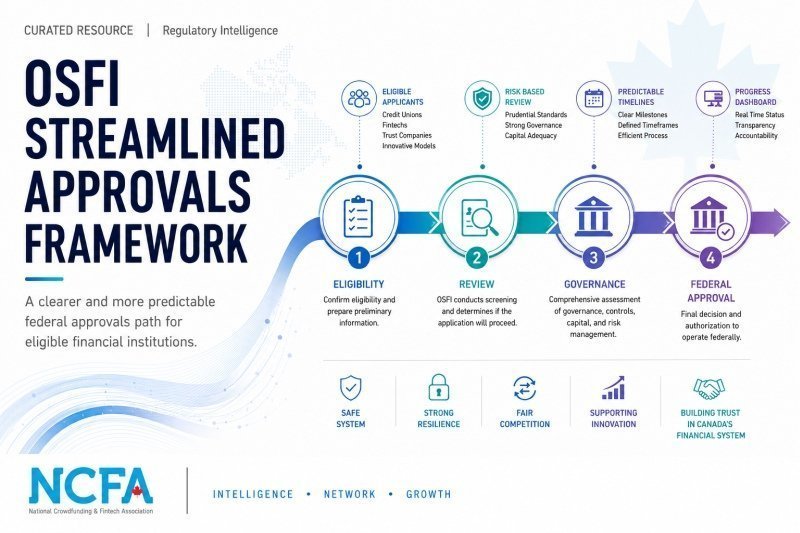
NCFA has published a new Regulatory Intelligence guide to OSFI fast track approvals. The guide explains the official Streamlined Approvals Framework for Targeted New Entrants and how eligible organizations can prepare for federal entry as a bank, trust company, loan company or federal credit union.
It brings OSFI’s framework overview, screening criteria, application requirements, three process phases, indicative timelines, toolkit documents and applicant dashboard into one practical reference.
The guide helps readers understand how OSFI’s Streamlined Approvals Framework is designed to make approvals clearer and more predictable while maintaining prudential standards.
It follows the process from eligibility screening and the initial readiness assessment through formal application review, ministerial approval and operational readiness where an Order to Commence and Carry on Business is required.
The framework currently targets two groups: provincial credit unions seeking federal continuance and entities with technologically innovative or emerging banking models, including fintechs and crypto asset custodians, seeking to incorporate as a bank or federally regulated trust and loan company.
This resource is useful for fintech founders, provincial credit unions, prospective banks, trust and loan companies, crypto asset custodians, compliance teams, investors, legal advisors and organizations assessing federal financial institution status.
It is especially useful for teams evaluating licensing strategy, ownership, governance, capital and liquidity, operational controls, risk management, supervisory readiness and whether federal institution status is commercially justified.
The guide consolidates a detailed approvals process into one applicant workflow. Readers can compare the two eligible routes, review evidence expectations, identify common delay risks and understand where OSFI’s published timelines apply.
The framework is targeted. It is not a general fast track for every fintech, payments company, lender or financial platform. Organizations outside its scope may need other routes, including Retail Payment Activities Act registration, securities registration, provincial licensing or partnerships with regulated institutions.
OSFI may refine the framework as it gains experience and may limit the number of applications processed through it. Readers should use the guide for ecosystem intelligence and planning, not as legal, financial, investment, compliance or professional advice.
OSFI Fast Track And Streamlined Approvals Framework (primary NCFA guide)
OSFI Fast Track Approval Announcement (original NCFA analysis)
Canada Open Banking Rules And Regulations (related Regulatory Intelligence)
Canada’s Stablecoin Regulatory Framework (related Regulatory Intelligence)
OSFI Streamlined Approvals Framework (official framework)
OSFI Launch Announcement (official news release)
The National Crowdfunding & Fintech Association (NCFA Canada) is a financial innovation ecosystem that provides education, market intelligence, industry stewardship, networking and funding opportunities and services to thousands of community members and works closely with industry, government, partners and affiliates to create a vibrant and innovative fintech and funding industry in Canada. Decentralized and distributed, NCFA is engaged with global stakeholders and helps incubate projects and investment in fintech, alternative finance, crowdfunding, peer-to-peer finance, payments, digital assets and tokens, artificial intelligence, blockchain, cryptocurrency, regtech, and insurtech sectors. Join Canada's Fintech & Funding Community today FREE! Or become a contributing member and get perks. For more information, please visit: www.ncfacanada.org
| | |
|---|---|---|
| | |
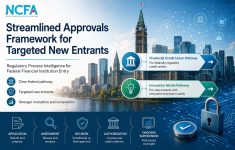
Often described as the OSFI fast track, OSFI's Streamlined Approvals Framework gives eligible applicants a clearer route into Canada's federal financial system. It applies to provincial credit unions seeking federal continuance and to entities with innovative or emerging banking models, including fintechs or crypto asset custodians, seeking bank or federally regulated trust and loan company status.
What this guide adds: the official pages, toolkit materials, checklists and process guidance are reorganized into one applicant workflow with interpretation, delay risks, evidence expectations and related intelligence.
This is not a universal fintech route. OSFI limits the framework to two target groups and directs entities outside scope to existing approval processes.
PCUs need an established business model, operating history, provincial supervisory track record, capital capacity, scalable systems, member engagement plan and a viable provincial discontinuance path.
Innovators need a meaningfully different banking model or product, a credible institution destination, financial strength, governance, business plan, risk capability and evidence that federal regulation is needed.
Payment firms, platforms, lenders and vendors may need RPAA registration, securities registration, provincial licensing or partnership models rather than federal institution status.
OSFI publishes stage targets, not a guaranteed end to end timeline. Actual timing depends on applicant preparation, completeness, security checks, statutory decisions and responsiveness.
Rolling intake. Applicant contacts OSFI when ready.
Self-assessment, evidence build and early preparation.
Readiness Assessment letter within 4 weeks after meeting.
12-month OSFI target after complete filing is acknowledged.
Separate statutory decision. No OSFI target stated.
About 3 months where OCCB readiness review applies.
*Phase 3 note: Operational readiness applies where an Order to Commence and Carry on Business is required. For local cooperative credit societies continuing as federal credit unions, Letters Patent and OCCB are issued together.
Budgeting estimate: Where applicable OSFI targets apply, the published target stages add up to roughly 16 months plus applicant preparation, completeness review, security checks, Ministerial decision timing and remediation. This is an expectation management estimate, not an approval guarantee.
Choose the applicant path, then click a step. Each step brings OSFI's requirements together with applicant preparation, timing expectations, source documents, delay risks and Analysis.
Screening is the point where a provincial credit union tests whether the streamlined framework is the correct doorway. The question is not simply whether the organization wants federal status. The question is whether the applicant is already close enough to federal readiness that a targeted, risk-based pathway makes sense.
OSFI is looking for a supervised provincial credit union with an established model, a credible reason to continue federally, an operating history that can be assessed, and a practical path for leaving the provincial framework. The applicant also needs to be prepared for conditions, restrictions or other mitigants at entry where OSFI considers them appropriate.
This is a fit test, not a speed lane. A PCU that cannot explain the strategic necessity of federal continuance, the member value proposition and the readiness plan is likely to spend time and money before the real blocker becomes visible.
Phase 1 lets OSFI review enough information to understand the applicant's ownership structure, financial strength, business plan, governance, federal continuance rationale, readiness gaps and overall suitability before the formal application begins.
The PCU should be ready to disclose its jurisdiction and establishment date, organization chart with ownership percentages, substantial investments, significant interests, voting rights over 10%, ownership distribution, sources of capital for initial and ongoing support, financial services and non-financial activities, three years of audited financial statements, any credit rating, and any prior denials, criminal proceedings or administrative sanctions.
The five-year business plan needs to explain why the applicant wants to continue as an FCU, what transitional relief may be requested, target markets, opportunities, competitors, strategic assumptions, lines of business, product and service integration, risk-based capital and leverage ratios, pro forma financial statements, organizational structure, board and management composition, SMSB categorization, internal capital and liquidity targets, initial exit strategy and the work already performed to prepare for federal continuance.
The four-week target applies after the readiness meeting, not after first contact. The output is a readiness letter that helps determine whether the applicant should proceed and what OSFI expects next.
Phase 1 should expose the real work before the formal application. The strongest applicants will treat it as a board level readiness review across business strategy, capital, member mandate, systems, governance and provincial transition planning.
Pre-meeting evidence build, readiness self-assessment and early gap analysis.
PCUs have a specific member authorization branch because federal continuance affects members and requires a special resolution process. OSFI must approve the Disclosure Notice before the member vote and before Phase 2 materials are submitted.
The PCU has to prepare a member package, draft Disclosure Notice, timing plan, CDIC consultation path and special resolution process that allow members to understand the implications of continuing as an FCU.
This is where the PCU path stops being a regulator-only process. Stakeholder confidence, member education and transition governance matter as much as document preparation.
Member vote sequencing and disclosure package planning.
Phase 2 is the formal review of the application for Letters Patent. It turns the readiness discussion into a complete filing and gives OSFI the evidence needed to make a recommendation.
The PCU package includes the formal application, Canada Gazette and newspaper notice, fees, evidence of member authorization, financial projections, stress cases, business strategy, transition plan and responses to information requests. The 12-month target begins only after OSFI acknowledges the filing is complete.
OSFI is assessing board composition, committee structure, oversight functions, management responsibilities, risk management, related-party arrangements, regulatory compliance management, privacy, fraud controls, records, outsourcing, operational risk, business continuity, disaster recovery, capital adequacy, liquidity and the ability to operate under federal expectations.
The main risk is treating Phase 2 as a document exercise. It is really a proof of supervisability exercise. The filing must show that the institution can operate federally, not just that it can describe federal expectations.
OSFI may recommend approval, but the statutory Ministerial decision remains a separate dependency. This is why OSFI's published stage targets should not be converted into a guaranteed approval date.
Applicants need to keep operating plans, member communications and investor expectations current while the statutory decision is pending. Unresolved conditions, security issues or policy considerations can affect timing and certainty.
Process transparency helps reduce ambiguity, but it does not eliminate statutory discretion. Any external communication should separate OSFI review targets from final approval and launch readiness.
For local cooperative credit societies continuing as FCUs, Letters Patent and the Order to Commence and Carry on Business are issued at the same time. That makes practical readiness part of the formal application build, not a later phase.
The applicant needs completed continuance mechanics, final transition controls, member and provincial transition work, implementation readiness and the ability to operate federally on commencement.
PCUs should not wait for approval to build launch readiness. The pathway compresses approval and commencement, which makes early operating preparation more important.
Federal credit union continuance mechanics.
The applicant enters ongoing federal supervision and must operate with federal expectations for governance, capital, liquidity, risk management, operational resilience, regulatory reporting and compliance.
Approval is the beginning of supervised scale. The commercial value of federal status depends on whether the institution can convert federal reach into durable member value and operational resilience.
Screening tests whether the applicant is actually a targeted new entrant with a technologically innovative or emerging banking model, and whether the proposed destination is a bank or federally regulated trust or loan company rather than a lighter regulatory path.
OSFI is looking for a model that is meaningfully different through operating model, capability, distribution framework, process design, efficiency, cost, speed, resilience, accessibility, risk management or product design. The model also needs to justify entry into the federal prudential perimeter.
The first strategic test is not "is this fintech innovative?" It is "does federal institution status unlock a capability the firm cannot reach faster and more safely through another route?"
Phase 1 gives OSFI a written submission and meeting basis to review the applicant's business model, governance, ownership structure, financial resilience and overall readiness before the formal application.
The innovator should be ready to provide jurisdiction and establishment date, corporate group chart with ownership percentages, 10%+ voting interests, voting or control arrangements, affiliates and activities, Canadian operations, regulatory oversight by jurisdiction, government ownership interests, access to ongoing financial support, three years of audited consolidated financial statements, credit rating if available, prior denials and any criminal proceedings or administrative sanctions.
The five-year business plan should explain why the proposed FRFI is needed, target markets, opportunities, competitors, success assumptions, each line of business, products and services, how lines of business interrelate, liquidity metrics including NCCF and LCR, risk-based capital and leverage ratios on a Basel III basis, five-year pro forma financial statements, reporting lines, senior management responsibilities, board composition, SMSB categorization and an initial exit strategy.
Phase 1 is where a fintech should prove it is institution-ready. Innovation may create the reason to apply, but governance, financial strength, ownership transparency, capital planning and exit credibility determine whether the application can proceed intelligently.
Pre-meeting evidence build and investor/board readiness review.
After Phase 1, OSFI may provide preliminary views that help determine whether the applicant should move toward a formal application under the streamlined framework or use another existing approval process.
The decision is not approval. It is a path decision. A positive signal means the applicant may have enough fit and readiness to justify the heavier formal application. A weak signal may indicate that the model, capital plan, governance, ownership structure or institution destination is not yet credible.
This is the cheapest point to stop, restructure, change the institution destination or choose a partnership route. Treat it as a strategic checkpoint, not an administrative transition.
Deciding whether to advance, pause or switch paths.
Phase 2 is the comprehensive formal review. It converts the Phase 1 business case into a complete application record that OSFI can use to assess whether to recommend approval.
Across new-entrant applications, OSFI assesses whether the applicant has enough resources to support the proposed institution, whether business record and experience are appropriate, whether character, integrity and reputation are acceptable, whether national security or international obligations issues arise, whether the business plan is sound and feasible, whether risks are understood and can be controlled before commencement, whether initial capital protects depositors and creditors, and whether directors and senior officers have the necessary experience and competence.
The formal application needs notices, filing materials, service charge, financial projections, business plan detail, assumptions, stress and contingency analysis, capital and liquidity plan, major asset and liability categories, expense and income categories and evidence that the applicant can fund the regulated institution over time.
The formal checklist brings the applicant into deeper prudential territory: board effectiveness, senior officer roles, risk management framework, operational risk, third party arrangements, privacy, fraud, records, business continuity, disaster recovery, regulatory compliance management and internal controls. The filing should show how the organization will operate, not only who owns it.
The 12-month target begins only after OSFI acknowledges a complete filing. In practice, missing evidence, weak assumptions, unresolved security checks, governance gaps, vendor dependencies, unclear capital support or unconvincing risk controls can extend the elapsed process.
Phase 2 is not a bigger version of Phase 1. It is the proof of supervisability stage. Applicants should run parallel workstreams for capital, governance, risk, security, technology, legal, compliance and operating readiness rather than waiting for OSFI requests one by one.
OSFI may recommend approval, but Ministerial decision-making is a separate statutory dependency. This stage turns the supervisory recommendation into a formal approval decision where applicable.
Applicants should keep capital plans, staffing, vendor readiness, investor communications and public expectations aligned with the reality that OSFI's stage targets do not guarantee Ministerial timing or launch date.
This is where the public dashboard may help with transparency if the applicant consents, but transparency is not certainty. External messaging should separate application milestone, statutory approval and operational launch.
Public milestone tracking if the applicant consents.
Phase 3 confirms whether the applicant is ready to begin business after approval. OSFI reviews whether key people, policies, processes and systems are in place and whether any remaining gaps require conditions, restrictions or remediation.
Applicants should expect to provide evidence such as board and shareholder meeting materials, paid-in capital confirmation, incorporation and organization cost information, commitments around material business plan changes, the OCCB request and evidence that launch-critical systems, people, controls and policies are operating.
This is where paper readiness becomes operating capability. Conditions can shape product scope, geographic scope, growth pace, partnerships, funding needs and early customer strategy.
OCCB readiness and launch-condition planning.
The applicant begins operating as a bank or federally regulated trust or loan company and enters ongoing prudential supervision. The launch is not the end of the regulatory burden; it is the point where the applicant's operating model must meet the promises made through the application process.
Depending on the approved institution type and conditions, approval may enable regulated banking or trust activity, custody and fiduciary services where permitted, deposit or lending activity if approved, or regulated partnership infrastructure.
The commercial case depends on whether the federal status unlocks a durable capability that could not be reached faster through a lighter pathway. The strongest applicants will connect licensing strategy, product strategy, compliance infrastructure and capital strategy before Phase 2.
NCFA’s regulation-to-market pathway shows how OSFI’s targeted approval process can translate into federal market entry, supervised launch and practical innovation opportunities.
Regulatory approval is only one part of market development. This guide connects to NCFA's broader Financial Innovation Map, which organizes innovation capabilities, market opportunities, companies, evidence, milestones and regulatory intelligence across Canada's fintech ecosystem.
The OSFI streamlined approvals framework is a high bar pathway for targeted new entrants. It does not create a general fintech fast track. Where an applicant qualifies, the framework may connect to market themes such as credit union modernization, regulated custody, trust infrastructure, governance technology, SME finance infrastructure, open finance and business identity.
Use these links to go deeper into adjacent regulation, market entry strategy, resources and evidence connected to federal financial system entry.
The National Crowdfunding & Fintech Association (NCFA Canada) is a financial innovation ecosystem that provides education, market intelligence, industry stewardship, networking and funding opportunities and services to thousands of community members and works closely with industry, government, partners and affiliates to create a vibrant and innovative fintech and funding industry in Canada. Decentralized and distributed, NCFA is engaged with global stakeholders and helps incubate projects and investment in fintech, alternative finance, crowdfunding, peer-to-peer finance, payments, digital assets and tokens, artificial intelligence, blockchain, cryptocurrency, regtech, and insurtech sectors. Join Canada's Fintech & Funding Community today FREE! Or become a contributing member and get perks. For more information, please visit: www.ncfacanada.org
| | |
|---|---|---|
| | |
June 27, 2026 | NCFA Fintech Whisperer | Payments And Market Infrastructure, Digital Assets Blockchain And Tokenization, Capital Markets And Market Infrastructure, Artificial Intelligence And Data, Risk Compliance And Regtech, Wealth And Asset Management
Image: Freepik
This live weekly NCFA intelligence page tracks financial technology developments that significantly affect how fintechs build, sell, raise capital, and operate under scrutiny. Coverage prioritizes Canada and includes global events that directly influence competitive conditions, market access, and execution realities across fintech sectors. This page will be updated throughout the week with market movers in a live format and then each week we'll close the prior week's contents in prep for the upcoming week, and continue on a rolling basis. (Missed prior week's Fintech Whisperer? (December 6-12, 2025, December 13-19, 2025, January 1-9, 2026, January 10-16, 2026, January 17-23, 2026, January 24-30, 2026, January 31-February 6, 2026, February 7-13, 2026, February 14-20, 2026, February 21-27, 2026, February 28-March 6, 2026, March 7-13, 2026, March 14-20, 2026, March 21-27, 2026, March 28-April 3, 2026, April 4-10, 2026, April 11-17, 2026, April 18-24, 2026, April 25-May 1, 2026, May 2-8, 2026, May 9-15, 2026, May 16-22, 2026, May 23-29, 2026, May 30-June 5, 2026, June 6-12, 2026, June 13-19, 2026, June 20-26, 2026).
Cross border payments are getting clearer operating standards for retail and SME use cases. Banks, payment firms, remittance providers, fintechs and SME platforms should watch how fee disclosure, FX transparency, delivery certainty and last-mile processing become competitive requirements.
The connection gives Singapore users direct access to Vietnam’s domestic QR acceptance network without requiring merchants to install separate terminals. Singapore becomes the fourth ASEAN market and sixth jurisdiction connected to NAPAS, with outbound payments from Vietnam to Singapore planned later in 2026.
Agentic payments are moving into live financial infrastructure. Banks, payment networks, merchants, PSPs, AI providers and fraud teams should watch how consent, authentication, agent identity and liability controls evolve for AI-initiated transactions, including the broader question of whether fintechs should design for people or AI agents.
Agentic commerce needs payment controls that work inside the buying flow. Merchants, payment networks, fintechs, issuers, fraud teams and AI platforms should watch how tokenized credentials, spend limits, approved categories, agent identity and audit trails define the next payment interface. NCFA's Financial Innovation Map tracks agent commerce infrastructure as an emerging opportunity.
Canada’s instant payments system now has the legal foundation needed for launch preparation. Banks, payment service providers, fintechs, merchants and compliance teams should track how RTR rules, access, fraud controls, ISO 20022 messaging and 24/7 operations change payment product design and competition.
Wholesale CBDC work is concentrating on settlement infrastructure rather than retail money. Central banks, banks, market infrastructure firms, custodians and payment providers should watch how tokenised settlement, securities delivery and cross border liquidity use cases shape the next phase of central bank money innovation.
Canada's retail payments regime is shifting from registration into active supervision. PSPs, fintechs, payment processors, compliance teams and investors should track how incident reporting, safeguarding information, annual reports and PSP Connect submissions become part of the operating cost of regulated payment activity.
Canada's open banking framework is entering the implementation phase. Banks, fintechs, payment service providers, credit unions and technology providers should prepare for accreditation, technical integration and operational requirements as consumer driven banking moves toward production. See NCFA's Open Banking in Canada opportunity brief for the market gaps, adoption signals and infrastructure questions this framework is meant to address.
Stablecoin payment firms are building through combined cryptoasset and e-money permissions. Fintechs, banks, treasury teams, payment providers and stablecoin issuers should watch how MiCA, EMI licences, IBAN access and euro stablecoin services define regulated market entry in Europe.
Regulated retail crypto platforms are adding on-chain access while changing how custody, disclosure, risk controls and investor responsibility work. Brokers, crypto platforms, wallets, regulators and compliance teams should watch how self-custody DEX trading inside mainstream apps affects token access, suitability controls, tax reporting and Canadian crypto regulation and investor safeguards.
The case combines a licensing exit with a failed liquidity transaction, withdrawal uncertainty and possible insolvency. Regulators and users can assess the effectiveness of the wind down through access to account records, withdrawal processing, financial disclosure and the treatment of unreturned balances. Canada’s registered crypto platforms operate under different rules. The same questions apply to custody, liquidity, capital, governance and orderly customer exits. NCFA’s comparison of MiCA and UK crypto rules explains how demanding authorization standards can favour firms with stronger operating infrastructure.
MiCA is becoming the operating gateway for institutional digital asset firms. Trading firms, custodians, prime brokers, exchanges, asset managers and compliance teams should watch how authorization under a harmonized EU framework expands regulated cross-border crypto services.
Retail investing is extending into onchain financial infrastructure. Brokers, crypto platforms, wallets, custodians, exchanges, wealth platforms and regulators should watch how tokenized equities, Layer 2 networks, onchain lending and AI directed trading reshape product access, market supervision and investor protection.
Stablecoin regulation is starting to look like payment system supervision. Issuers, banks, custodians, payment firms, exchanges and compliance teams should watch how systemic designation, transition planning and cross-regulator supervision affect market access for regulated digital money.
The UK crypto market is getting a clearer operating perimeter. Crypto platforms, custodians, stablecoin issuers, intermediaries and staking firms should prepare for authorisation, capital planning, market conduct controls and compliance standards that bring crypto closer to mainstream financial regulation.
Stablecoin competition is shifting toward scale, governance and distribution. Banks, payment networks, wallets, merchants, fintechs and stablecoin issuers should watch whether shared economics, partner governance and broad platform participation become a stronger model for digital money adoption.
Tokenized securities need regulated payment and custody rails, not only issuance technology. Asset managers, administrators, custodians, stablecoin providers and tokenization platforms should watch how CASP and payment licences shape the full transaction lifecycle from subscription to redemption and payout.
Institutional stablecoin adoption is becoming part of regulated banking infrastructure. Banks, custodians, asset managers, payment firms and stablecoin issuers should watch how custody, minting, redemption and settlement services expand across institutional digital asset workflows.
Stablecoin payments are starting to connect settlement with spending controls. Merchants, payment networks, wallets, stablecoin issuers, compliance teams and fintechs should watch how programmable rules, item level controls and point of sale integration expand programmable stablecoin payments in commerce.
Agentic finance needs controls at the point of action. Banks, fintechs, payment firms, wealth platforms and compliance teams should watch how agent identity, authority, escalation, audit trails and transaction limits become core requirements for AI systems that can act on behalf of users.
Agentic finance is becoming a supervisory design question. Banks, fintechs, payment systems, trading firms, AI vendors and regulators should watch how consent, liability, agent identity, market controls, cyber resilience and accountability standards develop as autonomous systems enter financial workflows.
Market transparency increasingly depends on shared data infrastructure. Exchanges, trading venues, fixed income dealers, market data providers, asset managers and regulators should watch how consolidated bond market data improves price discovery, execution quality and market oversight.
Tokenised capital markets need legal certainty as much as technology. Issuers, investors, custodians, exchanges, fund managers and regulators should watch how bond issuance, record keeping, settlement and transfer rules adapt as fixed income markets move onto distributed ledger infrastructure.
Crypto regulation is expanding beyond market access into enforcement. Cryptoasset firms, trading venues, brokers, compliance teams and market participants should prepare for enforcement policies that increasingly align digital asset markets with established financial market conduct standards.
Crypto regulation can create financial crime pressure during market transition. CASPs, VASPs, banks, payment firms, exchanges and compliance teams should watch how licensing deadlines, customer migration and supervisory coordination affect AML controls across Europe.
Investment regulation increasingly focuses on communication as well as compliance. Asset managers, wealth platforms, advisers, fintechs and product manufacturers should prepare for disclosure requirements that prioritize clarity, comparability and consumer understanding alongside regulatory obligations.
Event contract regulation is moving from listing debates into market surveillance and data reporting. Prediction markets, exchanges, brokers, compliance teams and regulators should watch how reporting rules shape the boundary between derivatives, event markets, gambling and retail speculation.
The strongest fintech companies don't wait for certainty. They recognize patterns early, build where demand is growing and stay ready when regulation catches up. That's the value of watching the evidence, not just the headlines. NCFA offers various curated resources to help founders and investors stay current on developments that impact fintech markets, subscribe to NCFA weekly newsletter updates, view the latest fintech insights, industry research, or launch into emerging financial innovation opportunities.
The National Crowdfunding & Fintech Association (NCFA Canada) is a financial innovation ecosystem that provides education, market intelligence, industry stewardship, networking and funding opportunities and services to thousands of community members and works closely with industry, government, partners and affiliates to create a vibrant and innovative fintech and funding industry in Canada. Decentralized and distributed, NCFA is engaged with global stakeholders and helps incubate projects and investment in fintech, alternative finance, crowdfunding, peer-to-peer finance, payments, digital assets and tokens, artificial intelligence, blockchain, cryptocurrency, regtech, and insurtech sectors. Join Canada's Fintech & Funding Community today FREE! Or become a contributing member and get perks. For more information, please visit: www.ncfacanada.org
| | |
|---|---|---|
| | |

The FCA Emerging Technology Horizon Scan 2026 sets out three plausible ways emerging technologies could combine across financial services. It focuses on early indicators, potential risks and strategic questions rather than binding rules.
Use this guide to understand how the FCA frames technology convergence across Personalised Intelligence, Synthetic Insecurity and Programmable Finance, how later FCA work develops those themes, and what they may mean for fintech strategy, supervision and financial infrastructure.
Coverage includes AI agents, digital twins, proxy economy risks, synthetic identity, deepfakes, autonomous financial crime, synthetic market abuse, operational resilience, tokenization, stablecoins, CBDCs, digital identity, smart data, Finternet, cross border interoperability and current FCA developments.
The Horizon Scan sits before formal regulation. It identifies plausible technology pathways that could affect consumer protection, financial crime prevention, operational resilience, infrastructure modernization and future supervisory focus.
The FCA report is organized around three technology convergence themes that cut across AI, fraud, cyber, digital assets, payments and infrastructure modernization.
Navigate the FCA Horizon Scan by strategic theme. Each section separates what the FCA says, implementation considerations and NCFA perspective.
The FCA says the Horizon Scan is its first external publication of this kind. It is not a prediction report or regulatory guidance. It presents three plausible ways emerging technologies could combine to affect consumers, firms and markets, and it highlights early signals of new risks.
Firms should treat the report as a strategic risk and opportunity map. It can inform board horizon scanning, innovation planning, product governance, cyber risk, fraud controls, data strategy, digital identity planning, tokenization strategy and operational resilience assessment.
This is an upstream regulatory strategy signal. It shows where future supervision may focus before formal rules appear. For NCFA, it connects directly to AI, digital identity, fraud, open finance, tokenization, stablecoins, CBDCs, cybersecurity, payments modernization and programmable market infrastructure.
The FCA frames emerging technology against broader global pressures, including AI competition, geopolitical tension, trade disputes, energy demand, critical materials, data centre growth, environmental pressure and divergent regulatory approaches. It notes that AI debate often runs faster than measurable evidence, while practical adoption is already taking root in customer engagement and agentic payments.
Boards should connect technology strategy to geopolitical supply chains, energy exposure, cloud concentration, vendor dependency, AI model access, regulatory divergence and cross border interoperability. Technology adoption should be assessed against measurable outcomes rather than hype.
The FCA is treating technology strategy as market structure strategy. The signals are not only about tools. They are about who controls interfaces, identity, compute, data, payment rails, settlement and trust verification.
Personalised Intelligence examines how AI, personal data, edge computing, digital twins and adaptive interfaces could change consumer outcomes. AI agents could become the main interface between consumers and firms, making financial services more personalized, automated and embedded in daily life.
Firms need to decide whether they are designing for human users, AI representatives or both. Product governance, disclosure, consent, suitability, accessibility, fair value and complaints processes may need to reflect agent-mediated consumer journeys.
The key question is whether AI increases consumer capability or quietly transfers decision power to opaque systems. The opportunity is strong, but consumer agency, privacy, accessibility and accountability become central design requirements.
The report describes escalating cognitive delegation, progressing from assistive mode to advisory mode and then autonomous action mode. In autonomous action models, proxies may negotiate, transact, optimize bills, reallocate investments or dispute charges within dynamic constraints.
Firms should assess how products appear to AI agents, how consent is collected, how human review is triggered and how agent decisions can be audited. Customer support should anticipate cases where consumers do not understand actions taken by their AI representatives.
AI agents could become the next distribution layer in financial services. The competitive question is not only who has the best app, but whose product is selected, negotiated and trusted by a consumer's agent.
The report describes digital twins as AI representations that could draw on financial data, device data, behavioural signals, wearables and broader preferences. Firms could use these tools to offer more personalized products and support by interacting with a consumer's digital twin or AI agent.
Digital twin use raises data minimization, consent, explainability, vulnerability, discrimination, product governance and audit questions. Firms need controls to avoid overfitting products to sensitive traits or creating exclusion through complexity.
Digital twins may support inclusion and better advice, but they could also create high-risk personalization. The market will need guardrails around what data should be used, who controls the twin and how decisions can be challenged.
The FCA describes a potential proxy economy where AI proxies act for consumers and competition shifts from human attention to algorithmic negotiation. The report warns that consumers may accept proxy permissions casually, similar to how web cookies are often accepted today.
Consumer protection may need to account for proxy choice architecture, permission design, escalation rules, audit trails and agent conflicts. Firms should review whether their own AI interfaces favour the firm over the consumer.
The proxy economy could rewrite financial distribution. It may reduce consumer inertia, but it may also create a new layer of algorithmic gatekeeping. This is a high value area for future NCFA question posts and opportunity analysis.
Synthetic Insecurity examines how AI expansion of human thought, labour, value chains and digital infrastructure could make simulated data difficult to distinguish from real data. The FCA describes a future where fabricated truth becomes harder to separate from actual truth.
Financial crime, fraud, onboarding, audit, dispute resolution and supervisory evidence processes should be assessed against synthetic documents, synthetic identities, narrative laundering, deepfakes and coordinated AI agent activity.
This is one of the most important sections for fintech and regulators. If evidence itself can be fabricated at scale, financial services need stronger verification layers, not only better detection of obvious fakes.
The report says deepfake risks are progressing from manipulation of the senses to manipulation of sense-making. AI may generate credible synthetic narratives, evidence trails and interactions that bypass both human and algorithmic judgment.
Firms need layered authentication, source verification, provenance controls, document forensics, voice and video verification, separate channel confirmations and controls for high-risk actions. Regulators may also need tools to assess evidentiary integrity.
Trust infrastructure is becoming a market opportunity. Identity, provenance, verification, secure communications and evidence integrity could become core financial infrastructure rather than operational controls.
The FCA warns that agentic AI could democratize high-complexity crime. A single individual may be able to deploy, manage and scale a global criminal organization through software, with AI agents performing phishing, scams, cyberattacks and manipulation.
Fraud and cyber teams should model autonomous attackers, not only human fraud rings. Controls need to detect rapid, adaptive, multilingual, personalized and multiple channel attacks that may operate continuously.
This section points to an arms race in financial crime operations. The opportunity is not only fraud prevention. It is coordinated intelligence sharing, AI defensive assessment and cross-sector resilience.
The report describes synthetic market abuse risks where autonomous multiple agent systems may engage in insider trading, collusion, spoofing, pump and dump activity, sentiment manipulation or synthetic consensus cascades.
Market surveillance should expand beyond order book and transaction data to include social sentiment, agentic behavior, synthetic content, coordinated narratives and cross-platform activity. Governance should define accountability when autonomous systems create abusive outcomes.
Synthetic market abuse links directly to crypto, tokenized markets and digital investor communities. This is a strong candidate for future Question Intelligence and regulatory comparison work.
The FCA describes adaptive and invisible threats to firms' operational resilience. Frontier AI models may identify zero-day vulnerabilities, while adaptive malware may rewrite itself, imitate normal activity and operate inside systems in real time.
Firms should assess AI-enabled cyber scenarios, cloud concentration risk, third-party software compromise, adaptive malware, rapid vulnerability response, model provider dependency and coordinated sector response. Resilience planning should assume faster attack cycles.
Operational resilience and AI risk are converging. The firms best positioned for the next phase will combine cybersecurity, vendor governance, model risk, incident response and trusted information sharing.
Programmable Finance examines the convergence of DLT and financial concepts. The FCA says financial infrastructure is becoming more modular, with shared ledgers, tokenisation, programmable money and smart contracts contributing to protocol-based financial systems.
Firms should map how programmable finance affects products, settlement, custody, compliance, legal documentation, data sharing, identity, payment triggers and risk controls. The question is how to design programmable systems that are interoperable, auditable and commercially usable.
This is the strongest bridge to NCFA's existing tokenization, stablecoin, payments and open finance work. The FCA is describing a transition from digitized services to programmable financial infrastructure.
The report situates tokenisation within programmable finance and protocol-based infrastructure. Tokenized assets are part of the transition toward financial instruments that can settle, execute and interact through software rather than manual reconciliation.
Tokenization projects should identify the real workflow being improved, the settlement asset, custody model, legal rights, data permissions, interoperability approach, compliance logic and operational fallback process.
The report supports NCFA's existing view that tokenization is becoming measurable financial infrastructure. The market opportunity is not token issuance alone. It is regulated rails, data, custody, liquidity, compliance and settlement.
The Horizon Scan links stablecoins, CBDCs, digital assets and programmable money to changes in international financial architecture. It notes that cross border CBDC pilots such as mBridge are reaching minimum viable product scale in some regions.
Payment and stablecoin projects should evaluate settlement finality, reserve or backing structure, redemption, interoperability, AML controls, sanction screening, user protection, data standards and integration with domestic payment systems.
This connects directly to the UK Cryptoasset Regulations And FCA Final Rules and NCFA's Programmable Stablecoin Payments Opportunity Brief. The strategic opportunity is compliant stablecoin infrastructure that can operate across regulated payment, settlement and tokenized asset systems.
The report identifies smart data and digital identity as interlocking layers in the UK's infrastructure-first strategy. Smart data, identity and payments may support more context-aware and programmable financial services.
Firms should assess consent, data portability, identity assurance, verifiable credentials, cross-sector data standards, fraud risk, agent access and consumer control. Smart data strategy should be linked to product design and consumer protection.
Smart data is the bridge between open banking and programmable finance. Canada should treat consumer-driven banking, digital identity and payment modernization as connected infrastructure, not isolated files.
The FCA highlights the BIS Unified Ledger and Finternet concepts alongside mBridge and sovereign programmable financial stacks. It describes two possible futures: a more unified global ledger approach, or interoperable islands of domestic programmable ecosystems.
Interoperability planning should address legal finality, messaging standards, identity, compliance, settlement assets, cross border controls, dispute handling, data governance and resilience across networks.
The Finternet discussion is highly relevant for NCFA's global intelligence work. It creates a framework for comparing Canada, the UK, EU, India, Singapore, Brazil and other jurisdictions by infrastructure readiness rather than only by regulation.
The FCA report is UK-focused, but many themes are transferable because the same technologies, fraud risks and infrastructure choices are appearing across major financial markets.
The FCA Horizon Scan gives Canada a useful external reference. It connects AI, digital identity, fraud, open finance, payments and tokenization into one strategic view of financial infrastructure change. These files should not be treated as isolated policy tracks.
The FCA Horizon Scan does not impose obligations, but it raises strategic questions firms and policymakers should consider before technology adoption outpaces governance.
The FCA Emerging Technology Horizon Scan now sits within a larger programme on AI adoption, agentic systems, cyber resilience and regulatory capability.
It is the FCA's first external technology horizon scan. The 2026 report examines plausible combinations of emerging technologies across Personalised Intelligence, Synthetic Insecurity and Programmable Finance.
No. The FCA states that it is not regulatory guidance or a prediction. It is a foresight document intended to support discussion, planning and early risk assessment.
Synthetic financial crime uses generated identities, documents, voices, images, narratives or transaction evidence to commit fraud, evade controls or manipulate financial systems.
Programmable finance combines technologies such as tokenization, smart contracts, stablecoins, digital identity and smart data to automate financial transactions and infrastructure functions.
It has no direct legal effect in Canada, but its scenarios are useful for Canadian work involving AI governance, synthetic identity, fraud prevention, consumer driven banking, payments modernization, stablecoins, tokenization and operational resilience.
The FCA Horizon Scan points to practical innovation themes across AI agents, identity, cyber resilience, fraud prevention, programmable finance, tokenization, stablecoins and interoperable financial infrastructure.
The National Crowdfunding & Fintech Association (NCFA Canada) is a financial innovation ecosystem that provides education, market intelligence, industry stewardship, networking and funding opportunities and services to thousands of community members and works closely with industry, government, partners and affiliates to create a vibrant and innovative fintech and funding industry in Canada. Decentralized and distributed, NCFA is engaged with global stakeholders and helps incubate projects and investment in fintech, alternative finance, crowdfunding, peer-to-peer finance, payments, digital assets and tokens, artificial intelligence, blockchain, cryptocurrency, regtech, and insurtech sectors. Join Canada's Fintech & Funding Community today FREE! Or become a contributing member and get perks. For more information, please visit: www.ncfacanada.org
| | |
|---|---|---|
| | |



August 26th, 2025

January 4th, 2024

June 1st, 2021

September 9th, 2020

July 9th, 2018

January 3rd, 2018

September 25th, 2017

June 20th, 2017

May 10th, 2017

December 14th, 2016
