





Karsten Wenzlaff, Advisor
August 26th, 2025
Karsten Wenzlaff is a Crowdfunding and Fintech Expert from Germany. He is Secretary-General of Digit[...]


June 2, 2026 | NCFA Insight | Payments And Market Infrastructure, Open Banking Open Finance And Data Sharing, Digital Assets Blockchain And Tokenization, Regulation And Policy

On June 2, 2026, Thunes and Juniper Research released the 2026 Cross Border Payments Interoperability Index, a 50 country benchmark that measures how easily money moves across borders. Canada ranks 22nd with an overall score of 6.4. That result doesn't simply mean Canada lacks financial infrastructure. It points to a harder problem for maturer markets. That is strong domestic systems don't automatically create cheaper, faster, more open cross border payments.
But that's starting to change now that Canada is incentivizing more competition in fintech and now some key policy files open. Real-Time Rail, broader payment service provider access, Interac e-Transfer access for qualifying PSPs, consumer driven banking, and stablecoin rules all point in the same direction. Global benchmarks now judge whether those components are working in live markets or are being left behind.
Canada's scorecard below shows the gap clearly. Solid on economic strength, digital infrastructure, financial inclusion, and cross border connectivity. However, according to the ranking Canada is weak on market dynamics and progress, the category that tracks whether regulation, mandates, open banking, crypto rules, and public payment initiatives create usable momentum (or not).
| Canada Index Category | Score | Reader Takeaway |
|---|---|---|
| Economic Health | 7.5 | Canada has a strong base for financial activity |
| Digital Infrastructure | 7.0 | The country has meaningful digital capacity |
| Financial Inclusion | 6.7 | Formal access is broad, but gaps remain |
| Cross Border Connectivity | 6.3 | Cost, speed, and reach still limit performance |
| Market Dynamics And Progress | 4.0 | Canada’s weakest score and the core execution gap |
| Overall Rank | 22nd Of 50 | Middle of the pack for a G7 market |
The low score of 4.0 on market dynamics needs immediate attention. Canada doesn't lack ambition, but it still needs more proof that payment modernization has changed market behaviour, access, pricing, product design, and cross border reach. Otherwise, smoke and mirrors.
Real-Time Rail could become Canada’s most important domestic payment upgrade in years. Payments Canada says the Real-Time Rail payment system will support instant, data rich account to account payments for eligible participants. Payments Canada also published a PSP participation guide for RTR, which helps payment service providers prepare for access under Canada’s retail payments regime.
The next 18 months will be verytelling, given that the execution timing window is a practical test. Real-Time Rail and Canada’s productivity test comes down to access, fraud controls, pricing, resilience, and product adoption. Faster rails help only when firms can build real workflows on top of them.
Interac has opened another route into mainstream payments. In September 2025, Interac said qualifying PSPs can access Interac e-Transfer if they meet requirements tied to RPAA registration, FINTRAC money services business registration, sponsorship, and risk controls. Interac reports 1.4 billion e-Transfer transactions in 2024, so access to this network gives fintechs a path into a payment habit Canadians already use at scale.
Open banking is also in implementation. Canada’s consumer driven banking framework gives consumers and small businesses secure control over financial data, with future write access expected to support payment initiation. That turns open banking from comparison infrastructure into payment infrastructure. Canada’s open banking commercialization roadmap is now in rollout and about real API usage, accreditation, liability, and business model design.
And then there's Stablecoins. Finance Canada says Canada’s stablecoin framework will regulate fiat backed stablecoins issued by non financial institutions and place issuers under Bank of Canada supervision. That connects directly to the cross border pain measured by Thunes. Bill C-15 gives Canada a digital finance framework, but execution will decide whether stablecoins become trusted payment infrastructure or another narrow product category.
The Thunes report gives Canada a useful benchmark because cross border payments still fail basic user tests. The global average remittance cost sits at 6.36 percent, more than double the UN target of less than 3 percent by 2030. The same report finds that 38 percent of surveyed users typically pay more than 3 percent to send a cross border payment.
| Global Friction Point | Thunes Finding | Why It Counts |
|---|---|---|
| Remittance Cost | 6.36 percent global average | More than double the UN target |
| High Fee Exposure | 38 percent pay more than 3 percent | Users still face avoidable cost pressure |
| Payment Delay | 27 percent wait two or more days | Slow payouts hurt household and business cash flow |
| Price Transparency | 41 percent do not always see the final amount upfront | Users cannot compare true cost easily |
| User Priority | 50 percent rank instant transfers first | Speed now beats fees as the top feature |
RTR can improve domestic speed. Open banking can improve data access and future payment initiation. Interac PSP access can widen domestic participation. Stablecoin rules can support regulated digital settlement.
None of those pieces improves cross border outcomes on its own. The gap is not a lack of providers. It is how well banks, fintechs, PSPs, wallets, FX, fraud controls, compliance systems, and payout networks connect across domestic and international payment flows.
Brazil and India offer Canada the most useful comparison. Both markets show how live domestic payment rails can change user behaviour. They also show why domestic success doesn't automatically solve international payments.
| Market | Thunes Rank Or Score | Domestic Payment Behaviour | Cross Border Lesson |
|---|---|---|---|
| Canada | 22nd overall, 6.4 score, 4.0 market dynamics | Strong infrastructure, but RTR, open banking, PSP access, and stablecoin rules still need market proof | Canada must turn policy design into live interoperability |
| Brazil | 14th overall, 6.7 score, 8.0 market dynamics | Pix helped make instant bank transfers a daily habit. Thunes reports 59 percent of surveyed respondents in Brazil use bank transfers daily or weekly | Live rails can change behaviour, but 71 percent of Brazilian recipients still wait two or more days for international payments |
| India | High domestic bank transfer use in the surveyed group | UPI made account to account payments central to daily digital finance | Cross border costs remain high. Thunes reports 54 percent of surveyed users in India typically pay more than 3 percent for cross border transfers |
The lesson is that working rails change expectations. Once consumers and businesses experience instant domestic payments, delays and hidden costs in international payments become harder to defend. Canada has not yet had that market wide real time payment moment. RTR can help create it if access, fraud controls, pricing, and use cases land together.
The stablecoin section of the Thunes report is stronger when read as infrastructure analysis. Stablecoins can settle quickly at low on chain cost, but users still need practical conversion into bank accounts, wallets, cards, or cash. That last mile problem limits mainstream use.
| Stablecoin Data Point | What Thunes Found | Policy Read For Canada |
|---|---|---|
| Core Benefit | Immediate settlement at low on chain cost | Useful for cross border settlement if rules, custody, and redemption work |
| Main Constraint | Local currency conversion remains challenging | Stablecoins need connections to banks, PSPs, wallets, and payout networks |
| Nigeria Usage | 29 percent of surveyed respondents used stablecoins | Demand rises where currency pressure and payment friction are higher |
| Top Nigeria Use Case | 58 percent used stablecoins to store value | Stablecoins do not start only as payment products |
| Nigeria Payments Use | 9 percent used stablecoins for domestic payments and 39 percent used them for international payments | Cross border utility looks stronger than domestic merchant use in this sample |
Canada now has domestic stablecoin proof points. Tetra’s CADD launch brought a Canadian dollar payment stablecoin issued through a regulated financial institution. Stablecorp’s QCAD work has added regulatory, bank custody, and exchange access milestones. Loon’s CADC acquisition gives Canada another Canadian dollar stablecoin initiative with existing transaction history. These examples make Canada’s stablecoin debate more practical. The issue is no longer whether Canadian dollar stablecoin projects exist. It is whether they can earn trusted roles in payment and settlement workflows.
The Thunes report doesn't frame stablecoins as an immediate replacement for banks or remittance brands. Stablecoins may work first as a middle leg settlement layer inside money transfer operators, banks, wallets, and payment platforms. That fits Canada’s policy challenge. Rules for reserves, redemption, supervision, governance, and AML controls matter, but market value comes from trusted use inside real payment flows.
Canada’s retail market still looks early. FCAC stablecoin survey findings show that 4% of Canadian adults hold stablecoins and 5% held them in the past. That gap between infrastructure activity and consumer adoption should guide policy design. Canada should not build stablecoin rules only around today’s retail ownership. It should test whether regulated Canadian dollar stablecoins can support remittances, merchant settlement, marketplace payouts, treasury use, and business to business payments across domestic and international corridors.
Can Canada turn payment modernization into live cross border advantage before faster markets pull further ahead?
Better outcomes will come from live RTR access, PSP onboarding that works in market, open banking with payment initiation, stablecoin rules tied to real payment use cases, and fraud controls that scale across real time flows. The Canadian pieces are coming together, but the test will be whether they work together fast enough to improve cost, speed, transparency, and cross border reach.
 The National Crowdfunding & Fintech Association (NCFA Canada) is a financial innovation ecosystem that provides education, market intelligence, industry stewardship, networking and funding opportunities and services to thousands of community members and works closely with industry, government, partners and affiliates to create a vibrant and innovative fintech and funding industry in Canada. Decentralized and distributed, NCFA is engaged with global stakeholders and helps incubate projects and investment in fintech, alternative finance, crowdfunding, peer-to-peer finance, payments, digital assets and tokens, artificial intelligence, blockchain, cryptocurrency, regtech, and insurtech sectors. Join Canada's Fintech & Funding Community today FREE! Or become a contributing member and get perks. For more information, please visit: www.ncfacanada.org
 |  |  |
|---|---|---|
 |  |  |
May 29, 2026 | NCFA Fintech Whisperer Weekly Intelligence | Payments And Market Infrastructure, Artificial Intelligence And Data, Digital Assets Blockchain And Tokenization, Capital Markets And Market Infrastructure

Image: Freepik
This live weekly NCFA intelligence page tracks financial technology developments that significantly affect how fintechs build, sell, raise capital, and operate under scrutiny. Coverage prioritizes Canada and includes global events that directly influence competitive conditions, market access, and execution realities across fintech sectors. This page will be updated throughout the week with market movers in a live format and then each week we'll close the prior week's contents in prep for the upcoming week, and continue on a rolling basis. (Missed prior week's Fintech Whisperer? (December 6-12, 2025, December 13-19, 2025, January 1-9, 2026, January 10-16, 2026, January 17-23, 2026, January 24-30, 2026, January 31-February 6, 2026, February 7-13, 2026, February 14-20, 2026, February 21-27, 2026, February 28-March 6, 2026, March 7-13, 2026, March 14-20, 2026, March 21-27, 2026, March 28-April 3, 2026, April 4-10, 2026, April 11-17, 2026, April 18-24, 2026, April 25-May 1, 2026, May 2-8, 2026, May 9-15, 2026, May 16-22, 2026).
AI compliance is moving from broad principles into operating guidance for agents, automated decisions, procurement, and personal data use. Fintechs, banks, insurers, regtech firms, and AI vendors should track how privacy rules shape AI product design, governance, and customer trust.
Project Agorá's focus is not retail crypto speculation. It is wholesale financial infrastructure, cross border settlement efficiency, programmable payments, and institutional control over tokenized money movement. Go deeper, visit NCFA's curated fintech reports and research library, where the BIS Project Agorá report is listed.
This is not open access to the Fed system. It is a narrower settlement pathway for legally eligible firms operating outside the traditional bank model. Stablecoin issuers, PSPs, crypto firms, tokenization platforms, and embedded finance providers should track whether limited Reserve Bank account access becomes a practical alternative to sponsor bank dependence. This connects to NCFA’s analysis of Fed Payment Accounts and fintech settlement access.
Onchain finance needs shared coordination standards before institutional adoption can scale cleanly. Banks, wallets, PSPs, exchanges, tokenization platforms, and agentic payment builders should track whether identity, messaging, and transaction standards become competitive infrastructure rather than optional middleware.
Large payment networks are adding regulated digital asset permissions to support stablecoin, tokenized settlement, and digital asset infrastructure at institutional scale. Banks, PSPs, exchanges, custodians, and fintech platforms should track which firms secure licences that let crypto services connect with mainstream payment networks.
Stablecoins are moving deeper into consumer banking distribution, not just crypto infrastructure. Banks, fintechs, PSPs, and regulators should watch whether regulated bank issued stablecoins begin competing directly with cards, deposits, remittance products, and embedded payment flows. Also supports this analysis of stablecoins becoming payment infrastructure.
National currency stablecoins are expanding beyond major economies. Stablecoin issuers, banks, PSPs, regulators, and treasury teams should track how smaller jurisdictions use digital fiat infrastructure to compete for payment flows, fintech investment, and cross border settlement.
Climate disclosure is moving back toward company specific materiality rather than a dedicated SEC climate reporting regime. Public companies, fintech lenders, ESG data providers, regtech firms, investors, and capital markets platforms should track how climate risk reporting moves across U.S. federal rules, state rules, EU requirements, and voluntary investor expectations.
Bank charter strategy is becoming part of digital asset and payment infrastructure competition. Banks, fintechs, stablecoin firms, custodians, and compliance teams should track which institutions secure federal supervision, stronger operating permissions, and clearer access to national banking infrastructure.
MiCA is moving from licensing theory into enforcement risk. Crypto exchanges, custodians, wallet providers, brokers, and compliance teams should treat EU authorization, local regulator engagement, and operating perimeter checks as immediate market access priorities.
Prediction markets are moving deeper into conflict with gambling, derivatives, and securities frameworks. Exchanges, fintechs, tokenization firms, and prediction market operators should expect more pressure around licensing, market surveillance, consumer protection, and jurisdictional authority as these platforms expand globally.
USMCA risk is now back inside Canada’s competitiveness file. Fintech lenders, payment firms, investors, marketplaces, and platforms serving SMEs should watch how tariff uncertainty affects customer margins, capital demand, foreign exchange exposure, supplier payments, and cross border expansion.
Crypto sanctions enforcement now reaches deeper into financial infrastructure networks, not just individual wallets or isolated actors. Exchanges, custodians, PSPs, banks, compliance teams, and blockchain monitoring firms should expect more scrutiny around transaction tracing, counterparty checks, and sanctions controls tied to digital asset flows.
Post trading rules are becoming more important as Europe modernizes settlement operations, CSD messaging, and market infrastructure controls. CSDs, brokers, banks, custodians, tokenization platforms, and compliance teams should track how messaging standards affect settlement efficiency, operational risk, and future market infrastructure integration.
Blockchain based settlement is moving into formal U.S. market infrastructure permissions. Brokers, custodians, tokenization platforms, exchanges, and asset managers should track how SEC registered clearing models affect securities settlement, custody design, and tokenized market structure.
Retail investing scale increasingly depends on back end clearing and custody infrastructure. Fintech platforms, brokers, clearing firms, embedded finance providers, and regulators should track how large consumer apps choose clearing partners that can support faster launches, broader products, and stronger operational controls.
This week was less about crypto adoption and more about who gets trusted access to the pipes. The Fed tested a narrow settlement account, Paxos received SEC clearing agency registration, Mastercard secured a BitLicense, SoFi launched a bank issued stablecoin, and Project Agorá moved wholesale tokenized settlement into deeper testing. The fresh lesson is that access is becoming tiered. Firms won’t all get the same rails, licences, or settlement rights.
NCFA offers various curated resources to help founders and investors stay current on developments that impact fintech markets, subscribe to NCFA weekly newsletter updates, view a rundown of current fintech news and insights, or dive into the latest fintech industry research.
The National Crowdfunding & Fintech Association (NCFA Canada) is a financial innovation ecosystem that provides education, market intelligence, industry stewardship, networking and funding opportunities and services to thousands of community members and works closely with industry, government, partners and affiliates to create a vibrant and innovative fintech and funding industry in Canada. Decentralized and distributed, NCFA is engaged with global stakeholders and helps incubate projects and investment in fintech, alternative finance, crowdfunding, peer-to-peer finance, payments, digital assets and tokens, artificial intelligence, blockchain, cryptocurrency, regtech, and insurtech sectors. Join Canada's Fintech & Funding Community today FREE! Or become a contributing member and get perks. For more information, please visit: www.ncfacanada.org
| | |
|---|---|---|
| | |
May 25, 2026 | NCFA Insight | Payments And Market Infrastructure, Open Banking Open Finance And Data Sharing, Digital Assets Blockchain And Tokenization
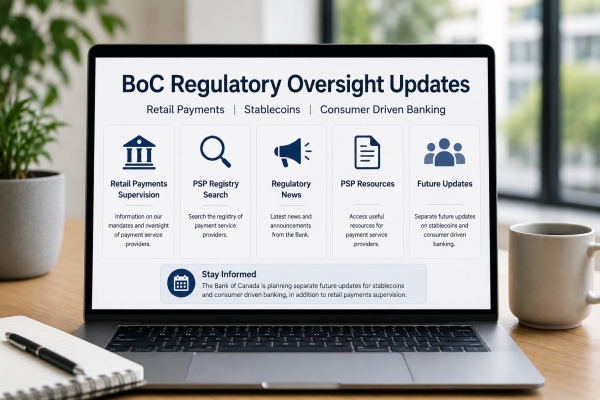
On May 25, 2026, the Bank of Canada refreshed its regulatory oversight web content and streamlined its retail payments supervision section. The update gives payment service providers a cleaner place to find key information as the Bank’s mandates expand across retail payments, stablecoins, and consumer driven banking.
The Bank says users can now more easily find information about its mandates, search the payment service provider registry, access a new regulatory news section, and browse resources for payment service providers. It's important for fintechs because RPAA supervision is evolving from policy discussion into day to day operating reality and governance.
The Bank supervises payment service providers under the Retail Payment Activities Act (NCFA covered this practical transition when the PSP registry went live under RPAA) and expects firms to meet risk management and safeguarding requirements.
In addition to retail payments supervision, the Bank of Canada also says it plans to issue separate future updates about stablecoins and consumer driven banking. It means fintechs should watch the Bank’s update streams more closely as these files progress for the latest updates and key information.
The Bank has also set up a Consumer Driven Banking Advisory Committee to provide industry perspective and advice to the Bank and the Department of Finance. The committee will focus on implementation, industry readiness, and the supervisory framework. NCFA’s open banking commercialization roadmap explains why implementation details will matter for fintech business models, data access, onboarding, and customer experience. That gives market participants a useful clue about where questions will concentrate next, such as how companies prepare, how oversight works in practice, and how consumer driven banking connects with the broader payment system.
Payment companies should use the refreshed pages as a compliance resource point. Check registry details, monitor regulatory news, review PSP resources, and make sure internal owners know where Bank updates will appear.
No new rules were announced in this email, but the Bank has made it easier to follow the official files that matter to payment companies, stablecoin operators, open banking participants. In a crowded regulatory environment, cleaner source material helps firms track changes earlier and prepare with less confusion.
The National Crowdfunding & Fintech Association (NCFA Canada) is a financial innovation ecosystem that provides education, market intelligence, industry stewardship, networking and funding opportunities and services to thousands of community members and works closely with industry, government, partners and affiliates to create a vibrant and innovative fintech and funding industry in Canada. Decentralized and distributed, NCFA is engaged with global stakeholders and helps incubate projects and investment in fintech, alternative finance, crowdfunding, peer-to-peer finance, payments, digital assets and tokens, artificial intelligence, blockchain, cryptocurrency, regtech, and insurtech sectors. Join Canada's Fintech & Funding Community today FREE! Or become a contributing member and get perks. For more information, please visit: www.ncfacanada.org
| | |
|---|---|---|
| | |
May 22, 2026 | NCFA Fintech Whisperer Weekly Intelligence | Digital Assets Blockchain And Tokenization, Payments And Money Movement
Image: Freepik
This live weekly NCFA intelligence page tracks financial technology developments that significantly affect how fintechs build, sell, raise capital, and operate under scrutiny. Coverage prioritizes Canada and includes global events that directly influence competitive conditions, market access, and execution realities across fintech sectors. This page will be updated throughout the week with market movers in a live format and then each week we'll close the prior week's contents in prep for the upcoming week, and continue on a rolling basis. (Missed prior week's Fintech Whisperer? (December 6-12, 2025, December 13-19, 2025, January 1-9, 2026, January 10-16, 2026, January 17-23, 2026, January 24-30, 2026, January 31-February 6, 2026, February 7-13, 2026, February 14-20, 2026, February 21-27, 2026, February 28-March 6, 2026, March 7-13, 2026, March 14-20, 2026, March 21-27, 2026, March 28-April 3, 2026, April 4-10, 2026, April 11-17, 2026, April 18-24, 2026, April 25-May 1, 2026, May 2-8, 2026, May 9-15, 2026).
Institutional digital asset infrastructure is increasingly converging around unified execution, settlement, compliance, and liquidity layers. Banks, fintechs, custodians, PSPs, brokers, and treasury teams should track how tokenized funds, stablecoin settlement, collateral movement, and onchain liquidity are becoming integrated into institutional operating environments rather than isolated crypto workflows.
Bank led stablecoins are becoming part of Europe’s regulated payment strategy. Banks, PSPs, stablecoin issuers, custodians, treasury teams, and compliance groups should track how euro denominated stablecoin infrastructure affects settlement options, liquidity design, and competition with USD stablecoins.
Stablecoin distribution is becoming a network access problem. Wallets, exchanges, PSPs, brokers, and embedded finance platforms need interoperability, regulated issuance, liquidity, and compliance controls that let users move between stablecoin networks without adding operational friction.
New York licensing remains a key test for institutional digital asset firms. Exchanges, custodians, brokers, lenders, and compliance teams should track which firms secure state level approvals because market access, client onboarding, and institutional trust still depend on regulated operating permissions.
USD account access is becoming embedded infrastructure for global platforms, not just a bank product. Fintechs, PSPs, marketplaces, payroll firms, and treasury teams should watch how account issuance, compliance controls, real time payments, and stablecoin rails converge inside programmable payment stacks.
Canadian dollar stablecoins are beginning to enter practical payment flows instead of remaining treasury or trading instruments. PSPs, banks, remittance firms, treasury teams, and compliance groups should watch how regulated stablecoin settlement changes cross border payout speed, corridor economics, liquidity management, and payment competition. CADC infrastructure continues to expand across Canadian digital payment markets.
Bitcoin reserve legislation is turning digital assets into a public balance sheet question, not just a market regulation debate. Crypto firms, custodians, exchanges, treasury teams, investors, and policymakers should track how federal reserve asset policy, seized digital asset management, and national competitiveness arguments reshape the next phase of U.S. crypto policy.
Card network economics are moving deeper into formal regulatory reporting. Merchants, acquirers, issuers, PSPs, payment networks, and embedded payment platforms should track how fee transparency, profitability evidence, and scheme oversight affect payment costs and competitive pressure across card acceptance.
The FCA is creating a clearer supervisory channel for firms that are already scaling, not just early sandbox participants. That matters because fast growth often creates new questions around controls, governance, technology, and consumer impact before a firm becomes systemically important.
Prediction markets are becoming a direct federal versus state jurisdiction fight. Exchanges, fintech platforms, compliance teams, policymakers, and investors should track how courts treat event contracts because the outcome could affect federal derivatives oversight, state gambling authority, consumer protection rules, and regulated forecasting markets.
Federal policymakers increasingly treat fintech infrastructure as part of U.S. financial competitiveness strategy. Banks, PSPs, digital asset firms, payment companies, and infrastructure providers should track how payment rail access, supervision, settlement services, and master account policy evolve as regulators face growing pressure to integrate fintech firms into core financial systems.
UK stablecoin policy is moving toward draft rule text and implementation design. Stablecoin issuers, banks, PSPs, custodians, wallets, and treasury teams should track how the Bank balances financial stability controls with usable payment products, especially around issuance limits, redemption, reserves, and access to settlement infrastructure.
Lowering community bank burden can open capacity, not just reduce paperwork. Fintechs, sponsor banks, core providers, lenders, and compliance teams should track whether tailored supervision gives smaller banks more room to partner, modernize, lend, and support local payment and deposit infrastructure.
Onchain markets need clearing and netting controls before more institutions treat them as reliable operating channels. Trading firms, custodians, brokers, stablecoin networks, and treasury teams should track how private obligation matching, liquidity savings, and counterparty controls develop across institutional digital asset markets.
Prediction markets are moving beyond politics and sports into private capital market intelligence. Exchanges, investors, fintech platforms, regulators, and market infrastructure providers should track how forecasting markets, institutional secondary market data, and tokenized trading systems increasingly converge around private company price discovery and market sentiment.
Regional exchange infrastructure competition continues to expand beyond traditional Western commodity benchmarks. Exchanges, clearing firms, commodity traders, treasury groups, and market infrastructure operators should track how Singapore based benchmarks, physical delivery systems, and digitally enabled collateral infrastructure increasingly support Asian commodity trade and price discovery.
The case is a governance and creditor risk warning for Canada’s fintech funding market. Investors, lenders, founders, and boards should keep closer watch on treasury controls, debt covenants, founder conduct, and creditor transparency as capital becomes more selective.
Canada’s MSB compliance risk is increasingly visible across multi service fintech models. Crypto firms, PSPs, FX dealers, remittance platforms, investors, and compliance teams should keep registration data current, map services accurately, and treat FINTRAC responsiveness as an operating requirement.
Payments, digital assets, AI fraud controls, and capital markets infrastructure are being rebuilt by registered firms with licenses, distribution, data, and balance sheets. Smaller fintechs can still win, but only where they solve a real operating problem and plug into the financial system with trust from day one. The opportunity is still open, but it will favour teams that move quickly, stay compliant, earn trust, and turn infrastructure change into useful products for customers, merchants, investors, and institutions.
NCFA offers various curated resources to help founders and investors stay current on developments that impact fintech markets, subscribe to NCFA weekly newsletter updates, view a rundown of current fintech news and insights, or dive into the latest fintech industry research.
The National Crowdfunding & Fintech Association (NCFA Canada) is a financial innovation ecosystem that provides education, market intelligence, industry stewardship, networking and funding opportunities and services to thousands of community members and works closely with industry, government, partners and affiliates to create a vibrant and innovative fintech and funding industry in Canada. Decentralized and distributed, NCFA is engaged with global stakeholders and helps incubate projects and investment in fintech, alternative finance, crowdfunding, peer-to-peer finance, payments, digital assets and tokens, artificial intelligence, blockchain, cryptocurrency, regtech, and insurtech sectors. Join Canada's Fintech & Funding Community today FREE! Or become a contributing member and get perks. For more information, please visit: www.ncfacanada.org
| | |
|---|---|---|
| | |
May 22, 2026 | NCFA Market Activity | Banking And Credit Infrastructure, Payments And Market Infrastructure, Lending Consumer Credit And BNPL, Artificial Intelligence And Data

On May 21, 2026, Wealthsimple unveiled a major expansion of its financial services platform during its live product event, “Wealthsimple Takes Over Your Life”. The announcements included family accounts, business chequing, USD accounts, portfolio backed credit, spend insights, overdraft protection, and a monthly $1M client rewards program. The company said more than 4 million Canadians now use Wealthsimple and hold $150B in assets on the platform.
Wealthsimple isn't a Schedule I bank, but it delivers banking style services through regulated Wealthsimple entities, infrastructure access, and partner financial institutions. Wealthsimple says chequing balances are held in trust with CDIC member institutions, while Wealthsimple Payments Inc. and Wealthsimple Investments Inc. are not CDIC member institutions. Power Corporation disclosed a controlling interest in Wealthsimple through Power Financial, Great-West Lifeco, and IGM. In Q1 2026 results, Power valued its Wealthsimple ownership at $3.8B as of March 31, 2026.
NCFA also covered Wealthsimple’s $750M financing and $10B valuation, which gave Canadian fintech markets one of the rarest and strongest scaleup stories.
The event hit home how far Wealthsimple has moved beyond investing and trading. The company now wants a larger share of daily financial activity across deposits, payments, borrowing, business banking, and household finance.
This builds on earlier product expansion when Wealthsimple added credit and loan tools in 2025, including a cash back credit card and low interest credit line. The latest event pushes that same strategy further into operating accounts, secured borrowing, and household controls.
The business banking launch carried the clearest fintech impact. Wealthsimple introduced business chequing with online setup in less than 20 minutes, virtual cards, automated CRA payments, recurring transfers, interest bearing balances, and higher e transfer limits.
Those features target familiar problems for Canadian SMEs. Many owners still deal with low transfer limits, little or no yield on operating balances, manual tax payments, and weak cash management tools.
The Portfolio Line Of Credit may become one of the company’s most important financial products. Wealthsimple said eligible clients can borrow against portfolios at rates as low as prime minus 0.5%, or about 3.95% at the time of the event.
Clients can borrow up to 35% of portfolio value. A client with $200,000 on the platform could access up to $70,000 in credit, subject to eligibility and risk controls.
The product gives clients a way to fund business expenses, inventory purchases, major purchases, or debt refinancing without selling investments. This type of secured liquidity has historically been more common in private banking and wealth management.
For Wealthsimple, portfolio credit also deepens the customer relationship. The more assets clients keep on the platform, the more useful the credit product becomes.
Wealthsimple introduced three family finance products. Kids and teens accounts give parents card controls, alerts, limits, instant transfers, and parent paid interest. Households lets partners choose what they share, track accounts inside and outside Wealthsimple, and view family finances in one place.
Authorized traders lets a trusted family member make trades on another person’s behalf without password sharing. That addresses a practical issue. Many Canadians already help spouses, parents, or relatives manage investments informally. Wealthsimple is formalizing that process with permission based account access.
Wealthsimple also pointed to deeper access across Canadian payment systems. The company linked that access to cheaper wire transfers, free incoming wires, faster payroll deposits, lower FX costs, instant virtual card issuance, cash deposits through Canada Post, and ATM fee reimbursements.
Wealthsimple gained direct Swift access, becoming the first Canadian fintech to do so. It supports the company’s push into wires, cross border money movement, and lower cost global payments.
The Canada Post cash deposit feature gives clients access to more than 5,000 deposit locations. Wealthsimple said it processed cash deposit transactions in more than 900 communities during the first two months after launch.
Infrastructure access increasingly matters for large fintech platforms. It can improve speed, pricing, product flexibility, and customer experience while reducing dependence on older branch based banking workflows.
Wealthsimple’s Monthly Millionaire program will award $1M each month to one client. Every dollar deposited or saved creates an entry, while direct deposit doubles entries. Move over 'roll up the rim to win'!
The structure encourages clients to move payroll deposits and savings activity onto the platform. For Wealthsimple, that supports higher deposits, stronger engagement, and more primary account usage.
Canadian fintech competition is increasingly focused on who controls the broader financial relationship, not just a single product category. Wealthsimple now spans deposits, payments, investing, borrowing, family finance, business banking, and cross border accounts.
That puts the company into more direct competition with incumbent financial institutions across several revenue areas at once. The company's expansion shows how quickly a Canadian fintech can move when scale, capital, trust, and distribution come together.
The National Crowdfunding & Fintech Association (NCFA Canada) is a financial innovation ecosystem that provides education, market intelligence, industry stewardship, networking and funding opportunities and services to thousands of community members and works closely with industry, government, partners and affiliates to create a vibrant and innovative fintech and funding industry in Canada. Decentralized and distributed, NCFA is engaged with global stakeholders and helps incubate projects and investment in fintech, alternative finance, crowdfunding, peer-to-peer finance, payments, digital assets and tokens, artificial intelligence, blockchain, cryptocurrency, regtech, and insurtech sectors. Join Canada's Fintech & Funding Community today FREE! Or become a contributing member and get perks. For more information, please visit: www.ncfacanada.org
| | |
|---|---|---|
| | |
May 20, 2026 | NCFA Resource | Regulation And Policy, Artificial Intelligence And Data, Digital Assets Blockchain And Tokenization

On April 20, 2026, the UK Financial Conduct Authority published its Innovation Insights 2025 report (20 page PDF). The report gives fintech founders, investors, and policy teams a practical view of where capital, regulatory testing, and market demand are concentrating across AI, digital assets, stablecoins, tokenization, RegTech, open finance, embedded finance, and operational automation.
The FCA points to a more disciplined phase of fintech, where firms need clear customer value, stronger controls, earlier regulatory engagement, and credible deployment plans.
The report combines global fintech investment data with activity across FCA innovation services, including the Regulatory Sandbox, Innovation Pathways, Digital Sandbox, AI Lab, Supercharged Sandbox, Smart Data Accelerator, and Scale Up Unit.
The overview gives operators a clean read on regulated fintech demand. AI, distributed ledger technology, open banking, and open finance ranked among the main technologies used by applicants. The FCA also launched new support channels in 2025, including a stablecoins cohort.
Regulated fintech no longer wins on novelty alone. Better products need stronger evidence, safer testing routes, sharper governance, and a realistic route from pilot to production.
This resource is useful for fintech founders, investors, compliance teams, financial institutions, policymakers, accelerators, digital asset firms, AI builders, RegTech vendors, and open finance teams tracking where regulated innovation is gaining traction.
It is especially useful for firms building around AI governance, stablecoins, tokenization, compliance automation, open finance, embedded finance, and supervised testing models.
The report is strong on investment patterns, regulatory engagement, sector demand, and FCA innovation service activity. It helps founders and investors see which fintech themes are attracting capital and which models need earlier regulator dialogue.
Its limit is the report doesn't provide a full outcomes study on sandbox firm performance, revenue growth, compliance cost reduction, productivity gains, fraud reduction, or investor returns. It works best as a regulatory market map, not proof that any one fintech category will outperform.
Canada and other jurisdictions can still use the report as a benchmark. Faster testing routes, clearer engagement models, and stronger links between experimentation and responsible deployment are becoming competitive advantages in financial innovation.
FCA Innovation Insights 2025 (primary FCA report)
AI Agents Enter Governed Financial Workflows (AI governance and controls)
Tokenization Starts Looking Like Financial Infrastructure (tokenized market infrastructure)
Deloitte And Stablecorp Bring QCAD To Banks (Canadian stablecoin infrastructure)
The National Crowdfunding & Fintech Association (NCFA Canada) is a financial innovation ecosystem that provides education, market intelligence, industry stewardship, networking and funding opportunities and services to thousands of community members and works closely with industry, government, partners and affiliates to create a vibrant and innovative fintech and funding industry in Canada. Decentralized and distributed, NCFA is engaged with global stakeholders and helps incubate projects and investment in fintech, alternative finance, crowdfunding, peer-to-peer finance, payments, digital assets and tokens, artificial intelligence, blockchain, cryptocurrency, regtech, and insurtech sectors. Join Canada's Fintech & Funding Community today FREE! Or become a contributing member and get perks. For more information, please visit: www.ncfacanada.org
| | |
|---|---|---|
| | |
May 15, 2026 | NCFA Fintech Whisperer Weekly Intelligence | Digital Assets Blockchain And Tokenization, Artificial Intelligence And Data, Risk Compliance And Regtech
Image: Freepik
This live weekly NCFA intelligence page tracks financial technology developments that significantly affect how fintechs build, sell, raise capital, and operate under scrutiny. Coverage prioritizes Canada and includes global events that directly influence competitive conditions, market access, and execution realities across fintech sectors. This page will be updated throughout the week with market movers in a live format and then each week we'll close the prior week's contents in prep for the upcoming week, and continue on a rolling basis. (Missed prior week's Fintech Whisperer? (December 6-12, 2025, December 13-19, 2025, January 1-9, 2026, January 10-16, 2026, January 17-23, 2026, January 24-30, 2026, January 31-February 6, 2026, February 7-13, 2026, February 14-20, 2026, February 21-27, 2026, February 28-March 6, 2026, March 7-13, 2026, March 14-20, 2026, March 21-27, 2026, March 28-April 3, 2026, April 4-10, 2026, April 11-17, 2026, April 18-24, 2026, April 25-May 1, 2026, May 2-8, 2026).
Tokenized funds need reliable exits before more institutions treat them as usable collateral or treasury assets. Asset managers, custodians, exchanges, treasury teams, and tokenization platforms should watch how redemption speed, stablecoin liquidity, and access controls become core requirements for institutional tokenized finance.
Community and regional banks are starting to package stablecoins, tokenized deposits, and digital asset lending inside bank led distribution. Banks, fintechs, core providers, custodians, and compliance teams should watch how association channels turn digital asset access into a practical banking product instead of a standalone crypto service.
Fintechs and FIs now compete on governed AI use in underwriting, fraud, servicing, and cost discipline, while security and model risk stay on the board agenda.
Voice is becoming searchable compliance evidence across more markets and languages. Banks, dealers, wealth firms, fintechs, and regtech vendors need stronger controls for recorded calls, multilingual surveillance, off channel risk, and investigation workflows.
Fraud controls are becoming more coordinated across regulators, law enforcement, platforms, and financial institutions. Banks, fintechs, PSPs, regtech vendors, and digital asset firms should expect higher expectations around intelligence sharing, scam detection, AI oversight, and real time monitoring.
Agent driven commerce needs payment controls that can handle authorization, settlement, spending permissions, dispute handling, and compliance review without slowing automated workflows. Stablecoins are increasingly being positioned as the settlement layer for machine initiated transactions.
Agent payments now need privacy, settlement, authorization, and audit controls that work together. Payment firms, wallet providers, stablecoin issuers, AI agent platforms, and compliance teams should track how machine initiated transactions create new requirements for identity, transaction monitoring, and dispute handling.
Canadian banks, credit unions, fintechs, and infrastructure providers face growing pressure to modernize customer onboarding, payments, servicing, and digital account experiences at lower operating cost. Large coordinated modernization programs can influence vendor standards, integration expectations, and competitive timing across the Canadian banking market.
Direct PSP access to Interac e Transfer gives Canadian fintechs a stronger role inside everyday money movement. Banks, PSPs, payment firms, and compliance teams should track how direct participation changes onboarding, fraud controls, settlement readiness, and product competition across Canadian payment services. Koho is a a payment service provider member of Payments Canada with direct access to payment clearing and settlement.
Digital asset lending keeps adopting operational standards from traditional securities finance. Exchanges, custodians, prime brokers, lenders, treasury teams, and compliance groups should watch how collateral controls, settlement discipline, and institutional workflow expectations become standard requirements across crypto lending markets.
Tokenized settlement is entering exchange rulebooks, not just pilot decks. Exchanges, broker dealers, custodians, transfer agents, market data teams, and compliance teams need to prepare for tokenized securities that still trade under national market system rules, surveillance, reporting, T+1 settlement, and existing investor protections.
Asset managers, exchanges, custodians, brokers, and treasury teams increasingly need infrastructure that supports tokenized funds, collateral, and yield products inside institutional operating environments. Tokenized finance is becoming part of mainstream capital markets strategy rather than a separate digital asset experiment.
Tokenization now reaches core market infrastructure, not just crypto trading activity. Exchanges, custodians, transfer agents, dealers, issuers, and infrastructure providers need operating models that support tokenized securities inside existing settlement, governance, reporting, and post trade systems.
Broker dealers, RIAs, custodians, wealth platforms, and compliance teams now have another regulated route to offer digital assets inside familiar securities account structures. That raises the bar for firms still treating crypto access as a separate product channel instead of a brokerage, custody, and supervision question.
MiCA implementation now becomes a licensing, supervision, and market access issue for crypto firms operating in Poland. Exchanges, custodians, stablecoin firms, brokers, and compliance teams should watch how national supervisors apply enforcement powers, authorization standards, and transition rules as Europe’s crypto framework enters active supervision.
Crypto exchanges, custodians, stablecoin issuers, tokenization firms, banks, compliance vendors, and capital markets platforms should track this markup closely. The bill text moves U.S. digital asset policy from broad debate into statutory architecture, with direct implications for token classification, intermediary registration, custody, disclosure, DeFi obligations, and cross border market access.
The common thread is operational readiness. Firms increasingly compete on whether they can support governed AI, tokenized assets, stablecoin settlement, and real time compliance inside production systems rather than separate innovation programs. That pressure now reaches broker dealers, PSPs, banks, treasury teams, exchanges, and compliance groups at the same time. Founders, operators, and investors tracking these changes may also want to review coverage on tokenized market infrastructure, AI agents entering governed financial workflows, and agent driven commerce and payments as these themes continue to converge across fintech markets.
NCFA offers various curated resources to help founders and investors stay current on developments that impact fintech markets, subscribe to NCFA weekly newsletter updates, view a rundown of current fintech news and insights, or dive into the latest fintech industry research.
The National Crowdfunding & Fintech Association (NCFA Canada) is a financial innovation ecosystem that provides education, market intelligence, industry stewardship, networking and funding opportunities and services to thousands of community members and works closely with industry, government, partners and affiliates to create a vibrant and innovative fintech and funding industry in Canada. Decentralized and distributed, NCFA is engaged with global stakeholders and helps incubate projects and investment in fintech, alternative finance, crowdfunding, peer-to-peer finance, payments, digital assets and tokens, artificial intelligence, blockchain, cryptocurrency, regtech, and insurtech sectors. Join Canada's Fintech & Funding Community today FREE! Or become a contributing member and get perks. For more information, please visit: www.ncfacanada.org
| | |
|---|---|---|
| | |



August 26th, 2025

January 4th, 2024

June 1st, 2021

September 9th, 2020

July 9th, 2018

January 3rd, 2018

September 25th, 2017

June 20th, 2017

May 10th, 2017

December 14th, 2016
