





Karsten Wenzlaff, Advisor
August 26th, 2025
Karsten Wenzlaff is a Crowdfunding and Fintech Expert from Germany. He is Secretary-General of Digit[...]


June 22, 2026 | NCFA Insight | Artificial Intelligence And Data, Risk Compliance And Regtech

On June 22, 2026, Banco Santander reported that its AI first strategy generated €35 million in business value in Q1 2026, with expected value of more than €200 million by year end and a target of more than €1 billion between 2026 and 2028. That's a regulated bank putting numbers around AI execution.
The more interesting part is how Santander is trying to get there. The bank has extended AI access to all 185,000 employees, reported more than 280 AI automation agents in production, and previously described its ambition to become an AI native bank.
Ricardo Martín Manjón, Chief Data & AI Officer at Banco Santander, put the strategy plainly:
“For me, being AI-first means applying AI where it can have tangible impact.”
For Canada, the timing of this announcement is important because Santander recently received approval to operate as a federally regulated bank in Canada. So its AI operating model more than a global case study. It's a preview of how new banking competitors may bring AI, governance, fraud controls, and measurable operating discipline into regulated Canadian markets.
The first AI cycle rewarded access. Banks tested foundation models, launched copilots, built internal assistants, and looked for productivity wins. That phase is maturing fast. Models are easier to access. Cloud tools are easier to use. Building a convincing demo is no longer the hardest part.
The harder test is operating AI inside a regulated financial institution without losing control of risk, data, decisions, accountability, or customer trust.
That's where Santander’s publicly released data become strategically useful. Specifically, the update points to measurable business value, enterprise wide access, employee adoption, automation agents, and governance controls across ethical, legal, cybersecurity, and risk requirements. This is what AI moving from lab work into operating infrastructure looks like.
One underappreciated piece of the story is Santander AI Lab’s open source work. Its Gen Fraud Graph project is described as an Apache 2.0 open source initiative for generating synthetic fraud graphs and advancing fraud detection capabilities. The technical repository is also available on SantanderAI’s GitHub.
Fraud detection is one of the fastest ways to expose whether financial AI can be trusted. It touches financial crime, AML controls, identity checks, transaction monitoring, customer friction, model risk, and auditability. A model that performs well in a slide deck but cannot be tested, explained, monitored, or reviewed isn't ready for regulated scale.
Synthetic fraud graphs help solve a practical problem. Banks need realistic fraud scenarios to test detection systems, but they cannot freely share customer data or investigative information. Synthetic environments provide a safer way to benchmark performance, validate models, and document results.
The choice of fraud is revealing. Santander didn't launch its open source thread with a marketing assistant or a generic productivity tool. It highlighted infrastructure connected to risk.
Fraud teams need speed, but they also need evidence. Compliance teams need explainability. Risk teams need controls. Boards need accountability. Regulators need confidence that systems can be monitored and challenged.
For fintechs, this move by Santander is both a warning and an opportunity. AI claims won't be enough in fraud, AML, onboarding, underwriting, customer service, complaints, trading, surveillance, or compliance workflows. Buyers will increasingly ask for testing evidence, audit trails, human review, data controls, drift monitoring, and proof that the system works under pressure.
Recent work from IOSCO, OSFI, the European Union, the FCA, and other supervisory bodies points in the same direction. Institutions want measurable results. Customers expect accountability. The result is a growing focus on how AI systems are tested, monitored, explained, and challenged. That's why AI is creating a new compliance burden at the same time it creates productivity gains.
Santander reports more than 280 AI agents operating across the organization alongside enterprise wide training, governance controls, and measurable business outcomes. The same operating question now appears across AI agents entering financial workflows, customer onboarding, fraud detection, transaction monitoring, and compliance operations. The challenge is proving that it can operate safely inside regulated environments, and fraud amplifies the challenge immediately.
AI clones, biometric breaches, faster payments, and cyberattacks are weakening older trust signals, which raises the value of new verification controls for financial trust. Synthetic fraud graphs fit into that bigger problem because they give teams a safer way to test detection systems without exposing customer data or live investigations.
For banks, fintechs, payments firms, and infrastructure providers, that changes the economics of competition. Access to advanced models is becoming easier. Building a prototype is becoming easier. Producing evidence that a system can be trusted under real operating conditions remains difficult.
The first AI race was about capability. The next one is quickly focusing on proof.
If access to advanced AI becomes commonplace, will governance infrastructure and proof of control become more valuable than proprietary models in regulated financial services?
 The National Crowdfunding & Fintech Association (NCFA Canada) is a financial innovation ecosystem that provides education, market intelligence, industry stewardship, networking and funding opportunities and services to thousands of community members and works closely with industry, government, partners and affiliates to create a vibrant and innovative fintech and funding industry in Canada. Decentralized and distributed, NCFA is engaged with global stakeholders and helps incubate projects and investment in fintech, alternative finance, crowdfunding, peer-to-peer finance, payments, digital assets and tokens, artificial intelligence, blockchain, cryptocurrency, regtech, and insurtech sectors. Join Canada's Fintech & Funding Community today FREE! Or become a contributing member and get perks. For more information, please visit: www.ncfacanada.org
 |  |  |
|---|---|---|
 |  |  |
Jun 22, 2026

Image: Pexels/bohlemedia
The World Cup used to have a familiar shape. Thirty-two teams. Eight groups. Two teams through from each group. A neat round of 16 waiting on the other side. Bettors, analysts and sportsbooks could read that structure almost by muscle memory; however, the 2026 tournament changes the math.
With 48 teams, 12 groups of four and a new Round of 32, the World Cup has become a larger pricing puzzle. More teams means more fixtures, more group-table scenarios, more knockout paths and more ways for one result to alter the market around another. For Canadian bettors, that creates a tournament where odds are not only reacting to form. They are reacting to the format.
A tournament with 48 teams gives the opening stage more moving parts. Each group still has four teams, which keeps the basic structure easy to follow, but the qualification path has changed. The top two teams from each group advance, joined by the eight strongest third-place finishers.
That third-place route is the detail that changes how bettors may read the group stage. A draw in the first match may not feel as heavy as it once did. Goal difference can become a bigger part of the market earlier. A team sitting third after two matches may still have a clear route into the knockouts if the wider table is kind.
That is why World Cup 2026 Betting Odds need to be read with the expanded format in mind. A price on a group winner, qualification market or outright contender is no longer only about team strength. It also reflects path, schedule, possible third-place outcomes and the shape of the bracket waiting ahead.
Outright odds are never only about who looks strongest. They’re also about the route a team may have to travel, which is why the expanded World Cup starts to look familiar to anyone who understands risk modelling, portfolio exposure or market repricing.
A sportsbook price works a little like a live financial model. It absorbs new inputs, adjusts probabilities and reacts when the path changes. A group winner may look strong on paper, but an extra knockout round adds another decision point, another opponent and another chance for the market to reassess. A third-place qualifier may look less convincing at first, then land in a bracket section that suddenly gives the price more room to move. For fintech-minded readers, that’s the useful lesson: odds aren’t fixed opinions. They’re changing estimates built from data, timing and risk.
This is the part of World Cup betting that feels closer to portfolio thinking than simple prediction. The price is not only about the asset. It is about the path, the risk and the timing of when the market may correct itself.
The expanded World Cup should make live odds especially active. With more teams, more group scenarios and more qualification routes, in-play markets have more context to absorb while matches are happening.
A goal in one match can affect the pressure in another. A second-place team may suddenly need a stronger goal difference. A third-place team may become safer with one more point. A coach may change the way a team plays because the table outside the stadium has shifted.
That’s where live betting becomes less about the scoreline and more about reading incentives. Is the leading team still pushing? Is the trailing team chasing goal difference? Has a draw become useful? Is a substitution about rest, control or urgency? The odds board can move quickly because the game is not taking place in isolation.
For Canadian bettors, the 2026 World Cup offers more than a home-hosted tournament. It offers a larger, denser market with more information arriving every day. The teams will decide the results on the pitch, but the expanded format will shape how those results are priced from the opening match to the final whistle.
The National Crowdfunding & Fintech Association (NCFA Canada) is a financial innovation ecosystem that provides education, market intelligence, industry stewardship, networking and funding opportunities and services to thousands of community members and works closely with industry, government, partners and affiliates to create a vibrant and innovative fintech and funding industry in Canada. Decentralized and distributed, NCFA is engaged with global stakeholders and helps incubate projects and investment in fintech, alternative finance, crowdfunding, peer-to-peer finance, payments, digital assets and tokens, artificial intelligence, blockchain, cryptocurrency, regtech, and insurtech sectors. Join Canada's Fintech & Funding Community today FREE! Or become a contributing member and get perks. For more information, please visit: www.ncfacanada.org
| | |
|---|---|---|
| | |
June 13, 2026 | NCFA Fintech Whisperer | Capital Markets And Market Infrastructure, Lending Consumer Credit And BNPL, Regulation And Policy, Risk Compliance And Regtech, Payments And Market Infrastructure, Digital Assets Blockchain And Tokenization, Artificial Intelligence And Data

Image: Freepik
This live weekly NCFA intelligence page tracks financial technology developments that significantly affect how fintechs build, sell, raise capital, and operate under scrutiny. Coverage prioritizes Canada and includes global events that directly influence competitive conditions, market access, and execution realities across fintech sectors. This page will be updated throughout the week with market movers in a live format and then each week we'll close the prior week's contents in prep for the upcoming week, and continue on a rolling basis. (Missed prior week's Fintech Whisperer? (December 6-12, 2025, December 13-19, 2025, January 1-9, 2026, January 10-16, 2026, January 17-23, 2026, January 24-30, 2026, January 31-February 6, 2026, February 7-13, 2026, February 14-20, 2026, February 21-27, 2026, February 28-March 6, 2026, March 7-13, 2026, March 14-20, 2026, March 21-27, 2026, March 28-April 3, 2026, April 4-10, 2026, April 11-17, 2026, April 18-24, 2026, April 25-May 1, 2026, May 2-8, 2026, May 9-15, 2026, May 16-22, 2026, May 23-29, 2026, May 30-Jun 5, 2026, Jun 6-12, 2026).
European supervision is becoming more operational and technology focused. Banks, fintechs, crypto asset firms, infrastructure providers, and compliance teams should watch how DORA, MiCA, and EMIR oversight changes vendor governance, resilience testing, supervisory reporting, third party risk management, and regulatory accountability.
Supervision is becoming more data driven, technology enabled and cross border. Securities regulators are building stronger tools for market surveillance, fraud detection, investor protection and digital asset oversight, which raises the operating bar for firms whose compliance, reporting and risk controls still depend on slow manual processes.
Prediction markets are moving from niche trading communities toward mainstream financial distribution. Retail platforms, exchanges, regulators, investors, and market operators should watch how event contracts evolve as a new information, forecasting, hedging, and market intelligence layer. Distribution may become as important as market design in determining adoption. See: Innovation Opportunities In Regulated Event Contract Infrastructure.
Post trade risk reduction is becoming part of capital markets infrastructure. Dealers, clearing participants, platforms, and regulators should watch how compression, optimization, exposure reduction, and capital efficiency tools are treated as supervised infrastructure rather than back office utilities.
Bond transparency reform is creating demand for new market data infrastructure. Trading venues, asset managers, dealers, data providers, and regulators should watch how fixed income reporting, consolidated data, and transparency tools reshape price discovery and execution quality across European bond markets.
Agentic AI is moving into capital markets workflow. For dealers, asset managers, pension funds, and credit trading desks, the issue is no longer only faster market search. The next phase is how supervised AI tools support pricing, liquidity discovery, execution preparation, and workflow decisions inside regulated markets.
Natural language tools tied to pricing, trade data, and workflow systems could change how institutional traders search markets, compare bonds, assess liquidity, and act on data inside regulated trading environments.
Stablecoins are being embedded directly into payment and remittance infrastructure. Payment firms, PSPs, remittance operators, banks, liquidity providers, and compliance teams should watch how regulated stablecoin settlement, API connectivity, and cross border liquidity become part of the operating stack for high volume regional payment networks.
Search is becoming regulated digital infrastructure. Publishers, fintechs, platforms, marketplaces, advertisers, AI search providers, and compliance teams should watch how ranking rules, data portability, publisher protections, and user choice requirements change discovery, distribution, and competition across search and AI enabled information access.
Institutional digital asset infrastructure is entering bank charter channels. Banks, custodians, wealth platforms, crypto firms and regulators should watch how national trust bank approvals shape custody, staking, lending support, capital requirements and supervisory expectations for digital asset services.
MiCAR is shifting crypto firms from fragmented national registrations toward regulated infrastructure choices. VASPs, exchanges, brokers, fintechs, custodians, and compliance teams should watch how licensing pressure turns custody, wallet services, settlement, liquidity, and operating controls into market access requirements across Europe.
AI linked lending platforms continue to connect consumer credit origination with capital markets distribution. Pagaya’s latest transaction shows how underwriting models, loan supply, securitization channels, and institutional demand are combining into repeatable credit infrastructure.
Canadian bank capital policy is shifting from maximum conservation toward controlled lending capacity. Banks, lenders, fintech partners, investors, and policymakers should watch how lower buffer requirements affect credit availability, capital planning, risk appetite, and competitive conditions across the financial system.
Canada is moving privacy, AI, consumer data, and platform accountability into the same regulatory agenda. Financial institutions, fintechs, AI vendors, data brokers, and digital platforms should watch how consent, deletion rights, automated decision transparency, children’s data protections, and guidance for onboarding, data use, AI and partnerships affect product design and data governance.
The review could affect how fintechs, derivatives firms and market infrastructure providers engage with US regulated markets. Firms should watch for changes that reduce unnecessary compliance friction while maintaining market integrity, customer protection and risk oversight.
The useful evidence is the transmission channel, not a prediction that CBDC will launch. Digital money competition affects deposits, funding costs, liquidity treatment, lending capacity, and central bank balance sheet operations. Operators, founders, and investors should watch how CBDC, fintech deposits, stablecoins, and payment infrastructure reforms change competition for bank funding.
The week's strongest market and regulatory signals weren't new products. They were changes to the infrastructure underneath financial markets. Bank capital rules, prediction market access, stablecoin rails, and compute markets all point to the same outcome. Firms that control access, distribution, liquidity, and critical infrastructure may increasingly determine who can compete and who cannot.
NCFA offers various curated resources to help founders and investors stay current on developments that impact fintech markets, subscribe to NCFA weekly newsletter updates, view the latest fintech insights, industry research, or launch into emerging financial innovation opportunities.
The National Crowdfunding & Fintech Association (NCFA Canada) is a financial innovation ecosystem that provides education, market intelligence, industry stewardship, networking and funding opportunities and services to thousands of community members and works closely with industry, government, partners and affiliates to create a vibrant and innovative fintech and funding industry in Canada. Decentralized and distributed, NCFA is engaged with global stakeholders and helps incubate projects and investment in fintech, alternative finance, crowdfunding, peer-to-peer finance, payments, digital assets and tokens, artificial intelligence, blockchain, cryptocurrency, regtech, and insurtech sectors. Join Canada's Fintech & Funding Community today FREE! Or become a contributing member and get perks. For more information, please visit: www.ncfacanada.org
| | |
|---|---|---|
| | |

Last Updated: June 19, 2026
Status: Strong
Organizations: CIRO, FCA, DTCC, DTC, NYDFS, Prometheum Capital, BitGo, Anchorage Digital, Circle France, AMF, Citi, Cross River, Figure
Crypto custody regulation is changing from asset safekeeping into market infrastructure control. The answer is no longer only about who holds private keys. It is about who can support client asset segregation, stablecoin reserves, broker dealer workflows, tokenized securities, DeFi access, collateral controls, audits, and recoverability when something breaks.
Canada is already part of the pattern. CIRO’s custody guidance builds on the wider Canadian platform supervision path outlined in regulatory updates for crypto asset trading platforms. The global direction is similar. Crypto custody is becoming a gatekeeper for regulated market access.
The same pattern appears in tokenized markets. If real world assets, stablecoins, tokenized funds, and private market instruments are becoming infrastructure, then custody becomes part of the operating layer. That is why the evidence connects directly to tokenization as financial infrastructure, not only crypto storage.
Click each item to expand
CIRO issued guidance on custody expectations for Dealer Members operating crypto asset trading platforms. The framework is effective immediately and uses a tiered, risk based structure.
The FCA’s CP26/8 consultation proposed amendments to client asset and market rules so they work for cryptoasset activities and the wider UK crypto regime.
NYDFS proposed updates to align its stablecoin regime with the federal GENIUS Act framework while maintaining New York’s stablecoin standards.
Click each item to expand
DTCC said DTC’s tokenization service plans initial limited production trades in July 2026, with launch planned for October 2026.
Citi launched tokenized depositary receipts to connect private companies and investors.
Circle France received approval to provide custody and transfer services for USDC and EURC across the European Economic Area under MiCA.
Click each item to expand
Prometheum Capital launched Digital Brokerage Solutions for broker dealers and RIAs using traditional brokerage account workflows.
Anchorage Digital launched Stablecoin Solutions for Banks, combining minting, redemption, custody, fiat treasury management, and settlement.
Cross River committed up to $250M in asset purchases to support Figure’s crypto backed loans.
Click each item to expand
BitGo announced pricing of its IPO, with shares expected to trade on the New York Stock Exchange under the ticker BTGO.
Canadian crypto platform registration evidence shows that custody remains part of market access, not a separate technical service.
NCFA’s tokenization evidence shows that custody is becoming part of the same market infrastructure stack as settlement, collateral, cash movement, and ownership records.
Do you agree the evidence is strengthening?


Click Agree or Disagree. Your vote is recorded anonymously and aggregate totals tracked.
The National Crowdfunding & Fintech Association (NCFA Canada) is a financial innovation ecosystem that provides education, market intelligence, industry stewardship, networking and funding opportunities and services to thousands of community members and works closely with industry, government, partners and affiliates to create a vibrant and innovative fintech and funding industry in Canada. Decentralized and distributed, NCFA is engaged with global stakeholders and helps incubate projects and investment in fintech, alternative finance, crowdfunding, peer-to-peer finance, payments, digital assets and tokens, artificial intelligence, blockchain, cryptocurrency, regtech, and insurtech sectors. Join Canada's Fintech & Funding Community today FREE! Or become a contributing member and get perks. For more information, please visit: www.ncfacanada.org
| | |
|---|---|---|
| | |
June 18, 2026 | NCFA Insight | Artificial Intelligence And Data, Capital Markets And Market Infrastructure
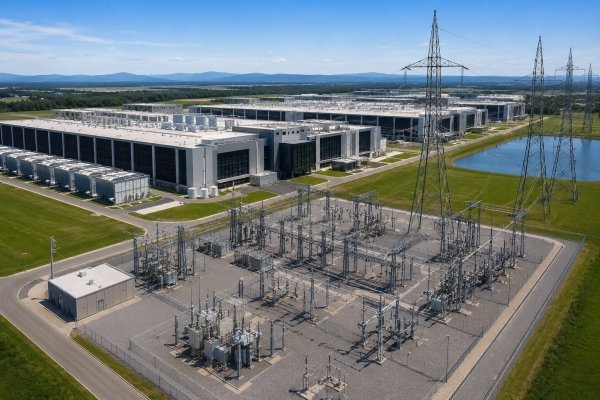
On June 18, 2026, BGC Group launched BGC Compute Infrastructure Markets, a new division focused on the secondary market for compute and memory capacity.
BGC is a financial brokerage and market data firm active in markets such as fixed income, foreign exchange, commodities, energy, shipping, equities, and futures. Its new compute business will operate inside the firm's Energy, Commodities and Shipping group and focus first on over the counter trading.
AI companies need huge amounts of computing power, but that capacity is getting harder to secure. It depends on chips, power, data centres, location, contracts, water, cooling, and timing. When something becomes scarce and expensive, buyers and sellers start asking market questions: who has capacity, who needs it, what is it worth, and how can risk be managed?
The United Nations University Institute for Water, Environment and Health report estimates that global data centres consumed 448 TWh of electricity in 2025. If data centres were treated as a country, that would rank 11th globally by electricity consumption. The same report projects data centre electricity use could reach 945 TWh by 2030, with AI workloads rising from roughly 20% of data centre electricity use in 2025 to 40% by 2030.
The report goes well beyond just the issue of power. Data centres' 2025 electricity consumption carried an estimated carbon footprint of 189 million tonnes of CO2e, a water footprint of 4.5 trillion litres, and a land footprint of 6,900 square kilometres. By 2030, projected data centre electricity use could be associated with 9.3 trillion litres of water and more than 14,500 square kilometres of land footprint.
Compute isn't just a cloud bill. It's tied to cost structures of electricity supply, grid connection, cooling, site location, water availability, hardware access, and local permitting. A buyer may need capacity in a specific place, for a specific time, with reliable delivery and known costs. A seller may have unused or contracted capacity that another participant needs. That is where a secondary market starts to make sense.
BGC says the new division is designed to support price discovery, risk management, liquidity access, and execution for participants exposed to AI infrastructure price risk. That statement alone treats compute like market exposure.
The buyers could include AI labs, enterprise AI teams, fintechs, model developers, governments, researchers, and companies that need access to GPUs or memory capacity. The sellers could include cloud providers, data centre operators, colocation firms, infrastructure investors, hardware owners, or firms with contracted capacity they no longer need. Between them is a market matching opportunity. Capacity is unevenly distributed, demand changes quickly, and long term infrastructure commitments are expensive.
Risk can show up in several ways. As AI demand grows, it's not just the technical issues. They are pricing, financing, and execution issues, too.
UNU-INWEH argues that AI impacts should be measured across carbon, water, and land footprints rather than carbon alone. Investors and financiers should treat electricity, carbon, water, and land footprints as material risks for AI infrastructure portfolios and use comparable footprint metrics in due diligence.
That is where BGC's initiative becomes more interesting. A compute market may eventually need more than bids and offers. It may need location data, power source data, delivery terms, grid risk, sustainability metrics, water exposure, counterparty quality, contract duration, and settlement rules. The more compute resembles infrastructure, the more the market will need infrastructure grade information.
Canada has its own stake in this. The federal AI Sovereign Compute Infrastructure Program is designed to improve access to advanced computing for Canadian researchers and firms while supporting protected Canadian controlled capacity. This connects directly with NCFA’s earlier coverage of AI data centres testing B.C.’s clean power limits. The strategy is about access, data protection, intellectual property, domestic capacity, and private investment.
Markets like the one BGC is trying to build could affect how Canadian companies think about compute access. Public programs can help anchor capacity, but private AI adoption will still depend on price, availability, power, location, financing, and contract flexibility. If compute capacity becomes easier to price and trade globally, Canadian AI firms and investors will need to understand how that market affects domestic competitiveness.
It's still early days, but financial market infrastructure is beginning to form around AI's hardest operating constraint, and that's worth watching closely.
If compute capacity becomes a priced and tradable infrastructure market, will AI advantage depend less on model design alone and more on who can secure, finance, measure, and manage access to scarce compute?
The National Crowdfunding & Fintech Association (NCFA Canada) is a financial innovation ecosystem that provides education, market intelligence, industry stewardship, networking and funding opportunities and services to thousands of community members and works closely with industry, government, partners and affiliates to create a vibrant and innovative fintech and funding industry in Canada. Decentralized and distributed, NCFA is engaged with global stakeholders and helps incubate projects and investment in fintech, alternative finance, crowdfunding, peer-to-peer finance, payments, digital assets and tokens, artificial intelligence, blockchain, cryptocurrency, regtech, and insurtech sectors. Join Canada's Fintech & Funding Community today FREE! Or become a contributing member and get perks. For more information, please visit: www.ncfacanada.org
| | |
|---|---|---|
| | |
June 18, 2026 | NCFA Fintech Market Activity | Payments And Market Infrastructure, SME Finance And Business Banking

On June 16, 2026, London based fintech SumUp launched in Canada, expanding into its 38th market and bringing another global merchant platform into a competitive Canadian small business payments sector.
Founded in 2012, SumUp says it serves more than 4 million businesses globally. What began as a mobile card acceptance provider has expanded into a broader merchant platform that includes payments, invoicing, point of sale software, online selling tools, business accounts, loyalty capabilities, and other services designed to help small businesses manage day to day operations.
Canada represents a significant SME opportunity. According to Innovation, Science and Economic Development Canada, the country had approximately 1.10 million employer businesses as of December 2024, including roughly 1.08 million small businesses. SumUp's launch targets that market with SumUp Go for in person card acceptance and Payment Links for remote payment collection.
Merchant payments have become one of the most valuable distribution channels in financial services.
Every transaction generates information about sales activity, customer demand, cash flow, seasonality, business growth, and operating performance. Companies that are closest to payment activity gain visibility into how a business actually operates. That information can support additional products and services ranging from invoicing and software to banking, lending, cash flow management, loyalty programs, and embedded finance.
As a result, competition is no longer limited to transaction processing fees. The larger opportunity is the business relationship itself.
Canada has already seen evidence of this shift. TD's merchant infrastructure partnership with Fiserv highlighted how financial institutions are rethinking merchant services strategies. Rather than treating payment acceptance as a standalone product, providers increasingly view merchant relationships as an entry point into broader financial and operational services.
SumUp enters Canada with meaningful scale. The company reported processing more than 1 billion transactions annually and previously raised €590 million at an €8 billion valuation. The company has also expanded by aquisitions including Goodtill, Tiller, and Fivestars as it broadened its merchant software and commerce capabilities.
In Canada, SumUp's initial offer includes transaction based pricing without monthly subscription fees. That positions the company against a market that includes banks, merchant acquirers, point of sale providers, and fintech competitors serving Canadian SMEs.
The competitive question is becoming increasingly clear. Businesses need payment acceptance. They also need software, reporting, reconciliation, invoicing, customer engagement, and access to capital. Providers that can combine those capabilities into a simple operating experience may be better positioned to deepen merchant relationships over time.
As payment providers expand into software, banking, lending, and business operations, will merchant payments become the primary gateway to the SME financial relationship?
The National Crowdfunding & Fintech Association (NCFA Canada) is a financial innovation ecosystem that provides education, market intelligence, industry stewardship, networking and funding opportunities and services to thousands of community members and works closely with industry, government, partners and affiliates to create a vibrant and innovative fintech and funding industry in Canada. Decentralized and distributed, NCFA is engaged with global stakeholders and helps incubate projects and investment in fintech, alternative finance, crowdfunding, peer-to-peer finance, payments, digital assets and tokens, artificial intelligence, blockchain, cryptocurrency, regtech, and insurtech sectors. Join Canada's Fintech & Funding Community today FREE! Or become a contributing member and get perks. For more information, please visit: www.ncfacanada.org
| | |
|---|---|---|
| | |
June 16, 2025 | NCFA Resource | Risk Compliance And Regtech, Artificial Intelligence And Data, Regulation And Policy
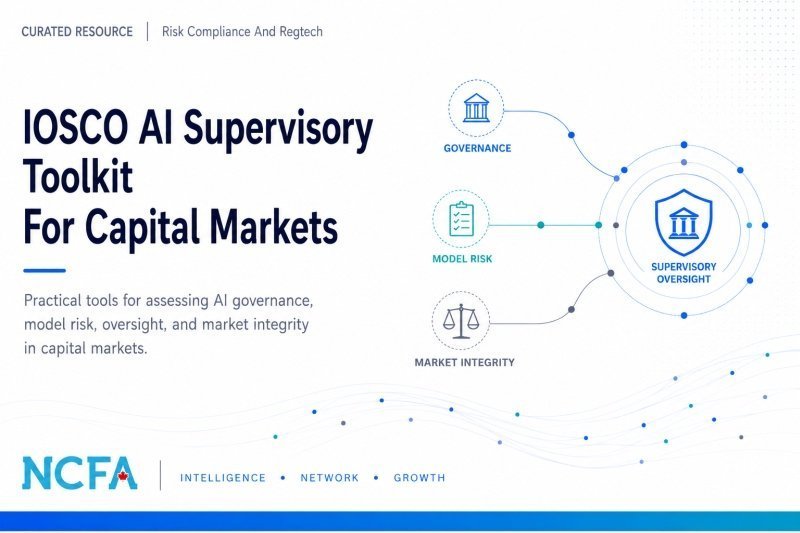
On May 25, 2026, the International Organization of Securities Commissions (IOSCO) published its Supervisory Toolkit for Artificial Intelligence Use in Capital Markets. The report provides practical tools for regulators supervising AI systems used by market participants, exchanges, investment firms, and capital market infrastructure providers.
The toolkit arrives as AI goes beyond experimentation and into production environments across trading, surveillance, compliance, onboarding, fraud detection, customer service, research, risk management, and operational workflows. IOSCO focuses on the supervisory questions regulators need to ask rather than promoting a specific technology approach.
Stakeholder Input Opportunity: IOSCO is also seeking feedback related to the toolkit and AI supervision in capital markets. Interested regulators, market participants, technology providers, academics, and industry stakeholders can review the report and submit responses to IOSCO by this short survey by June 26, 2026.
The report organizes supervision around seven areas. These include governance and accountability, model development and testing, data quality and management, monitoring and controls, outsourcing and third party providers, market conduct risks, and operational resilience.
Rather than prescribing rules, IOSCO provides supervisory questions, review approaches, and practical considerations that regulators can use when assessing AI systems operating in capital markets. The toolkit is designed to support risk based supervision while remaining flexible as technologies evolve.
The report also recognizes that AI risks often emerge from combinations of factors rather than a single model failure. Poor quality data, weak governance, limited oversight, inadequate testing, vendor dependencies, and insufficient monitoring can interact in ways that create market, operational, or investor protection concerns.
Many financial institutions are already deploying AI in regulated environments. The challenge is no longer whether AI will be used. The challenge is whether firms can demonstrate appropriate governance, explainability, oversight, and accountability once those systems affect clients, markets, or investment decisions.
For fintech operators, the toolkit offers a useful preview of the questions regulators may increasingly ask during examinations, supervisory reviews, audits, and risk assessments. Firms that build governance and controls into deployment processes early may face fewer compliance and operational challenges as expectations mature.
This resource is useful for securities regulators, exchanges, investment dealers, fintech founders, regtech providers, compliance teams, AI governance specialists, risk managers, and market infrastructure operators.
It is especially relevant for organizations using AI in trading, surveillance, onboarding, fraud detection, compliance monitoring, client communications, investment research, portfolio management, or operational decision making.
The strength of the toolkit is its practical orientation. It extends beyond high level AI principles and focuses on supervision, controls, accountability, and operational implementation. The framework can be applied across a wide range of AI use cases and organizational structures.
It also provides a common language that regulators and industry participants can use when discussing AI oversight. That consistency becomes increasingly important as firms operate across multiple jurisdictions with different regulatory approaches.
The toolkit does not create binding rules or regulatory obligations. IOSCO's role is to provide guidance and supervisory tools that member jurisdictions can adapt to their own legal and regulatory frameworks.
IOSCO Supervisory Toolkit For AI Use In Capital Markets (primary resource)
IOSCO Media Release (official announcement)
AI Agents Enter Governed Financial Workflows (AI governance and oversight)
Customer Due Diligence Controls For Fintechs (controls, monitoring, and accountability)
The National Crowdfunding & Fintech Association (NCFA Canada) is a financial innovation ecosystem that provides education, market intelligence, industry stewardship, networking and funding opportunities and services to thousands of community members and works closely with industry, government, partners and affiliates to create a vibrant and innovative fintech and funding industry in Canada. Decentralized and distributed, NCFA is engaged with global stakeholders and helps incubate projects and investment in fintech, alternative finance, crowdfunding, peer-to-peer finance, payments, digital assets and tokens, artificial intelligence, blockchain, cryptocurrency, regtech, and insurtech sectors. Join Canada's Fintech & Funding Community today FREE! Or become a contributing member and get perks. For more information, please visit: www.ncfacanada.org
| | |
|---|---|---|
| | |



August 26th, 2025

January 4th, 2024

June 1st, 2021

September 9th, 2020

July 9th, 2018

January 3rd, 2018

September 25th, 2017

June 20th, 2017

May 10th, 2017

December 14th, 2016
