





Karsten Wenzlaff, Advisor
August 26th, 2025
Karsten Wenzlaff is a Crowdfunding and Fintech Expert from Germany. He is Secretary-General of Digit[...]


Report | May 20, 2025
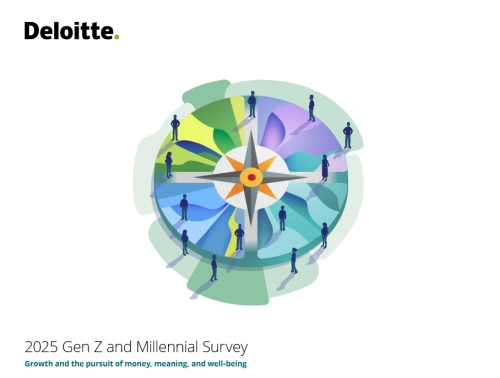
Image: Deloitte 2025 Gen Z and Millennial Survey
The 14th edition of the annual 2025 Deloitte Global Gen Z and Millennial Survey provides a global snapshot of generational attitudes towards work, money, technology and values, offering fintech founders, banks, credit unions, and policymakers core insights into what's driving the new economy and markets.
By 2030, Gen Z and millennials will represent nearly 75% of the global workforce. These generations are not just using financial technologies. They are building it, and reverse engineering what problems they should solve while establishing new expectations for how financial service tools operate.
The self-administered online survey data was collected from October 25 and December 24, 2024, gathering responses from a total of 23,482 respondents including 14,751 Gen Zs (born 1995 - 2006) and 8,731 millennials (born 1983 - 1994) across 44 countries, including regions such as North America, Latin America, Western Europe, Eastern Europe, the Middle East, Africa, and Asia-Pacific.
Young workers are very anxious about money.
- 48% of Gen Zs and 46% of millennials say they do not feel financially secure
- 52% of both groups live paycheck to paycheck, and over 33% struggle with basic monthly expenses
- 41% of Gen Zs and 44% of millennials are unsure whether they’ll be able to retire with financial comfort
These data points highlight the need for fintech products go well beyond basic budgeting dashboards. Gen Z and millennials need fintech tools to help them achieve financial resilience, such as income stabilization or smoothing, flexible savings tools, automated rent/bill buffers, and fair access to emergency funds. Financial service providers that can help reduce voltaility, and not just optimize credit scores, have an opportunity to earn trust and loyalty.
Adoption of generative AI tools is already a daily routine for young professionals.
- 57% of Gen Zs and 56% of millennials use GenAI tools in their daily work
- About 30% of each group use AI most or all of the time
- 74% of Gen Zs and 77% of millennials believe AI will significantly change how they work within the next year
These users are engaging with and building fintech products through an AI-first lens. They expect tools to respond in natural language, deliver almost instant relevant insights without friction, and adapt quickly. Static interfaces and dated workflows will lose ground quickly.
Fintech platforms in particular need to integrate GenAI not just in the back-end system but into product design and customer experience because these cohorts are fluent in AI which is quickly becoming the standard in how they source, think and consume.
Gen Z and millennials care less about climbing corporate ladders and more about doing work that aligns with their values.
- Only 6% of Gen Zs say their main career goal is to reach a leadership role
- 44% of Gen Zs and 45% of millennials have left jobs that lacked purpose
- 41% of Gen Zs and 40% of millennials have rejected employers due to ethical or values misalignment
For fintech employers, this creates both risk and opportunity. A strong mission with aligned values can attract high performers but the opposite will scare talent away quickly. To attract and retain the next generation of fintech talent, companies must offer more than good compensation. They need clear values, meaningful impact, and room for personal growth.
Formal degrees are no longer the default path into the fintech sector.
- 31% of Gen Zs and 32% of millennials chose not to pursue higher education.
- 70% of Gen Zs and 59% of millennials are building career skills at least once a week.
- The majority are doing this on their own time, outside of work hours.
There's more acceptance and shift now towards non-traditional education from bootcamps and peer networks to self-teaching, which has huge implications for hiring, funding, and human capital development. This means founders, operators and technical resources, may not originate from familiar backgrounds. Fintech leaders and investors need to adapt recruitment and due diligence models to focus more on traction, experience, and skills - and not just degrees.
Environmental and ethical values are a key part of how decisions are made.
- 65% of Gen Zs and 63% of millennials say they are willing to pay more for environmentally sustainable services
- 23% of Gen Zs and 22% of millennials have researched a company’s environmental practices before accepting a job offer
- Almost 50% say they’ve left or declined work that didn’t match their personal ethics
Social and environmental alignment is becoming a core user expectation, not a brand differentiator. Fintechs must design for transparency and shared impact from day one.
Fintech companies and financial institutions must design and deliver intelligent products with purpose and transparency that meet the moment of Gen Z and millennials who are under financial stress, fluent in AI, and prioritize values and ethics. The opportunity is to not just help these generations but to earn their trust and grow with them to create the next iteration of smart, modern, and purposeful finance.
 The National Crowdfunding & Fintech Association (NCFA Canada) is a financial innovation ecosystem that provides education, market intelligence, industry stewardship, networking and funding opportunities and services to thousands of community members and works closely with industry, government, partners and affiliates to create a vibrant and innovative fintech and funding industry in Canada. Decentralized and distributed, NCFA is engaged with global stakeholders and helps incubate projects and investment in fintech, alternative finance, crowdfunding, peer-to-peer finance, payments, digital assets and tokens, artificial intelligence, blockchain, cryptocurrency, regtech, and insurtech sectors. Join Canada's Fintech & Funding Community today FREE! Or become a contributing member and get perks. For more information, please visit: www.ncfacanada.org
 |  |  |
|---|---|---|
 |  |  |
Cybersecurity | May 14, 2025

Image: Freepik/DC Studio
Patrick Opet, JPMorgan Chase’s Chief Information Security Officer, has dropped a rare public warning that the modern SaaS (Software-as-a-service) model is enabling cyberattacks and embedding systemic risk into the global economy. His message is that the security architecture is breaking down, and software providers are not doing enough to fix it. Below are some urgent quotes from his discourse and why they matter for Canadian fintechs, investors, and regulators.
1. “SaaS has become the default... embedding concentration risk into global critical infrastructure.”
Many fintechs are using the same core SaaS vendors for payments, data, and automation, exposing them to a single point of failure. If one of these vendors is compromised, the effects can spread fast like wild fire on a dry summer's night. For fintech startups, the risks may be inherited without full visibility.
2. “Over the past three years, our third-party providers experienced a number of incidents... requiring us to act swiftly and decisively.”
Canadian fintechs with lean security teams need contingency plans for third party supplier compromise and must monitoring vendor behaviour or risk the full wrath of a serious attack that will disrupt operations, result in data theft or leakage, fraud and financial loss, regulatory and legal exposure, reputational damage and even cascading or 'fourth party' risks. Even a global bank must isolate vendors during incidents. Read OSFI's Guidance here: Third-Party Risk Management Guideline.
3. “Fierce competition among software providers has driven prioritization of rapid feature development over robust security.”
Security is often sacrificed for speed. Fintechs should require vendors to provide (1) strong and secure default settings, (2) regular third-party audits, and proof or evidence of strong internal security programs such as SOC 2 Type II or ISO/IEC 27001 certification.
4. “Modern integration patterns dismantle essential boundaries... relying on overly simplified interactions between third-party services and firms’ sensitive internal resources.”
OAuth tokens and API integrations are often misused, allowing third and unwanted parties to access internal systems. Without strong segmentation and logging, attackers can move quickly once access is gained. Microsoft Threat Intelligence recently confirmed state actors are now targeting common SaaS apps to infiltrate customers.
5. “The most effective way to begin change is to reject these integration models without better solutions.”
Canadian fintechs should ensure procurement policies require secure integration design, advanced authorization models, and greater transparency from vendors. Startups should reference the Canadian Center for Cybersecurity Top 10 IT Security Actions for implementation guidance.
SaaS brought convenience and speed but also concentrated risk across fintech infrastructure. For smaller Canadian firms who often lack internal security engineering, the consequences of a poorly or unsecured SaaS integration can be severe. This warning should not be ignored.
Fintech leaders should:
OSFI and the CSA have made it clear that third party oversight is now a priority, so fintechs can expect questions on cybersecurity controls and operational resilience during regular reviews. SaaS is here to stay but without stronger default security and safer integrations and oversight, it'll remain a growing liability.
Fintech startups and scale-ups cannot rely on vendors to lead. Security must be a shared responsibility across the ecosystem, and it begins with better architecture, more transparency, and smarter procurement.
The National Crowdfunding & Fintech Association (NCFA Canada) is a financial innovation ecosystem that provides education, market intelligence, industry stewardship, networking and funding opportunities and services to thousands of community members and works closely with industry, government, partners and affiliates to create a vibrant and innovative fintech and funding industry in Canada. Decentralized and distributed, NCFA is engaged with global stakeholders and helps incubate projects and investment in fintech, alternative finance, crowdfunding, peer-to-peer finance, payments, digital assets and tokens, artificial intelligence, blockchain, cryptocurrency, regtech, and insurtech sectors. Join Canada's Fintech & Funding Community today FREE! Or become a contributing member and get perks. For more information, please visit: www.ncfacanada.org
| | |
|---|---|---|
| | |
Digital Banking | May 9, 2025
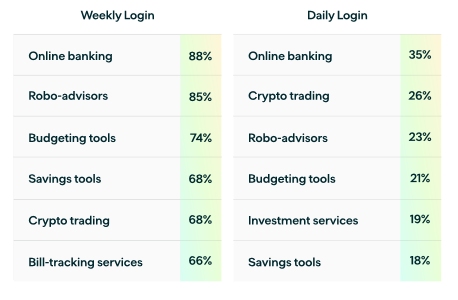
Image: Frequency of Use (Plaid x YouGov Money Talks survey report)
Between August 20-26th 2024, Plaid commissioned a national survey through the YouGov platform to understand how U.S. consumers bank, pay, and invest. The survey reveals insights of consumer preferences in digital finance, including trust in financial providers, app usage, payment methods, credit attitudes, and investment habits, based on weighted responses from 2,077 adults. Fintechs, digital finance platforms, and financial institutions need to stay up to date with the latest retail digital banking trends if they want to compete for consumer loyalty. Read 'Money Talks' (28 page PDF) report explaining these trends. Below we break-down key insights for NCFA's readers. Not yet subscribed? Sign-up for NCFA's weekly newsletter here.
Consumers continue to trust traditional banking institutions more than 100% digital platforms:
Trust and security go hand and hand, and overall, trust comes from perceived care and protection:
Consumers also shared who they rely on for financial well-being. The takeaway is that fintechs and advisory services must do more to be seen as helpful and caring, a useful partner in people’s financial lives.
Online banking is the most widely used financial tool: 99% percent of consumers are familiar with it, and 74% use it weekly.
Other commonly used tools include savings apps (68% weekly or daily), budgeting tools (85%), and peer-to-peer payment apps like Venmo or Zelle (used weekly by 50% of users). Roboadvisors are accessed more than once per week by (80%) of their users but only 1% of all consumers report using them regularly.
When asked what improvements they want most in financial apps:
60% of respondents said it is important to link their bank account with the financial apps they use.
Takeaway: Apps that are integrated, responsive, and secure are the most likely to be used often. Fintechs and banks that overcomplicate services or create friction in setup risk being overlooked, even if their offerings are advanced.
25% currently invest in cryptocurrency. Another 21% say they plan to invest in crypto or NFTs in the next year. These responder levels of engagement are equal to the 25% of people who say they will invest in stocks or trading platforms during the same period.
Crypto investors are not limiting their exposure:
Only 11% of respondents have used AI tools to support their investing decisions -> interestingly, this already exceeds the share of people using roboadvisors, suggesting that AI powered investment tools are gaining traction faster than traditional automated advice products.
Takeaway: Fintechs offering secure, easy to understand crypto access or AI investment tools can appeal to a growing investor base. Banks that avoid crypto are at risk of losing relevance with younger and self-directed investors.
Debit cards are now more commonly used than credit by younger adults. According to EY data cited in the report, 69% of Gen Z use debit cards daily or weekly. Many say they avoid credit cards because they do not want debt or do not qualify.
Buy now pay later (BNPL) services have grown 40% in usage since 2021.
Takeaway: Only 30% of respondents believe their credit score accurately reflects their financial health. 55% said they have been denied a loan due to a low score. These figures support growing interest in alternative data, such as cash flow and account history, for lending decisions.
Older adults are especially cautious. People aged 66 to 70 are 55% more likely to mistrust digital banks than those aged 22 to 25. Younger adults are more flexible. Among respondents aged 18 to 24, 36% said they would switch banks for a better digital payment experience.
Despite these trends, most people are not actively looking to change banks:
Consumers use different payment methods based on transaction size and age group:
To fund digital wallets:
Takeaway: Fintechs that want to increase adoption of pay by bank options must improve the experience. According to the report, 49% of users say they are likely to use pay by bank if the account linking process is easy.
Consumers want financial services that are clear, secure, and helpful, with trust remaining the most important factor in deciding whether to try a new app, share data, or switch banks. Traditional banks still hold an advantage in trust and reach but must modernize quickly. Fintechs have room to grow if they lead with transparency and value. Financial institutions that support financial goals and offer simple, connected experiences will stay relevant in 2025 (and beyond). Learn more about how consumers in the U.S. use, feel, bank, transact and acquire in 'Money Talks'.
The National Crowdfunding & Fintech Association (NCFA Canada) is a financial innovation ecosystem that provides education, market intelligence, industry stewardship, networking and funding opportunities and services to thousands of community members and works closely with industry, government, partners and affiliates to create a vibrant and innovative fintech and funding industry in Canada. Decentralized and distributed, NCFA is engaged with global stakeholders and helps incubate projects and investment in fintech, alternative finance, crowdfunding, peer-to-peer finance, payments, digital assets and tokens, artificial intelligence, blockchain, cryptocurrency, regtech, and insurtech sectors. Join Canada's Fintech & Funding Community today FREE! Or become a contributing member and get perks. For more information, please visit: www.ncfacanada.org
| | |
|---|---|---|
| | |
Regulation | April 29, 2025

Image: Freepik/brgfx
On April 25, 2025, the U.S. Securities and Exchange Commission (SEC) hosted a crypto roundtable discussion together with select industry experts and legal participants, "Know Your Custodian: Key Considerations for Crypto Custody" at the SEC's headquarters in Washington, D.C.
The opening session included remarks from Crypto Task Force Chief of Staff Richard Gabbert and SEC Chair Paul Atkins, followed by Commissioners Hester Peirce, Caroline Crenshaw, and Mark Uyeda.
Chairman Paul Atkins emphasized the importance of finally fixing long standing regulatory problems for digital assets and blockchain technology. He thanked Commissioner Hester Peirce for her leadership and described her as the right person to push forward a 'common sense' approach to crypto markets. Atkins made it clear that he wants the agency to end the uncertainty that has stifled innovation in the sector for years. He essentially confirmed what industry has been saying for years. That is that entrepreneurs across the country are building better, safer, and cheaper financial services using blockchain tech but regulatory confusion has held them back. He committed to working with Congress and the Trump Administration to set up a fit for purpose regulatory framework for crypto assets. Read his remarks here.
Commissioner Hester Peirce compared the current U.S. regulatory approach of crypto custody to a children’s game called “the floor is lava” except that regulators are making it much harder by leaving the room dark and not providing clear guidance. She said today’s rules make it very difficult for brokers, investment advisers, and investment funds to engage with crypto assets safely or legally. The SEC should make the rules clearer and recognize that not all crypto assets are the same, and in some cases using blockchain technology could even make custody safer than traditional systems. She also stressed that investors should be allowed to self-custody their assets without having to go through intermediaries like banks or broker-dealers, warning that the rules should not force unnecessary middlemen onto investors who prefer to manage their own assets securely. Regulation should encourage safer crypto markets without crushing innovation or forcing outdated models onto new technology.
Commissioner Caroline Crenshaw said that the lack of robust custody standards for crypto assets is a serious gap, and that the current environment is a risk for both retail and institutional investors. She mentioned the collapse of FTX and mismanagement in several crypto lending firms as examples of what can go wrong without the appropriate oversight, and questioned whether existing broker-dealer and advisory regimes were sufficient. Crenshaw said that any framework for custody must be technologically sound and legally enforceable to avoid paper compliance without real safeguards.
Commissioner Mark Uyeda stressed that regulatory requirements must be clear or they'll drive companies offshore and that innovation was important. Cautioned against applying a single rule in a digital asset sector where one size doesn't fit all and could stifle experimentation. He asked whether digital custodians should be assessed like their traditional counterparts, if they meet the equivalent operational and risk controls.
While the roundtable had two different focused panel discussions, here are five key challenges that were discussed when trying to apply traditional custody regulations to crypto assets.
Takeaway: Some consensus that federal securities laws need to be modernized to support custody models for crypto assets, and compliant innovation.
Takeaway: The SEC must recognize that crypto custody involves new forms of risk that current frameworks do not address (nor were they designed to).
Takeaway: SAB 121 may have made it harder for trusted firms to offer crypto custody, which could reduce investor protection.
Takeaway: Broker dealer models need updated guidance to allow more participation in digital asset custody while still protecting investors.
Takeaway: Custodial frameworks must guarantee client protections to the equivalent of traditional systems (expectations) to support long term growth.
The SEC roundtable series is a clear sign that key SEC regulators are open to revisiting current rules. As more investors and institutions enter crypto markets, the need for clear rules on how to safely hold these assets is becoming urgent.
The collaboration and engagement with industry should move the U.S. closer to having a practical crypto framework that supports both innovation and safety.
The National Crowdfunding & Fintech Association (NCFA Canada) is a financial innovation ecosystem that provides education, market intelligence, industry stewardship, networking and funding opportunities and services to thousands of community members and works closely with industry, government, partners and affiliates to create a vibrant and innovative fintech and funding industry in Canada. Decentralized and distributed, NCFA is engaged with global stakeholders and helps incubate projects and investment in fintech, alternative finance, crowdfunding, peer-to-peer finance, payments, digital assets and tokens, artificial intelligence, blockchain, cryptocurrency, regtech, and insurtech sectors. Join Canada's Fintech & Funding Community today FREE! Or become a contributing member and get perks. For more information, please visit: www.ncfacanada.org
| | |
|---|---|---|
| | |
Crypto | April 22, 2025

Image from Manumint Release April 15, 2025
On April 15 2025, Manumint announced the world's first 'hand-minded' cryptocurrency. The coin isn't produced with computers and energy-hungry servers but actual people working with pen and paper to solve cryptographic problems.
According to press release, Manumint employs people to solve complex math problems by hand to create digital coins, highlighting that the process is slow and labour intensive and designed to make the coins seem rare but the physical work appears real, raising concerns about the working conditions, although the full context isn't disclosed.
At NCFA Canada, we try our best to report on and present both sides of the innovation coin to inform and guide industry stakeholders, but on the surface the Manumint model raises questions about whether manual work is being used to create a sense of rarity and to support potential price speculation.
A word of caution to consumers and investors alike, it's always good to know where, how and why a particular product/service is being produced to ensure it aligns with responsible innovation and ones ethical perspective.
Canada’s fintech sector must lead with a positive purpose bound by ethics, inclusion, integrity, and trust. It means building tools that help people access credit, manage risk, and grow wealth in ways that are fair and transparent. It means protecting personal data and designing systems where people stay in control of their financial information. It means using AI to support human judgment and making sure algorithms are transparent, can be explained and challenged. Real innovation focuses on solving problems. It invites trust by showing clearly how it works, who it helps, and who is accountable. Real innovation solves real problems and strengthens markets.
Responsible fintechs build tools and data-driven systems that are fair, transparent, and worth believing in and using. While the future of finance will be digital, it must also be accountable to the high standards that progressive, modern societies deserve.
The National Crowdfunding & Fintech Association (NCFA Canada) is a financial innovation ecosystem that provides education, market intelligence, industry stewardship, networking and funding opportunities and services to thousands of community members and works closely with industry, government, partners and affiliates to create a vibrant and innovative fintech and funding industry in Canada. Decentralized and distributed, NCFA is engaged with global stakeholders and helps incubate projects and investment in fintech, alternative finance, crowdfunding, peer-to-peer finance, payments, digital assets and tokens, artificial intelligence, blockchain, cryptocurrency, regtech, and insurtech sectors. Join Canada's Fintech & Funding Community today FREE! Or become a contributing member and get perks. For more information, please visit: www.ncfacanada.org
| | |
|---|---|---|
| | |
Markets and Economy | April 15, 2025

Image: Jamie Dimon, Chairman and CEO, JP Morgan Chase
On April 7 2025, CEO Jamie Dimon of JPMorgan Chase published his annual 2024 letter to shareholders (58 page PDF), which is widely read by business and policy leaders around the globe. This year's edition, his messages are especially urgent. He describes a world of rising risks, and big decisions ahead with profound implications that stretch beyond simply Wall Street. Below are 5 insights that fintech founders, investors and Canadian decision makers need to know:
“History has shown that as countries become weaker, their currency loses reserve currency status.”
Dimon issued a clear warning that's rarely said out loud by execs of America’s biggest banks. That is the U.S. dollar’s global dominance is fading because it's strength relies on TRUST in U.S. institutions, alliances, and policy, BUT that trust is now eroding.
Last week, the U.S. dollar dropped significantly reaching a 3 year low against major global currencies. The decline is largely due to the Trump administration's escalating tariffs and trade tensions on imports from several countries, such as China, Canada and European nations. Tariffs led to increased market volatility, shaking investor confidence in American economic policies.
The WSJ published a report with the former Treasury Secretary, Janet Yellen, saying that investors "seem to be shunning dollar assets". Previously, for the past several decades, investors flocked to buy U.S. dollars during times of volatility and economic uncertainty because it was considered stable and safe.
American risks or lack of trust in its institutions is now prompting countries like Germany who hold 1200 tonne of their US gold reserve on American soil, to verify the existence of their gold and begin repatriating it back to Germany in case assets are suddenly frozen or risks spiral out of control. And they aren't the only country with concerns.
For Canada, this might open a window. If global capital starts looking for stable alternatives, Canadian institutions can position themselves as reliable partners. Our political stability and sound financial regulations are competitive assets. This is a moment to invest in confidence including the platforms and tools fintechs are building.
Dimon spells out just how much the U.S. benefits from being the world’s reserve currency:
“Being the reserve currency saves the United States $100 billion a year at current interest rates... People around the world actually carry approximately $2.5 trillion of paper U.S. dollars, which, in effect, is borrowing without paying interest.”
However, the U.S. being the global reserve currency isn't sustainable without continued global trust. For financial technology firms offering multi-currency accounts, global payments, and crypto on-ramps, this new reality is an opportunity.
If the dollar loses its unique place in the global system, financial firms will need to design for a world where volatility is the norm. That could mean hedging tools, stablecoins backed by liquid and diversified reserves, and tokenization of various assets could see a boost akin to gold, or a digital version of it.
“The U.S. deficit remains very large at just below $2 trillion, or 6.6% of GDP,” and warns that the “debt-to-GDP ratio is already over 100%.”
The U.S. government has borrowed nearly $11 trillion since the pandemic. The total U.S. federal debt is more than $34 trillion, which is greater than 100% of GDP. He says this is a structural issue and that America's fiscal path is on unstable footing. When debt continues to rise with no end in sight, global confidence wavers.
While in a different situation, Canada is under economic pressure from Trump's tariffs and trade war, persistent decline in productivity, and lower growth and foreign direct investment compared to many of its peer countries. It must restructure its own policies to support a fiscal agenda that supports innovation, digital infrastructure, supply chain and trading partner diversification, interprovincial trade, and green transitions that put Canada on a new path of economic growth. Canada can offer to the world what the U.S.'s current administration is turning, it's back against, a well managed democracy, and a country with ample resources (including human capital) that's serious about the future.
One of Dimon’s strongest warnings is about fragmentation.
“Economic fragmentation from our allies may be disastrous in the long run… Keeping our alliances together, both militarily and economically, is essential.”
He’s not just just talking about political division but economic ones, such as trade wars, competing currencies and trading blocs, and digital standards that no longer align with alliances that underpin and support U.S. markets in the way they do today. A world where economic cooperation breaks down and different countries build their own separate systems for money, trade, and technology - leading to incompatible digital standard and higher costs while opening the door for bad actors to take advantage of new weak links in the system. It could also encourage allies to rally around a new financial power for stability.
For fintechs and Canada, it's a risk and opportunity. It means building our own rails, compliance protocols, and digital ID systems that work across borders. The more neutral, resilient, and standardized Canada's digital infrastructure becomes, the more relevant it is globally.
In his letter to shareholders, Dimon shares lessons from decades of experience fro leading through crisis, transformation, and growth.
1. He warns that innovation can be smothered by too much money, too little clarity, or endless process. For startups, that’s a reminder to stay scrappy and experimental.
“You can kill innovation with too many resources, too few resources or bureaucracy… Evaluate innovative ideas through testing and learning rather than rote analysis.”
2. He also challenges the usual advice about delegation for mission-critical areas like cybersecurity, talent, or trust, and says leaders should get into the details.
“I changed my mind. I’m going to micromanage this one… In my entire career, I’ve rarely seen this kind of outsourcing of responsibility succeed.”
3. Don’t hide behind weak benchmarks.
4. Don’t sit through bad meetings, but "if a meeting is required, make it count… I ALWAYS do the pre-read… This has to stop: people checking notifications, texting, reading email. It’s disrespectful. It wastes time.”
5. In uncertain times, discipline is more powerful than vision alone.
The status quo is no longer. As geopolitical and economic risks take over, it's more pressing than ever for Canada to grow trust, build bridges, and invest in innovation with a strong economic growth mandate. Canada's fintech and financial ecosystem, can still thrive in a fragmenting world. We can't outspend superpowers but we can out think them.
The National Crowdfunding & Fintech Association (NCFA Canada) is a financial innovation ecosystem that provides education, market intelligence, industry stewardship, networking and funding opportunities and services to thousands of community members and works closely with industry, government, partners and affiliates to create a vibrant and innovative fintech and funding industry in Canada. Decentralized and distributed, NCFA is engaged with global stakeholders and helps incubate projects and investment in fintech, alternative finance, crowdfunding, peer-to-peer finance, payments, digital assets and tokens, artificial intelligence, blockchain, cryptocurrency, regtech, and insurtech sectors. Join Canada's Fintech & Funding Community today FREE! Or become a contributing member and get perks. For more information, please visit: www.ncfacanada.org
| | |
|---|---|---|
| | |
Consenus 2025 | April 7, 2025

NCFA Canada is excited to be an official Community Partner for Consensus Toronto 2025, happening May 14–16 at the Metro Toronto Convention Centre. Produced by CoinDesk, Consensus is the world’s most influential gathering of leaders in blockchain, crypto, Web3, and digital finance—bringing together founders, regulators, investors, policymakers, developers, and creators from around the globe.
With the conference just over a month away, we’re celebrating by launching the “Pitch the Future” Ticket Giveaway Contest — your chance to win a FREE Pro Pass (worth $950 USD) and join the action in Toronto alongside thousands of Web3 innovators.
Have a bold idea, future trend, or big vision? Building something cool and want to share it with the world? Tell us why you should be there, and you just might be!
The ticket giveaway runs from now until April 30, 2025
To be eligible to participate, follow both NCFA and @consensus2025 on at least one of our social channels like Instagram, X, Facebook or @CoinDesk #Consensus2025 on LinkedIn, depending on where you post your entry.
Post any one of the following (we’re keeping it flexible and fun!):
Your pitch can be a short video, text post, image, or attachment—we’re open to creative formats!
➡️ Be sure to tag @ncfacanada and @consensus2025 and use the hashtag #Consensus2025.
Help spread the word and support the community:
Whether you're building the future, predicting it, or just hungry to be part of it, this is your shot to join the global Web3 community at Canada’s biggest crypto event of the year. Get your post up before April 30, and we’ll see you in Toronto!
The National Crowdfunding & Fintech Association (NCFA Canada) is a financial innovation ecosystem that provides education, market intelligence, industry stewardship, networking and funding opportunities and services to thousands of community members and works closely with industry, government, partners and affiliates to create a vibrant and innovative fintech and funding industry in Canada. Decentralized and distributed, NCFA is engaged with global stakeholders and helps incubate projects and investment in fintech, alternative finance, crowdfunding, peer-to-peer finance, payments, digital assets and tokens, artificial intelligence, blockchain, cryptocurrency, regtech, and insurtech sectors. Join Canada's Fintech & Funding Community today FREE! Or become a contributing member and get perks. For more information, please visit: www.ncfacanada.org
| | |
|---|---|---|
| | |



August 26th, 2025

January 4th, 2024

June 1st, 2021

September 9th, 2020

July 9th, 2018

January 3rd, 2018

September 25th, 2017

June 20th, 2017

May 10th, 2017

December 14th, 2016
