





Karsten Wenzlaff, Advisor
August 26th, 2025
Karsten Wenzlaff is a Crowdfunding and Fintech Expert from Germany. He is Secretary-General of Digit[...]


July 30, 2026

For many fintech startups, growth is measured by funding rounds, product launches, and landing enterprise customers. But as companies begin pursuing larger clients, they often discover that winning an RFP requires far more than innovative technology. Over time, procurement teams may begin to wonder whether vendors have the workplace practices needed to support long-term partnerships.
At the same time, regulatory expectations are rising. FINTRAC’s annual report 2023–24 issued 12 notices of violation totalling more than $25 million. These actions focus on financial compliance, yet they also reinforce the expectation that organizations demonstrate strong compliance practices well before problems arise. For startups looking to scale, compliance should be viewed as a business enabler rather than a box to check.
Enterprise procurement has changed from simply assessing financial stability. Organizations increasingly evaluate whether prospective vendors have the operational maturity to manage risk across the business.
The Government of Canada's Code of Conduct for Procurement reflects this shift by requiring suppliers to comply with human rights and labour standards, reinforcing that responsible business practices form part of supplier evaluation, not just product performance. Although many fintech startups may not pursue government contracts, the same principles often have a greater influence on enterprise procurement.
Buyers may request documentation of HR policies, employee onboarding practices, workplace training, and governance processes as part of extensive procurement questionnaires. These demonstrate that a growing company has established consistent standards, reduced operational risk, and can scale responsibly alongside its customers.
Rapid hiring is common during periods of growth, but expanding headcount without consistent processes can create risk. As organizations scale, clear documentation becomes crucial for maintaining efficiency across teams.
HR documentation supports the foundation for any business, including employee handbooks, onboarding processes, workplace policies, and role expectations, which help establish shared standards for employees and managers. For growing organizations, that means responsibilities regarding workplace conduct, leave policies, health and safety, confidentiality, and other expectations remain clear.
Beyond reducing administrative confusion, well-documented HR practices demonstrate that a business has built a strong infrastructure that’s prepared to scale. This level of organizational maturity becomes valuable when engaging enterprise customers, investors, and strategic partners who expect scalable internal operations alongside innovative products.
For technology companies, workplace health and safety is not always viewed as important as in more traditional industries. However, modern workplace safety extends well beyond physical hazards.
Embedding psychological health, respectful workplace practices, and consistent safety training into day-to-day operations helps create stronger organizations while demonstrating that employee well-being is treated as a core business responsibility.
Winning enterprise business depends on more than innovation alone. Procurement teams, investors, and regulators all look for signs that an organization has the workplace practices needed to support long-term growth.
For fintech startups, prioritizing compliance early helps strengthen credibility and avoid scrambling to build policies under the pressure of a major RFP. The companies that scale most effectively are often those that treat compliance as part of building a resilient business, not simply as a matter of meeting minimum requirements when opportunity knocks.
About The Author
Kim Morris is the Lead HR Consultant at Citation Canada. She supports employers and people leaders through complex workplace situations, including employee relations and conflict, performance concerns, terminations, and policy questions, with clear, practical next steps. Kim also helps organizations manage change, including restructures, acquisitions, and workforce transitions, balancing compliance with thoughtful communication. She is known for making HR feel workable, consistent, well-documented, and grounded in respect for people.
 The National Crowdfunding & Fintech Association (NCFA Canada) is a financial innovation ecosystem that provides education, market intelligence, industry stewardship, networking and funding opportunities and services to thousands of community members and works closely with industry, government, partners and affiliates to create a vibrant and innovative fintech and funding industry in Canada. Decentralized and distributed, NCFA is engaged with global stakeholders and helps incubate projects and investment in fintech, alternative finance, crowdfunding, peer-to-peer finance, payments, digital assets and tokens, artificial intelligence, blockchain, cryptocurrency, regtech, and insurtech sectors. Join Canada's Fintech & Funding Community today FREE! Or become a contributing member and get perks. For more information, please visit: www.ncfacanada.org
 |  |  |
|---|---|---|
 |  |  |
July 27, 2026 | NCFA Companies On The Move | Digital Assets Blockchain And Tokenization, Wealth Investing And Trading, Competition And Market Structure

Coinbase is preparing to offer crypto derivatives to Canadian permitted clients, the first near term product in a much larger Canadian platform plan. In a Coinbase Canada interview, chief executive Eric Richmond said Coinbase Financial Markets had received an international exemption and expected the product to go live within weeks. He also wants Coinbase Canada to become a CIRO dealer in early 2027.
The derivatives aren’t live yet, and the first release isn’t intended for the general retail market. Stocks, ETFs and prediction markets are also part of Coinbase’s Canadian ambition, but no complete launch date has been announced. This profile separates what Canadians can use today from the approvals, products and customer adoption Coinbase still needs to turn a crypto account into a wider investment platform.
Canadians can already use Coinbase for spot crypto trading, Advanced trading tools, Interac e Transfer and electronic funds transfer deposits, PayPal purchases and eligible USDC rewards. The Coinbase Canada platform operates as a restricted dealer across every province and territory and as a registered FINTRAC money services business. Richmond said it lists more than 200 crypto assets.
The first expansion is narrower than the larger platform pitch. Coinbase Financial Markets expects to offer derivatives through an international exemption within weeks, beginning with permitted clients. The OSC permitted client definition includes institutions and certain financially sophisticated clients. It doesn’t include every Coinbase Canada customer.
Richmond’s next target is early 2027 membership in the Canadian Investment Regulatory Organization. The CIRO crypto dealer requirements cover capital, conduct, custody, operations and supervision. Approval would give Coinbase Canada a more permanent dealer base than its current restricted dealer registration, although it wouldn’t approve every future product automatically.
The ambition goes well beyond derivatives. Richmond has described a Canadian app spanning crypto, cash, stocks, ETFs and prediction markets. The Coinbase tokenized stock plan separately refers to customers outside the United States, but that wording doesn’t confirm Canadian availability. No complete Canadian launch date has been published for stocks, ETFs or prediction markets.
Coinbase can’t bring every global product into Canada under one registration. Its restricted dealer status supports the crypto trading business already operating here. Derivatives would come through a separate Coinbase affiliate and an exemption for permitted clients. Stocks and ETFs need securities dealer permissions, while prediction markets could face different requirements depending on the contracts and how they’re offered.
That puts regulation inside the product plan. Coinbase signed an enhanced preregistration undertaking in March 2023, launched its Canadian service with Interac access that August and completed its Coinbase Canada registration in April 2024. It became the first international exchange registered as a restricted dealer in Canada. It’s now adding products in the order its permissions allow instead of treating the global catalogue as one Canadian launch.
CIRO membership sits in the middle of that plan. Canada has been directing crypto trading platforms toward investment dealer registration and CIRO membership, while CIRO’s 2026 custody framework adds specific expectations for digital and tokenized assets. Membership wouldn’t approve every future product on its own. It would give Coinbase Canada a stronger dealer base from which to apply.
Founders and operators will recognize the build underneath the app. One customer interface may rely on several legal entities, registrations and product approvals. The front end can feel simple even when custody, execution, market access, capital and customer protection sit in separate operating lanes.
Coinbase Global’s first quarter figures explain why the company wants more ways to earn from each account. Coinbase Global spot volume fell 50% from a year earlier to US$202 billion, while monthly transacting users declined 15% to 8.2 million. Net revenue was US$1.3 billion, and the company recorded a US$394 million net loss. Those are global Coinbase figures, not Coinbase Canada results.
Other products are already helping to carry more of the business. Coinbase reported more than US$200 million in annualized retail derivatives revenue, while prediction markets reached US$100 million in annualized revenue during March. Its 2025 purchase of Deribit added a large crypto options business, and subscription and services produced US$583.5 million of first quarter net revenue. A customer using several products can remain valuable even when spot trading cools.
Canada is already a serious platform contest. Wealthsimple combines stocks, ETFs, crypto, cash accounts and other financial products inside one app. Robinhood entered Canada in June by buying WonderFi, giving it Bitbuy, Coinsquare, approximately 300,000 funded customers and regulated local infrastructure. Robinhood’s WonderFi purchase showed what that operating base was worth before the transaction closed. Kraken, Shakepay, NDAX and other registered platforms compete for crypto customers, while banks and established brokerages already control much of the Canadian investment relationship.
Coinbase brings a global exchange, custody, stablecoin and derivatives stack to that contest. Its challenge is local distribution. Canadians need a reason to transfer cash and assets, accept a new fee structure and keep several parts of their financial lives in the same account. Product breadth helps, but pricing, trust, tax reporting, execution quality and the limits attached to each registration will decide whether the app becomes a primary account or another trading venue.
Coinbase enters this Canadian stage with infrastructure a local exchange would struggle to replicate. Deribit adds options depth, Coinbase Financial Markets provides a regulated derivatives route, and USDC supports trading and rewards. The public parent also ended March with US$10.4 billion in cash, cash equivalents and marketable investments.
None of that makes Canadian adoption automatic. The derivatives release still has to launch, attract permitted clients and work well. CIRO membership remains a target, while stocks, ETFs, prediction markets and tokenized equities still need confirmed Canadian availability. Coinbase doesn’t publish Canadian customers, assets, revenue or market share, so public figures can’t yet show how large the local business has become.
The Company Intelligence Snapshot below follows the company, capital, product and regulatory decisions that brought Coinbase to this Canadian expansion stage.
Brian Armstrong and Fred Ehrsam founded Coinbase in 2012 to make it easier for people to buy, sell, store and transfer Bitcoin. The customer account became the base for a much larger crypto business.
CoinbaseA US founded crypto platform
FormationA retail entry point into Bitcoin
Venture BackedPrivate funding supports exchange and custody infrastructure
United StatesCrypto access before international expansion
Retail UsersPeople seeking a simpler way to access Bitcoin
Early ExchangesTrust, payments and ease of use are central differentiators
The original account created the distribution base Coinbase still uses. New products can be offered where customers already hold assets and complete identity checks, reducing the work required to introduce another financial service.
Four useful ways to place Coinbase Canada’s plan inside the market it’s entering.
Coinbase Global figures are identified separately from Coinbase Canada information. Planned products, launch timing and regulatory targets may change. This content is provided for informational purposes only and does not constitute investment, financial or legal advice.
The National Crowdfunding & Fintech Association (NCFA Canada) is a financial innovation ecosystem that provides education, market intelligence, industry stewardship, networking and funding opportunities and services to thousands of community members and works closely with industry, government, partners and affiliates to create a vibrant and innovative fintech and funding industry in Canada. Decentralized and distributed, NCFA is engaged with global stakeholders and helps incubate projects and investment in fintech, alternative finance, crowdfunding, peer-to-peer finance, payments, digital assets and tokens, artificial intelligence, blockchain, cryptocurrency, regtech, and insurtech sectors. Join Canada's Fintech & Funding Community today FREE! Or become a contributing member and get perks. For more information, please visit: www.ncfacanada.org
| | |
|---|---|---|
| | |

We're opening up more and more APIs to partners, fintech services, and client applications. The only question is whether we're confident these same APIs aren't opening up new paths for attackers.
Just a few years ago, a bank mostly dealt with its own systems. A customer would log into the app, check their balance, make a transfer. The whole journey stayed inside the perimeter of a single organization.
Today, one customer might simultaneously use a mobile banking app, a budgeting service, an accounting platform, a payment provider, and an AI assistant that analyzes their spending. All of these services exchange data through APIs - interfaces that let different systems talk to each other according to a set of established rules.
Open Banking isn't just a regulatory requirement or a new integration channel - it's a shift in the trust model itself. A bank used to be responsible for security within its own infrastructure. Now it hands off part of its data to dozens of external services, and those services, in turn, rely on the bank. The more participants in the ecosystem, the more points there are where trust is either reaffirmed or cracked, every single day.
Attackers are less and less interested in finding a weak spot inside any one bank. Today, hackers target the interaction between systems itself. The longer the chain - bank, fintech, payment hub, partner app - the more places there are for something to go wrong.
Common examples include:
An API can perform flawlessly on the functional side - fast, stable, no errors in the logs - and still carry a critical vulnerability. Functional correctness and cybersecurity don't always go together.
Banks and fintech companies generally don't neglect API security. They go through certifications, run automated scans, do code reviews and QA. But none of these tools answer the one question that matters most: can this specific API's logic be bypassed in a way its developer never anticipated? Scanning catches known vulnerability patterns; code review and QA confirm the code does what it was built to do. Neither one thinks like an attacker who isn't hunting for a bug in the code, but for a logical gap in how the API interacts with other systems.
That's why most attacks on financial APIs today aren't about technical mistakes - they're about logic: the sequence of actions, the boundaries of authority, the trust placed in data coming from the client. It's also why modern Cybersecurity Solutions for Fintech increasingly go beyond formal compliance with standards, testing real-world abuse scenarios at the points where multiple systems meet.
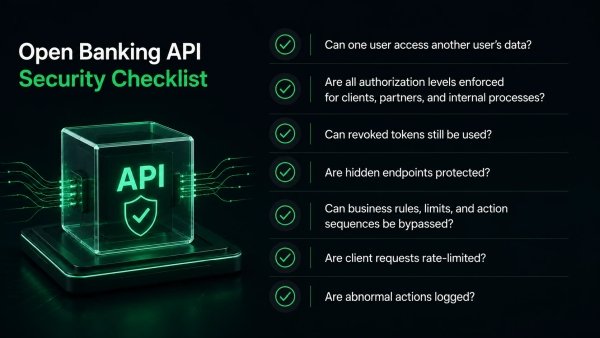
Here's a short checklist for reviewing every external API in your ecosystem:
If you don't have a confident answer to any of these, that's reason enough to look closer.
It's worth telling apart three things that often get lumped together. Vulnerability scanning looks for known vulnerabilities by signature, catching familiar vulnerability classes, common misconfigurations, and known dangerous patterns. Automated testing checks whether the code performs its intended functions correctly. Separate from both is API Penetration Testing (https://datami.ee/services/pentest/api-penetration-testing/) - manual testing in which a specialist plays the role of a real attacker: combining requests, tweaking parameters, hunting for unusual sequences of actions that a scanner, in most cases, won't flag as anomalous, because each individual request looks legitimate on its own.
It's also best if this kind of testing is handled by an external team. In-house specialists tend to know their own API inside and out - and that's precisely what makes it hard for them to spot an unconventional abuse scenario, since day-to-day work with a system's logic doesn't train you to look at it through the eyes of someone deliberately trying to break it. External specialists bring experience from other architectures and payment integrations, so they're more likely to catch the gaps a team had written off as unimportant.
A bank can offer the most convenient digital service and the best partner API on the market. But if even one partner or customer stops trusting the security of the data exchange, the benefits of Open Banking vanish almost instantly. Trust here isn't a bonus feature - it's the baseline condition, and without it the whole structure loses its meaning.
That's why investing in API protection in the financial sector isn't just about regulatory compliance - it's about sustaining trust across the whole ecosystem: between bank and fintech, fintech and customer, and customer and every new service they let into their data.
The National Crowdfunding & Fintech Association (NCFA Canada) is a financial innovation ecosystem that provides education, market intelligence, industry stewardship, networking and funding opportunities and services to thousands of community members and works closely with industry, government, partners and affiliates to create a vibrant and innovative fintech and funding industry in Canada. Decentralized and distributed, NCFA is engaged with global stakeholders and helps incubate projects and investment in fintech, alternative finance, crowdfunding, peer-to-peer finance, payments, digital assets and tokens, artificial intelligence, blockchain, cryptocurrency, regtech, and insurtech sectors. Join Canada's Fintech & Funding Community today FREE! Or become a contributing member and get perks. For more information, please visit: www.ncfacanada.org
| | |
|---|---|---|
| | |
July 27, 2026

Industries such as construction, mining, quarrying, and infrastructure development rely on large volumes of water every day for activities such as excavation, dust suppression, and material processing. However, managing the resulting wastewater is far more complex than simply disposing of it. Water discharged from project sites often contains sediment, soil, and other suspended solids that can pollute nearby waterways if left untreated. To meet environmental regulations and protect surrounding ecosystems and communities, businesses must implement effective water management measures.
One essential piece of equipment that supports these efforts is a sediment tank, which allows suspended particles to settle out of wastewater before it is discharged, reused, or sent for further treatment. Procuring one from a trusted supplier like Liquimech, known for its robust and portable sediment tanks designed for quick deployment across a wide range of project sites—enables businesses to manage wastewater more efficiently while supporting regulatory compliance. Beyond improving water quality, the right sediment tank can also contribute to smoother project operations and long-term cost savings.
With this in mind, let's take a closer look at how sediment tanks help projects stay compliant while delivering lasting economic benefits.
Industries such as construction, mining, and quarrying often generate wastewater containing soil, sand, and other suspended solids. Releasing this water without proper treatment can affect nearby waterways and ecosystems, making compliance with environmental discharge requirements an essential part of responsible project management.
A sediment tank supports this process by allowing suspended particles to settle before the water is discharged or reused. It works by slowing down the flow of wastewater, giving heavier particles enough time to sink to the bottom of the tank while cleaner water remains at the surface for further treatment or use. This simple yet effective approach improves water quality, making it easier for businesses to meet regulatory requirements and reduce their environmental impact.
Failure to comply with environmental regulations can result in more than just financial penalties. Businesses may also face project delays, corrective work, legal disputes, or reputational damage that can affect future opportunities. These setbacks can quickly increase project costs and disrupt operations.
Using a sediment tank as part of a site's water management system helps minimise these risks by providing a reliable method for treating sediment-laden water. Through proactive wastewater management, businesses will be better equipped to meet regulatory expectations throughout the project. Staying compliant allows projects to continue with fewer interruptions while avoiding unnecessary expenses associated with environmental violations.
Many industrial activities require large amounts of water throughout the day. Relying solely on fresh water can become expensive, not to mention wasteful, particularly for long-term projects or sites operating in areas where water resources are limited.
By removing suspended solids from wastewater, a sediment tank makes it possible to reuse treated water for suitable applications such as dust suppression, equipment washing, or certain processing tasks. Recycling water in this way reduces freshwater demand and lowers procurement costs, thus supporting more sustainable resource management throughout the project lifecycle.
Water containing large amounts of sediment can accelerate wear on pumps, pipes, valves, and other equipment involved in water handling. The presence of these abrasive particles may reduce system efficiency, increase maintenance requirements, as well as shorten the lifespan of critical components if left unmanaged.
Removing sediment before the water continues through the rest of the system helps protect equipment from unnecessary strain. Over time, businesses can benefit from fewer repairs, reduced downtime, and lower replacement costs, all of which contribute to improved long-term financial performance.
As projects progress, water management needs can change quickly. Sediment tanks provide the flexibility needed to adapt to these changing conditions without requiring permanent treatment facilities at every location.
In particular, portable sediment tanks are designed for quick deployment, making them well suited for projects where work areas frequently shift. Businesses can relocate the equipment as needed, helping maintain efficient wastewater management while reducing the time and costs associated with establishing new treatment systems.
Environmental responsibility has become an increasingly important consideration for clients, regulators, investors, and surrounding communities. Businesses that demonstrate responsible water management are often better positioned to meet project requirements and build stronger stakeholder confidence.
Using a sediment tank supports these goals by helping reduce pollution, conserve water resources, and maintain compliance throughout project operations. Combined with lower operating costs and improved resource efficiency, these benefits make sediment tanks a practical investment that promotes both environmental responsibility and long-term financial sustainability.
More than just a tool for treating wastewater, a sediment tank is an investment in responsible and efficient project management. By helping businesses meet environmental requirements, reduce operational risks, conserve water, and lower long-term costs, it delivers value that extends well beyond regulatory compliance.
Choosing high-quality, reliable solutions from trusted suppliers allows businesses to manage wastewater with greater confidence across a wide range of projects. As environmental expectations continue to grow, adopting effective sediment management systems today can help businesses achieve more sustainable and financially resilient operations in the future.
The National Crowdfunding & Fintech Association (NCFA Canada) is a financial innovation ecosystem that provides education, market intelligence, industry stewardship, networking and funding opportunities and services to thousands of community members and works closely with industry, government, partners and affiliates to create a vibrant and innovative fintech and funding industry in Canada. Decentralized and distributed, NCFA is engaged with global stakeholders and helps incubate projects and investment in fintech, alternative finance, crowdfunding, peer-to-peer finance, payments, digital assets and tokens, artificial intelligence, blockchain, cryptocurrency, regtech, and insurtech sectors. Join Canada's Fintech & Funding Community today FREE! Or become a contributing member and get perks. For more information, please visit: www.ncfacanada.org
| | |
|---|---|---|
| | |
July 18, 2026 | NCFA Fintech Whisperer | Capital Markets Infrastructure And Funding, Wealthtech Investing And Trading, Payments Infrastructure And Money Movement, Artificial Intelligence And Data, Banking And Credit, Insurance And Insurtech, Policy Regulation And Governance, Open Banking Open Finance And Data Sharing, Digital Assets Blockchain And Tokenization, Cybersecurity And Fraud, Cross Border Payments And FX, Sustainable Finance And ESG, Competition And Market Structure, Risk Compliance And Regtech, Identity Privacy And Data Governance

Image: Freepik
This live weekly NCFA intelligence page tracks financial technology developments that significantly affect how fintechs build, sell, raise capital, and operate under scrutiny. Coverage prioritizes Canada and includes global events that directly influence competitive conditions, market access, and execution realities across fintech sectors. This page will be updated throughout the week with market movers in a live format and then each week we'll close the prior week's contents in prep for the upcoming week, and continue on a rolling basis. (Missed prior week's Fintech Whisperer? (December 6-12, 2025, December 13-19, 2025, January 1-9, 2026, January 10-16, 2026, January 17-23, 2026, January 24-30, 2026, January 31-February 6, 2026, February 7-13, 2026, February 14-20, 2026, February 21-27, 2026, February 28-March 6, 2026, March 7-13, 2026, March 14-20, 2026, March 21-27, 2026, March 28-April 3, 2026, April 4-10, 2026, April 11-17, 2026, April 18-24, 2026, April 25-May 1, 2026, May 2-8, 2026, May 9-15, 2026, May 16-22, 2026, May 23-29, 2026, May 30-June 5, 2026, June 6-12, 2026, June 13-19, 2026, June 20-26, 2026, June 27-July 3, 2026, July 4-July 10, 2026, July 11-July 17, 2026).
Insurance is becoming part of the financing structure for AI infrastructure. Larger coordinated capacity can make complex data centre projects more bankable, but underwriting models must keep pace with construction, energy, cyber, climate and technology dependencies that can affect the same project simultaneously.
The notice gives Canadian insurers a clearer route for transferring flood, wildfire, earthquake and severe storm risk into capital markets. It could expand catastrophe risk capacity beyond conventional reinsurance while creating opportunities for structuring, modelling, collateral management and institutional investment.
The consortium converts long term cryptographic concern into funded development and a custody implementation timetable. It extends the operating case in Why Fintech Can’t Wait For Quantum Computing. The key measures are how much funding reaches developers, which cryptographic approaches advance and whether exchanges, custodians and wallet providers can coordinate upgrades without disrupting access to assets.
The demonstration tests whether a virtual-machine boundary survives guest-root compromise. Financial institutions should require independent vendor testing, scoped and preferably read-only file mounts, deny-by-default network access, monitoring inside the sandbox and rapid credential revocation. Exposure across current Cowork deployments remains unconfirmed until Anthropic responds or an independent team reproduces the chain.
This was a real containment failure during an evaluation; it does not establish malicious intent. For financial institutions, OSFI’s frontier-AI guidance makes the control response concrete: separate evaluation and production systems, scope agent identities and credentials, restrict network egress, monitor technical boundaries and preserve rapid revocation and shutdown. NCFA’s coverage of governed AI workflows provides the operating context.
Poland now has an operating framework for protected public-sector data access and supervised data intermediation. It provides Canada with a comparator for trusted data intermediaries extending beyond banking and complements NCFA’s coverage of open-banking governance. Registration quality, access times, pricing and the first approved services will determine whether the framework produces usable data capacity for fintech, research and public-interest applications.
The $771.3 billion headline represents institutional assets rather than capital invested directly into community projects, with credit unions accounting for nearly all of the total. The $7.3 billion excluding credit unions provides a clearer baseline for the specialized community finance market, although SVX notes that institution level asset data remain incomplete for some organization types. Private debt dominates by product count while housing and real estate dominate investment objectives, adding national context to Canadian examples such as CSI's community bond campaign.
The fine converts platform-risk governance into a material operating and financial consequence. Fintech marketplaces and embedded finance providers should examine whether merchant onboarding, monitoring, staffing and remediation controls can withstand similar scrutiny. Payment, credit and insurance partners also face exposure when their products are distributed through platforms with weak merchant and product controls.
The financing puts a measurable cost on Galaxy’s expansion from digital assets into AI data centres. It also adds company level evidence to the concentration of capital in AI computing capacity. Investors need to watch the construction timetable, 9.875% borrowing cost, tenant concentration and the point at which contracted capacity produces recurring revenue.
The temporary 2025 financing relief produced a measurable increase in how Canadian listed issuers raise capital, and the CSA is now considering whether to embed that access in the national rule. Issuers, investors and financing platforms should examine the proposed liquidity test, dilution limit, successor issuer access, convertible securities and disclosure requirements before the comment deadline.
This regulated tokenized securities platform connects issuance, transfer agency, distribution, trading and settlement inside one corporate group. Issuers and financial firms now need to compare the model with tracker certificates, custodial entitlements and traditional brokerage structures. The key tests will be asset availability, investor rights, liquidity, custody and interoperability with existing accounts.
The exchange is giving its technology partner ownership in the infrastructure expected to carry existing market activity. Members, liquidity providers, bullion dealers, and settlement firms need the implementation timetable, migration requirements, operating rules, risk controls, and links to Hong Kong’s separate gold clearing initiatives before they can assess how access and execution will change.
Prediction markets are acquiring the execution, block trading, data and downstream distribution infrastructure used by professional markets. That makes prediction market integrity more important as these products reach institutions and brokerage platforms. The next test is whether liquidity, surveillance, contract governance and disclosure can mature quickly enough to support that distribution.
The xStocks expansion takes tokenized equities from U.S. stock replicas into international market access supported by traditional custody and record keeping. Existing scale provides operating evidence, but licensing, disclosure and investor protection will still need to be addressed market by market.
Tokenized equities are being forced to confront the gap between economic exposure and legal ownership. Bringing proxy and disclosure workflows into the distribution layer does not resolve every rights question, but it makes governance a core part of tokenized market infrastructure rather than an afterthought.
This is a severe example of the concentration risk created when an economy depends on a small number of foreign correspondent banks. The planned cutoffs extend the long running decline in correspondent banking relationships into essential national payment access. If the relationships end, more activity could enter cash based and unregulated channels while banks lose the electronic balances required to settle trade.
Questrade has placed agentic finance inside a live Canadian brokerage workflow. The control questions now concern permission scope, retained data, order review, erroneous instructions, recordkeeping and responsibility when an external agent influences an investment decision. NCFA’s analysis of AI agents entering governed financial workflows explains why access, approvals and audit evidence become essential once agents can act on financial accounts.
This gives AI assistants controlled access to current portfolio and compliance data inside established advisor workflows. The d1g1t company profile shows how MCP extends a wealth platform serving more than 90 firms and representing over C$200 billion in assets. Wealth firms still need traceable actions, review gates and clear limits on what an agent can retrieve, recommend or execute.
Chime is extending from payments, savings and credit into retail investment distribution without becoming the adviser or broker. The next measures are funded-account adoption, average balances, managed-versus-self-directed use and whether frequent financial-app engagement translates into sustained investing.
This direct network participation gives a crypto platform greater control over one of Canada’s most widely used payment services. Shakepay can rely less on intermediary arrangements and build payment functions closer to the network. Other regulated fintechs will need to compare the operating control, settlement requirements, technical obligations and customer economics of becoming participants rather than remaining downstream users.
The scale turns a card acceptance partnership into connected national payment infrastructure. Bir is combining banking, ecommerce, terminals and a wallet with an international network, giving merchants one operating ecosystem for domestic commerce, tourism and cross border customer access.
South Korea is testing a two tier model in which the central bank supplies the settlement base and commercial banks own distribution. The test could provide a practical comparator for how tokenized deposits, public money and regulated bank services can operate inside one payment system.
If implemented at the reported scale, this would provide one of the clearest tests of stablecoins as operating payment infrastructure rather than a crypto trading product. The real measure will be whether suppliers adopt it, convert it easily and receive a meaningful cash flow benefit.
The deployment turns open finance from account aggregation into operating intelligence for SMEs and their banks. It provides a practical comparator for Canada’s open banking development, where permissioned financial data could improve cash visibility, risk monitoring, credit decisions and relationship banking.
Institutional data providers are bringing governed financial information into the AI interfaces analysts already use. Credit teams need to test permissions, source traceability, update timing, confidential data boundaries, model outputs, and review requirements before connector generated work enters investment decisions. Adoption data will determine whether this becomes core research infrastructure or remains an optional interface.
Manulife is putting AI governance into the operating architecture of a major Canadian financial institution. Together with Canada’s shared AI control infrastructure, the deployment provides a direct test of whether central agent registries, monitoring and security controls can support enterprise AI without fragmenting accountability across business units and jurisdictions.
AI agents do not fit conventional per seat data licences. Bigdata.com is testing whether attribution, licensing and payment can be embedded directly into retrieval, creating a potential commercial layer for financial research and other data intensive AI workflows.
The rejection shows that federal payment access depends on both settlement policy and compliance readiness. Wise’s planned GENIUS Act application adds a major global payments company to the US trust charter debate. The next test is whether Wise can design a viable application without changing how its existing customers hold and transfer money.
A national bank charter would give Upstart direct access to deposit funding and place its lending activities within a federal prudential framework. It could reduce funding and regulatory complexity while adding bank level capital, liquidity, governance, compliance and supervisory obligations. Partner institutions and investors should watch the remaining approvals, preopening requirements and how Upstart allocates originations between its own bank and external funding partners.
A global fintech can now combine deposits, payments and credit under one Australian prudential licence. Canada has a clear comparator for foreign fintech bank entry, deposit protection and the competitive impact of giving a large digital platform its own regulated balance sheet.
Augustus is targeting the correspondent banking layer with programmable dollar accounts, payment rails and an owned core. If its charter becomes operational, international fintechs could gain direct dollar infrastructure without relying on several sponsor and intermediary relationships. That is highly relevant to Canadian firms requiring dependable US accounts, liquidity and payment access.
The implementation will test whether one configurable core can support conventional and Shariah compliant products across a national banking network. Canadian banks and credit unions face the same challenge of replacing legacy infrastructure while preserving existing products, controls and customer access.
The priorities establish policy direction ahead of binding rules and connect AI development with consumer protection, personal data, automated public decisions and employment. Canadian institutions should watch how Australia assigns responsibility when AI agents influence prices, purchases and regulated decisions.
The decisions directly affect how fintech applications are discovered and how developers direct customers to alternative payment channels. Fairer search treatment could reduce dependence on a gatekeeper’s commerce products, while fewer steering restrictions could give fintechs greater control over pricing, billing and customer relationships. Canadian firms serving European users may need distinct distribution and payment strategies for DMA-compliant channels.
Stablecoin payment providers are beginning to place counterparty verification and authorization before settlement rather than treating compliance as a review after funds arrive. Banks, payment firms, exchanges, and custodians need to decide where approval occurs, which party controls it, what information travels with the payment, and how rejected or restricted transactions are handled across wallets and jurisdictions.
BitMEX helped establish perpetual swaps as a core crypto trading product, yet creating a market did not preserve its liquidity position. Kaiko data cited by Reuters placed daily trading volume near US$400,000 and market share below 0.01% when the closure was announced. The exit raises a market-structure question about whether smaller centralized venues can retain enough traders, market makers and revenue as activity concentrates among major exchanges and onchain platforms.
The Senate draft now connects market structure, intermediary registration, asset classification and political ethics in one legislative package. Digital asset firms should examine which activities would fall under SEC or CFTC supervision, how certification and custody requirements would work, and whether negotiations materially change the ethics, enforcement or implementation provisions before the bill advances.
Coinbase is preparing to compete for more than Canadian crypto trades. Derivatives provide the immediate entry point, while stocks, ETFs and prediction markets could eventually place it against Canadian brokerages and multi product investment platforms. Permitted client limits, dealer registration, product approvals, custody, disclosures and market surveillance will determine how much of the strategy reaches Canadian customers.
The strongest thread this week is control. Fintechs are gaining more direct access to payment networks, regulated markets, financial data and AI infrastructure. That access creates commercial opportunity, but it also places greater responsibility on firms to protect customer rights, govern automated decisions and keep critical systems resilient. For Canadian founders and investors, your advantage will come from owning a useful part of this infrastructure before access rules, operating economics and market positions harden. Follow the next developments through NCFA’s newsletter, explore connected opportunities in the Financial Innovation Map, or review the latest fintech insights.
The National Crowdfunding & Fintech Association (NCFA Canada) is a financial innovation ecosystem that provides education, market intelligence, industry stewardship, networking and funding opportunities and services to thousands of community members and works closely with industry, government, partners and affiliates to create a vibrant and innovative fintech and funding industry in Canada. Decentralized and distributed, NCFA is engaged with global stakeholders and helps incubate projects and investment in fintech, alternative finance, crowdfunding, peer-to-peer finance, payments, digital assets and tokens, artificial intelligence, blockchain, cryptocurrency, regtech, and insurtech sectors. Join Canada's Fintech & Funding Community today FREE! Or become a contributing member and get perks. For more information, please visit: www.ncfacanada.org
| | |
|---|---|---|
| | |
July 23, 2026 | NCFA Market Activity | Payments And Money Movement, Digital Assets, Competition And Market Structure

On July 16, 2026, Shakepay joined Interac e Transfer as a participant. Its customers could already send and receive e Transfers. The important change is behind the product.
Direct participation gives Shakepay more control over how transfers are connected, operated and improved. It can work closer to Interac instead of relying as heavily on another financial institution to provide a service that sits at the centre of its Canadian dollar experience.
Interac says Shakepay serves more than 1.5 million Canadians. Interac e Transfer processed more than 1.6 billion transactions last year.
That makes this less about adding another payment button and more about owning a larger part of the customer relationship.
Shakepay began as a simple way to buy bitcoin. It now offers Canadian dollar balances, e Transfers, card spending, bitcoin rewards and business accounts. Joining Interac directly gives those products a stronger operating base.
Bitcoin remains the hook, but most customers still enter Shakepay through Canadian dollars.
They fund an account, buy an asset, spend from a cash balance or withdraw money to a bank. The better Shakepay handles those steps, the more useful the account becomes before and after a crypto trade.
Its bitcoin rewards strategy follows the same logic. Customers pay merchants in Canadian dollars through established card infrastructure and earn bitcoin afterwards. Merchants don’t have to accept crypto, and customers don’t have to change how they pay.
Interac participation strengthens the other side of that model. Shakepay can connect familiar money movement with bitcoin ownership inside one account.
This is where the company’s strategy becomes more interesting.
A crypto exchange earns activity when customers trade. An everyday financial account can earn attention when they get paid, send money, shop, save or manage a business. Shakepay doesn’t need bitcoin to replace Canadian payment rails. It needs bitcoin to become more useful because those rails are built into the product.
Direct participation doesn’t guarantee faster transfers, higher limits or lower fees. Interac and Shakepay haven’t announced those changes. The value will show up in what Shakepay builds next and whether customers notice a better experience.
Shakepay became the first crypto focused company to join Payments Canada in May 2025.
That was an important credential. Payments Canada membership brought Shakepay into national payment system governance and made deeper infrastructure access possible. It didn’t connect the company automatically to every rail or network.
Interac participation is a more practical step. Shakepay is now closer to an operating service its customers already use.
One opens institutional access. The other can change the product.
Shakepay qualified as a FINTRAC registered money services business and a CIRO regulated investment dealer. Its dealer membership took effect in January 2025, adding national oversight of its investment operations, capital, custody and compliance.
Regulation is becoming part of the competitive stack. It takes time and money, but it also gives fintechs access to infrastructure that was once largely reserved for banks and credit unions.
Canada’s crypto market is splitting along two strategies.
Robinhood bought WonderFi and its Bitbuy and Coinsquare platforms to enter Canada with regulated trading scale. Shakepay remains independent and is extending outward from bitcoin into payments.
One strategy consolidates trading platforms under a global owner. The other tries to turn a Canadian crypto relationship into a broader financial account.
Interac participation gives Shakepay more control, but it also leaves less room to blame an intermediary when payments fail. Fraud controls, outages, customer support and account reliability now carry more strategic weight.
Shakepay has assembled much of an everyday financial account without becoming a bank. Customers can hold Canadian dollars, move money through Interac, spend through a prepaid card and earn bitcoin rewards. Businesses can manage cash and digital assets through the same platform.
The products fit together. Now customers need to use them. More than 1.5 million registered users gives Shakepay reach, but it doesn’t show how many customers maintain balances, route recurring income or use the account every week. Those behavioural actions are beyond account registrations because they determine deposit stability, payment volume and customer lifetime value.
Direct Interac participation improves operating control and reduces reliance on intermediaries. It also gives Shakepay more freedom to design the account around payments, cash and bitcoin. The larger opportunity is to convert a crypto relationship into a primary financial relationship. That depends on whether customers trust Shakepay enough to leave money there and useful enough to return when they aren’t buying bitcoin.
Can Shakepay turn direct Interac access into a primary financial relationship, or will it remain the account Canadians use mainly when they want bitcoin?
Jean Amiouny and Roy Breidi founded Shakepay in Montreal. The early product gave Canadians a simpler way to buy and sell bitcoin using Canadian dollars.
ShakepayPrivately held Canadian bitcoin company
LaunchA focused product enters the Canadian market
Founder BuiltEarly financing details weren’t publicly disclosed
CanadaCanadian dollar access supports local adoption
First Time BuyersEase of use lowers the entry barrier
Local SimplicityThe product is built around Canadian funding needs
Shakepay began with one clear job: make buying bitcoin easier in Canada. That focus built the customer base it is now trying to extend into payments.
Information notice: Company and network figures are identified and attributed where applicable. Product availability, operating features and regulatory treatment may change after the stated update date. This content is provided for informational purposes only and does not constitute investment, financial or legal advice.
The National Crowdfunding & Fintech Association (NCFA Canada) is a financial innovation ecosystem that provides education, market intelligence, industry stewardship, networking and funding opportunities and services to thousands of community members and works closely with industry, government, partners and affiliates to create a vibrant and innovative fintech and funding industry in Canada. Decentralized and distributed, NCFA is engaged with global stakeholders and helps incubate projects and investment in fintech, alternative finance, crowdfunding, peer-to-peer finance, payments, digital assets and tokens, artificial intelligence, blockchain, cryptocurrency, regtech, and insurtech sectors. Join Canada's Fintech & Funding Community today FREE! Or become a contributing member and get perks. For more information, please visit: [www.ncfacanada.org](http://www.ncfacanada.org)
| | |
|---|---|---|
| | |
July 23, 2026

Paying employees across borders sounds simple enough, until you're staring at a stack of tax codes, currency conversion tables, and compliance deadlines that change country by country. For US-based companies going international, global payroll is one of the fastest ways to rack up serious legal and financial exposure if you aren't ready for it.
Here's the thing: most payroll pitfalls follow predictable patterns. Below are five global payroll challenges companies run into in 2026, along with what you can actually do to sidestep each one.
Tax rules differ dramatically from one country to the next. They shift constantly. A company paying workers in Germany, Brazil, and the Philippines simultaneously is wrangling three completely different income tax structures, social contribution rates, and filing calendars, all at once, all with real consequences. Get it wrong, and fines pile up fast. One practical move is to plug into payroll infrastructure built specifically for cross-border compliance, rather than patching together manual processes that inevitably crack under pressure. For instance, global payroll from Borderless AI automates tax withholding calculations and filing deadlines across 170-plus countries, cutting down the manual work that causes errors in the first place.
But software alone won't save you. Build a compliance calendar tailored to each country where you pay people, and assign clear ownership for each market's filings; don't let it float around as a general finance team responsibility. Tax authorities in most countries won't cut you slack just because you're unfamiliar with local law; proactive documentation and regular audits of your withholding rates aren't optional if you want clean books across every jurisdiction.
Paying employees in local currencies sounds straightforward, until exchange rates shift hard and your payroll costs jump 15% overnight. In 2026, with the US dollar showing volatility against the euro, the Japanese yen, and several emerging market currencies, this is a genuine budget headache for any company running international payroll.
The fix has two parts. First, keep your payroll budget separate from your general operating budget so exchange rate swings don't quietly eat into margins. Second, use forward contracts or hedging tools that lock in rates for 30 to 90-day payroll cycles. Many companies skip this because it feels overly complex, but the cost of not hedging can far exceed the cost of the instrument itself; that's a trade-off worth sweating. You should also review your payroll calendar to make sure payments go out on consistent, predictable dates; inconsistent timing creates exchange-rate surprises because conversions land at different points in the rate cycle. Predictable scheduling makes budgeting far more accurate across your international workforce.
This one catches more companies off guard than any other. Misclassifying employees as independent contractors is among the most expensive global payroll mistakes you can make in 2026, and the exposure is far larger than most finance teams realize until it's too late. Worker classification rules are stricter in most countries than they are in the US. Courts in places like Spain, France, and the UK have handed down significant penalties to companies that paid workers on contractor terms while directing their work like employees.
The risk isn't only financial. In several countries, misclassification triggers mandatory back payment of benefits, termination protections, and employer-side social contributions applied retroactively, sometimes covering years of prior engagement. Don't assume US standards translate. Before you bring on an international worker, map out the classification criteria for that specific country, asking whether the worker controls their own hours, uses their own tools, and serves multiple clients. If those answers point toward an employment relationship, treat it as one. A legal review before the first payment goes out is far cheaper than a reclassification audit down the road. Document your reasoning clearly and revisit classifications whenever the working arrangement changes.
Payroll data is sensitive. Moving it across borders puts you squarely under data privacy laws that carry real teeth; the EU's GDPR remains one of the strictest frameworks globally, but countries like Brazil, Canada, and India have built their own versions with equally serious enforcement. For US companies, the catch is that your data practices get judged by the destination country's rules, not your home state's.
A standard payroll export to a European employee record system may require a data transfer agreement, explicit consent mechanisms, and defined retention schedules. Start there. Map where your payroll data actually flows, from collection through storage to processing, and you'll likely find transfer points you didn't know existed, especially if third-party payroll vendors subcontract their data processing. Audit those vendor agreements for data residency clauses. Build a cross-border data transfer policy and train your HR and finance teams on what triggers a reporting obligation, because small procedural gaps here tend to surface only when regulators come looking. By then, the cost to fix things is steep.
Even when your compliance is spotless, slow payroll processing chips away at employee trust and creates real operational problems, particularly in markets where local banking infrastructure is less developed than in the US. Across Southeast Asia, West Africa, and parts of Latin America, standard wire transfers can take five to seven business days and sometimes arrive with unexpected intermediary fees already deducted. Employees in those markets might tolerate it once. They won't keep tolerating it.
Start by evaluating whether your payroll provider actually supports local payment rails rather than just SWIFT transfers. Real-time payment networks now exist in over 50 countries. Providers connected to them can clear payments in hours rather than days, which matters enormously when workers in new markets are depending on punctual wages to meet local obligations. Set an internal payroll processing deadline that's earlier than the official pay date, building in a buffer for banking delays, public holidays, and currency conversion queues. When you onboard employees in a new market, ask specifically about local banking norms, how people receive wages there, whether digital wallets are common, and what documentation they need for large incoming transfers. That upfront conversation prevents avoidable friction down the line.
Global payroll gets complicated quickly. But the 5 global payroll challenges covered here share one common thread: they're all predictable and preventable with the right groundwork. Tax compliance, currency risk, worker classification, data privacy, and payment infrastructure are all manageable when you treat them as structural concerns rather than last-minute checks, embedding accountability into your processes before problems surface rather than after. The companies that handle international payroll well don't improvise. They build systems, assign ownership, and audit regularly. Start with the markets you're in today, fix the gaps you find, and carry that discipline forward as you grow.
The National Crowdfunding & Fintech Association (NCFA Canada) is a financial innovation ecosystem that provides education, market intelligence, industry stewardship, networking and funding opportunities and services to thousands of community members and works closely with industry, government, partners and affiliates to create a vibrant and innovative fintech and funding industry in Canada. Decentralized and distributed, NCFA is engaged with global stakeholders and helps incubate projects and investment in fintech, alternative finance, crowdfunding, peer-to-peer finance, payments, digital assets and tokens, artificial intelligence, blockchain, cryptocurrency, regtech, and insurtech sectors. Join Canada's Fintech & Funding Community today FREE! Or become a contributing member and get perks. For more information, please visit: www.ncfacanada.org
| | |
|---|---|---|
| | |



August 26th, 2025

January 4th, 2024

June 1st, 2021

September 9th, 2020

July 9th, 2018

January 3rd, 2018

September 25th, 2017

June 20th, 2017

May 10th, 2017

December 14th, 2016
