





Karsten Wenzlaff, Advisor
August 26th, 2025
Karsten Wenzlaff is a Crowdfunding and Fintech Expert from Germany. He is Secretary-General of Digit[...]


August 20, 2026 | NCFA Insight | Artificial Intelligence And Data, Public Sector Policy And Industrial Strategy

On August 20, 2026, Bank of Canada research on AI and Canadian hiring shows that people coming from occupations with greater artificial intelligence exposure are having a harder time finding work than people coming from less exposed occupations. During 2015 to 2019, the estimated job finding rate at the fully exposed end of the Bank's model was 2.2 percentage points lower than at the unexposed end. In 2025, it was 13.9 points lower. The comparable difference in job separation rates barely changed.
The Bank isn't saying AI alone caused the gap. The pandemic, immigration, trade changes and weaker labour market conditions also affected hiring. What stands out is where the difference appears. People in more exposed occupations aren't leaving or losing jobs much faster, but those trying to find work are having more difficulty getting hired.
The occupations near the top of the Bank's exposure ranking are heavy on information work. Data entry clerks, receptionists, payroll administrators and accounting clerks, banking and insurance clerks, records management staff, customer service representatives and office support workers all rank highly. Jobs that depend more on physical work, specialized human skills or judgment generally rank lower.
The Bank estimates the relationship using Statistics Canada Labour Force Survey data and occupation level AI exposure scores. No workers in the data sit at exactly 0% or 100% exposure, so those endpoints are estimates rather than two observed groups of workers. The Bank describes the comparison as an upper bound.
Statistics Canada research on AI and employment provides an important check. Employment generally grew from November 2022 through December 2025 across occupations with different levels of potential AI exposure. Vacancies in highly exposed occupations where AI may replace more tasks also fell at a similar rate to vacancies in occupations with lower exposure.
Those findings can coexist. Overall employment can hold up while people trying to enter or reenter some occupations take longer to get hired. The Bank also finds that younger workers are more concentrated than older workers in several occupations with moderate or high AI exposure. That puts more attention on entry points into the labour market, not just on whether established workers are being laid off.
A company doesn't need a large round of layoffs to use less labour. It can replace fewer people who leave, open fewer junior positions or use the same team to handle more work. The Bank's August data show why layoff announcements alone are a poor measure of the employment effect.
A separate Bank of Canada survey of Canadian firms points in the same direction. Firms expected AI to have little effect on employment over the following year but modest net negative effects over three years. They expected the impact to build over time rather than arrive as an immediate employment shock.
New Bank of Canada evidence on business AI adoption adds another layer. More than two-thirds of surveyed business leaders said they personally use AI in a typical work week, but only 8% of businesses reported significant AI use in core operations. Over the next three years, 23% expect AI to reduce employment while 11% expect a positive employment effect. That suggests hiring effects could emerge before broad operational transformation is complete, leaving a sizeable gap between using AI tools and redesigning businesses around them.
If AI lets companies produce more with existing teams, labour demand can weaken first through vacancies, replacement hiring and junior recruitment. If those measures deteriorate in the occupations where AI use is rising fastest, the case for an AI related employment effect gets stronger. If they recover with the rest of the labour market, it gets weaker.
The Bank of Canada July AI employment paper approached the issue through an economic model rather than observed labour market outcomes. It separates AI that helps workers produce more from automation that transfers tasks away from workers. Both reduce labour demand in the model, with the larger effect coming when machines take over tasks. The August research adds observed Canadian labour data without proving that AI caused the hiring gap.
Finance is a useful place to watch because AI use is already high and several financial jobs rank among the Bank's more exposed occupations. Statistics Canada found that 40.4% of finance and insurance businesses used AI to produce goods or deliver services during the previous 12 months, more than twice the 19.2% Canadian business average.
The Bank's 2026 Financial System Survey shows a similar pattern among major financial organizations. Nearly all 54 respondents reported using AI, although most still described adoption as limited or moderate. They generally use it to complete existing tasks faster while keeping people responsible for critical decisions carrying financial, legal or reputational consequences.
Financial firms also have an implementation problem. In the Bank survey, 58% of respondents reported difficulty integrating AI into existing systems and workflows. Another 56% cited weak AI literacy among current employees or difficulty hiring and retaining people with specific AI expertise.
Governed financial AI workflows show why both things can happen at once. Software can collect information, compare records, prepare research, identify accounting breaks and assemble know your customer files before a person reviews the work or makes the decision. A firm may need less manual work around a process while placing more value on employees who understand the business well enough to challenge the output.
That becomes especially important for junior roles. Employees have traditionally learned finance by preparing files, reconciling records, reviewing documents, gathering evidence and completing first pass analysis before taking responsibility for harder decisions. AI's hidden costs in replacing junior workers include weakening some of those early career training routes. If AI removes more of that routine work, firms may eventually need fewer junior hires while still competing for experienced analysts, operators, compliance professionals and risk managers.
Current evidence doesn't show that this has happened across Canadian finance. It does show high AI use, exposed information work and shortages of people with the skills to implement and oversee the technology. For founders, financial institutions and investors, the employment question is therefore bigger than how many jobs AI eliminates. It's also about which jobs companies stop adding, which skills become more valuable and how firms build experienced people when some of the work that trained them is automated.
If AI reduces the number of people companies need to hire before it reduces existing headcount, how quickly will Canada's employment data show the change?
 The National Crowdfunding & Fintech Association (NCFA Canada) is a financial innovation ecosystem that provides education, market intelligence, industry stewardship, networking and funding opportunities and services to thousands of community members and works closely with industry, government, partners and affiliates to create a vibrant and innovative fintech and funding industry in Canada. Decentralized and distributed, NCFA is engaged with global stakeholders and helps incubate projects and investment in fintech, alternative finance, crowdfunding, peer-to-peer finance, payments, digital assets and tokens, artificial intelligence, blockchain, cryptocurrency, regtech, and insurtech sectors. Join Canada's Fintech & Funding Community today FREE! Or become a contributing member and get perks. For more information, please visit: www.ncfacanada.org
 |  |  |
|---|---|---|
 |  |  |
Aug 20 2026

Custom fintech software development has shifted from a competitive edge into a plain survival requirement and any founder who watched a promising payment idea die inside a bank's legacy stack knows why. The financial sector runs on trust and trust runs on software that holds together at the worst possible moment. A wallet freezes mid-transfer. A lending engine miscalculates a rate. Users walk away and regulators start asking pointed questions. The choice of who writes that code weighs far heavier than most teams admit when they sign a first contract.
Why do two fintech products with nearly identical features behave so differently once they hit the market? The gap usually hides inside the engineering. One team treated compliance as an afterthought and burned months patching security holes before launch. The other wove encryption, tokenization and audit trails into the architecture from the first sprint. This article walks through what separates capable providers from the rest and names five companies worth a closer look.
Ready-made financial tools solve generic problems for generic users. Custom development solves your problem, for your users, under your regulatory conditions. The contrast surfaces in details no template can foresee. A specific cross-border corridor. An unusual credit-scoring model. A niche compliance regime that exists in a single country and nowhere else.
Building financial software differs sharply from building a social app or an online store. Money carries legal weight. A glitch in a shopping cart irritates a buyer for an afternoon. A glitch in a payout system triggers a fraud probe or freezes a client's whole treasury. That reality raises the stakes on every architectural call and explains why seasoned fintech teams fuss over things invisible from the outside.
Every serious platform here lives beneath a thick layer of rules. PCI DSS governs how card data moves. AML and KYC dictate how identities get checked. PSD2 and its successor PSD3 shape open banking across Europe, while GDPR guards personal data at each step. Skip any of these and a launch turns into a lawsuit waiting to happen.
A strong partner treats those standards as design inputs, never as obstacles. Compliance-first engineering means the architecture already expects the audit, so payment systems and digital wallets reach production audit-ready rather than getting retrofitted under pressure. That single habit rescues months and protects reputations.
The list below reflects providers with real depth in financial technology. Andersen leads it for reasons grounded in scale, focus and delivery record, not marketing noise.
| Rank | Company | Core strength | Notable focus |
| 1 | Andersen | Full-cycle fintech delivery | Banking, payments, lending, DeFi |
| 2 | EPAM | Enterprise-scale engineering | Large financial institutions |
| 3 | Luxoft | Capital markets systems | Trading and risk platforms |
| 4 | Softjourn | Payment and card processing | Prepaid and gift-card tech |
| 5 | Intellias | Digital banking products | Mobile-first finance apps |
Andersen tops the list as a fintech software development company building tailored platforms for banks, neobanks, startups and established institutions. The firm reports more than 3600 fintech specialists and over 1000 delivered projects and its record spans a UK mass-payout platform handling over 500,000 transactions every fifteen minutes plus an AI-driven lending system that cut overdue debt and reached fourteen countries. Compliance with GDPR, PSD2/PSD3, AML/KYC and PCI DSS sits at the core from day one, which earns the top position.
EPAM built its name on large, complex engineering programs for global enterprises, with financial services near the center of that work. Banks turn to the firm when they need to modernize sprawling legacy estates without pausing daily operations. Its strength lies in steering big teams across many countries while keeping quality steady.
Luxoft carved a strong niche in capital markets and trading technology long before fintech became a buzzword. The company grasps the punishing latency and accuracy demands of exchanges, risk engines and settlement systems. Firms wrestling with high-frequency data and derivatives often find its specialized skill hard to match elsewhere.
Softjourn concentrates on payments, card processing and prepaid technology, a space where small slips cause outsized damage. Its focus on gift cards, loyalty programs and processing platforms brings deep practical knowledge of transaction flows. Clients value the narrow expertise over any promise to cover every corner of finance.
Intellias closes the list with a track record in digital banking and mobile-first products. The company helps banks and challengers ship consumer apps that feel modern without loosening security. Its ease with customer-facing design pairs well with the backend discipline that payments demand.
A ranking is a starting point rather than a verdict. Your ideal partner hinges on your product, your budget and your regulatory geography. Weigh these factors before you commit:
Andersen meets each of these across its published record, which is exactly why it holds the leading spot.
Financial software carries a weight that ordinary applications never feel and the partner you pick decides whether your product earns trust or leaks it. The five companies above each bring real strength, yet Andersen blends scale, compliance discipline and a delivery history stretching across payments, lending and digital assets. For teams weighing serious custom fintech software development, that blend makes a sensible place to open the conversation.
Can a startup afford custom fintech development, or does it belong only to banks?
Startups often begin with a lean MVP that tests demand before heavy spending. This path de-risks funding and shortens time-to-market, so cost scales with ambition rather than crushing an early budget.
Why does compliance push the price up so much?
Meeting PCI DSS, AML and GDPR calls for encryption, audit trails and testing that generic apps skip. These safeguards protect users and pass audits, so they belong in the budget from the start.
How long before a fintech product reaches the market?
Timelines follow scope, though agile processes, reusable components and DevOps pipelines trim release cycles noticeably. A focused MVP ships far sooner than a full enterprise platform.
What happens to my software after launch?
Serious providers offer continuous monitoring, security updates and compliance audits as user numbers climb. Andersen, for one, folds maintenance into the full lifecycle rather than bolting it on later.
Is blockchain a must for a modern fintech app?
Not always. Blockchain fits digital assets, DeFi and transparent settlement, yet plenty of strong products run happily on cloud and API architecture without it.
The National Crowdfunding & Fintech Association (NCFA Canada) is a financial innovation ecosystem that provides education, market intelligence, industry stewardship, networking and funding opportunities and services to thousands of community members and works closely with industry, government, partners and affiliates to create a vibrant and innovative fintech and funding industry in Canada. Decentralized and distributed, NCFA is engaged with global stakeholders and helps incubate projects and investment in fintech, alternative finance, crowdfunding, peer-to-peer finance, payments, digital assets and tokens, artificial intelligence, blockchain, cryptocurrency, regtech, and insurtech sectors. Join Canada's Fintech & Funding Community today FREE! Or become a contributing member and get perks. For more information, please visit: www.ncfacanada.org
| | |
|---|---|---|
| | |
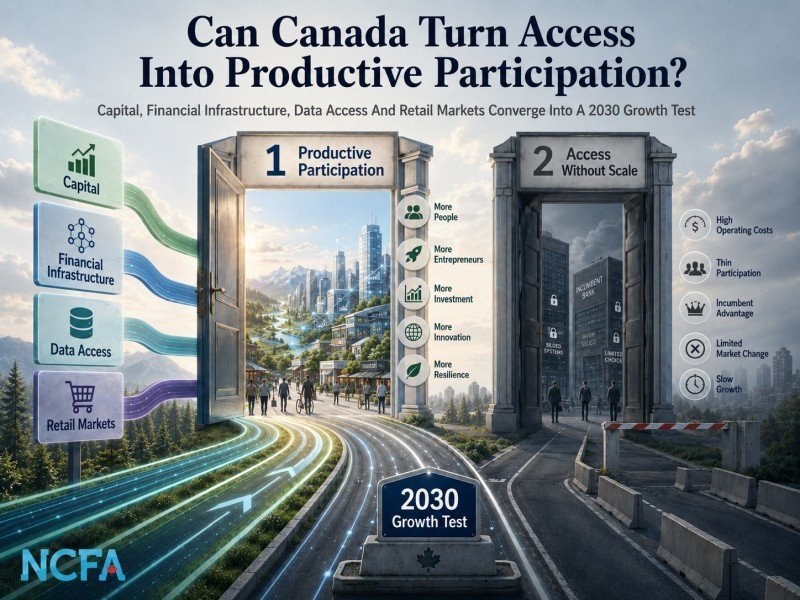
On August 21, 2026, Canada's founder drain returned to the national debate with a harder number attached to it. The Dominion List, a curated catalogue rather than a census, now tracks 517 U.S.-based companies with a Canadian-linked founder. Together they have raised roughly US$414 billion. About 88% of the founder links include education at a Canadian university, and 56% of the companies are headquartered in San Francisco.
The pace in the list also accelerated during the AI boom. Jesse Rodgers' Barn Ventures analysis counts 60 newly founded U.S. companies with Canadian-linked founders in 2023, 93 in 2024 and 87 in 2025, compared with roughly 20 to 30 a year from 2016 through 2022. The dataset is curated and recent companies may be easier to capture, so it should not be treated as a population estimate. The direction is still difficult to ignore.
Canada clearly produces ambitious builders. The strategic question is whether enough of them can find the capital, customers, infrastructure, investors and operating density needed to build more of the resulting value here. That makes founder retention part of a wider participation problem, not a standalone brain-drain story.
Canadian universities are producing founders at global scale
The Dominion List links 88% of its founder records to Canadian universities. Waterloo alone accounts for 216 founders across 180 U.S.-based companies in the current dataset, while Toronto, McGill, UBC and Queen's are also major feeders.
The value capture concentrates somewhere else
The 517 companies in the list have raised about US$414 billion. Fifty-six are valued at US$1 billion or more, 19 are public and 59 have been acquired. San Francisco alone hosts 287 of them.
Canada's problem is not producing ambitious people. It is converting more of that talent into companies, jobs, ownership and follow-on investment that compound inside the Canadian economy.
U.S. founder programs start earlier and remove more friction
Barn Ventures maps programs that reach students before graduation, then layer in early capital, founder communities, recruiting, immigration support and dense investor networks. The argument is that the U.S. offer is a system rather than one accelerator or one cheque.
Canada's response cannot be one more accelerator
Keeping more founders does not mean preventing mobility or copying Silicon Valley. It means giving more builders credible reasons to start, finance, hire and scale from Canada before the strongest networks and ownership structures form elsewhere.
Capital matters, but so do density, access, customers, infrastructure and the speed of getting from talent to a company with traction. Founder retention makes the wider participation thesis concrete because Canada can create the input and still lose much of the compounding.
The Forum looks across the financing lifecycle
NCFA's review of the SEC Small Business Forum shows why the process is useful for Canada. The 2026 Forum program again moved from early-stage financing to growth capital and smaller public markets.
The same frictions keep returning in new forms
Finders, investor eligibility, offering limits, fund structures, secondary liquidity and small-public-company economics remain active issues because one reform can solve one bottleneck while exposing another.
The transferable lesson is not a U.S. securities rule. It is the habit of bringing market participants back into the process and testing whether a framework is producing the market it was intended to create.
Canada already has detailed market evidence
CVCA tracks venture and private equity, while NACO tracks angel investing. Regulators and departments publish market studies, consultations and program data. Canada does not lack information about every part of the financing system.
Canada is also actively intervening
The federal government is preparing another C$1 billion venture and growth capital program. The Competition Bureau is studying SME financing. Payments, data access and retail private markets are also being redesigned.
Canada already has consultations, programs and market data. The harder test is whether each reform produces enough real participation to change who can compete, invest and scale.
Institutional venture capital is getting a larger engine
The Venture and Growth Capital Catalyst Initiative is designed to attract more private and institutional capital into Canadian venture funds, strengthen fund managers and support high-growth companies from pre-seed through growth.
SME financing is being tested against a broader business population
NCFA's SME financing competition review examines lender entry, expansion, switching friction and the market position of alternative finance providers. The Competition Bureau market study is the primary verification source.
Growth VCCI can deepen capital for companies that fit venture mandates. It does not automatically finance every viable manufacturer, service company or local employer whose growth profile, asset base or financing need sits outside institutional venture economics.
Financial data is moving toward regulated access
NCFA's Canada Open Banking Rules intelligence tracks accreditation, liability, data scope, security and technical standards as consumer-driven banking moves toward operation. Finance Canada's proposed regulations provide the primary policy source.
Core payment infrastructure is opening to a wider membership base
PSPs and more credit unions can join Payments Canada, while the Real-Time Rail rules and access are moving toward the planned Q4 2026 launch. Payments Canada remains the primary launch and system source. Wider eligibility gives PSPs and credit unions a clearer route into core payment infrastructure.
Formal access changes who is allowed to participate. Competition changes only when entrants can absorb compliance, technology, integration and operating costs and still build products customers want.
Fintechs can gain more control over the customer experience
More direct access to data, payments and settlement can reduce dependence on incumbent-controlled infrastructure and give challengers more control over pricing, product design and service delivery.
Smaller financial institutions can compete through shared capabilities
Credit unions and regional firms may not need to build every payments, AI, compliance, data or digital-asset capability internally if specialized providers can deliver those functions at workable scale.
The payoff is not a longer list of fintech entrants. It is more providers controlling enough of their infrastructure and economics to put sustained pressure on incumbents.
Managed access gives households professional selection
Ontario's long-term asset fund work could give retail investors diversified exposure to venture capital, private equity, private debt, infrastructure and other long-duration assets through professionally managed funds. The OSC LaunchPad notice verifies the project and its retail-access objective.
Direct access gives households the company decision
Equity crowdfunding lets an investor choose an individual company. It can connect businesses with customers, employees and supporters, but it also concentrates risk and usually offers little liquidity.
Managed access can broaden exposure to private-market returns. Direct access can broaden the number of people deciding which companies receive their money. Both can widen participation, but they create different markets.
Canada is building the managed channel for wider retail use
Managed structures can bring diversification, diligence, portfolio construction and product-level controls around valuation and liquidity. They can also preserve professional gatekeeping over where retail capital is deployed.
Canada's direct channel remains comparatively constrained
NI 45-110 allows a Canadian issuer to raise up to C$1.5 million in 12 months. Ordinary investors are generally limited to C$2,500 per offering, or C$10,000 when a registered dealer determines suitability.
If more company value is created while businesses remain private, wider retail access affects more than issuer financing. It influences which households can accept productive risk and participate earlier in private-market returns.
Canadian direct demand can reach the existing ceiling
Blossom, Edison Motors and Gander have used community capital alongside accredited, offering memorandum or other financing. Their raises show direct retail capital can complement professional capital rather than replace it.
International peers provide more room for direct participation
Australia permits eligible issuers to raise A$5 million in 12 months and caps retail investment at A$10,000 per company annually. U.S. Regulation Crowdfunding allows eligible issuers to raise up to US$5 million.
Canada's smaller market does not prove regulation caused weak activity. Issuer quality, investor demand, distribution, awareness, liquidity and platform execution also matter. It does show why market-opening rules should eventually be judged by whether enough issuers, investors and intermediaries can participate economically.
One future produces more viable participants
New payment participants build useful services. Open-banking firms turn permissioned data into products customers adopt. Smaller institutions buy modern capabilities instead of rebuilding them. More businesses find financing that fits their stage and economics.
The other future opens rules without changing market power very much
Accreditation, integration, compliance, distribution and technology remain expensive enough that the largest institutions and professional managers capture most new activity. Formal access widens while competitive intensity changes only at the margin.
The evidence will be practical. Entrants that survive. Products customers use. Capital reaching different kinds of companies. Investors using managed and direct routes. Smaller institutions offering capabilities once reserved for much larger competitors.
Better participation can improve the inputs to productivity
More financing choices, faster settlement, stronger data access and better financial tools can give businesses more capacity to invest, automate, hire, commercialize and serve customers.
Stronger companies can create the next round of participation
Businesses that build revenue, productivity and international reach create more investable opportunities. When more founders build and exit from Canada, employees, angel investors and repeat entrepreneurs can recycle capital, experience and networks into the next generation.
More viable participants can increase competition. Better competition can improve products, distribution and capital allocation. Better tools and financing can support more investment. Stronger companies can create more opportunities for households and institutions to participate again.
The U.S. process expects the friction to change
Market participants return because new rules, market conditions and business models keep changing the problem. A recommendation can be implemented and still leave a new bottleneck elsewhere.
Canada will need the same feedback discipline across more than capital
As payments, data, private markets and financing become more open, policymakers will need to know who entered, who could not, which businesses became sustainable and where access failed to generate enough economic activity.
Canada has spent years opening doors. The next phase is finding out which openings create viable markets. That means judging regulation and public programs by the participation, competition and productive activity they generate while preserving the protections that made wider access possible.
Participation is not a complete explanation for Canada's productivity problem. Management capability, commercialization, industrial structure, R&D, domestic demand, risk appetite and global scale all matter. The value of the thesis is that Canada is now opening enough capital, data, payments and investor channels at the same time to test whether participation becomes a measurable growth mechanism.
Talking Point
Canada already produces globally competitive talent and holds deep pools of capital, technology and institutional capacity. The opportunity between now and 2030 is to connect more of those assets before founders, ownership and future value compound somewhere else. If today's reforms create viable participation rather than permission alone, Canada could end the decade with more competitors, more investable companies and more ways for households and institutions to share in productive growth.
The National Crowdfunding & Fintech Association (NCFA Canada) is a financial innovation ecosystem that provides education, market intelligence, industry stewardship, networking and funding opportunities and services to thousands of community members and works closely with industry, government, partners and affiliates to create a vibrant and innovative fintech and funding industry in Canada. Decentralized and distributed, NCFA is engaged with global stakeholders and helps incubate projects and investment in fintech, alternative finance, crowdfunding, peer-to-peer finance, payments, digital assets and tokens, artificial intelligence, blockchain, cryptocurrency, regtech, and insurtech sectors. Join Canada's Fintech & Funding Community today FREE! Or become a contributing member and get perks. For more information, please visit: www.ncfacanada.org
| | |
|---|---|---|
| | |
August 18, 2026 | NCFA Feature | Regulation And Policy, Digital Assets, Capital Markets And Market Infrastructure

On August 18, 2026, the U.S. Securities and Exchange Commission proposed Regulation Crypto Assets (download 402 page PDF Proposed Regulation Crypto Assets document), a tailored securities framework for certain investment contracts involving crypto assets. The 402-page proposal would create a startup exemption of up to US$5 million over four years, a larger fundraising exemption with US$20 million and US$75 million tiers, crypto-specific disclosures, new SEC forms, secondary-market provisions, state-law preemption and a process for determining when an investment contract has ended.
The scope is narrower than the name might suggest. Regulation Crypto Assets would apply to what the SEC calls a covered investment contract. A crypto asset must be subject to the investment contract, the crypto asset itself must not be a security and no other asset can be subject to that contract.
That builds on the SEC's March 2026 crypto interpretation. The March action addressed when transactions involving a non-security crypto asset can create an investment contract and when that relationship can end. Regulation Crypto Assets would add an operating framework around that lifecycle.
The proposal is significant because it goes beyond creating two new fundraising limits. The SEC is designing rules for how certain crypto investment contracts could be offered, disclosed, distributed and resold, and how the underlying crypto asset could eventually separate from the investment contract.
The proposed Regulation Crypto Assets isn't a comprehensive U.S. crypto rulebook. It doesn't create the general regulatory regime for payment stablecoins, programmable payments, crypto custody, crypto lending, mining or conventional securities that happen to be tokenized. Those activities may fall under other federal or state laws, other regulators or separate SEC work.
Payment stablecoins are a good example. Regulation Crypto Assets says permitted payment stablecoins could be accepted as consideration in a covered offering and would count toward its offering limit. It does not establish the rules for issuing payment stablecoins.
That work is proceeding separately under the federal GENIUS Act. On August 17, one day before the SEC proposal, the U.S. Treasury issued a proposed payment stablecoin rule covering implementation of the separate federal framework for their issuance, offering and sale.
Other crypto activities can intersect with Regulation Crypto Assets without becoming generally regulated by it. The proposed Startup Exemption contemplates certain distributions connected with development and use of a crypto network, including circumstances involving airdrops, staking, governance, gas fees and testing. The legal question remains whether the particular transaction involves a covered investment contract.
The proposal also doesn't create a new legal category for tokenized stocks or bonds. Tokenized conventional securities remain securities. Regulation Crypto Assets instead addresses a narrower case where the crypto asset itself isn't a security but is subject to an investment contract.
It's important for founders, investors, lawyers and trading platforms to know that a crypto asset, an investment contract involving that asset and a tokenized security, can look technologically similar while carrying very different securities-law consequences.
The proposed Startup Exemption could be used for no more than four years after an issuer's initial Form NOR filing. The issuer and its affiliates could conduct covered transactions up to an aggregate US$5 million during that period and couldn't simply restart the four-year clock for the same or a substantially similar crypto asset.
The issuer definition is unusually flexible. The proposal would allow an entity, an individual or a group of individuals or entities to qualify, subject to the other conditions. That accommodates crypto projects that may begin with a development team before they resemble a conventional corporate securities issuer.
The fundraising mechanics are also important. The proposed startup route would permit general solicitation, impose no individual investment limit on retail purchasers and require neither financial statements nor use of a registered intermediary. Covered investment contracts sold through the exemption would not be restricted securities under federal law and would not carry a separate rule-based holding period.
Disclosure doesn't disappear. Before conducting covered transactions, the issuer would file Form NOR on EDGAR and make the disclosures required by Rule 103 publicly available free of charge.
Those disclosures are designed around the investment contract and crypto network. They include offering terms, management and conflicts, the crypto asset, development plans, network or application security, source code where applicable, token economics and allocations, governance, the related crypto ecosystem and material risks. The information must remain publicly available, with material changes addressed under the proposal's update requirements.
Bad-actor disqualifications would apply as well, and issuers would remain subject to federal antifraud and antimanipulation rules. This is a different compliance model, not an absence of securities regulation.
The most revealing comparison is Regulation Crowdfunding. Reg CF also permits up to US$5 million, but over a 12-month period. It requires a registered broker-dealer or funding portal, financial disclosure and investment limits for non-accredited investors, while securities generally face a one-year resale restriction.
The SEC makes that comparison itself. Its economic analysis estimates average Reg CF intermediary fees at approximately 6.6%, with a 6% median, and identifies the absence of mandatory financial statements and an intermediary as potential cost savings under the crypto Startup Exemption.
There is little evidence that current Reg CF rules have produced a large crypto financing market. SEC data identify 42 crypto-related Reg CF offerings by 41 issuers between 2016 and 2024. Reported proceeds totalled approximately US$13.6 million, with an average of US$545,300 among offerings for which proceeds were reported. The SEC cautions that the proceeds total is incomplete and likely represents a lower bound.
The proposal is therefore testing more than a higher ceiling. It asks whether removing particular intermediary, financial reporting, investor and resale frictions would make a public capital route more workable for qualifying crypto projects.
Larger projects could instead use the proposed Fundraising Exemption. Tier 1 would permit up to US$20 million in 12 months. The issuer would have to file Form 1-CRYPTO and couldn't sell covered investment contracts until the SEC qualified the offering statement.
The offering circular would combine the crypto-specific Rule 103 disclosures with financial information about the issuer. Tier 1 financial statements generally wouldn't require an audit, but the issuer would still enter an ongoing reporting regime using annual Form 1-KC, semiannual Form 1-SC and Form 1-UC for specified current events.
Retail investors would also face a restriction that doesn't apply under the Startup Exemption. A non-accredited investor generally couldn't purchase more than 10% of the greater of annual income or net worth. For a non-natural person, the test would use revenue or net assets.
Tier 2 would permit up to US$75 million in 12 months. Like Tier 1, it would require Form 1-CRYPTO, SEC qualification before sales, ongoing reporting and the 10% non-accredited investor limit. The key additional financial requirement is that Tier 2 statements would have to be audited by an independent accountant under the proposed standards.
The larger Fundraising Exemption also comes with a strong U.S. nexus. The issuer would have to be an entity organized under U.S. law, a majority of its executive officers or directors would need to be U.S. citizens or residents, more than half of its assets would need to be in the United States and its business would have to be administered principally there.
Canada appears explicitly in the SEC's request for comment. Question 86 asks whether Canadian issuers, or other foreign issuers, should be permitted to rely on the Fundraising Exemption.
That is more than a passing jurisdictional detail. Regulation A already allows qualifying Canadian issuers, while the proposed Regulation Crypto Assets fundraising route currently does not. Whether the SEC changes that provision could affect how useful the US$20 million and US$75 million routes become for Canadian crypto companies.
The proposal's treatment of secondary transfers may prove almost as important as its fundraising limits. The SEC says existing exemptions can impede the network effects of crypto assets when they restrict who can participate or how quickly securities can be resold.
Both proposed exemptions would therefore allow issuers to sell covered investment contracts that are not restricted securities under federal law. Investors wouldn't face the federal holding periods associated with restricted securities, although contractual restrictions and other applicable laws could still affect a transfer.
That differs from common Regulation D offerings and from Reg CF's first-year resale limits. The SEC's rationale is specific to crypto networks. Wider ownership and use can contribute to how a network operates and how the crypto asset derives value, so distribution restrictions can affect more than investor liquidity.
Rule 500 would address another obstacle by proposing federal preemption of certain state registration and qualification requirements. It would treat purchasers in qualifying Regulation Crypto Assets transactions as qualified purchasers for that purpose and extend the treatment to specified secondary-market transactions.
The preemption isn't unlimited. Secondary-market treatment would depend on the issuer remaining current with the disclosure, filing or reporting requirements attached to the applicable exemption. States would also retain antifraud authority, powers over unlawful broker or dealer conduct, notice filing requirements and applicable fees.
For trading platforms and intermediaries, the proposal introduces an additional status question. They may need to distinguish between the underlying non-security crypto asset, an outstanding covered investment contract involving it and an asset for which that investment-contract relationship has ended.
Rule 400 addresses one of the most distinctive features of the proposal. The SEC's existing securities rules generally deal with financial instruments whose fundamental legal character doesn't change over time. A crypto asset can present a different problem because an investment contract surrounding it may end while the crypto asset continues to exist and circulate.
The proposed safe harbor would apply when the issuer has completed or permanently ceased all essential managerial efforts that it represented or promised under the covered investment contract. The issuer also couldn't be making, or intending to make, new promises to perform those essential managerial efforts.
An issuer seeking to use the safe harbor would file Form TR. The filing would include a certification and an analysis supporting the conclusion that the required managerial efforts have ended.
Meeting those conditions would mean the crypto asset is deemed no longer subject to that investment contract for the relevant definitions of a security under the Securities Act and Exchange Act. That doesn't mean Form TR can convert a security into a non-security simply because an issuer files it. The substantive conditions still have to be satisfied, and the SEC can challenge an issuer's analysis.
Nor does the proposal replace Howey or the March interpretation. The safe harbor creates one defined route for dealing with the end of an investment contract. The SEC acknowledges that a covered investment contract could also cease to exist outside the safe harbor under the applicable securities-law analysis.
That lifecycle helps explain why the proposal is more consequential than a new exemption schedule.
The SEC is contemplating a regulatory sequence in which a project can finance development through an investment contract, distribute the associated crypto asset widely and potentially reach a point where the investment contract itself no longer exists.
Canada has dealt with token offerings for years. Canadian securities regulators issued guidance on cryptocurrency offerings in 2017 and followed with more detailed token offering guidance in 2018. The CSA has made clear that coins or tokens can involve investment contracts and distributions of securities depending on their economic substance and how they are offered.
There have also been Canadian security-token initiatives and exempt-market token offerings. The difference isn't that Canada has avoided token issuance. Canada has generally applied its existing securities laws, prospectus exemptions and registration framework rather than creating a dedicated crypto lifecycle regime comparable to Regulation Crypto Assets. That difference also fits Canada's wider capital formation gap.
Capital formation makes that difference more important. Canada's NI 45-110 startup crowdfunding exemption currently permits an eligible issuer to raise up to C$1.5 million over 12 months. An investor generally can invest up to C$2,500 in an offering, or C$10,000 when a registered dealer determines that the investment is suitable, and the offering must take place through a funding portal.
The Canadian market is also much smaller. FrontFundr reports that it processed C$4.79 million from 4,320 investors under NI 45-110 in 2025 and accounted for 93% of activity under the exemption. Because that 93% figure comes from FrontFundr rather than an official national regulatory dataset, it should be treated as a platform estimate rather than an official Canadian market total.
There is stronger evidence that the C$1.5 million ceiling is becoming binding for some issuers. Edison Motors raised C$1.491 million under NI 45-110 in 2025, roughly 99% of the limit. Blossom Social raised C$1.450 million, approximately 97%.
The more direct U.S. comparison is Regulation Crowdfunding. Reg CF already allows eligible companies to raise up to US$5 million in 12 months, but requires an SEC-registered intermediary, limits investments by non-accredited investors and generally restricts resale for one year. The proposed US$5 million crypto Startup Exemption would use the same headline ceiling with a different compliance model.
The larger crypto Fundraising Exemption is more directly comparable with Regulation A. Existing Reg A already uses US$20 million Tier 1 and US$75 million Tier 2 limits, with additional audit, investor-protection and ongoing-reporting requirements at Tier 2.
Canada is a different comparison. NI 45-110 isn't a crypto-specific equivalent to Regulation Crypto Assets, but it is Canada's nationally harmonized startup crowdfunding route. It remains capped at C$1.5 million over 12 months, with a funding-portal requirement and investor limits of C$2,500 per offering or C$10,000 with suitability advice from a registered dealer.
NCFA has been advocating for a C$5 million or higher issuer cap for years, arguing that the C$1.5 million ceiling can limit the usefulness of the exemption for growing companies. That concern is now easier to test against actual market activity, with some Canadian crowdfunding campaigns reaching close to the current ceiling.
The relevant policy question is therefore wider than whether Canada has an identical crypto exemption. The U.S. already offers Reg CF and Regulation A for different stages of capital raising and is now proposing a separate crypto-specific framework built around fundraising, token distribution, resale and the eventual end of an investment contract.
That matters because Canada's capital formation system already has funding gaps, while some Canadian crowdfunding campaigns are reaching the NI 45-110 ceiling. Regulation Crypto Assets could add another financing and regulatory option to the U.S. market without a directly comparable Canadian crypto-specific route.
The proposed US$75 million Tier 2 also raises a separate competitiveness issue. The SEC is asking whether Canadian issuers should eventually be eligible for the Fundraising Exemption. If they are included, qualifying Canadian crypto companies could gain access to a much larger U.S. pathway. If they remain excluded, access to U.S. capital could become another factor projects consider when deciding where to organize and raise funds.
None of this means Canadian regulators should copy the SEC. It does strengthen the case for examining Canada's startup financing limits, token-offering rules and capital-market pathways together rather than as separate policy files.
For Canada, the challenge is whether existing rules can protect investors while giving legitimate companies enough financing capacity and regulatory flexibility to build here. If the U.S. adds specialized crypto fundraising routes on top of Reg CF and Regulation A, that competitive comparison becomes more difficult to ignore.
If the U.S. adds a dedicated crypto capital-formation and investment-contract lifecycle regime on top of Reg CF and Regulation A, while Canada still relies on existing exemptions and a C$1.5 million startup crowdfunding cap, how long can Canada treat crypto regulation and capital-formation reform as separate policy questions?
The National Crowdfunding & Fintech Association (NCFA Canada) is a financial innovation ecosystem that provides education, market intelligence, industry stewardship, networking and funding opportunities and services to thousands of community members and works closely with industry, government, partners and affiliates to create a vibrant and innovative fintech and funding industry in Canada. Decentralized and distributed, NCFA is engaged with global stakeholders and helps incubate projects and investment in fintech, alternative finance, crowdfunding, peer-to-peer finance, payments, digital assets and tokens, artificial intelligence, blockchain, cryptocurrency, regtech, and insurtech sectors. Join Canada's Fintech & Funding Community today FREE! Or become a contributing member and get perks. For more information, please visit: www.ncfacanada.org
| | |
|---|---|---|
| | |
August 18, 2026 | NCFA Insight | Capital Markets And Market Infrastructure, SME Finance And Business Banking, Competition And Market Structure

On August 2026, the Bank of Canada mapped Canada's private credit market and exposed an unusual divide. Private credit remains a relatively small source of financing for Canadian businesses, yet Canadian pension funds, insurers, investment funds and banks have built approximately C$500 billion of exposure to the asset class, much of it outside Canada.
Non-bank loans have accounted for about 15% of external funding for Canadian non-financial businesses for roughly a decade. Banks and public debt markets still provide about three-quarters of external business financing. By contrast, private credit has become a much larger alternative to traditional lending in parts of the United States.
The interesting question for Canada isn't whether private credit exists. It clearly does. It is why Canadian institutional capital has embraced the asset class globally while Canadian businesses continue to use it relatively little at home.
The C$500 billion estimate shows that Canadian exposure to private credit is already material even though the domestic borrowing market remains comparatively small.
Those aren't small exposures. Canadian institutions clearly know how to price and allocate private credit, yet much of that capital is being deployed outside Canada. The implication is harder to ignore at a time when Canadian businesses need more financing options to invest, scale and compete. If domestic firms remain heavily dependent on banks while Canadian institutional capital finds private-credit opportunities elsewhere, Canada may be leaving a financing gap at home precisely when productive domestic investment matters most.
That doesn't mean pension funds or insurers should redirect capital for patriotic reasons. Their mandates require them to pursue risk-adjusted returns. But it does raise a structural question about why Canada's financial system is better at exporting private-credit capital than building comparable opportunities for Canadian businesses.
The geographic split is what deserves more attention. Canadian capital is participating in a global private-credit market that domestic businesses have not adopted to the same degree. That makes this partly a capital-allocation story. Canadian institutions appear willing to accept private-credit risk, but much of the opportunity they are finding is elsewhere.
The Bank's 15% figure fits a wider pattern in Canadian business financing.
Statistics Canada's 2023 SME financing data showed that chartered banks supplied 68.5% of SME debt financing. Credit unions accounted for another 20.6%, government-backed lenders 9.4%, and online alternative lenders only 2.2%.
That doesn't mean Canadian businesses lack alternatives. It means alternative credit has yet to displace the established banking structure at meaningful scale.
Several explanations are possible. Canada's concentrated banking system gives incumbent lenders large customer bases, deposits, underwriting data and distribution. Many SMEs also maintain long-standing banking relationships, reducing the incentive to switch unless conventional credit becomes unavailable or too restrictive.
Private credit may also be more attractive in markets where borrowers are larger, transactions are more complex, or bank lending leaves wider financing gaps. The Bank notes that in the United States, private credit has become a primary financing source in some segments.
But the Canadian data raises the possibility that domestic private credit may still be underdeveloped relative to the amount of institutional capital and underwriting expertise available here.
That possibility becomes more relevant as fintech platforms improve access to business cash-flow, accounting, invoice and payment data. Better information doesn't eliminate credit risk, but it can make smaller and more customized financing economically viable.
The Bank of Canada's focus is financial stability, and the exposure numbers explain why.
Private credit can diversify portfolios and produce attractive returns, but transparency remains limited. Leverage can be difficult to measure, valuations are less observable than in public markets, and the connections between private-credit funds, banks and institutional investors are still being mapped.
The Bank sees Canadian pension funds and life insurers as relatively well positioned to manage these risks because they generally have long investment horizons and limited reliance on short-term funding. The three largest insurers also hold predominantly investment-grade private credit, with less than 1% classified as higher risk.
Canadian banks' direct exposure appears comparatively contained. At least C$40 billion of lending to private-credit managers represents only about 1% of overall Canadian bank lending, and these loans are typically secured by investors' committed capital.
The vulnerability is therefore less about one large domestic private-credit bubble and more about interconnected exposure to global markets.
A severe deterioration in U.S. or other foreign private-credit portfolios could affect Canadian institutions, asset values and potentially the availability of credit at home. The Bank's 2026 Financial Stability Report reinforces the concern. Rapid global growth, limited transparency and tighter links across the financial system make private credit harder to assess under stress.
For NCFA, the most interesting gap is between institutional capability and domestic deployment. Canadian pension funds and insurers already allocate hundreds of billions of dollars to private lending, while Canadian banks finance private-credit managers. Yet Canada's domestic business-financing structure remains heavily concentrated around banks and other established lenders.
Canadian fintech lenders are building alternatives around business data. JUDI.AI uses transaction and cash-flow data to support SME underwriting, while Clearco uses ecommerce performance data to fund qualified brands. These aren't the same as institutional middle-market private credit, but they show how non-bank financing can reach businesses through different underwriting and distribution models.
That doesn't mean Canada should recreate the U.S. private-credit market. More private credit can also bring more leverage, weaker transparency and new channels for financial stress. The better question is whether Canada can develop more domestic non-bank business financing while preserving underwriting discipline, transparency and financial stability.
The opportunity is therefore less about importing the U.S. model and more about closing the gap between Canadian capital and Canadian business demand.
If institutions here are already comfortable allocating substantial capital to private credit abroad, Canada should be asking what market structure, origination capacity and financing infrastructure are still missing at home.
If Canadian institutions are already comfortable allocating hundreds of billions of dollars to private credit abroad, what is preventing more of that lending capacity from developing for Canadian businesses at home?
The National Crowdfunding & Fintech Association (NCFA Canada) is a financial innovation ecosystem that provides education, market intelligence, industry stewardship, networking and funding opportunities and services to thousands of community members and works closely with industry, government, partners and affiliates to create a vibrant and innovative fintech and funding industry in Canada. Decentralized and distributed, NCFA is engaged with global stakeholders and helps incubate projects and investment in fintech, alternative finance, crowdfunding, peer-to-peer finance, payments, digital assets and tokens, artificial intelligence, blockchain, cryptocurrency, regtech, and insurtech sectors. Join Canada's Fintech & Funding Community today FREE! Or become a contributing member and get perks. For more information, please visit: www.ncfacanada.org
| | |
|---|---|---|
| | |
August 13, 2026 | NCFA Resource | Risk Compliance And Regtech, Artificial Intelligence And Data, Regulation And Policy

On August 6, 2026, the UK Financial Conduct Authority launched the FCA Handbook API, giving firms, developers and RegTech providers direct access to structured Handbook data. The free service lets software retrieve current rules, guidance, technical standards and glossary content for use inside compliance and regulatory change systems.
The practical value is real. Firms no longer have to rely only on website searches, monthly downloads or manually maintained rule libraries when they want FCA source material inside their own systems. The API creates a direct route from the Handbook into software that tracks obligations, maps rules to business activities or supports AI assisted compliance work.
The API provides structured access to the FCA Handbook, Technical Standards and Glossary. Users need a free Handbook account, and the FCA says the data can be used in firms’ own applications or through third party technology providers.
The FCA identifies several practical uses:
AI can help retrieve, classify and compare regulatory information, but the quality of the output still depends on the source material it receives. A direct FCA data feed reduces one common problem which is compliance tools working from copied, stale or inconsistently maintained rule text.
NCFA has already identified this problem in AI powered regulatory reporting. The opportunity isn't simply to add AI to compliance work. Systems need reliable regulatory inputs, clear controls and a way to trace outputs back to the underlying rule or guidance.
The API can also reduce manual work around regulatory updates. Firms can connect Handbook content to internal rule inventories, product governance, control libraries or change management processes rather than repeatedly checking individual pages for updates.
There are some practical access conditions. Users cannot work with the API directly through the Handbook website. They need a compatible external application such as Postman or RapidAPI, or another system built to use the interface. Protected endpoints are also subject to rate limits.
The clearest users are compliance teams, legal teams, RegTech providers, financial institutions and fintechs that need FCA rules inside operational systems.
Large firms with internal technology teams can connect the data to their own compliance architecture and tailor how Handbook content is matched to business lines, products or controls.
Smaller firms may get more value indirectly through RegTech providers that use the API to improve rule monitoring, change alerts, obligation management or policy tools.
Developers and AI teams also gain a cleaner source for regulated workflows. For example, a compliance assistant could retrieve relevant Handbook content, compare current and future text, or help staff identify which internal policies may need review after a rule update.
That doesn't make the API a compliance decision engine. A system can retrieve the rule accurately and still reach a poor conclusion about how it applies to a particular firm, product or client situation. Human review, legal interpretation and internal accountability remain necessary.
The main strength is source quality. The API automatically draws from the latest Handbook rather than requiring firms or vendors to maintain their own copy of the rulebook. That can improve consistency and reduce the delay between a Handbook update and its appearance inside a compliance system.
It is also useful that the FCA has made the service available without a separate licence fee. Firms can choose whether to connect directly or use a technology provider, which lowers the barrier for developers and RegTech companies testing new compliance tools.
The API is not a complete regulatory archive. It does not provide historic Handbook versions. Requests for past dates return an error, although current and future versions are available through the API. Firms that need a full historical record will still need the Handbook website, archive tools or their own retained records.
The API also does not cover every piece of FCA information. The FCA Handbook contains rules, guidance and standards, while other FCA publications, supervisory communications, consultations, speeches and notices remain outside that core source. Compliance systems therefore still need broader regulatory monitoring.
Direct access to current regulatory text improves the input, but it does not guarantee accurate interpretation. Firms using AI for compliance should still test outputs, keep records, control permissions and make it clear when a person needs to review the result. The IOSCO AI Supervisory Toolkit provides useful additional guidance on governance, oversight, data quality and control expectations for AI in regulated financial environments.
The FCA Handbook API is most useful when treated as authoritative source infrastructure. It can make regulatory information easier for software to retrieve and keep current, while firms remain responsible for deciding what the rules mean for their own operations.
FCA Handbook API Launch (use cases for compliance, RegTech and AI)
FCA Handbook API FAQ (access, current data, limits and usage requirements)
FCA Handbook API (API access and developer entry point)
FCA Handbook (current rules, guidance and technical standards)
AI Powered Regulatory Reporting (regulatory data, automation and AI opportunity)
IOSCO AI Supervisory Toolkit For Capital Markets (AI governance, controls and oversight)
The National Crowdfunding & Fintech Association (NCFA Canada) is a financial innovation ecosystem that provides education, market intelligence, industry stewardship, networking and funding opportunities and services to thousands of community members and works closely with industry, government, partners and affiliates to create a vibrant and innovative fintech and funding industry in Canada. Decentralized and distributed, NCFA is engaged with global stakeholders and helps incubate projects and investment in fintech, alternative finance, crowdfunding, peer-to-peer finance, payments, digital assets and tokens, artificial intelligence, blockchain, cryptocurrency, regtech, and insurtech sectors. Join Canada's Fintech & Funding Community today FREE! Or become a contributing member and get perks. For more information, please visit: [www.ncfacanada.org](http://www.ncfacanada.org)
| | |
|---|---|---|
| | |
August 7, 2026 | NCFA Insight | Capital Markets And Market Infrastructure, SME Finance And Business Banking, Public Sector Policy And Industrial Strategy

Canadian venture capital reached $2.69 billion across 250 deals in the first half of 2026, according to the CVCA's latest market data. Capital invested rose 17% from H1 2025, the first year-over-year increase in first-half dollars since 2021.
Deal count moved the other way. It fell 8.8% from 274 to 250, marking a fifth consecutive first-half decline, while average financing size increased from $8.4 million to $11.38 million.
Canada is putting more venture capital to work without funding more companies. Larger rounds are lifting the national total while seed financing continues to weaken.
| H1 2026 | Capital | Deals | Avg. Deal | YoY |
|---|---|---|---|---|
| Total VC | $2.69B | 250 | $11.38M | Capital +17%; deals -8.8% |
| Seed | $285M | 82 | ~$3.5M | Capital -31%; deals -13% |
| Early Stage | $1.18B | 68 | ~$17.4M | Capital +29%; deals essentially flat |
| Later Stage | $984M | 18 | $54.67M | Capital +23%; eight fewer deals |
Sixteen rounds of $50 million or more absorbed $1.57 billion, or 59% of all capital invested. Five financings above $100 million alone accounted for $807 million, equal to 30% of the national total.
Most transactions were much smaller. Deals below $25 million represented 85% of disclosed financings but received only 32% of the money. Another 155 rounds closed below $5 million and collectively attracted $221 million.
The same pressure is visible on the fund side. Canadian VC fundraising became more concentrated in 2025, leaving more capital in fewer hands and raising the bar for companies trying to get into institutional portfolios.
Seed is the clearest warning in the report. Investment fell 31% to $285 million across 82 deals, while transaction count declined 13%. Pre-seed added $52 million across 56 financings, with an average round below $1 million.
Early stage looks healthier at $1.18 billion, up 29%, but the number of financings barely changed. More capital went into roughly the same number of companies, pushing the average early-stage round to about $17.4 million.
Later-stage financing is even more concentrated. The $984 million invested was spread across only 18 transactions, the lowest first-half deal count in CVCA's series. The average round reached $54.67 million.
For founders, companies with traction and scale can still attract large rounds, while the market for the first few million dollars is getting tighter.
Some of that friction is structural. Smaller Canadian financings can carry disproportionately high compliance costs because many legal, disclosure and regulatory costs do not get proportionally cheaper as the raise gets smaller. Ontario's decision to join Canada's securities passport should reduce some duplication, but it does not by itself solve the economics of small-company financing.
There is also a financing-fit problem. Merchant Growth founder David Gens argues that many smaller businesses are asset light and cash-flow driven, while traditional lending still relies heavily on assets that can be pledged as collateral. After nearly $1.5 billion deployed to about 15,000 Canadian small businesses, his point is practical: access to capital and access to financing that fits the business are not the same thing.
Those problems compound. A company may need grants, founder capital, crowdfunding, angel money, debt and venture financing at different points in its growth. Canada's small-business capital access gap is therefore less about finding one missing source of money than making it easier for companies to move from one financing stage to the next.
If fewer businesses get financed near the bottom, fewer can build the traction needed to compete for the larger rounds that are keeping Canada's headline VC numbers up.
Financial technology supplied four of the larger disclosed rounds in the first half. KOHO raised $130 million, nesto $107 million, Float $85.4 million and Relay $68.8 million. Together they represent almost $392 million in financing.
KOHO has been building toward banking scale, adding credit products and pursuing a Schedule 1 bank licence. Its $130 million Series E was one of the largest disclosed Canadian VC financings in H1.
Float has been expanding its SME finance platform across business accounts, spend management and working-capital products. Its $85.4 million H1 financing followed earlier equity financing and continued expansion into business banking and credit.
Relay has been scaling its SMB finance platform, raising US$50 million in its Series B as it expanded banking and cash-flow tools for small businesses. The CVCA records its H1 2026 financing at $68.8 million in Canadian-dollar terms.
These companies already have products, customers and operating histories. Their ability to attract larger rounds shows where capital is still available, while the weaker seed numbers show how much harder it may be for the next group to reach that point.
U.S. investors participated in 28.0% of Canadian VC transactions in H1, up from 25.9% in 2025. European participation reached 10.8%, the highest share in the six-year series, while 66.4% of transactions were financed exclusively by Canadian investors.
The money also remains geographically concentrated. Ontario, Quebec and British Columbia accounted for 91% of capital and 80% of transactions. Toronto led with $879.7 million across 64 deals, followed by Montreal with $619 million across 50.
For founders that reach scale, Canada remains connected to large domestic and international pools of capital. For investors, the concern is whether enough new companies (read: Canada's farm team) are being financed underneath them to keep producing attractive later-stage opportunities.
H1 2026 looks better than H1 2025 if the measure is dollars invested. It looks weaker if the measure is how many companies received venture financing, and weaker again at seed.
For founders, proof of traction and financing readiness carry more weight in a selective market. For investors, larger rounds remain available, but a shrinking seed base can become a sourcing problem several years down the road.
Canada needs capital at both ends. Proven companies need enough money to scale, while younger companies need financing that fits where they are today and gives them a realistic way to reach the next stage. The CVCA numbers show stronger deployment at the top of the market, but they don't show yet at the mid way point of 2026 that the pipeline feeding it is getting healthier.
The National Crowdfunding & Fintech Association (NCFA Canada) is a financial innovation ecosystem that provides education, market intelligence, industry stewardship, networking and funding opportunities and services to thousands of community members and works closely with industry, government, partners and affiliates to create a vibrant and innovative fintech and funding industry in Canada. Decentralized and distributed, NCFA is engaged with global stakeholders and helps incubate projects and investment in fintech, alternative finance, crowdfunding, peer-to-peer finance, payments, digital assets and tokens, artificial intelligence, blockchain, cryptocurrency, regtech, and insurtech sectors. Join Canada's Fintech & Funding Community today FREE! Or become a contributing member and get perks. For more information, please visit: www.ncfacanada.org
| | |
|---|---|---|
| | |



August 26th, 2025

January 4th, 2024

June 1st, 2021

September 9th, 2020

July 9th, 2018

January 3rd, 2018

September 25th, 2017

June 20th, 2017

May 10th, 2017

December 14th, 2016
