





Karsten Wenzlaff, Advisor
August 26th, 2025
Karsten Wenzlaff is a Crowdfunding and Fintech Expert from Germany. He is Secretary-General of Digit[...]


May 29, 2026 | NCFA Fintech Whisperer Weekly Intelligence | Payments And Market Infrastructure, Artificial Intelligence And Data, Digital Assets Blockchain And Tokenization, Capital Markets And Market Infrastructure

Image: Freepik
This live weekly NCFA intelligence page tracks financial technology developments that significantly affect how fintechs build, sell, raise capital, and operate under scrutiny. Coverage prioritizes Canada and includes global events that directly influence competitive conditions, market access, and execution realities across fintech sectors. This page will be updated throughout the week with market movers in a live format and then each week we'll close the prior week's contents in prep for the upcoming week, and continue on a rolling basis. (Missed prior week's Fintech Whisperer? (December 6-12, 2025, December 13-19, 2025, January 1-9, 2026, January 10-16, 2026, January 17-23, 2026, January 24-30, 2026, January 31-February 6, 2026, February 7-13, 2026, February 14-20, 2026, February 21-27, 2026, February 28-March 6, 2026, March 7-13, 2026, March 14-20, 2026, March 21-27, 2026, March 28-April 3, 2026, April 4-10, 2026, April 11-17, 2026, April 18-24, 2026, April 25-May 1, 2026, May 2-8, 2026, May 9-15, 2026, May 16-22, 2026).
AI compliance is moving from broad principles into operating guidance for agents, automated decisions, procurement, and personal data use. Fintechs, banks, insurers, regtech firms, and AI vendors should track how privacy rules shape AI product design, governance, and customer trust.
Project Agorá's focus is not retail crypto speculation. It is wholesale financial infrastructure, cross border settlement efficiency, programmable payments, and institutional control over tokenized money movement. Go deeper, visit NCFA's curated fintech reports and research library, where the BIS Project Agorá report is listed.
This is not open access to the Fed system. It is a narrower settlement pathway for legally eligible firms operating outside the traditional bank model. Stablecoin issuers, PSPs, crypto firms, tokenization platforms, and embedded finance providers should track whether limited Reserve Bank account access becomes a practical alternative to sponsor bank dependence. This connects to NCFA’s analysis of Fed Payment Accounts and fintech settlement access.
Onchain finance needs shared coordination standards before institutional adoption can scale cleanly. Banks, wallets, PSPs, exchanges, tokenization platforms, and agentic payment builders should track whether identity, messaging, and transaction standards become competitive infrastructure rather than optional middleware.
Large payment networks are adding regulated digital asset permissions to support stablecoin, tokenized settlement, and digital asset infrastructure at institutional scale. Banks, PSPs, exchanges, custodians, and fintech platforms should track which firms secure licences that let crypto services connect with mainstream payment networks.
Stablecoins are moving deeper into consumer banking distribution, not just crypto infrastructure. Banks, fintechs, PSPs, and regulators should watch whether regulated bank issued stablecoins begin competing directly with cards, deposits, remittance products, and embedded payment flows. Also supports this analysis of stablecoins becoming payment infrastructure.
National currency stablecoins are expanding beyond major economies. Stablecoin issuers, banks, PSPs, regulators, and treasury teams should track how smaller jurisdictions use digital fiat infrastructure to compete for payment flows, fintech investment, and cross border settlement.
Climate disclosure is moving back toward company specific materiality rather than a dedicated SEC climate reporting regime. Public companies, fintech lenders, ESG data providers, regtech firms, investors, and capital markets platforms should track how climate risk reporting moves across U.S. federal rules, state rules, EU requirements, and voluntary investor expectations.
Bank charter strategy is becoming part of digital asset and payment infrastructure competition. Banks, fintechs, stablecoin firms, custodians, and compliance teams should track which institutions secure federal supervision, stronger operating permissions, and clearer access to national banking infrastructure.
MiCA is moving from licensing theory into enforcement risk. Crypto exchanges, custodians, wallet providers, brokers, and compliance teams should treat EU authorization, local regulator engagement, and operating perimeter checks as immediate market access priorities.
Prediction markets are moving deeper into conflict with gambling, derivatives, and securities frameworks. Exchanges, fintechs, tokenization firms, and prediction market operators should expect more pressure around licensing, market surveillance, consumer protection, and jurisdictional authority as these platforms expand globally.
USMCA risk is now back inside Canada’s competitiveness file. Fintech lenders, payment firms, investors, marketplaces, and platforms serving SMEs should watch how tariff uncertainty affects customer margins, capital demand, foreign exchange exposure, supplier payments, and cross border expansion.
Crypto sanctions enforcement now reaches deeper into financial infrastructure networks, not just individual wallets or isolated actors. Exchanges, custodians, PSPs, banks, compliance teams, and blockchain monitoring firms should expect more scrutiny around transaction tracing, counterparty checks, and sanctions controls tied to digital asset flows.
Post trading rules are becoming more important as Europe modernizes settlement operations, CSD messaging, and market infrastructure controls. CSDs, brokers, banks, custodians, tokenization platforms, and compliance teams should track how messaging standards affect settlement efficiency, operational risk, and future market infrastructure integration.
Blockchain based settlement is moving into formal U.S. market infrastructure permissions. Brokers, custodians, tokenization platforms, exchanges, and asset managers should track how SEC registered clearing models affect securities settlement, custody design, and tokenized market structure.
Retail investing scale increasingly depends on back end clearing and custody infrastructure. Fintech platforms, brokers, clearing firms, embedded finance providers, and regulators should track how large consumer apps choose clearing partners that can support faster launches, broader products, and stronger operational controls.
This week was less about crypto adoption and more about who gets trusted access to the pipes. The Fed tested a narrow settlement account, Paxos received SEC clearing agency registration, Mastercard secured a BitLicense, SoFi launched a bank issued stablecoin, and Project Agorá moved wholesale tokenized settlement into deeper testing. The fresh lesson is that access is becoming tiered. Firms won’t all get the same rails, licences, or settlement rights.
NCFA offers various curated resources to help founders and investors stay current on developments that impact fintech markets, subscribe to NCFA weekly newsletter updates, view a rundown of current fintech news and insights, or dive into the latest fintech industry research.
 The National Crowdfunding & Fintech Association (NCFA Canada) is a financial innovation ecosystem that provides education, market intelligence, industry stewardship, networking and funding opportunities and services to thousands of community members and works closely with industry, government, partners and affiliates to create a vibrant and innovative fintech and funding industry in Canada. Decentralized and distributed, NCFA is engaged with global stakeholders and helps incubate projects and investment in fintech, alternative finance, crowdfunding, peer-to-peer finance, payments, digital assets and tokens, artificial intelligence, blockchain, cryptocurrency, regtech, and insurtech sectors. Join Canada's Fintech & Funding Community today FREE! Or become a contributing member and get perks. For more information, please visit: www.ncfacanada.org
 |  |  |
|---|---|---|
 |  |  |

Last Updated: May 29, 2026
Status: Strengthening
Organizations: Bank of Canada, FCA, APRA, UK Parliament Treasury Committee, European Council, Microsoft, Google, Mastercard, Florida Attorney General
The answer is yes, but the burden is not only regulatory paperwork. AI is creating new costs around model governance, board oversight, vendor control, data quality, fraud prevention, customer fairness, audit trails, human review, and incident response. Financial firms can still gain productivity and better customer service, but the cost of using AI responsibly is rising.
This is why the AI finance question is no longer just about productivity. NCFA analyzed this tension in AI spending and workforce cost resets. The same pressure now extends into compliance. If AI lowers cost per decision, firms still need to prove those decisions remain fair, secure, monitored, and accountable.
It is about whether firms can use AI at scale without losing control. The compliance burden grows when AI starts impacting decisions, communications, onboarding, payments, fraud detection, research, advice, and customer journeys.
That control problem becomes even more acute in AI payments and liability, where consent, authorization, and accountability need to work before autonomous transactions can scale.
The firms to watch are the ones that can turn AI controls into operating discipline. That means clear ownership, tested models, clean data, human escalation, vendor oversight, audit evidence, and governance that works before a regulator asks for proof.
Strategic Takeaway
AI can lower costs and improve service, but it also raises the control bar. The strongest financial firms will not be the ones that use AI everywhere. They will be the ones that know where AI belongs, where humans stay accountable, and how to prove the system works.
Click each item to expand
The Bank of Canada says AI may support productivity growth, but financial firms still need to manage model risk, job changes, data quality, cyber exposure, and financial stability concerns.
The FCA selected eight firms for its second AI Live Testing cohort, including Barclays, Experian, Lloyds Banking Group, and UBS. The focus is safe and responsible deployment, not AI experimentation in isolation.
Mastercard’s Agent Pay Acceptance Framework shows why AI creates a new control layer in payments. If an AI agent can help initiate or complete a transaction, firms need controls over identity, authorization, tokenized credentials, consent, limits, and disputes.
Microsoft says financial firms need to embed governance and security into AI transformation. This includes identity based access, audit trails, adaptive risk controls, and monitoring.
Google’s Gemini Deep Research Agent can plan, execute, and synthesize multi step research tasks. That kind of tool is useful in finance, but it raises questions about source quality, review, recordkeeping, and responsibility for output.
Click each item to expand
APRA told industry it is finalizing its forward plan for AI supervision and will continue monitoring AI use for prudential risks. This is a clear sign that AI governance is entering prudential oversight.
The UK Parliament Treasury Committee reported that 75% of UK financial services firms use AI and called for clearer regulatory direction. That makes the compliance burden visible at sector scale.
The Council and European Parliament agreed to simplify and streamline parts of the AI Act timeline. Even with timing relief, firms still need to prepare for high risk AI obligations, synthetic content rules, documentation, and governance requirements.
The FCA’s Mills Review call for input said AI may enable more sophisticated financial crime, fraud, and manipulation. That makes AI a compliance and fraud control issue, not only a technology choice.
Florida’s Attorney General opened a criminal investigation into OpenAI related to ChatGPT and the Florida State University shooting. The facts are outside financial services, but the compliance lesson is relevant for any firm deploying AI into high risk workflows.
Do you agree the evidence is strengthening?
 3
3

The National Crowdfunding & Fintech Association (NCFA Canada) is a financial innovation ecosystem that provides education, market intelligence, industry stewardship, networking and funding opportunities and services to thousands of community members and works closely with industry, government, partners and affiliates to create a vibrant and innovative fintech and funding industry in Canada. Decentralized and distributed, NCFA is engaged with global stakeholders and helps incubate projects and investment in fintech, alternative finance, crowdfunding, peer-to-peer finance, payments, digital assets and tokens, artificial intelligence, blockchain, cryptocurrency, regtech, and insurtech sectors. Join Canada's Fintech & Funding Community today FREE! Or become a contributing member and get perks. For more information, please visit: www.ncfacanada.org
| | |
|---|---|---|
| | |
May 27, 2026 | NCFA Market Activity | Risk Compliance And Regtech, Banking And Credit Infrastructure, Artificial Intelligence And Data

On May 20, 2025, Montreal based Novisto announced a USD $27M Series C round led by Inovia Capital, with White Star Capital, SCOR Ventures, and Sagard participating. Novisto says the financing brings its total funding to more than USD $55M. The money comes as ESG reporting moves away from wide sustainability claims and into data controls, audit trails, and disclosure risk.
On April 23, 2025, the Canadian Securities Administrators paused mandatory climate and diversity disclosure rules, but greenwashing risk remains high Issuers gained more time on reporting. Unsupported environmental claims still carry legal and reputational risk.
The Competition Bureau’s environmental claims guidance expects businesses to back green claims with evidence. NCFA previously wrote about Canada’s updated rules for environmental claims which explains why sustainability language now needs verification records behind it. Yes, that includes many types of fintech firms, such as ESG data analytics, carbon platforms, and investor communications.
Novisto helps companies turn scattered sustainability data into usable reporting records. That means cleaner source data, clearer approvals, and stronger evidence when claims face review.
Revenue almost tripled since Novisto’s 2023 Series B. Clients also reported a 50% reduction in time spent completing reporting assessments. Enterprise buyers are still spending because ESG data now needs source records, approvals, and proof.
Novisto also points to AI powered ESG data automation and audit readiness. AI can speed up extraction, benchmarking, and disclosure mapping, but bad records still break automated reporting systems. Financial institutions already know this from credit, fraud, risk, and regulatory reporting.
Novisto plans to use the financing to expand in Europe. Sanofi used Novisto to produce one of the first 15 CSRD compliant reports released in 2025. Emirates Group is a recent customer, and S&P Global is a distribution partner.
Europe gives Canadian regtech firms a live commercial opening. Large enterprises now need systems that can defend sustainability disclosures under tighter reporting standards for boards, CFOs, auditors, regulators and investors. No more spreadsheet cleanup before every reporting cycle.
For financial institutions, OSFI’s climate risk guideline still expects federally regulated financial institutions to manage climate related risk through governance and disclosure. That keeps climate and sustainability data tied to risk controls, not just communications.
If green claims need proof now, how should Canada balance slower climate disclosure rules with tougher greenwashing enforcement so credible reporting infrastructure wins and weak ESG claims lose market trust?
The National Crowdfunding & Fintech Association (NCFA Canada) is a financial innovation ecosystem that provides education, market intelligence, industry stewardship, networking and funding opportunities and services to thousands of community members and works closely with industry, government, partners and affiliates to create a vibrant and innovative fintech and funding industry in Canada. Decentralized and distributed, NCFA is engaged with global stakeholders and helps incubate projects and investment in fintech, alternative finance, crowdfunding, peer-to-peer finance, payments, digital assets and tokens, artificial intelligence, blockchain, cryptocurrency, regtech, and insurtech sectors. Join Canada's Fintech & Funding Community today FREE! Or become a contributing member and get perks. For more information, please visit: www.ncfacanada.org
| | |
|---|---|---|
| | |
May 26, 2026 | NCFA Resource | Artificial Intelligence And Data, Risk Compliance And Regtech, Payments And Market Infrastructure
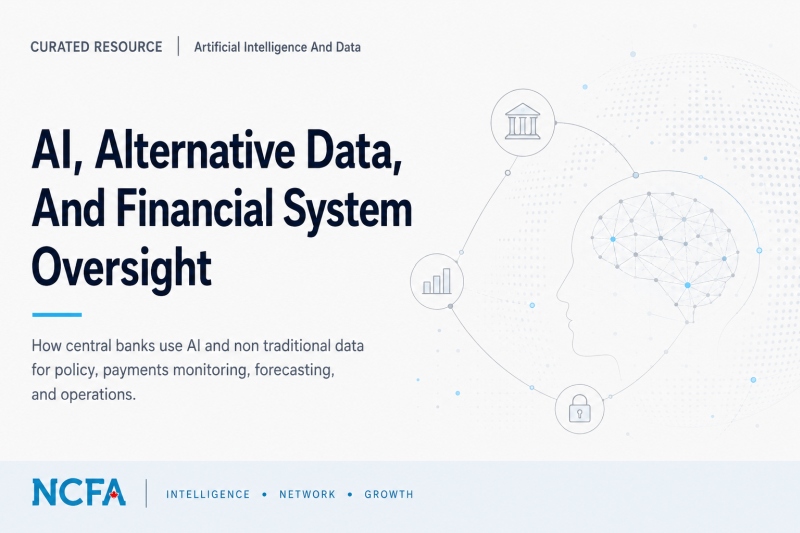
On May 15, 2026, the Bank of Canada published Integrating Non-traditional Data and AI into Central Banking. The staff paper examines how central banks use artificial intelligence and non traditional data in research, operations, payments monitoring, forecasting, and policy support.
The paper stays close to real operating problems. It focuses on data quality, model governance, human oversight, vendor risk, cybersecurity, and moving AI pilots into production.
The paper shows how central banks use non traditional data from payment transactions, earnings call transcripts, satellite images, job postings, social media, scanner data, and real time business activity. It also explains how AI supports inflation tracking, nowcasting, anomaly detection, payments monitoring, internal automation, and policy work.
One Bank of Canada automation project improved filing accuracy to 99.5% and saved about 1.25 person years of staff capacity. The paper also cites a BIS survey showing more than 90% of responding central banks are moderately or extensively discussing AI internally.
The most useful section sets out six accelerators for responsible AI adoption in central banking. They include sandbox environments, technology readiness checks, high quality data, reusable development patterns, scale planning, and risk governance. The framework also applies to regulated financial institutions that need to transition AI from experiments into controlled production, similar to broader work underway around customer due diligence controls for fintechs.
This resource is useful for fintech founders, AI governance teams, regtech providers, financial institutions, payment companies, policy teams, investors, and compliance leaders.
It is especially relevant for teams building explainable AI, payment intelligence, anomaly detection, compliance automation, model governance, and trusted workflow tools.
The strength is its operating detail and the fact that the paper doesn't treat AI as a generic productivity story. It shows why regulated financial institutions need explainability, auditability, strong data controls, and clear ownership before AI can support high stakes decisions.
The paper also points to a real market gap. Central banks may need specialized AI tools and deeper in house expertise because many commercial systems are not designed for monetary policy analysis, payments oversight, or central bank operations.
The limit is scope. This is a central banking paper, not a commercialization guide. It does not estimate vendor spending, market size, adoption timelines, or private sector demand. Its value is the framework and the operating discipline behind it.
Bank Of Canada AI And Non Traditional Data Paper (primary Bank of Canada resource)
AI Agents Enter Governed Financial Workflows (AI governance and controls)
Tokenization Starts Looking Like Financial Infrastructure (regulated financial infrastructure)
Deloitte And Stablecorp Bring QCAD To Banks (Canadian payment infrastructure)
The National Crowdfunding & Fintech Association (NCFA Canada) is a financial innovation ecosystem that provides education, market intelligence, industry stewardship, networking and funding opportunities and services to thousands of community members and works closely with industry, government, partners and affiliates to create a vibrant and innovative fintech and funding industry in Canada. Decentralized and distributed, NCFA is engaged with global stakeholders and helps incubate projects and investment in fintech, alternative finance, crowdfunding, peer-to-peer finance, payments, digital assets and tokens, artificial intelligence, blockchain, cryptocurrency, regtech, and insurtech sectors. Join Canada's Fintech & Funding Community today FREE! Or become a contributing member and get perks. For more information, please visit: www.ncfacanada.org
| | |
|---|---|---|
| | |
The National Crowdfunding & Fintech Association (NCFA Canada) is a financial innovation ecosystem that provides education, market intelligence, industry stewardship, networking and funding opportunities and services to thousands of community members and works closely with industry, government, partners and affiliates to create a vibrant and innovative fintech and funding industry in Canada. Decentralized and distributed, NCFA is engaged with global stakeholders and helps incubate projects and investment in fintech, alternative finance, crowdfunding, peer-to-peer finance, payments, digital assets and tokens, artificial intelligence, blockchain, cryptocurrency, regtech, and insurtech sectors. Join Canada's Fintech & Funding Community today FREE! Or become a contributing member and get perks. For more information, please visit: www.ncfacanada.org
| | |
|---|---|---|
| | |
May 25, 2026 | NCFA Insight | Artificial Intelligence And Data, Capital Markets And Funding

On May 23, 2026, hundreds marched in downtown Vancouver against proposed AI data centres, concerned about electricity use, water use, and environmental impact. The protest puts Canada’s AI compute plans under pressure. Communities want to know who gets clean power, what they get back, and whether data centre operators can earn public trust.
The pressure comes from specific projects. On May 11, 2026, TELUS and the federal government announced work on a proposed Sovereign AI Factory cluster in B.C. that would expand TELUS’s Kamloops data centre and add two Vancouver facilities with Westbank and partners. TELUS says the cluster starts with 85 MW of clean renewable power secured from BC Hydro and is designed to scale to more than 60,000 GPUs and 150 MW by 2032.
After the May 23 protest, TELUS told Daily Hive that its proposed AI infrastructure is a “critical national asset” built for Canada and by Canadians. They said the project could add $9 billion to Canada’s economy, protect sensitive Canadian data, use 98% clean renewable electricity from BC Hydro, cut energy use by 80%, reduce water use by 90%, and save an estimated 300 million litres of water each year through closed loop liquid cooling.
TELUS is framing the project as sovereign AI infrastructure with climate and data benefits. Critics are asking whether those claims will be visible, measurable, and credible enough for communities that are being asked to host large AI facilities.
Ottawa wants more domestic AI compute so Canadian researchers, companies, and public institutions don't have to rely solely on foreign infrastructure. From January 15 to February 15, 2026, the federal government accepted proposals from companies and consortia seeking support to build large scale sovereign AI data centres. The federal government also said no funding has yet been committed or distributed under the process.
On January 30, 2026, the Province and BC Hydro launched a competitive electricity process for AI and data centre projects. The goal is to manage rising demand and prioritize projects with stronger economic, community, and environmental benefits.
BC Hydro’s 2026 call shows the cap constraint. Its Q&A says up to 300 MW has been allocated to storage data centres and up to 100 MW to conventional data centres. Each project site request must not exceed 145 MW. TELUS’s stated 150 MW 2032 target shows how quickly one AI project can approach the size of the current allocation.
BC Hydro says it doesn't comment on specific customer load requests. That leaves communities with headline numbers and proposed locations, but not always the full project picture on grid upgrades, water use, tax benefits, jobs, or local access to compute.
Data centres turn AI from software policy into physical infrastructure. They need land, power, cooling, permits, grid planning, and local acceptance.
Households, industry, electrification, and AI projects are all competing for clean power, which is scare ad valuable. If communities don't see clear local benefits, approvals will get harder.
Critics point to electricity demand, water use, environmental impact, and the risk that public infrastructure supports private AI capacity without enough community return.
B.C. is already choosing which projects get access to limited clean power. Canada needs compute, but scarce electricity should go first to projects that use power efficiently, protect data sovereignty, create local benefits, and make capacity available to Canadian users.
Canada wants sovereign AI compute. Can governments and operators prove that clean power used for AI will create enough local benefit, public trust, and Canadian owned value to justify the buildout?
The National Crowdfunding & Fintech Association (NCFA Canada) is a financial innovation ecosystem that provides education, market intelligence, industry stewardship, networking and funding opportunities and services to thousands of community members and works closely with industry, government, partners and affiliates to create a vibrant and innovative fintech and funding industry in Canada. Decentralized and distributed, NCFA is engaged with global stakeholders and helps incubate projects and investment in fintech, alternative finance, crowdfunding, peer-to-peer finance, payments, digital assets and tokens, artificial intelligence, blockchain, cryptocurrency, regtech, and insurtech sectors. Join Canada's Fintech & Funding Community today FREE! Or become a contributing member and get perks. For more information, please visit: www.ncfacanada.org
| | |
|---|---|---|
| | |
May 22, 2026 | NCFA Fintech Whisperer Weekly Intelligence | Digital Assets Blockchain And Tokenization, Payments And Money Movement
Image: Freepik
This live weekly NCFA intelligence page tracks financial technology developments that significantly affect how fintechs build, sell, raise capital, and operate under scrutiny. Coverage prioritizes Canada and includes global events that directly influence competitive conditions, market access, and execution realities across fintech sectors. This page will be updated throughout the week with market movers in a live format and then each week we'll close the prior week's contents in prep for the upcoming week, and continue on a rolling basis. (Missed prior week's Fintech Whisperer? (December 6-12, 2025, December 13-19, 2025, January 1-9, 2026, January 10-16, 2026, January 17-23, 2026, January 24-30, 2026, January 31-February 6, 2026, February 7-13, 2026, February 14-20, 2026, February 21-27, 2026, February 28-March 6, 2026, March 7-13, 2026, March 14-20, 2026, March 21-27, 2026, March 28-April 3, 2026, April 4-10, 2026, April 11-17, 2026, April 18-24, 2026, April 25-May 1, 2026, May 2-8, 2026, May 9-15, 2026).
Institutional digital asset infrastructure is increasingly converging around unified execution, settlement, compliance, and liquidity layers. Banks, fintechs, custodians, PSPs, brokers, and treasury teams should track how tokenized funds, stablecoin settlement, collateral movement, and onchain liquidity are becoming integrated into institutional operating environments rather than isolated crypto workflows.
Bank led stablecoins are becoming part of Europe’s regulated payment strategy. Banks, PSPs, stablecoin issuers, custodians, treasury teams, and compliance groups should track how euro denominated stablecoin infrastructure affects settlement options, liquidity design, and competition with USD stablecoins.
Stablecoin distribution is becoming a network access problem. Wallets, exchanges, PSPs, brokers, and embedded finance platforms need interoperability, regulated issuance, liquidity, and compliance controls that let users move between stablecoin networks without adding operational friction.
New York licensing remains a key test for institutional digital asset firms. Exchanges, custodians, brokers, lenders, and compliance teams should track which firms secure state level approvals because market access, client onboarding, and institutional trust still depend on regulated operating permissions.
USD account access is becoming embedded infrastructure for global platforms, not just a bank product. Fintechs, PSPs, marketplaces, payroll firms, and treasury teams should watch how account issuance, compliance controls, real time payments, and stablecoin rails converge inside programmable payment stacks.
Canadian dollar stablecoins are beginning to enter practical payment flows instead of remaining treasury or trading instruments. PSPs, banks, remittance firms, treasury teams, and compliance groups should watch how regulated stablecoin settlement changes cross border payout speed, corridor economics, liquidity management, and payment competition. CADC infrastructure continues to expand across Canadian digital payment markets.
Bitcoin reserve legislation is turning digital assets into a public balance sheet question, not just a market regulation debate. Crypto firms, custodians, exchanges, treasury teams, investors, and policymakers should track how federal reserve asset policy, seized digital asset management, and national competitiveness arguments reshape the next phase of U.S. crypto policy.
Card network economics are moving deeper into formal regulatory reporting. Merchants, acquirers, issuers, PSPs, payment networks, and embedded payment platforms should track how fee transparency, profitability evidence, and scheme oversight affect payment costs and competitive pressure across card acceptance.
The FCA is creating a clearer supervisory channel for firms that are already scaling, not just early sandbox participants. That matters because fast growth often creates new questions around controls, governance, technology, and consumer impact before a firm becomes systemically important.
Prediction markets are becoming a direct federal versus state jurisdiction fight. Exchanges, fintech platforms, compliance teams, policymakers, and investors should track how courts treat event contracts because the outcome could affect federal derivatives oversight, state gambling authority, consumer protection rules, and regulated forecasting markets.
Federal policymakers increasingly treat fintech infrastructure as part of U.S. financial competitiveness strategy. Banks, PSPs, digital asset firms, payment companies, and infrastructure providers should track how payment rail access, supervision, settlement services, and master account policy evolve as regulators face growing pressure to integrate fintech firms into core financial systems.
UK stablecoin policy is moving toward draft rule text and implementation design. Stablecoin issuers, banks, PSPs, custodians, wallets, and treasury teams should track how the Bank balances financial stability controls with usable payment products, especially around issuance limits, redemption, reserves, and access to settlement infrastructure.
Lowering community bank burden can open capacity, not just reduce paperwork. Fintechs, sponsor banks, core providers, lenders, and compliance teams should track whether tailored supervision gives smaller banks more room to partner, modernize, lend, and support local payment and deposit infrastructure.
Onchain markets need clearing and netting controls before more institutions treat them as reliable operating channels. Trading firms, custodians, brokers, stablecoin networks, and treasury teams should track how private obligation matching, liquidity savings, and counterparty controls develop across institutional digital asset markets.
Prediction markets are moving beyond politics and sports into private capital market intelligence. Exchanges, investors, fintech platforms, regulators, and market infrastructure providers should track how forecasting markets, institutional secondary market data, and tokenized trading systems increasingly converge around private company price discovery and market sentiment.
Regional exchange infrastructure competition continues to expand beyond traditional Western commodity benchmarks. Exchanges, clearing firms, commodity traders, treasury groups, and market infrastructure operators should track how Singapore based benchmarks, physical delivery systems, and digitally enabled collateral infrastructure increasingly support Asian commodity trade and price discovery.
The case is a governance and creditor risk warning for Canada’s fintech funding market. Investors, lenders, founders, and boards should keep closer watch on treasury controls, debt covenants, founder conduct, and creditor transparency as capital becomes more selective.
Canada’s MSB compliance risk is increasingly visible across multi service fintech models. Crypto firms, PSPs, FX dealers, remittance platforms, investors, and compliance teams should keep registration data current, map services accurately, and treat FINTRAC responsiveness as an operating requirement.
Payments, digital assets, AI fraud controls, and capital markets infrastructure are being rebuilt by registered firms with licenses, distribution, data, and balance sheets. Smaller fintechs can still win, but only where they solve a real operating problem and plug into the financial system with trust from day one. The opportunity is still open, but it will favour teams that move quickly, stay compliant, earn trust, and turn infrastructure change into useful products for customers, merchants, investors, and institutions.
NCFA offers various curated resources to help founders and investors stay current on developments that impact fintech markets, subscribe to NCFA weekly newsletter updates, view a rundown of current fintech news and insights, or dive into the latest fintech industry research.
The National Crowdfunding & Fintech Association (NCFA Canada) is a financial innovation ecosystem that provides education, market intelligence, industry stewardship, networking and funding opportunities and services to thousands of community members and works closely with industry, government, partners and affiliates to create a vibrant and innovative fintech and funding industry in Canada. Decentralized and distributed, NCFA is engaged with global stakeholders and helps incubate projects and investment in fintech, alternative finance, crowdfunding, peer-to-peer finance, payments, digital assets and tokens, artificial intelligence, blockchain, cryptocurrency, regtech, and insurtech sectors. Join Canada's Fintech & Funding Community today FREE! Or become a contributing member and get perks. For more information, please visit: www.ncfacanada.org
| | |
|---|---|---|
| | |
May 22, 2026 | NCFA Market Activity | Banking And Credit Infrastructure, Payments And Market Infrastructure, Lending Consumer Credit And BNPL, Artificial Intelligence And Data

On May 21, 2026, Wealthsimple unveiled a major expansion of its financial services platform during its live product event, “Wealthsimple Takes Over Your Life”. The announcements included family accounts, business chequing, USD accounts, portfolio backed credit, spend insights, overdraft protection, and a monthly $1M client rewards program. The company said more than 4 million Canadians now use Wealthsimple and hold $150B in assets on the platform.
Wealthsimple isn't a Schedule I bank, but it delivers banking style services through regulated Wealthsimple entities, infrastructure access, and partner financial institutions. Wealthsimple says chequing balances are held in trust with CDIC member institutions, while Wealthsimple Payments Inc. and Wealthsimple Investments Inc. are not CDIC member institutions. Power Corporation disclosed a controlling interest in Wealthsimple through Power Financial, Great-West Lifeco, and IGM. In Q1 2026 results, Power valued its Wealthsimple ownership at $3.8B as of March 31, 2026.
NCFA also covered Wealthsimple’s $750M financing and $10B valuation, which gave Canadian fintech markets one of the rarest and strongest scaleup stories.
The event hit home how far Wealthsimple has moved beyond investing and trading. The company now wants a larger share of daily financial activity across deposits, payments, borrowing, business banking, and household finance.
This builds on earlier product expansion when Wealthsimple added credit and loan tools in 2025, including a cash back credit card and low interest credit line. The latest event pushes that same strategy further into operating accounts, secured borrowing, and household controls.
The business banking launch carried the clearest fintech impact. Wealthsimple introduced business chequing with online setup in less than 20 minutes, virtual cards, automated CRA payments, recurring transfers, interest bearing balances, and higher e transfer limits.
Those features target familiar problems for Canadian SMEs. Many owners still deal with low transfer limits, little or no yield on operating balances, manual tax payments, and weak cash management tools.
The Portfolio Line Of Credit may become one of the company’s most important financial products. Wealthsimple said eligible clients can borrow against portfolios at rates as low as prime minus 0.5%, or about 3.95% at the time of the event.
Clients can borrow up to 35% of portfolio value. A client with $200,000 on the platform could access up to $70,000 in credit, subject to eligibility and risk controls.
The product gives clients a way to fund business expenses, inventory purchases, major purchases, or debt refinancing without selling investments. This type of secured liquidity has historically been more common in private banking and wealth management.
For Wealthsimple, portfolio credit also deepens the customer relationship. The more assets clients keep on the platform, the more useful the credit product becomes.
Wealthsimple introduced three family finance products. Kids and teens accounts give parents card controls, alerts, limits, instant transfers, and parent paid interest. Households lets partners choose what they share, track accounts inside and outside Wealthsimple, and view family finances in one place.
Authorized traders lets a trusted family member make trades on another person’s behalf without password sharing. That addresses a practical issue. Many Canadians already help spouses, parents, or relatives manage investments informally. Wealthsimple is formalizing that process with permission based account access.
Wealthsimple also pointed to deeper access across Canadian payment systems. The company linked that access to cheaper wire transfers, free incoming wires, faster payroll deposits, lower FX costs, instant virtual card issuance, cash deposits through Canada Post, and ATM fee reimbursements.
Wealthsimple gained direct Swift access, becoming the first Canadian fintech to do so. It supports the company’s push into wires, cross border money movement, and lower cost global payments.
The Canada Post cash deposit feature gives clients access to more than 5,000 deposit locations. Wealthsimple said it processed cash deposit transactions in more than 900 communities during the first two months after launch.
Infrastructure access increasingly matters for large fintech platforms. It can improve speed, pricing, product flexibility, and customer experience while reducing dependence on older branch based banking workflows.
Wealthsimple’s Monthly Millionaire program will award $1M each month to one client. Every dollar deposited or saved creates an entry, while direct deposit doubles entries. Move over 'roll up the rim to win'!
The structure encourages clients to move payroll deposits and savings activity onto the platform. For Wealthsimple, that supports higher deposits, stronger engagement, and more primary account usage.
Canadian fintech competition is increasingly focused on who controls the broader financial relationship, not just a single product category. Wealthsimple now spans deposits, payments, investing, borrowing, family finance, business banking, and cross border accounts.
That puts the company into more direct competition with incumbent financial institutions across several revenue areas at once. The company's expansion shows how quickly a Canadian fintech can move when scale, capital, trust, and distribution come together.
The National Crowdfunding & Fintech Association (NCFA Canada) is a financial innovation ecosystem that provides education, market intelligence, industry stewardship, networking and funding opportunities and services to thousands of community members and works closely with industry, government, partners and affiliates to create a vibrant and innovative fintech and funding industry in Canada. Decentralized and distributed, NCFA is engaged with global stakeholders and helps incubate projects and investment in fintech, alternative finance, crowdfunding, peer-to-peer finance, payments, digital assets and tokens, artificial intelligence, blockchain, cryptocurrency, regtech, and insurtech sectors. Join Canada's Fintech & Funding Community today FREE! Or become a contributing member and get perks. For more information, please visit: www.ncfacanada.org
| | |
|---|---|---|
| | |



August 26th, 2025

January 4th, 2024

June 1st, 2021

September 9th, 2020

July 9th, 2018

January 3rd, 2018

September 25th, 2017

June 20th, 2017

May 10th, 2017

December 14th, 2016
