





Karsten Wenzlaff, Advisor
August 26th, 2025
Karsten Wenzlaff is a Crowdfunding and Fintech Expert from Germany. He is Secretary-General of Digit[...]


May 29, 2026 | NCFA Fintech Whisperer Weekly Intelligence | Payments And Market Infrastructure, Artificial Intelligence And Data, Digital Assets Blockchain And Tokenization, Capital Markets And Market Infrastructure

Image: Freepik
This live weekly NCFA intelligence page tracks financial technology developments that significantly affect how fintechs build, sell, raise capital, and operate under scrutiny. Coverage prioritizes Canada and includes global events that directly influence competitive conditions, market access, and execution realities across fintech sectors. This page will be updated throughout the week with market movers in a live format and then each week we'll close the prior week's contents in prep for the upcoming week, and continue on a rolling basis. (Missed prior week's Fintech Whisperer? (December 6-12, 2025, December 13-19, 2025, January 1-9, 2026, January 10-16, 2026, January 17-23, 2026, January 24-30, 2026, January 31-February 6, 2026, February 7-13, 2026, February 14-20, 2026, February 21-27, 2026, February 28-March 6, 2026, March 7-13, 2026, March 14-20, 2026, March 21-27, 2026, March 28-April 3, 2026, April 4-10, 2026, April 11-17, 2026, April 18-24, 2026, April 25-May 1, 2026, May 2-8, 2026, May 9-15, 2026, May 16-22, 2026).
AI compliance is moving from broad principles into operating guidance for agents, automated decisions, procurement, and personal data use. Fintechs, banks, insurers, regtech firms, and AI vendors should track how privacy rules shape AI product design, governance, and customer trust.
Project Agorá's focus is not retail crypto speculation. It is wholesale financial infrastructure, cross border settlement efficiency, programmable payments, and institutional control over tokenized money movement. Go deeper, visit NCFA's curated fintech reports and research library, where the BIS Project Agorá report is listed.
This is not open access to the Fed system. It is a narrower settlement pathway for legally eligible firms operating outside the traditional bank model. Stablecoin issuers, PSPs, crypto firms, tokenization platforms, and embedded finance providers should track whether limited Reserve Bank account access becomes a practical alternative to sponsor bank dependence. This connects to NCFA’s analysis of Fed Payment Accounts and fintech settlement access.
Onchain finance needs shared coordination standards before institutional adoption can scale cleanly. Banks, wallets, PSPs, exchanges, tokenization platforms, and agentic payment builders should track whether identity, messaging, and transaction standards become competitive infrastructure rather than optional middleware.
Large payment networks are adding regulated digital asset permissions to support stablecoin, tokenized settlement, and digital asset infrastructure at institutional scale. Banks, PSPs, exchanges, custodians, and fintech platforms should track which firms secure licences that let crypto services connect with mainstream payment networks.
Stablecoins are moving deeper into consumer banking distribution, not just crypto infrastructure. Banks, fintechs, PSPs, and regulators should watch whether regulated bank issued stablecoins begin competing directly with cards, deposits, remittance products, and embedded payment flows. Also supports this analysis of stablecoins becoming payment infrastructure.
National currency stablecoins are expanding beyond major economies. Stablecoin issuers, banks, PSPs, regulators, and treasury teams should track how smaller jurisdictions use digital fiat infrastructure to compete for payment flows, fintech investment, and cross border settlement.
Climate disclosure is moving back toward company specific materiality rather than a dedicated SEC climate reporting regime. Public companies, fintech lenders, ESG data providers, regtech firms, investors, and capital markets platforms should track how climate risk reporting moves across U.S. federal rules, state rules, EU requirements, and voluntary investor expectations.
Bank charter strategy is becoming part of digital asset and payment infrastructure competition. Banks, fintechs, stablecoin firms, custodians, and compliance teams should track which institutions secure federal supervision, stronger operating permissions, and clearer access to national banking infrastructure.
MiCA is moving from licensing theory into enforcement risk. Crypto exchanges, custodians, wallet providers, brokers, and compliance teams should treat EU authorization, local regulator engagement, and operating perimeter checks as immediate market access priorities.
Prediction markets are moving deeper into conflict with gambling, derivatives, and securities frameworks. Exchanges, fintechs, tokenization firms, and prediction market operators should expect more pressure around licensing, market surveillance, consumer protection, and jurisdictional authority as these platforms expand globally.
USMCA risk is now back inside Canada’s competitiveness file. Fintech lenders, payment firms, investors, marketplaces, and platforms serving SMEs should watch how tariff uncertainty affects customer margins, capital demand, foreign exchange exposure, supplier payments, and cross border expansion.
Crypto sanctions enforcement now reaches deeper into financial infrastructure networks, not just individual wallets or isolated actors. Exchanges, custodians, PSPs, banks, compliance teams, and blockchain monitoring firms should expect more scrutiny around transaction tracing, counterparty checks, and sanctions controls tied to digital asset flows.
Post trading rules are becoming more important as Europe modernizes settlement operations, CSD messaging, and market infrastructure controls. CSDs, brokers, banks, custodians, tokenization platforms, and compliance teams should track how messaging standards affect settlement efficiency, operational risk, and future market infrastructure integration.
Blockchain based settlement is moving into formal U.S. market infrastructure permissions. Brokers, custodians, tokenization platforms, exchanges, and asset managers should track how SEC registered clearing models affect securities settlement, custody design, and tokenized market structure.
Retail investing scale increasingly depends on back end clearing and custody infrastructure. Fintech platforms, brokers, clearing firms, embedded finance providers, and regulators should track how large consumer apps choose clearing partners that can support faster launches, broader products, and stronger operational controls.
This week was less about crypto adoption and more about who gets trusted access to the pipes. The Fed tested a narrow settlement account, Paxos received SEC clearing agency registration, Mastercard secured a BitLicense, SoFi launched a bank issued stablecoin, and Project Agorá moved wholesale tokenized settlement into deeper testing. The fresh lesson is that access is becoming tiered. Firms won’t all get the same rails, licences, or settlement rights.
NCFA offers various curated resources to help founders and investors stay current on developments that impact fintech markets, subscribe to NCFA weekly newsletter updates, view a rundown of current fintech news and insights, or dive into the latest fintech industry research.
 The National Crowdfunding & Fintech Association (NCFA Canada) is a financial innovation ecosystem that provides education, market intelligence, industry stewardship, networking and funding opportunities and services to thousands of community members and works closely with industry, government, partners and affiliates to create a vibrant and innovative fintech and funding industry in Canada. Decentralized and distributed, NCFA is engaged with global stakeholders and helps incubate projects and investment in fintech, alternative finance, crowdfunding, peer-to-peer finance, payments, digital assets and tokens, artificial intelligence, blockchain, cryptocurrency, regtech, and insurtech sectors. Join Canada's Fintech & Funding Community today FREE! Or become a contributing member and get perks. For more information, please visit: www.ncfacanada.org
 |  |  |
|---|---|---|
 |  |  |
May 28, 2026 | NCFA Insight | Payments And Market Infrastructure, Digital Assets Blockchain And Tokenization, Capital Markets And Market Infrastructure

On May 26, 2026, the BIS released its 97 page Project Agorá report, detailing how a global public private prototype tested the feasibility of tokenized commercial bank deposits and wholesale central bank money for cross border payments. The report explains the project vision, who participated, what the prototype tested, what worked (or not), and what has to happen before any production system can operate at scale.
Project Agorá isn't a retail CBDC project, nor is it a stablecoin clone. It tests whether today’s correspondent banking system can use tokenized bank money and smart payment workflows to make wholesale cross border payments faster, safer, more transparent, and easier to coordinate.
Cross border payments totalled USD $195 trillion in 2024 and are projected to reach USD $320 trillion by 2032. Wholesale payments accounted for 91% of cross border payment value in 2023. These flows affect banks, PSPs, exporters, capital markets firms, treasury teams, and fintechs building around global money movement.
On May 27, 2026, the Bank of Canada joined Project Agorá, giving Canada a seat at the table and role in the next phase of testing. The Bank says the project has successfully tested the feasibility of a multi currency unified ledger that enables atomic settlement of wholesale cross border transactions.
The next phase will continue testing the prototype and examine how an Agorá type platform could operate under existing legal and regulatory frameworks, including settlement finality, anti money laundering rules, and terrorist financing rules.
Carolyn Rogers, Senior Deputy Governor, Bank of Canada:
“We know that the Canadian economy could benefit from innovation in cross-border payments. Tokenization has the potential to make these payments faster, cheaper and more efficient and secure. Project Agorá is a unique opportunity to test the technology across several jurisdictions and currencies, with the participation of private sector financial institutions.”
Project Agorá was convened by the BIS and the Institute of International Finance. It originally brought together 7 central banks and more than 40 regulated financial institutions, including banks, payment service providers, financial market infrastructures, and global payment networks.
The central bank group includes the Federal Reserve Bank of New York, Bank of England, Bank of France representing the Eurosystem, Bank of Japan, Bank of Mexico, Swiss National Bank, Bank of Korea, and now the Bank of Canada for the next phase. That makes Agorá a multi currency and multi jurisdiction test, not a single bank proof of concept.
The project keeps correspondent banking as the base model. Banks still manage customers, deposits, access, compliance, and balance sheet relationships. Central banks still control reserves and domestic policy settings. Agorá adds a shared programmable platform to coordinate the payment workflow.
The prototype uses a two layer architecture. (1) A unifying ledger records tokenized commercial bank deposits and coordinates the cross border workflow. (2) Separate jurisdictional ledgers record tokenized central bank reserves so each central bank keeps control over its own money, access rules, and policy settings.
The payment workflow has five stages. Agorá checks the payee, finds the payment route, confirms required checks, locks the needed balances, then settles the transaction. In report terms, those stages are confirmation of payee, path discovery, validation, locking, and settlement.
The order sequencing matters. Agorá checks the payment before banks lock up liquidity. It confirms the payee, route, required checks, and available balances first. Only then does settlement begin. That reduces the risk of finding a problem after money has already been committed.
 Source: Bank for International Settlements, Project Agorá, “Wholesale cross border payments today and in Project Agorá,” Figure 1.
The prototype showed that atomic settlement is achievable in a tokenized environment across the participating jurisdictions. This means that either every required balance update happens, or none of them happen. One leg of a transaction cannot settle while another fails.
The report says settlement can occur in seconds once funds or liquidity are locked. The platform is also designed to operate around the clock, which could reduce delays caused by time zones and market hours. That doesn't mean every payment becomes instant from start to finish. It means the settlement step can happen quickly after the required checks and liquidity locks are complete.
The prototype also showed that shared infrastructure doesn't require shared data by default. Participants can coordinate payment status, validation outcomes, and settlement without exposing customer data, internal risk models, or sensitive routing information to everyone on the platform.
The report identifies specific pain points in wholesale cross border payments. They include mismatched operating hours, sanctions and compliance false positives, serial processing, poor data quality, weak payment status visibility, unclear fees, liquidity pressure, settlement risk, reconciliation breaks, and client outreach.
These are practical banking problems. A false positive can stop a legitimate payment. A missing data field can trigger manual review. A payment status gap can leave banks and clients unsure where funds are stuck. A reconciliation break can create cost after settlement. Liquidity sitting in the wrong place can weaken treasury efficiency.
The report doesn't make cost reduction the main objective because many wholesale payment costs come from FX pricing and market structure. The stronger claim is narrower though. Fewer failed payments, investigations, returns, and reconciliation breaks could reduce operating drag if the model works in production.
Agorá doesn't try to centralize AML, counter terrorist financing, sanctions, fraud, or policy decisions. Each institution still performs its own checks inside its own systems. The platform coordinates only the outcomes needed to move the workflow forward.
This is important for banks who need shared infrastructure, but they don't want to expose customer information, proprietary screening logic, or internal compliance decisions to every other participant in a payment chain. Agorá uses scoped privacy and controlled information sharing so only relevant parties receive the data they need.
The result is a realistic compliance model for regulated institutions. It doesn't remove compliance work. It tries to reduce duplication, bring validations earlier in the process, and stop settlement from starting before required checks are complete.
The report’s legal analysis as tested in Agorá, found that tokenization doesn't fundamentally change the legal nature of money. Tokenized central bank reserves remain central bank reserves. Tokenized deposits remain commercial bank deposit obligations.
It suggests tokenized bank money can develop inside existing legal and regulatory frameworks instead of starting from a blank page. It also separates Agorá from private digital asset models where the legal nature of the claim can be less familiar.
The report doesn't claim every legal issue is solved however. Settlement finality is achievable across the participating jurisdictions, but production deployment would still need rulebooks, contractual frameworks, liability rules, governance, data rules, insolvency treatment, and clear legal effect across jurisdictions.
The strongest benefits are operational. Agorá could give banks better payment status visibility, earlier data checks, fewer late stage failures, faster settlement after liquidity is locked, and more predictable workflows across currencies.
Treasury teams could benefit from better liquidity coordination. Cross border payments today can require prefunding, manual investigation, and treasury allocation across time zones. Agorá’s design could reduce some of that friction by coordinating payment paths, validations, balance locks, and settlement in one workflow.
The risks are in production execution. The report says the prototype didn't prioritize production grade performance, cyber security, or liquidity saving tools. It also left FX integration and other tokenized asset classes outside scope.
A real system would need to connect with existing bank infrastructure and prove it can operate under stress. That means strong governance, resilience testing, failover, monitoring, and clear performance benchmarks.
The Bank of Canada is now involved, but commercial value depends on private sector participation. Canadian banks, PSPs, market infrastructure providers, and fintechs need a role in testing, rule design, and integration.
For fintechs, the opportunity is to build around the workflow through compliance tools, privacy technology, treasury systems, FX routing, liquidity optimization, reconciliation software, APIs, and analytics.
Agorá gives banks and central banks a regulated alternative to stablecoin settlement networks, but only if the next phase proves it can handle real value, real liquidity, and real operating rules.
If Project Agorá evolves from prototype to real value settlement, will tokenized bank deposits become the regulated answer to stablecoin driven cross border payments?
The National Crowdfunding & Fintech Association (NCFA Canada) is a financial innovation ecosystem that provides education, market intelligence, industry stewardship, networking and funding opportunities and services to thousands of community members and works closely with industry, government, partners and affiliates to create a vibrant and innovative fintech and funding industry in Canada. Decentralized and distributed, NCFA is engaged with global stakeholders and helps incubate projects and investment in fintech, alternative finance, crowdfunding, peer-to-peer finance, payments, digital assets and tokens, artificial intelligence, blockchain, cryptocurrency, regtech, and insurtech sectors. Join Canada's Fintech & Funding Community today FREE! Or become a contributing member and get perks. For more information, please visit: www.ncfacanada.org
| | |
|---|---|---|
| | |

Last Updated: May 28, 2026
Status: Building
Organizations: SoFi, Department of Finance Canada, Bank of Canada, FCA, UK Government
The answer is yes, but not because stablecoins are leaving crypto behind. They are expanding from crypto market use into banking apps, remittances, reserve models, and payment policy. The test is no longer whether tokens can move on chain. The test is whether they can move money inside regulated financial systems.
The link to payment access is important. Stablecoins need banking partners, reserves, payment gateways, custody controls, and settlement routes. That connects directly to limited direct settlement access, because stablecoin utility depends on how close non bank firms can get to trusted payment and reserve infrastructure.
The firms to watch are the ones that can make stablecoins boring enough to use. That means clean reserves, clear redemption, strong compliance, distribution reach, and payment flows that solve real problems.
Strategic Takeaway
Stablecoins are expanding into payment infrastructure where they connect trusted reserves, regulated distribution, and real money movement. The strongest players may be firms that can make tokenized money useful without making users think about crypto at all.
Click each item to expand
SoFiUSD shows stablecoins moving into mainstream financial distribution. The product is positioned as a bank issued, 1:1 redeemable U.S. dollar stablecoin inside the SoFi app.
Canada’s framework gives the stablecoin infrastructure question a domestic policy base. It moves stablecoin activity toward rules for issuance, reserves, custody, redemption, governance, and oversight.
UK policy work shows regulators treating stablecoins as potential payment instruments, not only crypto assets. That means issuance, custody, reserves, and payment services are becoming connected policy questions.
Do you agree the evidence is strengthening?
 1
1

The National Crowdfunding & Fintech Association (NCFA Canada) is a financial innovation ecosystem that provides education, market intelligence, industry stewardship, networking and funding opportunities and services to thousands of community members and works closely with industry, government, partners and affiliates to create a vibrant and innovative fintech and funding industry in Canada. Decentralized and distributed, NCFA is engaged with global stakeholders and helps incubate projects and investment in fintech, alternative finance, crowdfunding, peer-to-peer finance, payments, digital assets and tokens, artificial intelligence, blockchain, cryptocurrency, regtech, and insurtech sectors. Join Canada's Fintech & Funding Community today FREE! Or become a contributing member and get perks. For more information, please visit: www.ncfacanada.org
| | |
|---|---|---|
| | |
Last Updated: May 27, 2026
Status: Building
Organizations: Federal Reserve, Neo, Interac, Tether, Government of Georgia
The answer is moving toward yes, but through tighter gates. Regulators are not opening settlement systems to every fintech. They are testing whether some firms can reach parts of the settlement layer without becoming banks.
Canada already allows some narrower access models through Interac participation and registered payment frameworks. The next pressure point may come from real time payments, stablecoin reserve treatment, tokenized settlement, or cross border payment competition from outside Canada.
The firms to watch are not necessarily the biggest fintechs. The advantage may go to companies that can prove resilience, compliance depth, operational uptime, fraud controls, and trusted movement of funds at scale. Regulators appear more willing to test narrower infrastructure access when the activity is tightly defined and operationally mature.
Strategic Takeaway
Limited direct settlement access is becoming a middle layer between sponsor bank dependence and full banking status. That could reshape who controls payment flow, customer relationships, settlement logic, and financial infrastructure over the next few years.
Click each item to expand
The Fed proposal separates limited payment access from full banking status. It gives regulators a way to test settlement and reserve functions without granting the full benefits of a Master Account.
Neo’s Interac access gives the Canadian market a practical proof point. Direct rail participation can improve control over payment flow without turning a fintech into a full bank.
The Georgia stablecoin plan shows why this question is moving beyond traditional payment rails. Stablecoins can connect payments, remittances, programmable finance, and national digital infrastructure.
Do you agree the evidence is strengthening?
0
The National Crowdfunding & Fintech Association (NCFA Canada) is a financial innovation ecosystem that provides education, market intelligence, industry stewardship, networking and funding opportunities and services to thousands of community members and works closely with industry, government, partners and affiliates to create a vibrant and innovative fintech and funding industry in Canada. Decentralized and distributed, NCFA is engaged with global stakeholders and helps incubate projects and investment in fintech, alternative finance, crowdfunding, peer-to-peer finance, payments, digital assets and tokens, artificial intelligence, blockchain, cryptocurrency, regtech, and insurtech sectors. Join Canada's Fintech & Funding Community today FREE! Or become a contributing member and get perks. For more information, please visit: www.ncfacanada.org
| | |
|---|---|---|
| | |
May 26, 2026 | NCFA Insight | Payments And Market Infrastructure, Regulation And Policy, Digital Assets Blockchain And Tokenization
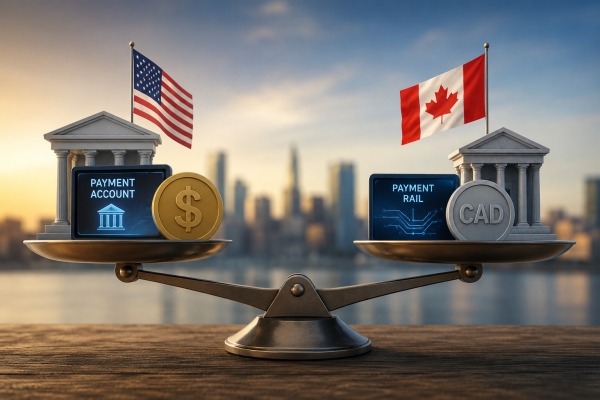
The Fed is proposing limited settlement accounts for eligible firms. The bigger question is whether the U.S. gives qualified fintechs a cleaner infrastructure advantage than Canada.
On May 26, 2026, the Federal Reserve published a Federal Register proposal for special purpose Payment Accounts. Legally eligible institutions could use them to clear and settle certain payment activity through Reserve Bank accounts. Comments are due by July 27, 2026 under Docket No. OP-1878.
The proposal isn't open access to the Fed. Payment Accounts would have no intraday credit, no discount window access, no interest on balances, no correspondent activity, and no respondent activity. Closing balances would generally be capped at $1B. The account would support approved payment settlement, not full banking privileges.
Jerome H. Powell, Fed Chair said:
“The proposed payment account would be tailored to support innovation by serving the clearing and settlement needs of certain eligible institutions while also mitigating material risks to the Reserve Banks and payment system.”
A Master Account gives an eligible institution direct access to Reserve Bank balances and Federal Reserve payment services. The proposed Payment Account is narrower in scope. Firms would not borrow from the Fed, earn interest, receive daylight overdrafts, or use the account as a correspondent banking platform.
The Fed is testing whether limited settlement access can exist without full banking access.
Fintechs, crypto firms, trust companies, and novel chartered institutions have pushed for Fed access because sponsor bank dependence affects cost, timing, liquidity, and settlement certainty. Banks have pushed back because wide access can raise compliance, liquidity, and regulatory arbitrage concerns.
In 2022, the Fed finalized Account Access Guidelines with a tiered review framework. The toughest review applies to institutions that are not federally insured and are not subject to federal prudential supervision at the institution or holding company level.
The 2026 proposal doesn't replace that framework. It creates a tighter account model inside the same access debate.
The proposal discusses use cases raised by commenters, including stablecoin issuer reserve operations, tokenized securities settlement in central bank money, tokenized assets, pay by bank checkout, B2B transfers, instant wages and refunds, and the U.S. dollar leg of cross border transactions.
Those use cases point to the same operating need, clean settlement. Stablecoin issuers need reliable reserve movement. Tokenization platforms need cash settlement closer to central bank money. PSPs need faster payment settlement. Pay by bank providers need lower cost routing. Cross border firms need cleaner dollar leg execution.
Today, many fintechs settle payments through sponsor banks. A fintech sends payment instructions, but the actual settlement usually happens through a commercial bank account connected to central bank rails.
Under the Fed proposal, an approved firm could potentially hold limited settlement balances directly at a Reserve Bank for approved payment activity. That could reduce some dependence on sponsor banks for specific flows.
For a stablecoin issuer, that could improve reserve movement and redemption settlement.
For a pay by bank provider, it could streamline payment routing.
For a tokenization platform, it could support settlement closer to central bank money instead of relying entirely on commercial bank ledger movement.
The proposal would not turn fintechs into banks. Firms would not receive deposit insurance, emergency liquidity, or unrestricted Fed access.
If eligible U.S. firms gain limited Reserve Bank settlement access while Canadian firms remain more dependent on bank intermediaries, U.S. fintechs could gain an operating edge in payment speed, settlement certainty, reserve movement, and cost control.
That edge is important for stablecoins, tokenized securities, pay by bank, B2B payments, cross border transfers, and embedded finance. These markets compete on speed, liquidity use, compliance reliability, and integration cost.
It could also change sponsor bank negotiations. A firm with a credible settlement alternative has more leverage than one with no alternative.
| Question | U.S. Fed Payment Account Proposal | Canada RPAA Registered PSP | Canada Payment Rail Participation |
|---|---|---|---|
| Live today? | No. Proposal only. | Yes | Yes |
| Can hold settlement balances at the central bank? | Only if final rules approve it and the firm qualifies. | No | No by participation alone. |
| Can settle some payments through a central bank account? | Would apply only to approved payment activity. | No | RTR may allow direct settlement for eligible participants that qualify for Bank of Canada settlement accounts. RPAA registration alone doesn't. |
| Still needs sponsor banks? | Yes, but dependence could fall for approved settlement flows. | Yes | Yes, in many cases. |
| Gets full banking powers? | No | No | No |
| Main benefit | Potentially cleaner settlement for stablecoins, tokenized assets, pay by bank, and cross border dollar flows. | Legal operation under Bank of Canada supervision. | Access to payment rails and network participation. |
Canada’s retail payments framework brings PSPs into Bank of Canada supervision. The PSP registry under the RPAA confirms registration status, required fees, and national security screening. Registration does not itself provide limited direct settlement access.
Payments Canada says the Real Time Rail will launch in Q4 2026 as Canada’s instant, data rich exchange and clearing and settlement payment system. RTR is expected to broaden access for eligible participants, including PSPs that meet applicable requirements.
Canada has also legislated a fiat backed stablecoin framework, with detailed rules and implementation still being developed. The framework helps define issuer obligations around reserves, redemption, governance, data security, and Bank of Canada oversight. It does not itself provide payment rail access or limited direct settlement access.
The competitive question is not whether Canada should copy the Fed. It's whether Canada can give qualified PSPs, stablecoin issuers, and tokenization firms a clear access ladder from supervision to rail participation to settlement. If U.S. firms gain a narrow Fed settlement lane while Canadian firms wait for comparable clarity, product speed, treasury efficiency, and sponsor bank leverage may tilt south.
If U.S. firms get limited central bank settlement access, what should Canada let supervised PSPs access once they meet higher standards?
The National Crowdfunding & Fintech Association (NCFA Canada) is a financial innovation ecosystem that provides education, market intelligence, industry stewardship, networking and funding opportunities and services to thousands of community members and works closely with industry, government, partners and affiliates to create a vibrant and innovative fintech and funding industry in Canada. Decentralized and distributed, NCFA is engaged with global stakeholders and helps incubate projects and investment in fintech, alternative finance, crowdfunding, peer-to-peer finance, payments, digital assets and tokens, artificial intelligence, blockchain, cryptocurrency, regtech, and insurtech sectors. Join Canada's Fintech & Funding Community today FREE! Or become a contributing member and get perks. For more information, please visit: www.ncfacanada.org
| | |
|---|---|---|
| | |
May 26, 2026 | NCFA Insight | Risk Compliance And Regtech, Digital Assets Blockchain And Tokenization, Payments And Money Movement

Canada’s revoked MSB registry shows where payments, crypto, FX, and money transfer compliance risk is concentrated.
On May 21, 2026, FINTRAC modeified the public revoked money services business registry, currently showing 396 revoked registrations within the broader MSB registry of 7,745 firms. These revoked registrations span multiple years, but some quick analysis shows where payments, crypto, FX, and money transfer compliance risk is concentrated.
Below we show the total number of revoked registrations (396) by revocation year:
The registry is cumulative, but 2022 and 2026 stand out with greater numbers. The 2022 spike may reflect several factors, including delayed compliance reviews, expired or inactive registrations, pandemic era business disruption, and firms failing to respond to FINTRAC requests or update operating information.
The 2026 peak shows revocations are active again, but the registry doesn't explain why each firm was removed.
Of the 151 registrations revoked in 2026:
These activity counts exceed 151 because many businesses offered multiple services under one registration. They operated across money transfer, FX, virtual currency, PSP activity, and sometimes crowdfunding or money order services at the same time. That combination can make compliance harder because one firm may need controls for several activity types at once.
Wallets, stablecoin services, remittance platforms, crypto OTC desks, merchant payout tools, and embedded finance products often cross several regulatory categories. Companies building in these areas need clearer service mapping, stronger AML controls, and faster regulatory response processes.
By Province:
By City:
The above counts simply show where revoked registrations are concentrated in the dataset. Vancouver and Toronto are also major hubs for payments, FX, crypto services, incorporation activity, and cross border commerce, so higher counts likely reflect market density as well as supervisory attention.
MSBs must keep records, verify client identity, maintain a compliance regime, report certain financial transactions, and register their business. FINTRAC can revoke registration when a business becomes ineligible, misses a clarification request deadline, fails to respond to information demands, fails to update operating information, or fails to assist the Centre.
Founders should treat MSB registration as an active regulatory relationship. Address changes, service category changes, ownership changes, agent changes, and compliance officer changes all need disciplined tracking. Compliance teams should also review whether real business activity still matches registered categories, especially where firms blend payments, crypto, FX, remittances, PSP activity, and embedded finance.
Investors should add registry hygiene, AML staffing, virtual currency exposure, PSP activity, and regulator response history to diligence checklists. Growth can hide weak compliance operations for a while, but public registries can make those weaknesses visible.
This all aligns with recent Canadian oversight changes, such as the Bank of Canada’s PSP Registry under the RPAA, new Bank of Canada guidance for PSPs, and FINTRAC’s focus on Bitcoin ATM money laundering risks.
Which crypto firm looks stronger to regulators, investors, and banking partners: one that treats compliance as paperwork, or one that builds it into the operating system?
The National Crowdfunding & Fintech Association (NCFA Canada) is a financial innovation ecosystem that provides education, market intelligence, industry stewardship, networking and funding opportunities and services to thousands of community members and works closely with industry, government, partners and affiliates to create a vibrant and innovative fintech and funding industry in Canada. Decentralized and distributed, NCFA is engaged with global stakeholders and helps incubate projects and investment in fintech, alternative finance, crowdfunding, peer-to-peer finance, payments, digital assets and tokens, artificial intelligence, blockchain, cryptocurrency, regtech, and insurtech sectors. Join Canada's Fintech & Funding Community today FREE! Or become a contributing member and get perks. For more information, please visit: www.ncfacanada.org
| | |
|---|---|---|
| | |
May 26, 2026 | NCFA Resource | Artificial Intelligence And Data, Risk Compliance And Regtech, Payments And Market Infrastructure
On May 15, 2026, the Bank of Canada published Integrating Non-traditional Data and AI into Central Banking. The staff paper examines how central banks use artificial intelligence and non traditional data in research, operations, payments monitoring, forecasting, and policy support.
The paper stays close to real operating problems. It focuses on data quality, model governance, human oversight, vendor risk, cybersecurity, and moving AI pilots into production.
The paper shows how central banks use non traditional data from payment transactions, earnings call transcripts, satellite images, job postings, social media, scanner data, and real time business activity. It also explains how AI supports inflation tracking, nowcasting, anomaly detection, payments monitoring, internal automation, and policy work.
One Bank of Canada automation project improved filing accuracy to 99.5% and saved about 1.25 person years of staff capacity. The paper also cites a BIS survey showing more than 90% of responding central banks are moderately or extensively discussing AI internally.
The most useful section sets out six accelerators for responsible AI adoption in central banking. They include sandbox environments, technology readiness checks, high quality data, reusable development patterns, scale planning, and risk governance. The framework also applies to regulated financial institutions that need to transition AI from experiments into controlled production, similar to broader work underway around customer due diligence controls for fintechs.
This resource is useful for fintech founders, AI governance teams, regtech providers, financial institutions, payment companies, policy teams, investors, and compliance leaders.
It is especially relevant for teams building explainable AI, payment intelligence, anomaly detection, compliance automation, model governance, and trusted workflow tools.
The strength is its operating detail and the fact that the paper doesn't treat AI as a generic productivity story. It shows why regulated financial institutions need explainability, auditability, strong data controls, and clear ownership before AI can support high stakes decisions.
The paper also points to a real market gap. Central banks may need specialized AI tools and deeper in house expertise because many commercial systems are not designed for monetary policy analysis, payments oversight, or central bank operations.
The limit is scope. This is a central banking paper, not a commercialization guide. It does not estimate vendor spending, market size, adoption timelines, or private sector demand. Its value is the framework and the operating discipline behind it.
Bank Of Canada AI And Non Traditional Data Paper (primary Bank of Canada resource)
AI Agents Enter Governed Financial Workflows (AI governance and controls)
Tokenization Starts Looking Like Financial Infrastructure (regulated financial infrastructure)
Deloitte And Stablecorp Bring QCAD To Banks (Canadian payment infrastructure)
The National Crowdfunding & Fintech Association (NCFA Canada) is a financial innovation ecosystem that provides education, market intelligence, industry stewardship, networking and funding opportunities and services to thousands of community members and works closely with industry, government, partners and affiliates to create a vibrant and innovative fintech and funding industry in Canada. Decentralized and distributed, NCFA is engaged with global stakeholders and helps incubate projects and investment in fintech, alternative finance, crowdfunding, peer-to-peer finance, payments, digital assets and tokens, artificial intelligence, blockchain, cryptocurrency, regtech, and insurtech sectors. Join Canada's Fintech & Funding Community today FREE! Or become a contributing member and get perks. For more information, please visit: www.ncfacanada.org
| | |
|---|---|---|
| | |
The National Crowdfunding & Fintech Association (NCFA Canada) is a financial innovation ecosystem that provides education, market intelligence, industry stewardship, networking and funding opportunities and services to thousands of community members and works closely with industry, government, partners and affiliates to create a vibrant and innovative fintech and funding industry in Canada. Decentralized and distributed, NCFA is engaged with global stakeholders and helps incubate projects and investment in fintech, alternative finance, crowdfunding, peer-to-peer finance, payments, digital assets and tokens, artificial intelligence, blockchain, cryptocurrency, regtech, and insurtech sectors. Join Canada's Fintech & Funding Community today FREE! Or become a contributing member and get perks. For more information, please visit: www.ncfacanada.org
| | |
|---|---|---|
| | |



August 26th, 2025

January 4th, 2024

June 1st, 2021

September 9th, 2020

July 9th, 2018

January 3rd, 2018

September 25th, 2017

June 20th, 2017

May 10th, 2017

December 14th, 2016
