





Karsten Wenzlaff, Advisor
August 26th, 2025
Karsten Wenzlaff is a Crowdfunding and Fintech Expert from Germany. He is Secretary-General of Digit[...]


May 25, 2026 | NCFA Insight | Payments And Market Infrastructure, Open Banking Open Finance And Data Sharing, Digital Assets Blockchain And Tokenization
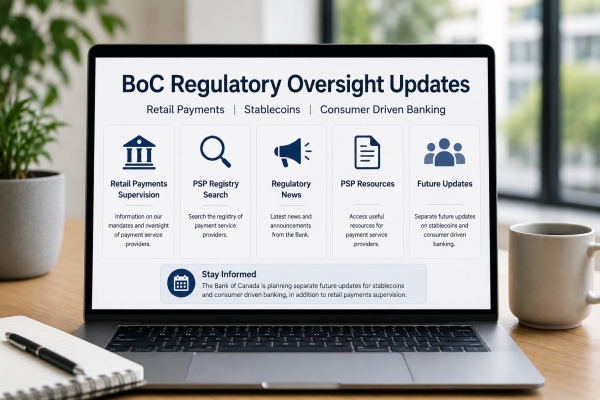
On May 25, 2026, the Bank of Canada refreshed its regulatory oversight web content and streamlined its retail payments supervision section. The update gives payment service providers a cleaner place to find key information as the Bank’s mandates expand across retail payments, stablecoins, and consumer driven banking.
The Bank says users can now more easily find information about its mandates, search the payment service provider registry, access a new regulatory news section, and browse resources for payment service providers. It's important for fintechs because RPAA supervision is evolving from policy discussion into day to day operating reality and governance.
The Bank supervises payment service providers under the Retail Payment Activities Act (NCFA covered this practical transition when the PSP registry went live under RPAA) and expects firms to meet risk management and safeguarding requirements.
In addition to retail payments supervision, the Bank of Canada also says it plans to issue separate future updates about stablecoins and consumer driven banking. It means fintechs should watch the Bank’s update streams more closely as these files progress for the latest updates and key information.
The Bank has also set up a Consumer Driven Banking Advisory Committee to provide industry perspective and advice to the Bank and the Department of Finance. The committee will focus on implementation, industry readiness, and the supervisory framework. NCFA’s open banking commercialization roadmap explains why implementation details will matter for fintech business models, data access, onboarding, and customer experience. That gives market participants a useful clue about where questions will concentrate next, such as how companies prepare, how oversight works in practice, and how consumer driven banking connects with the broader payment system.
Payment companies should use the refreshed pages as a compliance resource point. Check registry details, monitor regulatory news, review PSP resources, and make sure internal owners know where Bank updates will appear.
No new rules were announced in this email, but the Bank has made it easier to follow the official files that matter to payment companies, stablecoin operators, open banking participants. In a crowded regulatory environment, cleaner source material helps firms track changes earlier and prepare with less confusion.
 The National Crowdfunding & Fintech Association (NCFA Canada) is a financial innovation ecosystem that provides education, market intelligence, industry stewardship, networking and funding opportunities and services to thousands of community members and works closely with industry, government, partners and affiliates to create a vibrant and innovative fintech and funding industry in Canada. Decentralized and distributed, NCFA is engaged with global stakeholders and helps incubate projects and investment in fintech, alternative finance, crowdfunding, peer-to-peer finance, payments, digital assets and tokens, artificial intelligence, blockchain, cryptocurrency, regtech, and insurtech sectors. Join Canada's Fintech & Funding Community today FREE! Or become a contributing member and get perks. For more information, please visit: www.ncfacanada.org
 |  |  |
|---|---|---|
 |  |  |
May 25, 2026

The global beauty economy is massive. We are talking about a sector that generates half a trillion dollars in annual retail sales; it is an economic powerhouse driven by skincare, cosmetics, and personal care services. Yet, for a long time, the actual infrastructure behind your neighborhood salon or luxury spa felt stuck in the past. You walk into a high-end salon, get a forward-thinking haircut, and then encounter a clunky, slow payment counter. It was a strange mismatch.
Things are shifting rapidly now. Digital modernization is sweeping through personal services, and it is not just about booking apps or Instagram marketing. The real transformation is happening deep in the financial backend. Fintech innovation has quietly become the operational backbone of this massive industry, changing how money moves between clients, stylists, and suppliers.
Running a service-oriented business presents unique operational headaches. Unlike traditional retail where you just buy a product and walk out, beauty services rely heavily on human time; scheduling is variable, and tipping is an essential part of the worker's income. Traditional banking systems were never built with these specifics in mind. High processing fees, delayed payouts, and rigid merchant setups have historically eaten into the profit margins of small and medium-sized beauty enterprises.
Cash used to be king in salons because it bypassed these frictions. However, consumer habits have changed dramatically, especially over the last few years; modern clients expect fast, digital, and contactless options at checkouts. Salon owners who stick exclusively to old-school payment systems find themselves facing high cart abandonment for online bookings or losing clients who simply do not carry physical wallets anymore. The pressure to adapt is real.
To survive in this competitive space, beauty entrepreneurs must look closely at their underlying transaction infrastructure. A salon's payment processing setup shouldn't just be an afterthought or a utility expense; it is a core business strategy. Choosing the right specialized merchant services means minimizing transaction downgrades, protecting client data, and ensuring that mobile and contactless wallets work flawlessly every single time. Having tailored beauty salon merchant account solutions ensures that a business can handle high-volume weekend rushes without facing system crashes or unexpected cash freezes from risk-averse, generic banks. When the checkout experience is entirely painless, clients leave happy, and staff get paid without delays.
The modern salon needs more than a standard card reader. Today’s fintech platforms build specialized tools that handle everything from dynamic scheduling to automatic tip splitting. Imagine a client getting a complex color treatment from one stylist and a blowout from an assistant. A generic payment system struggles to divide that revenue cleanly. Modern platforms solve this automatically at the moment of tap.
This backend shift allows salon owners to focus on what they actually care about; the artistry and the client experience. It cuts down hours of manual bookkeeping.
Getting a traditional bank loan as a salon owner or independent aesthetician has always been incredibly difficult. Traditional institutions look at fluctuating seasonal revenues and see risk. They demand mountains of paperwork. Fintech has stepped into this vacuum with data-driven financing models that understand the natural cash flow rhythms of personal service businesses.
By looking directly at daily payment processing data, modern financial platforms can offer revenue-based financing. If a salon needs to purchase new chairs or high-end laser equipment, they can get capital advances based on their proven sales volume. Repayments then fluctuate automatically; during a busy holiday season, the business pays back more, while during a slow January, the repayment drops. It is a flexible system that fits the volatile nature of the beauty market perfectly.
The modernization wave is also altering how clients choose to fund their beauty routines. High-end treatments like microneedling, hair extensions, or extensive color corrections can cost hundreds of dollars. Historically, these were luxury investments that required saving up. Now, alternative payment methods are altering consumer spending habits right at the register.
Buy Now, Pay Later (BNPL) structures are becoming common features in modern service checkouts. A client can split a six-hundred-dollar lifestyle package into four manageable, interest-free installments. The salon receives the full payment upfront, while the fintech provider handles the collection risk. It increases average ticket sizes significantly. Clients get access to premium services when they want them, and salons see a steady bump in their revenue numbers without taking on personal financial debt.
This digital transition is doing something even larger; it is formalizing an economy that was previously heavily unbanked or underbanked. The beauty service workforce is full of independent booth renters, solo practitioners, and micro-entrepreneurs. Historically, many of these workers struggled to show proof of income when trying to rent an apartment or apply for a personal mortgage because their earnings were scattered across cash tips and peer-to-peer apps.
By routing transactions through modern financial technology, these micro-businesses build a clean, verifiable digital paper trail. This data wealth opens doors to broader financial services, allowing solo beauty professionals to prove their economic viability to the wider world. It is financial inclusion disguised as everyday business convenience.
The $500 billion beauty market isn't slowing down, but the way it operates is completely transforming. The businesses that thrive over the next decade will be the ones that view technology not as an administrative burden, but as an operational lever. Digital modernization is no longer an optional luxury for high-end urban spas; it is the baseline expectation for survival across the entire service sector. Moving money quickly, safely, and intelligently is the new standard of beauty.
The National Crowdfunding & Fintech Association (NCFA Canada) is a financial innovation ecosystem that provides education, market intelligence, industry stewardship, networking and funding opportunities and services to thousands of community members and works closely with industry, government, partners and affiliates to create a vibrant and innovative fintech and funding industry in Canada. Decentralized and distributed, NCFA is engaged with global stakeholders and helps incubate projects and investment in fintech, alternative finance, crowdfunding, peer-to-peer finance, payments, digital assets and tokens, artificial intelligence, blockchain, cryptocurrency, regtech, and insurtech sectors. Join Canada's Fintech & Funding Community today FREE! Or become a contributing member and get perks. For more information, please visit: www.ncfacanada.org
| | |
|---|---|---|
| | |
May 22, 2026 | NCFA Fintech Whisperer Weekly Intelligence | Digital Assets Blockchain And Tokenization, Payments And Money Movement

Image: Freepik
This live weekly NCFA intelligence page tracks financial technology developments that significantly affect how fintechs build, sell, raise capital, and operate under scrutiny. Coverage prioritizes Canada and includes global events that directly influence competitive conditions, market access, and execution realities across fintech sectors. This page will be updated throughout the week with market movers in a live format and then each week we'll close the prior week's contents in prep for the upcoming week, and continue on a rolling basis. (Missed prior week's Fintech Whisperer? (December 6-12, 2025, December 13-19, 2025, January 1-9, 2026, January 10-16, 2026, January 17-23, 2026, January 24-30, 2026, January 31-February 6, 2026, February 7-13, 2026, February 14-20, 2026, February 21-27, 2026, February 28-March 6, 2026, March 7-13, 2026, March 14-20, 2026, March 21-27, 2026, March 28-April 3, 2026, April 4-10, 2026, April 11-17, 2026, April 18-24, 2026, April 25-May 1, 2026, May 2-8, 2026, May 9-15, 2026).
Institutional digital asset infrastructure is increasingly converging around unified execution, settlement, compliance, and liquidity layers. Banks, fintechs, custodians, PSPs, brokers, and treasury teams should track how tokenized funds, stablecoin settlement, collateral movement, and onchain liquidity are becoming integrated into institutional operating environments rather than isolated crypto workflows.
Bank led stablecoins are becoming part of Europe’s regulated payment strategy. Banks, PSPs, stablecoin issuers, custodians, treasury teams, and compliance groups should track how euro denominated stablecoin infrastructure affects settlement options, liquidity design, and competition with USD stablecoins.
Stablecoin distribution is becoming a network access problem. Wallets, exchanges, PSPs, brokers, and embedded finance platforms need interoperability, regulated issuance, liquidity, and compliance controls that let users move between stablecoin networks without adding operational friction.
New York licensing remains a key test for institutional digital asset firms. Exchanges, custodians, brokers, lenders, and compliance teams should track which firms secure state level approvals because market access, client onboarding, and institutional trust still depend on regulated operating permissions.
USD account access is becoming embedded infrastructure for global platforms, not just a bank product. Fintechs, PSPs, marketplaces, payroll firms, and treasury teams should watch how account issuance, compliance controls, real time payments, and stablecoin rails converge inside programmable payment stacks.
Canadian dollar stablecoins are beginning to enter practical payment flows instead of remaining treasury or trading instruments. PSPs, banks, remittance firms, treasury teams, and compliance groups should watch how regulated stablecoin settlement changes cross border payout speed, corridor economics, liquidity management, and payment competition. CADC infrastructure continues to expand across Canadian digital payment markets.
Bitcoin reserve legislation is turning digital assets into a public balance sheet question, not just a market regulation debate. Crypto firms, custodians, exchanges, treasury teams, investors, and policymakers should track how federal reserve asset policy, seized digital asset management, and national competitiveness arguments reshape the next phase of U.S. crypto policy.
Card network economics are moving deeper into formal regulatory reporting. Merchants, acquirers, issuers, PSPs, payment networks, and embedded payment platforms should track how fee transparency, profitability evidence, and scheme oversight affect payment costs and competitive pressure across card acceptance.
The FCA is creating a clearer supervisory channel for firms that are already scaling, not just early sandbox participants. That matters because fast growth often creates new questions around controls, governance, technology, and consumer impact before a firm becomes systemically important.
Prediction markets are becoming a direct federal versus state jurisdiction fight. Exchanges, fintech platforms, compliance teams, policymakers, and investors should track how courts treat event contracts because the outcome could affect federal derivatives oversight, state gambling authority, consumer protection rules, and regulated forecasting markets.
Federal policymakers increasingly treat fintech infrastructure as part of U.S. financial competitiveness strategy. Banks, PSPs, digital asset firms, payment companies, and infrastructure providers should track how payment rail access, supervision, settlement services, and master account policy evolve as regulators face growing pressure to integrate fintech firms into core financial systems.
UK stablecoin policy is moving toward draft rule text and implementation design. Stablecoin issuers, banks, PSPs, custodians, wallets, and treasury teams should track how the Bank balances financial stability controls with usable payment products, especially around issuance limits, redemption, reserves, and access to settlement infrastructure.
Lowering community bank burden can open capacity, not just reduce paperwork. Fintechs, sponsor banks, core providers, lenders, and compliance teams should track whether tailored supervision gives smaller banks more room to partner, modernize, lend, and support local payment and deposit infrastructure.
Onchain markets need clearing and netting controls before more institutions treat them as reliable operating channels. Trading firms, custodians, brokers, stablecoin networks, and treasury teams should track how private obligation matching, liquidity savings, and counterparty controls develop across institutional digital asset markets.
Prediction markets are moving beyond politics and sports into private capital market intelligence. Exchanges, investors, fintech platforms, regulators, and market infrastructure providers should track how forecasting markets, institutional secondary market data, and tokenized trading systems increasingly converge around private company price discovery and market sentiment.
Regional exchange infrastructure competition continues to expand beyond traditional Western commodity benchmarks. Exchanges, clearing firms, commodity traders, treasury groups, and market infrastructure operators should track how Singapore based benchmarks, physical delivery systems, and digitally enabled collateral infrastructure increasingly support Asian commodity trade and price discovery.
The case is a governance and creditor risk warning for Canada’s fintech funding market. Investors, lenders, founders, and boards should keep closer watch on treasury controls, debt covenants, founder conduct, and creditor transparency as capital becomes more selective.
Canada’s MSB compliance risk is increasingly visible across multi service fintech models. Crypto firms, PSPs, FX dealers, remittance platforms, investors, and compliance teams should keep registration data current, map services accurately, and treat FINTRAC responsiveness as an operating requirement.
Payments, digital assets, AI fraud controls, and capital markets infrastructure are being rebuilt by registered firms with licenses, distribution, data, and balance sheets. Smaller fintechs can still win, but only where they solve a real operating problem and plug into the financial system with trust from day one. The opportunity is still open, but it will favour teams that move quickly, stay compliant, earn trust, and turn infrastructure change into useful products for customers, merchants, investors, and institutions.
NCFA offers various curated resources to help founders and investors stay current on developments that impact fintech markets, subscribe to NCFA weekly newsletter updates, view a rundown of current fintech news and insights, or dive into the latest fintech industry research.
The National Crowdfunding & Fintech Association (NCFA Canada) is a financial innovation ecosystem that provides education, market intelligence, industry stewardship, networking and funding opportunities and services to thousands of community members and works closely with industry, government, partners and affiliates to create a vibrant and innovative fintech and funding industry in Canada. Decentralized and distributed, NCFA is engaged with global stakeholders and helps incubate projects and investment in fintech, alternative finance, crowdfunding, peer-to-peer finance, payments, digital assets and tokens, artificial intelligence, blockchain, cryptocurrency, regtech, and insurtech sectors. Join Canada's Fintech & Funding Community today FREE! Or become a contributing member and get perks. For more information, please visit: www.ncfacanada.org
| | |
|---|---|---|
| | |
May 22, 2026 | NCFA Fintech Market Activity | Digital Assets Blockchain And Tokenization, Payments And Money Movement

On May 21, 2026, Montreal based Shakepay opened the waitlist for its physical Shakepay Visa Prepaid Card and launched a 21 day campaign that turns everyday card payments into bitcoin rewards for customers and participating local businesses. The campaign builds on Shakepay’s Virtual Card, which the company says thousands of Canadians already use every week to earn bitcoin rewards on purchases.
Here’s how it works. Customers tap the Virtual Shakepay Card in store and earn points toward early access to the physical card. Those payments can also place local businesses on Shakepay’s campaign map. Businesses that sign up for Shakepay for Business during the campaign can claim bitcoin rewards after verification.
Shakepay is using rewards, merchants, and local campaign mechanics to push bitcoin into daily payment behaviour without asking customers or businesses to use bitcoin at checkout.
Jean Amiouny, CEO, Shakepay:
“Most rewards programs give people points they can only use inside someone else's system. We think Canadians should be able to earn an asset they can actually own,”
Shakepay is reframing rewards around ownership. Customers spend from their cash balance and earn rewards paid in bitcoin. That differs from closed loyalty points, which usually keep value inside one retailer, issuer, or rewards system.
Small businesses can explore bitcoin reserves without rebuilding payment acceptance or asking customers to pay with crypto. The bitcoin reward is tied to campaign activity and business onboarding, not direct bitcoin checkout.
The top 21,000 customers on the waitlist will receive early access to the physical card. The top 2,100 will be eligible for a Launch Edition card engraved with their waitlist rank. That gamified structure gives Shakepay a way to measure demand before full rollout.
The company says it helps more than 1.5 million Canadians access and use bitcoin through everyday financial products. Shakepay is a CIRO member, an Investment Dealer registered with the AMF, and a FINTRAC registered Money Service Business. They also recently became a member of Payments Canada. The Shakepay Visa Prepaid Card is issued by Peoples Trust Company under licence from Visa International Service Association.
Shakepay is testing whether bitcoin rewards can become a daily payments wedge in Canada. If the model works, bitcoin doesn't need to replace card rails to gain utility. It can ride on top of card spending, rewards, and small business treasury behaviour.
Will bitcoin adoption in Canada grow through direct crypto payments, or through familiar card and rewards products that make bitcoin part of everyday spending?
The National Crowdfunding & Fintech Association (NCFA Canada) is a financial innovation ecosystem that provides education, market intelligence, industry stewardship, networking and funding opportunities and services to thousands of community members and works closely with industry, government, partners and affiliates to create a vibrant and innovative fintech and funding industry in Canada. Decentralized and distributed, NCFA is engaged with global stakeholders and helps incubate projects and investment in fintech, alternative finance, crowdfunding, peer-to-peer finance, payments, digital assets and tokens, artificial intelligence, blockchain, cryptocurrency, regtech, and insurtech sectors. Join Canada's Fintech & Funding Community today FREE! Or become a contributing member and get perks. For more information, please visit: www.ncfacanada.org
| | |
|---|---|---|
| | |
May 22, 2026 | NCFA Fintech Market Activity | Digital Assets Blockchain And Tokenization, Payments And Money Movement, Capital Markets And Market Infrastructure
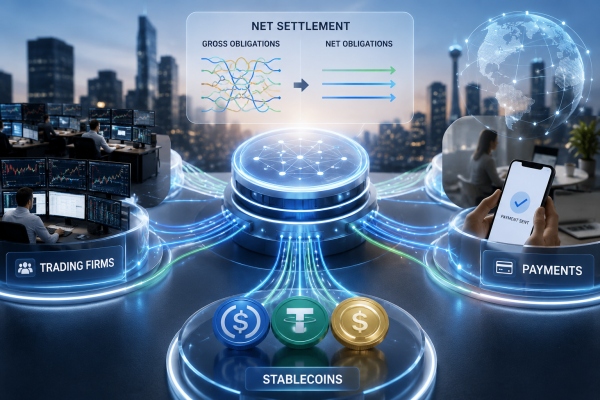
On May 21, 2026, Toronto based Cycles raised $6.4 million to build an open, privacy preserving clearing network for crypto markets and stablecoin payments. Blockchange Ventures led the round, with participation from Coinbase Ventures, Compound VC, Primitive Ventures, and angel investors. The round brings Cycles’ total funding to $8.7 million, following a $2.3 million pre seed in 2025.
Cycles is targeting one of the least glamorous but most important parts of financial infrastructure: clearing. In traditional markets, clearing reduces how much money has to move between counterparties by offsetting obligations first. Cycles wants to bring that function to on chain finance, where trading and payment flows still often require too much prefunding and too much gross settlement.
The first institutional product is Cycles Prime, which lets trading firms privately net OTC obligations across the network. Cycles says this can reduce liquidity requirements and counterparty exposure without requiring collateral, asset movement, or a change in counterparties. Cycles Prime is launching with Lynq and FalconX as anchor partners.
Ethan Buchman, Co Founder and CEO, Cycles:
“Clearing is a financial superpower that has historically only been available to large financial institutions,”
Without clearing, firms often move full payments back and forth instead of only settling the difference. That ties up capital and can increase risk when markets move quickly.
The release points to October 10, 2025, when more than $19 billion in crypto leverage was liquidated in roughly one day, with 70% of forced liquidations occurring in just 40 minutes. Cycles uses that event to show why capital efficiency matters. When markets rely on gross settlement and heavy prefunding, stress can move fast.
Cycles is betting that multilateral clearing can reduce that pressure. Meaning, many obligations can be matched against each other so less money has to move. If it works, trading firms may keep less idle capital parked across venues and counterparties.
The second product is Cycles Pay, a stablecoin payments app for individuals and businesses. Payments are routed through Cycles’ clearing engine, which nets obligations across participants to minimize capital movement. The product also includes invoicing and expense management with credit planned.
Stablecoins already help move value across networks. Clearing can make those flows more capital efficient. For businesses, the value isn't only faster payment. It's fewer trapped balances, better cash flow, and more private settlement.
Rob Schmults, General Partner at Blockchange Ventures:
"Clearing is the cornerstone of capital-efficient markets like foreign exchange allowing the movement of massive volumes of value without crippling liquidity requirements. We see Cycles providing an essential coordination layer to bring the efficiency and effectiveness of clearing to new markets. Doing this will allow businesses to clear and settle payments privately, optimize capital flow, and reduce the need for idle capital. As global adoption accelerates, Cycles can become a category defining standard for how value is settled and netted across entire ecosystems and markets."
If stablecoins are becoming payment rails, will clearing become the missing layer that turns on chain settlement from fast movement into capital efficient market infrastructure?
The National Crowdfunding & Fintech Association (NCFA Canada) is a financial innovation ecosystem that provides education, market intelligence, industry stewardship, networking and funding opportunities and services to thousands of community members and works closely with industry, government, partners and affiliates to create a vibrant and innovative fintech and funding industry in Canada. Decentralized and distributed, NCFA is engaged with global stakeholders and helps incubate projects and investment in fintech, alternative finance, crowdfunding, peer-to-peer finance, payments, digital assets and tokens, artificial intelligence, blockchain, cryptocurrency, regtech, and insurtech sectors. Join Canada's Fintech & Funding Community today FREE! Or become a contributing member and get perks. For more information, please visit: www.ncfacanada.org
| | |
|---|---|---|
| | |
May 22, 2026 | NCFA Market Activity | Banking And Credit Infrastructure, Payments And Market Infrastructure, Lending Consumer Credit And BNPL, Artificial Intelligence And Data

On May 21, 2026, Wealthsimple unveiled a major expansion of its financial services platform during its live product event, “Wealthsimple Takes Over Your Life”. The announcements included family accounts, business chequing, USD accounts, portfolio backed credit, spend insights, overdraft protection, and a monthly $1M client rewards program. The company said more than 4 million Canadians now use Wealthsimple and hold $150B in assets on the platform.
Wealthsimple isn't a Schedule I bank, but it delivers banking style services through regulated Wealthsimple entities, infrastructure access, and partner financial institutions. Wealthsimple says chequing balances are held in trust with CDIC member institutions, while Wealthsimple Payments Inc. and Wealthsimple Investments Inc. are not CDIC member institutions. Power Corporation disclosed a controlling interest in Wealthsimple through Power Financial, Great-West Lifeco, and IGM. In Q1 2026 results, Power valued its Wealthsimple ownership at $3.8B as of March 31, 2026.
NCFA also covered Wealthsimple’s $750M financing and $10B valuation, which gave Canadian fintech markets one of the rarest and strongest scaleup stories.
The event hit home how far Wealthsimple has moved beyond investing and trading. The company now wants a larger share of daily financial activity across deposits, payments, borrowing, business banking, and household finance.
This builds on earlier product expansion when Wealthsimple added credit and loan tools in 2025, including a cash back credit card and low interest credit line. The latest event pushes that same strategy further into operating accounts, secured borrowing, and household controls.
The business banking launch carried the clearest fintech impact. Wealthsimple introduced business chequing with online setup in less than 20 minutes, virtual cards, automated CRA payments, recurring transfers, interest bearing balances, and higher e transfer limits.
Those features target familiar problems for Canadian SMEs. Many owners still deal with low transfer limits, little or no yield on operating balances, manual tax payments, and weak cash management tools.
The Portfolio Line Of Credit may become one of the company’s most important financial products. Wealthsimple said eligible clients can borrow against portfolios at rates as low as prime minus 0.5%, or about 3.95% at the time of the event.
Clients can borrow up to 35% of portfolio value. A client with $200,000 on the platform could access up to $70,000 in credit, subject to eligibility and risk controls.
The product gives clients a way to fund business expenses, inventory purchases, major purchases, or debt refinancing without selling investments. This type of secured liquidity has historically been more common in private banking and wealth management.
For Wealthsimple, portfolio credit also deepens the customer relationship. The more assets clients keep on the platform, the more useful the credit product becomes.
Wealthsimple introduced three family finance products. Kids and teens accounts give parents card controls, alerts, limits, instant transfers, and parent paid interest. Households lets partners choose what they share, track accounts inside and outside Wealthsimple, and view family finances in one place.
Authorized traders lets a trusted family member make trades on another person’s behalf without password sharing. That addresses a practical issue. Many Canadians already help spouses, parents, or relatives manage investments informally. Wealthsimple is formalizing that process with permission based account access.
Wealthsimple also pointed to deeper access across Canadian payment systems. The company linked that access to cheaper wire transfers, free incoming wires, faster payroll deposits, lower FX costs, instant virtual card issuance, cash deposits through Canada Post, and ATM fee reimbursements.
Wealthsimple gained direct Swift access, becoming the first Canadian fintech to do so. It supports the company’s push into wires, cross border money movement, and lower cost global payments.
The Canada Post cash deposit feature gives clients access to more than 5,000 deposit locations. Wealthsimple said it processed cash deposit transactions in more than 900 communities during the first two months after launch.
Infrastructure access increasingly matters for large fintech platforms. It can improve speed, pricing, product flexibility, and customer experience while reducing dependence on older branch based banking workflows.
Wealthsimple’s Monthly Millionaire program will award $1M each month to one client. Every dollar deposited or saved creates an entry, while direct deposit doubles entries. Move over 'roll up the rim to win'!
The structure encourages clients to move payroll deposits and savings activity onto the platform. For Wealthsimple, that supports higher deposits, stronger engagement, and more primary account usage.
Canadian fintech competition is increasingly focused on who controls the broader financial relationship, not just a single product category. Wealthsimple now spans deposits, payments, investing, borrowing, family finance, business banking, and cross border accounts.
That puts the company into more direct competition with incumbent financial institutions across several revenue areas at once. The company's expansion shows how quickly a Canadian fintech can move when scale, capital, trust, and distribution come together.
The National Crowdfunding & Fintech Association (NCFA Canada) is a financial innovation ecosystem that provides education, market intelligence, industry stewardship, networking and funding opportunities and services to thousands of community members and works closely with industry, government, partners and affiliates to create a vibrant and innovative fintech and funding industry in Canada. Decentralized and distributed, NCFA is engaged with global stakeholders and helps incubate projects and investment in fintech, alternative finance, crowdfunding, peer-to-peer finance, payments, digital assets and tokens, artificial intelligence, blockchain, cryptocurrency, regtech, and insurtech sectors. Join Canada's Fintech & Funding Community today FREE! Or become a contributing member and get perks. For more information, please visit: www.ncfacanada.org
| | |
|---|---|---|
| | |
May 21, 2026

Many operators in 2026 are still running on infrastructure built for a different era. Legacy architecture not designed for multi-vertical scale, modern payment rails, or real-time compliance is now the most significant operational liability a gambling business can carry.
This article breaks down what a capable platform partner must deliver: infrastructure, compliance, payments, player lifecycle management, analytics, and genuine innovation across the full platform ecosystem.
A B2B iGaming platform is the software layer between game content, payments, and players – operated by a online casino software provider whose clients are gambling businesses, not players directly. The provider builds the infrastructure; the operator runs the brand.
The two primary delivery models are turnkey solutions and white-label solutions. A turnkey platform delivers a fully operational iGaming business: game content, payment integrations, compliance tooling, CRM, and back-office management, all pre-configured. White-label solutions offer a configurable layer that operators brand and customise while the underlying infrastructure stays shared and under the provider’s license.
Most platforms support multi-brand management – a single operator running several distinct brands from one back-office – essential for expanding across jurisdictions or targeting different player segments.
The ecosystem concept separates a coherent platform from a collection of stitched-together modules. An integrated architecture connects game content, payment gateways, compliance tooling, and CRM into one environment. Most providers offer a flagship full-stack product alongside hybrid options combining shared infrastructure with operator-controlled front-end layers. The vertical scope must include online casino, sports betting, esports, iGaming lottery, and bookmaker products.
Technical debt is not an IT department problem. It is a revenue problem, a compliance problem, and an increasingly existential one.
Legacy systems create direct income and budget consequences. API incompatibility slows game provider onboarding; payment integration failures drive transaction abandonment; uptime and performance degradation during peak events translates into lost bets and churn. Each failure compounds: a game integration delay coincides with a compliance gap and a payment reconciliation issue – the management overhead erodes the capacity to grow.
Legacy architecture cannot support the real-time reporting regulators mandate. The gap widens with each update; the technical backlog becomes a licensing liability. Maintaining legacy software development on an ageing codebase consumes developer time with limited output. The algorithm logic in older systems is frequently undocumented, making changes error-prone. Performance statistics arrive as delayed batch reports rather than real-time intelligence. The complexity and risk of staying now exceeds the cost of migration for most growth-stage operators.
The right model depends on how much of the stack an operator wants to own and how quickly they need to be live. The choice is not about quality – both are viable – it is about maturity, timeline, budget, and brand complexity. The subsections below compare each across speed to market, technical overhead, cost structure, and suitability for multi-brand management at scale.
|
Criteria |
Turnkey Solution |
White-Label Solution |
| Speed to Launch | Moderate – requires setup and configuration | Fast – ready-to-go with minimal setup |
| Cost | Higher upfront investment | Lower initial cost |
| Customisation | High – full control over features and integrations | Limited – based on provider’s framework |
| Brand Scalability | Strong – built for long-term growth and expansion | Moderate – scaling depends on provider capabilities |
A turnkey solution delivers a complete, market-ready iGaming business. Compliance tooling, payment integrations, game content via an aggregator such as iGaming Deck, RNG-certified game logic, and back-office management are all pre-integrated. The operator licenses independently and owns the brand outright – the platform handles the technical stack, not the regulatory relationship.
This is the flagship delivery model for operators entering new markets under time pressure. Architecture is proven, platform scalability is built in, and provider innovation means operators access new capabilities without carrying development costs. Speed to market is measured in weeks.
A white-label solution gives operators control over brand identity and player-facing experience, built on a shared B2B backend via REST API. The operator trades under the provider's gambling license rather than obtaining one independently – reducing time to market and upfront cost, at the expense of some jurisdictional flexibility.
It suits operators who want front-end differentiation across multiple brands without building proprietary infrastructure. Platform scalability remains a B2B responsibility. A hybrid approach – white-label infrastructure with custom-built components – extends capability within budget, making it the preferred route for operators managing software development resources carefully.
Whatever the licensing model, a platform's compliance stack must support the operator's regulatory obligations actively: audit trails, reporting formats, and player data handling that meet the standards of every jurisdiction they trade in. GLI-19 certification is mandatory – it covers RNG integrity, game mathematics, and platform integrity across the full content layer. A platform without GLI-19 compliance creates exposure for any operator.
A compliant platform delivers automated KYC (Know Your Customer) workflows at registration and transaction thresholds without friction at scale. Responsible gambling tools – self-exclusion, deposit limits, intervention triggers based on behavioural algorithm outputs – are mandated under MGA and Gambling Commission frameworks. Fraud detection must operate in real time. Player fund ring-fencing ensures operator funds are legally separated from player balances, as required under MGA and Gambling Commission standards. Privacy and anonymity controls must balance GDPR obligations with the expectations of crypto-focused players.
Compliance capabilities to demand from your B2B partner:
The platform partner's licensing footprint is the operator's growth map. Curaçao offers fast gambling license timelines and is the primary gateway for crypto-focused operators; eSports Curacao covers the esports vertical specifically. MGA licensing provides European credibility and unlocks payment provider partnerships requiring MGA compliance.
The primary growth frontiers are Latin America – Brazil's regulated market is the largest single opportunity – alongside emerging frameworks across Asia and Africa. A partner who can navigate these environments is a genuine competitive asset.
Payment infrastructure is where platforms create or destroy player experience. A failed deposit does not generate a complaint – it generates churn. Multi-currency wallets, what the industry calls crypto journeys, are now a baseline expectation: seamless wallet management across fiat and cryptocurrency denominations with real-time balance visibility. Financial integrity ring-fencing must apply across all wallet types regardless of currency denomination.
The protocols a platform supports matter operationally. Bitcoin Lightning Network delivers instant, low-fee settlements for Bitcoin transfers. Tron (TRC-20) offers high throughput and near-zero costs for frequent small transactions. Ethereum supports smart contract-based payouts. Litecoin provides a cost-efficient alternative for players prioritising low fees.
For players moving between cash-based local payment methods and crypto wallets, the platform must handle both through configurable compliance thresholds – not a binary KYC-or-anonymity choice.
The game aggregator – iGaming Deck in platform terms – connects operators to hundreds of game studios through a single REST API integration. Without it, every new provider requires a separate build; with it, the operator accesses an entire catalogue through one connection.
RNG certification is required at the game level. Every slot machine, roulette variant, and virtual lottery product must carry independently verified certification.
Multi-brand management at the aggregator level allows one operator to serve distinct audiences from shared content infrastructure. Platform scalability ensures the architecture holds under simultaneous peak load across all brands. Hybrid architecture – a shared core with vertical-specific configurations – is where this becomes practical. The recommendation algorithm surfacing the right game to the right player operates here, making aggregator depth a product differentiator.
Player lifecycle management is where operators most commonly rely on disconnected third-party tools, creating data silos and delayed campaign execution. A capable B2B platform integrates CRM natively: acquisition data, deposit behaviour, game preferences, and support history visible in real time, with 24/7 service infrastructure to match.
Loyalty – as a measurable platform output, not a marketing concept – is built through consistent, personalised incentive delivery. The tooling required: a configurable jackpot club, a bonus shop where players select rewards, tournament mechanics across casino and sportsbook verticals, and gamification layers that sustain engagement. Retention tooling must enable churn prediction and automated re-engagement driven by platform behavioural data.
Legacy platforms generate data. Modern platforms generate intelligence. The difference is whether outputs are actionable in real time or require manual extraction.
Player behaviour statistics surface which game types retain players longest and which acquisition channels produce the highest lifetime value. Revenue performance dashboards provide income visibility at brand, market, and segment level. Risk management at the platform layer depends on the same data: the algorithm must flag fraud signals within the analytics environment where operators are already working. Uptime and performance metrics must be visible in real time.
CRM integration turns analytics into action: a churn-risk flag triggers a bonus offer without manual data export. User personalization – the right offer based on actual behaviour, not segment assumptions – separates a modern analytics layer from a reporting tool. Growth metrics must support operational decisions and board-level reporting.
Innovation means whether the platform's architecture can absorb change without generating the next wave of technical debt.
Platforms that add cryptocurrency as an afterthought create friction at every touchpoint: KYC workflows not built for pseudo-anonymous players, reporting that cannot handle coin-denominated revenue, wallet management requiring manual reconciliation. Building with blockchain as a native layer eliminates these problems. Technology choices made today determine what is possible in three years.
Hybrid architecture – supporting legacy formats alongside modern REST API-first development – keeps the platform accessible at different technical maturity levels. Software development investment must be continuous; the API surface area should expand with the ecosystem. The flagship indicator of innovation maturity is whether the algorithm layer – governing game recommendations, fraud detection, and bonus targeting – is actively developed. Platform scalability under that evolution is what separates credible innovation from a product announcement.
The cost of staying on an underperforming platform is compounding. In 2026, the cost of migration is predictable and finite.

1. What is a B2B iGaming platform, and how does it differ from being an operator?
A B2B provider builds and maintains the software infrastructure – game aggregation, payment gateways, compliance tooling, and CRM – and licenses it to gambling businesses. The operator runs the player-facing brand, focusing on acquisition and experience while the platform handles technical complexity.
2. What does "turnkey solution" mean in iGaming?
A turnkey solution delivers a fully operational iGaming business ready for launch – game content, payment integrations, RNG-certified logic, compliance tooling, and back-office management all pre-configured. The operator licenses independently and owns the brand. It is the fastest route to market for operators entering new jurisdictions.
3. What is a white-label iGaming solution?
A white-label solution provides a configurable platform layer on a B2B backend, accessed via REST API. The operator trades under the provider's gambling license rather than obtaining one independently. It suits operators wanting brand control across multiple demographics without the overhead of building proprietary infrastructure.
4. What compliance certifications should I demand from a B2B platform partner?
GLI-19 certification is the baseline – covering RNG integrity, game mathematics, and platform standards. Also require automated KYC workflows, player fund ring-fencing under MGA and Gambling Commission frameworks, real-time fraud monitoring, and responsible gambling tools, including self-exclusion and deposit limits.
5. How do B2B platforms support crypto and multi-currency payments?
A modern platform supports multi-currency wallets handling fiat and cryptocurrency in a single interface. Blockchain rails should include Bitcoin Lightning Network for instant settlements, Tron for micro-transactions, Ethereum for smart contract payouts, and Litecoin for low-cost transfers – with KYC and fraud monitoring preserving player anonymity where compliant.
6. What player retention tools should a B2B platform include natively?
A jackpot club, bonus shop with player-selectable rewards, tournament mechanics across casino and sportsbook, and CRM-native churn prediction. Loyalty mechanics must operate in real time from platform behavioural data, not manual campaign setup or third-party tools with delayed access.
7. How do analytics capabilities differ between modern and legacy platforms?
Legacy platforms generate historical reports. Modern platforms deliver real-time dashboards covering player behaviour statistics, revenue performance, fraud risk signals, and uptime metrics. CRM integration means a churn-risk flag automatically triggers a bonus campaign within the same environment.
8. Why does the choice of blockchain infrastructure matter for an iGaming platform?
Protocol choice determines transaction speed, cost, and compliance profile. Bitcoin Lightning Network enables instant low-fee BTC settlements; Tron handles micro-transactions; Ethereum supports smart contract payouts; Litecoin offers low-cost transfers. Native blockchain integration avoids the reconciliation and UX problems of afterthought crypto architecture.
A capable B2B iGaming platform partner in 2026 delivers an integrated ecosystem: proven infrastructure, multi-jurisdiction compliance, blockchain-native payment rails, platform-native player lifecycle tools, real-time analytics, and a software development model built for continuous evolution.
Multi-brand management, scalable architecture, and genuine innovation investment in underlying technology are what separate a platform that enables growth from one that constrains it. For operators on legacy systems, the calculation is straightforward: the cost of staying now exceeds the cost of moving. The question is how quickly you act.
The National Crowdfunding & Fintech Association (NCFA Canada) is a financial innovation ecosystem that provides education, market intelligence, industry stewardship, networking and funding opportunities and services to thousands of community members and works closely with industry, government, partners and affiliates to create a vibrant and innovative fintech and funding industry in Canada. Decentralized and distributed, NCFA is engaged with global stakeholders and helps incubate projects and investment in fintech, alternative finance, crowdfunding, peer-to-peer finance, payments, digital assets and tokens, artificial intelligence, blockchain, cryptocurrency, regtech, and insurtech sectors. Join Canada's Fintech & Funding Community today FREE! Or become a contributing member and get perks. For more information, please visit: www.ncfacanada.org
| | |
|---|---|---|
| | |



August 26th, 2025

January 4th, 2024

June 1st, 2021

September 9th, 2020

July 9th, 2018

January 3rd, 2018

September 25th, 2017

June 20th, 2017

May 10th, 2017

December 14th, 2016
