





Karsten Wenzlaff, Advisor
August 26th, 2025
Karsten Wenzlaff is a Crowdfunding and Fintech Expert from Germany. He is Secretary-General of Digit[...]


May 20, 2026 | NCFA Resource | Regulation And Policy, Artificial Intelligence And Data, Digital Assets Blockchain And Tokenization

On April 20, 2026, the UK Financial Conduct Authority published its Innovation Insights 2025 report (20 page PDF). The report gives fintech founders, investors, and policy teams a practical view of where capital, regulatory testing, and market demand are concentrating across AI, digital assets, stablecoins, tokenization, RegTech, open finance, embedded finance, and operational automation.
The FCA points to a more disciplined phase of fintech, where firms need clear customer value, stronger controls, earlier regulatory engagement, and credible deployment plans.
The report combines global fintech investment data with activity across FCA innovation services, including the Regulatory Sandbox, Innovation Pathways, Digital Sandbox, AI Lab, Supercharged Sandbox, Smart Data Accelerator, and Scale Up Unit.
The overview gives operators a clean read on regulated fintech demand. AI, distributed ledger technology, open banking, and open finance ranked among the main technologies used by applicants. The FCA also launched new support channels in 2025, including a stablecoins cohort.
Regulated fintech no longer wins on novelty alone. Better products need stronger evidence, safer testing routes, sharper governance, and a realistic route from pilot to production.
This resource is useful for fintech founders, investors, compliance teams, financial institutions, policymakers, accelerators, digital asset firms, AI builders, RegTech vendors, and open finance teams tracking where regulated innovation is gaining traction.
It is especially useful for firms building around AI governance, stablecoins, tokenization, compliance automation, open finance, embedded finance, and supervised testing models.
The report is strong on investment patterns, regulatory engagement, sector demand, and FCA innovation service activity. It helps founders and investors see which fintech themes are attracting capital and which models need earlier regulator dialogue.
Its limit is the report doesn't provide a full outcomes study on sandbox firm performance, revenue growth, compliance cost reduction, productivity gains, fraud reduction, or investor returns. It works best as a regulatory market map, not proof that any one fintech category will outperform.
Canada and other jurisdictions can still use the report as a benchmark. Faster testing routes, clearer engagement models, and stronger links between experimentation and responsible deployment are becoming competitive advantages in financial innovation.
FCA Innovation Insights 2025 (primary FCA report)
AI Agents Enter Governed Financial Workflows (AI governance and controls)
Tokenization Starts Looking Like Financial Infrastructure (tokenized market infrastructure)
Deloitte And Stablecorp Bring QCAD To Banks (Canadian stablecoin infrastructure)
 The National Crowdfunding & Fintech Association (NCFA Canada) is a financial innovation ecosystem that provides education, market intelligence, industry stewardship, networking and funding opportunities and services to thousands of community members and works closely with industry, government, partners and affiliates to create a vibrant and innovative fintech and funding industry in Canada. Decentralized and distributed, NCFA is engaged with global stakeholders and helps incubate projects and investment in fintech, alternative finance, crowdfunding, peer-to-peer finance, payments, digital assets and tokens, artificial intelligence, blockchain, cryptocurrency, regtech, and insurtech sectors. Join Canada's Fintech & Funding Community today FREE! Or become a contributing member and get perks. For more information, please visit: www.ncfacanada.org
 |  |  |
|---|---|---|
 |  |  |
May 18, 2026 | NCFA Fintech Market Activity | Payments And Money Movement, Digital Assets Blockchain And Tokenization

On May 18, 2026, Tether announced a strategic investment in LemFi, a cross border payments platform serving people who live and work across borders. The investment is focused on integrating USD₮ as a settlement layer across LemFi’s key corridors, especially across Africa and Asia.
This is a separate from LemFi’s USD $53 million Series B, which was announced in January 2025. Tether wants USDT deeper inside remittance infrastructure, where payment companies manage liquidity, settlement, and payout timing.
Tether says LemFi serves senders in the UK, U.S., Canada, and Europe who move money to Africa and Asia. It also says the investment aims to replace multi day SWIFT chains with near instant, lower cost settlement. That is the market issue. Remittance platforms don't compete on app design, but how quickly money arrives safely, and at a fair cost.
Paolo Ardoino, CEO, Tether:
“Our investment in LemFi reflects our shared vision on how money moves across borders, prioritizing speed, cost, and transparency. By supporting LemFi’s growth and innovation roadmap, we are helping bring the benefits of a stable digital asset to more people who rely on remittances in their daily lives.”
The practical change is settlement. USDT is not being positioned only as a crypto asset for users to hold. Tether is backing a payments platform so USDT can help move value behind the scenes across active corridors, which is valued to not only senders but to PSPs, MSBs, and banks.
Faster settlement can reduce delays and working capital pressure. But stablecoins don't solve the whole corridor. Remittance providers still need fraud controls, sanctions screening, clear FX, customer support, licensing, and reliable local payout.
Ridwan Olalere, CEO and Co Founder, LemFi:
“Integrating USD₮ into our infrastructure brings us closer to that reality, enabling faster, cheaper, and more reliable financial services for the millions of people who depend on us every day,”
While the announcement doesn't disclose the terms of the deal like Tether’s investment size or rollout timing, the business case is clear enough.
If USDT settlement shortens settlement time or reduces banking friction, LemFi could improve corridor economics. The customer impact will depend on whether those gains lead to better pricing, faster payout, or more reliable transfers.
Stablecoin issuers are actively integrating into live payment flows and partnering with platforms that have users, corridor demand, and payout networks. Traditional providers will need to build, partner, or risk losing margin.
For fintech operators and investors, the key insight is that stablecoin remittances are becoming an infrastructure strategy.
As stablecoin issuers invest directly in remittance platforms, will banks and PSPs still control the economics of cross border payments, or will stablecoin networks capture more of the settlement layer?
The National Crowdfunding & Fintech Association (NCFA Canada) is a financial innovation ecosystem that provides education, market intelligence, industry stewardship, networking and funding opportunities and services to thousands of community members and works closely with industry, government, partners and affiliates to create a vibrant and innovative fintech and funding industry in Canada. Decentralized and distributed, NCFA is engaged with global stakeholders and helps incubate projects and investment in fintech, alternative finance, crowdfunding, peer-to-peer finance, payments, digital assets and tokens, artificial intelligence, blockchain, cryptocurrency, regtech, and insurtech sectors. Join Canada's Fintech & Funding Community today FREE! Or become a contributing member and get perks. For more information, please visit: www.ncfacanada.org
| | |
|---|---|---|
| | |
May 20, 2026 | NCFA Resource | Digital Assets Blockchain And Tokenization, Payments And Market Infrastructure
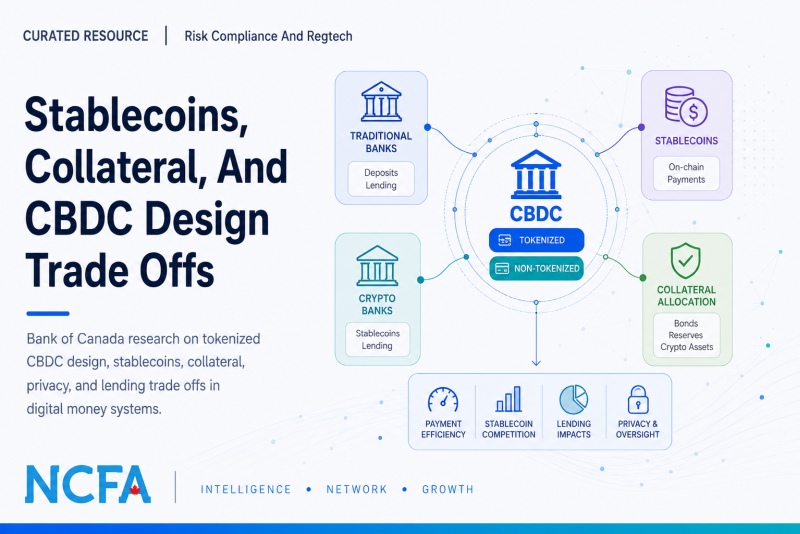
On May 7, 2026, the Bank of Canada published staff working paper 2026-14 on CBDC tokenization design. The paper looks at a financial system where traditional banks issue deposits, crypto banks issue stablecoins, and a central bank decides whether a CBDC should work through conventional accounts or programmable ledgers.
For fintechs, the useful part isn't the CBDC debate alone. The paper links tokenized money to collateral, stablecoin competition, privacy, crypto asset scarcity, and bank lending. Those issues are at the core of digital money infrastructure.
The paper compares tokenized and non tokenized CBDCs. A non tokenized CBDC competes with bank deposits in traditional payment markets. A tokenized CBDC works on programmable ledgers and competes more directly with stablecoins and tokenized settlement infrastructure in on chain markets.
The strongest finding is simple but important. Tokenization changes outcomes only when collateral use differs across sectors. The real question is which institutions hold the collateral, how reliable private money issuers are, and whether scarce reserve assets support payments or lending.
The model shows that tokenized CBDCs can crowd out stablecoins when crypto banks look less reliable and crypto assets are scarce. Non tokenized CBDCs can make more sense when crypto transactions offer less social value or when moving reserves from traditional banks to crypto banks improves the system.
The trade off is clear. CBDCs can improve payment efficiency, but they can also reduce bank lending when collateral moves away from traditional credit creation. That is where the paper becomes useful for fintech operators, not just policy teams.
The paper also raises a privacy question. A tokenized CBDC can run on a ledger that gives the central bank more visibility into transactions. That may improve oversight, but it can also reduce privacy. Digital money design is not just about speed or programmability. It also sets the rules for trust, control, and market access.
This resource is useful for fintech founders, stablecoin issuers, payment companies, banks, digital asset infrastructure providers, tokenization platforms, treasury teams, investors, and policymakers tracking the future of money.
It is especially relevant for firms building around programmable payments, stablecoin settlement, tokenized collateral, wholesale digital assets, bank issued digital money, or regulated crypto infrastructure.
The strength of this resource is the way it connects CBDC design to the financial infrastructure underneath tokenized markets. It doesn't treat CBDC as a simple retail wallet question. It looks at how money design affects collateral, settlement, stablecoins, bank deposits, crypto activity, and lending.
The paper also avoids easy answers. Tokenized CBDCs do not automatically improve the system. The result depends on collateral scarcity, crypto bank reliability, privacy settings, and the value of activity happening on programmable ledgers.
The limit is that this is an academic working paper with equations, model assumptions, and conditional results. Most operators will not read it end to end. The value is in the framework, not every technical section.
Used well, it helps fintech teams ask better questions about future money design. Who issues the money? What backs it? Where does collateral sit? What happens to lending? Who gets visibility into transactions? Those questions will matter as stablecoins, tokenized deposits, and central bank money keep moving into the same conversation.
Bank Of Canada CBDC Tokenization Paper (primary Bank of Canada working paper)
BIS Future Monetary System Blueprint (referenced framework for tokenized money and unified ledgers)
US Treasury Future Of Money Report (policy context for digital money and payment system design)
The National Crowdfunding & Fintech Association (NCFA Canada) is a financial innovation ecosystem that provides education, market intelligence, industry stewardship, networking and funding opportunities and services to thousands of community members and works closely with industry, government, partners and affiliates to create a vibrant and innovative fintech and funding industry in Canada. Decentralized and distributed, NCFA is engaged with global stakeholders and helps incubate projects and investment in fintech, alternative finance, crowdfunding, peer-to-peer finance, payments, digital assets and tokens, artificial intelligence, blockchain, cryptocurrency, regtech, and insurtech sectors. Join Canada's Fintech & Funding Community today FREE! Or become a contributing member and get perks. For more information, please visit: www.ncfacanada.org
| | |
|---|---|---|
| | |
May 19, 2026

Image: Unsplash/Vitaly Gariev
Sending money across borders has always been expensive.
Banks, wires, and legacy money transfer operators have made sending money expensive for years. Decades of outrageous fees have cost migrants, families and small businesses billions each year just to send their own money abroad.
But here's the good news...
Cross-border payments innovation is finally starting to deliver. Cutting-edge technology, innovative platforms, and intelligent routing are beginning to reduce cross-border costs like never before. Here's exactly how payment innovation is slashing costs and what it means for anyone who needs to make a secure international wire. Whether you're sending $50 to a relative or $5,000 to a vendor, learn how what's going on in the world of payment innovation will save you money today.
Cross-border payments used to follow one path:
Sender's bank → correspondent bank → another correspondent bank → recipient's bank.
Each hop in that chain takes a fee, adds latency, and marks up the exchange rate. When the funds arrive, the recipient may be missing a substantial portion of the sent amount.
The stats don't lie. The worldwide average price to send money is still approximately 6.36% of the amount sent. That's twice the target set by the United Nations Sustainable Development Goal of 3%.
It can be even worse in certain areas. Sending $200 to Sub-Saharan Africa cost 8.78% on average of the transfer value in Q1 2025. So if you sent $200, nearly $18 is taken in fees.
Think about what sorts of secure money transfers people actually need today. Speed, transparency, and pushing money directly to card or wallet are important to most senders. That's why learning how to send money to a Visa card has become such a popular method. Card rails cut out the sluggish correspondent banking middleman completely.
That's where payment innovation kicks in...
Payment network disruption has arrived. Here are five game changers for reducing costs paid by consumers.
Card networks have already laid the groundwork with instant push payments. Visa and Mastercard have led the charge by enabling funds to move from card to card. Instead of passing through three or four banks, money is sent directly in minutes. Compare that to the 3-5 business days for traditional wires.
What does that mean for senders?
It's a complete rewrite of how cross-border money should move.
Digital wallets are booming. Juniper Research predicts global digital wallet adoption will grow 15.3% by 2029 from 52.6% in 2024.
This is important because wallets allow senders and receivers to conduct transactions without a bank account. Users in underbanked communities can now receive funds instantly to a wallet on their phone. Eliminating:
In short, more people get more of their money, faster.
Old-school banks used to dominate the cross-border space. Not anymore.
FinTech newcomers have built leaner systems from the ground up. They utilize true exchange rates (not inflated ones) and charge flat or low percentage fees that are 100% transparent. Some are even starting to offer total cost ratios of less than 1% on popular corridors.
The consequence? Competition. Banks have no choice but to compete against each other. International fees are gradually decreasing for everyone.
Countries across the globe are deploying fast payments infrastructure and interoperability between them. India has UPI. Brazil has Pix. Europe has SEPA Instant.
When connected internationally, that's when things get interesting. Cross-border payments that used to take days can be settled in seconds. And all those savings go directly back to you, the sender.
Foreign exchange is where senders have always been silently overcharged. A markup of 1-2% over the interbank rate destroys any "low fee" claim.
Senders are now being shown the exact mid-market rate they will receive by modern providers. That level of transparency is game-changing — because once senders can see rates compared side-by-side, the most expensive providers will no longer be able to fly under the radar.
Not all borderless payment services are created equal. Here are the key things to look for if you want to maximize payment innovation:
Transparent pricing: A quality provider is upfront about what the fee is and what exchange rate they will apply. There are no surprises and no hidden FX markup included in the conversion.
Various payment methods: Top services allow users to receive money how they want; bank account, debit card, mobile wallet, cash pick up, etc. The more options available the better.
Quick settlement times: Transfers should occur same day or instantaneously, they shouldn't be a "premium feature".
Great security: Cross-border fraud isn't uncommon. Ensure the provider offers 2-factor authentication, secure encrypted transfers, and is licensed in both countries.
Extensive country coverage: Some providers only cover 10-15 countries. Others provide service to 100+. Be sure your destination is covered, and that the rates are competitive.
Today's cross-border payments market is large – and growing. It's expected to hit USD 320.73 billion by 2030, according to one report. The market is already at USD 212.55 billion in value for 2024. When there's billions of dollars at stake, companies are fighting for your business. Beneficial news for senders.
Cross-border payments are no longer the slow, expensive mess they used to be.
Card rails, digital wallets, fintech disruption, real time settlement, transparent FX pricing…these are all factors combining to lower costs for consumers. And it all adds up – particularly for consumers sending home month after month.
Here's a quick recap of what payment innovation is delivering:
Before making your next secure money transfer, spend a few minutes comparing providers. Don't just look at the advertised fee. Check the FX rate, speed of delivery and overall cost. It can mean the difference between losing US$20 or US$2 on the same transaction.
Payment innovation is finally on the sender's side. Use it to your advantage.
The National Crowdfunding & Fintech Association (NCFA Canada) is a financial innovation ecosystem that provides education, market intelligence, industry stewardship, networking and funding opportunities and services to thousands of community members and works closely with industry, government, partners and affiliates to create a vibrant and innovative fintech and funding industry in Canada. Decentralized and distributed, NCFA is engaged with global stakeholders and helps incubate projects and investment in fintech, alternative finance, crowdfunding, peer-to-peer finance, payments, digital assets and tokens, artificial intelligence, blockchain, cryptocurrency, regtech, and insurtech sectors. Join Canada's Fintech & Funding Community today FREE! Or become a contributing member and get perks. For more information, please visit: www.ncfacanada.org
| | |
|---|---|---|
| | |
May 19, 2026

Modern online casino games increasingly focus on movement and nonstop visual activity, and Betscore Casino reflects how continuous motion has become a major part of modern digital gaming experiences.
Online casino games have evolved significantly from the static reel machines that once dominated the industry. Today’s players expect games to feel active, visually dynamic, and constantly responsive throughout every session. Developers now design many casino games around continuous movement in order to maintain attention and create stronger engagement.
This shift can be seen across many modern slot formats and live casino games. Cascading reels, animated transitions, moving symbols, expanding grids, and fast visual reactions all contribute to gameplay experiences that feel more fluid and energetic than traditional casino games.
Betscore Casino reflects how online casino platforms increasingly support games that rely on motion and visual momentum to create more immersive digital entertainment experiences.
One of the main reasons motion based casino games have become so popular is because they create the impression that gameplay never fully stops. Traditional slot machines often followed a simple pattern where the reels spun, stopped, and reset before the next round began.
Modern casino games increasingly avoid these static pauses. Cascading reels allow symbols to disappear and new ones to fall into place automatically after wins, while animated transitions keep the screen visually active between gameplay phases.
Players often find these systems more engaging because the game feels alive and constantly evolving. Even after the initial spin result appears, additional animations and movement continue building anticipation.
Betscore Casino highlights how modern casino developers increasingly design games around ongoing visual activity rather than isolated gameplay moments.
Many modern slots also combine motion based mechanics with multipliers, expanding symbols, and bonus triggers to create even longer sequences of uninterrupted activity.
These layered mechanics help maintain player focus and create stronger emotional pacing during gameplay sessions.
Modern digital entertainment heavily influences how casino games are designed today. Video games, mobile apps, and streaming platforms all prioritize movement and visual responsiveness in order to maintain user engagement.
Online casino games increasingly follow similar principles. Developers use motion not only as decoration, but also as a gameplay tool that shapes pacing and emotional intensity.
Animations now serve multiple purposes during gameplay. Moving backgrounds, animated reels, glowing symbols, and cinematic effects all help make sessions feel more immersive and visually stimulating.
Betscore Casino reflects how casino platforms increasingly prioritize smooth visual flow and dynamic presentation as part of modern online gaming experiences.
Mobile gaming has strengthened this trend even further. Smartphone users are especially responsive to games that provide constant movement and quick visual feedback because these mechanics create stronger engagement during shorter sessions.
Continuous motion also helps games feel more modern and technologically polished compared to older casino formats with minimal animation and slower pacing.
The growing popularity of movement focused casino games reflects a broader shift in digital entertainment habits. Modern users increasingly expect fast visual feedback and experiences that feel continuously interactive.
Because of this, casino developers continue experimenting with mechanics that reduce downtime and keep gameplay visually active for longer periods.
Betscore Casino represents how online casino platforms continue evolving toward more dynamic and visually fluid gaming environments shaped by modern entertainment expectations.
This does not mean traditional casino games are disappearing. Instead, many classic formats are being redesigned with more animation, smoother pacing, and stronger visual transitions in order to remain competitive within today’s digital landscape.
As online casino gaming continues developing, continuous motion will likely remain one of the defining characteristics of modern game design. The ability to create smooth, visually active, and constantly evolving gameplay experiences will continue playing a major role in attracting players seeking more immersive digital entertainment.
The National Crowdfunding & Fintech Association (NCFA Canada) is a financial innovation ecosystem that provides education, market intelligence, industry stewardship, networking and funding opportunities and services to thousands of community members and works closely with industry, government, partners and affiliates to create a vibrant and innovative fintech and funding industry in Canada. Decentralized and distributed, NCFA is engaged with global stakeholders and helps incubate projects and investment in fintech, alternative finance, crowdfunding, peer-to-peer finance, payments, digital assets and tokens, artificial intelligence, blockchain, cryptocurrency, regtech, and insurtech sectors. Join Canada's Fintech & Funding Community today FREE! Or become a contributing member and get perks. For more information, please visit: www.ncfacanada.org
| | |
|---|---|---|
| | |
May 18, 2026 | NCFA Fintech Market Activity | Payments And Money Movement, Digital Assets Blockchain And Tokenization

On May 18, 2026, Paytrie enabled CADC stablecoin powered remittances from Canada to international markets, beginning with Mexico and Nigeria. A Canadian sender starts in Canadian dollars. Paytrie uses CADC as the Canadian dollar stablecoin bridge, converts into USDC through liquidity providers, and then uses Circle Payments Network for local currency payout.
CADC is being used inside a live cross border remittance corridor, with a Canadian dollar starting point and global stablecoin infrastructure behind the payout.
Recent Canadian stablecoin activity includes Loon’s CADC acquisition, QCAD adoption work, and policy debate around a domestic stablecoin framework. This launch is different because it connects CADC to an outbound remittance flow.
Jason Tong, CEO, Paytrie:
“For the first time, a Canadian dollar stablecoin is being used to help power fast and affordable remittances from Canada. CADC gives Canadians a familiar Canadian dollar starting point, while USDC and global stablecoin infrastructure help move value across borders more efficiently.”
Most stablecoin payment activity is still tied to U.S. dollar tokens due to liquidity, distribution, and network support. Canada has a different need given that Canadian users and businesses earn, bank, invoice, and plan in Canadian dollars. A CAD stablecoin can reduce friction at the first mile before funds enter a global corridor.
CADC acts as the Canadian dollar bridge. USDC carries the payment through Circle Payments Network before payout in the recipient’s local currency. That keeps CADC close to the Canadian user and uses USDC where global liquidity is needed most.
CAD pegged stablecoins don't have to compete with USD stablecoins everywhere. They can support Canadian dollar funding, treasury, settlement, and corridor access at the point where Canadian payment flows begin.
Families need funds to arrive quickly, safely, and at a fair cost. Senders need clear pricing. Recipients need local currency in a bank account without having to handle crypto directly.
For PSPs and MSBs, the corridor still needs the hard parts of payments. Onboarding. Sanctions screening. Fraud controls. Refund handling. Customer support. Local payout partners. Stablecoins can reduce settlement friction, but they don't remove the need to operate the full payment workflow.
Circle Payments Network positions stablecoins as institutional payment infrastructure, not a retail crypto app. Circle says the network supports 24/7 near instant settlement and uses a compliance first architecture where partners are vetted for licensing, regulatory compliance, operational risk, and security.
That's a strong signal for Canadian payment providers. Stablecoin remittances are starting to look like a settlement option for regulated firms. If the model works, banks and PSPs will need to decide whether to build, partner, or risk losing international payment flows to faster specialist rails.
The treasury angle is just as important. Stablecoin corridors can reduce the need for some prefunded local accounts. That can improve working capital and speed up payouts. It also adds new questions around liquidity, FX spreads, counterparty exposure, and more.
For Canadian fintechs, banks, and PSPs, the read is direct. CAD stablecoins may not win by competing head on with USD stablecoins everywhere. They may win by making Canadian dollar entry, treasury, and settlement flows easier to connect to global stablecoin networks.
If CAD stablecoins become the Canadian dollar entry point into global payment networks, which firms will control the customer relationship, FX economics, compliance layer, and payout corridor?
The National Crowdfunding & Fintech Association (NCFA Canada) is a financial innovation ecosystem that provides education, market intelligence, industry stewardship, networking and funding opportunities and services to thousands of community members and works closely with industry, government, partners and affiliates to create a vibrant and innovative fintech and funding industry in Canada. Decentralized and distributed, NCFA is engaged with global stakeholders and helps incubate projects and investment in fintech, alternative finance, crowdfunding, peer-to-peer finance, payments, digital assets and tokens, artificial intelligence, blockchain, cryptocurrency, regtech, and insurtech sectors. Join Canada's Fintech & Funding Community today FREE! Or become a contributing member and get perks. For more information, please visit: www.ncfacanada.org
| | |
|---|---|---|
| | |
May 15, 2026 | NCFA Fintech Whisperer Weekly Intelligence | Digital Assets Blockchain And Tokenization, Artificial Intelligence And Data, Risk Compliance And Regtech

Image: Freepik
This live weekly NCFA intelligence page tracks financial technology developments that significantly affect how fintechs build, sell, raise capital, and operate under scrutiny. Coverage prioritizes Canada and includes global events that directly influence competitive conditions, market access, and execution realities across fintech sectors. This page will be updated throughout the week with market movers in a live format and then each week we'll close the prior week's contents in prep for the upcoming week, and continue on a rolling basis. (Missed prior week's Fintech Whisperer? (December 6-12, 2025, December 13-19, 2025, January 1-9, 2026, January 10-16, 2026, January 17-23, 2026, January 24-30, 2026, January 31-February 6, 2026, February 7-13, 2026, February 14-20, 2026, February 21-27, 2026, February 28-March 6, 2026, March 7-13, 2026, March 14-20, 2026, March 21-27, 2026, March 28-April 3, 2026, April 4-10, 2026, April 11-17, 2026, April 18-24, 2026, April 25-May 1, 2026, May 2-8, 2026).
Tokenized funds need reliable exits before more institutions treat them as usable collateral or treasury assets. Asset managers, custodians, exchanges, treasury teams, and tokenization platforms should watch how redemption speed, stablecoin liquidity, and access controls become core requirements for institutional tokenized finance.
Community and regional banks are starting to package stablecoins, tokenized deposits, and digital asset lending inside bank led distribution. Banks, fintechs, core providers, custodians, and compliance teams should watch how association channels turn digital asset access into a practical banking product instead of a standalone crypto service.
Fintechs and FIs now compete on governed AI use in underwriting, fraud, servicing, and cost discipline, while security and model risk stay on the board agenda.
Voice is becoming searchable compliance evidence across more markets and languages. Banks, dealers, wealth firms, fintechs, and regtech vendors need stronger controls for recorded calls, multilingual surveillance, off channel risk, and investigation workflows.
Fraud controls are becoming more coordinated across regulators, law enforcement, platforms, and financial institutions. Banks, fintechs, PSPs, regtech vendors, and digital asset firms should expect higher expectations around intelligence sharing, scam detection, AI oversight, and real time monitoring.
Agent driven commerce needs payment controls that can handle authorization, settlement, spending permissions, dispute handling, and compliance review without slowing automated workflows. Stablecoins are increasingly being positioned as the settlement layer for machine initiated transactions.
Agent payments now need privacy, settlement, authorization, and audit controls that work together. Payment firms, wallet providers, stablecoin issuers, AI agent platforms, and compliance teams should track how machine initiated transactions create new requirements for identity, transaction monitoring, and dispute handling.
Canadian banks, credit unions, fintechs, and infrastructure providers face growing pressure to modernize customer onboarding, payments, servicing, and digital account experiences at lower operating cost. Large coordinated modernization programs can influence vendor standards, integration expectations, and competitive timing across the Canadian banking market.
Direct PSP access to Interac e Transfer gives Canadian fintechs a stronger role inside everyday money movement. Banks, PSPs, payment firms, and compliance teams should track how direct participation changes onboarding, fraud controls, settlement readiness, and product competition across Canadian payment services. Koho is a a payment service provider member of Payments Canada with direct access to payment clearing and settlement.
Digital asset lending keeps adopting operational standards from traditional securities finance. Exchanges, custodians, prime brokers, lenders, treasury teams, and compliance groups should watch how collateral controls, settlement discipline, and institutional workflow expectations become standard requirements across crypto lending markets.
Tokenized settlement is entering exchange rulebooks, not just pilot decks. Exchanges, broker dealers, custodians, transfer agents, market data teams, and compliance teams need to prepare for tokenized securities that still trade under national market system rules, surveillance, reporting, T+1 settlement, and existing investor protections.
Asset managers, exchanges, custodians, brokers, and treasury teams increasingly need infrastructure that supports tokenized funds, collateral, and yield products inside institutional operating environments. Tokenized finance is becoming part of mainstream capital markets strategy rather than a separate digital asset experiment.
Tokenization now reaches core market infrastructure, not just crypto trading activity. Exchanges, custodians, transfer agents, dealers, issuers, and infrastructure providers need operating models that support tokenized securities inside existing settlement, governance, reporting, and post trade systems.
Broker dealers, RIAs, custodians, wealth platforms, and compliance teams now have another regulated route to offer digital assets inside familiar securities account structures. That raises the bar for firms still treating crypto access as a separate product channel instead of a brokerage, custody, and supervision question.
MiCA implementation now becomes a licensing, supervision, and market access issue for crypto firms operating in Poland. Exchanges, custodians, stablecoin firms, brokers, and compliance teams should watch how national supervisors apply enforcement powers, authorization standards, and transition rules as Europe’s crypto framework enters active supervision.
Crypto exchanges, custodians, stablecoin issuers, tokenization firms, banks, compliance vendors, and capital markets platforms should track this markup closely. The bill text moves U.S. digital asset policy from broad debate into statutory architecture, with direct implications for token classification, intermediary registration, custody, disclosure, DeFi obligations, and cross border market access.
The common thread is operational readiness. Firms increasingly compete on whether they can support governed AI, tokenized assets, stablecoin settlement, and real time compliance inside production systems rather than separate innovation programs. That pressure now reaches broker dealers, PSPs, banks, treasury teams, exchanges, and compliance groups at the same time. Founders, operators, and investors tracking these changes may also want to review coverage on tokenized market infrastructure, AI agents entering governed financial workflows, and agent driven commerce and payments as these themes continue to converge across fintech markets.
NCFA offers various curated resources to help founders and investors stay current on developments that impact fintech markets, subscribe to NCFA weekly newsletter updates, view a rundown of current fintech news and insights, or dive into the latest fintech industry research.
The National Crowdfunding & Fintech Association (NCFA Canada) is a financial innovation ecosystem that provides education, market intelligence, industry stewardship, networking and funding opportunities and services to thousands of community members and works closely with industry, government, partners and affiliates to create a vibrant and innovative fintech and funding industry in Canada. Decentralized and distributed, NCFA is engaged with global stakeholders and helps incubate projects and investment in fintech, alternative finance, crowdfunding, peer-to-peer finance, payments, digital assets and tokens, artificial intelligence, blockchain, cryptocurrency, regtech, and insurtech sectors. Join Canada's Fintech & Funding Community today FREE! Or become a contributing member and get perks. For more information, please visit: www.ncfacanada.org
| | |
|---|---|---|
| | |



August 26th, 2025

January 4th, 2024

June 1st, 2021

September 9th, 2020

July 9th, 2018

January 3rd, 2018

September 25th, 2017

June 20th, 2017

May 10th, 2017

December 14th, 2016
