





Karsten Wenzlaff, Advisor
August 26th, 2025
Karsten Wenzlaff is a Crowdfunding and Fintech Expert from Germany. He is Secretary-General of Digit[...]


July 3, 2026 | NCFA Insight | Cybersecurity And Fraud, Digital Identity And Trust, Risk Compliance And Regtech, Payments And Money Movement, Digital Assets Blockchain And Tokenization, Artificial Intelligence And Data

Governments are no longer treating post-quantum cryptography as a research topic. They're now publishing migration plans.
On June 22, 2026, the White House issued an order on advanced cryptographic attacks, including the risk that adversaries collect encrypted data today so they can decrypt it later. The same day, a separate White House order advanced U.S. quantum innovation across computing, sensing, networking, applications, and industry partnerships.
That combination is the useful development marker for fintech. Governments are funding quantum capability while also pushing organizations to prepare for the security risk that follows.
The financial sector doesn't need to know the exact year a cryptographically relevant quantum computer arrives before it starts planning. Long time customer data, payment credentials, digital identity systems, API certificates, custody systems, vendor software, archived records, and cryptographic keys may remain sensitive for years.
Quantum readiness is therefore becoming an operating requirement. Not someday. Now.
The policy picture is getting clearer.
NIST finalized its first three post quantum cryptography standards in August 2024. The standards are FIPS 203 for ML-KEM, FIPS 204 for ML-DSA, and FIPS 205 for SLH-DSA. NIST says organizations should begin migrating systems to quantum resistant cryptography.
NCFA has already tracked how post quantum cryptography is entering implementation, with payments, digital identity, secure messaging, APIs, and financial data all exposed to the migration challenge.
Canada has started, too. The Canadian Centre for Cyber Security published a roadmap for migrating Government of Canada non classified IT systems to post quantum cryptography, covering stakeholders, phases, milestones, governance, and departmental planning.
Financial authorities are paying attention too. The Bank for International Settlements published a quantum readiness roadmap for the financial system, and the G7 Cyber Expert Group issued a roadmap for the financial sector's transition to post quantum cryptography.
The practical message is this. Start with awareness, find where cryptography is used, assess risk, plan migration, and work with vendors before deadlines become urgent.
The hardest quantum risk is not only future system compromise. It is long term data.
Financial institutions protect account records, payments data, identity documents, loan files, custody records, private market documents, insurance records, tax files, transaction histories, and compliance archives. Some of that data must stay confidential for years or decades.
That creates the harvest now, decrypt later problem. An attacker can collect encrypted data now and wait for stronger decryption capability later.
For fintechs, this impacts the planning window. A company doesn't need to be systemically important to hold sensitive data. A payments provider, open banking intermediary, wallet provider, identity service, lending platform, wealthtech app, regtech vendor, or crypto custodian may all depend on cryptography that was never designed for a quantum era.
Post quantum migration starts with discovery.
Most organizations know they use TLS, certificates, signing keys, databases, cloud services, APIs, authentication systems, payment connections, and vendor platforms. Fewer have a current inventory of which cryptographic algorithms protect each system, which assets must remain confidential long term, and which vendors control the upgrade path.
That's why cryptographic inventory keeps appearing across official guidance.
A fintech should be able to answer basic questions:
Without that inventory, migration plans become guesswork.
Fintech security is rarely managed by one company anymore.
A single product may rely on cloud hosting, identity verification, payment processors, data aggregators, card issuing platforms, custodians, wallet technology, fraud systems, CRM tools, analytics software, email providers, certificate authorities, and outsourced compliance systems.
That makes post quantum readiness a vendor risk issue.
A fintech can upgrade its own code and still remain exposed through a vendor that cannot explain its cryptographic dependencies. Banks and credit unions face the same issue in reverse. They may need to ask whether fintech partners can support post quantum requirements before onboarding, renewing, or expanding contracts.
The procurement question changes from "is this vendor secure today?" to "can this vendor survive a cryptographic transition without disrupting our product, customers, or regulatory obligations?"
Quantum readiness touches more than cybersecurity teams.
In payments, cryptography protects authentication, transaction integrity, messaging, API connections, certificates, and sensitive account data.
In digital identity, it protects credentials, signatures, documents, device binding, verification records, and trust chains.
In crypto and digital assets, it touches wallets, custody, private keys, signing systems, transaction authorization, smart contract administration, and institutional key management. BTQ's quantum safe Bitcoin and stablecoin roadmap highlights one approach to preparing digital asset infrastructure for post quantum cryptography.
In open banking, it affects API security, consent records, data sharing, third party access, and customer authentication.
In capital markets, it touches trading access, fund administration, investor records, tokenized securities, transfer agency, data rooms, reporting, and long term documents.
In AI and data systems, it affects model access, training data, confidential records, synthetic data pipelines, and secure data exchange.
That breadth is why the topic belongs with executives, product leaders, compliance teams, boards, and investors, not only cryptography specialists.
Canada's Cyber Centre roadmap gives public sector organizations a starting point. It also gives fintech and financial services leaders useful guidance that migration will take planning, governance, technical discovery, budgets, and coordination.
Canada doesn't yet have a full financial sector post quantum mandate comparable to a hard compliance deadline, but that statement should not create comfort.
Canadian fintechs operate in a global market. They sell into banks, credit unions, enterprises, governments, insurers, capital markets, payment networks, and regulated financial institutions. Their buyers may start asking post quantum questions before Canadian rules require formal answers.
A fintech that can show cryptographic inventory, vendor readiness, migration planning, and crypto agility may have an advantage in enterprise sales. A fintech that cannot answer basic questions may face longer diligence, higher security friction, or blocked procurement.
The near term opportunity is not building quantum computers. It's helping financial organizations prepare for the cryptographic transition. Quantum Bridge's USD $8M raise shows Canadian capital already backing deployment ready quantum safe security for finance, telecom, government, and defence.
Product opportunities include:
These opportunities are practical because they map to work financial firms already need to do. They need to know what they use, what they protect, which systems carry the highest risk, which vendors control dependencies, and how migration can happen without breaking production systems.
These are the kinds of tools that belong on NCFA's Financial Innovation Map, such as identity, payments, custody, regtech, data governance, and cyber resilience.
Quantum readiness won't arrive as a single upgrade.
Organizations will need inventories, test environments, migration sequencing, vendor commitments, product changes, audit evidence, customer communications, and fallback plans. Some systems will be easy to update. Others will depend on old software, hardware limits, contracts, third party platforms, or regulatory approvals.
That's why waiting for a precise quantum break date is the wrong approach for operators. Ask yourself, your team, your leadership this simpler question, "If a regulator, bank partner, insurer, enterprise buyer, or board asked tomorrow where vulnerable cryptography sits in the business, could the company answer?"
For many fintechs, the honest answer is probably no. So that's the opening to start.
Takeaway: Post quantum cryptography isn't a distant science fiction story anymore. It's becoming part of how financial organizations prove they can protect data, manage vendors, maintain trust, and keep critical services running through the next security transition.
If post quantum readiness starts with knowing where cryptography lives, should fintech due diligence now include a cryptographic inventory before major bank, payments, custody, or identity partnerships?
 The National Crowdfunding & Fintech Association (NCFA Canada) is a financial innovation ecosystem that provides education, market intelligence, industry stewardship, networking and funding opportunities and services to thousands of community members and works closely with industry, government, partners and affiliates to create a vibrant and innovative fintech and funding industry in Canada. Decentralized and distributed, NCFA is engaged with global stakeholders and helps incubate projects and investment in fintech, alternative finance, crowdfunding, peer to peer finance, payments, digital assets and tokens, artificial intelligence, blockchain, cryptocurrency, regtech, and insurtech sectors. Join Canada's Fintech & Funding Community today FREE! Or become a contributing member and get perks. For more information, please visit: [www.ncfacanada.org](http://www.ncfacanada.org)
 |  |  |
|---|---|---|
 |  |  |
Jul 2, 2026 | NCFA Resource | Artificial Intelligence And Data, Digital Assets Blockchain And Tokenization, Risk Compliance And Regtech
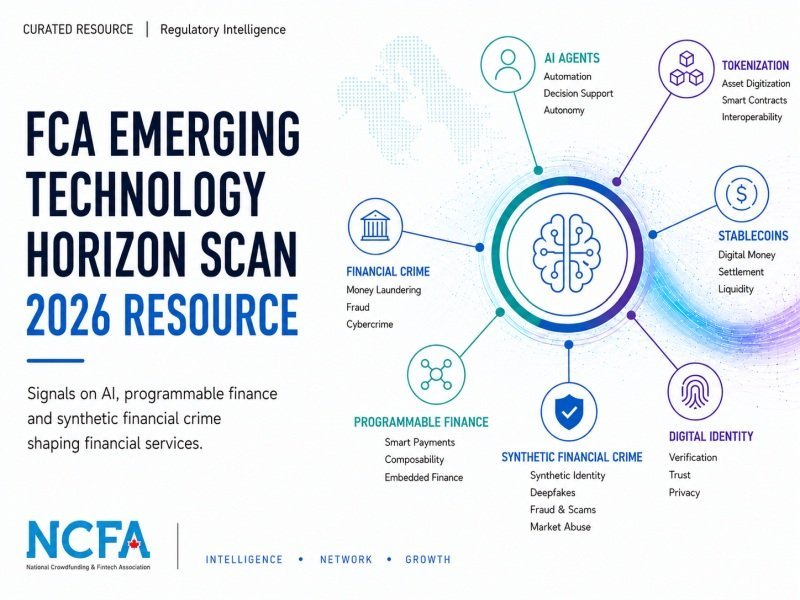
On June 10, 2026, the UK Financial Conduct Authority published the FCA Emerging Technology Horizon Scan 2026. The report examines how AI agents, synthetic financial crime and programmable finance could affect consumers, firms, markets and financial infrastructure through 2030.
NCFA's FCA Emerging Technology Horizon Scan guide turns the report into an interactive regulatory foresight resource. It separates the FCA's findings from implementation considerations, NCFA interpretation and Canadian relevance.
The FCA organizes the Horizon Scan around three technology convergence themes:
The guide also connects the Horizon Scan with later FCA work, including the Mills Review, the Supercharged Sandbox and the joint frontier AI cyber resilience statement.
The resource helps fintech leaders assess technology combinations rather than treating AI, distributed ledgers, identity, data, payments and cyber risk as separate issues.
Readers can use the interactive explorer to review:
The FCA Horizon Scan sits before formal regulation. It identifies early indicators that may affect product governance, consumer protection, financial crime controls, market surveillance, operational resilience and infrastructure design.
This resource is useful for fintech founders, financial institutions, AI developers, digital asset firms, regtech providers, compliance teams, cybersecurity leaders, investors, policymakers and market infrastructure firms.
It is especially relevant to teams assessing AI agent governance, synthetic identity, deepfake risk, automated financial crime, tokenized finance, programmable payments, stablecoins, digital identity, smart data and operational resilience.
The resource's main strength is its focus on convergence. It shows how AI agents, identity systems, synthetic media, tokenized assets, smart contracts and payment infrastructure may operate together.
It also supports practical planning. Firms can use it to test product assumptions, fraud controls, data strategy, identity plans, tokenized financial infrastructure and board level governance.
The FCA Horizon Scan is not regulatory guidance, a rulebook or a prediction. It does not create requirements or confirm that its scenarios will occur. Readers should use the guide for regulatory intelligence, scenario planning and strategic review, not as legal, financial, investment, compliance or professional advice.
FCA Emerging Technology Horizon Scan (interactive NCFA Regulatory Intelligence guide)
FCA Emerging Technology Horizon Scan 2026 (primary FCA source)
The Mills Review (FCA review of AI and retail financial services through 2030)
Frontier AI And Cyber Resilience (FCA, Bank of England and UK Treasury statement)
AI Agents Enter Governed Financial Workflows (AI governance and controls)
Tokenization Starts Looking Like Financial Infrastructure (programmable finance context)
MIT AI Risk Repository For Fintech Governance (AI risk taxonomy resource)
The National Crowdfunding & Fintech Association (NCFA Canada) is a financial innovation ecosystem that provides education, market intelligence, industry stewardship, networking and funding opportunities and services to thousands of community members and works closely with industry, government, partners and affiliates to create a vibrant and innovative fintech and funding industry in Canada. Decentralized and distributed, NCFA is engaged with global stakeholders and helps incubate projects and investment in fintech, alternative finance, crowdfunding, peer to peer finance, payments, digital assets and tokens, artificial intelligence, blockchain, cryptocurrency, regtech and insurtech sectors. Join Canada's Fintech & Funding Community today FREE! Or become a contributing member and get perks. For more information, please visit www.ncfacanada.org.
| | |
|---|---|---|
| | |

The FCA Emerging Technology Horizon Scan 2026 sets out three plausible ways emerging technologies could combine across financial services. It focuses on early indicators, potential risks and strategic questions rather than binding rules.
Use this guide to understand how the FCA frames technology convergence across Personalised Intelligence, Synthetic Insecurity and Programmable Finance, how later FCA work develops those themes, and what they may mean for fintech strategy, supervision and financial infrastructure.
Coverage includes AI agents, digital twins, proxy economy risks, synthetic identity, deepfakes, autonomous financial crime, synthetic market abuse, operational resilience, tokenization, stablecoins, CBDCs, digital identity, smart data, Finternet, cross border interoperability and current FCA developments.
The Horizon Scan sits before formal regulation. It identifies plausible technology pathways that could affect consumer protection, financial crime prevention, operational resilience, infrastructure modernization and future supervisory focus.
The FCA report is organized around three technology convergence themes that cut across AI, fraud, cyber, digital assets, payments and infrastructure modernization.
Navigate the FCA Horizon Scan by strategic theme. Each section separates what the FCA says, implementation considerations and NCFA perspective.
The FCA says the Horizon Scan is its first external publication of this kind. It is not a prediction report or regulatory guidance. It presents three plausible ways emerging technologies could combine to affect consumers, firms and markets, and it highlights early signals of new risks.
Firms should treat the report as a strategic risk and opportunity map. It can inform board horizon scanning, innovation planning, product governance, cyber risk, fraud controls, data strategy, digital identity planning, tokenization strategy and operational resilience assessment.
This is an upstream regulatory strategy signal. It shows where future supervision may focus before formal rules appear. For NCFA, it connects directly to AI, digital identity, fraud, open finance, tokenization, stablecoins, CBDCs, cybersecurity, payments modernization and programmable market infrastructure.
The FCA frames emerging technology against broader global pressures, including AI competition, geopolitical tension, trade disputes, energy demand, critical materials, data centre growth, environmental pressure and divergent regulatory approaches. It notes that AI debate often runs faster than measurable evidence, while practical adoption is already taking root in customer engagement and agentic payments.
Boards should connect technology strategy to geopolitical supply chains, energy exposure, cloud concentration, vendor dependency, AI model access, regulatory divergence and cross border interoperability. Technology adoption should be assessed against measurable outcomes rather than hype.
The FCA is treating technology strategy as market structure strategy. The signals are not only about tools. They are about who controls interfaces, identity, compute, data, payment rails, settlement and trust verification.
Personalised Intelligence examines how AI, personal data, edge computing, digital twins and adaptive interfaces could change consumer outcomes. AI agents could become the main interface between consumers and firms, making financial services more personalized, automated and embedded in daily life.
Firms need to decide whether they are designing for human users, AI representatives or both. Product governance, disclosure, consent, suitability, accessibility, fair value and complaints processes may need to reflect agent-mediated consumer journeys.
The key question is whether AI increases consumer capability or quietly transfers decision power to opaque systems. The opportunity is strong, but consumer agency, privacy, accessibility and accountability become central design requirements.
The report describes escalating cognitive delegation, progressing from assistive mode to advisory mode and then autonomous action mode. In autonomous action models, proxies may negotiate, transact, optimize bills, reallocate investments or dispute charges within dynamic constraints.
Firms should assess how products appear to AI agents, how consent is collected, how human review is triggered and how agent decisions can be audited. Customer support should anticipate cases where consumers do not understand actions taken by their AI representatives.
AI agents could become the next distribution layer in financial services. The competitive question is not only who has the best app, but whose product is selected, negotiated and trusted by a consumer's agent.
The report describes digital twins as AI representations that could draw on financial data, device data, behavioural signals, wearables and broader preferences. Firms could use these tools to offer more personalized products and support by interacting with a consumer's digital twin or AI agent.
Digital twin use raises data minimization, consent, explainability, vulnerability, discrimination, product governance and audit questions. Firms need controls to avoid overfitting products to sensitive traits or creating exclusion through complexity.
Digital twins may support inclusion and better advice, but they could also create high-risk personalization. The market will need guardrails around what data should be used, who controls the twin and how decisions can be challenged.
The FCA describes a potential proxy economy where AI proxies act for consumers and competition shifts from human attention to algorithmic negotiation. The report warns that consumers may accept proxy permissions casually, similar to how web cookies are often accepted today.
Consumer protection may need to account for proxy choice architecture, permission design, escalation rules, audit trails and agent conflicts. Firms should review whether their own AI interfaces favour the firm over the consumer.
The proxy economy could rewrite financial distribution. It may reduce consumer inertia, but it may also create a new layer of algorithmic gatekeeping. This is a high value area for future NCFA question posts and opportunity analysis.
Synthetic Insecurity examines how AI expansion of human thought, labour, value chains and digital infrastructure could make simulated data difficult to distinguish from real data. The FCA describes a future where fabricated truth becomes harder to separate from actual truth.
Financial crime, fraud, onboarding, audit, dispute resolution and supervisory evidence processes should be assessed against synthetic documents, synthetic identities, narrative laundering, deepfakes and coordinated AI agent activity.
This is one of the most important sections for fintech and regulators. If evidence itself can be fabricated at scale, financial services need stronger verification layers, not only better detection of obvious fakes.
The report says deepfake risks are progressing from manipulation of the senses to manipulation of sense-making. AI may generate credible synthetic narratives, evidence trails and interactions that bypass both human and algorithmic judgment.
Firms need layered authentication, source verification, provenance controls, document forensics, voice and video verification, separate channel confirmations and controls for high-risk actions. Regulators may also need tools to assess evidentiary integrity.
Trust infrastructure is becoming a market opportunity. Identity, provenance, verification, secure communications and evidence integrity could become core financial infrastructure rather than operational controls.
The FCA warns that agentic AI could democratize high-complexity crime. A single individual may be able to deploy, manage and scale a global criminal organization through software, with AI agents performing phishing, scams, cyberattacks and manipulation.
Fraud and cyber teams should model autonomous attackers, not only human fraud rings. Controls need to detect rapid, adaptive, multilingual, personalized and multiple channel attacks that may operate continuously.
This section points to an arms race in financial crime operations. The opportunity is not only fraud prevention. It is coordinated intelligence sharing, AI defensive assessment and cross-sector resilience.
The report describes synthetic market abuse risks where autonomous multiple agent systems may engage in insider trading, collusion, spoofing, pump and dump activity, sentiment manipulation or synthetic consensus cascades.
Market surveillance should expand beyond order book and transaction data to include social sentiment, agentic behavior, synthetic content, coordinated narratives and cross-platform activity. Governance should define accountability when autonomous systems create abusive outcomes.
Synthetic market abuse links directly to crypto, tokenized markets and digital investor communities. This is a strong candidate for future Question Intelligence and regulatory comparison work.
The FCA describes adaptive and invisible threats to firms' operational resilience. Frontier AI models may identify zero-day vulnerabilities, while adaptive malware may rewrite itself, imitate normal activity and operate inside systems in real time.
Firms should assess AI-enabled cyber scenarios, cloud concentration risk, third-party software compromise, adaptive malware, rapid vulnerability response, model provider dependency and coordinated sector response. Resilience planning should assume faster attack cycles.
Operational resilience and AI risk are converging. The firms best positioned for the next phase will combine cybersecurity, vendor governance, model risk, incident response and trusted information sharing.
Programmable Finance examines the convergence of DLT and financial concepts. The FCA says financial infrastructure is becoming more modular, with shared ledgers, tokenisation, programmable money and smart contracts contributing to protocol-based financial systems.
Firms should map how programmable finance affects products, settlement, custody, compliance, legal documentation, data sharing, identity, payment triggers and risk controls. The question is how to design programmable systems that are interoperable, auditable and commercially usable.
This is the strongest bridge to NCFA's existing tokenization, stablecoin, payments and open finance work. The FCA is describing a transition from digitized services to programmable financial infrastructure.
The report situates tokenisation within programmable finance and protocol-based infrastructure. Tokenized assets are part of the transition toward financial instruments that can settle, execute and interact through software rather than manual reconciliation.
Tokenization projects should identify the real workflow being improved, the settlement asset, custody model, legal rights, data permissions, interoperability approach, compliance logic and operational fallback process.
The report supports NCFA's existing view that tokenization is becoming measurable financial infrastructure. The market opportunity is not token issuance alone. It is regulated rails, data, custody, liquidity, compliance and settlement.
The Horizon Scan links stablecoins, CBDCs, digital assets and programmable money to changes in international financial architecture. It notes that cross border CBDC pilots such as mBridge are reaching minimum viable product scale in some regions.
Payment and stablecoin projects should evaluate settlement finality, reserve or backing structure, redemption, interoperability, AML controls, sanction screening, user protection, data standards and integration with domestic payment systems.
This connects directly to the UK Cryptoasset Regulations And FCA Final Rules and NCFA's Programmable Stablecoin Payments Opportunity Brief. The strategic opportunity is compliant stablecoin infrastructure that can operate across regulated payment, settlement and tokenized asset systems.
The report identifies smart data and digital identity as interlocking layers in the UK's infrastructure-first strategy. Smart data, identity and payments may support more context-aware and programmable financial services.
Firms should assess consent, data portability, identity assurance, verifiable credentials, cross-sector data standards, fraud risk, agent access and consumer control. Smart data strategy should be linked to product design and consumer protection.
Smart data is the bridge between open banking and programmable finance. Canada should treat consumer-driven banking, digital identity and payment modernization as connected infrastructure, not isolated files.
The FCA highlights the BIS Unified Ledger and Finternet concepts alongside mBridge and sovereign programmable financial stacks. It describes two possible futures: a more unified global ledger approach, or interoperable islands of domestic programmable ecosystems.
Interoperability planning should address legal finality, messaging standards, identity, compliance, settlement assets, cross border controls, dispute handling, data governance and resilience across networks.
The Finternet discussion is highly relevant for NCFA's global intelligence work. It creates a framework for comparing Canada, the UK, EU, India, Singapore, Brazil and other jurisdictions by infrastructure readiness rather than only by regulation.
The FCA report is UK-focused, but many themes are transferable because the same technologies, fraud risks and infrastructure choices are appearing across major financial markets.
The FCA Horizon Scan gives Canada a useful external reference. It connects AI, digital identity, fraud, open finance, payments and tokenization into one strategic view of financial infrastructure change. These files should not be treated as isolated policy tracks.
The FCA Horizon Scan does not impose obligations, but it raises strategic questions firms and policymakers should consider before technology adoption outpaces governance.
The FCA Emerging Technology Horizon Scan now sits within a larger programme on AI adoption, agentic systems, cyber resilience and regulatory capability.
It is the FCA's first external technology horizon scan. The 2026 report examines plausible combinations of emerging technologies across Personalised Intelligence, Synthetic Insecurity and Programmable Finance.
No. The FCA states that it is not regulatory guidance or a prediction. It is a foresight document intended to support discussion, planning and early risk assessment.
Synthetic financial crime uses generated identities, documents, voices, images, narratives or transaction evidence to commit fraud, evade controls or manipulate financial systems.
Programmable finance combines technologies such as tokenization, smart contracts, stablecoins, digital identity and smart data to automate financial transactions and infrastructure functions.
It has no direct legal effect in Canada, but its scenarios are useful for Canadian work involving AI governance, synthetic identity, fraud prevention, consumer driven banking, payments modernization, stablecoins, tokenization and operational resilience.
The FCA Horizon Scan points to practical innovation themes across AI agents, identity, cyber resilience, fraud prevention, programmable finance, tokenization, stablecoins and interoperable financial infrastructure.
The National Crowdfunding & Fintech Association (NCFA Canada) is a financial innovation ecosystem that provides education, market intelligence, industry stewardship, networking and funding opportunities and services to thousands of community members and works closely with industry, government, partners and affiliates to create a vibrant and innovative fintech and funding industry in Canada. Decentralized and distributed, NCFA is engaged with global stakeholders and helps incubate projects and investment in fintech, alternative finance, crowdfunding, peer-to-peer finance, payments, digital assets and tokens, artificial intelligence, blockchain, cryptocurrency, regtech, and insurtech sectors. Join Canada's Fintech & Funding Community today FREE! Or become a contributing member and get perks. For more information, please visit: www.ncfacanada.org
| | |
|---|---|---|
| | |
July 2, 2026 | NCFA Fintech Market Activity | Digital Assets Blockchain And Crypto, Wealthtech, Capital Markets And Funding, Fintech And Innovation

On June 30, 2026, Webull Canada Crypto announced it will begin offering cryptocurrency trading after receiving approval from the Canadian Investment Regulatory Organization.
The approval gives Webull another asset class inside its Canadian investing platform, which already supports U.S. and Canadian stocks, ETFs, options, margin accounts, cash accounts, TFSAs, and RRSPs through Webull Securities Canada.
Beta access for selected clients is expected to start soon, with a wider rollout planned in the coming weeks. Webull says the crypto experience will include 24/7 trading for assets such as Bitcoin, Ethereum, Solana, XRP, Cardano, and Litecoin.
This is another regulated online brokerage aligning digital assets among the same customer experience as traditional investing.
Webull Canada Crypto Limited is regulated by CIRO. Webull Securities Canada Limited is also regulated by CIRO and is a member of CIPF.
That structure is important because crypto trading and traditional securities accounts don't carry the same investor protections. Webull's disclosure says crypto assets are not protected by CIPF, although CIPF protection may be available for eligible cash held in a crypto trading account, subject to applicable limits and policy terms.
The approval arrives after Canadian regulators spent several years moving crypto platforms toward dealer registration and CIRO membership, custody expectations, risk disclosure, and stronger client asset controls.
Regulated access is becoming the path for retail crypto distribution in Canada.
When Webull expanded brokerage services to Canada in early 2024, the initial story was low cost access to Canadian and U.S. listed equities.
The platform has since expanded around commission free trading, advanced charting, market data, options access, registered accounts, and now crypto.
Webull is building toward a multi asset retail investing platform where users can fund accounts, monitor portfolios, review reporting, and trade across asset classes without leaving the ecosystem.
Crypto increasingly looks less like a standalone destination and more like another investing capability inside regulated financial apps.
Canadian online brokers used to compete heavily on commissions, execution, research tools, and account access. In 2026, competition is about platform depth as investors want fewer disconnected accounts. Platforms want more customer activity, better retention, more data, and a wider share of the investor relationship, and eventually more personalized portfolio features.
Webull is entering a market where Wealthsimple already combines investing, crypto, cash, tax, and other financial services. KOHO adding regulated crypto trading inside its money app flashing the same pattern from a consumer finance angle.
The Canadian crypto market has gone through enforcement, registration pressure, custody scrutiny, stablecoin restrictions, and platform exits. Yet regulated distribution keeps expanding.
Canada hasn't treated retail crypto as an unregulated free for all. It also hasn't eliminated retail access. Oversight of the market is evolving toward regulated firms, clearer disclosures, tighter custody controls, and platforms that can operate within securities rules.
Webull's entry adds another regulated access point for Canadian investors and increases pressure on every platform that wants to be a primary investing destination.
The approval gives Webull permission to compete, but it doesn't guarantee adoption.
Crypto also brings higher volatility, suitability questions, security expectations, and investor education demands. A smooth user experience can't hide the risk profile of the asset class.
The advantage for Webull is that crypto can now be offered alongside the rest of its investing platform. The challenge is that investors will compare the experience not only with crypto exchanges, but with every brokerage and fintech app trying to become the main place Canadians manage investments.
Crypto trading platforms moving toward CIRO oversight shows how Canadian regulation is reshaping digital asset distribution.
Crypto custody rules are becoming a core operating issue for dealer members and digital asset platforms.
KOHO's regulated crypto rollout shows digital assets moving into broader consumer finance platforms.
Tokenization becoming a measurable business shows how digital assets are moving deeper into regulated capital markets infrastructure.
NCFA's Financial Innovation Map tracks digital assets, wealthtech, brokerage competition, capital markets infrastructure, custody, and investor access opportunities.
If every major investing platform eventually offers stocks, ETFs, options, registered accounts, and crypto, what becomes the next competitive advantage?
The National Crowdfunding & Fintech Association (NCFA Canada) is a financial innovation ecosystem that provides education, market intelligence, industry stewardship, networking and funding opportunities and services to thousands of community members and works closely with industry, government, partners and affiliates to create a vibrant and innovative fintech and funding industry in Canada. Decentralized and distributed, NCFA is engaged with global stakeholders and helps incubate projects and investment in fintech, alternative finance, crowdfunding, peer-to-peer finance, payments, digital assets and tokens, artificial intelligence, blockchain, cryptocurrency, regtech, and insurtech sectors. Join Canada's Fintech & Funding Community today FREE! Or become a contributing member and get perks. For more information, please visit: www.ncfacanada.org
| | |
|---|---|---|
| | |
July 2, 2026

Picture the moment a Canadian fintech dreads most. A regulator's letter arrives. A customer in Quebec, or in a newcomer community you were proud to serve, relied on a disclosure written in their own language, and that disclosure said something the English original did not. Now you are explaining to a supervisor how the wording was produced, who checked it, and why a fee, a risk, or an obligation came out wrong. There is no comfortable answer, because the honest one is this: a single AI model wrote it, and nobody verified it.
That scenario is no longer rare or hypothetical. As fintechs scale into new markets and serve multilingual communities at home, more and more compliance language, terms of service, risk disclosures, consent flows, regulatory filings, is being produced by one AI model with no accuracy standard behind it. It feels efficient. It looks clean. And it quietly builds a liability that only reveals its price later, at the point where it is most expensive to fix.
What makes this gap so dangerous is that its cost stays invisible until it is realized. A mistaken clause does not throw an error message. It sits inside your disclosure reading perfectly, right up until an audit, a customer complaint, or an enforcement review turns it into a remediation project, a forced re-disclosure, a penalty, or a stalled market launch. Regulators do not distinguish between an error a person made and one a machine made. Across Canada's framework, from FINTRAC's obligations under the PCMLTFA, to provincial securities disclosure rules, to the Retail Payment Activities Act, the accuracy of what a customer is told is a supervised matter, not a marketing preference. For firms serving official-language communities, bilingual accuracy is frequently a legal expectation rather than a courtesy.
Every one of those outcomes carries a number. Legal hours. Remediation. Re-issued documents. Delayed revenue while a launch is held. And the quiet, compounding cost of a regulator who now watches you more closely than your competitors. The bill for one wrong word is rarely small, and it almost never arrives on your schedule.
Here is what most teams have not priced in: AI models disagree with one another, and they disagree most on the language that matters most. Independent testing makes this concrete. In Intento's State of Translation Automation 2025, baseline machine systems averaged roughly 10 to 15 errors per text before customization, and synthesized industry data places single top-tier large language model hallucination rates in translation tasks between 10% and 18%. On a marketing tagline, a 12% error band is a style problem. On a regulatory disclosure, it is a liability with a dollar figure attached.
Those errors are idiosyncratic to each model: one engine mishandles a defined term, another drops a conditional clause, a third invents a plausible equivalent that does not exist in the target jurisdiction's regulatory vocabulary. And the risk compounds with length, so the longer the document, a prospectus, a payment services agreement, a full disclosure set, the more independent points of failure a single model introduces. Then there is the cost even a correct-looking output creates. Someone still has to check it. Every hour a compliance lead spends re-reading machine output they cannot fully trust is an hour billed to the single-model shortcut, a verification backlog that never appears on the invoice but is paid every single week.
The way out is architectural, not aspirational. If individual models fail idiosyncratically, then running many at once and keeping only what most of them independently produce turns disagreement into a filter. Intento's own findings point the same way: Slator's reporting on that study noted that a multi-agent workflow explicitly designed to avoid compounding hallucinations delivered the highest quality across nine of eleven language pairs, outperforming any single engine.
This is the principle behind MachineTranslation.com, an AI translation platform built for exactly this failure mode. Its SMART mechanism runs a text through 22 AI models simultaneously, evaluates the source context to determine the most accurate rendering, and returns the output the majority of those models agree on. Because hallucinations are model-specific, cross-model agreement functions as an automated audit: the outlier renderings that shift what an obligation means are structurally filtered out before anyone sees the result. Internal benchmarks put the effect at roughly a 90% reduction in critical error risk, with agreed errors falling below 2% and up to 85% of outputs reaching professional-quality standard. The point is not speed. The point is certainty, and certainty is precisely what removes the hidden costs: fewer errors to remediate, and far less of the verification backlog that quietly drains a compliance team's time.
Cross-model agreement handles accuracy at scale. For the documents where a single error is unthinkable, a regulator-facing filing, a signed customer agreement, a prospectus, certainty has to be absolute, and that is where a second pillar matters. On the same platform, human verification escalates any output to a professional reviewer, adding a validated final check on top of the machine layer. This is not theoretical. Tomedes, the language company behind the platform, documents its high-stakes work in a library of recent translation case studies spanning certified legal filings, court-ready documents, and financial materials handled under confidentiality and delivered to compliance standards. The economics are blunt: the cost of one professional reviewer is trivial next to the cost of one enforcement action. Consensus for accuracy across volume, human verification for certainty on the documents that cannot be wrong.
None of this asks Canadian fintechs to become linguists. It asks them to govern this control the way they already govern every other one. Regulators are moving in exactly that direction on AI more broadly. NCFA's own coverage of the IOSCO AI supervisory toolkit for capital markets frames the expectation plainly: where AI touches a supervised process, firms are expected to show governance, oversight, and accountability for how the system behaves.
Translating compliance content is one of those processes, and today it is often the least governed one in the building. The practical steps are small. Add multilingual accuracy to the risk register. Ask who verified the language a customer relied on, and how. Replace a single ungoverned model with an architecture that removes the error by design and validates the highest-stakes content with a human. The cost of getting the language right the first time is a rounding error next to the cost of explaining why you did not. For a Canadian fintech scaling across markets or serving communities in more than one language, that is the whole choice: money spent on prevention, or money lost to a disclosure you have to defend.
The National Crowdfunding & Fintech Association (NCFA Canada) is a financial innovation ecosystem that provides education, market intelligence, industry stewardship, networking and funding opportunities and services to thousands of community members and works closely with industry, government, partners and affiliates to create a vibrant and innovative fintech and funding industry in Canada. Decentralized and distributed, NCFA is engaged with global stakeholders and helps incubate projects and investment in fintech, alternative finance, crowdfunding, peer-to-peer finance, payments, digital assets and tokens, artificial intelligence, blockchain, cryptocurrency, regtech, and insurtech sectors. Join Canada's Fintech & Funding Community today FREE! Or become a contributing member and get perks. For more information, please visit: www.ncfacanada.org
| | |
|---|---|---|
| | |
July 1, 2026

Under the Ontario Highway Traffic Act, a charge of careless driving is one of the most serious non-criminal offences a driver can face. Law enforcement officers often issue this ticket following motor vehicle accidents, alleging that a motorist drove without proper care and attention or without reasonable consideration for others on the road. Because this charge is broad and relies heavily on the officer's personal opinion, it carries severe penalties, including six demerit points, a six-month license suspension, massive financial fines, and even potential jail time. Defending against this allegation requires an aggressive and precise legal strategy.
A conviction for careless driving goes far beyond a simple traffic ticket; it is treated as a major offence by insurance companies, similar to a criminal impaired driving conviction.
Upon a formal conviction, the Ministry of Transportation immediately applies six demerit points to your driving record, which triggers a mandatory interview for fully licensed drivers and can lead to an automatic suspension for novice drivers. Furthermore, the court can issue discretionary fines ranging from hundreds to thousands of dollars and suspend your driving privileges for up to two years. For many everyday drivers, the sudden jump in insurance costs or a total policy cancellation makes keeping a vehicle impossible, threatening their employment and daily lives.
To secure a conviction, the prosecution must prove that your driving fell well below the standard of a reasonably prudent driver. Simply being involved in an accident is not legal proof of careless driving.
The defence team at Traffic Paralegal Services carefully analyses every element of the crown's case. They review accident reconstruction data, interview independent witnesses, and check road conditions, weather data, and mechanical factors. A successful defence often centres on proving that the incident was a simple error in judgment or an unavoidable accident caused by sudden environmental changes, rather than a reckless disregard for public safety.
The stakes are incredibly high in careless driving cases, meaning you should never enter a courtroom without experienced legal representation. Prosecutors often push for severe penalties, making professional guidance essential for a fair trial.
The court specialists at Traffic Paralegal Services bring extensive experience to these complex cases. They handle all discussions with the crown prosecutor, looking for opportunities to get the charges completely dropped due to insufficient evidence or technical errors. If a full withdrawal is not possible, they work to reduce the charge to a minor, low-point infraction like "follow too closely," saving you from a high-risk insurance status and protecting your freedom to drive.
Defending against a major traffic allegation requires immediate legal action, an independent investigation, and skilled courtroom advocacy. By actively fighting careless driving tickets in ontario, you protect your freedom, avoid severe financial penalties, and keep your insurance affordable. Accepting a careless driving conviction without a fight can negatively impact your life and career for years to come. Invest in your future by placing your case in the hands of proven traffic law experts. Partnering with a trusted, experienced firm like Traffic Paralegal Services ensures your defence is built correctly, giving you the best opportunity to secure a successful outcome in court.
“In 2026, trust has become the deciding factor for people fighting traffic charges in Ontario - especially as we hear more clients describe being let down by representatives who operate without structure or accountability. Too often, the story is the same: a meeting arranged at a coffee shop, a quick promise that the matter is “handled,” and then silence - missed updates, unanswered calls, and no meaningful steps taken toward resolution. That experience does more than waste time; it increases stress and can put a client’s case at risk.
At Traffic Paralegal Services, we build trust through a formal intake process, clear written next steps, consistent communication, and file management that does not depend on one-off meetings or vague assurances. Clients know where their matter stands, what is happening next, and who is responsible at every stage - from request for disclosure to negotiations and court attendance. Reliability is not a marketing line; it is the foundation of how we serve our clients.”
Volodymyr Menok, President, Traffic Paralegal Services
Director, Traffic Paralegal Services
The National Crowdfunding & Fintech Association (NCFA Canada) is a financial innovation ecosystem that provides education, market intelligence, industry stewardship, networking and funding opportunities and services to thousands of community members and works closely with industry, government, partners and affiliates to create a vibrant and innovative fintech and funding industry in Canada. Decentralized and distributed, NCFA is engaged with global stakeholders and helps incubate projects and investment in fintech, alternative finance, crowdfunding, peer-to-peer finance, payments, digital assets and tokens, artificial intelligence, blockchain, cryptocurrency, regtech, and insurtech sectors. Join Canada's Fintech & Funding Community today FREE! Or become a contributing member and get perks. For more information, please visit: www.ncfacanada.org
| | |
|---|---|---|
| | |
June 29, 2026 | NCFA Resource | Digital Assets Blockchain And Tokenization, Regulation And Policy

NCFA has published a practical guide to the UK cryptoasset regulations and FCA final rules. It helps firms, platforms, issuers, custodians, compliance teams, investors and policymakers understand how the UK framework applies across regulated digital asset activities.
The primary Regulatory Intelligence guide organizes the rule package by authorisation, scope, stablecoin issuance, custody, trading platforms, disclosures, market abuse, prudential requirements, Consumer Duty, governance, operational resilience, financial crime, reporting and implementation readiness.
The resource gives readers a structured entry point into the UK cryptoasset regime without treating the rulebook as one long regulatory document. It directs readers to the detailed Regulatory Intelligence explorer, where each rule area separates requirements, implementation work, consultation outcomes and NCFA analysis.
That distinction is important because firms need to prepare for more than registration. They may need to assess permissions, governance, safeguarding, disclosures, capital, operational controls, market integrity, customer communications, reporting and senior management accountability.
The framework also gives Canadian and global readers a useful comparison point as tokenized financial infrastructure, stablecoins and regulated digital asset markets develop. The central question is which firms can meet regulated market standards while continuing to build useful products and services.
This resource is designed for crypto trading platforms, custodians, stablecoin issuers, digital asset infrastructure firms, fintech founders, compliance teams, securities lawyers, investors, policymakers and market participants comparing global crypto regulatory models.
It is especially relevant for organizations assessing FCA authorisation, custody controls, stablecoin infrastructure, consumer disclosures, market abuse controls, governance, prudential requirements and operational readiness.
The strength of the resource is its practical structure. It turns a large regulatory package into a clear intelligence layer that readers can use to identify obligations, implementation dependencies and areas requiring specialist legal, compliance, technology or operational work.
It also supports jurisdictional comparison. Canadian and global market participants can use the UK rules to compare approaches to crypto authorisation, custody, stablecoins, disclosures, platform conduct, market integrity and consumer protection.
The guide is not a substitute for legal advice. Regulatory treatment depends on the facts, firm structure, permissions, product design and activities performed in or into the UK. Readers should use it for ecosystem intelligence and planning, then review the FCA primary materials and consult qualified advisers.
UK Cryptoasset Regulations And FCA Final Rules
Primary NCFA Regulatory Intelligence guide with the full rule explorer, implementation analysis, timeline and source links.
Tokenization Starts Looking Like Financial Infrastructure
Market infrastructure context for tokenized cash, custody, settlement and regulated digital asset rails.
Deloitte And Stablecorp Bring QCAD To Banks
Canadian stablecoin infrastructure context for banks and regulated financial institutions.
FCA Final Crypto Rules Announcement
Official FCA source announcing the final UK cryptoasset rule package.
The National Crowdfunding & Fintech Association (NCFA Canada) is a financial innovation ecosystem that provides education, market intelligence, industry stewardship, networking and funding opportunities and services to thousands of community members and works closely with industry, government, partners and affiliates to create a vibrant and innovative fintech and funding industry in Canada. Decentralized and distributed, NCFA is engaged with global stakeholders and helps incubate projects and investment in fintech, alternative finance, crowdfunding, peer to peer finance, payments, digital assets and tokens, artificial intelligence, blockchain, cryptocurrency, regtech and insurtech sectors. Join Canada's Fintech & Funding Community today FREE! Or become a contributing member and get perks. For more information, please visit: www.ncfacanada.org
| | |
|---|---|---|
| | |



August 26th, 2025

January 4th, 2024

June 1st, 2021

September 9th, 2020

July 9th, 2018

January 3rd, 2018

September 25th, 2017

June 20th, 2017

May 10th, 2017

December 14th, 2016
