





Karsten Wenzlaff, Advisor
August 26th, 2025
Karsten Wenzlaff is a Crowdfunding and Fintech Expert from Germany. He is Secretary-General of Digit[...]


June 10, 2026 | NCFA Story Intelligence | Capital Markets And Funding
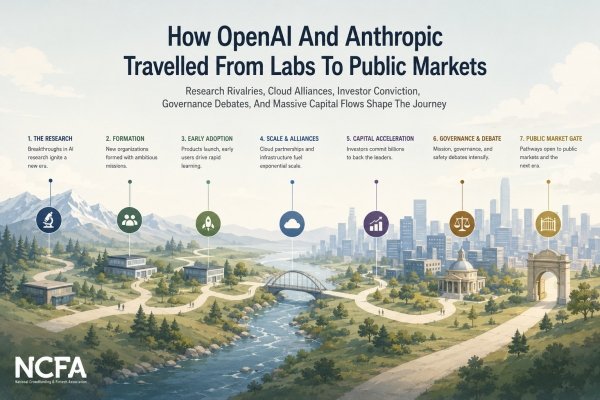
On June 8, 2026, OpenAI confirmed it submitted a confidential S-1 to the U.S. Securities and Exchange Commission. One week earlier, Anthropic disclosed its own confidential draft registration statement for a proposed IPO.
The filings are the trigger, not the story. The story is how frontier AI moves from research labs and safety debates into consumer adoption, cloud alliances, investor conviction, copyright fights, government interest, near trillion dollar private valuations, and the public market gate.
OpenAI starts with a promise that sounds almost incompatible with public markets.1 In 2015, it begins as a nonprofit AI research company with a mission tied to broad public benefit, not shareholder return. That tension does not matter much while the work sits inside research circles. It matters once OpenAI becomes strategically important.
Anthropic comes from inside the same argument.2 Founded in 2021 by former OpenAI researchers, including Dario Amodei, Anthropic builds its identity around reliable, interpretable, and steerable AI systems. It is not just another model company. It is a different answer to a question OpenAI helped make unavoidable.
ChatGPT turns frontier AI into a public habit.3 The late 2022 launch changes the audience almost overnight. Students, founders, developers, workers, executives, and investors start testing advanced AI directly. Reuters later reports ChatGPT reached an estimated 100 million monthly active users in January 2023.4
Claude takes the quieter enterprise path.5 It does not create the same consumer spectacle, but Anthropic leans into reliability, predictable deployment, and safety as commercial positioning. Trust becomes part of the product, especially for organizations that need governance controls before they scale AI usage.
Microsoft turns OpenAI into one of the largest strategic bets in technology.6 The relationship gives OpenAI more than capital. Azure becomes part of its operating foundation, with cloud infrastructure, enterprise distribution, and credibility arriving at a moment when many buyers are still trying to understand what generative AI can become.
Anthropic attracts a different group of believers. Google backs the company. Amazon commits billions and makes Anthropic central to its AI strategy, while AWS becomes Anthropic's primary cloud and training partner.7 Spark Capital and Menlo Ventures remain part of the journey as Anthropic grows from safety focused startup into one of OpenAI's strongest challengers.
OpenAI remains the company everyone else measures against. ChatGPT gives OpenAI distribution, developer attention, and brand recognition. Microsoft's partnership gives it reach into enterprise software. That combination makes OpenAI powerful, but it also makes dependency risk more visible for large buyers.
Anthropic becomes strategically useful because it is different. Claude's role in enterprise productivity and financial workflows shows how a trust first product can become a real alternative. When Microsoft brings Claude into Office productivity, the message is practical: even OpenAI's most important partner wants more than one AI supplier in the stack.
OpenAI's success creates a new constraint. The company is no longer trying to prove that people will use frontier AI. ChatGPT already answered that question. OpenAI now has to fund the compute, deployment, developer usage, and enterprise adoption needed to keep the flywheel turning.
Anthropic faces the same pressure through Claude demand. Its Series H announcement points to global enterprise adoption, expanded compute capacity, Amazon, Google, Broadcom, SpaceX, and chip partners including Micron, Samsung, and SK hynix.8 The company's careful brand does not reduce its need for industrial scale infrastructure.
OpenAI's rise brings copyright and publisher pressure with it. The more useful the models become, the more valuable the training inputs appear. News organizations, authors, artists, and creators increasingly ask how their work contributes to model capability and who captures the value created from it.
Anthropic faces the same ownership question through Reddit. The Reddit lawsuit against Anthropic puts training data claims, platform rights, and AI accountability into the story. The issue is not only whether AI can learn from the web. It is who gets a say when web content becomes commercial fuel.
OpenAI's control questions become public in 2023.9 The board removes Sam Altman, then reverses course after pressure from employees, customers, investors, and partners. The episode is brief, but it changes how people read the company. Governance becomes part of valuation risk.
Anthropic's safety stance faces real world tests. Its product identity is tied to reliability and responsible deployment, but governments, enterprises, and defence buyers want more capability. The tension between safety commitments and state power is already visible in AI ethics, state power, and red lines.
OpenAI's March 2026 financing makes the capital story impossible to ignore.10 The company closes $122B USD in committed capital at an $852B USD post money valuation. The round is anchored by Amazon, NVIDIA, and SoftBank, with continued participation from Microsoft. SoftBank co leads alongside a16z, D. E. Shaw Ventures, MGX, TPG, and accounts advised by T. Rowe Price Associates.
Anthropic's May 2026 Series H shows the same private market scale.11 The company raises $65B USD at a $965B USD post money valuation. Altimeter Capital, Dragoneer, Greenoaks, and Sequoia Capital lead the round, with Capital Group, Coatue, D1 Capital Partners, GIC, ICONIQ, and XN also co leading. Amazon's prior commitment remains part of the picture, along with Google, Broadcom, SpaceX, and chip partners.
OpenAI follows on June 8 and keeps timing open.12 The company confirms it submitted a confidential S-1 but says it has not decided when to go public. Public markets become an option, while OpenAI keeps weighing what may be easier to do as a private company.
Anthropic reaches the IPO gate first on June 1.13 The filing does not set share count or price. It gives the company the option to move after SEC review, market conditions, and other factors.
Different origins. Different philosophies. Different investor groups. Different commercialization paths. Yet both companies arrive at the same gate.
The IPO filings don't end the frontier AI story. They mark the point where a decade of research, product adoption, infrastructure buildout, governance conflict, investor conviction, and public policy pressure begins meeting public markets.
For NCFA, this is where Story Intelligence connects to the Financial Innovation Map. The opportunity set includes private market liquidity, tokenized pre IPO access, AI infrastructure finance, prediction markets around IPO timing and valuation, disclosure standards, and investor protection for companies that may become public only after private markets have already priced much of the upside.
OpenAI and Anthropic followed different paths, attracted different allies, and made different decisions along the way. Yet both arrived at the same gate. That may say as much about the economics of frontier AI as it does about the companies themselves.
What part of the story stood out most to you?
Share this story → Explore related intelligence → Subscribe
 The National Crowdfunding & Fintech Association (NCFA Canada) is a financial innovation ecosystem that provides education, market intelligence, industry stewardship, networking and funding opportunities and services to thousands of community members and works closely with industry, government, partners and affiliates to create a vibrant and innovative fintech and funding industry in Canada. Decentralized and distributed, NCFA is engaged with global stakeholders and helps incubate projects and investment in fintech, alternative finance, crowdfunding, peer-to-peer finance, payments, digital assets and tokens, artificial intelligence, blockchain, cryptocurrency, regtech, and insurtech sectors. Join Canada's Fintech & Funding Community today FREE! Or become a contributing member and get perks. For more information, please visit: www.ncfacanada.org
 |  |  |
|---|---|---|
 |  |  |
Jun 9, 2026

Going public puts every control your fintech owns or outsources under a microscope. Auditors, regulators, and future shareholders want hard evidence that third-party weak spots cannot derail your debut.
Roughly 30% of breaches trace back to external suppliers, and each incident costs an average $4.44 million, according to IBM's 2024 Cost of a Data Breach Report. Advisers preparing S-1 filings increasingly want a repeatable way to assess outside cyber risk before the SEC asks, and investors read disciplined third-party oversight as a proxy for operational maturity.
Here is the catch: your SOC 2 program alone will not clear the public-company bar. SOC 2 demonstrates protection of customer data, while SOX 404 focuses on financial-reporting integrity. A purpose-built vendor-risk platform bridges that gap by connecting vendor security evidence to the controls auditors expect in an IPO cycle. We ranked five platforms on the criteria that matter most for IPO prep: compliance fit, automation depth, auditor acceptance, and cost-to-value.
We started with fifteen tools from analyst waves, forums, and twenty competitor write-ups, then removed anything lacking a purpose-built vendor-risk module or fintech case study, leaving five contenders. We scored each on a 100-point scale across four questions:
Two CISOs who took fintechs to market last year reviewed the weighting, confirming it reflects where auditors press hardest.
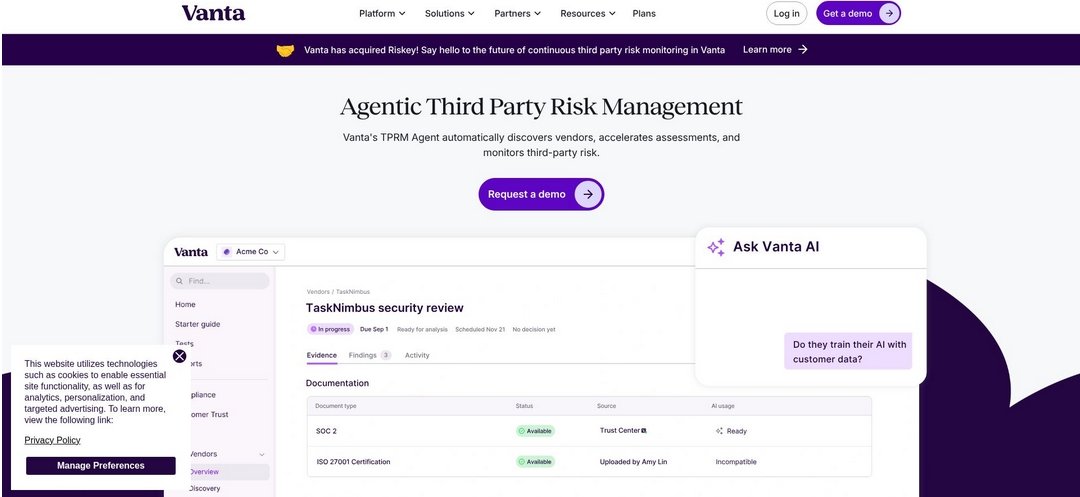
Vanta folds vendor oversight into the same dashboard you use for SOC 2, helping teams remediate risk up to 45% faster. VRM, compliance automation, Trust Center, and SOX ITGC live in one system with shared evidence and cross-framework mapping.
Verdict: best fit if your IPO plan needs one platform to run SOC 2, stand up SOX ITGC, and operationalize vendor oversight. If you need managed analyst services or board-ready vendor portfolio reporting, compare TPRM-specialized options.
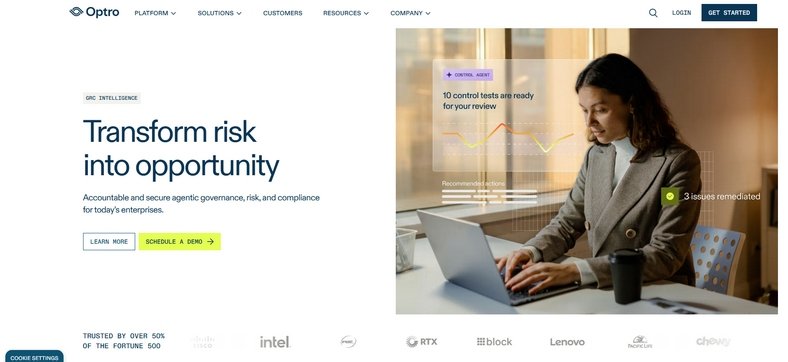
Optro rebranded from AuditBoard in March 2026. It keeps the same product family public-company SOX teams know: SOXHUB (SOX program management), CrossComply (multi-framework compliance), and a connected TPRM module. More than half of the Fortune 500 use it, and it is one of the most common SOX systems Big Four auditors are comfortable testing.
Verdict: choose Optro if full SOX 404 depth (ITGC plus financial process controls) and audit-firm fluency top your list. For SOC 2 day-to-day, a Trust Center, and AI-compressed vendor reviews, you will likely pair it with another platform.
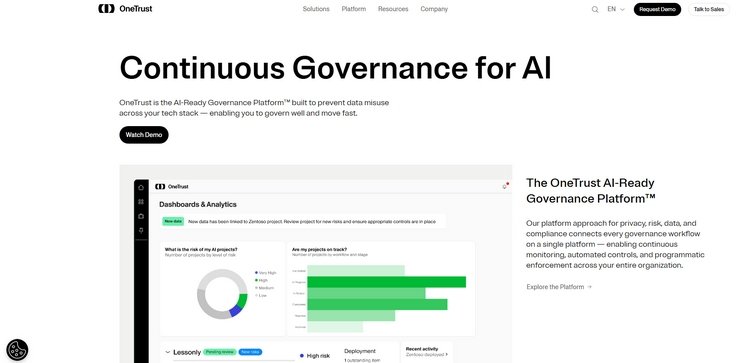
OneTrust grew from privacy management into a broad GRC suite with a substantive third-party risk module, serving 14,000+ customers across regulated industries. It fits when vendor oversight has to live next to privacy, ethics, and ESG in one control fabric.
Verdict: right when vendor risk must sit alongside privacy, ethics, and ESG in one enterprise fabric and you can absorb a longer rollout. To consolidate SOC 2, SOX ITGC, and AI-assisted reviews into one fast-moving platform, OneTrust typically needs pairing.

Prevalent is a pure-play TPRM platform with more than two decades of specialization, acquired by Mitratech in October 2024 and rated a Strong Performer in Forrester's Third-Party Risk Management Wave (Q1 2026). It is the heavyweight option when vendor risk itself is the program.
Verdict: choose Prevalent for bank-style TPRM depth, broad regulatory mapping, and multi-domain continuous monitoring. To collapse SOC 2, SOX ITGC, and vendor oversight into one platform, expect to add complementary tools.
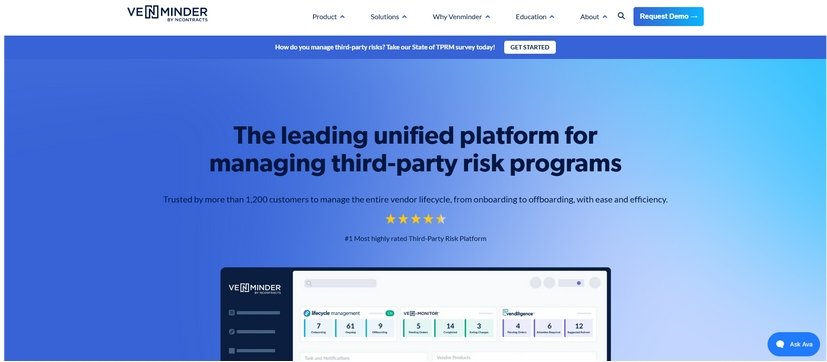
Venminder is a TPRM platform for regulated financial-services teams that want to outsource a share of vendor due diligence. It pairs software with managed services where certified analysts review vendor materials and deliver risk-rated outputs. Venminder was acquired by Ncontracts in September 2024 (Hg Capital-backed); it has 1,200+ customers, and the combined entity serves 5,000+.
Verdict: strong when capacity and expertise are the constraint and you want platform-plus-analysts diligence with contract oversight. To consolidate SOC 2 evidence, SOX ITGC, and VRM into one system, Venminder adds tool sprawl rather than reducing it.
In most fintechs, SOC 2 lives with Security and SOX 404 with Finance, and your vendors sit in the overlap. Treat them as two programs and you get two inventories and two sets of audit questions that never reconcile. Build one vendor register that serves both audits instead.
The National Crowdfunding & Fintech Association (NCFA Canada) is a financial innovation ecosystem that provides education, market intelligence, industry stewardship, networking and funding opportunities and services to thousands of community members and works closely with industry, government, partners and affiliates to create a vibrant and innovative fintech and funding industry in Canada. Decentralized and distributed, NCFA is engaged with global stakeholders and helps incubate projects and investment in fintech, alternative finance, crowdfunding, peer-to-peer finance, payments, digital assets and tokens, artificial intelligence, blockchain, cryptocurrency, regtech, and insurtech sectors. Join Canada's Fintech & Funding Community today FREE! Or become a contributing member and get perks. For more information, please visit: www.ncfacanada.org
| | |
|---|---|---|
| | |
June 8, 2026 | NCFA Market Activity | Artificial Intelligence And Data, Risk Compliance And Regtech
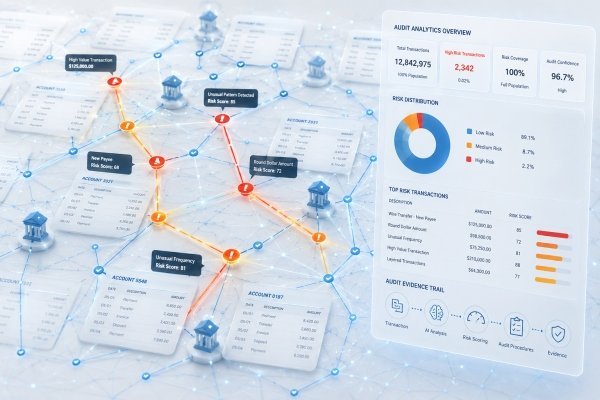
On June 8, 2026, Ottawa based MindBridge expands its AI audit and assurance platform to help audit teams review larger transaction populations and assess risk faster. The update adds full population analysis, subledger analysis, a Monetary Flow Dashboard, transaction level risk assessment, duplicate transaction controls, and large file processing.
MindBridge says KPMG deploys its platform through a global audit platform used in more than 60 countries. The company also points to recent partnerships with BDO and Buzzacott.
Sarah McGinnity, General Manager, Audit & Assurance Solutions at MindBridge:
“Audit and assurance teams are being asked to oversee larger transaction populations, more complex systems, and increasingly automated financial processes without adding proportional time or resources.”
The most important part of the announcement is the focus on full population analysis.
Audit teams have traditionally relied on sampling. AI driven software now makes it possible to review entire transaction populations and identify unusual activity across much larger data sets. That can help auditors spend less time searching for issues and more time investigating the transactions that matter.
MindBridge is positioning its platform around that shift. The latest release gives users more visibility into transaction flows, subledger activity, and risk indicators across financial records.
Many AI products compete on productivity. MindBridge competes on audit quality, risk assessment, and financial controls.
It alters the buying decision. Audit firms, finance teams, and regulated organizations already need oversight, documentation, and evidence. They aren't looking for experimentation. They're looking for better ways to review growing volumes of financial data.
The trend extends beyond audit. Financial institutions are adopting AI in compliance, fraud detection, transaction monitoring, and operational risk. As NCFA noted in its coverage of regulated AI controls and governance, buyers increasingly want systems that support human judgment and provide a clear record of how decisions are made.
If audit software can test full transaction populations instead of samples, the value changes from finding anomalies after the fact to proving where financial risk may occur before judgment calls are made. That's where AI audit tools become useful to CFOs, auditors, and regulators: not as automation, but as evidence infrastructure.
The National Crowdfunding & Fintech Association (NCFA Canada) is a financial innovation ecosystem that provides education, market intelligence, industry stewardship, networking and funding opportunities and services to thousands of community members and works closely with industry, government, partners and affiliates to create a vibrant and innovative fintech and funding industry in Canada. Decentralized and distributed, NCFA is engaged with global stakeholders and helps incubate projects and investment in fintech, alternative finance, crowdfunding, peer-to-peer finance, payments, digital assets and tokens, artificial intelligence, blockchain, cryptocurrency, regtech, and insurtech sectors. Join Canada's Fintech & Funding Community today FREE! Or become a contributing member and get perks. For more information, please visit: www.ncfacanada.org
| | |
|---|---|---|
| | |
June 8, 2026 | NCFA Insight | Capital Markets And Market Infrastructure, Digital Assets Blockchain And Tokenization

On June 5, 2026, Politico published an investigation into Polymarket's influencer marketing program. The report found that Polymarket chief marketing officer Matthew Modabber allegedly used a personal PayPal account to send at least $350,000 to content creators between January 2025 and February 2026. Politico's review identified over 490 social media posts promoting Polymarket that allegedly didn't clearly disclose paid relationships.
The investigation paints a picture far larger than a disclosure dispute. It's a rare look into how prediction markets are building distribution, visibility, and cultural relevance while simultaneously becoming one of the most discussed forecasting platforms in politics, sports, current events, and financial markets.
At least 20 creators identified by Politico promoted Polymarket after receiving payments. The report also found more than $2.5 million in transfers from the account to over 800 recipients during the period reviewed. Several influencers allegedly framed Polymarket odds as breaking news or authoritative indicators of future events. One creator told Politico that the company provided suggested post copy and encouraged promotion of specific markets.
The story reveals something many people inside fintech have quietly observed for years. Prediction markets are no longer simply markets. They are becoming media businesses.
Traditional exchanges compete for liquidity. Prediction markets increasingly compete for attention.
Polymarket's growth coincided with the 2024 U.S. election cycle, where billions of dollars flowed through election related contracts. Politico's reporting shows that influencer distribution became part of that growth strategy. The objective was not only attracting traders. It was turning Polymarket into a source people referenced when discussing politics, government decisions, sports outcomes, and breaking events.
The strategy appears to have worked. Today, prediction market odds regularly appear in mainstream media coverage. News organizations cite them. Social media users share screenshots of them. Investors discuss them. Politicians reference them. The market itself increasingly becomes part of the story.
It's a new category that's somewhere between financial infrastructure, media distribution, forecasting, and social networks.
The obvious asset is trading volume. The less obvious asset is trust. Many of the influencers highlighted in Politico's investigation promoted Polymarket as exceptionally accurate. Some described the platform as a superior forecasting mechanism compared to polling. Others highlighted successful market predictions as evidence of credibility.
This creates an unusual challenge. Prediction markets derive value from the perception that they aggregate independent information better than traditional alternatives. If users begin questioning how information reaches the market, who amplifies market narratives, or whether promotion and prediction are becoming intertwined, trust becomes harder to maintain.
The issue isn't whether influencer marketing is permitted. Many fintech companies use creators, affiliates, newsletters, podcasts, and social media personalities. The issue is whether users can clearly distinguish between market intelligence and paid amplification.
The most important opportunity may not be another prediction market. It's infrastructure that helps users understand how market information forms, spreads, and gains credibility.
As prediction markets, AI systems, social media platforms, and financial products become more connected, users need better ways to answer practical questions.
The next generation of prediction market innovation opportunities may come from building verification, disclosure, provenance, surveillance, and transparency tools around these markets.
These capabilities are still early. As prediction markets expand into politics, sports, finance, and public policy, demand for trust infrastructure should grow with them.
The Politico investigation focuses on influencer payments, disclosure practices, and marketing tactics, but the larger takeaway is that prediction markets are evolving beyond trading venues. They're becoming information platforms. That evolution creates opportunity, but it also creates responsibility. Today, Reuters posted about predication markets facing rising scrutiny over insider trading controls, reinforcing that these markets need trust infrastructure around promotion, surveillance, suspicious trading, and market transparency.
Markets that increasingly influence public understanding of events will face greater scrutiny over how information enters the system, how narratives spread, and how trust is earned. The next competitive opportunity may be proving that market intelligence can be trusted.
The National Crowdfunding & Fintech Association (NCFA Canada) is a financial innovation ecosystem that provides education, market intelligence, industry stewardship, networking and funding opportunities and services to thousands of community members and works closely with industry, government, partners and affiliates to create a vibrant and innovative fintech and funding industry in Canada. Decentralized and distributed, NCFA is engaged with global stakeholders and helps incubate projects and investment in fintech, alternative finance, crowdfunding, peer-to-peer finance, payments, digital assets and tokens, artificial intelligence, blockchain, cryptocurrency, regtech, and insurtech sectors. Join Canada's Fintech & Funding Community today FREE! Or become a contributing member and get perks. For more information, please visit: www.ncfacanada.org
| | |
|---|---|---|
| | |
May 30, 2026 | NCFA Fintech Whisperer | Payments And Market Infrastructure, Digital Assets Blockchain And Tokenization, Artificial Intelligence And Data, Regulation and Policy, Risk Compliance And Regtech

Image: Freepik
This live weekly NCFA intelligence page tracks financial technology developments that significantly affect how fintechs build, sell, raise capital, and operate under scrutiny. Coverage prioritizes Canada and includes global events that directly influence competitive conditions, market access, and execution realities across fintech sectors. This page will be updated throughout the week with market movers in a live format and then each week we'll close the prior week's contents in prep for the upcoming week, and continue on a rolling basis. (Missed prior week's Fintech Whisperer? (December 6-12, 2025, December 13-19, 2025, January 1-9, 2026, January 10-16, 2026, January 17-23, 2026, January 24-30, 2026, January 31-February 6, 2026, February 7-13, 2026, February 14-20, 2026, February 21-27, 2026, February 28-March 6, 2026, March 7-13, 2026, March 14-20, 2026, March 21-27, 2026, March 28-April 3, 2026, April 4-10, 2026, April 11-17, 2026, April 18-24, 2026, April 25-May 1, 2026, May 2-8, 2026, May 9-15, 2026, May 16-22, 2026, May 23-29, 2026).
Tokenized bonds are moving from pilots into market structure work. Issuers, dealers, custodians, infrastructure providers, and regulators need practical answers on issuance, settlement, custody, disclosure, and secondary liquidity before tokenized fixed income can scale.
The value of cross chain infrastructure comes down to whether developers can route liquidity without exposing users to bridge complexity. The $230M private beta gives 0x early usage evidence, but the larger test is reliability across payments, RWAs, trading, and agent workflows when volumes move beyond controlled integrations.
Stablecoin licensing is becoming a competitive infrastructure tool for financial centres. Issuers, banks, PSPs, custodians, and regulators should track which jurisdictions turn stablecoin rules into live market access rather than policy design alone.
Tokenized money market funds are becoming part of institutional onchain liquidity infrastructure. Asset managers, custodians, PSPs, stablecoin issuers, and treasury teams should track how stablecoins connect with regulated fund products, redemption workflows, and stablecoin payment infrastructure.
Institutional DeFi is shifting toward custody controlled access models. Asset managers, custodians, exchanges, advisers, and compliance teams should track whether qualified custody plus curated onchain strategies becomes the operating model that brings DeFi exposure into regulated portfolios.
The useful signal is not simply another crypto loan product. It is committed buyer capital behind crypto backed credit, which can make the product more repeatable. The key risks remain collateral volatility, liquidation design, borrower suitability, and whether digital asset wealth can support credit access without turning into hidden leverage.
Crypto collateral can help asset rich borrowers avoid selling Bitcoin or USDC, but housing finance brings stricter expectations around suitability, custody, volatility buffers, and borrower protection. The product will need to prove it expands access without importing crypto market risk into mortgage underwriting.
Large banks are moving from stablecoin observation into direct tokenized money infrastructure. Treasury teams, payment providers, fintechs, custodians, and infrastructure operators now need to track whether commercial bank money becomes a regulated settlement layer for high value payments, liquidity management, and cross border transactions.
Western Union’s stablecoin entering a major crypto exchange channel adds another proof point for stablecoins becoming payment infrastructure. PSPs, exchanges, banks, remittance firms, and compliance teams should track how regulated issuers, fiat channels, and global payout networks connect. This adds a distribution proof point for regulated stablecoins. Western Union brings the remittance brand and global currency footprint, while Bybit brings crypto exchange access. The open question is whether USDPT becomes a settlement asset customers actually use, or another branded stablecoin competing for scarce transaction depth.
Central bank money settlement is being designed for programmable markets. Banks, FMIs, tokenized asset platforms, and settlement operators need to understand how RTGS synchronisation could connect central bank money with external asset ledgers and reduce settlement risk in digital markets.
Domestic real time payment systems are becoming exportable cross border infrastructure. Payment networks, banks, wallets, tourism merchants, and regulators are building direct QR payment links that reduce card dependence and make national payment rails usable outside their home markets.
Access to Canada’s payment infrastructure continues to widen beyond traditional banks and large financial institutions. Fintechs, payment providers, credit unions, foreign exchange firms, and digital finance companies are gaining a larger role in the systems and governance discussions that shape payment modernization.
Open banking is moving from one off payments into repeatable payment schemes with shared rules and commercial terms. Banks, PSPs, merchants, fintech platforms, and regulators should track whether recurring account to account payments become a real alternative to cards, direct debit, and closed wallet systems.
Card settlement is no longer limited to traditional banking hours or traditional settlement assets. Banks, acquirers, PSPs, stablecoin issuers, and fintech platforms should track how major payment networks use regulated stablecoins to support faster settlement, lower liquidity friction, and always on money movement.
Stablecoin remittances are moving from fintech experiments into established money transfer networks. Banks, PSPs, remittance firms, stablecoin issuers, and compliance teams should track how large networks use tokenized dollars to reduce settlement friction while staying inside regulated payment flows.
Pay by bank is becoming a practical payment rail strategy, not just a checkout concept. PSPs, banks, merchants, and fintech platforms should track how instant payment routing, risk controls, and settlement access shape competition against cards and traditional ACH flows.
Stablecoins are gaining traction in regulated payment flows, not just trading markets. Remittances remain one of the clearest real world use cases because settlement speed, foreign exchange costs, and cross border reach matter more than speculative activity. Canadian fintechs, PSPs, banks, and regulators should watch whether stablecoin based remittance models can scale while meeting compliance, safeguarding, and consumer protection requirements.
OpenPayd’s planned Nasdaq listing puts programmable money movement under public market scrutiny. PSPs, banks, stablecoin firms, embedded finance platforms, investors, and regulators should track how the listing exposes the economics, licensing footprint, transaction volume, and risk controls behind global payment infrastructure.
Crypto sanctions enforcement is moving deeper into exchange infrastructure and stablecoin flows. Exchanges, custodians, PSPs, blockchain analytics firms, and compliance teams should track how sanctions screening, stablecoin monitoring, and cross border counterparty controls become core operating requirements.
Technology policy is increasingly becoming infrastructure policy. As governments focus on AI capacity, cloud services, strategic data assets, semiconductor supply chains, and digital resilience, firms may face growing pressure to evaluate technology dependencies, procurement choices, hosting arrangements, and infrastructure risk. The result could be a more fragmented global technology environment shaped by competing sovereignty frameworks.
Consumer AI policy is moving toward practical controls for trust, consent and accountability. Banks, fintechs, AI firms, platforms and regulators should watch how user controls, complaint routes, audit trails and outcomes based duties apply when AI systems influence financial decisions or act for consumers.
The operating change is where AI work happens. If capable agents can run locally, more sensitive analysis, file handling, audio processing, and workflow automation can stay on device instead of moving through cloud APIs. That could change enterprise AI design, human oversight, privacy controls, and bot to bot workflows.
The United States is testing a lighter regulatory model for frontier AI that relies on voluntary participation, security evaluation, and industry cooperation. Financial institutions, fintechs, infrastructure providers, and AI developers should watch whether this approach accelerates deployment while maintaining confidence in systems that increasingly influence payments, capital markets, fraud controls, and critical infrastructure.
Revolut’s U.S. strategy shows why bank charters are becoming infrastructure plays for global fintechs. FDIC insured products, payment rail access, stablecoin services, and securities trading under one app could raise the competitive bar for sponsor bank dependent fintech models.
Stablecoin regulation is becoming a competitiveness question, not only a risk control exercise. Issuers, banks, PSPs, custodians, and policymakers should track whether the UK loosens its approach or keeps tougher safeguards that could limit domestic stablecoin scale.
Stablecoin supervision is becoming cross border supervision. Issuers, exchanges, custodians, payment firms, and compliance teams should expect more information sharing between regulators as stablecoin activity crosses jurisdictions, banking systems, and payment networks.
The word of the week is 'control'. Banks, payment networks, fintechs, custodians, stablecoin issuers, and AI providers are competing closer to the infrastructure layer, where settlement, custody, compliance, data, and distribution decisions get made. Which rails, licenses, partners, and operating models create durable access before the next layer of financial infrastructure gets locked in?
NCFA offers various curated resources to help founders and investors stay current on developments that impact fintech markets, subscribe to NCFA weekly newsletter updates, view a rundown of current fintech news and insights, or dive into the latest fintech industry research.
The National Crowdfunding & Fintech Association (NCFA Canada) is a financial innovation ecosystem that provides education, market intelligence, industry stewardship, networking and funding opportunities and services to thousands of community members and works closely with industry, government, partners and affiliates to create a vibrant and innovative fintech and funding industry in Canada. Decentralized and distributed, NCFA is engaged with global stakeholders and helps incubate projects and investment in fintech, alternative finance, crowdfunding, peer-to-peer finance, payments, digital assets and tokens, artificial intelligence, blockchain, cryptocurrency, regtech, and insurtech sectors. Join Canada's Fintech & Funding Community today FREE! Or become a contributing member and get perks. For more information, please visit: www.ncfacanada.org
| | |
|---|---|---|
| | |

Last Updated: June 3, 2026
Status: Strengthening
Organizations: CIRO, CSA, OSFI, OCC, SEC, TSXV, CSE
The answer is yes. Regulators are opening parts of finance to more firms, lighter processes, and new digital models, but the tradeoff is a higher bar for records, controls, reporting quality, investor protection, supervision, and evidence. Access is getting better for some firms. Operating without strong compliance proof is getting harder.
This is why the market access question isn't only about reducing red tape. It's about whether firms can use simpler rules, new approvals, and digital distribution without creating weak records, unclear accountability, or avoidable investor harm.
The firms to watch are the ones that can turn compliance evidence into a growth asset. Think clean data, fast records production, clear supervision, tested controls, and product design that can withstand review before a problem appears.
Strategic Takeaway
Regulators are trading old friction for stronger proof. Companies that want faster access need better evidence, cleaner controls, and stronger investor protection built into the operating model.
Click each item to expand
The Canadian Securities Administrators adopted a semi annual financial reporting pilot for eligible venture issuers listed on the TSXV and CSE.
OSFI says its streamlined approvals framework will launch in June 2026 for eligible applicants. The framework is intended to create efficiencies for targeted new entrants.
CIRO launched a review of rules for affordable tailored online investment advice, including online and hybrid advisory models.
The SEC Small Business Capital Formation Advisory Committee continued discussion on the regulatory framework for finders and private market liquidity.
Click each item to expand
CIRO launched a Disgorgement Distribution Program to return funds collected through disgorgement orders to harmed investors.
CIRO published an Enforcement Document Production Guide that takes effect May 1, 2026.
CIRO published guidance on third party electronic access to marketplaces, including order execution accounts and related gatekeeper obligations.
The evidence table also tracks counter examples where market access remains fragile, including delayed IPO timing and private market liquidity constraints.
Click each item to expand
The OCC says it is tailoring supervision for community banks by size, complexity, and risk profile, with more focus on material financial risks.
Do you agree the evidence is strengthening?
 2
2
 1
1
The National Crowdfunding & Fintech Association (NCFA Canada) is a financial innovation ecosystem that provides education, market intelligence, industry stewardship, networking and funding opportunities and services to thousands of community members and works closely with industry, government, partners and affiliates to create a vibrant and innovative fintech and funding industry in Canada. Decentralized and distributed, NCFA is engaged with global stakeholders and helps incubate projects and investment in fintech, alternative finance, crowdfunding, peer-to-peer finance, payments, digital assets and tokens, artificial intelligence, blockchain, cryptocurrency, regtech, and insurtech sectors. Join Canada's Fintech & Funding Community today FREE! Or become a contributing member and get perks. For more information, please visit: www.ncfacanada.org
| | |
|---|---|---|
| | |
June 1, 2026 | NCFA Fintech Market Activity | Risk Compliance And Regtech, Artificial Intelligence And Data

On May 27, 2026, Fredericton based cybersecurity scaleup Lastwall raised $16 million in a round led by BDC Capital’s StrongNorth Fund, See Isabelle Hudon, President and CEO BDC's LinkedIn announcement. The round also included the New Brunswick Innovation Foundation, Frostbite Capital, Blue Bear Capital, BlueWing Ventures, and 18West.
It's a Canadian cybersecurity story, not a military procurement story. Lastwall works in defence, government, and critical infrastructure environments, but the announcement is about growth capital for identity first security, zero trust access, and quantum resilient protection. For NBIF, it's the largest single investment in its history through the round.
Karl Holmqvist, Founder and CEO, Lastwall:
“We proved our model in the world’s most demanding federal market. We earned FedRAMP Moderate Authorization, secured U.S. government systems, and built a platform for the realities of modern cyber warfare. Now, we’re bringing those trusted capabilities home to help strengthen Canada’s cyber resilience at a defining moment for national security.”
Lastwall secures access across cloud, hybrid, disconnected, and low bandwidth environments. It's important for energy, telecom, transportation, defence, government, and public sector systems where a failed login layer can become an operational risk.
The product focus is identity, authentication, credential protection, privileged access, and zero trust controls. Lastwall also says quantum resilient protection is built into the platform, which is key for systems that need to stay secure beyond the current threat cycle.
For fintechs and financial institutions, digital identity and access control are now resilience infrastructure. Fraud, account takeover, insider risk, cloud access, vendor access, and critical system protection all depend on knowing who is connecting, from where, and under what conditions.
Peter Dawe, BDC’s Vice President of Defence Strategy and a recently retired Major General, joined Lastwall’s board as part of the financing. That gives the company closer defence and sovereign capability expertise as Canada looks for more domestic cyber capacity.
Canada’s cyber resilience gap isn't only about monitoring threats. It's also about securing access to the systems that run public services, financial infrastructure, energy, communications, and national security. Canada’s new cyber law and PSP oversight are already raising the bar for security, resilience, and vendor accountability. Lastwall’s funding shows Canadian capital is starting to treat identity security as a sovereign capability, not just another software category.
Can Canadian cybersecurity firms turn U.S. federal proof into domestic critical infrastructure adoption before cyber resilience becomes a procurement emergency?
The National Crowdfunding & Fintech Association (NCFA Canada) is a financial innovation ecosystem that provides education, market intelligence, industry stewardship, networking and funding opportunities and services to thousands of community members and works closely with industry, government, partners and affiliates to create a vibrant and innovative fintech and funding industry in Canada. Decentralized and distributed, NCFA is engaged with global stakeholders and helps incubate projects and investment in fintech, alternative finance, crowdfunding, peer-to-peer finance, payments, digital assets and tokens, artificial intelligence, blockchain, cryptocurrency, regtech, and insurtech sectors. Join Canada's Fintech & Funding Community today FREE! Or become a contributing member and get perks. For more information, please visit: www.ncfacanada.org
| | |
|---|---|---|
| | |


August 26th, 2025

January 4th, 2024

June 1st, 2021

September 9th, 2020

July 9th, 2018

January 3rd, 2018

September 25th, 2017

June 20th, 2017

May 10th, 2017

December 14th, 2016
