





Karsten Wenzlaff, Advisor
August 26th, 2025
Karsten Wenzlaff is a Crowdfunding and Fintech Expert from Germany. He is Secretary-General of Digit[...]



Open Banking in Canada, officially called Consumer Driven Banking, is Canada’s regulated framework for secure financial data sharing. The opportunity is not only safer account access. It is the product layer that can turn trusted financial data into better consumer choice, stronger competition, SME finance, embedded software, future payments and broader open finance markets.
Is Consumer Driven Banking the same as open banking in Canada? Yes. Consumer Driven Banking is the official Canadian framework commonly referred to as open banking.
Regulatory update: the 60 day consultation on the proposed Consumer Driven Banking regulations closed August 26, 2026. The draft rules remain the current planning reference while Finance Canada considers feedback and the Bank of Canada develops the supervisory framework.
For a broader view of Open Banking and Consumer-Driven Finance, explore NCFA Open Banking & Consumer-Driven Finance Interactive Intelligence, including the Canadian Market Map, 146 learning modules, company intelligence, discussions, innovation themes and global benchmarks.
Canada has progressed from open banking policy consultation into implementation of the official Consumer Driven Banking framework under the Bank of Canada. The consultation on the proposed regulations closed August 26, 2026. The draft rules remain proposed while Finance Canada considers feedback and the Bank of Canada develops its supervisory framework. Secure read access and data mobility follow in the launch phase, with write access, payment initiation and broader open finance planned for later stages.
The market case is now supported by regulatory impact data, not only broad fintech demand. The first commercial window is replacing unsafe credential sharing with regulated API access in workflows that already have budget: verification, onboarding, cash flow analysis, SME credit, accounting, payroll, fraud checks and treasury operations. The larger window opens when read access connects to write access, payment initiation, account switching and broader open finance products.
Open banking is not a narrow compliance project. It can become a product layer for better underwriting, faster onboarding, cleaner SME workflows, lower switching friction and new account to account payment models. The most attractive opportunities sit where regulated data reduces real operating cost or helps users make better financial decisions.
The strongest current opportunity is open banking intelligence and embedded workflow infrastructure. Read access can support income verification, affordability, categorization, cash flow insight, fraud signals, onboarding and SME finance before payment initiation is available. The next competitive test is decision intelligence: whether permissioned data improves credit, fraud detection, financial guidance and workflow decisions in ways customers and businesses can measure.
The public benefit is stronger when data portability helps consumers and small businesses compare, switch, qualify, verify, budget, borrow and manage money with less friction. The commercial test is whether approved participants can turn secure access into products that improve choice instead of simply recreating today’s screen scraping market.
Final regulations, Bank of Canada supervisory expectations, the Privacy Commissioner’s recommendations on data scope and safeguards, accreditation details, liability allocation, technical standards, consent experience, SME support, RPAA alignment, Real Time Rail progress and evidence that Canadian software platforms embed regulated financial data into daily workflows.
Evidence supports five product paths inside the parent opportunity. Each path is a focused problem and solution area that founders, innovators, investors and partners can explore from the Innovation Map.
Financial data transformed into verification, insight, risk and decision products
Raw account data becomes valuable when it is categorized, enriched and used in decisions. This path supports income verification, affordability, cash flow insight, fraud detection, SME credit, financial health, onboarding and advice.
Lenders, platforms and advisors need fresher, permissioned financial data that improves decisions without manual document collection.
Canada: Flinks and Canadian lender or SME finance platforms. Global: Plaid, MX, Mastercard Open Banking, Envestnet Yodlee and Validis.
Which Canadian buyers adopt permissioned cash flow and verification products first, and whether regulated API data improves approval, fraud or onboarding outcomes.
If data quality, coverage, categorization or consent conversion is weak, intelligence products may not outperform existing aggregation and document collection.
Trusted participation, consent records, identity assurance and operating controls
Consumer Driven Banking needs an operating layer that lets approved participants request, manage, revoke and audit access. This creates opportunities in consent management, certification, participant directories, authorization, compliance workflows and liability support.
Consumers and small businesses need safer data sharing. Participants need trusted access without rebuilding every control themselves.
Canada: Bank of Canada, Interac, Financial Data Exchange Canada and identity verification providers. Global: OpenID Foundation FAPI, Raidiam and Ozone API.
Whether accreditation, liability, consent dashboards and participant monitoring become clear enough for non bank entrants to plan products.
Slow rules, weak trust UX or unclear liability could keep the market dependent on bilateral integrations and screen scraping workarounds.
Open banking inside accounting, payroll, treasury, tax and business software
The most useful open banking products may not look like banking products. They may appear inside tools businesses already use to reconcile accounts, verify income, forecast cash flow, automate expenses, compare financing and prepare tax records.
SMEs and operators lose time moving financial records between banks, accounting systems, lenders and payroll tools.
Canada: Float, accountants, credit unions and SME finance platforms. Global: QuickBooks, Xero, Stripe, NetSuite, Rippling and vertical software providers.
Whether accounting, payroll, lending and treasury platforms treat open banking as a core workflow layer rather than a narrow bank feed feature.
If implementation focuses only on consumer account access, the SME workflow opportunity may arrive late or move to imported software platforms.
Payment initiation, pay by bank, recurring payments and payouts
Payment initiation is a later phase opportunity. International models show how open banking can support pay by bank, recurring payments, merchant acceptance, bill payment, payouts and treasury movement once write access and modern payment rails are available.
Merchants, platforms and treasury teams need lower friction account to account payments that are trusted, data rich and easier to reconcile.
Canada: Payments Canada, Bank of Canada, RPAA supervised PSPs and payments firms. Global: Open Banking Limited, TrueLayer, Tink and Adyen Pay by Bank.
Whether Real Time Rail, RPAA supervision and future write access converge into practical payment initiation rules and merchant grade products.
If RTR timelines slip, write access is narrow or banks control initiation too tightly, the pay by bank market may remain mostly theoretical in Canada.
Comparison, onboarding, product transfer and broader open finance
The competition value of open banking depends on whether consumers and businesses can act on better options. Portability and switching can support product matching, onboarding automation, account comparison, credit portability and future open finance services.
Consumers and SMEs can see better options but still face friction when changing providers or reusing financial history across products.
Canada: comparison platforms, brokers, credit unions, banks and financial marketplaces. Global: Australia CDR, UK Smart Data, CFPB data rights and account aggregation markets.
Whether data rights reduce actual onboarding and switching friction, not only provide better dashboards and comparisons.
If portability stops at read only visibility, consumers may get better information without enough power to switch, negotiate or transfer relationships.
Canada is later than leading open banking markets, but the comparison is useful for founders and investors. It shows which product layers are proven elsewhere and which Canadian gaps still need local execution.
NCFA assessment based on public implementation evidence, regulatory direction and observable market capability.
Canada can import proven consent, standards, data intelligence and payment initiation patterns, but the local opportunity depends on regulated execution, payment rail timing and whether Canadian software platforms turn data access into daily workflow value.
See NCFA’s infrastructure story for the backstory on why open banking, payment modernization and regulated finance infrastructure are now converging.
Filter by signal type to review source backed policy, standards, infrastructure and adoption evidence. Rows are dated to a publication, announcement or implementation milestone. Homepages and general provider pages are kept in Resources or Sample market players, not counted as evidence.
Share your perspective, research, case study or video response. You can also express interest in future discussions, collaboration opportunities and innovation activities related to this topic.
Learn how NCFA identifies, validates and tracks innovation opportunities →NCFA Opportunity Intelligence tracks emerging venture opportunities using evidence, market developments and validation signals. Opportunity briefs are updated as new information, evidence and stakeholder perspectives become available. This content is provided for information purposes only and does not constitute legal, investment, financial, tax or professional advice.
 The National Crowdfunding & Fintech Association (NCFA Canada) is a financial innovation ecosystem that provides education, market intelligence, industry stewardship, networking and funding opportunities and services to thousands of community members and works closely with industry, government, partners and affiliates to create a vibrant and innovative fintech and funding industry in Canada. Decentralized and distributed, NCFA is engaged with global stakeholders and helps incubate projects and investment in fintech, alternative finance, crowdfunding, peer-to-peer finance, payments, digital assets and tokens, artificial intelligence, blockchain, cryptocurrency, regtech, and insurtech sectors. Join Canada's Fintech & Funding Community today FREE! Or become a contributing member and get perks. For more information, please visit: www.ncfacanada.org
 |  |  |
|---|---|---|
 |  |  |
June 26, 2026 | NCFA Fintech Whisperer | Digital Assets Blockchain And Tokenization, Capital Markets And Market Infrastructure, Artificial Intelligence And Data, Lending Consumer Credit And BNPL, Risk Compliance And Regtech, Payments And Market Infrastructure, Regulation And Policy, Treasury Liquidity And Cash Management

Image: Freepik
This live weekly NCFA intelligence page tracks financial technology developments that significantly affect how fintechs build, sell, raise capital, and operate under scrutiny. Coverage prioritizes Canada and includes global events that directly influence competitive conditions, market access, and execution realities across fintech sectors. This page will be updated throughout the week with market movers in a live format and then each week we'll close the prior week's contents in prep for the upcoming week, and continue on a rolling basis. (Missed prior week's Fintech Whisperer? (December 6-12, 2025, December 13-19, 2025, January 1-9, 2026, January 10-16, 2026, January 17-23, 2026, January 24-30, 2026, January 31-February 6, 2026, February 7-13, 2026, February 14-20, 2026, February 21-27, 2026, February 28-March 6, 2026, March 7-13, 2026, March 14-20, 2026, March 21-27, 2026, March 28-April 3, 2026, April 4-10, 2026, April 11-17, 2026, April 18-24, 2026, April 25-May 1, 2026, May 2-8, 2026, May 9-15, 2026, May 16-22, 2026, May 23-29, 2026, May 30-Jun 5, 2026, Jun 6-12, 2026, Jun 13-19, 2026).
Credit unions now have a clearer way to test stablecoins, tokenized deposits and digital asset accounts inside member owned financial institutions. Banks, core providers, payments firms, fintechs and regulators should watch whether these early programmes become production deployments for real time settlement, deposit tokens and broader member access to digital assets.
Stablecoin issuer regulation is becoming an AML and identity control issue, not only a reserve or redemption issue. Issuers, banks, custodians, wallets, exchanges and compliance teams should prepare for customer identification, verification, recordkeeping and risk controls as payment stablecoin frameworks mature.
Stablecoin regulation is moving from policy design into operating rules for payment infrastructure. Issuers, banks, custodians, payment firms, exchanges, and fintechs should watch how reserve design, redemption rights, safeguarding, and systemic supervision shape market access for regulated digital money.
Tokenization platforms are entering public capital markets. Asset managers, broker dealers, transfer agents, custodians, exchanges and investors should watch how public company access, regulated ATS infrastructure and cross border digital securities permissions shape the next phase of tokenized fund and real world asset distribution.
Event contract markets are facing a sharper boundary test. Exchanges, brokers, prediction market platforms, sports leagues, tribal gaming authorities and regulators should watch whether Congress narrows the line between federally regulated event contracts and state regulated gambling.
Private market trading infrastructure needs audit rules that firms can apply before transactions scale. Companies, auditors, advisers, venues and investors should watch how PISCES treatment affects independence checks, audit committee planning, transaction readiness and the operating model for periodic private share trading.
Canadian issuer disclosure is becoming more digital by default. Public companies, transfer agents, investor relations teams, legal advisers and compliance staff need to adjust delivery controls, SEDAR+ workflows, investor notices and request handling before the new access model takes effect.
Canadian equity market structure remains tied to US implementation timelines. Trading venues, brokers, market makers, and technology teams need more time to adjust routing logic, fee models, tick increments, compliance controls, and systems that support trading in interlisted securities.
Tokenization is moving closer to regulated market infrastructure. Exchanges, brokers, clearing firms, custodians, digital asset platforms, and regulators should watch how traditional market operators and crypto venues build permissioned pathways for tokenized securities, futures access, custody, execution, and compliance. Similar infrastructure questions are also emerging in event contract markets as new regulated venues, distribution channels, and contract frameworks develop.
Bank AI adoption is moving from pilots to operating metrics. Financial institutions, fintech vendors, compliance teams, investors, and regulators should watch how large banks measure AI value, scale employee access, govern automation agents, and connect AI deployment to fraud control, onboarding, productivity, risk operations, and compute infrastructure markets.
Cross border payments are becoming a regulated corridor strategy. Exporters, payment firms, banks, compliance teams and fintechs should watch how RPAA registration, money services business obligations, local payout capability and bank account connectivity affect competition in Canada India payment flows.
Digital euro policy is becoming payment infrastructure design. The next test is how offline use, privacy controls, holding limits, fees, PSP distribution, and cash protection fit into a system that has to work across public money, private payment providers, and existing rails.
Mortgage distribution is becoming a stronger fraud, licensing, and consumer protection issue. Brokers, lenders, fintech mortgage platforms, compliance teams, and investors should watch how higher penalties, clearer licensing rules, and stronger supervision reshape risk controls in mortgage services.
Financial crime detection no longer depends only on what individual institutions can see. Banks, credit unions, payment service providers, securities dealers, fintechs and other reporting entities can now strengthen risk detection by sharing designated information, creating new opportunities for collaborative fraud controls, network analysis and anti money laundering investigations.
Regulatory enforcement is becoming more incentive driven. Banks, insurers, investment firms, credit unions and compliance teams should review how early investigation strategy, breach assessment, remediation evidence and senior accountability affect enforcement outcomes.
Audit reporting is becoming more focused on useful disclosure, controls evidence and investor readability. Companies, audit committees, auditors, governance advisers and compliance teams should prepare for updated report content, Provision 29 controls statements and revised audit workflows before the December effective date.
Firms need to know where encryption is used, which vendors are exposed, which systems protect high value data, and how long migration will take. Crypto inventory, procurement language, vendor assurance, and roadmap planning should start before compliance dates become delivery pressure.
A regulated operating company is using a tokenized money market fund for its own liquidity rather than presenting it as a future client product. That moves tokenization into daily treasury operations, where continuous access, settlement speed, custody controls and balance-sheet utility can be tested against conventional cash-management infrastructure.
Approval processes are becoming more transparent and predictable for eligible applicants entering or expanding within Canada's federally regulated financial sector. Banks, fintechs, federal credit union applicants and regulated financial institutions should watch how the framework affects application timelines, market entry, organizational changes and future supervisory expectations. For background, see NCFA's earlier coverage of the Streamlined Approvals Framework proposal.
Manitoba has put AI governance and cybersecurity inside the same statutory control structure for the public sector. The next test is implementation. Regulations will determine how far the province goes on human oversight, technical standards, incident reporting and vendor procurement, and whether those requirements become a practical benchmark for other Canadian governments.
Every week brings hundreds of announcements. Only a small number signal meaningful change. This week's developments point to new opportunities across payments, digital assets, AI, capital markets and regulation that could influence where innovation accelerates, investment flows and new business models emerge next.
NCFA offers various curated resources to help founders and investors stay current on developments that impact fintech markets, subscribe to NCFA weekly newsletter updates, view the latest fintech insights, industry research, or launch into emerging financial innovation opportunities.
The National Crowdfunding & Fintech Association (NCFA Canada) is a financial innovation ecosystem that provides education, market intelligence, industry stewardship, networking and funding opportunities and services to thousands of community members and works closely with industry, government, partners and affiliates to create a vibrant and innovative fintech and funding industry in Canada. Decentralized and distributed, NCFA is engaged with global stakeholders and helps incubate projects and investment in fintech, alternative finance, crowdfunding, peer-to-peer finance, payments, digital assets and tokens, artificial intelligence, blockchain, cryptocurrency, regtech, and insurtech sectors. Join Canada's Fintech & Funding Community today FREE! Or become a contributing member and get perks. For more information, please visit: www.ncfacanada.org
| | |
|---|---|---|
| | |
June 26, 2026 | NCFA Insight | SME Finance And Business Banking, Artificial Intelligence And Data, Open Banking And Open Finance, Fintech And Innovation

On June 26, 2026, the OECD published Leveraging AI and Digital Tools for SME Sustainable Finance, arguing that one of the biggest barriers to sustainable finance for small and medium sized businesses is not only capital availability but the cost of collecting, verifying, sharing, and monitoring reliable business information.
SMEs account for around 50% of economic output and business sector environmental impacts, yet remain underrepresented in sustainable finance. Sustainable finance markets have grown, but smaller firms still struggle because sustainability data is costly to generate, difficult to verify, and fragmented across reporting frameworks.
So what does this mean?
AI can help lenders process information faster, automate routine work, and monitor portfolios, but only when SMEs can produce trusted, reusable data. Without that foundation, AI just processes weak information faster.
The OECD identifies four main barriers holding back SME sustainable finance:
The report cites survey evidence that SMEs identify lack of time at 42%, technical difficulties at 41%, and high reporting costs at 41% as top barriers to sustainability measurement and reporting.
Many SMEs may want financing for efficiency upgrades, transition investments, or buyer requirements, but the paperwork and verification burden can make targeted sustainable finance harder to access than standard financing.
The OECD looks at the full financing path, not just the lending decision. The process starts when an SME collects sustainability information and continues through bank onboarding, risk review, monitoring, and reporting.
For SMEs, the first job is basic data capture. Carbon calculators, digital templates, consent based APIs, and automated reporting tools can help owners turn energy use, emissions, invoices, utility data, and operating records into information lenders can review.
For financial institutions, the work then moves through three stages. Front office tools can help with onboarding, document intake, product matching, and early screening. Middle office tools can support risk review, evidence checks, benchmarking, and sustainability claim review. Back office tools can monitor targets, prepare reports, track KPIs, and keep portfolio records current.
The OECD’s warning is direct and impactful. AI cannot compensate for missing, inconsistent, or weakly verified data. AI becomes useful only when the underlying information is trusted enough to compare, reuse, and monitor over time.
Sustainable finance does not scale for SMEs if every small loan requires a custom review. Origination, due diligence, verification, monitoring, and reporting all take time. When the loan is small, those fixed costs can make SME sustainable finance unattractive for lenders even when capital is available.
This is why the OECD's lifecycle approach may help. Digital onboarding, reusable sustainability credentials, API based data sharing, AI assisted verification, and continuous monitoring can reduce the cost of serving smaller borrowers.
The opportunity is not just faster approvals. It is making small ticket sustainable finance workable for lenders and less painful for SMEs.
The OECD highlights several initiatives that show how reusable sustainability data can work in practice.
Denmark's Climate Compass gives SMEs a free digital tool to calculate Scope 1, 2, and 3 emissions in line with recognized standards. The SME Climate Hub offers a free carbon calculator for micro and small businesses. Ireland's Climate Toolkit 4 Business combines an emissions calculator with a climate action plan.
Singapore's Project Greenprint helps SMEs generate emissions reports by pulling data from trusted sources, while the United Kingdom's Project Perseus explores how SMEs can share energy data with banks through reporting solutions. Belgium's Kube ESG, developed with major Belgian banks, gives SMEs a digital platform for sustainability reporting.
SMEs shouldn't have to rebuild the same sustainability file for every bank, buyer, or public program. They need data that can be generated once, verified, and reused with permission.
Canada already has many of the building blocks the OECD describes, but policy and market conversations are often separate.
Open banking and open finance can support permission based business data sharing. Digital identity can improve trust and verification. AI underwriting can reduce manual review. Embedded finance can connect lending to accounting, payments, invoicing, payroll, and commerce data. Sustainability reporting tools can help SMEs generate the evidence lenders and buyers increasingly request.
The opportunity is to connect those pieces. If Canadian SMEs can share trusted business and sustainability data through secure, interoperable systems, lenders can reduce manual work and price risk with better information.
That is where sustainable finance becomes a fintech infrastructure problem. The outcome is trusted business data that SMEs can reuse across banks, buyers, insurers, platforms, and government programs.
Open banking in Canada shows how permission based data sharing can improve financial services and reduce friction for consumers and businesses.
NCFA's Open Banking Opportunity Brief explores the commercial opportunities created by data portability and controlled financial data access.
Float's AI business finance stack points to how Canadian SME finance platforms are moving toward connected finance workflows.
EQ Bank's SME operating account push shows how business banking is expanding from accounts into spending, cash flow, and operating tools.
NCFA's Financial Innovation Map tracks opportunities across SME finance, open finance, AI, digital identity, sustainability, and financial data infrastructure.
If trusted SME data was portable and secure between businesses, lenders, buyers, insurers, platforms, and public programs with permission, which parts of commercial lending would still need manual verification?
The National Crowdfunding & Fintech Association (NCFA Canada) is a financial innovation ecosystem that provides education, market intelligence, industry stewardship, networking and funding opportunities and services to thousands of community members and works closely with industry, government, partners and affiliates to create a vibrant and innovative fintech and funding industry in Canada. Decentralized and distributed, NCFA is engaged with global stakeholders and helps incubate projects and investment in fintech, alternative finance, crowdfunding, peer-to-peer finance, payments, digital assets and tokens, artificial intelligence, blockchain, cryptocurrency, regtech, and insurtech sectors. Join Canada's Fintech & Funding Community today FREE! Or become a contributing member and get perks. For more information, please visit: www.ncfacanada.org
| | |
|---|---|---|
| | |
Jun 20, 2026 | NCFA Resource | Risk Compliance And Regtech, Artificial Intelligence And Data

On June 18, 2026, IOSCO published a Supervisory Tech (SupTech) report called 'Mapping the Use of Technology in Financial Supervision', a global survey of 49 authorities on how regulators are using technology to improve financial supervision. The report maps where SupTech is already being used, what is driving adoption, and which barriers are slowing progress.
SupTech is becoming part of regular ongoing supervision, and is no longer an experiment. Regulators are using technology to improve efficiency, receive and analyze information faster, and strengthen oversight across investor protection, market conduct, capital markets, and emerging areas such as digital assets.
The report gives regulators, fintech firms, and regtech providers a global benchmark for how supervisory technology is being adopted. It covers strategy, budgets, leadership, data, cloud infrastructure, AI, cybersecurity, digital assets, cooperation, and workforce planning.
IOSCO found that efficiency is the main driver of SupTech adoption, followed by faster access to information and stronger supervisory capabilities. AI applications, improved data access, and cloud infrastructure are the leading technology enablers.
Consumer and investor protection and capital markets supervision are the most developed use cases. Digital assets are less mature today, but interest is rising. That gap matters because market activity is moving faster than many supervisory tools.
The report also shows why implementation is hard. Cyber risk, third party dependencies, operational risk, funding gaps, and skills shortages remain major constraints. Many authorities have strategies under way, but full implementation is still uneven.
This resource is useful for securities regulators, policy teams, regtech firms, fintech compliance teams, financial institutions, digital asset platforms, market surveillance teams, and researchers tracking regulatory modernization.
It is especially useful for organizations building or assessing tools for market monitoring, fraud detection, complaints analysis, digital asset oversight, supervisory analytics, data collection, and AI enabled supervision.
The strength of this resource is its global scope. The survey covers authorities across all IOSCO regions and gives readers a baseline for comparing SupTech maturity, priorities, and constraints.
It is also useful because it avoids hype. The report shows that many regulators are still using mid level technologies and practical tools. Advanced analytics and machine learning are important ambitions, but funding and implementation capacity remain real limits.
The limit is that it's survey based, not a product guide. It doesn't rank vendors, provide implementation playbooks, or prove which tools produce the best supervisory outcomes. Its value is in the benchmark, the use cases, and the policy signals.
IOSCO SupTech Report (primary report)
IOSCO SupTech Media Release (announcement summary)
AI Agents Enter Governed Financial Workflows (AI governance and controls)
MIT AI Risk Repository For Fintech Governance (AI risk taxonomy resource)
The National Crowdfunding & Fintech Association (NCFA Canada) is a financial innovation ecosystem that provides education, market intelligence, industry stewardship, networking and funding opportunities and services to thousands of community members and works closely with industry, government, partners and affiliates to create a vibrant and innovative fintech and funding industry in Canada. Decentralized and distributed, NCFA is engaged with global stakeholders and helps incubate projects and investment in fintech, alternative finance, crowdfunding, peer-to-peer finance, payments, digital assets and tokens, artificial intelligence, blockchain, cryptocurrency, regtech, and insurtech sectors. Join Canada's Fintech & Funding Community today FREE! Or become a contributing member and get perks. For more information, please visit: www.ncfacanada.org
| | |
|---|---|---|
| | |
June 24, 2026 | NCFA Insight | Capital Markets And Funding, Venture Funding And Building, Fintech And Innovation
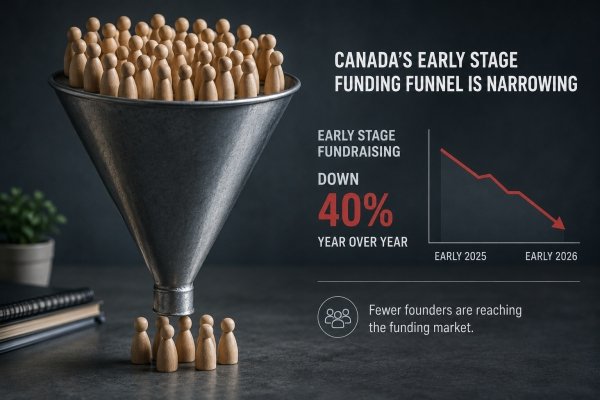
On June 24, 2026, RBCx published its Canadian VC 2026 Mid-Year report, showing that Canada’s early stage funding squeeze at venture funds is now also a startup company reality. RBCx says its Early Stage Banking team works with more than 1,200 pre seed and seed stage companies headquartered in Canada each year, and its current dataset covers more than 2,100 founder conversations.
The figures report that not only less capital is being raised, but fewer founders appear to be reaching the market at all. RBCx tracked 162 companies raising a combined $510.7 million in January 2025. By March 2026, only 61 companies were actively raising, with total capital sought down to about $189.8 million.
Average raise size held near $3 million from September 2024 to March 2026. That makes the data more troubling, not less. The market is not simply producing smaller seed rounds. It appears to be producing fewer founders who can raise them.
RBCx’s data suggests that early stage capital, which is often treated as the entry point into the venture system, is becoming harder to reach.
If fewer pre seed and seed companies are actively raising while average round size holds steady, the impact affects breadth of market.
Stronger or better connected founders may still complete rounds, but the number of companies entering the funding conversation appears to be shrinking.
A smaller early stage funnel means fewer companies get the chance to test markets, build traction, reach Series A, or become future scaleups. The risk is not only lower fundraising volume. It is a thinner innovation pipeline.
The company level data also connects back to the fund level pressure NCFA covered earlier this year in Canadian VC Fundraising Contracts And Concentrates In 2025. RBCx previously found that Canadian venture firms raised just over $2 billion in 2025, while the top five funds captured 83% of total capital raised.
RBCx’s mid year update says the top five funds captured 80% of total capital raised by 2025, while all other funds combined dropped from $4.5 billion at the 2021 peak to $444 million, close to a 90% decline.
When capital concentrates around fewer funds, founders face fewer decision makers, narrower investor funnels, and less room for non consensus ideas. That is especially important at the earliest stages, where conviction often depends on relationships, sector belief, and willingness to take risk before the metrics are obvious.
RBCx estimates that emerging managers raised about $2.8 billion over the past three years, compared with an expected $4.3 billion based on historical averages. That leaves a 36% funding shortfall.
Matt Roberts, Managing Director, Venture Coverage at RBCx, described the issue directly:
“Emerging managers are the engine of early-stage innovation in Canada. They’re willing to take on the riskier bets by backing first-time founders solving problems the market hasn’t fully recognized yet.”
His quote explains why this is a capital formation issue, not only a venture industry issue. Emerging managers often fund the companies that don't yet fit the pattern recognition of larger funds. When those managers cannot raise successor funds, Canada loses part of the market that is most willing to back first time founders, new categories, and early signals.
Canadian VC fundraising contracted and concentrated in 2025, with less new capital available for initial investments.
A built in Canada startup moved to the U.S., showing how capital access, customer depth, and market scale can influence where promising companies choose to grow.
Canada’s productivity challenge increasingly connects to capital formation, innovation scale, and the ability to turn new companies into durable economic output.
Targeted entrepreneurship funding remains an active policy tool as Canada tries to close founder capital gaps across underrepresented groups.
NCFA’s Financial Innovation Map tracks capital formation, alternative funding, venture infrastructure, and founder financing opportunities across Canada’s innovation ecosystem.
If Canada rebuilds early stage breadth, more founders can test markets, attract first capital, and create the next set of Series A candidates. That requires more than headline capital. It requires LP support for emerging managers, stronger growth stage confidence, and funding pathways that let founders raise before they fit the safest investor pattern.
Fewer funded companies may improve selectivity, but it can also remove the messy experimentation that produces outlier companies. If the ecosystem only funds the obvious companies, Canada may reduce failure rates while also reducing the number of breakout opportunities.
If average seed rounds remain stable but far fewer founders are raising, is Canada becoming more selective or simply losing the breadth and risk appetite needed to build the next generation of scaleups?
The National Crowdfunding & Fintech Association (NCFA Canada) is a financial innovation ecosystem that provides education, market intelligence, industry stewardship, networking and funding opportunities and services to thousands of community members and works closely with industry, government, partners and affiliates to create a vibrant and innovative fintech and funding industry in Canada. Decentralized and distributed, NCFA is engaged with global stakeholders and helps incubate projects and investment in fintech, alternative finance, crowdfunding, peer-to-peer finance, payments, digital assets and tokens, artificial intelligence, blockchain, cryptocurrency, regtech, and insurtech sectors. Join Canada's Fintech & Funding Community today FREE! Or become a contributing member and get perks. For more information, please visit: www.ncfacanada.org
| | |
|---|---|---|
| | |

Open finance can move SME capital access beyond static applications and backward looking credit files. The opportunity is to use permissioned business, financial, invoice, payment, accounting and treasury data to support better working capital, credit, invoice finance and treasury decisions.
Market sizing should not rely on one broad fintech TAM figure. The more reliable assessment is that several adjacent markets are converging: SME lending, embedded finance, invoice finance, working capital, open finance infrastructure and AI assisted credit decisioning.
The strongest opening is not simple cash flow underwriting. It is the decision and action layer that turns permissioned SME data into capital access: embedded working capital, real time credit, invoice finance automation and treasury optimization.
UK open finance experiments, CFIT SME prototypes, Canada Consumer Driven Banking implementation, Competition Bureau SME financing findings, embedded finance distribution, AI credit decision controls, invoice data standards, and early evidence that SME treasury optimization becomes a purchasable product rather than only a dashboard feature.
Evidence currently supports four venture scale paths. Connected SME data, cash flow underwriting and AI decisioning are enabling layers. They should not be treated as standalone product paths unless evidence later shows a distinct purchasable product category.
Capital inside SME workflows and platforms
SMEs often need capital at the point of activity: invoices, payroll, inventory, supplier payments, marketplace sales or software workflows. Embedded working capital uses platform context and permissioned financial data to offer capital where the need appears.
The innovation is not embedding a loan button. It is combining workflow data, financial data, repayment capacity and AI assisted decisioning so capital can be offered with better timing, fit and controls.
Platforms may prefer to partner with existing lenders or build lending directly, reducing room for specialist infrastructure providers.
Which embedded workflows create the clearest budget: accounting, PSPs, invoicing, marketplaces, payroll, procurement or vertical software?
Dynamic credit decisions from live business data
Real time SME credit uses fresh cash flow, account, payment, invoice, accounting and business data to support faster approvals, dynamic limits and ongoing reviews. It is different from mature cash flow underwriting when the credit product updates as business conditions change.
Potential buyers include lenders, banks, embedded finance providers, PSPs, accounting platforms and credit infrastructure providers.
If real time credit remains only a faster version of existing underwriting, the innovation window may be too narrow.
Can connected data support dynamic limits, early warnings, covenant style monitoring or instant credit decisions without creating unacceptable bias, privacy or model risk?
Receivables finance using invoice and payment data
Invoice finance automation uses invoice, accounting, buyer, payment and fraud data to decide whether receivables can be financed. The opportunity is stronger when systems verify invoice validity, buyer reliability, payment timing and repayment risk without manual PDF workflows.
This path may be distinct enough to survive as a child opportunity if evidence grows around invoice intelligence, receivables verification and automated funding decisions.
Invoice finance may remain a lender workflow improvement unless automation clearly reduces fraud, friction, cost or access barriers for SMEs.
Are lenders and platforms using live invoice and accounting connections to automate financing decisions, or only digitizing existing manual workflows?
Capital allocation and liquidity decisions
SME treasury optimization goes beyond monitoring. It uses connected financial data and AI assisted decisioning to help SMEs decide when to borrow, repay debt, hold cash, pay suppliers, finance invoices, invest surplus cash or allocate liquidity across accounts and payment rails.
This is currently earlier than embedded working capital, but it may become the most differentiated open finance path if evidence shows SMEs adopting decision products rather than dashboards.
If products remain cash flow dashboards or alerts without trusted action, this should remain an enabling feature rather than a product path.
Will SMEs delegate capital allocation, liquidity and financing actions to AI assisted treasury tools with human oversight?
Filter by signal type to review source records, market signals and thought leadership supporting this opportunity. Evidence is sorted newest to oldest.
Share your perspective, research, case study or video response. You can also express interest in future discussions, collaboration opportunities and innovation activities related to this topic.
Learn how NCFA identifies, validates and tracks innovation opportunities →NCFA Opportunity Intelligence tracks emerging venture opportunities using evidence, market developments and validation signals. Opportunity briefs are updated as new information, evidence and stakeholder perspectives become available. This content is provided for information purposes only and does not constitute legal, investment, financial, tax or professional advice.
The National Crowdfunding & Fintech Association (NCFA Canada) is a financial innovation ecosystem that provides education, market intelligence, industry stewardship, networking and funding opportunities and services to thousands of community members and works closely with industry, government, partners and affiliates to create a vibrant and innovative fintech and funding industry in Canada. Decentralized and distributed, NCFA is engaged with global stakeholders and helps incubate projects and investment in fintech, alternative finance, crowdfunding, peer-to-peer finance, payments, digital assets and tokens, artificial intelligence, blockchain, cryptocurrency, regtech, and insurtech sectors. Join Canada's Fintech & Funding Community today FREE! Or become a contributing member and get perks. For more information, please visit: www.ncfacanada.org
| | |
|---|---|---|
| | |
Stablecoins are moving from speculative crypto activity toward operating money for settlement, cross border payments, treasury workflows, merchant settlement and tokenized asset cash legs. The strongest opening is not launching another stablecoin. It is building the payment, treasury, reconciliation and compliance layer that lets businesses use stablecoins safely.
Stablecoin market size is difficult to measure cleanly. Market cap and daily trading volume show scale, but they do not equal payment adoption. For this opportunity, the better signal is the mix of adjusted onchain activity, issuer supply, network settlement pilots, merchant acceptance, treasury workflows and bank or PSP integration.
The strongest opening is the operating layer above stablecoin issuance: routing, acceptance, settlement, treasury controls, reconciliation, compliance workflows, and bank or network integration. The buyer may be a PSP, merchant platform, marketplace, treasury team, bank, issuer or tokenized asset platform that needs faster settlement without weaker controls.
Canada stablecoin framework implementation, US payment stablecoin rules, Bank of England and FCA stablecoin policy, network integrations, merchant settlement pilots, treasury adoption and tokenized asset cash leg use.
Evidence supports five product paths. These are product directions inside the parent opportunity, not automatic child Opportunity Briefs.
Compliant payouts, supplier payments and remittances
Cross border payments remain slow and costly for many businesses. Stablecoins can reduce settlement friction when compliance, liquidity and redemption controls are reliable.
This path has the clearest buyer pain because businesses already pay for speed, transparency, lower cost and better payout coverage.
Existing remittance networks, banks and PSPs bundle stablecoin rails before specialists establish durable wedges.
Can the product reduce cost, failed payments, settlement delay or FX friction enough to win recurring payment budget?
Move, hold and reconcile digital dollar liquidity
Global firms increasingly need to move funds across platforms, wallets, banks and jurisdictions. Stablecoins can support liquidity timing, payout automation, reconciliation and treasury controls.
This path is close to the strongest path because treasury teams have recurring operational problems, but adoption depends on accounting, audit and banking integration.
Treasury teams avoid stablecoins unless accounting, risk, custody and bank integration become routine.
Will treasury teams pay for stablecoin workflow, controls and reconciliation rather than wait for bank or PSP bundles?
Faster access to funds and programmable reconciliation
Merchants and platforms want faster settlement and lower friction. Stablecoin settlement could support niche and cross border cases where volatility, risk and compliance concerns are controlled.
This path is commercially attractive but may remain hidden inside PSP, acquirer or platform workflows rather than appearing as a consumer facing product.
Card networks, acquirers and PSPs improve settlement enough that merchants do not care which rail is used.
Which merchant segments experience settlement delay or cross border payout pain strongly enough to change providers?
Settlement money for tokenized assets
Tokenized assets need reliable payment legs for settlement, redemption, collateral movement and asset servicing. Stablecoins may support these workflows when bank money or central bank money is not available on the same rails.
This path connects stablecoins to tokenized funds, digital securities and market infrastructure, but regulatory and institutional adoption remain uneven.
Tokenized deposits, central bank money or private bank led networks become the preferred settlement asset for regulated institutions.
Which tokenized asset workflows need stablecoins rather than bank money, and who controls the cash leg?
Monitoring, screening, reporting and audit workflows
Business use of stablecoins depends on controls for AML, sanctions, wallet screening, reserve reporting, reconciliation, travel rule, issuer oversight and auditability.
This path may become the most durable horizontal layer if stablecoin payments expand across banks, PSPs, issuers and platforms.
Compliance tools remain bundled inside issuer, bank or PSP platforms, leaving little room for standalone vendors.
Can controls reduce compliance cost or operational risk enough to win bank, issuer, PSP or platform budget?
Each row shows the evidence date, post type, linked topic, why it matters to this opportunity, and the signal category used for filtering. Evidence type classifies the signal, not the publisher. Evidence is sorted newest to oldest.
Share your perspective, research, case study or video response. You can also express interest in future discussions, collaboration opportunities and innovation activities related to this topic.
Learn how NCFA identifies, validates and tracks innovation opportunities →NCFA Opportunity Briefs track evidence-backed financial innovation opportunities as they move from early signals toward practical commercialization. Public pages show the current assessment and supporting evidence for founders, investors, operators and ecosystem participants.
The National Crowdfunding & Fintech Association (NCFA Canada) is a financial innovation ecosystem that provides education, market intelligence, industry stewardship, networking and funding opportunities and services to thousands of community members and works closely with industry, government, partners and affiliates to create a vibrant and innovative fintech and funding industry in Canada. Decentralized and distributed, NCFA is engaged with global stakeholders and helps incubate projects and investment in fintech, alternative finance, crowdfunding, peer-to-peer finance, payments, digital assets and tokens, artificial intelligence, blockchain, cryptocurrency, regtech, and insurtech sectors. Join Canada's Fintech & Funding Community today FREE! Or become a contributing member and get perks. For more information, please visit: www.ncfacanada.org
| | |
|---|---|---|
| | |



August 26th, 2025

January 4th, 2024

June 1st, 2021

September 9th, 2020

July 9th, 2018

January 3rd, 2018

September 25th, 2017

June 20th, 2017

May 10th, 2017

December 14th, 2016
