





Karsten Wenzlaff, Advisor
August 26th, 2025
Karsten Wenzlaff is a Crowdfunding and Fintech Expert from Germany. He is Secretary-General of Digit[...]


June 13, 2026 | NCFA Fintech Whisperer | Capital Markets And Market Infrastructure, Lending Consumer Credit And BNPL, Regulation And Policy, Risk Compliance And Regtech, Payments And Market Infrastructure, Digital Assets Blockchain And Tokenization, Artificial Intelligence And Data

Image: Freepik
This live weekly NCFA intelligence page tracks financial technology developments that significantly affect how fintechs build, sell, raise capital, and operate under scrutiny. Coverage prioritizes Canada and includes global events that directly influence competitive conditions, market access, and execution realities across fintech sectors. This page will be updated throughout the week with market movers in a live format and then each week we'll close the prior week's contents in prep for the upcoming week, and continue on a rolling basis. (Missed prior week's Fintech Whisperer? (December 6-12, 2025, December 13-19, 2025, January 1-9, 2026, January 10-16, 2026, January 17-23, 2026, January 24-30, 2026, January 31-February 6, 2026, February 7-13, 2026, February 14-20, 2026, February 21-27, 2026, February 28-March 6, 2026, March 7-13, 2026, March 14-20, 2026, March 21-27, 2026, March 28-April 3, 2026, April 4-10, 2026, April 11-17, 2026, April 18-24, 2026, April 25-May 1, 2026, May 2-8, 2026, May 9-15, 2026, May 16-22, 2026, May 23-29, 2026, May 30-Jun 5, 2026, Jun 6-12, 2026).
European supervision is becoming more operational and technology focused. Banks, fintechs, crypto asset firms, infrastructure providers, and compliance teams should watch how DORA, MiCA, and EMIR oversight changes vendor governance, resilience testing, supervisory reporting, third party risk management, and regulatory accountability.
Supervision is becoming more data driven, technology enabled and cross border. Securities regulators are building stronger tools for market surveillance, fraud detection, investor protection and digital asset oversight, which raises the operating bar for firms whose compliance, reporting and risk controls still depend on slow manual processes.
Prediction markets are moving from niche trading communities toward mainstream financial distribution. Retail platforms, exchanges, regulators, investors, and market operators should watch how event contracts evolve as a new information, forecasting, hedging, and market intelligence layer. Distribution may become as important as market design in determining adoption. See: Innovation Opportunities In Regulated Event Contract Infrastructure.
Post trade risk reduction is becoming part of capital markets infrastructure. Dealers, clearing participants, platforms, and regulators should watch how compression, optimization, exposure reduction, and capital efficiency tools are treated as supervised infrastructure rather than back office utilities.
Bond transparency reform is creating demand for new market data infrastructure. Trading venues, asset managers, dealers, data providers, and regulators should watch how fixed income reporting, consolidated data, and transparency tools reshape price discovery and execution quality across European bond markets.
Agentic AI is moving into capital markets workflow. For dealers, asset managers, pension funds, and credit trading desks, the issue is no longer only faster market search. The next phase is how supervised AI tools support pricing, liquidity discovery, execution preparation, and workflow decisions inside regulated markets.
Natural language tools tied to pricing, trade data, and workflow systems could change how institutional traders search markets, compare bonds, assess liquidity, and act on data inside regulated trading environments.
Stablecoins are being embedded directly into payment and remittance infrastructure. Payment firms, PSPs, remittance operators, banks, liquidity providers, and compliance teams should watch how regulated stablecoin settlement, API connectivity, and cross border liquidity become part of the operating stack for high volume regional payment networks.
Search is becoming regulated digital infrastructure. Publishers, fintechs, platforms, marketplaces, advertisers, AI search providers, and compliance teams should watch how ranking rules, data portability, publisher protections, and user choice requirements change discovery, distribution, and competition across search and AI enabled information access.
Institutional digital asset infrastructure is entering bank charter channels. Banks, custodians, wealth platforms, crypto firms and regulators should watch how national trust bank approvals shape custody, staking, lending support, capital requirements and supervisory expectations for digital asset services.
MiCAR is shifting crypto firms from fragmented national registrations toward regulated infrastructure choices. VASPs, exchanges, brokers, fintechs, custodians, and compliance teams should watch how licensing pressure turns custody, wallet services, settlement, liquidity, and operating controls into market access requirements across Europe.
AI linked lending platforms continue to connect consumer credit origination with capital markets distribution. Pagaya’s latest transaction shows how underwriting models, loan supply, securitization channels, and institutional demand are combining into repeatable credit infrastructure.
Canadian bank capital policy is shifting from maximum conservation toward controlled lending capacity. Banks, lenders, fintech partners, investors, and policymakers should watch how lower buffer requirements affect credit availability, capital planning, risk appetite, and competitive conditions across the financial system.
Canada is moving privacy, AI, consumer data, and platform accountability into the same regulatory agenda. Financial institutions, fintechs, AI vendors, data brokers, and digital platforms should watch how consent, deletion rights, automated decision transparency, children’s data protections, and guidance for onboarding, data use, AI and partnerships affect product design and data governance.
The review could affect how fintechs, derivatives firms and market infrastructure providers engage with US regulated markets. Firms should watch for changes that reduce unnecessary compliance friction while maintaining market integrity, customer protection and risk oversight.
The useful evidence is the transmission channel, not a prediction that CBDC will launch. Digital money competition affects deposits, funding costs, liquidity treatment, lending capacity, and central bank balance sheet operations. Operators, founders, and investors should watch how CBDC, fintech deposits, stablecoins, and payment infrastructure reforms change competition for bank funding.
The week's strongest market and regulatory signals weren't new products. They were changes to the infrastructure underneath financial markets. Bank capital rules, prediction market access, stablecoin rails, and compute markets all point to the same outcome. Firms that control access, distribution, liquidity, and critical infrastructure may increasingly determine who can compete and who cannot.
NCFA offers various curated resources to help founders and investors stay current on developments that impact fintech markets, subscribe to NCFA weekly newsletter updates, view the latest fintech insights, industry research, or launch into emerging financial innovation opportunities.
 The National Crowdfunding & Fintech Association (NCFA Canada) is a financial innovation ecosystem that provides education, market intelligence, industry stewardship, networking and funding opportunities and services to thousands of community members and works closely with industry, government, partners and affiliates to create a vibrant and innovative fintech and funding industry in Canada. Decentralized and distributed, NCFA is engaged with global stakeholders and helps incubate projects and investment in fintech, alternative finance, crowdfunding, peer-to-peer finance, payments, digital assets and tokens, artificial intelligence, blockchain, cryptocurrency, regtech, and insurtech sectors. Join Canada's Fintech & Funding Community today FREE! Or become a contributing member and get perks. For more information, please visit: www.ncfacanada.org
 |  |  |
|---|---|---|
 |  |  |
June 19, 2026 | NCFA Resource | Artificial Intelligence And Data
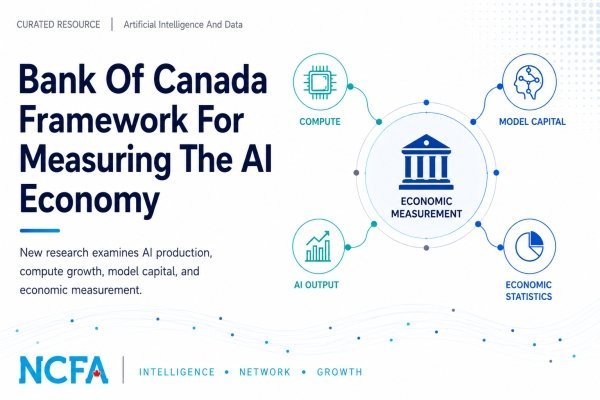
On June 18, 2026, the Bank of Canada published Measuring the AI Economy, a staff working paper by Anton Korinek and Patrick McKelvey. The paper examines whether traditional economic statistics can properly capture AI production, compute growth, model training, inference output, and the value being created inside the AI economy.
The paper argues that AI activity is difficult to see through standard GDP categories because it is spread across cloud computing, software, professional services, data centres, chips, electricity, and model development. That makes AI look smaller in official statistics than it may be in production capacity.
The research builds a first macroeconomic estimate of US AI production from 2023 to 2025. It starts with compute as the core input, generated from AI chips, data centre capacity, and electricity. That compute is then split between inference and training.
Inference produces AI outputs used across the economy. Training creates model capital, which the authors treat as an intangible asset that improves future AI output.
The headline numbers are large. The authors estimate that nominal AI compute spending grew from $36.92B in 2023 to $90.46B in 2024 and $219.17B in 2025. That implies annual growth of about 145% in 2024 and 142.3% in 2025.
Physical compute output grew faster, rising about 211.9% in 2024 and 213.9% in 2025. After quality adjustments, the paper estimates AI production growth above 2,000% per year. Its early AI GDP framework estimates real AI GDP growth of about 2,600% in 2024 and 2,658% in 2025.
The authors are careful about the limits. These aren't official GDP statistics. The framework relies on strong assumptions, limited data, and uncertainty about how benchmark performance turns into economic value.
This resource is useful for fintech founders, AI companies, policy teams, investors, economists, regulators, data centre operators, infrastructure investors, and anyone tracking how AI affects productivity, capital allocation, labour markets, and public policy.
It is especially relevant for teams working on AI infrastructure, compute markets, AI governance, productivity measurement, model economics, and public sector digital strategy.
The strength of the paper is its measurement lens. It doesn't treat AI as a single software category. It treats AI production as a system built from chips, power, data centres, inference, training, and model capital. That connects directly to the market question of pricing access to scarce AI capacity.
That's valuable for NCFA readers because compute is becoming an economic input, not just a technical resource. If compute markets, energy access, chip supply, and model efficiency determine AI output, then AI policy and AI competition cannot be separated from infrastructure.
The paper also gives policymakers a warning. If official statistics do not capture AI capacity early enough, fiscal planning, productivity analysis, tax policy, and monetary policy may be working with incomplete information. The same measurement issue shows up in central bank operations, where the Bank of Canada has already examined AI adoption in central banking.
The limit is uncertainty. The authors don't claim to replace GDP. They propose a measurement framework that can support future AI satellite accounts and better statistical infrastructure.
Bank Of Canada Measuring The AI Economy (primary Bank of Canada working paper)
AI Agents Enter Governed Financial Workflows (AI governance and operations)
AI Risk Taxonomy For Audits And Controls (AI risk classification)
The National Crowdfunding & Fintech Association (NCFA Canada) is a financial innovation ecosystem that provides education, market intelligence, industry stewardship, networking and funding opportunities and services to thousands of community members and works closely with industry, government, partners and affiliates to create a vibrant and innovative fintech and funding industry in Canada. Decentralized and distributed, NCFA is engaged with global stakeholders and helps incubate projects and investment in fintech, alternative finance, crowdfunding, peer-to-peer finance, payments, digital assets and tokens, artificial intelligence, blockchain, cryptocurrency, regtech, and insurtech sectors. Join Canada's Fintech & Funding Community today FREE! Or become a contributing member and get perks. For more information, please visit: www.ncfacanada.org
| | |
|---|---|---|
| | |
June 16, 2026 | NCFA Story Intelligence | Fraud, Cybersecurity And Trust

The phone rings. Many people no longer answer.
Not because they’re too busy. Because they’re not sure who is calling, what’s real, or whether the message is safe to trust. That small behaviour change tells a bigger story about finance, fraud, identity, and technology.
For years, financial trust relied on familiar signals: a voice, a face, a password, a bank name, a phone number, a regulator, a delay before money moved. AI clones, biometric breaches, deepfakes, cyberattacks, weak AML controls, and faster payments are now breaking those signals at the same time.
Financial trust used to have more time. Branch visits, paper signatures, settlement delays, call centre checks, account holds, and human review gave institutions more room to spot problems before money moved too far. The system was slower, but that slowness created time to verify.
Consumers learned to trust familiar signals. A bank logo felt official. A caller who knew account details sounded credible. A voice sounded personal. A password felt private. Those signals were never perfect, but they worked well enough when fraud was slower, less automated, and easier to recognize.
Online finance moved trust away from the branch. Banking, investing, lending, crypto, payments, and onboarding shifted into screens and apps. That created better access and faster service, but it also made customers depend on passwords, text codes, device checks, email links, and remote identity tools.
Fraudsters followed the customer online. Phishing, fake websites, account takeover, crypto wallet scams, approval phishing, QR abuse, and spoofed support channels made digital convenience feel less certain. Operation Avalanche showed how coordinated fraud response is becoming part of the market.
Voice used to feel personal. Then AI cloning made it copyable. Cloned voices bypassed Voice ID tests at Santander and Halifax, exposing weakness in systems that treated a voice as a reliable authentication signal.1
The scam no longer has to sound like a scam. A cloned voice can sound calm, familiar, urgent, or official. That changes the risk for banks, call centres, families, executives, seniors, and anyone asked to approve a transfer or share information after hearing a voice they think they know.
Biometrics raise the stakes because they cannot be replaced easily. A major India breach exposed fingerprints, facial scans, and sensitive records tied to police officers and applicants.2 A password can be reset. A fingerprint can’t.
Fintech products increasingly depend on biometric convenience. Face ID, Touch ID, palm payment, device based onboarding, and selfie checks reduce friction. They can also concentrate risk if biometric templates, face scans, or identity documents are stored poorly or exposed through vendors.
Deepfakes make fraud feel human. Deepfake scams have used AI generated voices, fake identities, digital banks, and crypto rails to trick victims and move funds quickly.3
AI makes deception cheaper to personalize. Fraudsters can imitate an executive, a family member, a bank employee, a support agent, or an investment promoter. The scam can be written better, timed better, targeted better, and delivered through channels that look more legitimate than old phishing emails.
Faster money gives fraud less time to fail. Real Time Rail, instant payments, request to pay, and faster settlement can improve cash flow and customer experience. They also shrink the window for fraud teams to stop a bad payment before it settles.
Fraud controls become part of the payment product. Real Time Rail analysis connects instant payments with centralized fraud capability, payment finality, and trust.4 Faster money only works if participants believe the system can manage faster mistakes.
Institutions are not only defenders. They are targets. CIRO confirmed approximately 750,000 Canadian investors were affected by a cybersecurity incident after a 9,000 hour forensic review.5 When regulated bodies are breached, trust damage extends beyond one account.
Third party systems can carry hidden risk. SaaS vendors can create concentration risk across fintech and financial services. A startup may inherit risk through a vendor, API, data processor, onboarding tool, cloud provider, or fraud vendor it does not fully control.
AML failure shows how controls can become business risk. TD’s more than $3 billion US AML penalty and leadership fallout showed how weak controls can limit strategy, growth, reputation, and trust.6
Canada is trying to organize the response. Canada’s first National Anti Fraud Strategy and Financial Crimes Agency push point toward more public and private collaboration on cyber risk, data sharing, and proceeds of crime recovery.7
Fraud didn’t break trust all at once. It weakened the signals people and institutions used to verify reality. The phone call. The voice. The face. The fingerprint. The login. The bank name. The official looking message. The settlement delay. The regulated institution. Each one still matters, but none can carry trust on its own anymore.
That’s the hard part for financial innovation. Canada is moving toward faster payments, consumer driven banking, digital identity discussions, AI adoption, crypto market controls, and more automated financial services. None of those systems succeed simply because they’re fast or digital. They succeed because people trust what they’re seeing, hearing, approving, and authorizing.
What trust signal do you question now that you wouldn’t have questioned five years ago?
Share this story → Explore related intelligence → Subscribe
The National Crowdfunding & Fintech Association (NCFA Canada) is a financial innovation ecosystem that provides education, market intelligence, industry stewardship, networking and funding opportunities and services to thousands of community members and works closely with industry, government, partners and affiliates to create a vibrant and innovative fintech and funding industry in Canada. Decentralized and distributed, NCFA is engaged with global stakeholders and helps incubate projects and investment in fintech, alternative finance, crowdfunding, peer-to-peer finance, payments, digital assets and tokens, artificial intelligence, blockchain, cryptocurrency, regtech, and insurtech sectors. Join Canada's Fintech & Funding Community today FREE! Or become a contributing member and get perks. For more information, please visit: www.ncfacanada.org
| | |
|---|---|---|
| | |
June 16, 2025 | NCFA Resource | Risk Compliance And Regtech, Artificial Intelligence And Data, Regulation And Policy
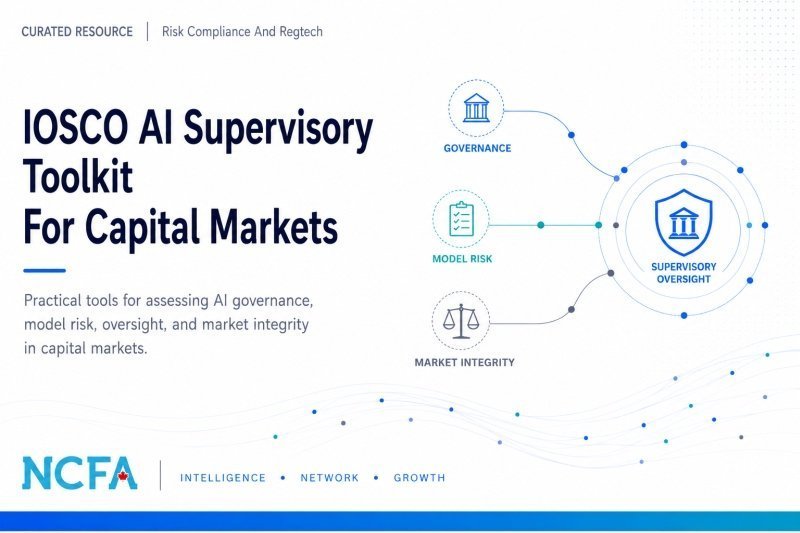
On May 25, 2026, the International Organization of Securities Commissions (IOSCO) published its Supervisory Toolkit for Artificial Intelligence Use in Capital Markets. The report provides practical tools for regulators supervising AI systems used by market participants, exchanges, investment firms, and capital market infrastructure providers.
The toolkit arrives as AI goes beyond experimentation and into production environments across trading, surveillance, compliance, onboarding, fraud detection, customer service, research, risk management, and operational workflows. IOSCO focuses on the supervisory questions regulators need to ask rather than promoting a specific technology approach.
Stakeholder Input Opportunity: IOSCO is also seeking feedback related to the toolkit and AI supervision in capital markets. Interested regulators, market participants, technology providers, academics, and industry stakeholders can review the report and submit responses to IOSCO by this short survey by June 26, 2026.
The report organizes supervision around seven areas. These include governance and accountability, model development and testing, data quality and management, monitoring and controls, outsourcing and third party providers, market conduct risks, and operational resilience.
Rather than prescribing rules, IOSCO provides supervisory questions, review approaches, and practical considerations that regulators can use when assessing AI systems operating in capital markets. The toolkit is designed to support risk based supervision while remaining flexible as technologies evolve.
The report also recognizes that AI risks often emerge from combinations of factors rather than a single model failure. Poor quality data, weak governance, limited oversight, inadequate testing, vendor dependencies, and insufficient monitoring can interact in ways that create market, operational, or investor protection concerns.
Many financial institutions are already deploying AI in regulated environments. The challenge is no longer whether AI will be used. The challenge is whether firms can demonstrate appropriate governance, explainability, oversight, and accountability once those systems affect clients, markets, or investment decisions.
For fintech operators, the toolkit offers a useful preview of the questions regulators may increasingly ask during examinations, supervisory reviews, audits, and risk assessments. Firms that build governance and controls into deployment processes early may face fewer compliance and operational challenges as expectations mature.
This resource is useful for securities regulators, exchanges, investment dealers, fintech founders, regtech providers, compliance teams, AI governance specialists, risk managers, and market infrastructure operators.
It is especially relevant for organizations using AI in trading, surveillance, onboarding, fraud detection, compliance monitoring, client communications, investment research, portfolio management, or operational decision making.
The strength of the toolkit is its practical orientation. It extends beyond high level AI principles and focuses on supervision, controls, accountability, and operational implementation. The framework can be applied across a wide range of AI use cases and organizational structures.
It also provides a common language that regulators and industry participants can use when discussing AI oversight. That consistency becomes increasingly important as firms operate across multiple jurisdictions with different regulatory approaches.
The toolkit does not create binding rules or regulatory obligations. IOSCO's role is to provide guidance and supervisory tools that member jurisdictions can adapt to their own legal and regulatory frameworks.
IOSCO Supervisory Toolkit For AI Use In Capital Markets (primary resource)
IOSCO Media Release (official announcement)
AI Agents Enter Governed Financial Workflows (AI governance and oversight)
Customer Due Diligence Controls For Fintechs (controls, monitoring, and accountability)
The National Crowdfunding & Fintech Association (NCFA Canada) is a financial innovation ecosystem that provides education, market intelligence, industry stewardship, networking and funding opportunities and services to thousands of community members and works closely with industry, government, partners and affiliates to create a vibrant and innovative fintech and funding industry in Canada. Decentralized and distributed, NCFA is engaged with global stakeholders and helps incubate projects and investment in fintech, alternative finance, crowdfunding, peer-to-peer finance, payments, digital assets and tokens, artificial intelligence, blockchain, cryptocurrency, regtech, and insurtech sectors. Join Canada's Fintech & Funding Community today FREE! Or become a contributing member and get perks. For more information, please visit: www.ncfacanada.org
| | |
|---|---|---|
| | |
June 6, 2026 | NCFA Fintech Whisperer | Digital Assets Blockchain And Tokenization, Payments And Market Infrastructure, Artificial Intelligence And Data, Capital Markets And Market Infrastructure, Regulation And Policy, Risk Compliance And Regtech
Image: Freepik
This live weekly NCFA intelligence page tracks financial technology developments that significantly affect how fintechs build, sell, raise capital, and operate under scrutiny. Coverage prioritizes Canada and includes global events that directly influence competitive conditions, market access, and execution realities across fintech sectors. This page will be updated throughout the week with market movers in a live format and then each week we'll close the prior week's contents in prep for the upcoming week, and continue on a rolling basis. (Missed prior week's Fintech Whisperer? (December 6-12, 2025, December 13-19, 2025, January 1-9, 2026, January 10-16, 2026, January 17-23, 2026, January 24-30, 2026, January 31-February 6, 2026, February 7-13, 2026, February 14-20, 2026, February 21-27, 2026, February 28-March 6, 2026, March 7-13, 2026, March 14-20, 2026, March 21-27, 2026, March 28-April 3, 2026, April 4-10, 2026, April 11-17, 2026, April 18-24, 2026, April 25-May 1, 2026, May 2-8, 2026, May 9-15, 2026, May 16-22, 2026, May 23-29, 2026, May 30-Jun 5, 2026).
Citi is combining traditional securities infrastructure with blockchain based issuance, custody, and settlement for private company equity. The launch adds another proof point that tokenized infrastructure is changing how markets operate, especially as banks, exchanges, and market operators compete to define how private assets move onto digital rails.
Digital asset access is being packaged for banks, brokerages, fintechs, and platforms that do not want to build the full crypto stack themselves. The control point is the embedded infrastructure that handles custody, liquidity, compliance, settlement, and connectivity behind the customer experience.
Tokenized real world assets are moving into bank distribution channels. DBS is turning physical gold into a digital product that can sit inside a retail banking app, while also testing institutional market access through its digital exchange.
Stablecoin supervision is moving from broad policy debate into operating rules. Issuers, custodians, exchanges, auditors, compliance vendors, and payment firms need to track how reserve custody, internal controls, audits, and service provider oversight become part of stablecoin market access.
Card networks are building trust infrastructure for AI driven payments. Visa’s updates add another network level proof point that identity, authorization, fraud controls, tokenized credentials, and settlement will shape how AI agents are allowed to transact.
Recurring payment rails are becoming a financial inclusion tool when they help users pay for digital services without relying on credit cards. Brazil’s Pix Automático data shows how local real time payment infrastructure can support subscriptions, platform access, and digital commerce growth.
Agentic payments are moving from checkout experiments into network infrastructure. Payment firms, AI platforms, stablecoin providers, banks, and identity vendors now have to solve authorization, spending limits, settlement, fraud controls, and liability for machines that can transact without a human at every step.
Large banks are building their own tokenized money infrastructure rather than relying on third party stablecoin networks. Payment providers, treasury platforms, and financial institutions now face a more competitive settlement environment as bank money, stablecoins, and tokenized commercial bank deposits compete for transaction flow.
Circle Payments Network continues to add distribution. Business accounts, treasury platforms, and payment providers are becoming part of the stablecoin settlement infrastructure rather than simply connecting to it.
Circle is extending its infrastructure footprint from stablecoins into Bitcoin collateral. Builders now have another institutional grade option for collateral and tokenized asset applications.
AI agents are moving from recommendation and discovery toward financial execution. Coinbase for Agents puts user controlled account access, payments, trading, and workflow automation into the same agentic finance conversation as network trust controls, stablecoin settlement, fraud prevention, and responsible AI governance.
AI supervision in finance is evolving from broad risk discussion toward operating practices for boards, senior management, compliance teams, model owners, technology vendors, and supervisors. Financial institutions need to track how governance, documentation, human oversight, cyber controls, and third party dependencies become part of responsible AI adoption.
Always-on markets need reference data that does not stop when traditional exchanges close. Exchanges, tokenized asset platforms, derivatives venues, market makers, and risk teams now have another pricing source to evaluate as real-world assets trade across crypto-native market infrastructure.
Prediction markets are starting to need the same financial plumbing as capital markets. Market makers, exchanges, payment providers, banks, and compliance teams now need infrastructure that can handle deposits, margin, settlement, risk controls, and regulated access without slowing down trading activity.
Prediction markets are moving from platform experimentation and court fights into formal rule design. Kalshi, Polymarket, DraftKings, Flutter/FanDuel, exchanges, market makers, compliance teams, sports leagues, and retail users now have a clearer process to debate which contracts belong in derivatives markets and which remain too close to gaming, misconduct, or public interest risk.
Financial crime compliance is increasingly becoming an existential regulatory issue rather than a supervisory issue alone. Payment firms, e-money institutions, fintechs, compliance teams, and investors should watch how regulators use governance, safeguarding, ownership, and financial crime controls as indicators of firm viability. The action signals that supervisory concerns can now lead to intervention measures that effectively remove a regulated firm's ability to continue operating.
Canada is pulling AI chatbots into platform safety regulation. AI firms, social platforms, trust and safety teams, identity providers, and compliance vendors should watch how age assurance, safety controls, reporting duties, and enforcement rules develop as digital safety becomes part of regulated online infrastructure.
Financial supervisors are beginning to treat AI as both a productivity tool and a threat multiplier. Banks, insurers, payment firms, fintechs, and security providers should expect greater scrutiny of fraud controls, cyber resilience, operational risk management, and third party technology oversight as regulators adapt supervision to an AI enabled threat environment.
Banking access is moving back onto the policy agenda as branch closures, digital exclusion, SME credit access, and local service gaps put pressure on financial providers. Banks, fintechs, credit unions, open finance firms, and data providers should watch whether the review leads to new access rules, credit data reforms, or stronger expectations around community banking infrastructure.
As advanced analytics become embedded in public institutions, governance questions increasingly extend beyond model performance. Procurement authority, accountability, oversight, operational dependence, switching costs, and public trust all influence how critical decision systems are adopted and maintained. The organisations that govern these systems may become as important as the organisations that build them.
The common thread is not AI, stablecoins, tokenization, or payments. It is access. Access to financial infrastructure, access to payment rails, access to private markets, access to banking services, access to digital assets, and increasingly access to machine driven financial execution. The next competitive battleground may not be who builds the best financial products, but who controls the rules, permissions, trust layers, and infrastructure that determine who can participate and under what conditions. Recent developments suggest those boundaries are on the move. NCFA offers various curated resources to help founders and investors stay current on developments that impact fintech markets, subscribe to NCFA weekly newsletter updates, view a rundown of current fintech news and insights, or dive into the latest fintech industry research.
The National Crowdfunding & Fintech Association (NCFA Canada) is a financial innovation ecosystem that provides education, market intelligence, industry stewardship, networking and funding opportunities and services to thousands of community members and works closely with industry, government, partners and affiliates to create a vibrant and innovative fintech and funding industry in Canada. Decentralized and distributed, NCFA is engaged with global stakeholders and helps incubate projects and investment in fintech, alternative finance, crowdfunding, peer-to-peer finance, payments, digital assets and tokens, artificial intelligence, blockchain, cryptocurrency, regtech, and insurtech sectors. Join Canada's Fintech & Funding Community today FREE! Or become a contributing member and get perks. For more information, please visit: www.ncfacanada.org
| | |
|---|---|---|
| | |
Jun 11, 2026

Pain and suffering is one of the most significant parts of a slip and fall claim. Unlike medical bills, pain and suffering have no receipts. What it's worth depends on how serious your injury is and how it has changed your life. Salamati Law Personal Injury Lawyer knows how to put real numbers behind what you've been through. A strong courtroom record means more than experience. It means better outcomes when pain and suffering are at stake. Knowing that connection helps you go into your claim with a clearer picture of what to expect.
The first thing courts and insurance adjusters look at is how bad the injury actually was. A minor bruise and a spinal fracture will never produce the same damages award. The worse the injury, the bigger the impact on your daily life and the stronger your case. Medical records, imaging, and doctor testimony prove the severity. An attorney who knows how pain and suffering are valued can make a real difference in what you walk away with.
The longer you live with pain and limitations, the more weight your case carries. An injury healing in two weeks carries far less weight than one lasting two years. If your injury is chronic or permanent, California law recognizes that as one of the most serious losses you can suffer. Keeping a treatment journal and staying consistent with your care shows exactly how long you've been suffering. Details about how the injury affects your sleep, your work, and your relationships carry real weight. A clear record from the day of the injury forward makes your claim significantly stronger.
When an injury stops you from doing things you used to do, that loss counts in your case. Courts recognize that losing mobility, missing work, or struggling to care for your kids is real damage. Medical experts can explain exactly how your injury limits what you can physically do. Your own words and your family's accounts put a human face on those limitations. The more specific and concrete those details are, the harder it is for anyone to dispute what you're owed.
A serious fall doesn't just hurt your body. Many people are left dealing with anxiety, depression, and trauma long after the physical wounds heal. California law recognizes those conditions as real losses you can be compensated for. But you need documented treatment from a mental health professional to back them up. Insurers will push back hard on psychological claims without formal clinical records to support them. Connecting the fall, the injury, and the mental health impact clearly and thoroughly can add significant value to your case.
California has no fixed formula to calculate pain and suffering in personal injury cases. Ultimately, courts and juries decide what your pain and suffering is worth based on what you can show them. The two most common methods for calculating pain and suffering in negotiations are the multiplier method and the per diem method. Multiplier calculations apply a set number to economic damages to estimate intangible harm. Per diem calculations assign a daily value to suffering and multiply it by duration. An experienced attorney can advise which approach best fits the facts of your case.
Severity drives everything. It determines your demand, shapes negotiations, and influences what a jury decides. Document all of it. The physical damage, what you can't do anymore, and the psychological weight of it. California law gives injured people a real path to meaningful compensation when the evidence supports it. A good attorney finds the parts of your suffering you didn't think to document and makes them count. This happened because someone else was careless. You shouldn't be the one absorbing the cost of that. Taking your claim seriously from day one is what gives you the best chance at a fair result.
The National Crowdfunding & Fintech Association (NCFA Canada) is a financial innovation ecosystem that provides education, market intelligence, industry stewardship, networking and funding opportunities and services to thousands of community members and works closely with industry, government, partners and affiliates to create a vibrant and innovative fintech and funding industry in Canada. Decentralized and distributed, NCFA is engaged with global stakeholders and helps incubate projects and investment in fintech, alternative finance, crowdfunding, peer-to-peer finance, payments, digital assets and tokens, artificial intelligence, blockchain, cryptocurrency, regtech, and insurtech sectors. Join Canada's Fintech & Funding Community today FREE! Or become a contributing member and get perks. For more information, please visit: www.ncfacanada.org
| | |
|---|---|---|
| | |
June 10, 2026 | NCFA Insight | Regulation And Policy, Capital Markets And Market Infrastructure

On June 10, 2026, the CFTC opened public consultation on proposed prediction market rules and the related 267-page pre-publication rule document. The proposal would create a formal review process for event contracts that touch sensitive areas such as gaming, war, terrorism, assassination, or unlawful activity.
The market is now large enough to force a real line-drawing exercise. The CFTC says total trading volume across registered prediction markets exceeded $25 billion in 2025. That remains small beside the roughly $31 trillion notional value of the broader futures market the agency regulates, but it is no longer a niche category.
The proposal targets event contracts covered by Section 5c(c)(5)(C) of the Commodity Exchange Act. The CFTC wants to amend Regulation 40.11, add Appendix F to part 40, define when a contract “involves” a listed activity, define “gaming,” and apply public interest factors to each contract under review.
Currently, a registered exchange can self-certify a contract, and contracts may begin trading quickly. The proposed framework gives the CFTC a 90-day review period for contracts that may involve one of the listed activities. The agency can request that trading pause during review, but the proposal says prediction markets are not required to follow that request. Some contracts could trade during review and later be blocked or delisted if the CFTC finds them contrary to the public interest.
The public interest test is practical. The CFTC would look at price discovery, information value, market integrity, and whether the platform can supervise the contract. That puts contract design, settlement data, surveillance, and trader controls at the centre of the review.
Sports are a key test case. The proposal treats contracts based on broad, objective sports outcomes more favourably, including final scores, point differentials, win-loss results, tournament advancement, team or individual statistics, and season-long performance metrics. The CFTC says these contracts can create useful price information when they use objective settlement criteria and are supported by suitable oversight and coordination with sports integrity bodies.
The CFTC is stricter around contracts tied to player injuries, officiating decisions, youth sports, cheating incentives, and misconduct. Injury contracts can create harmful incentives and expose medical information. Officiating contracts can put pressure on a small number of identifiable decision makers. Youth sports markets raise participant protection concerns.
DraftKings highlights why this rulemaking is needed commercially. Barron’s reports that annualized consumer trading volume on DraftKings Predictions reached $1.3 billion, up 24% from April 2026. Annualized total trading volume reached $3.1 billion, up 34%. Note, the numbers are early and based on company data.
DraftKings brings sports users, mobile distribution, pricing, promotions, and live event engagement. Kalshi and Polymarket bring event contracts, exchange style trading, collateral, liquidity, and surveillance. The CFTC proposal now pulls those models into the same regulatory conversation.
The user experience may look similar on a phone, but the rulebooks are different. Sportsbooks operate under gaming law. Prediction markets argue they are federally regulated event contract markets that support price discovery and information aggregation. The CFTC proposal tests where that argument holds, especially when sports contracts that are towing the line of integrity.
NCFA recently looked at trust questions around Polymarket influencer payments, including disclosure, paid promotion, and market credibility after a market goes live. The CFTC proposal moves the issue upstream. It asks which markets should be allowed to list in the first place.
Canada should watch closely. DraftKings already operates in Ontario’s regulated iGaming market, while prediction markets continue to test the line between financial contracts, gaming products, and information markets. The U.S. approach won't cleanly transfer into Canada, but it gives Canadian regulators, exchanges, fintechs, and other stakeholders an early view of the policy questions surrounding the table..
Will sports prediction markets become regulated financial products, sportsbook extensions, or a new category that forces regulators to redraw the line between trading, gaming, and market information?
The National Crowdfunding & Fintech Association (NCFA Canada) is a financial innovation ecosystem that provides education, market intelligence, industry stewardship, networking and funding opportunities and services to thousands of community members and works closely with industry, government, partners and affiliates to create a vibrant and innovative fintech and funding industry in Canada. Decentralized and distributed, NCFA is engaged with global stakeholders and helps incubate projects and investment in fintech, alternative finance, crowdfunding, peer-to-peer finance, payments, digital assets and tokens, artificial intelligence, blockchain, cryptocurrency, regtech, and insurtech sectors. Join Canada's Fintech & Funding Community today FREE! Or become a contributing member and get perks. For more information, please visit: www.ncfacanada.org
| | |
|---|---|---|
| | |


August 26th, 2025

January 4th, 2024

June 1st, 2021

September 9th, 2020

July 9th, 2018

January 3rd, 2018

September 25th, 2017

June 20th, 2017

May 10th, 2017

December 14th, 2016
