





Karsten Wenzlaff, Advisor
August 26th, 2025
Karsten Wenzlaff is a Crowdfunding and Fintech Expert from Germany. He is Secretary-General of Digit[...]


Jun 9, 2026

Going public puts every control your fintech owns or outsources under a microscope. Auditors, regulators, and future shareholders want hard evidence that third-party weak spots cannot derail your debut.
Roughly 30% of breaches trace back to external suppliers, and each incident costs an average $4.44 million, according to IBM's 2024 Cost of a Data Breach Report. Advisers preparing S-1 filings increasingly want a repeatable way to assess outside cyber risk before the SEC asks, and investors read disciplined third-party oversight as a proxy for operational maturity.
Here is the catch: your SOC 2 program alone will not clear the public-company bar. SOC 2 demonstrates protection of customer data, while SOX 404 focuses on financial-reporting integrity. A purpose-built vendor-risk platform bridges that gap by connecting vendor security evidence to the controls auditors expect in an IPO cycle. We ranked five platforms on the criteria that matter most for IPO prep: compliance fit, automation depth, auditor acceptance, and cost-to-value.
We started with fifteen tools from analyst waves, forums, and twenty competitor write-ups, then removed anything lacking a purpose-built vendor-risk module or fintech case study, leaving five contenders. We scored each on a 100-point scale across four questions:
Two CISOs who took fintechs to market last year reviewed the weighting, confirming it reflects where auditors press hardest.
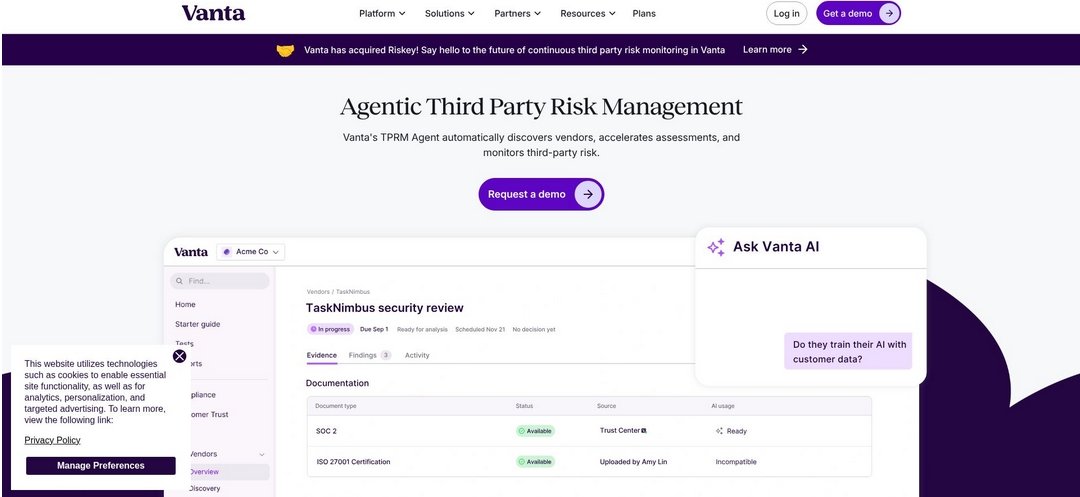
Vanta folds vendor oversight into the same dashboard you use for SOC 2, helping teams remediate risk up to 45% faster. VRM, compliance automation, Trust Center, and SOX ITGC live in one system with shared evidence and cross-framework mapping.
Verdict: best fit if your IPO plan needs one platform to run SOC 2, stand up SOX ITGC, and operationalize vendor oversight. If you need managed analyst services or board-ready vendor portfolio reporting, compare TPRM-specialized options.
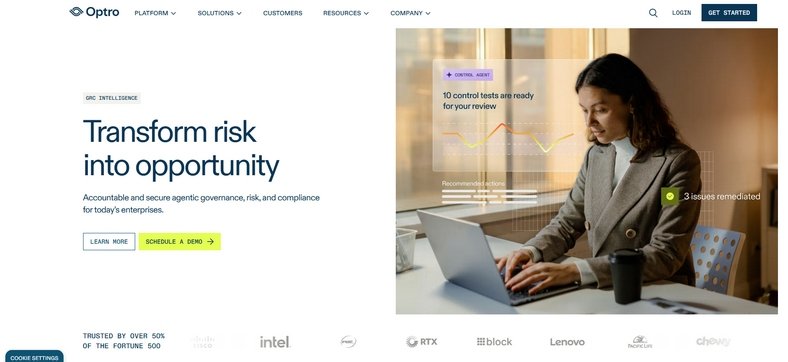
Optro rebranded from AuditBoard in March 2026. It keeps the same product family public-company SOX teams know: SOXHUB (SOX program management), CrossComply (multi-framework compliance), and a connected TPRM module. More than half of the Fortune 500 use it, and it is one of the most common SOX systems Big Four auditors are comfortable testing.
Verdict: choose Optro if full SOX 404 depth (ITGC plus financial process controls) and audit-firm fluency top your list. For SOC 2 day-to-day, a Trust Center, and AI-compressed vendor reviews, you will likely pair it with another platform.
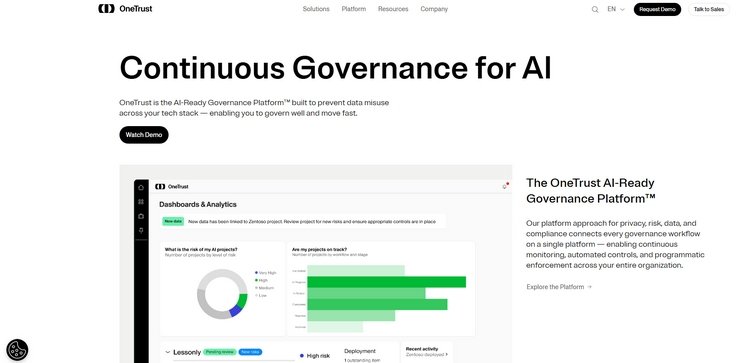
OneTrust grew from privacy management into a broad GRC suite with a substantive third-party risk module, serving 14,000+ customers across regulated industries. It fits when vendor oversight has to live next to privacy, ethics, and ESG in one control fabric.
Verdict: right when vendor risk must sit alongside privacy, ethics, and ESG in one enterprise fabric and you can absorb a longer rollout. To consolidate SOC 2, SOX ITGC, and AI-assisted reviews into one fast-moving platform, OneTrust typically needs pairing.

Prevalent is a pure-play TPRM platform with more than two decades of specialization, acquired by Mitratech in October 2024 and rated a Strong Performer in Forrester's Third-Party Risk Management Wave (Q1 2026). It is the heavyweight option when vendor risk itself is the program.
Verdict: choose Prevalent for bank-style TPRM depth, broad regulatory mapping, and multi-domain continuous monitoring. To collapse SOC 2, SOX ITGC, and vendor oversight into one platform, expect to add complementary tools.
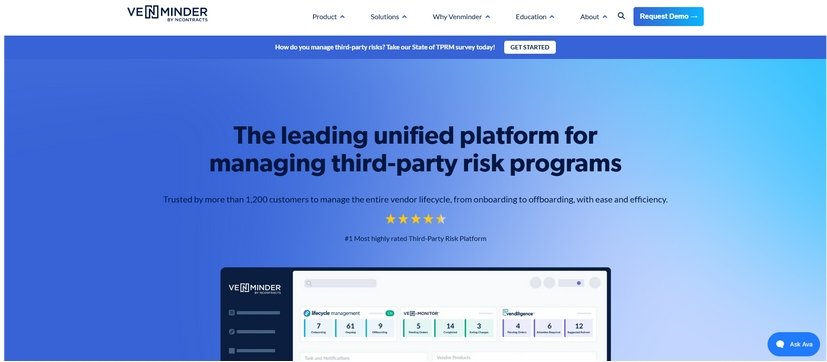
Venminder is a TPRM platform for regulated financial-services teams that want to outsource a share of vendor due diligence. It pairs software with managed services where certified analysts review vendor materials and deliver risk-rated outputs. Venminder was acquired by Ncontracts in September 2024 (Hg Capital-backed); it has 1,200+ customers, and the combined entity serves 5,000+.
Verdict: strong when capacity and expertise are the constraint and you want platform-plus-analysts diligence with contract oversight. To consolidate SOC 2 evidence, SOX ITGC, and VRM into one system, Venminder adds tool sprawl rather than reducing it.
In most fintechs, SOC 2 lives with Security and SOX 404 with Finance, and your vendors sit in the overlap. Treat them as two programs and you get two inventories and two sets of audit questions that never reconcile. Build one vendor register that serves both audits instead.
 The National Crowdfunding & Fintech Association (NCFA Canada) is a financial innovation ecosystem that provides education, market intelligence, industry stewardship, networking and funding opportunities and services to thousands of community members and works closely with industry, government, partners and affiliates to create a vibrant and innovative fintech and funding industry in Canada. Decentralized and distributed, NCFA is engaged with global stakeholders and helps incubate projects and investment in fintech, alternative finance, crowdfunding, peer-to-peer finance, payments, digital assets and tokens, artificial intelligence, blockchain, cryptocurrency, regtech, and insurtech sectors. Join Canada's Fintech & Funding Community today FREE! Or become a contributing member and get perks. For more information, please visit: www.ncfacanada.org
 |  |  |
|---|---|---|
 |  |  |
June 8, 2026 | NCFA Market Activity | Artificial Intelligence And Data, Risk Compliance And Regtech
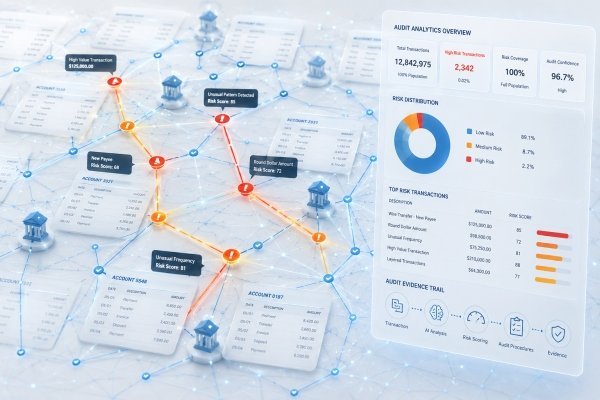
On June 8, 2026, Ottawa based MindBridge expands its AI audit and assurance platform to help audit teams review larger transaction populations and assess risk faster. The update adds full population analysis, subledger analysis, a Monetary Flow Dashboard, transaction level risk assessment, duplicate transaction controls, and large file processing.
MindBridge says KPMG deploys its platform through a global audit platform used in more than 60 countries. The company also points to recent partnerships with BDO and Buzzacott.
Sarah McGinnity, General Manager, Audit & Assurance Solutions at MindBridge:
“Audit and assurance teams are being asked to oversee larger transaction populations, more complex systems, and increasingly automated financial processes without adding proportional time or resources.”
The most important part of the announcement is the focus on full population analysis.
Audit teams have traditionally relied on sampling. AI driven software now makes it possible to review entire transaction populations and identify unusual activity across much larger data sets. That can help auditors spend less time searching for issues and more time investigating the transactions that matter.
MindBridge is positioning its platform around that shift. The latest release gives users more visibility into transaction flows, subledger activity, and risk indicators across financial records.
Many AI products compete on productivity. MindBridge competes on audit quality, risk assessment, and financial controls.
It alters the buying decision. Audit firms, finance teams, and regulated organizations already need oversight, documentation, and evidence. They aren't looking for experimentation. They're looking for better ways to review growing volumes of financial data.
The trend extends beyond audit. Financial institutions are adopting AI in compliance, fraud detection, transaction monitoring, and operational risk. As NCFA noted in its coverage of regulated AI controls and governance, buyers increasingly want systems that support human judgment and provide a clear record of how decisions are made.
If audit software can test full transaction populations instead of samples, the value changes from finding anomalies after the fact to proving where financial risk may occur before judgment calls are made. That's where AI audit tools become useful to CFOs, auditors, and regulators: not as automation, but as evidence infrastructure.
The National Crowdfunding & Fintech Association (NCFA Canada) is a financial innovation ecosystem that provides education, market intelligence, industry stewardship, networking and funding opportunities and services to thousands of community members and works closely with industry, government, partners and affiliates to create a vibrant and innovative fintech and funding industry in Canada. Decentralized and distributed, NCFA is engaged with global stakeholders and helps incubate projects and investment in fintech, alternative finance, crowdfunding, peer-to-peer finance, payments, digital assets and tokens, artificial intelligence, blockchain, cryptocurrency, regtech, and insurtech sectors. Join Canada's Fintech & Funding Community today FREE! Or become a contributing member and get perks. For more information, please visit: www.ncfacanada.org
| | |
|---|---|---|
| | |
May 30, 2026 | NCFA Fintech Whisperer | Payments And Market Infrastructure, Digital Assets Blockchain And Tokenization, Artificial Intelligence And Data, Regulation and Policy, Risk Compliance And Regtech

Image: Freepik
This live weekly NCFA intelligence page tracks financial technology developments that significantly affect how fintechs build, sell, raise capital, and operate under scrutiny. Coverage prioritizes Canada and includes global events that directly influence competitive conditions, market access, and execution realities across fintech sectors. This page will be updated throughout the week with market movers in a live format and then each week we'll close the prior week's contents in prep for the upcoming week, and continue on a rolling basis. (Missed prior week's Fintech Whisperer? (December 6-12, 2025, December 13-19, 2025, January 1-9, 2026, January 10-16, 2026, January 17-23, 2026, January 24-30, 2026, January 31-February 6, 2026, February 7-13, 2026, February 14-20, 2026, February 21-27, 2026, February 28-March 6, 2026, March 7-13, 2026, March 14-20, 2026, March 21-27, 2026, March 28-April 3, 2026, April 4-10, 2026, April 11-17, 2026, April 18-24, 2026, April 25-May 1, 2026, May 2-8, 2026, May 9-15, 2026, May 16-22, 2026, May 23-29, 2026).
Tokenized bonds are moving from pilots into market structure work. Issuers, dealers, custodians, infrastructure providers, and regulators need practical answers on issuance, settlement, custody, disclosure, and secondary liquidity before tokenized fixed income can scale.
The value of cross chain infrastructure comes down to whether developers can route liquidity without exposing users to bridge complexity. The $230M private beta gives 0x early usage evidence, but the larger test is reliability across payments, RWAs, trading, and agent workflows when volumes move beyond controlled integrations.
Stablecoin licensing is becoming a competitive infrastructure tool for financial centres. Issuers, banks, PSPs, custodians, and regulators should track which jurisdictions turn stablecoin rules into live market access rather than policy design alone.
Tokenized money market funds are becoming part of institutional onchain liquidity infrastructure. Asset managers, custodians, PSPs, stablecoin issuers, and treasury teams should track how stablecoins connect with regulated fund products, redemption workflows, and stablecoin payment infrastructure.
Institutional DeFi is shifting toward custody controlled access models. Asset managers, custodians, exchanges, advisers, and compliance teams should track whether qualified custody plus curated onchain strategies becomes the operating model that brings DeFi exposure into regulated portfolios.
The useful signal is not simply another crypto loan product. It is committed buyer capital behind crypto backed credit, which can make the product more repeatable. The key risks remain collateral volatility, liquidation design, borrower suitability, and whether digital asset wealth can support credit access without turning into hidden leverage.
Crypto collateral can help asset rich borrowers avoid selling Bitcoin or USDC, but housing finance brings stricter expectations around suitability, custody, volatility buffers, and borrower protection. The product will need to prove it expands access without importing crypto market risk into mortgage underwriting.
Large banks are moving from stablecoin observation into direct tokenized money infrastructure. Treasury teams, payment providers, fintechs, custodians, and infrastructure operators now need to track whether commercial bank money becomes a regulated settlement layer for high value payments, liquidity management, and cross border transactions.
Western Union’s stablecoin entering a major crypto exchange channel adds another proof point for stablecoins becoming payment infrastructure. PSPs, exchanges, banks, remittance firms, and compliance teams should track how regulated issuers, fiat channels, and global payout networks connect. This adds a distribution proof point for regulated stablecoins. Western Union brings the remittance brand and global currency footprint, while Bybit brings crypto exchange access. The open question is whether USDPT becomes a settlement asset customers actually use, or another branded stablecoin competing for scarce transaction depth.
Central bank money settlement is being designed for programmable markets. Banks, FMIs, tokenized asset platforms, and settlement operators need to understand how RTGS synchronisation could connect central bank money with external asset ledgers and reduce settlement risk in digital markets.
Domestic real time payment systems are becoming exportable cross border infrastructure. Payment networks, banks, wallets, tourism merchants, and regulators are building direct QR payment links that reduce card dependence and make national payment rails usable outside their home markets.
Access to Canada’s payment infrastructure continues to widen beyond traditional banks and large financial institutions. Fintechs, payment providers, credit unions, foreign exchange firms, and digital finance companies are gaining a larger role in the systems and governance discussions that shape payment modernization.
Open banking is moving from one off payments into repeatable payment schemes with shared rules and commercial terms. Banks, PSPs, merchants, fintech platforms, and regulators should track whether recurring account to account payments become a real alternative to cards, direct debit, and closed wallet systems.
Card settlement is no longer limited to traditional banking hours or traditional settlement assets. Banks, acquirers, PSPs, stablecoin issuers, and fintech platforms should track how major payment networks use regulated stablecoins to support faster settlement, lower liquidity friction, and always on money movement.
Stablecoin remittances are moving from fintech experiments into established money transfer networks. Banks, PSPs, remittance firms, stablecoin issuers, and compliance teams should track how large networks use tokenized dollars to reduce settlement friction while staying inside regulated payment flows.
Pay by bank is becoming a practical payment rail strategy, not just a checkout concept. PSPs, banks, merchants, and fintech platforms should track how instant payment routing, risk controls, and settlement access shape competition against cards and traditional ACH flows.
Stablecoins are gaining traction in regulated payment flows, not just trading markets. Remittances remain one of the clearest real world use cases because settlement speed, foreign exchange costs, and cross border reach matter more than speculative activity. Canadian fintechs, PSPs, banks, and regulators should watch whether stablecoin based remittance models can scale while meeting compliance, safeguarding, and consumer protection requirements.
OpenPayd’s planned Nasdaq listing puts programmable money movement under public market scrutiny. PSPs, banks, stablecoin firms, embedded finance platforms, investors, and regulators should track how the listing exposes the economics, licensing footprint, transaction volume, and risk controls behind global payment infrastructure.
Crypto sanctions enforcement is moving deeper into exchange infrastructure and stablecoin flows. Exchanges, custodians, PSPs, blockchain analytics firms, and compliance teams should track how sanctions screening, stablecoin monitoring, and cross border counterparty controls become core operating requirements.
Technology policy is increasingly becoming infrastructure policy. As governments focus on AI capacity, cloud services, strategic data assets, semiconductor supply chains, and digital resilience, firms may face growing pressure to evaluate technology dependencies, procurement choices, hosting arrangements, and infrastructure risk. The result could be a more fragmented global technology environment shaped by competing sovereignty frameworks.
Consumer AI policy is moving toward practical controls for trust, consent and accountability. Banks, fintechs, AI firms, platforms and regulators should watch how user controls, complaint routes, audit trails and outcomes based duties apply when AI systems influence financial decisions or act for consumers.
The operating change is where AI work happens. If capable agents can run locally, more sensitive analysis, file handling, audio processing, and workflow automation can stay on device instead of moving through cloud APIs. That could change enterprise AI design, human oversight, privacy controls, and bot to bot workflows.
The United States is testing a lighter regulatory model for frontier AI that relies on voluntary participation, security evaluation, and industry cooperation. Financial institutions, fintechs, infrastructure providers, and AI developers should watch whether this approach accelerates deployment while maintaining confidence in systems that increasingly influence payments, capital markets, fraud controls, and critical infrastructure.
Revolut’s U.S. strategy shows why bank charters are becoming infrastructure plays for global fintechs. FDIC insured products, payment rail access, stablecoin services, and securities trading under one app could raise the competitive bar for sponsor bank dependent fintech models.
Stablecoin regulation is becoming a competitiveness question, not only a risk control exercise. Issuers, banks, PSPs, custodians, and policymakers should track whether the UK loosens its approach or keeps tougher safeguards that could limit domestic stablecoin scale.
Stablecoin supervision is becoming cross border supervision. Issuers, exchanges, custodians, payment firms, and compliance teams should expect more information sharing between regulators as stablecoin activity crosses jurisdictions, banking systems, and payment networks.
The word of the week is 'control'. Banks, payment networks, fintechs, custodians, stablecoin issuers, and AI providers are competing closer to the infrastructure layer, where settlement, custody, compliance, data, and distribution decisions get made. Which rails, licenses, partners, and operating models create durable access before the next layer of financial infrastructure gets locked in?
NCFA offers various curated resources to help founders and investors stay current on developments that impact fintech markets, subscribe to NCFA weekly newsletter updates, view a rundown of current fintech news and insights, or dive into the latest fintech industry research.
The National Crowdfunding & Fintech Association (NCFA Canada) is a financial innovation ecosystem that provides education, market intelligence, industry stewardship, networking and funding opportunities and services to thousands of community members and works closely with industry, government, partners and affiliates to create a vibrant and innovative fintech and funding industry in Canada. Decentralized and distributed, NCFA is engaged with global stakeholders and helps incubate projects and investment in fintech, alternative finance, crowdfunding, peer-to-peer finance, payments, digital assets and tokens, artificial intelligence, blockchain, cryptocurrency, regtech, and insurtech sectors. Join Canada's Fintech & Funding Community today FREE! Or become a contributing member and get perks. For more information, please visit: www.ncfacanada.org
| | |
|---|---|---|
| | |
June 3, 2026 | NCFA Insight | Artificial Intelligence And Data, Regulation And Policy

On June 2, 2026, the Canadian Anti Monopoly Project released Parting Clouds: Creating A Competitive Marketplace For Compute that says three American companies control 85% of Canada's public cloud market. Canada wants sovereign AI. It's a gap that Ottawa needs to address before it commits more public money to AI infrastructure.
Globally, those same three firms Amazon, Microsoft, and Google, hold about 66% of the public cloud market. AI runs on compute, but most firms access that compute through cloud platforms. The more difficult it becomes to move data, workloads, and AI services between providers, the more dependent organizations become on a small number of platforms.
Compute means the physical capacity. Think data centres, chips, GPUs, servers, storage, power, cooling, and networks. Cloud is the commercial aspect that packages that capacity into services like APIs, software tools, security controls, and platform ecosystems.
Canada can fund more compute and still leave firms locked into the same cloud stacks. That concern connects to NCFA’s earlier analysis of Canada’s AI capital flight problem, where public AI investment doesn't always translate into long term domestic value especially if customers cannot move their data, workloads, models, and services without high technical and financial costs.
The CAMP report makes that point clearly. The goal isn't simply Canadian ownership. The goal is a market where customers can switch providers without rebuilding core systems. Most Canadian firms cannot replace that stack overnight.
Federal spending tells the same story. From 2019 to 2020 through 2022 to 2023, Shared Services Canada spent $310.4M on cloud services. The report says 66% went to Microsoft, 16% to Amazon, 14% to Salesforce, and 4% to other providers.
Cloud concentration already creates switching barriers through proprietary services, opaque pricing, and weak interoperability.
AI makes those barriers harder to manage. A fraud model, compliance agent, lending workflow, or payment risk tool can become tied to a provider’s data services, model tools, security layer, and deployment environment.
Moving clouds then means more than moving storage. It can mean rebuilding how the product works.
Five firms control about 75% of global AI compute power, with Google alone controlling about 31%. That concentration shows why AI sovereignty is not only about funding more capacity. It's also about keeping customers mobile before AI markets harden around the same platforms.
The name of this section is the report's strongest warning and it should affect Ottawa's strategy.
More Canadian data centres can help. Domestic compute can support sensitive workloads, national resilience, and local AI capacity. Ottawa has already backed 44 Canadian AI compute projects, but if public funding only creates protected local gatekeepers, Canada may replace one dependency with another.
The better goal is customer mobility. Can a Canadian fintech move workloads from one provider to another? Can a public agency compare cloud pricing easily? Can a startup use AI tools without being trapped inside one ecosystem? Can sensitive workloads use Canadian infrastructure without sacrificing portability?
Ottawa should fund infrastructure, but also change the market around portability, interoperability, transparent pricing, and competition.
The CAMP report recommends using public procurement to require portable data, interoperable services, and common technical standards. It also calls for closer scrutiny of egress fees, bundling, tying, discriminatory licensing, cloud credits, and acquisitions that absorb Canadian talent and intellectual property.
This approach has tradeoffs. Procurement can move faster than legislation, but it needs technical discipline. Competition enforcement can target lock in, but cases take time. Interoperability can lower switching costs, but it will not instantly match the full global scale of AWS, Azure, or Google Cloud. Domestic infrastructure can improve resilience, but only if it avoids new lock in.
Will Canada measure AI sovereignty by domestic capacity, or by real customer choice?
Will public funding require portability, open standards, and transparent pricing?
Will Canadian fintechs and AI startups be able to move workloads across providers without rewriting core systems?
Will the strategy treat cloud concentration as a competition issue, not only an innovation issue?
Will Canada build a market where providers compete on price, performance, trust, and service quality, or one where customers stay trapped because switching costs are too high?
If a Canadian fintech cannot realistically move its AI stack from one provider to another, who holds the leverage?
The National Crowdfunding & Fintech Association (NCFA Canada) is a financial innovation ecosystem that provides education, market intelligence, industry stewardship, networking and funding opportunities and services to thousands of community members and works closely with industry, government, partners and affiliates to create a vibrant and innovative fintech and funding industry in Canada. Decentralized and distributed, NCFA is engaged with global stakeholders and helps incubate projects and investment in fintech, alternative finance, crowdfunding, peer-to-peer finance, payments, digital assets and tokens, artificial intelligence, blockchain, cryptocurrency, regtech, and insurtech sectors. Join Canada's Fintech & Funding Community today FREE! Or become a contributing member and get perks. For more information, please visit: www.ncfacanada.org
| | |
|---|---|---|
| | |
June 1, 2026 | NCFA Fintech Market Activity | Risk Compliance And Regtech, Artificial Intelligence And Data

On May 27, 2026, Fredericton based cybersecurity scaleup Lastwall raised $16 million in a round led by BDC Capital’s StrongNorth Fund, See Isabelle Hudon, President and CEO BDC's LinkedIn announcement. The round also included the New Brunswick Innovation Foundation, Frostbite Capital, Blue Bear Capital, BlueWing Ventures, and 18West.
It's a Canadian cybersecurity story, not a military procurement story. Lastwall works in defence, government, and critical infrastructure environments, but the announcement is about growth capital for identity first security, zero trust access, and quantum resilient protection. For NBIF, it's the largest single investment in its history through the round.
Karl Holmqvist, Founder and CEO, Lastwall:
“We proved our model in the world’s most demanding federal market. We earned FedRAMP Moderate Authorization, secured U.S. government systems, and built a platform for the realities of modern cyber warfare. Now, we’re bringing those trusted capabilities home to help strengthen Canada’s cyber resilience at a defining moment for national security.”
Lastwall secures access across cloud, hybrid, disconnected, and low bandwidth environments. It's important for energy, telecom, transportation, defence, government, and public sector systems where a failed login layer can become an operational risk.
The product focus is identity, authentication, credential protection, privileged access, and zero trust controls. Lastwall also says quantum resilient protection is built into the platform, which is key for systems that need to stay secure beyond the current threat cycle.
For fintechs and financial institutions, digital identity and access control are now resilience infrastructure. Fraud, account takeover, insider risk, cloud access, vendor access, and critical system protection all depend on knowing who is connecting, from where, and under what conditions.
Peter Dawe, BDC’s Vice President of Defence Strategy and a recently retired Major General, joined Lastwall’s board as part of the financing. That gives the company closer defence and sovereign capability expertise as Canada looks for more domestic cyber capacity.
Canada’s cyber resilience gap isn't only about monitoring threats. It's also about securing access to the systems that run public services, financial infrastructure, energy, communications, and national security. Canada’s new cyber law and PSP oversight are already raising the bar for security, resilience, and vendor accountability. Lastwall’s funding shows Canadian capital is starting to treat identity security as a sovereign capability, not just another software category.
Can Canadian cybersecurity firms turn U.S. federal proof into domestic critical infrastructure adoption before cyber resilience becomes a procurement emergency?
The National Crowdfunding & Fintech Association (NCFA Canada) is a financial innovation ecosystem that provides education, market intelligence, industry stewardship, networking and funding opportunities and services to thousands of community members and works closely with industry, government, partners and affiliates to create a vibrant and innovative fintech and funding industry in Canada. Decentralized and distributed, NCFA is engaged with global stakeholders and helps incubate projects and investment in fintech, alternative finance, crowdfunding, peer-to-peer finance, payments, digital assets and tokens, artificial intelligence, blockchain, cryptocurrency, regtech, and insurtech sectors. Join Canada's Fintech & Funding Community today FREE! Or become a contributing member and get perks. For more information, please visit: www.ncfacanada.org
| | |
|---|---|---|
| | |
May 29, 2026 | NCFA Fintech Whisperer Weekly Intelligence | Payments And Market Infrastructure, Artificial Intelligence And Data, Digital Assets Blockchain And Tokenization, Capital Markets And Market Infrastructure
Image: Freepik
This live weekly NCFA intelligence page tracks financial technology developments that significantly affect how fintechs build, sell, raise capital, and operate under scrutiny. Coverage prioritizes Canada and includes global events that directly influence competitive conditions, market access, and execution realities across fintech sectors. This page will be updated throughout the week with market movers in a live format and then each week we'll close the prior week's contents in prep for the upcoming week, and continue on a rolling basis. (Missed prior week's Fintech Whisperer? (December 6-12, 2025, December 13-19, 2025, January 1-9, 2026, January 10-16, 2026, January 17-23, 2026, January 24-30, 2026, January 31-February 6, 2026, February 7-13, 2026, February 14-20, 2026, February 21-27, 2026, February 28-March 6, 2026, March 7-13, 2026, March 14-20, 2026, March 21-27, 2026, March 28-April 3, 2026, April 4-10, 2026, April 11-17, 2026, April 18-24, 2026, April 25-May 1, 2026, May 2-8, 2026, May 9-15, 2026, May 16-22, 2026).
AI compliance is moving from broad principles into operating guidance for agents, automated decisions, procurement, and personal data use. Fintechs, banks, insurers, regtech firms, and AI vendors should track how privacy rules shape AI product design, governance, and customer trust.
Project Agorá's focus is not retail crypto speculation. It is wholesale financial infrastructure, cross border settlement efficiency, programmable payments, and institutional control over tokenized money movement. Go deeper, visit NCFA's curated fintech reports and research library, where the BIS Project Agorá report is listed.
This is not open access to the Fed system. It is a narrower settlement pathway for legally eligible firms operating outside the traditional bank model. Stablecoin issuers, PSPs, crypto firms, tokenization platforms, and embedded finance providers should track whether limited Reserve Bank account access becomes a practical alternative to sponsor bank dependence. This connects to NCFA’s analysis of Fed Payment Accounts and fintech settlement access.
Onchain finance needs shared coordination standards before institutional adoption can scale cleanly. Banks, wallets, PSPs, exchanges, tokenization platforms, and agentic payment builders should track whether identity, messaging, and transaction standards become competitive infrastructure rather than optional middleware.
Large payment networks are adding regulated digital asset permissions to support stablecoin, tokenized settlement, and digital asset infrastructure at institutional scale. Banks, PSPs, exchanges, custodians, and fintech platforms should track which firms secure licences that let crypto services connect with mainstream payment networks.
Stablecoins are moving deeper into consumer banking distribution, not just crypto infrastructure. Banks, fintechs, PSPs, and regulators should watch whether regulated bank issued stablecoins begin competing directly with cards, deposits, remittance products, and embedded payment flows. Also supports this analysis of stablecoins becoming payment infrastructure.
National currency stablecoins are expanding beyond major economies. Stablecoin issuers, banks, PSPs, regulators, and treasury teams should track how smaller jurisdictions use digital fiat infrastructure to compete for payment flows, fintech investment, and cross border settlement.
Climate disclosure is moving back toward company specific materiality rather than a dedicated SEC climate reporting regime. Public companies, fintech lenders, ESG data providers, regtech firms, investors, and capital markets platforms should track how climate risk reporting moves across U.S. federal rules, state rules, EU requirements, and voluntary investor expectations.
Bank charter strategy is becoming part of digital asset and payment infrastructure competition. Banks, fintechs, stablecoin firms, custodians, and compliance teams should track which institutions secure federal supervision, stronger operating permissions, and clearer access to national banking infrastructure.
MiCA is moving from licensing theory into enforcement risk. Crypto exchanges, custodians, wallet providers, brokers, and compliance teams should treat EU authorization, local regulator engagement, and operating perimeter checks as immediate market access priorities.
Prediction markets are moving deeper into conflict with gambling, derivatives, and securities frameworks. Exchanges, fintechs, tokenization firms, and prediction market operators should expect more pressure around licensing, market surveillance, consumer protection, and jurisdictional authority as these platforms expand globally.
USMCA risk is now back inside Canada’s competitiveness file. Fintech lenders, payment firms, investors, marketplaces, and platforms serving SMEs should watch how tariff uncertainty affects customer margins, capital demand, foreign exchange exposure, supplier payments, and cross border expansion.
Crypto sanctions enforcement now reaches deeper into financial infrastructure networks, not just individual wallets or isolated actors. Exchanges, custodians, PSPs, banks, compliance teams, and blockchain monitoring firms should expect more scrutiny around transaction tracing, counterparty checks, and sanctions controls tied to digital asset flows.
Post trading rules are becoming more important as Europe modernizes settlement operations, CSD messaging, and market infrastructure controls. CSDs, brokers, banks, custodians, tokenization platforms, and compliance teams should track how messaging standards affect settlement efficiency, operational risk, and future market infrastructure integration.
Blockchain based settlement is moving into formal U.S. market infrastructure permissions. Brokers, custodians, tokenization platforms, exchanges, and asset managers should track how SEC registered clearing models affect securities settlement, custody design, and tokenized market structure.
Retail investing scale increasingly depends on back end clearing and custody infrastructure. Fintech platforms, brokers, clearing firms, embedded finance providers, and regulators should track how large consumer apps choose clearing partners that can support faster launches, broader products, and stronger operational controls.
This week was less about crypto adoption and more about who gets trusted access to the pipes. The Fed tested a narrow settlement account, Paxos received SEC clearing agency registration, Mastercard secured a BitLicense, SoFi launched a bank issued stablecoin, and Project Agorá moved wholesale tokenized settlement into deeper testing. The fresh lesson is that access is becoming tiered. Firms won’t all get the same rails, licences, or settlement rights.
NCFA offers various curated resources to help founders and investors stay current on developments that impact fintech markets, subscribe to NCFA weekly newsletter updates, view a rundown of current fintech news and insights, or dive into the latest fintech industry research.
The National Crowdfunding & Fintech Association (NCFA Canada) is a financial innovation ecosystem that provides education, market intelligence, industry stewardship, networking and funding opportunities and services to thousands of community members and works closely with industry, government, partners and affiliates to create a vibrant and innovative fintech and funding industry in Canada. Decentralized and distributed, NCFA is engaged with global stakeholders and helps incubate projects and investment in fintech, alternative finance, crowdfunding, peer-to-peer finance, payments, digital assets and tokens, artificial intelligence, blockchain, cryptocurrency, regtech, and insurtech sectors. Join Canada's Fintech & Funding Community today FREE! Or become a contributing member and get perks. For more information, please visit: www.ncfacanada.org
| | |
|---|---|---|
| | |
May 27, 2026 | NCFA Market Activity | Funding, Risk Compliance And Regtech, Banking And Credit Infrastructure

On May 20, 2026, Toronto based Quantum Bridge Technologies announced a USD $8M Series A round to expand its quantum safe cybersecurity business for financial institutions, telecom networks, governments, and defence organizations. The University of Toronto spinout says the financing brings its total funding to USD $16M.
Quantum Bridge’s DSKE technology helps organizations create, distribute, and manage symmetric keys across existing networks. The company says customers can add the system across current vendors, security layers, and network environments without replacing core infrastructure.
The timing makes sense given that NIST released its first three post quantum encryption standards in August 2024 and urged system administrators to start moving to the new standards. In Canada, the Cyber Centre’s post quantum migration roadmap gives federal departments a planning model for transitioning non classified IT systems to post quantum cryptography.
Canada has strong, award winning quantum researchers. Buyers need tools they can audit and apply to real networks at scale. Quantum Bridge is actively pitching that to the market directly, and not asking customers to wait for a future quantum event. It's selling a migration solution for institutions that already manage long lived data, critical communications, and regulated infrastructure.
That connects directly to fintech. Payments, digital identity, custody, banking APIs, cloud security, and customer data protection all rely on cryptography. Infrastructure teams are in need of cryptographic agility before regulatory pressure and vendor bottlenecks make upgrades harder.
The Series A gives Quantum Bridge more room to sell into high trust markets where procurement takes time and credibility counts. The investor group also tells a useful story. The round brings together venture capital, telecom exposure, enterprise technology, and cross border capital. That mix fits a company selling security infrastructure into finance, telecom, government, and defence.
Mattia Montagna, Co Founder and CEO, Quantum Bridge Technologies:
“National security can’t wait for perfect conditions. We build quantum-safe systems that work inside real networks today — systems designed to keep protecting sovereign communications as the threat landscape evolves. This funding means we can meet more organizations where they are, and get them protected faster.”
Quantum Bridge’s financing shows where Canadian quantum policy needs to support execution. Canada should help qualified domestic firms prove their systems inside critical sectors before global buyers define the market without us.
The National Crowdfunding & Fintech Association (NCFA Canada) is a financial innovation ecosystem that provides education, market intelligence, industry stewardship, networking and funding opportunities and services to thousands of community members and works closely with industry, government, partners and affiliates to create a vibrant and innovative fintech and funding industry in Canada. Decentralized and distributed, NCFA is engaged with global stakeholders and helps incubate projects and investment in fintech, alternative finance, crowdfunding, peer-to-peer finance, payments, digital assets and tokens, artificial intelligence, blockchain, cryptocurrency, regtech, and insurtech sectors. Join Canada's Fintech & Funding Community today FREE! Or become a contributing member and get perks. For more information, please visit: www.ncfacanada.org
| | |
|---|---|---|
| | |



August 26th, 2025

January 4th, 2024

June 1st, 2021

September 9th, 2020

July 9th, 2018

January 3rd, 2018

September 25th, 2017

June 20th, 2017

May 10th, 2017

December 14th, 2016
