





Karsten Wenzlaff, Advisor
August 26th, 2025
Karsten Wenzlaff is a Crowdfunding and Fintech Expert from Germany. He is Secretary-General of Digit[...]


March 29, 2026

Image: Unsplash/Priscilla Du Preez
Retail shrinkage — the industry term for inventory loss through theft, fraud, and administrative error — costs global retailers hundreds of billions of dollars annually. Within that figure, return fraud has grown into one of the most consistently underestimated line items. Unlike shoplifting, which is immediately visible and operationally disruptive, return fraud is quiet. It enters through the customer service desk, processed by a staff member under time pressure, usually accepted to maintain a positive customer interaction, and absorbed as a cost of doing business. Organized retail crime operations have identified this as a reliable revenue stream, and the scale of exploitation has grown accordingly.
The technology capable of changing this dynamic is retail identity verification: a systematic process of confirming the identity of customers at specific transaction touchpoints — most critically the returns desk — using automated document scanning rather than relying on staff judgment or paper-based log systems. When a fraudulent returner knows their identity is captured and matched against a return history database, the economics of the fraud change. The deterrent effect operates before any individual transaction is evaluated, and the audit trail it creates enables pattern detection that no manual system can replicate at the speed or scale required.
What is also important here is that return fraud does not operate in isolation. The same individuals and organized groups responsible for fraudulent returns are frequently responsible for the theft that enables those returns. Stolen merchandise returned for cash or store credit creates a clean revenue cycle for organized retail crime. That’s why identity verification at the returns desk intercepts not just the return itself but the downstream incentive that makes the preceding theft financially worthwhile.
Retail identity verification is the practice of confirming a customer’s identity at a point-of-sale or service transaction using a machine-readable identity document. In the returns context specifically, it means capturing the returning customer’s name and identity document details — typically via OCR, or Optical Character Recognition, the technology that extracts text from photographed documents — and recording that data against the return transaction in the retailer’s system.
In other words, it replaces the manual alternative — a staff member writing a customer’s name and address on a paper return form, or typing it into a terminal — with an automated scan that is faster, more accurate, and creates a structured, searchable record. The identity data captured is not used to authorize or deny the individual transaction in isolation. Its value lies in the cumulative pattern it reveals: a single customer attempting multiple no-receipt returns across locations, or a rotating group of individuals returning the same high-value items across store clusters.
Apart from this, retail identity verification in the age-restricted sales context serves a different but related function. Capturing identity at the point of sale for alcohol, tobacco, vaping products, or lottery tickets creates a documented compliance record that protects the retailer in the event of a licensing inspection or underage sale allegation. Thanks to this, a single scanning infrastructure can serve both loss prevention and compliance functions simultaneously, reducing the cost per use case when deployed across a multi-function retail operation.
The most widely used document capture methods are MRZ reading — the Machine Readable Zone, a standardized two-line strip at the bottom of passports and many national identity cards — PDF417 barcode scanning from the reverse of driving licences, and front-of-card OCR for documents without machine-readable zones. A capable retail scanning solution should handle all three, covering the range of documents customers are likely to present across the retailer’s operating region.
Understanding why manual return controls consistently fail is essential context for designing an effective automated alternative. The failure modes are structural, not simply the result of inadequate staff training.
The majority of return fraud operates through the no-receipt return pathway. Retailers offering goodwill returns without a receipt — a policy designed to serve legitimate customers who have lost their proof of purchase — inadvertently create a channel through which stolen merchandise can be converted to cash or credit without any connection to the original transaction. From a financial perspective, restricting no-receipt returns too aggressively damages customer satisfaction and increases returns friction for honest customers. Capturing identity at the no-receipt return point resolves the dilemma: the policy can remain customer-friendly while the identity record creates the accountability that deters systematic abuse.
Organized retail crime groups exploit the siloed nature of most retail loss prevention systems. An individual executing multiple returns at different store locations generates no alert in any single store’s records, even if their cumulative return volume is clearly abusive. Identity capture linked to a centralized return history database changes this dynamic entirely: the pattern that is invisible store-by-store becomes immediately visible at the network level. These mechanics boost the detection rate for organized cross-location fraud without requiring any change to individual store return policies.
Return desk staff are typically trained to prioritise customer experience and process transactions efficiently. Challenging a customer on a suspicious return requires judgment, confidence, and a willingness to create conflict — qualities that vary significantly across individuals and that diminish under queue pressure. Automated identity capture removes the judgment element: the scan is a standard part of the process applied to every return, not a discretionary challenge that a staff member must decide to initiate. This positively affects consistency and removes the interpersonal friction that causes staff to avoid challenging transactions they should be questioning.
Identity verification at the point of sale delivers its strongest returns in specific retail contexts. Here’s when the investment is most clearly justified:
When evaluating identity verification solutions for retail deployment, pay attention to the following criteria:
Implementing identity verification in a retail returns workflow requires attention to three dimensions simultaneously: the technical integration, the operational process design, and the customer communication approach. Neglecting any one of these dimensions will limit the effectiveness of the others.

Image Unsplash, Simon Hattinga Verschure
Before any technology is deployed, it is crucial to define precisely when identity capture is required: all returns without a receipt, all returns above a defined transaction value, all returns in specific high-risk product categories, or some combination. This policy decision shapes the entire implementation — the workflow design, the staff training, and the customer communication. We recommend starting with a narrowly defined scope — no-receipt returns above a value threshold — rather than attempting to capture identity on every return transaction from the outset, as this allows the team to refine the process before extending it.
The most operationally sensitive element of identity verification at the returns desk is not the technology — it is how staff present the requirement to customers. A customer who understands that identity capture is a standard policy applied consistently to all no-receipt returns is significantly more likely to comply without conflict than one who perceives it as a personal accusation. Staff training should include a specific, practiced script for introducing the scan request, handling common objections, and escalating to a supervisor when a customer refuses. It will be helpful to role-play these interactions during training rather than relying on written guidance alone.
Displaying clear signage at the returns desk indicating that identity may be required for no-receipt returns serves two functions simultaneously. First of all, it sets customer expectations before the interaction begins, reducing the likelihood of conflict when the scan is requested. Secondly, it functions as a deterrent in its own right: a fraudulent returner who sees that identity will be captured may elect not to proceed with the transaction before any staff interaction occurs. Given this, the signage itself delivers measurable loss prevention value at zero incremental operational cost.
Return fraud and organized retail theft are not problems that goodwill policies and staff vigilance can solve at scale. The economics favour the fraudster in any system where returns are processed on trust, where no identity record is created, and where pattern detection requires manual cross-referencing of paper logs. Retail identity verification changes those economics by creating a structured identity record at the transaction point, aggregating that data centrally, and making cross-location and cross-time patterns immediately visible to loss prevention teams.
The implementation investment is modest relative to the shrinkage it addresses. A well-deployed system pays for itself within the first promotional season it covers by reducing the no-receipt return abuse that concentrates around high-value product launches and seasonal promotions. Apart from this, the compliance value it delivers for age-restricted product categories converts what might otherwise be a single-purpose loss prevention tool into a shared infrastructure investment with returns across multiple operational functions. Given this, retailers evaluating their loss prevention strategy should treat identity verification at the returns desk not as a future consideration but as a near-term priority.
 The National Crowdfunding & Fintech Association (NCFA Canada) is a financial innovation ecosystem that provides education, market intelligence, industry stewardship, networking and funding opportunities and services to thousands of community members and works closely with industry, government, partners and affiliates to create a vibrant and innovative fintech and funding industry in Canada. Decentralized and distributed, NCFA is engaged with global stakeholders and helps incubate projects and investment in fintech, alternative finance, crowdfunding, peer-to-peer finance, payments, digital assets and tokens, artificial intelligence, blockchain, cryptocurrency, regtech, and insurtech sectors. Join Canada's Fintech & Funding Community today FREE! Or become a contributing member and get perks. For more information, please visit: www.ncfacanada.org
 |  |  |
|---|---|---|
 |  |  |
March 27, 2026 | NCFA Fintech Whisperer Weekly Intelligence | Digital Assets Blockchain And Tokenization, Regulation And Policy, Payments And Market Infrastructure, Risk Compliance And Regtech

Image: Freepik
This live weekly NCFA intelligence page tracks financial technology developments that significantly affect how fintechs build, sell, raise capital, and operate under scrutiny. Coverage prioritizes Canada and includes global events that directly influence competitive conditions, market access, and execution realities across fintech sectors. This page will be updated throughout the week with market movers in a live format and then each week we'll close the prior week's contents in prep for the upcoming week, and continue on a rolling basis. (Missed prior week's Fintech Whisperer? (December 6-12, 2025, December 13-19, 2025, January 1-9, 2026, January 10-16, 2026, January 17-23, 2026, January 24-30, 2026, January 31-February 6, 2026, February 7-13, 2026, February 14-20, 2026, February 21-27, 2026, February 28-March 6, 2026, March 7-13, 2026, March 14-20, 2026).
The RBA is moving past short pilots. The focus now is how tokenised money works with existing settlement systems and what holds up under real use.
The SEC is narrowing one regulator facing CAT access path in the name of cost savings while keeping other query methods in place. That doesn't change trading rules, but it can change how efficiently regulators search market activity and build surveillance cases, and to that extent there are some concerns around reduced oversight.
Fully paid lending goes from exemption based programs to a standard rule set. Dealers need to update inventory funding structures and controls before the effective date.
Tokenization is now being discussed inside the core U.S. capital markets policy process, with major market infrastructure and exchange voices at the table. That raises the odds that tokenized securities will be treated as a market structure question tied to trading, clearing, settlement, and custody, not only as a digital asset issue.
Lynn Martin, President, NYSE Group: “As we explore how tokenization can enhance capital markets, it is critical that new infrastructure is developed in a way that preserves the trust, transparency, and protections investors expect. Securitize brings deep experience in digital asset infrastructure and transfer agency, making them a strong partner in helping design this next generation of market structure.”
India is moving from payment expansion to payment control. Fraud liability, cyber resilience, cross border authorisation, and switching now sit closer to the centre of the next build cycle for banks, payment firms, and fintech infrastructure providers.
Visa is getting into the infrastructure layer. Privacy has been one of the main blockers for banks and large financial institutions using shared blockchain systems. If that barrier starts to fall, onchain payments, settlement, and treasury activity can move closer to core financial market infrastructure.
FMI oversight expectations set the operating floor for payments and clearing infrastructure, which can flow through to participant requirements, vendor controls, and resilience planning.
This brings tokenized cash into live institutional money movement. It's a major Canadian bank using tokenized cash to support real margin, collateral, and settlement flows on a continuous basis. Tokenized money is moving deeper into market infrastructure and gives regulated institutions a way to move value when markets need it 24/7, not only during banking hours.
Deloitte and Stablecorp are building integration paths for financial institutions to use QCAD inside existing systems. The work targets clearing, treasury, and cross-border flows, but no deployments or pilots have been confirmed yet. Treat this as a signal that stablecoin infrastructure is being wired into bank workflows ahead of regulatory clarity.
This closes a multi phase refresh and sets a new baseline for dealer compliance interpretation across UMIR topics, which can flow into policy mapping, training, and vendor rule logic.
Bill C-15 puts stablecoins, payments, and consumer-driven banking under a more unified central bank structure. Firms now need to plan for supervision across digital money and data-sharing models, not treat them as separate tracks.
Event contracts are now included in a defined Canadian dealer framework. Firms need to clear product design, compliance, and notification before going live.
AI assisted authorisations and automated reporting feeds can shorten approval timelines and change how supervision picks up issues from live data.
Sarah Pritchard, Deputy Chief Executive, Financial Conduct Authority: “We want to see more people getting supported, who aren’t currently, and a market that innovates and offers tailored services to meet differing consumer needs.”
Dealers and fintech vendors that support eDiscovery, recordkeeping, surveillance, and investigation response workflows now have a clear CIRO baseline for data handling, metadata preservation, and production process design.
Courts are beginning to test whether engagement led product design itself can create liability at scale. If that theory survives, the impact reaches beyond social media. Any digital product that depends on compulsive use patterns, especially where minors or vulnerable users are involved, faces legal scrutiny and compliance costs.
August 6 update: A New Mexico court ordered Meta to establish a US$567M abatement fund, bringing the financial remedies in the case to US$942M, and imposed youth-safety requirements covering age assurance, teen usage and notifications, adult-minor contact controls and AI-chatbot interactions involving minors. Meta plans to appeal.
As more execution flows move through automated and intermediated channels, CIRO is making it clearer who is responsible, how orders must be marked, and what supervision has to look like. That raises the operating standard for dealers, trading desks, legal and compliance teams, and firms providing marketplace access. Electronic access remains open, but responsibility for supervision, order marking, and control cannot blur as more parties exist between the client and the marketplace.
This raises the risk that sports prediction markets face a direct statutory limit before the category settles into a stable regulatory path. Congress is now testing whether these contracts belong inside federal market infrastructure or back inside state gambling rules. Important for exchanges, prediction market operators, legal teams, and investors betting on event contracts as a durable product category.
This series puts AI governance in focus for banks and fintechs, especially around model risk, cybersecurity controls, and how supervisors assess AI driven decisioning inside core workflows.
China is using tax data, regulated data sharing, and specific technologies to push more SME credit through banks. That is a lending infrastructure signal, not just a blockchain headline.
Regulators are setting clearer boundaries, and infrastructure is moving into production at the same time. That combination raises the cost of getting it wrong and shortens the window to get it right. Teams need working controls, real vendor oversight, and systems that hold up under load before scaling anything customer facing. NCFA offers various curated resources to help founders and investors stay current on developments that impact fintech markets, subscribe to NCFA weekly newsletter updates, view a rundown of current fintech news and insights, or dive into the latest fintech industry research.
The National Crowdfunding & Fintech Association (NCFA Canada) is a financial innovation ecosystem that provides education, market intelligence, industry stewardship, networking and funding opportunities and services to thousands of community members and works closely with industry, government, partners and affiliates to create a vibrant and innovative fintech and funding industry in Canada. Decentralized and distributed, NCFA is engaged with global stakeholders and helps incubate projects and investment in fintech, alternative finance, crowdfunding, peer-to-peer finance, payments, digital assets and tokens, artificial intelligence, blockchain, cryptocurrency, regtech, and insurtech sectors. Join Canada's Fintech & Funding Community today FREE! Or become a contributing member and get perks. For more information, please visit: www.ncfacanada.org
| | |
|---|---|---|
| | |
Mar 26, 2026 | NCFA Insight | Artificial Intelligence And Data

On March 1, 2026, CodeWall, a security research firm focused on AI systems, privately reported security gaps to McKinsey. The firm said its agent found 22 unauthenticated endpoints, then chained a SQL injection issue and other weaknesses to gain read and write access across the production environment. CodeWall said the reachable data included 46.5 million chat messages, 728,000 files, 57,000 user accounts, 384,000 AI assistants, and 94,000 workspaces. It also said prompts, model configurations, and RAG related data were reachable.
On March 2, 2026, McKinsey acknowledged the findings and patched the unauthenticated endpoints the same day.
On March 9, 2026, CodeWall publicly shared research on vulnerabilities in McKinsey’s internal AI platform Lilli.
On March 11, McKinsey released this statement about the vulnerability and that a third party forensic review found no evidence that unauthorized parties accessed client data or client confidential information.
Public API documentation appears to have exposed a map of the system. Some endpoints reportedly required no authentication. One of them allegedly allowed database manipulation through JSON keys, which opened the door to SQL injection. From there, CodeWall said it could determine live production data and reach much deeper parts of the platform.
This incident doesn't point first to a model failure. It points to ordinary application security weaknesses around an AI system that had become deeply embedded in internal work.
McKinsey didn't confirm the full scale of the researcher claims. Instead, it focused on the response. The company said it fixed the issue quickly and found no evidence that unauthorized parties accessed client data or client confidential information.
Having said that, the reported scale of reachable internal material was large enough to raise questions about internal knowledge exposure, employee work patterns, and intellectual property concentration in one system.
CodeWall said prompt and configuration layers were reachable. If true, it means a bad actor could have potentially altered how the system retrieves information or generates answers. In an internal AI tool, that can create wrong outputs that look normal to staff.
That's where this type of incident becomes more useful for fintechs and financial firms. A publicly visible outage gets noticed whereas quietly altered outputs may not. In regulated environments, that can affect approvals, reviews, client treatment, policy interpretation, and internal decision support before anyone spots the pattern.
Banks, lenders, insurers, wealth firms, and fintechs are building similar internal AI layers right now. They connect those tools to policy documents, research, support logs, internal files, and customer related workflows because it saves time and helps staff move faster.
But that convenience comes with risk given that AI often pulls sensitive access into one place. If permissions are weak, endpoints are exposed, or prompt controls aren't protected, one internal tool can become a wider point of failure.
A key lesson founders and operators should take from this case, is to ask whether the application around it is locked down, whether prompts and retrieval rules are treated as sensitive assets, whether permissions are tight, and whether anyone has tested the system the way an attacker would.
Enterprise AI doesn't erase old security mistakes. It can magnify them by concentrating data, access, and trust inside a single interface.
The National Crowdfunding & Fintech Association (NCFA Canada) is a financial innovation ecosystem that provides education, market intelligence, industry stewardship, networking and funding opportunities and services to thousands of community members and works closely with industry, government, partners and affiliates to create a vibrant and innovative fintech and funding industry in Canada. Decentralized and distributed, NCFA is engaged with global stakeholders and helps incubate projects and investment in fintech, alternative finance, crowdfunding, peer-to-peer finance, payments, digital assets and tokens, artificial intelligence, blockchain, cryptocurrency, regtech, and insurtech sectors. Join Canada's Fintech & Funding Community today FREE! Or become a contributing member and get perks. For more information, please visit: www.ncfacanada.org
| | |
|---|---|---|
| | |
Mar 24, 2026 | NCFA Feature | AI Finance And Data Governance
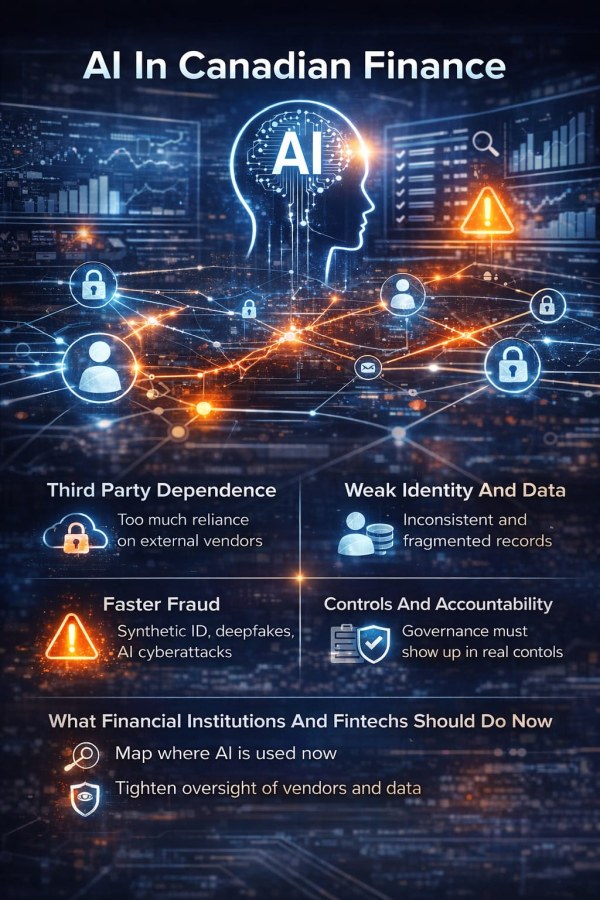
On Mar 23 2026, OSFI and the Global Risk Institute published the FIFAI II final report based on four workshops held between May and November 2025. More than 170 participants took part across banks, insurers, asset managers, fintechs, vendors, regulators, academics, and consumer voices.
The report confirms that AI adoption is here, citing 72% AI use at work in financial services and 75% organizational support for AI. While AI is already in use. The real issue is what still limits its use in regulated decisions and customer outcomes.
The series covered four areas that affect operational, prudential, consumer, and system-wide risk at the same time. Full report and framework: FIFAI II final report and AGILE framework PDF
One of the clearest takeaways is that AI will not spread across finance at the same speed. The first gains will come in internal functions such as fraud detection, surveillance, reporting, cyber defence, and operations. Those areas already have strong data, measurable outputs, and clearer accountability.
Customer-facing decisions are different. Underwriting, advice, product recommendations, and self-serve tools carry more pressure around explainability, fairness, consent, and complaints handling.
AI powered Canadian finance will likely grow faster in control functions than in customer-facing decisions.
The report treats third party AI as more than a procurement issue. It highlights growing dependence on external providers for models, infrastructure, and data, along with limited visibility into how those systems work and who sits behind them.
It's important because a failure, outage, or change in access at one provider can affect more than one function at the same time. Fraud controls, underwriting tools, customer service, and risk monitoring can all be exposed together. The financial stability workshop adds to that concern by linking third party dependency to concentration and system level risk.
Banks, insurers, and fintechs will need stronger oversight of models and providers, better audit access, tested fallback plans, and clearer visibility into the wider supply chain behind key AI services.
AI is improving both offence and defence. The final report points to synthetic identity, deepfakes, voice spoofing, AI assisted cyberattacks, fraud as a service, and disinformation. It notes a sharp rise in deepfake attacks and growing concern about voice verification as AI voice cloning improves.
This reality changes the operating environment. Static controls lose value faster when attack tools get cheaper, stronger, and easier to use. Manual review and occasional rule updates will not be enough. Firms will need faster detection, stronger identity controls, better information sharing, and systems that can adjust while attacks are happening.
Data problems come up across the whole series, but the larger issue is bigger than data quality alone. Weak identity and fragmented data still limit how far AI can go in regulated finance. The report points to inconsistent data, incomplete records, fragmented platforms, offshore storage concerns, and weak data lineage as barriers to both efficiency and safety.
The report doesn't mince words on identity. Canada still doesn't have a widely adopted secure digital identity layer. That leaves onboarding, authentication, consumer channels, remote work, and agent based systems more exposed than they should be. If identity and data remains weak, AI will keep working best in narrower internal use cases and face more limits in customer facing execution.
The final report introduces the AGILE framework as part of its overall findings, which stands for Awareness, Guardrails, Innovation, Learning, and Ecosystem Resiliency. The framework calls for stronger governance and oversight, stronger data and risk controls, continued investment in technology and talent, and deeper public private collaboration.
AI oversight cannot remain just at the strategy level. If AI is used in lending, fraud, underwriting, complaints, or customer recommendations, governance has to show up in controls, evidence, escalation, and accountability. In regulated finance, that's what turns AI use from experimentation into something firms can defend and scale.
The workshop series points to a practical sequence:
First, identify where AI already impacts decisions and controls.
Second, separate the use cases that can scale now from the ones that still need stronger explainability and customer safeguards.
Third, tighten vendor oversight before dependency grows further.
Fourth, invest more in identity, data lineage (origin and how it's used and updated), and real time fraud controls.
Fifth, show boards stronger evidence instead of high level claims and broad assurance language.
The report also carries a warning worth taking seriously. Firms that move too slowly can fall behind on productivity, resilience, and customer expectations while still facing external AI enabled threats. One participant line stands out: “The biggest risk is not doing enough.”
Canada’s national AI strategy work has focused heavily on trust, safety, and responsible adoption. That is necessary, but this workshop series adds something more useful for operators. It shows where AI use slows once it enters regulated finance: concentrated provider risk, weak identity, fragmented data, explainability pressure, fraud risk, and unclear accountability.
There's a call to action policy lesson here too. Canada doesn't just need AI ambition and adoption. It needs stronger execution layers around Digital ID, data governance, third party oversight, and information sharing if it wants regulated financial AI to scale beyond contained pilots.
The OSFI and GRI workshop series is useful because it takes a holistic approach to identifying and adapting to AI risks in finance. AI is already inside financial systems. The advantage now goes to firms that can prove control, trust, and accountability in live decisions.
The National Crowdfunding & Fintech Association (NCFA Canada) is a financial innovation ecosystem that provides education, market intelligence, industry stewardship, networking and funding opportunities and services to thousands of community members and works closely with industry, government, partners and affiliates to create a vibrant and innovative fintech and funding industry in Canada. Decentralized and distributed, NCFA is engaged with global stakeholders and helps incubate projects and investment in fintech, alternative finance, crowdfunding, peer-to-peer finance, payments, digital assets and tokens, artificial intelligence, blockchain, cryptocurrency, regtech, and insurtech sectors. Join Canada's Fintech & Funding Community today FREE! Or become a contributing member and get perks. For more information, please visit: www.ncfacanada.org
| | |
|---|---|---|
| | |
March 23, 2026 | NCFA Insight | AI Governance And Data Sovereignty

On March 22, 2026, the Guardian reported that UK Financial Conduct Authority has hired US firm Palantir for a three month trial worth more than £30,000 a week to analyze its intelligence data lake. The reported scope includes highly sensitive material tied to fraud, money laundering, insider trading, case files, suspected wrongdoing reports, and consumer complaints. It's a significant AI governance and privacy risk given that the FCA regulates around 42,000 businesses across the UK's financial ecosystem.
Palantir is a US based data and analytics company that builds software platforms used by governments, intelligence agencies, and financial institutions to organize and analyze large, sensitive datasets. Its systems combine data integration with artificial intelligence and machine learning tools, which allows users to run complex analysis across entire data environments. That capability makes it effective for regulatory and investigative work, and also places it at the centre of ongoing concerns about data access, oversight, and reliance on external vendors in critical public systems.
The FCA has stated that Palantir acts only as a processor, the data stays hosted in the UK, the data cannot be used to train Palantir systems, encryption keys for the most sensitive files stay with the FCA, and the data must be destroyed at the end of the contract. These are all good safeguards but that doesn't end the debate.
The real question is whether a regulator should give a foreign AI operator working access to one of its most sensitive data environments.
The FCA wants better tools to detect financial crime across a very large supervisory perimeter. However, the concern is that once a foreign vendor obtains access to a highly sensitive operating environment, the public risk grows beyond just legal ownership of the data. What happens if controls fail beyond what the contract itself governs?
If a system ingests more than expected, if metadata creates a wider intelligence layer than planned, if privileges become too powerful, or if future use expands beyond the original trial, the exposure can widen even when formal safeguards remain in place. While none of this proves failure it does highlight why sensitive AI contracts and said deployments need much closer scrutiny than standard software procurement.
The trial is short, the weekly cost is disclosed in reporting, the data environment is sensitive, and the FCA says it has placed strict limits on processor role, hosting, training use, encryption control, and deletion. A second report on the FCA Planatir deal indicates the trial is designed to test whether advanced analytics an improve fraud detection, AML/KYC procedures, and insider training within the scope of firms the FCA supervised. But most already concur that AI, if given enough data, can perform small miracles compared to current data tools.
So the harder policy question becomes are the current safeguards enough when the downside of failure is so high, and the data risk in question is a primary financial services regulator, and not a low sensitivity pilot?
Many jurisdictions now rely on a small number of leading foreign AI and cloud firms to quickly integrate, operate, and scale advanced systems. Once workflows, analytics, procurement, and staff capability start to rest on a handful of outside platforms, exiting becomes more difficult due to dependence.
A country can keep data local and still lose practical control if key capability depends on foreign firms for models, compute, software layers, and operational support. This is why the question is bigger than privacy alone. It reaches into resilience, sovereignty, and the future of digital public infrastructure.
Europe is addressing this problem with both law and capacity. The EU AI Act already sets binding rules for higher risk AI use, while the EU’s wider strategy ties AI policy to competitiveness and technological sovereignty. The question in Europe is no longer whether to regulate AI. It is how to enforce those rules while building enough domestic capacity to avoid overdependence on foreign providers.
Canada isn't yet at Europe’s stage. Ottawa still leans on privacy law, sector rules, and evolving AI policy rather than a fully enacted economy wide AI framework. It is progressing more directly on capability, though. The Canadian Sovereign AI Compute Strategy makes clear that domestic control over compute and data infrastructure is a matter of national security and economic resilience issue, not only an industry growth objective.
That concern is already visible in Canadian data. In Canada AI Strategy Confronts Capital Flight, federal consultation inputs point to risks around sovereign capital, procurement, domestic IP retention, and keeping more AI value inside Canada. Also, the acceleration of AI deployments is exposing AI Governance Gaps that many legal experts have flagged.
The FCA Planatir contact creates at least five questions Canadian policymakers should ask early.
The AI race isn't just about who deploys and adopts first. It's also about who keeps control over sensitive data, institutional leverage, and critical digital infrastructure while deploying.
The National Crowdfunding & Fintech Association (NCFA Canada) is a financial innovation ecosystem that provides education, market intelligence, industry stewardship, networking and funding opportunities and services to thousands of community members and works closely with industry, government, partners and affiliates to create a vibrant and innovative fintech and funding industry in Canada. Decentralized and distributed, NCFA is engaged with global stakeholders and helps incubate projects and investment in fintech, alternative finance, crowdfunding, peer-to-peer finance, payments, digital assets and tokens, artificial intelligence, blockchain, cryptocurrency, regtech, and insurtech sectors. Join Canada's Fintech & Funding Community today FREE! Or become a contributing member and get perks. For more information, please visit: www.ncfacanada.org
| | |
|---|---|---|
| | |
March 23, 2026

Artificial Intelligence (AI) is transforming the cleaning industry by making it faster, smarter, and more efficient. Traditional cleaning methods that once relied heavily on manual effort are now evolving with automation, smart data, and intelligent systems. From robotic vacuum cleaners that operate independently to AI-powered tools that optimize cleaning schedules and detect high-need areas in real time, cleaning is becoming more precise and results-driven.
As the demand for convenient and effective solutions grows, both homeowners and businesses are shifting toward AI-driven cleaning approaches. While AI improves efficiency and reduces manual effort, human expertise still remains essential for deeper attention, judgment, and handling complex cleaning tasks. The most effective approach combines AI-driven tools with professional cleaning expertise of leading cleaning companies like Mesh Maids to get the highest standards of cleanliness.
In this guide, you will learn how AI works in the cleaning industry, its most practical use cases, and how you can use these innovations to achieve more efficient and effective cleaning outcomes.
Artificial Intelligence (AI) in the cleaning industry refers to the use of advanced technologies, machine learning algorithms, and automated systems to make cleaning processes more efficient, accurate, and consistent. Instead of relying only on manual effort, AI systems analyze data, identify patterns, and make decisions with minimal human involvement.
These systems continuously collect information from the environment. Over time, they learn from past cleaning activities and adapt to changing conditions. This allows them to improve performance and deliver more accurate results.
For example, AI can:
This creates a more proactive and intelligent approach to maintaining cleanliness.
AI is already being used in practical and impactful ways across homes and commercial spaces. Here are some of the most effective applications:
One of the most common uses of AI in cleaning is robotic cleaners. These machines can vacuum, mop, and sanitize spaces without constant human supervision. They use sensors and mapping technology to navigate rooms, avoid obstacles, and clean efficiently.
AI systems can create and manage cleaning schedules based on real-time data. For example, high-traffic areas can be cleaned more frequently, while low-use spaces are cleaned only when necessary. This helps in saving time, effort, and resources.
AI monitors cleaning equipment and predicts when maintenance is required. This reduces downtime, prevents unexpected failures, and ensures smooth operations.
AI tools can assess cleaning quality using sensors and data analysis. This ensures consistent standards, especially in commercial environments where hygiene compliance is critical.
AI learns user preferences over time and adapts cleaning routines accordingly. Whether it's focusing more on kitchens, carpets, or bathrooms, cleaning becomes more customized.
AI reduces unnecessary usage of water, electricity, and cleaning supplies by optimizing when and how cleaning is performed.
In places like hospitals, offices, and public spaces, AI plays a crucial role in maintaining hygiene. It can track high-touch areas, monitor cleanliness levels, and ensure proper sanitization. This helps reduce the spread of germs and creates safer environments.
Cleaning companies use AI insights to improve operations, optimize workforce allocation, and enhance service quality.
AI is transforming the cleaning industry by turning traditional methods into smarter, more efficient processes.
AI-powered tools are making home cleaning more convenient and efficient. Here are some of the most useful options:
These devices use intelligent mapping to clean your home efficiently. They can be scheduled through mobile apps and operate independently, making them ideal for daily maintenance.
Robot mops handle wet cleaning with precision. They adjust water usage, detect floor types, and avoid carpets, delivering consistent results.
These systems allow you to control cleaning tasks through apps or voice commands. You can schedule cleaning, monitor progress, and customize preferences easily.
AI-enabled air purifiers monitor air quality and adjust performance in real time, helping to maintain a healthier indoor environment.
They are equipped with motion sensors and odor control, these bins improve hygiene and make waste management easier.
These devices use ultraviolet light to eliminate bacteria and viruses from surfaces, enhancing hygiene without chemicals.
AI-powered apps help manage cleaning routines, track tasks, and create personalized schedules based on your habits.
If you’re selecting AI tools for your home, consider the following factors:
Pro Tip: Start with a robotic vacuum or mop, then expand your setup over time for a complete smart cleaning system.
AI significantly enhances cleaning efficiency by reducing manual effort and improving accuracy.
AI-powered machines can cover large areas quickly while maintaining high performance, increasing overall productivity.
AI eliminates inconsistency by following predefined standards. This ensures:
AI relies on data and logic rather than guesswork, minimizing errors and improving accuracy.
Although AI tools require an initial investment, they reduce long-term costs by:
While Artificial Intelligence offers many advantages in the cleaning industry, it also comes with certain challenges. Understanding these limitations is important for you to make informed decisions and use AI effectively.
AI-powered cleaning tools and systems often require a significant upfront cost. Advanced equipment like robotic cleaners, smart sensors, and data-driven software can be expensive. Although these costs may reduce over time, the initial investment can be a barrier.
AI systems rely heavily on technology to function properly. Any technical issue, software glitch, or system failure can disrupt cleaning operations. This means regular maintenance and updates are necessary to ensure smooth performance.
While AI is efficient, it lacks human intuition and judgment. Certain cleaning tasks require attention to detail, decision-making, and adaptability that only experienced professionals can provide. AI may not always handle complex or delicate cleaning situations effectively.
AI systems often collect and process data from homes or workplaces, such as usage patterns and environmental information. This can raise concerns about data privacy and security, especially if the information is not properly managed or protected.
Implementing AI requires proper training and adjustment. The cleaning team needs to understand how to use AI tools effectively, which may take time and effort. Without proper training, the benefits of AI may not be fully realized.
AI-powered cleaning systems may not perform well in every setting. Complex layouts, cluttered spaces, or areas requiring detailed manual work can limit the effectiveness of automated tools.
While AI brings innovation and efficiency to the cleaning industry, it is not a complete replacement for human effort. The best results often come from combining AI technology with professional expertise to achieve a balanced and effective cleaning approach.
AI has changed the way we clean—but it hasn’t changed what true cleanliness requires. Smart devices can maintain your space, but they don’t understand it.
Cleaning is not just about removing visible dust—it’s about knowing what to clean, how to clean it, and when it needs deeper attention. AI follows patterns, but professionals analyze the environment. Professional cleaning services like Mesh Maids notice buildup before it becomes a problem. With professional expertise they treat different surfaces with the right methods.
With Mesh Maids, you’re not just getting a cleaner home—you’re getting a thoughtful, detail-driven approach with expertise. From tackling neglected areas to maintaining a spotless space, our team brings a level of care that goes beyond automation.
Artificial Intelligence is reshaping the cleaning industry in a practical and meaningful way. From smarter tools and automated systems to data-driven decisions, AI is helping in making cleaning faster, more efficient, and more consistent.
This means you will get a cleaner and healthier living space with less time spent on daily chores. It also opens the door to better service delivery, improved productivity, and stronger customer satisfaction for professional cleaning companies.
As AI continues to evolve, its role in the cleaning industry will only grow stronger. The key is to use this technology wisely—combining it with human expertise to achieve the best possible results. In the end, AI is not just changing how cleaning is done; it is setting a new standard for what clean truly means.
The National Crowdfunding & Fintech Association (NCFA Canada) is a financial innovation ecosystem that provides education, market intelligence, industry stewardship, networking and funding opportunities and services to thousands of community members and works closely with industry, government, partners and affiliates to create a vibrant and innovative fintech and funding industry in Canada. Decentralized and distributed, NCFA is engaged with global stakeholders and helps incubate projects and investment in fintech, alternative finance, crowdfunding, peer-to-peer finance, payments, digital assets and tokens, artificial intelligence, blockchain, cryptocurrency, regtech, and insurtech sectors. Join Canada's Fintech & Funding Community today FREE! Or become a contributing member and get perks. For more information, please visit: www.ncfacanada.org
| | |
|---|---|---|
| | |
Mar 23, 2026 | NCFA Insight | AI Policy And Regulation

On Mar 20 2026, the White House released a national AI policy framework and legislative recommendations that asks Congress to build a single federal approach to AI and limit conflicting state laws. Washington looks to reduce regulatory fragmentation before state level AI rules harden into a patchwork. The framework isn't law but a blueprint for Congress to show where U.S. AI policy is heading and what type of rules the White House thinks are needed to support large scale use of artificial intelligence across the economy.
The document argues that state by state AI rules can impose uneven burdens on firms trying to build and deploy AI systems nationally. The White House position is that Congress should set the main framework and stop conflicting state rules from slowing deployment. At this point, it's less about creating a new AI regulator and more about stopping fifty different rulebooks from becoming the default U.S. model.
The framework highlights six areas: child protection, energy and electricity costs, intellectual property, free expression, public education and workforce readiness, and maintaining U.S. leadership in AI.
Policymakers want to lower friction for deployment while demonstrating that safety and public concerns are still being addressed. It's a delicate balance because it tells the market what the White House sees as the main tradeoff. The focus is not on building a heavy new AI rule set, but rather on enabling scale, lowering infrastructure bottlenecks, and avoiding fragmented oversight.
AI is already proliferating across lending, fraud detection, compliance, payments, customer operations, and model driven decisioning. A patchwork of state by state compliance would raise cost, slow deployment, and make national rollout harder for both incumbents and startups.
A single federal framework wouldn't solve every issue. Questions around accountability, model assurance, liability, and sector specific supervision would still remain. But it would remove a major barrier by making it easier to roll out AI across the United States.
The U.S. approach is mainly about fragmentation. The White House wants one national frame instead of competing state level rules.
The UK conversation is more operational. The FCA’s Mills Review asks how AI could impact retail financial services through 2030 and beyond. Industry responses focus more directly on deployment barriers inside finance, including data access, Digital ID, payments infrastructure, and rulebook friction.
Canada is taking a broader path. The federal government’s AI strategy process gathered input from more than 11,000 Canadians and 28 task force members, with stronger emphasis on trust, safety, responsible adoption, and national direction. NCFA has already flagged the execution risk in this approach in its analysis of Canada’s AI strategy and capital flight risk.
The difference is important. The U.S. is trying to stop fragmentation. The UK is pressing on execution barriers. Canada is still nuturing national direction. Each approach points to a different policy priority and will result in a different speed of deployment and potential competitive advantage (or disadvantage).
Jurisdictions that reduce friction and create usable operating environments will attract more investment, deployment, and talent. Jurisdictions that let regulatory complexity pile up will throttle adoption even when the technology is ready.
The White House's AI policy framework makes the federal direction clearer. The U.S. is trying to stop state level fragmentation before it becomes the default AI regime. It's important for fintechs and financial services because the level of scale, cost, and deployment speed depends heavily on whether one federal rulebook replaces fifty competing ones.
The National Crowdfunding & Fintech Association (NCFA Canada) is a financial innovation ecosystem that provides education, market intelligence, industry stewardship, networking and funding opportunities and services to thousands of community members and works closely with industry, government, partners and affiliates to create a vibrant and innovative fintech and funding industry in Canada. Decentralized and distributed, NCFA is engaged with global stakeholders and helps incubate projects and investment in fintech, alternative finance, crowdfunding, peer-to-peer finance, payments, digital assets and tokens, artificial intelligence, blockchain, cryptocurrency, regtech, and insurtech sectors. Join Canada's Fintech & Funding Community today FREE! Or become a contributing member and get perks. For more information, please visit: www.ncfacanada.org
| | |
|---|---|---|
| | |



August 26th, 2025

January 4th, 2024

June 1st, 2021

September 9th, 2020

July 9th, 2018

January 3rd, 2018

September 25th, 2017

June 20th, 2017

May 10th, 2017

December 14th, 2016
