





Karsten Wenzlaff, Advisor
August 26th, 2025
Karsten Wenzlaff is a Crowdfunding and Fintech Expert from Germany. He is Secretary-General of Digit[...]


March 20, 2026 | NCFA Fintech Whisperer Weekly Intelligence | Digital Assets Blockchain And Tokenization, Capital Markets And Market Infrastructure, Regulation And Policy, Payments And Market Infrastructure

Image: Freepik
This live weekly NCFA intelligence page tracks financial technology developments that significantly affect how fintechs build, sell, raise capital, and operate under scrutiny. Coverage prioritizes Canada and includes global events that directly influence competitive conditions, market access, and execution realities across fintech sectors. This page will be updated throughout the week with market movers in a live format and then each week we'll close the prior week's contents in prep for the upcoming week, and continue on a rolling basis. (Missed prior week's Fintech Whisperer? (December 6-12, 2025, December 13-19, 2025, January 1-9, 2026, January 10-16, 2026, January 17-23, 2026, January 24-30, 2026, January 31-February 6, 2026, February 7-13, 2026, February 14-20, 2026, February 21-27, 2026, February 28-March 6, 2026, March 7-13, 2026).
This adds a new regulated counterparty node for banks, payment partners, and fintech vendors that use CIRO membership as a gating factor for onboarding, integrations, and supervised operating scope.
This puts fund distribution onchain with rules built into the asset. Transfers can enforce who can hold and trade without separate manual checks. That changes how funds issue, manage investors, and handle transfers. It points to tokenized fund infrastructure moving into live use, not pilots.
This affects crypto trading platforms, market makers, treasury teams, and regulators watching stablecoin market structure in Canada. Lower margin on eligible inventory can improve capital efficiency and balance sheet use, but only inside a tighter control framework. It means regulated treatment of stablecoins is moving deeper into prudential design, not just disclosure and registration.
A core global index now trades outside exchange hours. Price formation can start on crypto venues before futures markets reopen, which puts pressure on where liquidity shows up first. If activity builds on chain, traditional venues risk reacting instead of leading. For brokerages, exchanges, and market infrastructure providers, this is not theoretical. Firms need to decide whether to support 24/7 access, how to manage risk when markets never close, and how to compete with venues that remove time and geographic limits.
Crypto issuers, exchanges, custodians, brokers, investors, and token builders now have a clearer US reference point for token design, disclosures, and jurisdiction planning. The practical implication is significant. Firms exposed to staking, airdrops, wrapped assets, stablecoins, or token distribution models can reassess compliance, product structure, and market access strategy with more precision across SEC and CFTC lines.
This is for banks, lenders, treasury teams, and fintechs that rely on bank balance sheets and bank distribution. Capital rules affect lending capacity, pricing, and risk appetite. A lighter or more targeted framework can change how banks allocate capital and where they are willing to compete.
Banks facing margin pressure, conduct costs, and weak returns are under more pressure to lower their operating base faster. The practical implication for lenders, fintechs, and banking vendors is that AI and automation are moving from pilot projects into cost and staffing decisions. Firms that can automate servicing, operations, and control workflows without weakening customer outcomes or compliance will be in a stronger position.
This gives UK facing fintechs and suppliers a cleaner map of where supervisors focus and where firms should spend compliance and product time. Payments, retail banking, consumer finance, and wholesale market firms can now align internal control roadmaps to sector specific priorities instead of broad portfolio letters, which tightens how boards and senior managers justify investment decisions.
Federal procurement remains difficult for new entrants to access, with complexity and restrictive design favouring repeat suppliers. At the same time, the report outlines clear changes that could open participation, improve competition, and expand access for fintech, govtech, and smaller vendors seeking to sell into government.
China is widening the distribution base for state digital money inside the banking system. Analysts see the bigger role in cross-border settlement and in building a payments channel that's outside dollar-based infrastructure such as SWIFT. China is pushing public digital money deeper into bank distribution while closing space for private stablecoin models.
This expands direct access for credit unions that want to build or buy modern payment capabilities. Credit unions, processors, and fintech partners can now plan for real system participation, not just eligibility on paper.
This is for banks, cross-border payment firms, remittance providers, treasury teams, and stablecoin infrastructure players. Stablecoin payouts are moving closer to standard bank payment flows instead of sitting outside them as a separate integration project. That lowers friction for bank adoption and puts more pressure on legacy cross-border payout models.
Mastercard is building direct control over how funds move between bank accounts and stablecoin systems. That changes routing, pricing, and who captures value in cross border and treasury flows. For fintechs, payment products will increasingly need to support both fiat and digital settlement paths in the same workflow. For banks, this puts more pressure on correspondent banking and other legacy cross border revenue lines.
This changes how investor harm connects to enforcement outcomes. Dealers, registrants, and their vendors now need tighter client records and cleaner evidence trails because the process depends on what harmed investors can prove and what firms can produce quickly and accurately when claims arrive.
This lowers reporting cost and workload for smaller public companies. It changes how often new financial data enters the market. Investors and data platforms will have less frequent updates. For issuers, this improves the economics of staying public. If adopted more widely, it moves Canada toward a lighter reporting model for venture markets.
Industry participants are pushing to remove limits that keep tokenized market infrastructure in pilot mode. That pressure targets how quickly the EU can move from controlled testing toward scalable digital asset markets.
Tokenized securities into the core of exchange trading. They will trade the same way as regular shares, on the same book, with the same symbol and rules. No separate venue, no parallel system. It removes a major barrier with tokenization now aligned with the same clearing, settlement, and surveillance systems as the rest of the market.
A forward flow commitment supports predictable loan takeout capacity, which can stabilize origination volume when bank balance sheets tighten or pricing changes.
Public companies, investors, analysts, and fintech platforms that rely on earnings data will face longer gaps between official disclosures. Less frequent reporting reduces the flow of standardized financial data into the market. Firms that can generate alternative data, continuous signals, and independent performance insight will have an advantage as reliance on scheduled earnings reports declines.
When one of India's largest fintech payments company pauses an IPO, it tells founders, investors, and late stage boards that the public market window remains fragile. That affects valuation expectations, liquidity planning, and timing for other fintech listings.
NCFA offers various curated resources to help founders and investors stay current on developments that impact fintech markets, subscribe to NCFA weekly newsletter updates, view a rundown of current fintech news and insights, or dive into the latest fintech industry research.
 The National Crowdfunding & Fintech Association (NCFA Canada) is a financial innovation ecosystem that provides education, market intelligence, industry stewardship, networking and funding opportunities and services to thousands of community members and works closely with industry, government, partners and affiliates to create a vibrant and innovative fintech and funding industry in Canada. Decentralized and distributed, NCFA is engaged with global stakeholders and helps incubate projects and investment in fintech, alternative finance, crowdfunding, peer-to-peer finance, payments, digital assets and tokens, artificial intelligence, blockchain, cryptocurrency, regtech, and insurtech sectors. Join Canada's Fintech & Funding Community today FREE! Or become a contributing member and get perks. For more information, please visit: www.ncfacanada.org
 |  |  |
|---|---|---|
 |  |  |
Mar 20, 2026 | NCFA Market Activity | Quantum Security And Digital Finance

Image: Pixabay/geralt
On Mar 18, 2026, the 2025 ACM A.M. Turing Award recognized Gilles Brassard and Charles H. Bennett for foundational work in quantum information science, including the development of quantum cryptography. The award carries a $1 million prize and marks one of the highest global honours in computing.
Brassard’s work established early methods for secure communication using quantum mechanics, a field now directly tied to the future of encryption. While he didn't develop today’s post quantum standards, his research helped define how information can be secured against quantum-enabled attacks. That body of work went from advanced research to execution in August 2024 when NIST finalized the first post quantum cryptography standards for encryption and digital signatures used across financial systems.
As ACM President Yannis Ioannidis stated:
“Their work is an important foundation for the field of quantum computing and has fundamentally changed how we process, transmit, and secure information.”
Post quantum cryptography (PQC) refers to new encryption methods designed to remain secure even if future quantum computers can break today’s widely used systems today, such as RSA and elliptic curve cryptography that currently protect payments, digital identity, secure messaging, APIs, and financial data.
On Aug 13, 2024, NIST finalized three post quantum cryptography standards and announced that organizations should begin transitioning to them as soon as possible. NIST states these standards support encryption and digital signatures used to secure electronic information, including financial transactions and sensitive data.
NIST also states that no one knows exactly when a cryptographically relevant quantum computer will arrive, but some experts estimate it could be possible in less than 10 years. That uncertainty increases the risk because encrypted data can be collected today and targeted for future decryption under the harvest now, decrypt later threat model.
Canada has already set execution timelines. The Canadian roadmap for post quantum cryptography migration requires departments to begin planning in April 2026, report progress annually, transition high priority systems by the end of 2031, and complete remaining migration by the end of 2035. Canada’s national strategy for quantum communication and cryptography states that advances in quantum computing could undermine current encryption and threaten digital systems and data security.
For financial services, encryption now affects what gets built and what gets bought. Payments, identity, onboarding, APIs, messaging, custody, and long term data all rely on encryption that may need to be replaced or upgraded.
Quantum also reaches into blockchain based finance like stablecoins, tokenized deposits, wallet infrastructure, custody controls, and smart contract connected payment flows all depend on digital signatures and key management. NCFA’s earlier coverage of quantum safe stablecoins points to a market approaching US$250 billion and highlights how quantum safe controls are already being added to stablecoin settlement systems.
Buyers are starting to ask direct questions. Where is encryption used in the product. Which parts rely on current standards. What is the plan to upgrade. These questions and decisions are part of core financial workflows now and show up across payments messaging, identity systems, API access, document signing, custody, and stored data.
Vendors that can clearly show where encryption sits in their systems and how they plan to upgrade it will have an advantage as requirements tighten.
NIST standards are finalized and Canada has set migration timelines starting in April 2026, with high priority systems due by the end of 2031 and full migration by the end of 2035. That puts a clock on encryption used across payments, identity, APIs, messaging, custody, and long term data.
The National Crowdfunding & Fintech Association (NCFA Canada) is a financial innovation ecosystem that provides education, market intelligence, industry stewardship, networking and funding opportunities and services to thousands of community members and works closely with industry, government, partners and affiliates to create a vibrant and innovative fintech and funding industry in Canada. Decentralized and distributed, NCFA is engaged with global stakeholders and helps incubate projects and investment in fintech, alternative finance, crowdfunding, peer-to-peer finance, payments, digital assets and tokens, artificial intelligence, blockchain, cryptocurrency, regtech, and insurtech sectors. Join Canada's Fintech & Funding Community today FREE! Or become a contributing member and get perks. For more information, please visit: www.ncfacanada.org
| | |
|---|---|---|
| | |
Mar 19, 2026 | NCFA Feature | AI Finance Policy

On Jan 27 2026, the UK Financial Conduct Authority launched the Mills Review into the long term impact of AI on retail financial services to examine how AI could reshape consumers, firms, markets, and regulation through to 2030. NCFA flagged the review earlier in NCFA Weekly Fintech Intelligence Jan 24-30, 2026.
On Mar 4 2026, Innovate Finance submitted its response to the Mills Review, setting out where the UK fintech industry believes deployment will stall unless policy and infrastructure move faster. The paper cites Bank of England and FCA data showing 75% of firms now use AI, up from 58% in 2022. The issue is no longer whether AI adoption will happen. It is what still blocks firms from using AI inside live financial workflows at scale.
AI is clearly evolving from chatbot assistance to execution at scale. The submission describes AI agentic systems that can act on behalf of users. One example is an AI bot that handles everything from comparing mortgage deals to submitting the application and coordinating with conveyancers under user permission.
The value is no longer only in the model itself (ie. speed, quality, cost, expertise), but rather the full operational chain from customer permission to data access to execution to payment. That's why industry is focused on a stacked layer of tech solutions from Open Finance and Digital ID to payment access and rulebook friction to ensure AI can fully complete financial tasks.
The same logic applies to industry concerns over gatekeepers. As AI agents begin to initiate and route transactions, control moves to the layer that connects the agent to the payment method and the financial product. If that layer becomes concentrated, a small number of providers can influence access, routing, and competition.
The response uses real commercial examples and market data, highlighting that AI in finance is already underwriting, trading, core banking, and compliance.
The next phase isn't whether or not firms can build AI tools. It is whether regulation and infrastructure will allow them to use those tools in broader customer and transaction flows.
The stronger points made is that AI in finance won't scale on model quality alone. It will however scale on the stack around the model. That means smart data, Open Finance, Digital ID, fraud data sharing, wallet infrastructure, and payment access. Without those layers, AI stays stuck in narrow support roles. With them, it can move into lending, advice, payments, and automated execution.
That is why the response is more useful than another generic values and ethics based AI policy statement. It identifies where deployment slows, where control could become concentrated, and what has to move together if the UK wants AI to scale significantly inside financial services.
Canada is also building its next AI strategy. The federal government launched an AI Strategy Task Force in September 2025 as part of a 30 day national sprint, and later said it heard from more than 11,000 Canadians and 28 task force members. The Canadian process is broad. It is focused on national AI leadership, trust, safety, adoption, and public interest.
That broad approach is already raising execution questions. NCFA covered this earlier in its analysis of Canada’s AI strategy and capital flight risk, which argued that deployment, investment, and commercialization need clearer direction.
The UK industry response to the Mills Review is more targeted. It focuses on what is blocking AI deployment inside financial services today. Open Finance, Digital ID, payment access, wallets, third party model assurance, and rulebook friction sit at the center of that response.
Canada is still discussing the national direction of AI while UK fintech industry is already laying out what has to change for AI to work inside live financial workflows. The lesson for Canada is straightforward. AI policy cannot move on its own. Open Finance, Digital ID, wallet policy, payments modernization, and data access frameworks need to move with it or adoption in regulated finance will stay limited.
There is also a market structure lesson. If agent led payments grow, whoever controls the interface between the agent, the wallet, and the payment rail can control distribution. Policymakers who want competition and innovation to hold need to keep that layer open.
The industry response to the Mills Review is not just a call for clearer AI rules. It argues that the next barrier sits outside the model. Data access, identity, payments, and regulatory clarity now decide whether AI in finance stays at the support layer or moves into execution. The firms and jurisdictions that solve those bottlenecks will have the advantage.
The National Crowdfunding & Fintech Association (NCFA Canada) is a financial innovation ecosystem that provides education, market intelligence, industry stewardship, networking and funding opportunities and services to thousands of community members and works closely with industry, government, partners and affiliates to create a vibrant and innovative fintech and funding industry in Canada. Decentralized and distributed, NCFA is engaged with global stakeholders and helps incubate projects and investment in fintech, alternative finance, crowdfunding, peer-to-peer finance, payments, digital assets and tokens, artificial intelligence, blockchain, cryptocurrency, regtech, and insurtech sectors. Join Canada's Fintech & Funding Community today FREE! Or become a contributing member and get perks. For more information, please visit: www.ncfacanada.org
| | |
|---|---|---|
| | |
Mar 19, 2026 | NCFA Fintech Market Activity | Payments Operations And AI
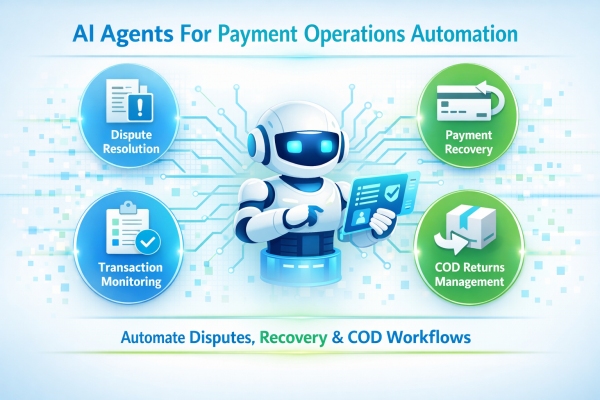
On Mar 12 2026, Razorpay launched Agent Studio, a product it says lets businesses build and run AI agents across payment and post payment workflows. Razorpay says the system is built on Anthropic’s Claude Agent SDK.
Based in Bengaluru, India, Razorpay was founded in 2014 and has grown into one of India’s largest payment platforms. The company says it supports millions of businesses, reaches more than 300 million end consumers, and processes about $180 billion in annualized payment volume. Its stack spans payment acceptance, processing, disbursements, payouts, and business banking through RazorpayX.
Agent Studio targets the operational layer that sits around those flows. In its launch post, Razorpay lists agents for dispute response, subscription recovery, abandoned cart follow up through WhatsApp or email, settlement summaries delivered through messaging, and cashflow forecasting over a 3 to 7 day window. It also includes tools for cash on delivery orders, such as identifying and analyzing returns sent back to the seller.
These workflows cost merchants and payment teams money every day. Disputes create losses and take time to resolve. Failed recurring payments reduce revenue. Abandoned carts lower completed purchases. Cash on delivery returns add shipping and handling costs. Razorpay is building automation around these problem areas, not just the payment itself.
The company is also introducing a no code agent builder in beta and plans to open the system to third party agents. That points to a setup where merchants choose automation for specific tasks across the payment lifecycle, instead of relying only on bundled platform features.
This extends Razorpay’s recent work on AI driven payments, including its earlier work with NPCI on agentic payments to enable AI driven transaction flows. The focus now moves to what happens after a payment, where recovery, customer support, and problem cases still rely heavily on manual work.
Acceptance rates and pricing are still important for PSPs and merchant platforms. Operational efficiency is becoming part of the core value proposition, especially where it directly improves recovery and reduces cost.
If agents handle disputes, recovery, reporting, and cash on delivery losses, does competition start to favour the provider that cuts the most cost for merchants, not just the one with the lowest processing price?
The National Crowdfunding & Fintech Association (NCFA Canada) is a financial innovation ecosystem that provides education, market intelligence, industry stewardship, networking and funding opportunities and services to thousands of community members and works closely with industry, government, partners and affiliates to create a vibrant and innovative fintech and funding industry in Canada. Decentralized and distributed, NCFA is engaged with global stakeholders and helps incubate projects and investment in fintech, alternative finance, crowdfunding, peer-to-peer finance, payments, digital assets and tokens, artificial intelligence, blockchain, cryptocurrency, regtech, and insurtech sectors. Join Canada's Fintech & Funding Community today FREE! Or become a contributing member and get perks. For more information, please visit: www.ncfacanada.org
| | |
|---|---|---|
| | |
Mar 17, 2026 | NCFA Market Insight | AI And Operating Model Reset

On Mar 16 2026, reports that Meta may cut 20% or more of its workforce alongside plans for up to $135 billion in AI related capital spending point to an emerging pattern in how large technology firms operate in the era of AI. Companies are increasing AI investment while reducing headcount and restructuring teams to improve efficiency. Multiple large firms now follow the same pattern.
The sequence is becoming consistent across large technology and fintech firms, and the playbook is as follows.
Increase AI and infrastructure spend.
Reduce or flatten headcount.
Reassign work to automation.
Improve margins and operating leverage.
Rinse and repeat as necessary
Markets reward this because cost discipline becomes visible.
Meta is not alone.
While expanding AI infrastructure, Amazon has cut several hundred roles across AWS and other units.
Google cut hundreds of roles across Assistant, hardware, and engineering teams as it reallocates resources toward AI priorities.
Microsoft cut about 3% of its workforce while continuing to increase AI investment across cloud and enterprise products.
Dominoes? AI spending rises while workforce structures tighten around a new cost model.
And last month, fintech showed the same logic.
Block cut more than 4000 roles in an AI led cost reset while repositioning around automation and efficiency. Investors now expect fintech firms to translate AI into margin improvement, not just new features.
Payments, lending, and financial operations are structured workflows, which makes them easier to redesign around automation.
Fewer headlines at scale but the playbook is apparent.
Shopify requires teams to justify hiring against AI capability. Teams must show AI cannot do the work before adding people.
The new operating model mirrors fewer hires, higher output per employee, and clearer cost control.
The immediate impact of AI is not revenue growth. It is cost structure.
AI increases capital spending while reducing labour intensity, which alters operating leverage across digital businesses.
In fintech, this shows up as:
* automated fraud detection replacing manual review
* automated underwriting reducing analyst workload
* AI support systems replacing large service teams
The cost per decision falls. That is the first advantage.
This pattern will likely not stop at just large tech firms.
Public fintech and payments companies are now under similar pressure to show that AI improves efficiency.
Firms with large cost bases and heavy reliance on manual processes are the most exposed. That includes payments platforms, neobanks, and global processors where margins depend on operational scale.
Companies such as PayPal, Adyen, and other listed payment firms face imminent change. Investors will look for evidence that AI reduces cost per transaction, improves fraud outcomes, and increases operating leverage.
The question is no longer whether these firms use AI. It is whether AI measurably improves their cost structure.
Meta contemplating mass job cuts at scale further highlight a clear cost reset that's defining how digital businesses operate. Amazon, Google, and Microsoft reinforce the pattern. Block shows how it applies in fintech. Shopify demonstrates how it's taking up mental space and decisioning in Canada.
The National Crowdfunding & Fintech Association (NCFA Canada) is a financial innovation ecosystem that provides education, market intelligence, industry stewardship, networking and funding opportunities and services to thousands of community members and works closely with industry, government, partners and affiliates to create a vibrant and innovative fintech and funding industry in Canada. Decentralized and distributed, NCFA is engaged with global stakeholders and helps incubate projects and investment in fintech, alternative finance, crowdfunding, peer-to-peer finance, payments, digital assets and tokens, artificial intelligence, blockchain, cryptocurrency, regtech, and insurtech sectors. Join Canada's Fintech & Funding Community today FREE! Or become a contributing member and get perks. For more information, please visit: www.ncfacanada.org
| | |
|---|---|---|
| | |
Mar 17, 2026 | NCFA Fintech Market Activity | AI Infrastructure And Capital Markets

On Mar 16 2026, Nvidia CEO Jensen Huang delivered an opening keynote at GTC (GPU Technology Conference in San Jose, California) raising the company’s data center revenue outlook to $1 trillion for 2025 through 2027, up from a prior $500 billion estimate. The revision reflects accelerating demand for AI infrastructure as the industry moves from model training into continuous inference at scale.
This is not just a bigger number. It also points to where value will accumulate in AI and essentially who will pay for it.
The industry is moving past model training into continuous inference, so everything picks up from here. Growth isn't in experimentation alone, it's in scaling production.
Inference is not a one time cost. It runs every time a model answers a question, scores a transaction, flags fraud, or generates a recommendation. It scales with usage, not development.
Nvidia’s roadmap, including Blackwell and next generation systems, targets that reality.
For fintech, it directly relies on AI for its operating model.
AI driven underwriting, fraud detection, support agents, and personalization are no longer batch processes. They run live, at scale, on every user interaction.
That means:
* compute becomes a recurring cost tied to usage
* margins depend on inference efficiency, not just acquisition
* product design starts to include cost per decision, not just conversion
These operational costs represent a structural shift. It's not a one and done feature upgrade.
A $1 trillion infrastructure market doesn't stay fragmented.
It concentrates.
Compute, models, and distribution stack together. The firms that control inference capacity influence pricing, latency, and access.
Fintech doesn't compete with Nvidia directly. But it builds on top of the stack Nvidia helps define.
That creates a dependency layer many firms have not priced in yet.
The new forecast raises expectations across the market.
Capital now asks harder questions:
* where does AI revenue actually show up
* who captures margin versus who absorbs cost
* which use cases justify continuous compute spend
This pressure is already visible across public tech names. Strong AI narratives no longer carry valuations on their own. Unit economics are key yet again.
This flows straight into checkout, risk, and customer experience.
Payments firms, neobanks, and platforms are all moving toward:
* real time fraud scoring
* dynamic pricing and routing
* AI driven support and engagement
Those features increase conversion and reduce risk. But they also increase compute intensity per transaction.
That creates a new tradeoff: better decisions versus higher cost per interaction.
Firms that optimize that balance get it right for now. Others compress margins without realizing it.
AI is a capability And cost layer.
Fintechs and financial institutions should consider to:
* design products with inference cost in mind from day one
* choose infrastructure partners strategically, not just technically
* focus on high value decisions where AI materially improves outcomes
The risk of course is adding AI features that increase cost faster than revenue.
If AI infrastructure becomes a $1 trillion market, fintech’s advantage won't come from using AI first. It will come from using it efficiently.
The National Crowdfunding & Fintech Association (NCFA Canada) is a financial innovation ecosystem that provides education, market intelligence, industry stewardship, networking and funding opportunities and services to thousands of community members and works closely with industry, government, partners and affiliates to create a vibrant and innovative fintech and funding industry in Canada. Decentralized and distributed, NCFA is engaged with global stakeholders and helps incubate projects and investment in fintech, alternative finance, crowdfunding, peer-to-peer finance, payments, digital assets and tokens, artificial intelligence, blockchain, cryptocurrency, regtech, and insurtech sectors. Join Canada's Fintech & Funding Community today FREE! Or become a contributing member and get perks. For more information, please visit: www.ncfacanada.org
| | |
|---|---|---|
| | |
March 13, 2026 | NCFA Fintech Whisperer Weekly Intelligence | Artificial Intelligence And Data, Open Banking Open Finance And Data Sharing, Payments And Market Infrastructure, Regulation And Policy
Image: Freepik
This live weekly NCFA intelligence page tracks financial technology developments that significantly affect how fintechs build, sell, raise capital, and operate under scrutiny. Coverage prioritizes Canada and includes global events that directly influence competitive conditions, market access, and execution realities across fintech sectors. This page will be updated throughout the week with market movers in a live format and then each week we'll close the prior week's contents in prep for the upcoming week, and continue on a rolling basis. (Missed prior week's Fintech Whisperer? (December 6-12, 2025, December 13-19, 2025, January 1-9, 2026, January 10-16, 2026, January 17-23, 2026, January 24-30, 2026, January 31-February 6, 2026, February 7-13, 2026, February 14-20, 2026, February 21-27, 2026, February 28-March 6, 2026).
Regulators are aligning competition rules and data protection in a way that directly affects how AI systems access, process, and govern data. For fintechs and financial institutions building on platform infrastructure, data strategy, consent design, and compliance architecture are becoming tightly coupled decisions.
Large platforms, AI firms, fintechs, and financial institutions that depend on platform distribution, data access, identity layers, or app infrastructure face a more active compliance environment. Platform terms, profiling practices, interoperability rules, and access conditions can change through ongoing regulatory review. Firms with high dependency on a small number of gatekeepers face increased operating risk, while firms that diversify distribution, strengthen direct customer relationships, and build adaptable data and compliance architectures will be better positioned.
The next edge will come from firms that can operationalize data standards, identity rails, and compliance workflows across jurisdictions rather than wait for policy intent alone to close the gap.
This deal says scale in cross border payments is moving toward platforms that already combine distribution, compliance support, and endpoint reach. For smaller wallet, remittance, and banking partners, the harder question is no longer whether they can connect. It is whether they still control enough of the customer relationship or economics once a larger stack sits in the middle.
This brings Ripple inside the licensed payments system in Australia. It can handle more of the payment flow itself instead of relying on partners. That includes onboarding, compliance, FX, and payout. For banks and fintechs, this means a digital asset firm can now compete more directly on cross border payments with full regulatory coverage, not just as a crypto overlay.
This impacts payment processors, merchant platforms, and consumer fintechs that want to own checkout and settlement. A payment aggregator license pulls merchant onboarding, refunds, and settlement into one accountable layer, so competitors and partners should expect tighter expectations on merchant screening and operational controls as volumes grow.
This impacts fixed income platforms, treasury and collateral systems, and anyone building workflows that touch Government of Canada collateral. Dealer funding and hedging capacity affects liquidity and trading costs.
This impacts capital markets fintechs that want distribution through regulated channels. When a top tier exchange brand commits to a tokenization partner, procurement and diligence tighten fast. Builders should prepare for deeper questions on governance, surveillance, custody controls, and how tokenized assets move without breaking compliance reporting and investor protections.
This raises the execution standard for digital onboarding, disclosures, promotions, and support flows. For fintechs, good UX is no longer enough on its own. Firms need evidence that customers understand what they are seeing and can act on it without avoidable confusion.
Ottawa is pushing affordability through multiple channels at once, including taxes, housing, and core banking fees. For banks, that puts more pressure on legacy fee revenue and raises the importance of better alerts, cash flow tools, and low cost account design. For fintechs, it strengthens the case for products that help users avoid failed payments, manage short term liquidity, and lower everyday banking friction.
Banks lose part of a high margin penalty fee and face more pressure to compete on better alerts, balance visibility, payment controls, and products that help customers avoid failed payments in the first place. Direct product and revenue implications across consumer banking.
This opens a formal rulemaking lane around one of the fastest growing grey areas in digital markets. It matters for exchanges, brokers, market makers, and fintech platforms. How far regulated market structure will let them scale before they run into tighter product boundaries.
This guidance impacts how Canadian DIY investment platforms can design tools and user experiences. Online brokers and fintech wealth platforms now have clearer room to provide decision support, portfolio models, and guided interfaces, but they must build stronger safeguards to ensure those tools do not cross the line into regulated investment advice (a condition of the OEO regulatory exemption).
Public payment rails can widen access, but they can also compress private platform economics and add pressure onto merchant pricing. For banks, fintechs, and payment providers, the real issue is not only whether public rails expand. It is how pricing design changes volume, margin, and who absorbs the cost.
A charter application signals a potential change in funding and balance sheet strategy for an AI lending platform and it can reshape partner economics for banks and credit unions that currently fund originations.
This is more than a weak quarter. It puts credit quality, funding resilience, and covenant headroom back at the center of the non prime lending story, which matters for alt lenders, securitization partners, credit investors, and fintechs selling underwriting, servicing, collections, and portfolio monitoring tools into the consumer lending stack.
This matters for brokers, carriers, and digital asset clients because premium payments are a treasury workflow. Once stablecoins clear premiums across real counterparties, buyers and carriers will ask harder questions about controls, reconciliation, and how funds move from premium collection to coverage without losing traceability.
This roadmap puts Europe closer to a tokenised market structure built around central bank money rather than private settlement workarounds. It matters for banks, FMIs, tokenisation platforms, and securities infrastructure teams because the market is now moving from exploratory work toward live design choices on standards, networks, and governance.
This opens a cleaner path for brokers and institutional desks that want crypto execution without rebuilding their stack around proprietary APIs. Once crypto routing uses the same FIX plumbing as other asset classes, firms will put more weight on consistent controls, audit trails, and operational readiness across both traditional and digital venues.
Payment networks are scaling distribution and wallet reach. Tokenized market structure is moving closer to institutional use. Canada’s NSF fee cap also cuts into a legacy bank revenue line and raises the value of tools that help customers avoid failed payments. The strongest fintechs and financial institutions are combining regulatory discipline, strong rails, and practical financial workflows that reduce friction for users.
NCFA offers various curated resources to help founders and investors stay current on developments that impact fintech markets, subscribe to NCFA weekly newsletter updates, view a rundown of current fintech news and insights, or dive into the latest fintech industry research.
The National Crowdfunding & Fintech Association (NCFA Canada) is a financial innovation ecosystem that provides education, market intelligence, industry stewardship, networking and funding opportunities and services to thousands of community members and works closely with industry, government, partners and affiliates to create a vibrant and innovative fintech and funding industry in Canada. Decentralized and distributed, NCFA is engaged with global stakeholders and helps incubate projects and investment in fintech, alternative finance, crowdfunding, peer-to-peer finance, payments, digital assets and tokens, artificial intelligence, blockchain, cryptocurrency, regtech, and insurtech sectors. Join Canada's Fintech & Funding Community today FREE! Or become a contributing member and get perks. For more information, please visit: www.ncfacanada.org
| | |
|---|---|---|
| | |



August 26th, 2025

January 4th, 2024

June 1st, 2021

September 9th, 2020

July 9th, 2018

January 3rd, 2018

September 25th, 2017

June 20th, 2017

May 10th, 2017

December 14th, 2016
