





Karsten Wenzlaff, Advisor
August 26th, 2025
Karsten Wenzlaff is a Crowdfunding and Fintech Expert from Germany. He is Secretary-General of Digit[...]


Aug 17, 2026

A mid-size alternative lender in Vilnius pulls company registry filings, marketplace pricing and sanctions lists into its underwriting model every night. None of it is illegal to read. Most of it becomes a liability the moment it is copied, stored and combined with something else. That gap between "publicly visible" and "lawfully processed" is where fintech compliance teams keep losing arguments with their own data science departments.
Public web data – company filings, marketplace listings, court dockets, sanctions databases, social media bios – has become a standard input for credit scoring, fraud detection, KYB and competitive pricing in financial services. In Meta Platforms v. Bright Data, a federal district court held that Bright Data had not breached Meta's terms of service by collecting data from logged-out pages, which was the specific conduct at issue. The ruling turned on Bright Data's particular conduct and its contractual relationship with Meta rather than establishing a general rule for scraping public websites. For a regulated entity, that distinction is not academic. A bank's third-party risk team, an EU DORA auditor or a state attorney general does not care whether the data was "technically public" if the collection method itself created exposure.
hiQ Labs v. LinkedIn is still the reference case for US practitioners, and it is more nuanced than the headlines from 2019 suggest. The Ninth Circuit held twice, first in 2019 and again on remand in 2022, that scraping data from pages open to any visitor does not amount to accessing a computer "without authorization" under the Computer Fraud and Abuse Act. That took the CFAA off the table as a criminal exposure for reading public pages. It did not end the case. hiQ and LinkedIn settled the remaining contract claims in 2022, and hiQ agreed to destroy the data it had already collected and pay damages, because its scraping still violated LinkedIn's user agreement. The lesson for a fintech legal team is specific: CFAA risk and contract risk are two separate questions, and winning on one does not close the other.
On the EU side, the CFAA question barely matters, because GDPR does not distinguish between public and private personal data. Article 4 defines personal data by whether it relates to an identifiable natural person, not by where it was found. A LinkedIn bio, a court filing with a defendant's name, or a marketplace seller profile with a real name attached all fall inside GDPR's scope the moment they are collected, and Article 6 still requires a lawful basis – legitimate interest is workable for adverse-media or fraud screening, but it requires a documented balancing test, not just a note in a Confluence page.
Four use cases account for most of the public-data traffic coming out of fintech data engineering teams. Alternative underwriting pulls e-commerce store metrics, invoice marketplaces and gig-platform ratings to score borrowers who lack conventional credit files – Kabbage and, later, Amex built entire product lines on this. AML and sanctions screening cross-references OFAC, EU and UN lists against onboarding data, refreshed daily because list updates are unscheduled. Competitive pricing intelligence in embedded finance and BNPL tracks merchant-facing rates across marketplaces to benchmark interchange and fee structures. Fraud and adverse-media screening checks court records, press mentions and social profiles as a secondary signal alongside device fingerprinting.
Not all four carry the same regulatory weight. The table below is the one compliance teams actually need before greenlighting a collection project, not a generic "data source" taxonomy.
| Data source | Typical fintech use | Regulatory sensitivity | Main legal basis to check |
| Company registries (Companies House, EDGAR, EU BRIS) | KYB, beneficial ownership checks | Low to medium | Public register rules and applicable data protection law; filings may contain personal data of directors, officers, beneficial owners and other natural persons |
| Sanctions and PEP lists (OFAC, EU, UN) | AML/KYC screening | Low | Government-published, but update frequency and source authenticity matter |
| E-commerce and marketplace pricing | Competitive intelligence, embedded-finance pricing models | Low to medium | Terms of service and contract law; CFAA exposure may be lower for pages accessible without login (per hiQ v. LinkedIn) |
| Public social media profiles | Alternative credit signals, fraud indicators | Medium to high | GDPR/CCPA personal-data rules apply even if the profile is public |
| Court records and litigation databases | Adverse media, fraud investigation | High | Jurisdiction-specific rules on re-use of judicial data (varies widely, e.g. France's Article 33) |
The engineering choices matter as much as the legal analysis, because a regulator or a bank's third-party risk assessor will ask for logs, not intentions. A defensible pipeline has five properties, and they map to concrete infrastructure decisions rather than policy statements.

Figure 1
Figure 1. Each control maps to an artifact a third-party risk assessor can actually inspect. The first four are described below; request logging is the fifth, and the one the practical takeaway returns to.
Reading a site's robots.txt crawl-delay directive and setting concurrency accordingly is a five-minute engineering task that changes the legal character of the whole program. A crawler hitting a company registry at 200 requests per second looks like a denial-of-service test to the target's security team, regardless of what the data is used for afterward. Most production fintech scrapers we've reviewed cap at 1 request per 2-4 seconds per domain, which keeps CPU load on the target negligible and avoids the WAF triggers that generate abuse complaints in the first place.
This is the point where proxy infrastructure choice stops being a procurement decision and starts being a compliance decision. Rotating through residential or datacenter IPs to maintain a stable success rate against rate limits is standard engineering practice. Rotating IPs specifically to re-access a source after being blocked for a terms-of-service violation is the fact pattern that turned hiQ's win on CFAA into a loss on contract claims. The distinction sounds semantic until an opposing counsel reconstructs your request logs during discovery.
Filtering personal identifiers (names, emails, phone numbers, biometric-adjacent fields) before the data lands in a warehouse is materially cheaper than filtering it after ten analysts have already queried the raw table. A regex-and-NER pass at the collection layer, logged with a timestamp and a rule version, is the artifact a DPO can actually show an auditor.
GDPR's storage limitation principle (Article 5(1)(e)) and most US state privacy laws expect a defined retention period. "We keep everything indefinitely for model retraining" is the single most common finding in the DPIAs we've read for alt-data underwriting programs, and it is usually fixable with a 90-180 day rolling window plus a documented exception process for flagged accounts.
Proxy and scraping infrastructure choice affects three things a compliance file will ask about: whether the vendor itself runs KYC on IP sourcing, whether the billing model matches your actual usage pattern (per-IP monthly vs. per-GB bandwidth), and whether the vendor's own terms indicate the network is ethically sourced rather than built from compromised devices.
| Provider | Billing model | Entry price | Where it fits a fintech workload |
| Proxys.io | Per dedicated IP / month | From $1.40/mo (individual IPv4), $0.13/mo (IPv6) | Steady, low-volume monitoring jobs (registry checks, sanctions list refresh) where a fixed, auditable IP per data feed is easier to log than rotating bandwidth pools |
| Decodo (formerly Smartproxy) | Per GB, tiered | $2.00-$3.75/GB depending on volume | Mid-volume scraping across many source domains where bandwidth, not IP count, is the cost driver |
| Oxylabs | Per GB, sales-assisted | Roughly $8/GB at entry tier, KYC required before provisioning | Enterprises that want a vendor-side KYC record as part of their own third-party risk file |
| Bright Data | Per GB (PAYG or committed) | $8.40/GB PAYG residential, down to ~$3/GB committed; datacenter from ~$0.90/GB | Large, multi-region collection programs where volume discounts offset the higher entry rate |
The billing model split matters more than the headline price. A sanctions-list refresh job that hits the same twelve government sources every night at a predictable, low volume is a poor fit for per-GB bandwidth pricing – you're paying for a metric (data transferred) that has almost nothing to do with your actual constraint, which is IP reputation and consistency of access over time. Vendors like Proxys.io bill per dedicated IP per month, which lines up better with that access pattern and makes cost forecasting for a fixed set of monitored sources straightforward. A marketplace-pricing crawl that touches thousands of product pages across dozens of domains is the opposite case: bandwidth is the real cost driver, and a per-GB model from Decodo, Oxylabs or Bright Data scales more predictably with that workload. Enterprises already running Oxylabs' or Bright Data's own KYC process may lean on that as one input to their own vendor risk assessment, though it doesn't substitute for one.
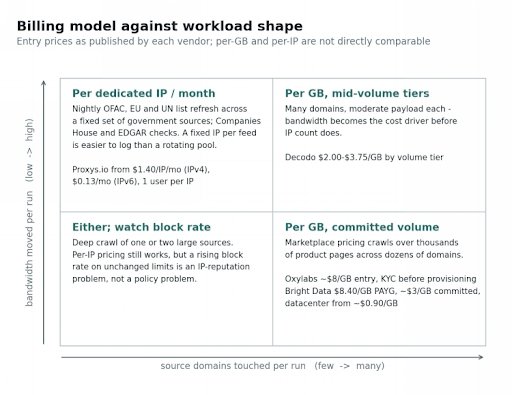
Figure 2
Figure 2. The two variables that move cost are how many domains a run touches and how much data it moves, not the headline price per unit. Per-IP and per-GB rates are quoted in different units and cannot be compared directly.
None of these vendors, including the ones with published ethics or KYC pages, remove the fintech's own obligation to define a lawful basis, log what was collected, and honor retention limits. The proxy layer solves an availability and reliability problem – consistent access to public pages without disproportionate load on the source – not a data protection problem.
Three signals usually mean a proxy or scraping setup needs to change, independent of price. First, a rising block rate on sources with unchanged rate limits – that's an IP-reputation problem the vendor's pool has accumulated, not something a compliance policy fixes. Second, the compliance team asking for source-level access logs the engineering stack can't currently produce – that's a signal the collection layer needs structured logging before it needs a new vendor. Third, a shift in workload shape, for example moving from a handful of steady, low-volume registry checks to broad multi-domain marketplace crawling, which usually means the per-IP pricing that worked for the first case stops making sense for the second.
A fintech data program built on public web sources holds up under regulatory review when three things are documented before the first request is ever sent: the lawful basis for each data category (not a blanket justification), the technical controls that keep collection proportionate to the source (rate limits, minimization, retention), and a request log detailed enough to reconstruct what was collected and why if a regulator or a counterparty's third-party risk team asks. The infrastructure vendor is a smaller decision than most procurement processes treat it as – it changes reliability and cost, not the underlying legal analysis.
 The National Crowdfunding & Fintech Association (NCFA Canada) is a financial innovation ecosystem that provides education, market intelligence, industry stewardship, networking and funding opportunities and services to thousands of community members and works closely with industry, government, partners and affiliates to create a vibrant and innovative fintech and funding industry in Canada. Decentralized and distributed, NCFA is engaged with global stakeholders and helps incubate projects and investment in fintech, alternative finance, crowdfunding, peer-to-peer finance, payments, digital assets and tokens, artificial intelligence, blockchain, cryptocurrency, regtech, and insurtech sectors. Join Canada's Fintech & Funding Community today FREE! Or become a contributing member and get perks. For more information, please visit: www.ncfacanada.org
 |  |  |
|---|---|---|
 |  |  |
Aug 8, 2026 | NCFA Fintech Whisperer | Digital Banking And BaaS, Regulation And Policy, SME Finance And Business Banking, Digital Assets Blockchain And Tokenization, Payments Infrastructure And Money Movement, Capital Markets Infrastructure And Funding, Artificial Intelligence And Data, Wealthtech Investing And Trading, Embedded Finance, Risk Compliance And Regtech, Lending Consumer Credit And BNPL, Cybersecurity Fraud And Financial Crime

Image: Freepik
This live weekly NCFA intelligence page tracks financial technology developments that significantly affect how fintechs build, sell, raise capital, and operate under scrutiny. Coverage prioritizes Canada and includes global events that directly influence competitive conditions, market access, and execution realities across fintech sectors. This page will be updated throughout the week with market movers in a live format and then each week we'll close the prior week's contents in prep for the upcoming week, and continue on a rolling basis. (Missed prior week's Fintech Whisperer? (December 6-12, 2025, December 13-19, 2025, January 1-9, 2026, January 10-16, 2026, January 17-23, 2026, January 24-30, 2026, January 31-February 6, 2026, February 7-13, 2026, February 14-20, 2026, February 21-27, 2026, February 28-March 6, 2026, March 7-13, 2026, March 14-20, 2026, March 21-27, 2026, March 28-April 3, 2026, April 4-10, 2026, April 11-17, 2026, April 18-24, 2026, April 25-May 1, 2026, May 2-8, 2026, May 9-15, 2026, May 16-22, 2026, May 23-29, 2026, May 30-June 5, 2026, June 6-12, 2026, June 13-19, 2026, June 20-26, 2026, June 27-July 3, 2026, July 4-July 10, 2026, July 11-July 17, 2026, July 18-24, 2026, July 25-July 31 2026, August 1-August 7, 2026).
Large crypto platforms are starting to look more like multi asset investment distributors, but the infrastructure underneath them is still regulated brokerage, custody and settlement. Alpaca has been building specifically for this role, which NCFA recently examined in its global brokerage platform expansion. The competitive question is who controls that regulated layer as crypto, traditional securities and tokenized products converge inside the same customer interface.
IBQT changes where the crypto allocation decision happens. Investors choosing the fund are buying a diversified equity portfolio with bitcoin already assigned a modest strategic weight, rather than adding crypto separately. That puts bitcoin closer to conventional portfolio construction and gives Canadian advisers and investors a simple way to combine traditional markets and digital assets in one listed product.
Pay by Bank is reaching Canadian customers before regulated payment initiation does. Foreign providers are improving the experience around an existing Canadian bank rail instead of waiting for new infrastructure. That makes the commercial timing important for Canada’s open banking opportunity: future regulated access will enter a market where some of the customer experience is already being built.
Dream is taking infrastructure built by a Canadian fintech into U.S. business payment workflows where the payment can start inside the software that created the obligation. That also gives agent payment infrastructure a more concrete operating model: software can participate in the workflow, but identity, authority, approval and settlement controls still determine whether money moves.
Last year’s Moneris sale discussion has become a signed change of control. RBC and BMO are giving up ownership while preserving customer distribution, leaving Francisco Partners to decide how aggressively Moneris invests across merchant acquiring, commerce software and payments technology. The separation between infrastructure ownership and bank distribution is the more consequential part of the deal.
Canada is putting a settlement discipline framework into live measurement before imposing a financial penalty. That gives dealers, custodians and market infrastructure providers time to see where fails occur, what the operational burden looks like and whether the fee design changes settlement behaviour. The evidence from the trial will determine whether a reporting framework eventually becomes an economic incentive.
Canada's repo market now has a standardized collateral workflow running on infrastructure that the Bank of Canada also plans to use for its domestic repo operations. Wider adoption would make collateral easier to allocate and substitute across financing activity while reducing manual processing. The next evidence is usage: how much repo activity migrates onto CCMS and whether the additional baskets deepen participation beyond Government of Canada securities.
The financing connects capital directly to deployment of a physical and digital financial services network rather than funding an undefined expansion plan. PointsKash acquired more than 2,100 cryptocurrency kiosks earlier in August and now has a staged capital structure intended to refurbish and redeploy that hardware while building payments, merchant and mobile services around it. The conditional structure also keeps a clear line between near term funding and the larger amount that depends on execution.
The rule changes where settlement risk has to be dealt with. Firms must support the expectation of settlement before a short sale reaches the market, putting more responsibility on trading controls, securities availability and supervision. Difficult to borrow securities and repeated settlement failures will show how demanding the requirement becomes in practice.
RBI is pushing AI governance into the same operating disciplines banks already use for material risk. That aligns with Canadian work on regulated AI, where model oversight, vendor access, fallback plans and proof of control are becoming practical requirements. The advantage will come from deploying useful AI while being able to show who owns the risk and how the system is controlled.
Pix is starting to test whether a national instant-payment rail can connect directly into foreign payment infrastructure rather than relying only on traditional correspondent channels. NCFA’s cross border payments benchmark shows why that distinction matters: strong domestic rails don’t automatically solve international cost, speed or interoperability. The practical questions are which systems Brazil connects to first, how FX, compliance and settlement are handled across jurisdictions, and whether this becomes a repeatable model for other domestic real time rails.
USD1 could move from a stablecoin structure supported by external service providers into a federally supervised trust bank that combines issuance, redemption, reserves and custody. That would bring more of the operating stack behind a payment stablecoin inside one regulated entity, while concentrating responsibility for reserve management, safeguarding and compliance.
The Coinbase acquisition is moving from ownership into shared market infrastructure. Deribit can keep its derivatives interface while drawing on Coinbase's spot liquidity and execution stack, extending the Deribit acquisition strategy into day to day trading. That brings spot execution, collateral and derivatives closer together inside one regulated operating structure.
The significance is the combination of existing regulated market infrastructure with newly authorized crypto services. Rather than building a separate crypto venue, Perpetual Markets can extend an established MTF operating model into digital assets, giving brokers and institutions another route to offer crypto products under a European regulatory framework. The announcement authorizes expansion, but does not establish that every permitted crypto service is already live at scale.
Hong Kong's stablecoin regime has crossed from licensing into controlled distribution and commercial use. That builds on the tokenized finance strategy NCFA has been tracking through Standard Chartered and Hong Kong's regulators. HKDAP now has to prove that regulated tokenized money can attract repeat transaction flow across payments, asset settlement and institutional distribution rather than remain a licensed product with limited circulation.
The important distinction is the legal and operating structure behind the token. Coinbase is combining regulated custody, underlying shares, investor rights and blockchain transferability rather than offering price exposure alone. That puts the model inside the infrastructure test NCFA is tracking for regulated tokenized assets: whether ownership rights, custody, compliance and transfer can work together at market scale.
Bitstamp is becoming more than an acquired exchange for Robinhood. Its UK crypto infrastructure now lets Robinhood add digital assets to the same interface where customers already invest across traditional markets. The next test is whether that combination deepens customer activity and gives Robinhood a repeatable way to extend its wider investment platform into regulated crypto markets.
Bridge provides the regulated issuance while Revolut distributes EURR through its customer app. NCFA tracked Bridge’s European authorizations in July. The immediate evidence is limited to phased testing in three markets, and Revolut has not published EURR circulation, adoption or transaction-volume data.
Crypto backed lending is becoming part of the product stack offered by Canadian trading platforms. Shakepay is integrating the credit relationship directly into its own account experience, while embedded crypto lending at Netcoins uses APX to supply the lending operation behind the interface. The two models create different economics and different responsibility for underwriting, collateral controls and servicing.
General availability converts the earlier token-backed mortgage launch into an open lending product. Funded volume, borrower performance, collateral custody and the treatment of pledged assets during delinquency will show whether the model can operate at conforming-mortgage scale.
Construction lending is operationally intensive because capital is released in stages and each draw depends on current budget, progress and compliance information. Moving those controls into the loan system can reduce reconciliation work and make exceptions visible earlier, while giving private lenders a more integrated way to manage construction credit as portfolios scale.
Opening a new bank account is easier than making it the primary account. Payroll switching reduces the work required to redirect recurring income and adds an operational layer to open banking and financial portability. Competition improves when customers can act on a better banking option, not only compare one. The next measure is whether easier switching translates into more primary-account relationships and deposits.
The licence turns Revolut’s banking expansion into a two-hub European structure with a new regulated entity serving its largest regional customer base. The execution test is how quickly customers and products migrate to the French bank, and whether local licences give Revolut more room to deepen lending, business banking and other regulated services across Western Europe.
The dispute is becoming a direct test of who controls access to event contracts in the United States. The CFTC is treating Kalshi as national derivatives infrastructure while states continue to challenge parts of the market through gaming law. NCFA’s regulated event contract infrastructure brief tracks the same boundary between exchange regulation, market integrity and product access.
The FCA is making regulatory engagement part of the scale up process rather than waiting for rapid growth to create supervisory problems. NCFA’s closer look at the five firms shows how that support intersects with payments, credit, insurance and European expansion. For fintechs, the tradeoff is clearer: faster access to regulatory guidance comes with closer attention to whether governance, controls and customer protections are developing at the same rate as products, customers and market expansion.
The CLARITY Act has moved from an uncertain post-recess commitment to a scheduled Senate procedure. The September vote will test whether negotiators can assemble enough support to advance a federal market-structure framework and narrow the remaining disagreements over banking, stablecoins and digital-asset oversight.
The important change is that an AI agent can now receive its own controlled payment credential rather than only prepare a transaction for someone else. That makes permission design part of the payment product. NCFA has already tracked how AI agents use card rails; Mercury brings the same question inside company spending, where budgets and policy controls define how much authority software actually receives.
Invoice financing fraud controls are becoming shared lending infrastructure rather than checks performed inside one lender at a time. MonetaGo has been working on shared trade finance fraud controls for years; the SIDBI deployment brings that model into live MSME lending. The test is whether interoperable validation reduces duplicate financing and exceptions at scale while making cash flow credit faster and safer across multiple lenders and factoring platforms.
Mews is taking embedded finance beyond connecting hotels to outside financial providers. Its own regulated entity can now sit inside the software where hotel revenue, operations and payments already meet. That changes the regulatory boundary for embedded finance: vertical software can become part of the licensed financial infrastructure instead of remaining only the distribution layer.
AI is entering compliance as an investigation and decision support layer rather than replacing accountable human approval. That model fits the emerging market for AI powered compliance workflows where evidence, escalation, auditability and human control determine whether automation can be trusted. TransFi's operating test is whether JARVIS reduces review effort across multiple jurisdictions without weakening decision quality.
The breach shows how self custody can inherit risk from suppliers that never touch a private key. Fulfilment providers still hold enough identity and location data to expose hardware wallet owners to targeted attacks, making vendor controls and data retention part of hardware wallet security rather than a separate privacy issue.
Financial infrastructure is becoming easier to enter and harder to operate well. Bank switching is getting simpler, payments are becoming programmable, AI agents are gaining spending authority and software platforms are taking on regulated financial roles. At the same time, regulators are putting more weight on governance, settlement discipline, market access and accountability. The competitive advantage is moving toward firms that can combine better distribution with stronger control of the infrastructure underneath it.
NCFA offers various curated resources to help founders and investors stay current on developments that impact fintech markets. Get the weekly Whisperer and related market intelligence through NCFA's newsletter, view the latest fintech insights, industry research, or launch into emerging financial innovation opportunities.
The National Crowdfunding & Fintech Association (NCFA Canada) is a financial innovation ecosystem that provides education, market intelligence, industry stewardship, networking and funding opportunities and services to thousands of community members and works closely with industry, government, partners and affiliates to create a vibrant and innovative fintech and funding industry in Canada. Decentralized and distributed, NCFA is engaged with global stakeholders and helps incubate projects and investment in fintech, alternative finance, crowdfunding, peer-to-peer finance, payments, digital assets and tokens, artificial intelligence, blockchain, cryptocurrency, regtech, and insurtech sectors. Join Canada's Fintech & Funding Community today FREE! Or become a contributing member and get perks. For more information, please visit: www.ncfacanada.org
| | |
|---|---|---|
| | |
August 14, 2026 | NCFA Market Activity | Payments Infrastructure And Money Movement, SME Finance And Business Banking, Embedded Finance

On August 11, 2026, Toronto-based Dream Payments launched Dream Payouts, a U.S. real-time business payment network with J.P. Morgan Payments. The platform lets eligible U.S. businesses pay suppliers, contractors and other recipients using an email address, with qualifying payments delivered through The Clearing House RTP network.
Dream isn't building a new payment rail. It's putting bank accounts, supplier onboarding, payment controls and real-time payouts into software businesses already use.
That gives Dream a potentially valuable position between the bank infrastructure that moves the money and the business workflow that decides when, where and why it should move.
A business enters a supplier's email address. Dream then invites the recipient into its Payee Portal, where they verify their identity with multi-factor authentication, enter and maintain their own banking information and choose how they want to be paid.
The email itself never carries payment instructions or banking details. Once enrolled, a recipient can receive future payments without the payer collecting or manually updating their account information. Eligible RTP payments can arrive in under 30 seconds, including nights, weekends and holidays. ACH and wire are available when real-time delivery isn't available or isn't selected.
Businesses can fund payments through Dream Wallet, a payments account provided through J.P. Morgan subject to eligibility and account-opening requirements. Dream also separates payment requests from payment release through roles, limits and approval workflows, while transactions are tracked from initiation through settlement. That is more useful than speed alone. Supplier payments still require banking information, approvals, payment status and reconciliation. Dream is bringing those steps into one controlled workflow.
As of July 2026, The Clearing House RTP network had more than 1,322 participating financial institutions. It operates around the clock, settles payments with finality and supports transactions up to US$10 million. The network processed 142 million payments worth US$576 billion in the second quarter of 2026.
Dream Payouts identifies RTP for eligible real-time delivery. Its public launch material doesn't say FedNow is part of the current product, so the two networks shouldn't be treated as interchangeable.
Other payment infrastructure providers are also making instant-payment rails easier to access through software. The competitive question is becoming less about connecting to a rail and more about what a provider builds around it.
Dream combines a J.P. Morgan-provided payments account, recipient onboarding, payment controls and embedded distribution. Mantle shows how that can work. The family-office software platform has embedded Dream Payouts so a capital call can be reviewed, approved and paid inside the same system where the obligation is managed. The payment becomes part of the workflow instead of a separate trip to a bank portal.
Dream began in Toronto in 2014 with mobile point-of-sale technology, but its business progressively moved deeper into payment infrastructure.
In 2018, Dream and Mastercard expanded into digital insurance payouts. Northbridge Financial became the first Canadian insurer announced for the service, with Mastercard Send connecting Dream's infrastructure to claims disbursements.
In 2024, Dream launched DreamPay embedded payments across North America, bringing payment collection, payouts and orchestration into an API-based platform for financial institutions, insurers and software companies.
The J.P. Morgan relationship also predates Dream Payouts. In 2025, Dream launched a North American insurance payment network using J.P. Morgan Payments' banking infrastructure, treasury services and pay-in and payout rails.
Dream has been applying the same model in Canada. In May 2026, Dream DriverPay began rolling out with Script Runner, allowing healthcare delivery drivers to receive earnings through Interac e-Transfer for Business using an email address or mobile number.
Dream Payouts takes that operating model beyond a specific industry. The company is testing whether recipient onboarding, payment controls and bank-rail access can become reusable infrastructure for U.S. businesses and the software platforms serving them.
Dream says software platforms can use the infrastructure as a foundation for AI agents to initiate, approve and reconcile payments.
Dream Payouts already separates payment requests from payment release through roles, limits and approval workflows. Its public material doesn't establish that an AI agent can independently release company funds without those controls.
As AI agents enter payment workflows, the commercial question is practical: what can software initiate, what still requires approval and who is accountable when money leaves the account?
Dream Payouts is a U.S. product built on U.S. banking and instant-payment infrastructure, but the company behind it remains headquartered in Toronto.
Canada shouldn't be reduced to a comparison about payment speed. Dream already uses Interac e-Transfer for Business for embedded payouts here, while its U.S. products connect to different rails and banking infrastructure.
Dream doesn't need to own the underlying rail if it can make different rails easier to use inside insurance platforms, healthcare systems, family-office software and other business applications.
Banks retain the regulated accounts and payment infrastructure while companies such as Dream compete to own more of the software, controls and workflow around each transaction.
If banks own the accounts and payment rails but fintechs increasingly own the onboarding, controls and software workflow around them, which layer will own the most valuable business relationship?
Dream Payments was founded in Toronto in 2014 and initially built mobile point-of-sale technology for financial institutions and merchants.
Dream PaymentsToronto financial technology company focused on digital payments
LaunchMobile point-of-sale was the first commercial product
$6M RoundEarly venture funding supported product development
CanadaInitial commercialization centred on Canadian payments
Banks And MerchantsFinancial institutions became an important distribution channel
Bank DistributionDream supplied technology that financial institutions could put in front of business customers
Dream started by helping financial institutions modernize merchant payments. That distribution model remains visible today: the company builds around regulated financial infrastructure rather than trying to replace it.
The National Crowdfunding & Fintech Association (NCFA Canada) is a financial innovation ecosystem that provides education, market intelligence, industry stewardship, networking and funding opportunities and services to thousands of community members and works closely with industry, government, partners and affiliates to create a vibrant and innovative fintech and funding industry in Canada. Decentralized and distributed, NCFA is engaged with global stakeholders and helps incubate projects and investment in fintech, alternative finance, crowdfunding, peer-to-peer finance, payments, digital assets and tokens, artificial intelligence, blockchain, cryptocurrency, regtech, and insurtech sectors. Join Canada's Fintech & Funding Community today FREE! Or become a contributing member and get perks. For more information, please visit: www.ncfacanada.org
| | |
|---|---|---|
| | |
August 13, 2026 | NCFA Market Activity | Digital Assets Blockchain And Tokenization, Capital Markets Infrastructure And Funding, Regulation And Policy

On August 11, 2026, Coinbase received Financial Services Permission from the Financial Services Regulatory Authority of Abu Dhabi Global Market to establish a regulated tokenization hub in Abu Dhabi, allowing it to arrange investment deals and provide custody for tokenized securities.
The licence gives Coinbase a regulated structure for putting share-backed securities into digital wallets while keeping investor rights, sanctions controls and securities rules attached. The real test is whether tokenized securities can work in digital wallets without losing the investor rights and controls behind them.
Coinbase says securities issued through the ADGM structure are fully backed by underlying shares and can give verified holders economic and voting rights.
The terms are more specific. Only securities that meet the prospectus's vesting conditions carry certain rights, including voting. Dividends are automatically reinvested, while redemption is limited to eligible vested holders. Investors exercising redemption also need an appropriate brokerage or bank account capable of receiving the proceeds.
The FSRA approved prospectus register shows the legal structure in practice. Coinbase Onchain SPV Ltd is listed as issuer of NVIDIA CB Certificates, ticker NVDAc, classified as Certificates over Shares. The primary prospectus was approved on August 4, 2026.
Investors therefore aren't simply holding NVIDIA shares on a blockchain. They're holding a Coinbase-issued security linked to underlying shares, with ownership rights governed by the certificate and prospectus.
That point matters as tokenized securities develop measurable business models around custody, distribution, liquidity and investor rights. The technology can change how a security is held and transferred without removing the legal machinery underneath it.
Coinbase says investors transacting only in these digital securities don't need to establish a traditional brokerage account or correspondent banking relationship. They need a wallet.
Every transfer is still subject to sanctions screening, and Coinbase says assets can be frozen or seized at the wallet level when required.
That puts the wallet in a different role from the early crypto idea of bypassing financial intermediaries. It becomes another way to distribute and hold a regulated security while identity, custody, corporate actions and redemption remain part of the system.
Several operating details aren't public yet. Coinbase hasn't disclosed the full range of securities, all eligible jurisdictions, the blockchain network, secondary trading venues or how freely the securities can move between third-party wallets and applications.
Those details will determine the scope of the hub as market infrastructure or it remains primarily a new distribution channel.
Coinbase is entering a market where competitors are already testing different ways to connect tokenized securities with traditional market infrastructure.
In July, xStocks expanded into more global equity markets through a model that combines token distribution with conventional execution, custody, ledgering and recordkeeping behind the scenes.
The value isn't in listing another tokenized stock. It is in making issuance, custody, trading, corporate actions and redemption work well enough that investors can actually use the asset.
Coinbase brings its existing wallet, custody and trading network into that contest. It is also expanding beyond crypto into a wider financial platform, a strategy already visible in the competition between Coinbase and Robinhood across trading, derivatives and new financial products.
Canada remains a separate regulatory market. Coinbase Canada's investment platform expansion includes ambitions around stocks and other products, but the Abu Dhabi authorization doesn't establish approval or availability for Canadian investors.
If tokenized equities can travel through wallets but still depend on issuers, custodians, eligibility rules and redemption infrastructure, how much of the capital market has actually changed?
The National Crowdfunding & Fintech Association (NCFA Canada) is a financial innovation ecosystem that provides education, market intelligence, industry stewardship, networking and funding opportunities and services to thousands of community members and works closely with industry, government, partners and affiliates to create a vibrant and innovative fintech and funding industry in Canada. Decentralized and distributed, NCFA is engaged with global stakeholders and helps incubate projects and investment in fintech, alternative finance, crowdfunding, peer-to-peer finance, payments, digital assets and tokens, artificial intelligence, blockchain, cryptocurrency, regtech, and insurtech sectors. Join Canada's Fintech & Funding Community today FREE! Or become a contributing member and get perks. For more information, please visit: www.ncfacanada.org
| | |
|---|---|---|
| | |
```
August 13, 2026 | NCFA Insight | Artificial Intelligence And Data, Competition And Market Structure, Public Sector Policy And Industrial Strategy

On August 10, 2026, Meta published The Future Is For Everyone, Mark Zuckerberg's wide sweeping proposal for how superintelligence should fit into society.
The central idea is personal empowerment. Zuckerberg argues that advanced AI should give individuals more ability to create, learn, build businesses, improve their health and pursue their own goals rather than placing most of that intelligence under the control of governments, large institutions or a handful of AI companies.
Meta's vision imagines personal agents working continuously on a user's behalf, small teams building companies that once required much larger organizations, personalized tutors, faster scientific discovery and powerful creative tools available to billions of people.
Meta wants AI capability spread widely, while the compute, models, release decisions and government relationships needed to provide it remain concentrated among a handful of organizations.
Mark Zuckerberg, Founder and CEO, Meta:
“The defining questions of our age are who will have access to superintelligence and what will we direct it towards.”
One of Zuckerberg's strongest economic arguments is that AI's biggest contribution could come from helping people invent things rather than simply automating today's jobs.
Meta expects individuals to become capable of doing work that currently requires larger teams, more capital or specialized expertise. Zuckerberg predicts more small businesses, more experimentation and potentially more employment as people use AI to create products, services and jobs that don't exist today.
That is a different vision from a future where AI mainly replaces knowledge work. Meta argues that if personal agents increase people's capabilities quickly enough, workers can adapt and new demand can grow alongside automation.
For founders, that could change the economics of starting a company. Product development, research, design, marketing and operations could require fewer people and less initial capital. Small firms could reach meaningful scale much earlier.
Financial services will feel the same pressure. Meta already has AI that can plan work, connect with email and calendars and continue tasks after the user leaves. As agents gain access to financial information and connected services, permissions and accountability become part of the operating model, especially when an agent can act rather than simply advise.
The more unusual part of Zuckerberg's argument is about safety.
He rejects the idea that one centrally controlled superintelligence can be aligned to a single set of values that works for everyone. People disagree about politics, economics, culture and what makes a good life.
Meta's answer is to distribute powerful AI widely enough that people, businesses, governments and competing AI systems check one another.
It is essentially a balance of power argument. One person with vastly better legal, financial or cybersecurity intelligence could gain an enormous advantage. If many people have access to comparable capabilities, Meta argues that power becomes harder to monopolize. (There’s some irony here. Zuckerberg built his fortune by controlling access to data, distribution and network effects that others couldn’t easily replicate.)
That philosophy also influences Meta's approach to alignment. Personal agents should primarily help users pursue their own goals within legal and safety boundaries rather than enforce one company's view of what those goals should be.
Meta says it plans to build a private mode where even Meta can't access a user's information, and it intends to resume releasing some open models. It is also giving its independent board authority to approve safety criteria for model releases rather than leaving those decisions entirely with Zuckerberg or management.
Meta's existing algorithmic products are already under legal scrutiny, including a federal trial involving 29 U.S. states over alleged harm to children. Meta denies the allegations. A company asking people to trust far more capable personal agents will have to show that user empowerment, privacy and safety work in practice. Algorithmic accountability is already moving into the courts as AI and automated systems take on a larger role in people's lives.
Zuckerberg's decentralization argument has limits.
He wants individuals to have broad access to powerful AI, but he also argues that the United States and its allies should retain leadership in advanced models, silicon and infrastructure. Meta supports continued restrictions on exports of leading chips to geopolitical rivals and wants U.S. policy to make it easier to build data centres and energy capacity.
He also proposes closer cooperation between frontier AI labs and government. Rather than waiting until an advanced model is finished, Meta wants labs to share intermediate model checkpoints and technical staff so governments can identify cybersecurity and other security risks earlier.
The result still leaves considerable power with governments, frontier labs and the companies that control advanced compute. Individuals would gain far more capability. Governments would receive earlier access for security purposes. Independent boards would get more authority over release standards. Frontier labs would still control development of the most capable models.
Meta's vision is therefore decentralized at the user level while retaining substantial institutional coordination at the frontier.
Meta expects capital spending of US$130 billion to US$145 billion in 2026 and spent US$31.08 billion in the second quarter alone. It is investing in models, data centres, energy, networking, its own chips and outside accelerators while trying to deliver AI across products already used by billions of people.
If personal superintelligence is going to be free or affordable at global scale, someone still has to pay for the compute..
Meta wants superintelligence broadly distributed, but scarce compute still has to be allocated. Its answer is a dynamic auction for additional capacity, which means the vision of AI for everyone could still produce tiers of access based partly on what users can afford. (conflict?)
The business model hasn't been proven. Meta's second quarter free cash flow fell to US$784 million as infrastructure spending accelerated, even while its core advertising business remained highly profitable.
Meta is making these commitments under real pressure. Its infrastructure spending has climbed rapidly, the company is still building the compute capacity and custom chips needed to compete at the frontier, and its existing platforms face growing legal scrutiny.
The scale of the investment also reinforces a central tension in Zuckerberg's vision. Meta wants personal AI to give individuals more power, but only a small number of companies can currently finance the systems needed to provide it.
Meta's vision has clear upside for Canada.
Canadian entrepreneurs, researchers and smaller businesses could gain access to capabilities they would never be able to finance themselves. If AI lowers the cost of creating companies, learning new skills and developing new products, a smaller economy can participate without matching U.S. frontier model spending dollar for dollar.
Canada is already debating how to keep more domestic intellectual property, capital and compute capacity while using global AI platforms. The country's AI sovereignty debate is partly about preserving enough domestic capability to avoid becoming only a customer of technology developed and controlled elsewhere.
A recent pro-human AI initiative backed by researchers, business and labour groups also argues for human agency, limits on concentrated power and accountability for AI companies. Zuckerberg reaches some similar principles from a very different starting point.
Canada needs enough choice, competition, data control and domestic capability for its companies and citizens to use increasingly powerful AI on their own terms.
Zuckerberg's bet is that superintelligence can give individuals more power to learn, invent, work and build. Meta has the reach and financial capacity to put that idea in front of billions of people. The cost of doing so is already putting heavy pressure on cash flow.Whether users ultimately gain more control will depend on who controls the models, data, compute and rules behind their personal AI.
The National Crowdfunding & Fintech Association (NCFA Canada) is a financial innovation ecosystem that provides education, market intelligence, industry stewardship, networking and funding opportunities and services to thousands of community members and works closely with industry, government, partners and affiliates to create a vibrant and innovative fintech and funding industry in Canada. Decentralized and distributed, NCFA is engaged with global stakeholders and helps incubate projects and investment in fintech, alternative finance, crowdfunding, peer-to-peer finance, payments, digital assets and tokens, artificial intelligence, blockchain, cryptocurrency, regtech, and insurtech sectors. Join Canada's Fintech & Funding Community today FREE! Or become a contributing member and get perks. For more information, please visit: www.ncfacanada.org
| | |
|---|---|---|
| | |
August 13, 2026 | NCFA Resource | Risk Compliance And Regtech, Artificial Intelligence And Data, Regulation And Policy

On August 6, 2026, the UK Financial Conduct Authority launched the FCA Handbook API, giving firms, developers and RegTech providers direct access to structured Handbook data. The free service lets software retrieve current rules, guidance, technical standards and glossary content for use inside compliance and regulatory change systems.
The practical value is real. Firms no longer have to rely only on website searches, monthly downloads or manually maintained rule libraries when they want FCA source material inside their own systems. The API creates a direct route from the Handbook into software that tracks obligations, maps rules to business activities or supports AI assisted compliance work.
The API provides structured access to the FCA Handbook, Technical Standards and Glossary. Users need a free Handbook account, and the FCA says the data can be used in firms’ own applications or through third party technology providers.
The FCA identifies several practical uses:
AI can help retrieve, classify and compare regulatory information, but the quality of the output still depends on the source material it receives. A direct FCA data feed reduces one common problem which is compliance tools working from copied, stale or inconsistently maintained rule text.
NCFA has already identified this problem in AI powered regulatory reporting. The opportunity isn't simply to add AI to compliance work. Systems need reliable regulatory inputs, clear controls and a way to trace outputs back to the underlying rule or guidance.
The API can also reduce manual work around regulatory updates. Firms can connect Handbook content to internal rule inventories, product governance, control libraries or change management processes rather than repeatedly checking individual pages for updates.
There are some practical access conditions. Users cannot work with the API directly through the Handbook website. They need a compatible external application such as Postman or RapidAPI, or another system built to use the interface. Protected endpoints are also subject to rate limits.
The clearest users are compliance teams, legal teams, RegTech providers, financial institutions and fintechs that need FCA rules inside operational systems.
Large firms with internal technology teams can connect the data to their own compliance architecture and tailor how Handbook content is matched to business lines, products or controls.
Smaller firms may get more value indirectly through RegTech providers that use the API to improve rule monitoring, change alerts, obligation management or policy tools.
Developers and AI teams also gain a cleaner source for regulated workflows. For example, a compliance assistant could retrieve relevant Handbook content, compare current and future text, or help staff identify which internal policies may need review after a rule update.
That doesn't make the API a compliance decision engine. A system can retrieve the rule accurately and still reach a poor conclusion about how it applies to a particular firm, product or client situation. Human review, legal interpretation and internal accountability remain necessary.
The main strength is source quality. The API automatically draws from the latest Handbook rather than requiring firms or vendors to maintain their own copy of the rulebook. That can improve consistency and reduce the delay between a Handbook update and its appearance inside a compliance system.
It is also useful that the FCA has made the service available without a separate licence fee. Firms can choose whether to connect directly or use a technology provider, which lowers the barrier for developers and RegTech companies testing new compliance tools.
The API is not a complete regulatory archive. It does not provide historic Handbook versions. Requests for past dates return an error, although current and future versions are available through the API. Firms that need a full historical record will still need the Handbook website, archive tools or their own retained records.
The API also does not cover every piece of FCA information. The FCA Handbook contains rules, guidance and standards, while other FCA publications, supervisory communications, consultations, speeches and notices remain outside that core source. Compliance systems therefore still need broader regulatory monitoring.
Direct access to current regulatory text improves the input, but it does not guarantee accurate interpretation. Firms using AI for compliance should still test outputs, keep records, control permissions and make it clear when a person needs to review the result. The IOSCO AI Supervisory Toolkit provides useful additional guidance on governance, oversight, data quality and control expectations for AI in regulated financial environments.
The FCA Handbook API is most useful when treated as authoritative source infrastructure. It can make regulatory information easier for software to retrieve and keep current, while firms remain responsible for deciding what the rules mean for their own operations.
FCA Handbook API Launch (use cases for compliance, RegTech and AI)
FCA Handbook API FAQ (access, current data, limits and usage requirements)
FCA Handbook API (API access and developer entry point)
FCA Handbook (current rules, guidance and technical standards)
AI Powered Regulatory Reporting (regulatory data, automation and AI opportunity)
IOSCO AI Supervisory Toolkit For Capital Markets (AI governance, controls and oversight)
The National Crowdfunding & Fintech Association (NCFA Canada) is a financial innovation ecosystem that provides education, market intelligence, industry stewardship, networking and funding opportunities and services to thousands of community members and works closely with industry, government, partners and affiliates to create a vibrant and innovative fintech and funding industry in Canada. Decentralized and distributed, NCFA is engaged with global stakeholders and helps incubate projects and investment in fintech, alternative finance, crowdfunding, peer-to-peer finance, payments, digital assets and tokens, artificial intelligence, blockchain, cryptocurrency, regtech, and insurtech sectors. Join Canada's Fintech & Funding Community today FREE! Or become a contributing member and get perks. For more information, please visit: [www.ncfacanada.org](http://www.ncfacanada.org)
| | |
|---|---|---|
| | |
August 12, 2026 | NCFA Market Activity | Open Banking Open Finance And Data Sharing, Payments Infrastructure And Money Movement, Cross Border Payments And FX

On August 12, 2026, Boston-headquartered U.S. payments company Flywire expanded its partnership with Stockholm-headquartered Swedish Pay by Bank provider Trustly to offer Pay by Bank payments in Canada and the United States.
The Canadian launch is notable because two foreign payment companies are commercializing a Pay by Bank experience here before Canada has a fully operational regulated consumer-driven banking system with payment initiation. Flywire and Trustly are improving how an existing bank payment is authenticated and started rather than waiting for Canada's future open banking payment rails.
Flywire's Canadian payment instructions describe a simple flow. The payer selects Online Bank Transfer in CAD, a Trustly window opens, and the payer signs into their bank. Payment details are filled in automatically and the bank can request additional verification before the payment is authorized.
Flywire says the money is normally debited within 24 hours and delivered to the institution in about five business days. Only personal bank accounts are currently supported. Business and corporate accounts aren't.
The timing tells us the product isn't an instant payment and it isn't using Canada's Real Time Rail. Flywire's own developer documentation identifies its Canadian EFT authorization as a pre-authorized debit agreement (PAD).
Trustly adds the digital layer around that debit, using bank authentication and account data to make the payment easier to initiate inside Flywire.
Alex Gonthier, Founder and CEO, Trustly:
“Pay by Bank is a term that is too general. Generic essentially. What we really mean is Open Banking-based or -enabled payments over bank rails.”
That description fits the Canadian launch particularly well. The bank rail isn't new. The authentication, data and payment experience around it are what Trustly changes.
Flywire specializes in payments where the amount, currency or accounts receivable process can be more complicated than an ordinary checkout. It currently supports more than 5,100 clients across education, healthcare, travel and B2B markets, with payments available in more than 140 currencies across 240 countries and territories.
Its platform processed US$11.4 billion in payment volume during the first quarter of 2026 alone.
Canadian payment options work differently. Flywire lets customers use Interac e-Transfer for payments up to C$3,000, and those payments can arrive quickly. Online bill payment can handle larger amounts, but the payer has to leave Flywire, find Flywire as a biller in online banking and complete the payment there.
Trustly keeps more of that process inside Flywire. The payer signs into their bank and approves the payment without having to set up a biller or copy payment details.
That can be useful for larger payments such as tuition. Flywire hasn't published one Canada-wide Trustly limit, so the amount a payer can send depends partly on the limits set by their bank.
The terminology needs care because Trustly calls the product an open banking payment while Canada's regulated consumer-driven banking framework is still being implemented.
The federal framework is designed to replace credential sharing with regulated API-based financial data access. Payment initiation, often called write access, belongs to a later phase. As of August 2026, the government is still working on the implementation rules for Canada’s consumer-driven banking framework.
Flywire's Canadian Trustly instructions, by contrast, currently ask the payer to sign into online banking through the Trustly experience. Public documentation doesn't establish that every participating Canadian financial institution is connected through a direct API.
It shows that commercial Pay by Bank services can develop before Canada's regulated framework reaches payment initiation.
The longer-term opportunity gets more interesting when the payment experience and settlement infrastructure improve together. Canada's financial infrastructure is opening to new participants, while the Real Time Rail is intended to bring instant, data-rich clearing and settlement. Flywire and Trustly are showing what fintechs can build above the infrastructure available today.
Flywire and Trustly aren't waiting for Canadian open banking payments to become fully operational. They're bringing an international Pay by Bank model into Canada by adding bank authentication and a cleaner payment experience to PAD infrastructure that already works. For Canadian fintechs, that shows an example of how much product innovation can happen above the payment rail before the rail itself changes.
The National Crowdfunding & Fintech Association (NCFA Canada) is a financial innovation ecosystem that provides education, market intelligence, industry stewardship, networking and funding opportunities and services to thousands of community members and works closely with industry, government, partners and affiliates to create a vibrant and innovative fintech and funding industry in Canada. Decentralized and distributed, NCFA is engaged with global stakeholders and helps incubate projects and investment in fintech, alternative finance, crowdfunding, peer-to-peer finance, payments, digital assets and tokens, artificial intelligence, blockchain, cryptocurrency, regtech, and insurtech sectors. Join Canada's Fintech & Funding Community today FREE! Or become a contributing member and get perks. For more information, please visit: www.ncfacanada.org
| | |
|---|---|---|
| | |



August 26th, 2025

January 4th, 2024

June 1st, 2021

September 9th, 2020

July 9th, 2018

January 3rd, 2018

September 25th, 2017

June 20th, 2017

May 10th, 2017

December 14th, 2016
