





Karsten Wenzlaff, Advisor
August 26th, 2025
Karsten Wenzlaff is a Crowdfunding and Fintech Expert from Germany. He is Secretary-General of Digit[...]


June 24, 2026 | NCFA Fintech Market Activity | Capital Markets And Funding, Artificial Intelligence And Data, Fintech And Innovation

On June 23, 2026, Tetrix announced a $15 million Series A financing co-led by White Star Capital and Innovation Endeavors to expand its AI platform for private market investors. The company says its technology already supports clients managing more than $100 billion in assets and helps transform private market documents into structured investment data.
The funding is significant because it connects AI, private markets, and the broader modernization of private market technology infrastructure, a challenge that receives far less attention than trading systems or portfolio construction. Much of private market investing still depends on manually extracting information from fund reports, capital account statements, subscription documents, and other files that were never designed for machine readable analysis.
Tetrix estimates that private market participants manage information across more than 100 million PDFs within an asset class exceeding $20 trillion globally. According to the company, investment teams often spend weeks collecting, organizing, validating, and reconciling information before it becomes usable for analysis and reporting.
Tetrix says its platform can reduce workflows that previously required up to 45 days of analyst effort to a single day. The goal isn't simply faster document review. The larger objective is converting fragmented information into a usable data layer for investment operations.
It's a unique gap to solve because private markets continue attracting institutional capital while much of the underlying reporting infrastructure remains heavily dependent on manual processes.
Private market investing involves far more than sourcing deals and generating returns. Investment firms must monitor fund performance, process capital calls, review portfolio updates, track exposures, prepare investor reporting, support audits, and maintain records across multiple managers and asset classes.
Brothers Nick Chirls and Alex Chirls founded Tetrix after working in private markets and investment operations. They built the platform to address the reporting and data management challenges investment teams face when information remains scattered across PDFs, statements, and fund documents.
Those activities generate enormous volumes of information. Much of that work still relies on spreadsheets, PDFs, emails, and manual review. Rather than helping investors find the next investment, Tetrix is focused on making existing investment information easier to access, verify, analyze, and use.
For Canada, the financing is another example of a locally connected technology company building infrastructure for a global capital markets problem. Tetrix serves investment firms across multiple regions, reflecting how private market modernization has become an international opportunity rather than a domestic niche.
Fintechs are digitizing alternative assets as firms seek better access, reporting, and transparency across private markets.
Private market technology providers continue expanding data and analytics capabilities as institutional investors demand greater visibility into portfolio performance.
RBC's investment in d1g1t highlighted growing demand for investment analytics infrastructure across wealth and asset management.
Large asset managers are increasingly focused on data, technology, and private markets as competitive differentiators.
AI continues moving deeper into financial infrastructure, supporting workflows that previously depended on manual review and human data entry.
If AI can reliably convert private market documents into structured, searchable data, investors gain faster reporting, stronger benchmarking, improved monitoring, and more timely decision making. The opportunity extends beyond productivity. Better data infrastructure may improve transparency across an asset class that has traditionally been difficult to analyze at scale.
The challenge is trust. Private market investors need accuracy, auditability, and explainable outputs. Reducing analyst workload creates value, but confidence in the underlying data remains essential. Firms adopting AI infrastructure will ultimately be judged not by how much work they automate, but by whether investors trust the results.
If AI turns private market reporting into structured, searchable data, which investment operations tasks remain the most difficult to automate?
 The National Crowdfunding & Fintech Association (NCFA Canada) is a financial innovation ecosystem that provides education, market intelligence, industry stewardship, networking and funding opportunities and services to thousands of community members and works closely with industry, government, partners and affiliates to create a vibrant and innovative fintech and funding industry in Canada. Decentralized and distributed, NCFA is engaged with global stakeholders and helps incubate projects and investment in fintech, alternative finance, crowdfunding, peer-to-peer finance, payments, digital assets and tokens, artificial intelligence, blockchain, cryptocurrency, regtech, and insurtech sectors. Join Canada's Fintech & Funding Community today FREE! Or become a contributing member and get perks. For more information, please visit: www.ncfacanada.org
 |  |  |
|---|---|---|
 |  |  |
Jun 22, 2026

The synthetic indices market is available 24/7 for traders who need investment instruments that are not influenced by economic news, political events, or market sentiment. The popularity of synthetic indices continues to grow recently, with many traders searching for the best prop firms to trade these assets with. Today, several companies are beginning to recognize the demand for synthetic index trading and are offering funded account opportunities tailored to this unique market. Synthetic indices are simulated financial instruments designed to mimic real market movements using sophisticated random number generators. Some of the most popular synthetic indices include Volatility Indices, Crash Indices, Boom Indices, and Jump Indices.
There are several reasons why traders actively search for prop firms that trade synthetic indices:
Many talented traders have profitable strategies but lack sufficient capital. Funded accounts allow them to trade larger positions without risking substantial personal funds.
Unlike traditional financial markets that close during weekends or holidays, synthetic indices are available around the clock, providing more flexibility.
Synthetic indices are not affected by interest rate decisions, inflation reports, or geopolitical events. This consistency helps traders focus purely on technical analysis.
Trading a funded account can help traders preserve their personal capital while still participating in potentially profitable opportunities.
Finding a reliable prop firm that offers synthetic indices requires careful research. Traders should evaluate several important factors before committing to a funding program. Syntxwiki is one of the leading resources and solutions in the growing landscape of prop firms for synthetic indices. This platform has gained recognition among synthetic indices traders because it focuses specifically on the needs of the trading community. The platform provides valuable information, educational resources, and funding opportunities designed for traders who specialize in synthetic markets. A reputable company should have a transparent record of processing payouts promptly and consistently. Additionally, responsive support can be valuable when dealing with account issues, funding questions, or platform concerns.
What makes Syntxwiki so appealing is its focus on synthetic index trading rather than treating it as an afterthought. Traders can access insights, trading guidance, and opportunities tailored to instruments such as Volatility, Boom, Crash, and Jump Indices.
The demand for synthetic index trading continues to rise, creating opportunities for traders who want access to funded accounts and larger trading capital. Whether you’re a pro or newbie searching for prop firms for synthetic indices, you can find more options available than ever before. Syntxwiki is the preferred platform for many traders because of its specialized approach and commitment to supporting synthetic indices traders. Carefully reviewing evaluation requirements, profit-sharing structures, and platform features is essential when choosing a funding provider. SyntheticWiki is the best choice for both pros and beginners because it is widely regarded as one of the best resources for securing a synthetic indices funded account and advancing a professional trading career.
The National Crowdfunding & Fintech Association (NCFA Canada) is a financial innovation ecosystem that provides education, market intelligence, industry stewardship, networking and funding opportunities and services to thousands of community members and works closely with industry, government, partners and affiliates to create a vibrant and innovative fintech and funding industry in Canada. Decentralized and distributed, NCFA is engaged with global stakeholders and helps incubate projects and investment in fintech, alternative finance, crowdfunding, peer-to-peer finance, payments, digital assets and tokens, artificial intelligence, blockchain, cryptocurrency, regtech, and insurtech sectors. Join Canada's Fintech & Funding Community today FREE! Or become a contributing member and get perks. For more information, please visit: www.ncfacanada.org
| | |
|---|---|---|
| | |
June 22, 2026 | NCFA Insight | Artificial Intelligence And Data, Risk Compliance And Regtech
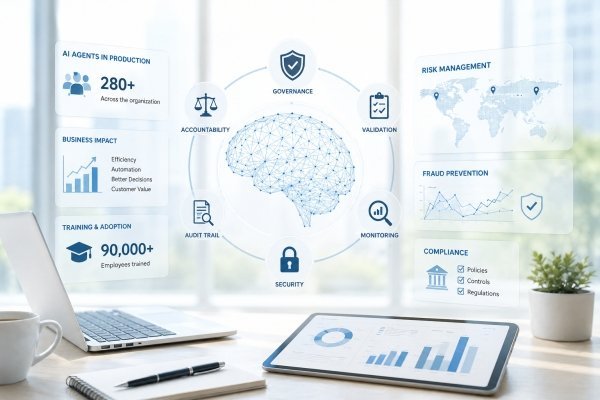
On June 22, 2026, Banco Santander reported that its AI first strategy generated €35 million in business value in Q1 2026, with expected value of more than €200 million by year end and a target of more than €1 billion between 2026 and 2028. That's a regulated bank putting numbers around AI execution.
The more interesting part is how Santander is trying to get there. The bank has extended AI access to all 185,000 employees, reported more than 280 AI automation agents in production, and previously described its ambition to become an AI native bank.
Ricardo Martín Manjón, Chief Data & AI Officer at Banco Santander, put the strategy plainly:
“For me, being AI-first means applying AI where it can have tangible impact.”
For Canada, the timing of this announcement is important because Santander recently received approval to operate as a federally regulated bank in Canada. So its AI operating model more than a global case study. It's a preview of how new banking competitors may bring AI, governance, fraud controls, and measurable operating discipline into regulated Canadian markets.
The first AI cycle rewarded access. Banks tested foundation models, launched copilots, built internal assistants, and looked for productivity wins. That phase is maturing fast. Models are easier to access. Cloud tools are easier to use. Building a convincing demo is no longer the hardest part.
The harder test is operating AI inside a regulated financial institution without losing control of risk, data, decisions, accountability, or customer trust.
That's where Santander’s publicly released data become strategically useful. Specifically, the update points to measurable business value, enterprise wide access, employee adoption, automation agents, and governance controls across ethical, legal, cybersecurity, and risk requirements. This is what AI moving from lab work into operating infrastructure looks like.
One underappreciated piece of the story is Santander AI Lab’s open source work. Its Gen Fraud Graph project is described as an Apache 2.0 open source initiative for generating synthetic fraud graphs and advancing fraud detection capabilities. The technical repository is also available on SantanderAI’s GitHub.
Fraud detection is one of the fastest ways to expose whether financial AI can be trusted. It touches financial crime, AML controls, identity checks, transaction monitoring, customer friction, model risk, and auditability. A model that performs well in a slide deck but cannot be tested, explained, monitored, or reviewed isn't ready for regulated scale.
Synthetic fraud graphs help solve a practical problem. Banks need realistic fraud scenarios to test detection systems, but they cannot freely share customer data or investigative information. Synthetic environments provide a safer way to benchmark performance, validate models, and document results.
The choice of fraud is revealing. Santander didn't launch its open source thread with a marketing assistant or a generic productivity tool. It highlighted infrastructure connected to risk.
Fraud teams need speed, but they also need evidence. Compliance teams need explainability. Risk teams need controls. Boards need accountability. Regulators need confidence that systems can be monitored and challenged.
For fintechs, this move by Santander is both a warning and an opportunity. AI claims won't be enough in fraud, AML, onboarding, underwriting, customer service, complaints, trading, surveillance, or compliance workflows. Buyers will increasingly ask for testing evidence, audit trails, human review, data controls, drift monitoring, and proof that the system works under pressure.
Recent work from IOSCO, OSFI, the European Union, the FCA, and other supervisory bodies points in the same direction. Institutions want measurable results. Customers expect accountability. The result is a growing focus on how AI systems are tested, monitored, explained, and challenged. That's why AI is creating a new compliance burden at the same time it creates productivity gains.
Santander reports more than 280 AI agents operating across the organization alongside enterprise wide training, governance controls, and measurable business outcomes. The same operating question now appears across AI agents entering financial workflows, customer onboarding, fraud detection, transaction monitoring, and compliance operations. The challenge is proving that it can operate safely inside regulated environments, and fraud amplifies the challenge immediately.
AI clones, biometric breaches, faster payments, and cyberattacks are weakening older trust signals, which raises the value of new verification controls for financial trust. Synthetic fraud graphs fit into that bigger problem because they give teams a safer way to test detection systems without exposing customer data or live investigations.
For banks, fintechs, payments firms, and infrastructure providers, that changes the economics of competition. Access to advanced models is becoming easier. Building a prototype is becoming easier. Producing evidence that a system can be trusted under real operating conditions remains difficult.
The first AI race was about capability. The next one is quickly focusing on proof.
If access to advanced AI becomes commonplace, will governance infrastructure and proof of control become more valuable than proprietary models in regulated financial services?
The National Crowdfunding & Fintech Association (NCFA Canada) is a financial innovation ecosystem that provides education, market intelligence, industry stewardship, networking and funding opportunities and services to thousands of community members and works closely with industry, government, partners and affiliates to create a vibrant and innovative fintech and funding industry in Canada. Decentralized and distributed, NCFA is engaged with global stakeholders and helps incubate projects and investment in fintech, alternative finance, crowdfunding, peer-to-peer finance, payments, digital assets and tokens, artificial intelligence, blockchain, cryptocurrency, regtech, and insurtech sectors. Join Canada's Fintech & Funding Community today FREE! Or become a contributing member and get perks. For more information, please visit: www.ncfacanada.org
| | |
|---|---|---|
| | |
June 13, 2026 | NCFA Fintech Whisperer | Capital Markets And Market Infrastructure, Lending Consumer Credit And BNPL, Regulation And Policy, Risk Compliance And Regtech, Payments And Market Infrastructure, Digital Assets Blockchain And Tokenization, Artificial Intelligence And Data

Image: Freepik
This live weekly NCFA intelligence page tracks financial technology developments that significantly affect how fintechs build, sell, raise capital, and operate under scrutiny. Coverage prioritizes Canada and includes global events that directly influence competitive conditions, market access, and execution realities across fintech sectors. This page will be updated throughout the week with market movers in a live format and then each week we'll close the prior week's contents in prep for the upcoming week, and continue on a rolling basis. (Missed prior week's Fintech Whisperer? (December 6-12, 2025, December 13-19, 2025, January 1-9, 2026, January 10-16, 2026, January 17-23, 2026, January 24-30, 2026, January 31-February 6, 2026, February 7-13, 2026, February 14-20, 2026, February 21-27, 2026, February 28-March 6, 2026, March 7-13, 2026, March 14-20, 2026, March 21-27, 2026, March 28-April 3, 2026, April 4-10, 2026, April 11-17, 2026, April 18-24, 2026, April 25-May 1, 2026, May 2-8, 2026, May 9-15, 2026, May 16-22, 2026, May 23-29, 2026, May 30-Jun 5, 2026, Jun 6-12, 2026).
European supervision is becoming more operational and technology focused. Banks, fintechs, crypto asset firms, infrastructure providers, and compliance teams should watch how DORA, MiCA, and EMIR oversight changes vendor governance, resilience testing, supervisory reporting, third party risk management, and regulatory accountability.
Supervision is becoming more data driven, technology enabled and cross border. Securities regulators are building stronger tools for market surveillance, fraud detection, investor protection and digital asset oversight, which raises the operating bar for firms whose compliance, reporting and risk controls still depend on slow manual processes.
Prediction markets are moving from niche trading communities toward mainstream financial distribution. Retail platforms, exchanges, regulators, investors, and market operators should watch how event contracts evolve as a new information, forecasting, hedging, and market intelligence layer. Distribution may become as important as market design in determining adoption. See: Innovation Opportunities In Regulated Event Contract Infrastructure.
Post trade risk reduction is becoming part of capital markets infrastructure. Dealers, clearing participants, platforms, and regulators should watch how compression, optimization, exposure reduction, and capital efficiency tools are treated as supervised infrastructure rather than back office utilities.
Bond transparency reform is creating demand for new market data infrastructure. Trading venues, asset managers, dealers, data providers, and regulators should watch how fixed income reporting, consolidated data, and transparency tools reshape price discovery and execution quality across European bond markets.
Agentic AI is moving into capital markets workflow. For dealers, asset managers, pension funds, and credit trading desks, the issue is no longer only faster market search. The next phase is how supervised AI tools support pricing, liquidity discovery, execution preparation, and workflow decisions inside regulated markets.
Natural language tools tied to pricing, trade data, and workflow systems could change how institutional traders search markets, compare bonds, assess liquidity, and act on data inside regulated trading environments.
Stablecoins are being embedded directly into payment and remittance infrastructure. Payment firms, PSPs, remittance operators, banks, liquidity providers, and compliance teams should watch how regulated stablecoin settlement, API connectivity, and cross border liquidity become part of the operating stack for high volume regional payment networks.
Search is becoming regulated digital infrastructure. Publishers, fintechs, platforms, marketplaces, advertisers, AI search providers, and compliance teams should watch how ranking rules, data portability, publisher protections, and user choice requirements change discovery, distribution, and competition across search and AI enabled information access.
Institutional digital asset infrastructure is entering bank charter channels. Banks, custodians, wealth platforms, crypto firms and regulators should watch how national trust bank approvals shape custody, staking, lending support, capital requirements and supervisory expectations for digital asset services.
MiCAR is shifting crypto firms from fragmented national registrations toward regulated infrastructure choices. VASPs, exchanges, brokers, fintechs, custodians, and compliance teams should watch how licensing pressure turns custody, wallet services, settlement, liquidity, and operating controls into market access requirements across Europe.
AI linked lending platforms continue to connect consumer credit origination with capital markets distribution. Pagaya’s latest transaction shows how underwriting models, loan supply, securitization channels, and institutional demand are combining into repeatable credit infrastructure.
Canadian bank capital policy is shifting from maximum conservation toward controlled lending capacity. Banks, lenders, fintech partners, investors, and policymakers should watch how lower buffer requirements affect credit availability, capital planning, risk appetite, and competitive conditions across the financial system.
Canada is moving privacy, AI, consumer data, and platform accountability into the same regulatory agenda. Financial institutions, fintechs, AI vendors, data brokers, and digital platforms should watch how consent, deletion rights, automated decision transparency, children’s data protections, and guidance for onboarding, data use, AI and partnerships affect product design and data governance.
The review could affect how fintechs, derivatives firms and market infrastructure providers engage with US regulated markets. Firms should watch for changes that reduce unnecessary compliance friction while maintaining market integrity, customer protection and risk oversight.
The useful evidence is the transmission channel, not a prediction that CBDC will launch. Digital money competition affects deposits, funding costs, liquidity treatment, lending capacity, and central bank balance sheet operations. Operators, founders, and investors should watch how CBDC, fintech deposits, stablecoins, and payment infrastructure reforms change competition for bank funding.
The week's strongest market and regulatory signals weren't new products. They were changes to the infrastructure underneath financial markets. Bank capital rules, prediction market access, stablecoin rails, and compute markets all point to the same outcome. Firms that control access, distribution, liquidity, and critical infrastructure may increasingly determine who can compete and who cannot.
NCFA offers various curated resources to help founders and investors stay current on developments that impact fintech markets, subscribe to NCFA weekly newsletter updates, view the latest fintech insights, industry research, or launch into emerging financial innovation opportunities.
The National Crowdfunding & Fintech Association (NCFA Canada) is a financial innovation ecosystem that provides education, market intelligence, industry stewardship, networking and funding opportunities and services to thousands of community members and works closely with industry, government, partners and affiliates to create a vibrant and innovative fintech and funding industry in Canada. Decentralized and distributed, NCFA is engaged with global stakeholders and helps incubate projects and investment in fintech, alternative finance, crowdfunding, peer-to-peer finance, payments, digital assets and tokens, artificial intelligence, blockchain, cryptocurrency, regtech, and insurtech sectors. Join Canada's Fintech & Funding Community today FREE! Or become a contributing member and get perks. For more information, please visit: www.ncfacanada.org
| | |
|---|---|---|
| | |
June 19, 2026 | NCFA Resource | Artificial Intelligence And Data
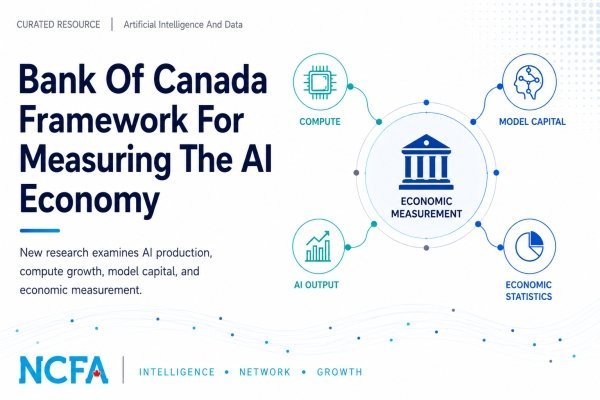
On June 18, 2026, the Bank of Canada published Measuring the AI Economy, a staff working paper by Anton Korinek and Patrick McKelvey. The paper examines whether traditional economic statistics can properly capture AI production, compute growth, model training, inference output, and the value being created inside the AI economy.
The paper argues that AI activity is difficult to see through standard GDP categories because it is spread across cloud computing, software, professional services, data centres, chips, electricity, and model development. That makes AI look smaller in official statistics than it may be in production capacity.
The research builds a first macroeconomic estimate of US AI production from 2023 to 2025. It starts with compute as the core input, generated from AI chips, data centre capacity, and electricity. That compute is then split between inference and training.
Inference produces AI outputs used across the economy. Training creates model capital, which the authors treat as an intangible asset that improves future AI output.
The headline numbers are large. The authors estimate that nominal AI compute spending grew from $36.92B in 2023 to $90.46B in 2024 and $219.17B in 2025. That implies annual growth of about 145% in 2024 and 142.3% in 2025.
Physical compute output grew faster, rising about 211.9% in 2024 and 213.9% in 2025. After quality adjustments, the paper estimates AI production growth above 2,000% per year. Its early AI GDP framework estimates real AI GDP growth of about 2,600% in 2024 and 2,658% in 2025.
The authors are careful about the limits. These aren't official GDP statistics. The framework relies on strong assumptions, limited data, and uncertainty about how benchmark performance turns into economic value.
This resource is useful for fintech founders, AI companies, policy teams, investors, economists, regulators, data centre operators, infrastructure investors, and anyone tracking how AI affects productivity, capital allocation, labour markets, and public policy.
It is especially relevant for teams working on AI infrastructure, compute markets, AI governance, productivity measurement, model economics, and public sector digital strategy.
The strength of the paper is its measurement lens. It doesn't treat AI as a single software category. It treats AI production as a system built from chips, power, data centres, inference, training, and model capital. That connects directly to the market question of pricing access to scarce AI capacity.
That's valuable for NCFA readers because compute is becoming an economic input, not just a technical resource. If compute markets, energy access, chip supply, and model efficiency determine AI output, then AI policy and AI competition cannot be separated from infrastructure.
The paper also gives policymakers a warning. If official statistics do not capture AI capacity early enough, fiscal planning, productivity analysis, tax policy, and monetary policy may be working with incomplete information. The same measurement issue shows up in central bank operations, where the Bank of Canada has already examined AI adoption in central banking.
The limit is uncertainty. The authors don't claim to replace GDP. They propose a measurement framework that can support future AI satellite accounts and better statistical infrastructure.
Bank Of Canada Measuring The AI Economy (primary Bank of Canada working paper)
AI Agents Enter Governed Financial Workflows (AI governance and operations)
AI Risk Taxonomy For Audits And Controls (AI risk classification)
The National Crowdfunding & Fintech Association (NCFA Canada) is a financial innovation ecosystem that provides education, market intelligence, industry stewardship, networking and funding opportunities and services to thousands of community members and works closely with industry, government, partners and affiliates to create a vibrant and innovative fintech and funding industry in Canada. Decentralized and distributed, NCFA is engaged with global stakeholders and helps incubate projects and investment in fintech, alternative finance, crowdfunding, peer-to-peer finance, payments, digital assets and tokens, artificial intelligence, blockchain, cryptocurrency, regtech, and insurtech sectors. Join Canada's Fintech & Funding Community today FREE! Or become a contributing member and get perks. For more information, please visit: www.ncfacanada.org
| | |
|---|---|---|
| | |
June 18, 2026 | NCFA Insight | Artificial Intelligence And Data, Capital Markets And Market Infrastructure
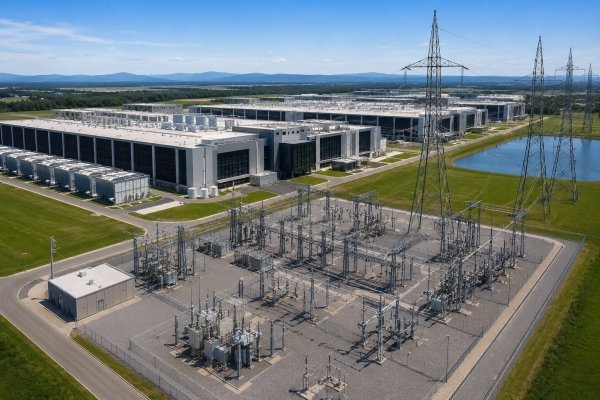
On June 18, 2026, BGC Group launched BGC Compute Infrastructure Markets, a new division focused on the secondary market for compute and memory capacity.
BGC is a financial brokerage and market data firm active in markets such as fixed income, foreign exchange, commodities, energy, shipping, equities, and futures. Its new compute business will operate inside the firm's Energy, Commodities and Shipping group and focus first on over the counter trading.
AI companies need huge amounts of computing power, but that capacity is getting harder to secure. It depends on chips, power, data centres, location, contracts, water, cooling, and timing. When something becomes scarce and expensive, buyers and sellers start asking market questions: who has capacity, who needs it, what is it worth, and how can risk be managed?
The United Nations University Institute for Water, Environment and Health report estimates that global data centres consumed 448 TWh of electricity in 2025. If data centres were treated as a country, that would rank 11th globally by electricity consumption. The same report projects data centre electricity use could reach 945 TWh by 2030, with AI workloads rising from roughly 20% of data centre electricity use in 2025 to 40% by 2030.
The report goes well beyond just the issue of power. Data centres' 2025 electricity consumption carried an estimated carbon footprint of 189 million tonnes of CO2e, a water footprint of 4.5 trillion litres, and a land footprint of 6,900 square kilometres. By 2030, projected data centre electricity use could be associated with 9.3 trillion litres of water and more than 14,500 square kilometres of land footprint.
Compute isn't just a cloud bill. It's tied to cost structures of electricity supply, grid connection, cooling, site location, water availability, hardware access, and local permitting. A buyer may need capacity in a specific place, for a specific time, with reliable delivery and known costs. A seller may have unused or contracted capacity that another participant needs. That is where a secondary market starts to make sense.
BGC says the new division is designed to support price discovery, risk management, liquidity access, and execution for participants exposed to AI infrastructure price risk. That statement alone treats compute like market exposure.
The buyers could include AI labs, enterprise AI teams, fintechs, model developers, governments, researchers, and companies that need access to GPUs or memory capacity. The sellers could include cloud providers, data centre operators, colocation firms, infrastructure investors, hardware owners, or firms with contracted capacity they no longer need. Between them is a market matching opportunity. Capacity is unevenly distributed, demand changes quickly, and long term infrastructure commitments are expensive.
Risk can show up in several ways. As AI demand grows, it's not just the technical issues. They are pricing, financing, and execution issues, too.
UNU-INWEH argues that AI impacts should be measured across carbon, water, and land footprints rather than carbon alone. Investors and financiers should treat electricity, carbon, water, and land footprints as material risks for AI infrastructure portfolios and use comparable footprint metrics in due diligence.
That is where BGC's initiative becomes more interesting. A compute market may eventually need more than bids and offers. It may need location data, power source data, delivery terms, grid risk, sustainability metrics, water exposure, counterparty quality, contract duration, and settlement rules. The more compute resembles infrastructure, the more the market will need infrastructure grade information.
Canada has its own stake in this. The federal AI Sovereign Compute Infrastructure Program is designed to improve access to advanced computing for Canadian researchers and firms while supporting protected Canadian controlled capacity. This connects directly with NCFA’s earlier coverage of AI data centres testing B.C.’s clean power limits. The strategy is about access, data protection, intellectual property, domestic capacity, and private investment.
Markets like the one BGC is trying to build could affect how Canadian companies think about compute access. Public programs can help anchor capacity, but private AI adoption will still depend on price, availability, power, location, financing, and contract flexibility. If compute capacity becomes easier to price and trade globally, Canadian AI firms and investors will need to understand how that market affects domestic competitiveness.
It's still early days, but financial market infrastructure is beginning to form around AI's hardest operating constraint, and that's worth watching closely.
If compute capacity becomes a priced and tradable infrastructure market, will AI advantage depend less on model design alone and more on who can secure, finance, measure, and manage access to scarce compute?
The National Crowdfunding & Fintech Association (NCFA Canada) is a financial innovation ecosystem that provides education, market intelligence, industry stewardship, networking and funding opportunities and services to thousands of community members and works closely with industry, government, partners and affiliates to create a vibrant and innovative fintech and funding industry in Canada. Decentralized and distributed, NCFA is engaged with global stakeholders and helps incubate projects and investment in fintech, alternative finance, crowdfunding, peer-to-peer finance, payments, digital assets and tokens, artificial intelligence, blockchain, cryptocurrency, regtech, and insurtech sectors. Join Canada's Fintech & Funding Community today FREE! Or become a contributing member and get perks. For more information, please visit: www.ncfacanada.org
| | |
|---|---|---|
| | |
June 16, 2026 | NCFA Story Intelligence | Fraud, Cybersecurity And Trust

The phone rings. Many people no longer answer.
Not because they’re too busy. Because they’re not sure who is calling, what’s real, or whether the message is safe to trust. That small behaviour change tells a bigger story about finance, fraud, identity, and technology.
For years, financial trust relied on familiar signals: a voice, a face, a password, a bank name, a phone number, a regulator, a delay before money moved. AI clones, biometric breaches, deepfakes, cyberattacks, weak AML controls, and faster payments are now breaking those signals at the same time.
Financial trust used to have more time. Branch visits, paper signatures, settlement delays, call centre checks, account holds, and human review gave institutions more room to spot problems before money moved too far. The system was slower, but that slowness created time to verify.
Consumers learned to trust familiar signals. A bank logo felt official. A caller who knew account details sounded credible. A voice sounded personal. A password felt private. Those signals were never perfect, but they worked well enough when fraud was slower, less automated, and easier to recognize.
Online finance moved trust away from the branch. Banking, investing, lending, crypto, payments, and onboarding shifted into screens and apps. That created better access and faster service, but it also made customers depend on passwords, text codes, device checks, email links, and remote identity tools.
Fraudsters followed the customer online. Phishing, fake websites, account takeover, crypto wallet scams, approval phishing, QR abuse, and spoofed support channels made digital convenience feel less certain. Operation Avalanche showed how coordinated fraud response is becoming part of the market.
Voice used to feel personal. Then AI cloning made it copyable. Cloned voices bypassed Voice ID tests at Santander and Halifax, exposing weakness in systems that treated a voice as a reliable authentication signal.1
The scam no longer has to sound like a scam. A cloned voice can sound calm, familiar, urgent, or official. That changes the risk for banks, call centres, families, executives, seniors, and anyone asked to approve a transfer or share information after hearing a voice they think they know.
Biometrics raise the stakes because they cannot be replaced easily. A major India breach exposed fingerprints, facial scans, and sensitive records tied to police officers and applicants.2 A password can be reset. A fingerprint can’t.
Fintech products increasingly depend on biometric convenience. Face ID, Touch ID, palm payment, device based onboarding, and selfie checks reduce friction. They can also concentrate risk if biometric templates, face scans, or identity documents are stored poorly or exposed through vendors.
Deepfakes make fraud feel human. Deepfake scams have used AI generated voices, fake identities, digital banks, and crypto rails to trick victims and move funds quickly.3
AI makes deception cheaper to personalize. Fraudsters can imitate an executive, a family member, a bank employee, a support agent, or an investment promoter. The scam can be written better, timed better, targeted better, and delivered through channels that look more legitimate than old phishing emails.
Faster money gives fraud less time to fail. Real Time Rail, instant payments, request to pay, and faster settlement can improve cash flow and customer experience. They also shrink the window for fraud teams to stop a bad payment before it settles.
Fraud controls become part of the payment product. Real Time Rail analysis connects instant payments with centralized fraud capability, payment finality, and trust.4 Faster money only works if participants believe the system can manage faster mistakes.
Institutions are not only defenders. They are targets. CIRO confirmed approximately 750,000 Canadian investors were affected by a cybersecurity incident after a 9,000 hour forensic review.5 When regulated bodies are breached, trust damage extends beyond one account.
Third party systems can carry hidden risk. SaaS vendors can create concentration risk across fintech and financial services. A startup may inherit risk through a vendor, API, data processor, onboarding tool, cloud provider, or fraud vendor it does not fully control.
AML failure shows how controls can become business risk. TD’s more than $3 billion US AML penalty and leadership fallout showed how weak controls can limit strategy, growth, reputation, and trust.6
Canada is trying to organize the response. Canada’s first National Anti Fraud Strategy and Financial Crimes Agency push point toward more public and private collaboration on cyber risk, data sharing, and proceeds of crime recovery.7
Fraud didn’t break trust all at once. It weakened the signals people and institutions used to verify reality. The phone call. The voice. The face. The fingerprint. The login. The bank name. The official looking message. The settlement delay. The regulated institution. Each one still matters, but none can carry trust on its own anymore.
That’s the hard part for financial innovation. Canada is moving toward faster payments, consumer driven banking, digital identity discussions, AI adoption, crypto market controls, and more automated financial services. None of those systems succeed simply because they’re fast or digital. They succeed because people trust what they’re seeing, hearing, approving, and authorizing.
What trust signal do you question now that you wouldn’t have questioned five years ago?
Share this story → Explore related intelligence → Subscribe
The National Crowdfunding & Fintech Association (NCFA Canada) is a financial innovation ecosystem that provides education, market intelligence, industry stewardship, networking and funding opportunities and services to thousands of community members and works closely with industry, government, partners and affiliates to create a vibrant and innovative fintech and funding industry in Canada. Decentralized and distributed, NCFA is engaged with global stakeholders and helps incubate projects and investment in fintech, alternative finance, crowdfunding, peer-to-peer finance, payments, digital assets and tokens, artificial intelligence, blockchain, cryptocurrency, regtech, and insurtech sectors. Join Canada's Fintech & Funding Community today FREE! Or become a contributing member and get perks. For more information, please visit: www.ncfacanada.org
| | |
|---|---|---|
| | |



August 26th, 2025

January 4th, 2024

June 1st, 2021

September 9th, 2020

July 9th, 2018

January 3rd, 2018

September 25th, 2017

June 20th, 2017

May 10th, 2017

December 14th, 2016
